Home Blog Page 327

Terrorists’ surrender in Kashmir reflects desire for peace amongst youth

0

Nine local terrorists have surrendered in Kashmir in the current year, of which five terrorists surrendered in the month of October itself. Inspector General Police (IGP) Kashmir, Vijay Kumar, has very aptly defined this as a “welcome development.” There are many factors responsible for this situation, the main being “terrorism related fatigue” among the locals in Kashmir. There is now widespread realization that this destructive path  causes terrible pain to the families while giving no dividends.

The new reality is that the youth of Kashmir simply do not wish to join terrorism. They are intimidated into joining the terror ranks by the ISI-separatist-terrorist nexus through life threats extended to their families too. Fear has, since long, been the sole factor responsible for recruitment and support for the terrorist and separatist movement. With the security situation  improving, youth and parents feel assured that they need not get swayed by the threats, leading to a perceptible decrease in recruitment. The security forces have felt the pulse of the people and are taking intensive measures to motivate entrapped terrorists to surrender. The good results being achieved by this humane policy are now visible.

Click on this YouTube link to watch News Intervention video of a terrorist surrendering to the Indian Army in Kashmir Valley.

The panic that this development has caused to terrorists in Kashmir is quite apparent from the manner in which they are reacting. The Resistance Front (TRF), which is the latest fraud organisation created by the ISI in Kashmir, has been given the responsibility to damage control this huge setback. TRF, in turn, has made public a letter in which it has denounced the surrenders as, “orchestrated by JK Police and Indian army in collaboration.” The letter further states that the videos of the surrenders are being made viral to “demoralise Kashmiri youth and parents.” The letter culminates with the threat, “the general public should not fall prey to such propaganda and stay firm. We warn against public involvement in these dramas.” This malevolent warning exposes the actual brutal, coercive face of the TRF.

TRF (The Resistance Front) has reacted in this manner because its narrative is failing. It has been exposed as a fake organisation espousing a fake cause. The attempt made by the ISI to position it as a liberal secular, indigenous outfit carrying forward the so-called “freedom movement” has fallen flat.  What has emerged instead is the fact that the people of Jammu and Kashmir do not want terrorism to gain ascendency all over again and the authorities are also ensuring that it does not happen.

On earlier occasions, terrorist outfits like the Lashkar-e-Taiba (LeT) and the Jaish-e-Mohammad (JeM) have been reconstituted as charity establishments to overcome international censure. LeT created the Falah-e-Insaniyat foundation; JeM has a number of charity fronts like Jamat-ud-Dawa and Falah-e-Insaniyat.

TRF (The Resistance Front) was created in consonance with the aforementioned time tested policy of the Pakistani deep state to put a veil on its diabolic operations when under international pressure. In this case the pressure is emanating from the Financial Action Task Force (FATF) that is seriously contemplating putting Pakistan on its ignominious Black List. Two more factors have been responsible for creation of this new establishment. First, the bold action by India in reorganising the state of Jammu and Kashmir into two Union Territories and abrogation of Article 370 which called for a strong response from the Pakistani side to keep its demoralised cadre intact. Second, to offset the loss of terrorist cadre and Over Ground Workers (OGWs) in Kashmir due to relentless and successful operations by security forces. By creating the TRF, the Pakistani deep state sought to integrate its remnant terrorist and OGW resources under one umbrella organisation while ensuring deniability in terms of linkages with Pakistan.

The name was specially chosen to give to the organisation a secular sheen and portray it as an indigenous  movement. Many similar groups like Joint Kashmir Front, Jammu Kashmir Ghaznavi Force also came up but TRF (The Resistance Front) remained the most prominent.

The TRF has been tasked to enhance recruitment of local cadre into the fold of terrorism. It has been given adequate media support through structures located in Pakistan. It has a strong online presence in social media platforms like Telegram, Twitter, WordPress, TamTam, Discord, Hoop, Facebook, WhatsApp and Instagram etc. Its content is viewed across Kashmir through Virtual Private Networks  (VPNs) to bypass the restriction on internet accessibility. Pakistan is a master of propaganda and has created methodologies to glamourize terrorism mainly through visual content showing the Indian security forces on the back foot. Other themes include posting of provocative messages, which target security forcesmainly J&K Police, mainstream politicians, Kashmiri political bodies and civilians.

TRF (The Resistance Front) did gain some success in the initial stages of its inception. It has, over the months, taken responsibility for grenade and gunmen attacks in public places and on security forces and for killing of political leaders and workers mainly Ajay Pandit in Anantnag and Sheikh Waseem Bari in Bandipore, both workers of the BJP. TRF has also claimed responsibility for the counter infiltration operation in Kupwara in April this year in which five Pakistani infiltrators were killed and the Indian Army also lost five brave soldiers. In all of these instances its information campaigns have grossly exaggerated the success to create a larger than life persona.

The Indian security forces and civil administration have understood the concept and modus operandi of the TRF and have put in place effective countermeasures. The integrative plan of the TRF has not been allowed to gain an upper hand, most of its acclaimed commanders like Sajad Ahmed and Abu Anas have been killed. Now, its weakness has put contributing organisations like the LeT, JeM and Hizbul Mujahideen on the defensive. They have realised the folly of joining hands and losing their identity with nothing concrete having been achieved. With depleting resources, TRF stands weakened and its very relevance is under the cloud. The possibility of a turf war is quite strong. This situation has led to the spate of surrenders.

The terror nexus created by Pakistan in Kashmir has failed. Its diabolic agenda has been exposed. Its structures are falling apart notwithstanding the fancy names being given to them. Kashmir can now look towards a well deserved era of peace and prosperity.

Order Generation and Maintenance – Stuck at Home in the Universe

0

The longing of the spirit can never be stilled. – Hildegard von Bingen

A reality comprised of conscious agents more likely evolved them than not. In fact, a reality with agency, insofar as appears known, only evolves agency rather than the reverse. Charles Darwin provided the baseline principles in Evolution via Natural Selection.

When a reality exists and evolves consciousness, two premises exist as assumptions. One comes from the fact of existence. Reality exists in a sufficient manner as to garner a concretized form of realness.

At a minimum, to the conscious agents in it, the reality feels concrete, material, physical, actual, tangible, or somatic, so existentially real. Another emerges from the term “evolves.” Behind it, one needs time. A sequential progression of linked moments creating existence’s directionality.

In standard terminology, this gets called the Arrow of Time. Time moves forwards, not backwards. If living in a reverse universe, the real backwards would seem as if forwards. In either case, time exhibits directionality, hence an “Arrow.” It points one way, not both.

With modern science, empiricism, and mathematical derivations, we come to the tentative and evidenced conclusions of a world with moments as non-absolute, as statistical, as a series of moments only at the macro scale.

A macro scale world with the Arrow of Time. A large-scale existence with directionality in time while, at bottom, a series of statistically or probabilistically connected moments with implied pasts in each moment and potential futures.

The instantiation of each moment implies a history and constrains an open future. With “implied pasts in each moment and potential futures,” this means ‘once upon a times’ lead to the ‘here-and-now’ while eventuating only a select grouping of ‘there-and-thens.’

The fact of existence and the truth of time become points of reference in consideration of a reality with conscious agents. Those operators in existence with agency, consciousness. Conscious aspects of consciousness as the mentation of the operations, the system.

Consciousness, as rich, diverse, and deeply interconnected networks of natural information processing devoted to an agentic arena of processing and selection, seems to emerge, evolve, later in reality rather than in some incomprehensibly early stage of the lifecycle of reality.

Non-conscious consciousness as the filter of the natural information derived from interpreted reality through the ‘senses’ or the external nodes — e.g., tactile, olfactory, auditory, gustatory, or visual, informational structures.

Those delivered — e.g., afferent-efferent nerve pathways — to conscious consciousness for selection, choice. It appears through evolutionary selective processes rather than creative teleological operations, whether instantaneous or progressive.

Some environmental, psychological, sexual, and social, selective pressures formulate the ‘need’ for some centralization of information processing. A conscious arena to manipulate the information gathered from the environment and generated internal to the system.

Entities, agents, thinking and moving in a reality define ethics; the principles governing the thought and behaviour define the morality. In that, the fact of being in reality of an agent comprises the ethics.

In this sense, ethics becomes non-absolute too. As the complete nature and existence of the agent defines its morality, agency internal to the system becomes the generativity of the ethical constructs themselves.

Thus, with existence and time, agency and morality, the qualitative difference becomes the next consideration of the speculation. Agents with an ethic tilted more towards directives of annihilation will cease to exist, eventually and even instantaneously.

Entities with a morality tilted more towards directives of creation will continue to exist. Both based on principles of reasoning grounded in statistical or probabilistic considerations of the matters of existence, time, agency, morality, and annihilation/creation.

Once the principles of reasoning construct the Statistical Argument for Existence, the Statistical Argument for Temporality, the Statistical Argument for Agency, and the Statistical Argument for Morality, these can become the bases for the principles of existence as a generalized truism set.

A philosophy of truism as a basis for principles not laws, loose rules not divine decrees. Those which can’t not be; those distinct significations of existence as principles demarcating unique markers of reality sufficient to become a novel variant. Everything coupled together.

The apparent metaphysical matters of ethics do not come with this presentation. The ideas of morality or ethics acquire this stain due to the theological and religious, i.e., transcendentalist, poundings of the previous centuries.

Only the last couple to recent few centuries began to wash the cloth and refresh the minds, as if cool water on the face on a hot, arid day. No need for the necessary metaphysical, except in other considerations properly deemed non-theological, perhaps theosophical — as in an utter rejection of theology.

Annihilation and creation may appear tighter definitions of the more generalized terms disorder and order, respectively. The principles of the morality of “annihilation” as “disorder” and the ethics of “creation” as “order.”

Thus, “Agents with an ethic tilted more towards directives of annihilation will cease to exist, eventually and even instantaneously” translates as “agents with an ethic tilted more towards directives of disorder will cease to exist, eventually and even instantaneously.”

“Entities with a morality tilted more towards directives of creation will continue to exist” translates as “entities with a morality tilted more towards directives of order will continue to exist.”

The “agents” or “entities” as conscious operators whose being or complete manifestation in reality dispose to the disorder generating & maintaining or order generating and maintaining, whose total nature inclines more to annihilation or creation, respectively.

As with the statistical inevitability of existence, time, agency, and morality, the unavoidability of existence and time in existence attests to the order generation and maintenance of realities, probabilistically. They exist more than not; they last more than end.

The actuality of an order generation and maintenance in the domain of discourse relevant to facts grounded in existence and temporality for agency, as in the two base premises prior to the is/ought distinction, or the line drawn out, before.

Beings exist. By existing, beings equate to facts. Factual propositions exist about them. Substantive statements exist for them. Those premises about pieces of reality with evidenced content.

Beings with conscious consciousness, conscious entities, operators, or entities with property “agency.” If only one, this operator constructs value for their self and their environment. If more than one, these operators create value for their selves, their relations, and their environment.

A valuation of no value becomes a value, too. To some, their self, other selves, or the environment, don’t matter to them. To a sole inhabitant of a reality, to value itself at zero, it may self-murder/self-annihilate, this becomes an ethic, too. Ethics becomes inevitable.

Nihilism, as in no ethics whatsoever, becomes a failed stance in realities with agency. In that, with valuation, this influences actions in the world; hence, this amounts to the ethic, unavoidably. In degrees of affirmation/negation, it’s there. Thus, agency generates ethics.

The facts of reality must inform the values in reality with the facts as first matter and values as second matter, or facts as primary and values as secondary, not vice versa. Meaningful values discourse begins with factual morality, not moral facts.

The truth of order for existence, time, and (non-conscious and) conscious agents in the universe informs ethics, as agency generates ethics and facts inform morality. These agents follow the incline of the statistical tendencies of form and content of reality, or do not.

The “incline of the statistical tendencies of form and content of reality” meaning “the unavoidability of existence and time in existence attests to the order generation and maintenance of realities,” or a set of them.

An implied truth in order generation and maintenance as a baseline for existence and time, and for the fact of order generation and maintenance required for evolved agency. In turn, the values of agency, whether order disposed or disorder inclined, will require the same.

As the values come from agency, and as order generation and maintenance provide the baseline for existence and time, the values constructed by the agency’s being will exhibit the same forms of persistence as a statistical tendency and inevitability seen in existence, with time, and in agency.

The facts of reality evince persistence for existence, for temporality, for agency, for morality. The facts of order generation and maintenance for each as a probabilistic outcome of the sets of the possible and the favoured amongst the potential.

The values of operators in reality will tend to value order generation and maintenance for themselves, others, and the environment more than value disorder generation and maintenance for themselves, others, and the environment.

Therefore, the statistical tendency or statistical inevitability of morality/ethics, derived as a consequence of agency with a base of existence and time will internalize in mentation and externalize in action, towards valuation of order over disorder.

The value of order generation and maintenance by agency in reality as a reflective statistical consequent of the fact of realities manifesting as order generation and maintenance by the truth of existence, itself, existing.

Any agency valuing more disorder than order will cease to exist in time, eventually. In this, is/ought, as facts/values, exhibit a separation and a coupling with the persistence of reality and agency as then reflected in the tendency in values of agency towards order over disorder.

If islands of agency determine disorder more valuable than order, then the agency — itself, immediate others, and its environment — will cease existing in due time. Sufficient disorder ends agency. Thus, the ethics/morality of agency will become order disposed.

As stated in “Statistical Inevitability as a Cross-Sect of the Axiomatic, the Temporal, the Existential, and the Axiological”:

We come to the stream of statistical inevitabilities with statistical arguments for existence, temporality, agency, and morality.

If the set of possible universes remains larger than the set of null universes, then existence becomes statistically more probable. If existence becomes statistically more probable, then realities with more than one moment of time become statistically more probable than realities with only one moment of time.

If realities with more than one moment become statistically more probable than realities with only one moment of time, then one set will evolve conscious information processors and one set will not.

If conscious information processors evolve in one set of universes, and if morality/ethics define as “principles governing behaviour or conducting of an activity,” then evolving conscious information processors creates morality/ethics, because conscious information processors cerebrate/move or conduct activities.

If evolving conscious information processors creates morality/ethics, then ethics/morality becomes statistically inevitable in one set of universes. Thus, if the set of possible universes remains larger than the set of null universes, then ethics/morality becomes statistically inevitable in one set of universes.

The statistically probable occurrence of existence, of time, of agency, of ethics. If negated at any stage, the argument fails. If no existence, then no time, no agency, and no ethics; if existence and no time, then no agency and no ethics; if existence, time, and no agency, then no ethics; if existence, time, and agency, then ethics.

Ethics comes from agency. Agency comes from time. Time comes from existence. Existence separates from non-existence more likely than not. Is/ought remains preserved as separate ideas, but become coupled together.

Furthermore, if “ethics/morality becomes statistically inevitable in one set of universes,” then the persistence of existence, of time, of agency, will derivate a persistence in ethics/morality in reality, as ethics/morality comes from agency.

If the persistence of existence, of time, of agency, will derivate a persistence in ethics/morality in reality, then existence, time, agency, and ethics/morality exhibit order generation and maintenance.

If existence, time, agency, and ethics/morality exhibit order generation and maintenance, then the truth of reality, in existence, time, and agency, exhibits order generation and maintenance, as facts of the matter.

If the truth of reality, in existence, time, and agency, exhibits order generation and maintenance, then the values in reality reflect the truth of reality, in existence, time, and agency, exhibiting order generation and maintenance.

If values in reality reflect the truth of reality, in existence, time, and agency, exhibiting order generation and maintenance, then agency as manifest through operators in existence dispose more towards order than disorder.

If agency as manifest through operators in existence dispose more towards order than disorder, then the statistical tendency or unavoidability of ethics/morality of operators in existence disposed towards order generation and maintenance.

If the statistical tendency or unavoidability of ethics/morality of operators in existence dispose towards order generation and maintenance, then the probabilistic default of ethics/morality in existence as order generation and maintenance rather than disorder generation and maintenance.

Therefore, “if the set of possible universes remains larger than the set of null universes,” then the probabilistic default of ethics/morality in existence as order generation and maintenance rather than disorder generation and maintenance.

The inevitable, unavoidable, fact of existence, of time, of agency, of morality, of order, the real not only statistically exists and probabilistically becomes favoured to exist; its persistence becomes favoured as a property in the truth of reality and the values about reality.

Photo by NASA on Unsplash

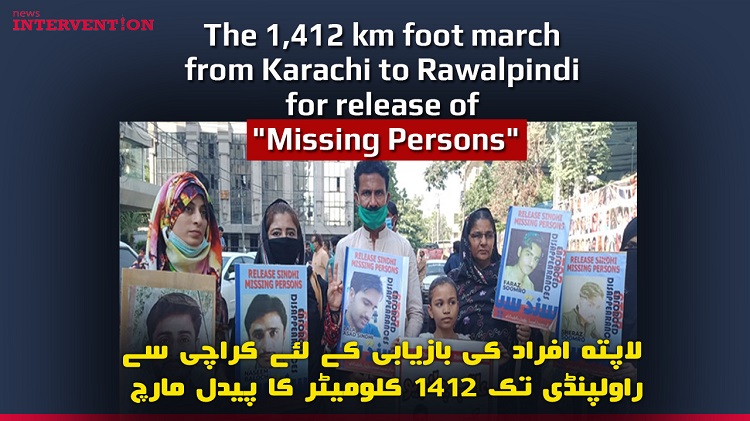
Why are women, children and elderly walking from Karachi towards GHQ Rawalpindi?

What will you do if a family member goes “missing”? Yes, you will report about the missing person and expect that the authorities find out about your “missing” family member, or at least inform about what happened to him/her. This is the normal course of action in a civilized nation. In Pakistan complaints about “missing persons” are tossed over into the dustbin and their family members continue to wait endlessly in vain, which in most cases is several years.

Over the last decade more than 40,000 Baloch and over 5,000 Sindhis have gone missing from occupied Balochistan and Sindh provinces in Pakistan. Friends and family members organized thousands of protests, filed countless litigations in the courts, approached big media groups and human rights organizations but none of these haloed institutions did anything. Absolutely nothing.

Family and friends of these missing people feel dejected and desperate. They know they have hit a dead-end. On November 10, a group of such desperate people from Karachi decided to walk on foot for 1,412 kilometers to protest in front of the GHQ (General Headquarters) Rawalpindi. GHQ is the headquarter of Pakistan Army in Rawalpindi.

But before you frown at this ‘Long March’ spare a thought for the raison d’être for such an arduous foot march.

It’s now an open secret that people in Balochistan or Sindh just do not vanish into thin air, rather they are systematically abducted by Pakistan Army, intelligence agency ISI (Inter-Services Intelligence) and other wings of the Pakistani security forces. The family members of ‘missing’ Baloch and Sindhi people have also understood that it’s only the Pakistan Army whose writ is honored across Pakistan. And since their friends and family members have been abducted by Pakistan Army or the ISI it would be best if they protest and plead with them, rather than run around the Pakistani courts.

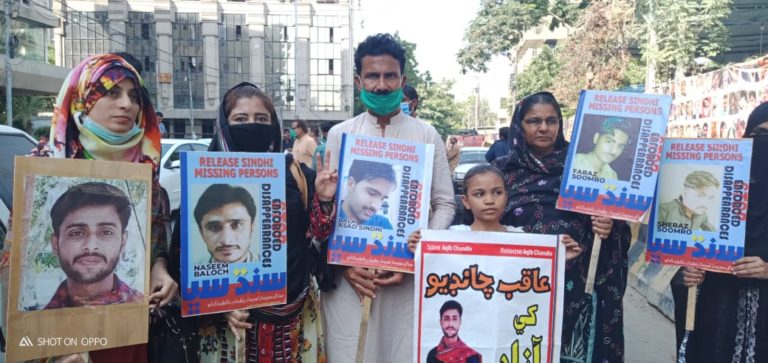
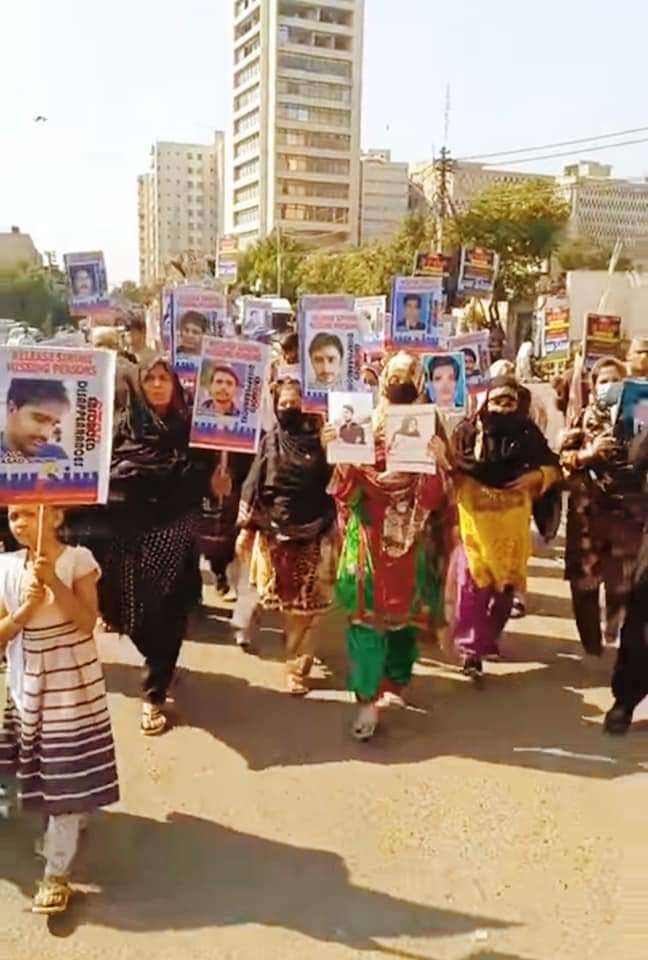
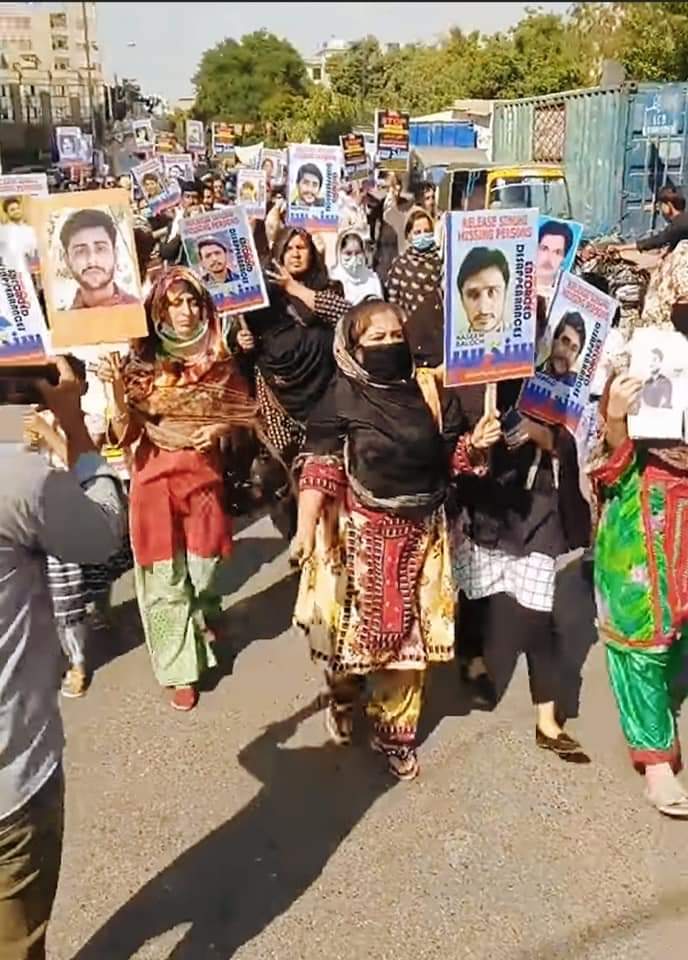
Family members and friends of “Missing Persons” walking from Karachi to the headquarters of Pakistan Army in Rawalpindi. (Photo: News Intervention)

Long March, by no means, is an easy trip. Rawalpindi is 1,412 km from Karachi and walking through this distance braving threats of Coronavirus pandemic and the harsh weather conditions is a herculean task. There are women, children and elderly who are walking in this Long March towards GHQ Rawalpindi.

When the Sindh Sabha announced this Long March from the Karachi Press Club on November 10 barely a hundred people started this arduous journey. These courageous people do not know when will they reach Rawalpindi, or if they will reach the GHQ Rawalpindi at all. Pakistan Army and Pakistani security forces are infamous for silencing people who they dislike with clinical precision. In three days the group could barely cross Karachi and has begun receiving death threats. Targeted attacks, accidents, Coronavirus the list of threats is too long to ignore.

And these threats are not just some figment of imagination. Pakistani security forces have done similar things earlier as well. In 2014 when the Voice for Baloch Missing Persons (VBMP) started a similar march from Quetta till Islamabad then also several attempts were made to eliminate the protesters. There is a high probability that the Sindh Sabha’s Long March from Karachi till GHQ Rawalpindi could meet a similar fate.

Ironically, big daddies of media and international human rights organizations have never raised a voice against the Baloch and Sindhi “Missing Persons”. And mind you, these missing persons are no small number. More than 40,000 Baloch have gone “missing” over the last decade and over 5,000 Sindhi went missing during the last few years. Over and above these missing people, thousands of Baloch and Sindhi have been forcefully abducted and killed. Yet the haloed United Nations or self-proclaimed human rights activists or even the larger media organizations continue to maintain a deafening silence.

Women, children and elderly walking from Karachi towards Rawalpindi to press for their demand to release the “Missing Persons” who have been abducted by Pakistan Army and ISI. (Photo: News Intervention)

It’s not that the big media groups, the United Nations or international human rights organizations are not aware of the daily abductions and killings across Balochistan or Sindh. Ironically, they are fully aware. Why do they still choose to stay silent or look the other way when Pakistan Army or the ISI abduct and kill Baloch and Sindhi at their whims is anybody’s guess.

Pakistan Army is dominated by Punjabi Muslims and so the Punjab province considers Balochistan and Sindh provinces as their colonies and Baloch and Sindhi as second class citizens. Any Baloch or Sindhi who refuses to toe the line of Rawalpindi is simply abducted in broad day light. It’s these abducted people who join the list of “Missing Persons” in Pakistan. Since these abductions and enforced disappearances are carried out by the Pakistan Army and ISI so even the courts and provincial police do not dare to go against the diktats of Rawalpindi.

Click on the YouTube link to watch video report

The Long March which started on November 10 is a desperate attempt by a group of Sindhi and Baloch people who decided to walk towards the GHQ Rawalpindi. This group is led by Inam Abbasi, Faisal Ara, Atif Chandio, Hani Gul Baloch, Shazia Chandio and family members of Dr Fateh Muhammad Khoso, among several others.

Click on the YouTube link to watch video report

Rights Mean Responsibilities

0

Two conflicts common to North American sociopolitical discourse comes from the idea of rights as inherent in the nature of a human being qua a human being. If a human being, then you get rights. If a non-human animal, then you don’t get human rights.

Although, as with Peter Singer, you may get animal rights in some cases. In that, some argue for non-human animal rights. Even Leonardo da Vinci, he made direct statements about ethical treatment of animals without the necessary use of the language of rights.

However, as rights come as broad ethical principles, these become foundational. To personal sensibilities, realities with agency imply inevitable ethics. Thus, the age-old question about if ethics becomes moot.

Because the issue isn’t ethics or no ethics, moral system or none. The issue becomes, “What ethic?” It’s a profound difference based on a slight shift in emphasis. Similarly, transcendent ethics dominated before. Nihilism doesn’t work, as ethics only works without agency.

If a universe with agents, then ethics becomes an inevitability. Similarly, in instances of a first-year philosophy student with a modicum of intelligence, they may question ethics’ ontological status. However, their act of existing, being, and acting in the world instantiates it.

Colloquially, the transcendent ethics can be known as religious ethics. By and large, they’ve won the numbers game. Also, they’ve lost the legitimacy game. When we examine international ethics, systems, rules, and global order, the winner is clearly not religious ethics.

The religious ethics binding to the transcendent, as in imbuing an unseen transcendent object as the source of The Good from which every good follows by natural discourse, logical derivation. International human rights won the day.

All nations are bound to international human rights. Every nation contains a different religion, sect of a faith, and interpretation of the proper ethic therefrom. In terms of human rights, fewer seem this way.

In that, international human rights ethics are the fundamental basis for the modern nation-states bound by regions and the globe. People may self-define as religious. However, their ethics and governments are guided by international institutions.

If the governments and the institutions, nongovernmental organizations, international nongovernmental organizations, civil society organizations, and others, fail to live up to a standard, they are not judged by religious/transcendental standards.

They are judged within frameworks of international human rights. By logical implication, the hidden premise is international secular human rights. Because the basis for the rights do not rely upon a transcendent source. Some philosophical idea within the metaphysical/supernatural/extramaterial domains of discourse.

The rights inherent for others become, as well, requirements for the comprehension of others’ boundaries. Where they start, I stop; where they stop, I, or others, start. If I claim rights for myself from others, then I imply obligations of myself for others.

The right to a freedom stops at the infringement of the right of the other person. These become more generalized utility markers or signifiers in social settings than the parochial and limited transcendent ethics.

Those latter ethics claiming objective status while littered with the language of the local, the provincial, often the cruel, in fact. The former morality incorporative of more neutral, inclusive though diversified, and sophisticated language than the vagaries found in the verities of religious holy texts.

In this sense, the international secular rights become a basis for truer universality of the ethics of rights. Furthermore, these will mean a fuller sense of the obligations derivative or implied as a coupling with the “truer universality of the ethics of rights.”

Any right will require a concomitant obligation; every obligation comes with a coincident right. While the basis for universal remains statistical or approximated, never achieved in a sense of finality of the aim, the fundamental implication of rights is obligations or responsibilities.

The mature orientation on ethics imbues a sense of a consciousness-based Golden Rule behind the scenes of rights and obligations. Where the rights imply obligations, and vice versa, this is the logic of the Golden Rule.

However, implied within it, we find the necessity of a conscious agent behind it. Rocks don’t have consciousness, don’t have rights and responsibilities. Thusly, rights mean responsibilities; responsibilities mean rights.

Essentially, it couldn’t not be; it couldn’t be any other way.

Photo by Christophe Hautier on Unsplash

The 1,412 km walk from Karachi to Rawalpindi for ‘Missing Persons’

Sindhi & Baloch people are desperate for their “Missing” family members. For the last several years they have been protesting for the release of their “Missing” family members, but the Pakistanis do not listen to them. Now they have been left with no other option but to walk through 1,412 km from Karachi to Rawalpindi to plead with Pakistan Army for release of their loved ones. This Long March started on November 10 from Karachi, the capital of Sindh.

Click on the YouTube link to watch video report

A Way Forward – Mental Health as a Human Right

1

Mental health sits at the foundation of general human wellbeing. Human rights stand as a universalist vision of the international community of nations and citizens. If we want an equitable world, we need health global citizens with equal opportunity and stature.

Human rights and mental health are a united front for the equal treatment of all. Human rights mean every human being is provided the same privileges and responsibilities. Mental health is something for everyone to strive to attain and maintain for a better life.

On December 10, 1948, the Universal Declaration of Human Rights created the foundation for an international human rights and rules based global order. Everyone, in theory, acquires the same rights, becomes subject to the same laws, and operates within the same boundaries.

Personal development deals with individual people who each have a mental status: healthy or unhealthy. For proper functioning in a society, in relationship, in professional life, in individual self-management and self-care, mental health reigns supreme.

In a sense, without mental health, we can’t have professional life health, relationship health, or societal health. It’s bottom up. It starts with an apparent irreducible component of the field of psychology, individual human personalities.

Therefore, ill societies are comprised of ill individuals; healthy societies are composed of healthy individuals. To make incremental change or piecemeal reform to the health status of societies, we should focus on individuals, individual needs, and personal development as these over time.

A fundamental basis of the international rights and rules based order is the idea of the rights as principles. In general, these principles, human rights as such, mean broad ethical principles with legal and social import for freedoms and entitlements.

The tacit implication behind human rights freedoms and entitlements is the consequent need for obligations and duties. If you want a right, then you purchase a responsibility as a consequence of it. It’s a two-part deal.

Individual human rights follow from the ideas of the Universal Declaration of Human Rights. In that, the rights inhere, tie to, individual human beings. You have rights and obligations. I have rights and obligations. Same with our neighbours. We have right to exercise them, too.

One obscure idea in the United Nations is the idea of autonymity. I do not see the term used much, but I see the concept used all the time. It’s foundational to rights. If you have ethical principles, what is the point without the ability to exercise them.

Take, for example, the right to freedom of expression; it’s a fundamental human right. By writing this article in this forum with this particular formulation of ideas, I am exercising the right to freedom of expression.

Even with rare formalization with the explicit use of the term, it’s a hugely consequential idea. The concept of guarding, keeping, the right to exercise all other rights. The idea, typically, is applied to use of names, as in autonymity.

It means “inalienable personal rights which may be exercised in any situation.” In the domain of mental health and the cross-sect of individual fundamental human rights, the question arises, “What is the relevance of human rights and mental health?” It’s a good question.

With some more thought, it is a profound question with deep, lasting consequences for our lives and, as argued above, societies’ health. One would need to connect human rights to mental health in a direct way.

Where, a basic international human rights argument is made for the right to mental health. Following this, the “inalienable personal rights which may be exercised in any situation” become relevant to psychological wellness.

In fact, this has been argued, directly, by the United Nations. The United Nations Office of the High Commissioner of Human Rights in “Mental health is a human right.” If we take this foundational part of the United Nations and the article, some of the core paragraphs include the following:

In a recent report on the right to mental health, the UN right to health expert, Mr. Dainius Pūras, pointed out that despite evidence that there cannot be health without mental health, nowhere in the world does mental health enjoy parity with physical health in terms of budgeting, or medical education and practice…

…A report by the UN Human Rights office points out that people with mental health conditions and those with psychosocial disabilities experience disproportionately higher rates of poor physical health; and have a reduced life expectancy – a 20-year drop for men and 15 years for women – compared with the general population. Stigma is also a significant determinant of quality care and access to the full range of services they require…

…Discrimination, harmful stereotypes and stigma in the community, family, schools and the workplace prevent healthy relationships, social interactions and the inclusive environments that are needed for anyone’s well-being…

For the UN health expert, Dainius Pūras also, recognizing the diversity of human experience and the multitude of ways in which people process life needs to be more broadly understood.

“Respecting that diversity is crucial to ending discrimination,” he writes in his report. “Peer-led movements and self-help groups, which help to normalize human experiences that are considered unconventional, contribute towards more tolerant, peaceful and just societies,” he says. 

The extended quote at the end seems the most important because the emphasis is on some of the facets of the work on the “peer-led movements and self-help groups.”

The fact of the matter, the international community lacks proper comprehension of the issues of mental health and, even if they have the understanding, do not have the appropriate infrastructure to deal with it.

It’s not only the OHCHR working on bringing this need to public global attention. In Canada, a number of efforts exist here. A number of public statements have been made about the importance of public mental health. Ontario Human Rights Commission works with a number of communities and partners.

Some of those include the CAMH Empowerment Council, Canadian Mental Health Association – Ontario Branch, Canadian Mental Health Association – Ottawa Branch, Canadian Mental Health Association – Toronto Branch, and Centre for Addiction and Mental Health, and more.

Internationally, the World Health Organization states, “We are facing a global human rights emergency in mental health. All over the world people with mental disabilities experience a wide range of human rights violations…”

They continue, “Mental health policies and laws are absent or inadequate in most countries of the world and yet they are critical to improving conditions for people with mental disabilities… All people and professionals who have an impact on the lives of people with mental disabilities should receive training on human rights issues.”

South, to the United States, the American Psychological Association stipulated:

During the 183rd plenary meeting on Dec. 10, 1948, the United Nations General Assembly (UNGA) adopted the Universal Declaration of Human Rights (UDHR) Article 25, which states that: “Everyone has the right to a standard of living adequate for the health and well-being of himself and of his family, including food, clothing, housing and medical care and necessary social services, and the right to security in the event of unemployment, sickness, disability, widowhood, old age or other lack of livelihood in circumstances beyond his control…

…The UN Human Rights Council (UNHRC) is an inter-governmental body within the UN’s system that is made up of 47 countries elected from the full membership. The council is responsible for the promotion and protection of all human rights around the globe, and it views physical and mental health as a central tenet of its work…

…The preamble to the 1946 Constitution of the World Health Organization (WHO) defines health as “a state of complete physical, mental and social well-being and not merely the absence of disease or infirmity.” The relationship between mental health and human rights is an integral and interdependent one…

…The UN right to health expert, Special Rapporteur Dainius Pūras, states that one of the most basic challenges to mental health is stigma and discrimination.

Those should make the emphasis clearer. These can create the basis for a better knowledge of the interconnectedness of international, national, and provincial efforts to improve both the status of human rights and the mental health of citizens.

Similarly, direct efforts at improving the conditions of human rights through increased mental health are ongoing, the question, at this point, shouldn’t be, “What is the relation of human rights and mental health?”

Rather, it should be, “What is the best way in which to implement human rights to improve international mental health at an individual level?” Fundamentally, this is the question. It is not a singular solution. Because it’s a plural problem.

This hydra will require targeted interventions and community-based interventions to work on specific, individualized issues. There’s anxiety, depression, narcissism, psychopathy/sociopathy (antisocial personality disorder), bipolar disorder, schizophrenia, and so on.

Each one has a differentiated formal solution. Every one with multiple ways to combat them in better and worse ways.

Photo by Tim Mossholder on Unsplash

Statistical Inevitability as a Cross-Sect of the Axiomatic, the Temporal, the Existential, and the Axiological

Before we understand science, it is natural to believe that God created the universe. But now science offers a more convincing explanation… What I meant by ‘we would know the mind of God’ is, we would know everything that God would know, if there were a God, which there isn’t.

-Stephen Hawking

A world without ethics or morality comes only in the set of realities without conscious agents or in the set of null universes. A world comprised of matter and energy, or information, and potential, with conscious agents. One with implied pasts and potential futures.

No light, no ought, agency births ethics. Thus, the tale of the tribe: theology failed; no magic. A discipline of primitive eras and peoples — “primitive” meaning original — best set in the field of anthropology and archaeology now.

A verisimilitude to knowledge without the authenticity of actuality. A propinquity to materiality without substantive veracity. A claim to truth for a species in its youth. A “more convincing explanation” exists in the present situation.

Some approximation to the principles of ‘the mind of God’ without a god, as such. The set of possible universes remains larger than the set of null universes. Therefore, existence becomes statistically favoured more than non-existence.

With this, the statistical existence argument to a set of realities including time because more universes with a large finite number of moments exist than a set of realities with only one moment. Hence, a statistical argument for temporality on top of the statistical argument for existence.

Time as manifest in the Arrow of Time. ‘Old archaeological digs’ find arguments for a transcendent and immanent object. A source of The Good, an assertion of an extranatural atemporal, and natural immanent, entity as the source of ethics or morality. Theology failed to deliver.

One traditional partition in ethics comes from the Humean formulation of is/ought. Facts of the world versus actions in the world. A possible way forward of the is/ought solution sits in temporal statistical unavoidability or the inevitability of time in statistical considerations. Time implies sequences. Thus, the inescapable fact of consequences in a reality with time.

Another possible partial solution comes from the bifurcation of realities. Consider for the moment, two sets of realities exist. One without conscious information processors. Another with them. In the first, no ethics because no conscious action. In the second, morality exists because of conscious action.

Morality may define principles governing behaviour or the conducting of an activity. If morality/ethics define as “principles governing behaviour or the conducting of an activity,” then ethics/morality become inevitable in the second set of realities. Because actions occur through conscious information processors.

Both sets of realities inevitably include time. Only one incorporates conscious information processors. In the only set incorporative of conscious information processors, time and morality become inevitable, statistically, as with existence. We come to the stream of statistical inevitabilities with statistical arguments for existence, temporality, agency, and morality.

If the set of possible universes remains larger than the set of null universes, then existence becomes statistically more probable. If existence becomes statistically more probable, then realities with more than one moment of time become statistically more probable than realities with only one moment of time.

If realities with more than one moment become statistically more probable than realities with only one moment of time, then one set will evolve conscious information processors and one set will not.

If conscious information processors evolve in one set of universes, and if morality/ethics define as “principles governing behaviour or conducting of an activity,” then evolving conscious information processors creates morality/ethics, because conscious information processors cerebrate/move or conduct activities.

If evolving conscious information processors creates morality/ethics, then ethics/morality becomes statistically inevitable in one set of universes. Thus, if the set of possible universes remains larger than the set of null universes, then ethics/morality becomes statistically inevitable in one set of universes.

The statistically probable occurrence of existence, of time, of agency, of ethics. If negated at any stage, the argument fails. If no existence, then no time, no agency, and no ethics; if existence and no time, then no agency and no ethics; if existence, time, and no agency, then no ethics; if existence, time, and agency, then ethics.

Ethics comes from agency. Agency comes from time. Time comes from existence. Existence separates from non-existence more likely than not. Is/ought remains preserved as separate ideas, but become coupled together.

Any act contains moral content without morality as an extranatural occurrence or with an implied metaphysical content. Natural informational processes evolve the organism with the structures generating both the interior landscape, the mind, and the exterior framework, the body.

Nothing extranatural invoked as, for example, brains produce valuations of entities, objects, abstractions, and relations between them. An error comes from the claim of ethical values or moral claims as metaphysical or supernatural. In fact, this adds nothing.

Natural structures construct relations between structures as facts of the world. Internal agents to the natural structures, as relations between structures themselves, create internalized frameworks for entities, objects, abstractions, and relations between them. All internalized frameworks come from within the system and/or relate to the system.

No metaphysics, only the natural present there. Hence, the reason for the failure of theology – logical missteps, and the creative formulation of unnecessary/false premises and without proper accounts for required hidden premises.

Otherwise, we can claim abstractions manifested in the information processing within the digital computation system count as metaphysical operators because of computation/valuation in the universe.

It posits more than necessitated and ignores the obvious. Evolved organisms exist in time processing information while giving value to things in reality. Where, an act in the world becomes something of factual content, as contained in reality.

While, the factual content implies moral content because ethics/morality defines as “principles governing behaviour or conducting of an activity.” These acts come coupled with ethical content because of agency.

If a conscious information processor exists in a reality, then morality/ethics becomes unavoidable because the “conscious information processor” must deal with itself and its environment (if only one entity in the universe), or must deal with itself, others, and its environment (if more than one entity in the universe).

The distinction between is/ought comes with the preservation of the separation in one sense, where the individual ideas exist as substantive and legitimate in their own right. Further, though, they, in fact, must give one from the other.

Thus, we can communicate meaning in terms of factual morality, not moral facts. As above, ethics/morals are unavoidable for any reality with at least one conscious information processor. Time, at our scales, appears completely unavoidable, so consequences of “behaviour” in an environment seem inevitable.

Whether actions in reality to oneself, to its environment, or to others, ethics comes with agency. Only one conscious information processor required in the universe.

A reality exists first with facts as pieces of the real world, then an agent, whether knowing or not, enacts mentation and action, which, by definition, impart moral content. Those two together make ethics unavoidable, so any facts must inform our ethics or morality.

Because ethics amounts to the conducting of an activity with activities relevant to conscious information processing systems and time implied in both the known physics of the universe at the scales of the conscious information processing agents, and in the sense of the agents existing and “processing.”

A macro world with the Arrow of Time means statistically linked moments with directionality. A world of conscious information processors (with physical exteriors, frames) creates actions in the world, even mentation can mean action in the world.

Both mean a time sense with moments providing a range of possible moments while harbouring a set of implied pasts based on each instantiation of moments. The only issue seems as if whether the conscious information processor becomes aware of the enactment of the ethic, or not, but there exists a moral value set enacted regardless, unavoidably.

Ethics requires the conscious information processing system, while without the necessity for sufficient awareness within the conscious information processing system for a systematic comprehension of the morality/ethics of the mentation and actions in the world.

Therefore, if ethics (actions in the world) are unavoidable with a conscious information processor (or conscious information processors), and if a conscious information processor exists on a magnitude in which the Arrow of Time exists inevitably, then any facts about reality impinging on a conscious information processor (or conscious information processors) and its environment (their environment and one another) have ethical consequences; everything factual to agency implies the moral, but the “everything” is statistical, because existence statistically exists.

Photo by v2osk on Unsplash

Pakistan continues to torture Tanveer Ahmed in POK

0

Tanveer Ahmed, senior journalist of Pakistan-occupied Kashmir (POK) was arrested on August 21 by the Pakistan government. Tanveer Ahmed continues to be tortured inside the POK jails by ISI and Pakistan Army.

The Shibli Faraz ‘Triangle’

“PDM, India, and Israel three sides of the same triangle: Shibli Faraz”
— News Item Press News Agency [October 25, 2020]

In an age when geometry is no longer being taught in schools, Pakistan information minister Shibli Faraz’s equating India, Israel and Pakistan Democratic Movement [PDM] with three sides of a triangle is bound to fill old timers (who as kids spent hours trying to comprehend what triangles were all about), with a deep sense of nostalgia. It could also well end up creating interest of the younger generation in geometry as it would give them the option of using an impressive sounding ‘QED’ instead of the curt ‘period’ to indicate the end of a discussion. But before that, let’s first demystify the ‘Faraz Triangle’.

India, Israel and PDM being three sides of a triangle is indeed an interesting analogy. However, Faraz hasn’t indicated what exactly is the type of triangle which these three devils incarnate (hereinafter referred to as ‘evil trio’) form and this makes the task of identifying the right type of triangle, which the geometrically inclined minister has in his mind, quite difficult. So, for better comprehension, it may be necessary brush up one’s geometry by quickly recapitulating that triangles are classified on either the basis of their angles (equiangular, acute obtuse, and right), or their sides (isosceles, equilateral or scalene).

Even though he has mentioned that each of the ‘evil trio’ forms one side of the ‘Faraz Triangle’ it would still be incorrect to rule out the possibility of this triangle being based on angles. Remember, there always used to be a catch in geometry questions, and the ‘Faraz Statement’ could well have one! So, let’s start the elimination process by first examining triangles on the basis of their angles to see if any fit the bill. Such an analysis leads to some surprising revelations because each of ‘evil trio’ entity that forms one side of ‘Faraz’s triangle’ has a definite ‘obtuse’ mindset, and suffers from ‘acute’ paranoia.

However, since all the sides of the ‘Faraz Triangle’ are involved in serious wrongdoings, the ‘triangle’ that the Pakistan information minister is referring to is certainly not a ‘right’ angled triangle. In addition, since all of them have unequal levels of complicity in bringing down the house called Pakistan, neither can the ‘Faraz Triangle’ be an ‘equiangular’ triangle (in which, all angles are equal)! 

So, having established that the ‘Faraz Triangle’ has some properties of acute and obtuse angled triangles, let’s try and further unravel the mystery of this enigmatic geometrical three-sided object by examining triangles on the basis of their sides.

The easiest would be to conclude that it’s an ‘equilateral triangle’ (in which all three sides are equal). But doing so would imply that each entity of the ‘evil trio’ that represents one side of the triangle is equally complicit in orchestrating anti-Pakistan activities, and this somehow doesn’t sound very convincing because in real life there are no such congruences. Moreover, by equitably apportioning blame for fomenting unrest in Pakistan on three entities dilutes the enormity of this humongous crime and takes the ‘punch’ out of the blame game. Lastly, since this deduction neither suits Islamabad nor Rawalpindi, hence its prudent to rule out this possibility!

Next, we come to the isosceles triangle, in which only two sides are equal and this could be the ‘Faraz Triangle’ with India and Israel representing the two equal sides, while the third side is the PDM. This interpretation is a bit more convincing as it implies that India and Israel are working as agent provocateurs in concert and provoking the PDM to create political instability in Pakistan. This deduction also buttresses Islamabad’s allegations of foreign hands being behind the chaos in their country.

However, the conclusion that ‘Faraz’s Triangle’ is ‘isosceles’ has one major drawback- it portrays PDM as an innocent entity which is being instigated by the India-Israel duo and needless to say, this hypothesis would not be acceptable to Prime Minister Imran Khan who seems to be determined to see his predecessor and political arch rival Nawaz Sharif decimated. Moreover, blaming India for only one half of Pakistan’s troubles goes against the military’s view that New Delhi is wholly behind each and everything that goes wrong in Pakistan!

That leaves us with the ‘scalene triangle’ in which no side is equal, and this seems to be the closest match to the ‘Faraz Triangle’ since it has an inherent element of ambiguity that can be used to great advantage. The essence lies in not disclosing as to who represents which side of the triangle as this gives both the government as well as the military establishment ample flexibility to point fingers as well as accuse whomsoever they wish to and also change the target of their attack without being accused of capriciousness!

If Indo-Pak tensions flare up, the ‘RAW corollary’ can be applied to depict New Delhi as the longest side of the scalene triangle. Whenever the PDM becomes an unbearable pain in the neck for Khan or Gen Bajwa, it’s place can be conveniently switched with that of India with the simple use of ‘Panama Postulate’ along with the ‘Mehran Bank’ and ‘Hudaibiya Paper Mills’ adjuncts for greater effect. As far as Israel is concerned, use of the ‘Zionist hypothesis’ and Imran Khan’s recently expounded deduction of Tel Aviv’s “hegemonic design and approach” can easily be used to justify making it the longest side of the scalene triangle- as and when required. 

So, in the final analysis, the ‘Faraz Triangle’ can be defined as “A unique ‘Scalene Triangle’, each side of which is unequal and formed by a different yet closely-linked ‘evil’ force acting in concert to destroy Pakistan. Whereas the entity of all side remains interchangeable, the sum total of the angles formed by their acute [paranoia] and obtuse [mindset] can never be either ‘right’ or ‘equal’”
QED!

India inching closer towards wiping terrorism in Kashmir

1

Terrorism in Kashmir is now coming a step nearer to complete decimation due to incisive and highly successful counter-terrorist operations being conducted by security forces. The latest success came on November 1, when a terrorist killed in a gun fight in Rangreth was identified as Saifullah, commander of the terrorist organisation Hizbul Mujahedeen (HM). Saifullah had been appointed as commander only a few months back post the killing of the previous commander, Riyaz Naikoo. Naikoo had taken up the mantle after the death of Burhan Wani and defection of Zakir Musa to the Al-Qaeda in 2017. While Naikoo remained operational for about three years, Saifullah could last hardly for six months.

Media attempted to project the killing of Saifullah as a big success, however, realistically speaking Saifullah did not amount to much as he was highly constrained due to a depleted cadre and indifferent recruitment success, unlike Naikoo who was adept at indoctrination and recruitment of locals into the fold of terrorism. Saifullah’s killing was also a docile affair with his single associate preferring to surrender. Hizbul Mujahideen has not been able to appoint a new commander since it has nobody to fit the bill.

Surrender by terrorists, as in the case of the associate of Saifullah, is yet another big setback to the terrorist movement in recent times. On October 13, Special Police Officer (SPO) Altaf Hasan Bhat decamped with an AK 47 rifle. The police identified his location within two days and a cordon was laid out. While Altaf managed to escape his associate Jahangir Ahmad Bhat preferred to surrender. Within a few days, on 22 October, two other newly recruited terrorists named Abid and Mehraj belonging to the Al-Badr terrorist group also opted to surrender when their families, brought specially to the encounter site, appealed to them to do so.

The security forces led by the Indian Army have been following a policy of giving entrapped terrorists an opportunity to surrender. On many occasions, as in the aforementioned case, families are called in to make the appeal; in recent times, considerable success has been achieved in this process. The impact of the efforts to make the youth eschew the path of violence is now visible and it is a welcome development.

An analysis of aforementioned cases leads to two derivatives. First, the life span of a terrorist, even if he is a highly protected commander, is very limited. It ranges from a few days to a few months at the maximum.  It is so because of effective intelligence about the movement of terrorists is being provided by the people themselves who wish to see an end to this menace.

Secondly,  the new recruits into terrorism lack commitment since they are being forced into this line. Such locals who get swayed into joining terrorist groups soon realise their mistake but hesitate to leave due to fear of reprisal. In recent times these new cadres have evolved a good strategy of surrendering to security forces in the course of an encounter.

It needs to be kept in mind that once a person joins the cult of terrorism, getting back becomes very difficult indeed. The security of the person as well as that of his family comes under threat. Hence, the best option is to nip this malaise in the bud. It is here that families, elders, teachers, role models and civil society have a very important role to play. It is they who can educate and isolate the youth from the intense propaganda and well oiled indoctrination machinery of the terrorists. As things stand, the poster boys like Burhan Wani who pulled large number of youngsters are now eliminated. However, social media continues to be used by Pakistan to infiltrate vulnerable minds. It is not without reason that 4G connection is not being allowed in the region. The threat from the enemy is very real and very potent.

The security forces are doing their bit to build upon the existing thrust to reverse the process of terrorist recruitment. During a recent press interaction, Lt. General BS Raju, the General Officer Commanding of the Srinagar-based Chinar Corps is reported to have said, “It gives us no pleasure to kill young boys who have picked up arms a month ago or a bit earlier. We will be doing more work on ensuring that more surrenders take place.” No better words can be used by any soldier to express his desire to avoid unnecessary bloodshed. It is for this reason that an elaborate drill is being followed to save entrapped local terrorists.

The government is also looking towards modifying the surrender and rehabilitation policy in a manner that serves as an incentive to the misled youth and gets them back into the mainstream.

The people of Jammu and Kashmir do not want terrorism to gain ascendency all over again and the authorities need to ensure that it does not happen. The government and the forces are, therefore, going all out to save precious lives of locals who have been indoctrinated into this suicidal path and give to them an opportunity to rehabilitate themselves. Some good steps have been taken but more needs to be done. No space should be given to terrorists and divisive forces to resurrect the draconian times when terrorism was at its peak.

The time has come for the people of Kashmir to bring about a closure to the cult of evil foreign sponsored terrorism. A clear message needs to be given out that there is no element of religiosity and sacrifice visible in the murderous and perfidious acts of the terrorists. The government and the nation have spread out their hands to assist able and qualified Kashmiri youth in chalking out a career. This opportunity that needs to be leveraged instead of the despicable path of terrorism that assures nothing other than ignominious death.