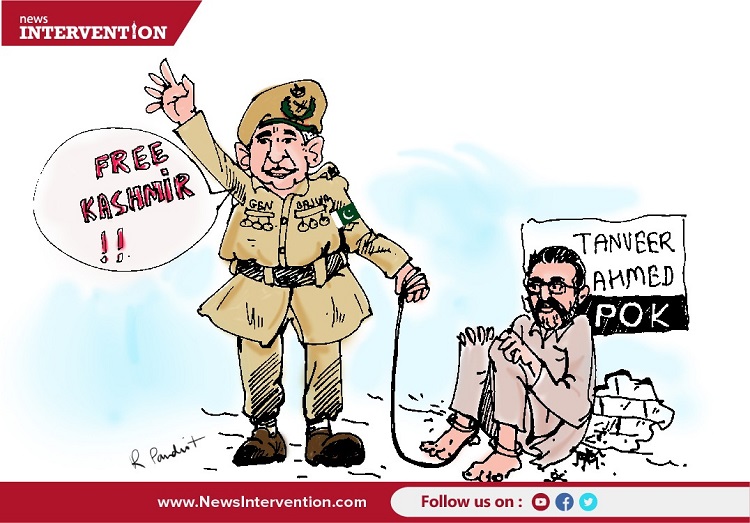
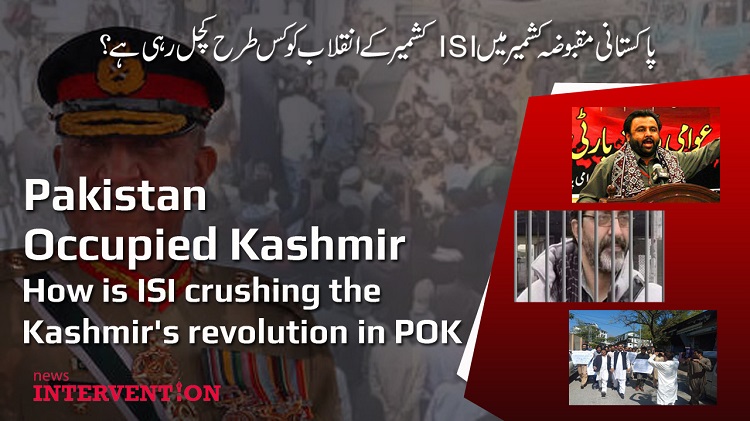
Pakistan’s intelligence agency ISI is systematically crushing the Kashmir’s revolution in “Azad Kashmir”. This “Azad Kashmir” is only on paper as there’s no “Azadi” (freedom) available to the Kashmiris. Watch this news report to understand how ISI is crushing the Kashmir’s revolution in Pakistan-occupied Kashmir (POK).
Rawalakot stands against the abduction of local Kashmiri by ISI
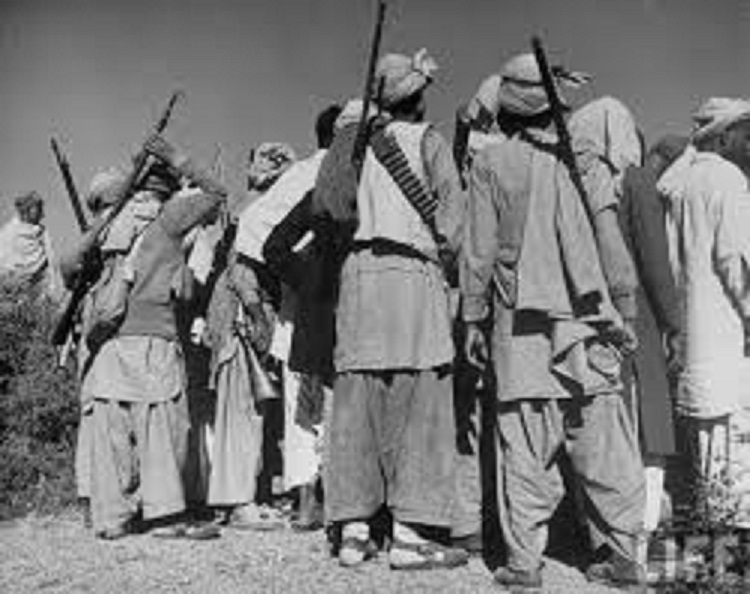
Valiant Indian soldiers saved Kashmir from Pak tribal attack in 1947
India looks upon October (the month gone by) as a very auspicious month; the festival of Dusshera falls in this month and so does the Muslim festival of Bakrid. Both festivals epitomise the victory of all that is just and righteous. This month also holds great significance so far as the military history of the nation is concerned. Netaji Subash Chandra Bose laid the foundation of Indian National Army (INA) on October 21, 1943 at Singapore. China declared an unjust war against India on October 20, 1962.
Most significantly, the Indo-Pakistan War of 1947-48, that laid the foundation of a free and resurgent India commenced on October 27, 1947 with the landing of Indian troops at Srinagar airport post the signing of the Instrument of Accession by Maharaja Hari Singh a day before on October 26, 1947 making his state a part of the Indian dominion.
The courage and resilience of the Indian troops who fought the war over two campaigning seasons is now a part of Indian military folklore. The first unit to land in Kashmir was 1 Sikh commanded by Lt Col Ranjit Rai. The Battalion Headquarters and one Company of the unit took off from Delhi at 0600 hours on October 27, 1947 and landed at Srinagar airfield at 0930 hours. They were received and briefed on the airfield itself by senior civil and state forces’ officers. The military engagement of the enemy commenced almost immediately. It was a very challenging task since the enemy was vastly superior in numbers. Lt Col Ranjit Rai died in action after having delayed the enemy enough for reinforcements to land.
On November 3, 1947 within a few days of his joining the battle, Major Somnath Sharma of 4 Kumaon created history by stalling the invading hordes in the historic Battle of Budgam. Major Somnath Sharma laid down his life in the battle under such heroic circumstances that he was awarded the first Param Vir Chakra (PVC) in independent India.
The war witnessed award of four more Param Vir Chakras and many other gallantry awards to the brave Indian soldiers who fought against terrible odds. The brave PVC recipients were Lance Naik Karam Singh, 1 Sikh, in the Battle of Tithwal, Second Lieutenant Rama Raghoba Rane, Corps of Engineers for the Battle of Jhangar and Naushera. Naik Jadunath Singh, 1 Rajput, for the defense of Naushera and Company Havildar Major Piru Singh, 6 Rajputana Rifles, for the Battle of Tithwal.
Also part of folklore is the bravery of Brigadier Rajendra Singh, Chief of Staff of the Jammu and Kashmir State Forces, who obeyed with his life the command of his Maharaja to hold the “enemy at Uri at all costs and to the last man.” Brigadier Rajendra Singh is the recipient of the first Maha Vir Chakra of independent India.
Any talk of bravery and tenacity exhibited during the war would be incomplete without mention of Brigadier Mohammad Usman. Such was his spirit of nationalism that, at the time of partition, he declined to move to Pakistan despite being given the bait of being made the Pakistan Army Chief. He was in command of 50 Parachute Brigade during the Indo-Pakistan war of 1947-48 and deployed in the Nowshera-Jhangar sector. When Jhangar fell to insurmountable odds Brigadier Usman vowed to take back the strategic location and did so within a period of three months. He died on July 3, 1948 due to Artillery fire while defending Jhangar and was awarded Maha Vir Chakra posthumously thus becoming the highest ranking Indian Army officer to have received this award. His funeral was attended by Prime Minister Jawaharlal Nehru and his cabinet colleagues. For his feats of valour he was nicknamed “Lion of Nowshera.”
Before the Indian Army landed in Srinagar, the invading hordes had laid waste every living being that came their way. Even under such terrible conditions the human spirit prevailed. A 19 year old boy, Maqbool Sherwani, went about on a cycle spreading a message that the Indian Army was on the doors of Baramulla. This information stalled the tribal (kabailee) march to Srinagar and literally saved the city from a fate even worse than that of Baramulla. When the mercenaries realised that young Maqbool Sherwani had misled them, they shot and crucified him. The young boy, with his courage and presence of mind, etched a place for himself in history for all times.
If the Indian Army had not fought with such unprecedented courage, Srinagar would have been a huge, desolate graveyard and the history of the Kashmir Valley would have changed forever. It merits mention here that the Indian Army fought the war with full support of the local population inclusive of the Muslims, Hindus, Sikhs, Buddhists, Paharis and the many other communities who form part of the state. There was not even an inkling of separatist tendencies in that period of time. The Indian troops who fought the war had only the safety and security of the people of Jammu and Kashmir in mind. The people at that time were full of praise for the Indian forces as they are even today, except for a few anti-national elements.
Kashmir has found its destiny as a part of the largest democracy in the world with a test of fire and sacrifice of blood. The bravery of the soldiers and civilians who fought the war shoulder to shoulder can never be forgotten nor allowed to go in vain. Those who are trying to break away the region due to some evil vested interests should understand that their malevolent designs will never fructify since they disrespect the great sacrifices made by the previous generations to create a good life for their off-springs in the democratic environment of the Indian Union. It is necessary for the present generation to live up to the ideals that their forefathers fought for and ensure that the sacrifices made by them do not go in vain.
Suffering’s Fortress – Not Bad or Lost People, But Bad and Lost Theology
Life as an LGBTI individual in most societies, including Canadian culture, remains a difficult hurdle for progress and mental wellness due more to external factors imposed rather than internal variables alone based on health statistics, experiences of violence and hate crimes statistics, laws against their being, and self-reports en masse. In British Columbia, we can see “LGBTQ+” or “LGBTQIA2S+.” It’s a patois. I use the United Nations terminology of LGBTI because of the United Nations LGBTI Core Group. It sets a baseline, as does some of this commentary. Within fundamentalist religious culture, in the land of the damned, individuals who are LGBTI, in some interpretations of Christian holy scripture become this by their nature. In others, they interpret the LGBTI as a relation to homosexual and other, typically, sexual acts. Those deemed sinful acts, not sinful beings or identities. For LGBTI individuals in Canada, this fact of self-identity and natural inclination or outgrowth becomes a factor in mental health, even suicide. Communities can do better. Theologies can march inclusively.
I do not subscribe to the ideas behind the language of “moving forward” or “progress” in some sense of the universe necessarily committing a deep care to human affairs in some absolute terms. If we select a reasonable timeline and contrast the treatment of select sectors, or if the comparison of material wealth and wellness conditions between centuries ago and now, then there has been technological complexification utilized for the improvement of human life. None of this changed fundamental human nature. Thus, material conditions may improve while human prototypicalities may maintain themselves for the same centuries of apparent technological sophistication, which becomes synonymous with “progress.”
In Canada, according to Egale, 500 Canadian youth (ages 10 to 24) die by suicide each year with support from Statistics Canada. They stipulated some further facts with appropriate references in the article entitled “What You Should Know About LGBTQI2S Youth Suicide in Canada“:
- 33% of LGB youth have attempted suicide in comparison to 7% of youth in general (Saewyc 2007).
- Over half of GLB students (47% of GB males and 73% of LB females) have thought about suicide (Eisenberg & Resnick, 2006).
- In 2010, 47% of trans youth in Ontario had thought about suicide and 19% had attempted suicide in the preceding year (Scanlon, Travers, Coleman, Bauer, & Boyce, 2010).
- LGBTQ youth are 4 times more likely to attempt suicide than their heterosexual peers (Massachusetts Department of Education, 2009).
- Adolescent youth who have been rejected by their families for being LGB are over 8 times more likely to attempt suicide than their heterosexual peers (Ryan, Huebner, Diaz, & Sanchez, 2009).
- A study in Manitoba and Northwestern Ontario revealed that 28% of transgender and Two Spirit people had attempted suicide at least once (Taylor, 2006).
- Both victims and perpetrators of bullying are at a higher risk for suicide than their peers. Children who are both victims and perpetrators of bullying are at the highest risk (Kim & Leventhal, 2008; “Suicide and bullying: Issue brief,” 2011).
- While suicide is never the result of one cause, bullying can have a long-lasting effect on suicide risk and mental health. The relationship between bullying and suicide is stronger for lesbian, gay and bisexual youth than for their heterosexual peers (Kim & Leventhal, 2008):
- 68% of trans students, 55% of LB students and 42% of GB students reported being verbally harassed about their perceived gender identity or sexual orientation.
- 20% of LGBTQ students reported being physically harassed or assaulted about their perceived gender identity or sexual orientation.
- 49% of trans students, 33% of lesbian students and 40% of gay male students have experienced sexual harassment in school in the last year (Taylor et al. 2011).
A large number of LGBTI youth kill themselves in this country. They self-murder more than their peers for non-mystical, non-supernatural, non-spiritual reasons. They commit suicide due to stigma, shame, guilt, ostracism, lack of self-understanding, poor educational provisions, a condemnatory community, and/or prior mental health diagnoses. These particular youth are not the “damned.” One, the language lacks descriptive rigour. Two, the vernacular fails to take into account modern empirical and behavioural accounts of comprehensive health and wellness. They are the unrealized. Those with fewer pathways to express their real selves, to self-actualize in some meaningful sense.
When religious institutions, organizations, communities, or collectives, duly maltreat LGBTI youth, they put the lives of the youth at risk. This should be condemned. Because the individual is harmed peripherally or directly. This makes a natural claim about natural events rather than attributing some moral act to some transcendent and/or immanent identity. To attribute an identity of a moral act to a transcendent object, it does not make the act more established as ethical or not. It becomes a useless step. Religious communities can do better. Some of the more fundamentalist Christians can do better. Indeed, the Evangelical Christians can do better in providing for these LGBTI youth, including the institutions of private higher Christian learning. Those lone or few voices exist amongst the youth, the staff, the academics, and the administrative classes. Some fear making a public face with pro-LGBTI stances.
Not in all cases, in many, though, the LGBTI youth remain the aspersed, the banished, the denounced, the reprobated, even the self-hidden. To the last, unknown to others so long as to feel not known to themselves. A false self presented for communal consumption and individual self-murder: the forced into becoming the walking dead. If their God proclaims, “I am who I am,” then they whisper, “I am not who I am.” Those made in the image and likeness of their God. Those children loved infinitely. Those with a cosmic, objective plan for their little, subjective lives. Those coerced by community into rejecting a fundamental claim to reflective identity with YHWH. They cannot claim they are who they are with “I am who I am” because they must present a lie in the communion of fellow believers in public. A rejection of their union with the Most High. Some have been working against this at the premier Evangelical Christian institution of higher learning for the liberal arts in Canada, One TWU at Trinity Western University.
One TWU believes in equality for all and “LGBTQIA2S+ community members are in no way inferior, abnormal, or less than their heterosexual or cisgender counterparts.” They speak to the humanity of individuals as themselves and as the heterosexual and cisgender community as well. From their point of view, “…homophobia and transphobia are affronts to our Creator God. We stand in opposition to the stigmatisation of people who identify as Queer just as we stand in opposition to racism, sexism, and the like.” It’s an affirmation of fundamental humanity in a universalized language while taken to mean objective, as in an ‘affront to their Creator God.’ I disagree on the point of a necessary Creator God or on the claim to objectivity, while the universal nature of the moral message seems statistically true.
They consider Christian love as something deeply felt rather than something “characterized by condemnation and judgment” without regard to “how carefully worded or well intentioned the church’s statements on the LGBTQIA2S+ community may be.” They refer more to the “Community Covenant” of Trinity Western University. One TWU continues, “While we accept that we will not always see eye to eye on every issue, we refuse to engage in judgment or tearing down one another. We will always seek to express discordant views in a way that respects the humanity of others.”
The community of One TWU, as an independently run group without formal affiliation with Trinity Western University, understands institutionalized rejection based on theology because of existence on the receiving end of it. Yet, they still have the conscientiousness and love to speak in these terms, “We believe reconciliation and healing is needed to bridge the gap between the Christian church and the LGBTQIA2S+ community at large. For too long, the relationships between Christians and people who identify as Queer have been characterised by distrust, cynicism, and even hatred on both sides. Instead of accepting this as the status quo, we believe that this is a situation that can change, and we seek to be catalysts in bringing people together.”
If you have read the news, some names may emerge more often than others, including current leadership with Kieran Wear[1], Elisabeth Browning[2], Queenie Rabanes[3], and Micah Bron[4]. Then you’ve become acquainted with some of the important names of One TWU. Not all likely will be public in some manner. Only a few will do this. They wrestle with difficult, to them, internal issues of psychology, identity, and theology. In personal terms, it seems as if an easy theological issue to completely comprehend and resolve as a ‘paradox’ and more something to act on in community for base level respect as a start rather than cloaked in some obscure, “carefully worded” backhand to the face of each and every LGBTI member of community and ally of said community. These kids are not unwell because of who they are, who they love, and what they see as a relationship with their Creator God; the theology, the hermeneutics, is not well because it causes unnecessary suffering of individuals.
Matthew Wigmore[5], Bryan Sandberg[6], and David Evans-Carlson[7] are the co-founders of One TWU. Other names are Nate/Nathan Froelich[8], Kelsey Tiffin[9], and Robynne Healey[10]. Matthew Wigmore in “LGBTQ At TWU” stated:
To lay the context for those not completely familiar with TWU, there are two important documents for staff and students at Trinity Western. One is the “Statement of Faith,” which is signed by staff and faculty, that dictates what the university believes. It expresses TWU’s overarching worldview. Some may argue the Statement of Faith is an inclusive document as it allows signatories to write in some qualifications or clarifications. The other document is the “Community Covenant,” which regulates the behaviour of all members of the TWU community. While the Statement of Faith may raise some eyebrows, it’s the Community Covenant that’s at issue in the current Supreme Court case…
…TWU insiders know the Community Covenant, especially recently, is rarely enforced. Why go to such great lengths to defend it?…
…LGBTQ+ persons are disproportionately targeted by the religious freedom claims. For example, there’s been very little backlash over the ease at which couples can divorce, especially compared with half a century ago. Indeed, fundamentalist evangelicals boast about the same levels of divorce as their non-religious counterparts. Surely this poses a threat to “traditional Biblical marriage,” considering the apparently intertwined nature between religious freedom and heterosexual marriage, and the religious freedom of Christians in Canada…
…It seems that although this debate, outside of the legal context, often masquerades as a debate about religious freedom, the core issue is the treatment of, not just belief about, LGBTQ+ persons. Take the LGBTQ+ factor away from the equation and religious freedom might be doing better than we’re giving it credit for.
Wigmore knows full well, as with many others. The issue comes from theology, not religious freedom. The writing looks diplomatic more than direct. The treatment of LGBTI peoples remains the core issue because the theological interpretation, as such, condemns them either as they are, as they behave in sex, or both.
As their “Statement of Faith” states:
As the verbally inspired Word of God, the Bible is without error in the original writings, the complete revelation of His will for salvation, and the ultimate authority by which every realm of human knowledge and endeavour should be judged… In union with Adam, human beings are sinners by nature and by choice, alienated from God, and under His wrath… The true church is manifest in local churches, whose membership should be composed only of believers… With God’s Word, the Spirit’s power, and fervent prayer in Christ’s name, we are to combat the spiritual forces of evil… We believe that God commands everyone everywhere to believe the gospel by turning to Him in repentance and receiving the Lord Jesus Christ. We believe that God will raise the dead bodily and judge the world, assigning the unbeliever to condemnation and eternal conscious punishment and the believer to eternal blessedness and joy with the Lord in the new heaven and the new earth, to the praise of His glorious grace. Amen.
‘Love and believe in me, or endure eternal conscious torment” – signed, A Loving Creator God. Anyhow, the implication within community comes in judgment of ‘human beings as sinners by nature and by choice’ (answering the “theological interpretation” point above as neither ‘as they are or as they behave in sex,’ but both), where LGBTI peoples are sinners by nature, as with all other unrepentant peoples, but also behaviour if enacting intimacy with those who they love. We can state with this certainty because Trinity Western University believes “the Bible is… ultimate authority by which every realm of human knowledge and endeavour should be judged.” Thus, the LGBTI who remain unrepentant are considered under God’s wrath, by nature and action. These are some of the “spiritual forces of evil” the TWU community must “combat.” Otherwise, rather than no soup, it’s no blessedness for you. On this basis, Wigmore seems ‘more diplomatic than direct’ on this communal issue. Something many TWU students still face in silence. Sometimes, they come from fundamentalist homes in which this became the only option for postsecondary education for them. Parental influence can be overwhelming with heaven and ‘right’ theology at stake.
Wigmore knows this community because he had to know the strong positives of living within a loving Christian community bound by mutual respect and dignity towards one another as Christians, and the strong negatives and xenophobia against LGBTI peoples from the same community coming straight out of the same theology. He marks the more direct statement in the place in which less diplomatic stances are required, on the One TWU website, in “This is not about a Law School… but it kind of is.” He states:
…despite whether it’s used or not, Trinity Western continues to reserve the right to expel LGBTQ+ persons, specifically those who are in relationships…
…we have yet to receive an apology. In 2016, the Mars Hill Newspaper (see the story here: http://www.marshillonline.com/) published a story featuring the experiences of LGBTQ+ alumni. This was followed by a spotlight in the Vancouver Sun (http://vancouversun.com/news/local-news/queer-at-twu), and an even more in-depth story by Daily Xtra (read it here) Before these stories were written, we had several meetings with President Bob Kuhn and other members of the administration. This was not a calculated attack. This was the result of being methodically ignored for several years. And when our stories finally came to the surface, and into the public sphere we still did not receive an apology.
Finally, the persecution complex is perhaps the highest it has ever been. President Bob Kuhn has said this case is fighting for the freedom of all Canadians. Ironically, he states, “In Canada… We don’t protect the rights of one community by extinguishing the rights of another. This is not a time to start down that path” (read the full story here). And yet TWU continues to fight for the right to expel those who cannot subject themselves to this premise: namely, LGBTQ+ students. Considering this is what this case hinges on, we have to wonder, “is our freedom being fought for?” Moreover, if Canadian-wide freedom is being fought for by those seeking the freedom to continue withholding the power to discriminate against LGBTQ+ students, is that really a freedom we want extended Canada wide? The answer is no. But at the end of the day, the discourse not only tries to equate being discriminated against for being gay with being “discriminated” against for being homophobic, but pushes further to suggest that in fact the LGBTQ+ community is the chief discriminator, not TWU.
I met Bob Kuhn. He permitted a long interview with me. A nice man, someone who endures horrible suffering from Parkinson’s Disease. Yet, as a community at that time, and now, the issue becomes the LGBTI community rather than the freedom of religion, as per the reasons described above by Wigmore. There are many stories to be told, to unfold over time, and to be covered in the future articles, which will cover some of the other inter-related commentaries. Wigmore seems as if a relevant and important place for the co-founder status of One TWU and to the public image in the media provided via advocacy and leadership on Trinity Western University and its LGBTI community.
As an outsider to these parties, I would strongly argue for and encourage a public, recorded sit-down chat or informal conversation between LGBTI members of the Trinity Western Community, in and out of One TWU, and the relevant movers and shakers[11] in the TWU communal-scape. It would be, at a minimum, educational. Something to open dialogue and alter internal culture based on understanding to build both compassion and a theology deserving of the title “Mighty Fortress.”
[1] Kieran Wear’s biography states:
Name:
Kieran Wear
.
Pronouns:
They/Them
.
What are you studying?
English and Philosophy
.
Where are you from?
Missoula, Montana
.
Who’s your favourite author?
“Jean-Paul Sartre”
.
What are you looking forward to doing this year?
“I am excited to be leading with One because I love participating in and
sharing the narratives of our community. Hearing the stories of people’s pasts,
sharing my own, these work to reimagine a continuing narrative: together.”
[2] Elisabeth Browning’s biography states:
Name:
Elisabeth Browning
.
Pronouns:
They/Them
.
What are you studying?
Social sciences with a human services certificate
.
Where are you from?
Winsted, Connecticut. (Tiny state on the east coast known for its fall leaves!)
.
What’s your favourite drink
“Chocolate milk”
.
What are you looking forward to doing this year?
“I’m excited to make One TWU a more visible and tangible resource for students.
I want everyone who might need our support to know who we are and how to
connect with us. This is all while protecting the anonymity of our members and
making One a safe space for all involved.”
[3] Queenie Rabanes’s biography states:
Name:
Queenie Rabanes
.
Pronouns:
Her/She
.
What are you studying?
Environmental studies and Biology
.
Where are you from?
Abbotsford, BC
.
What instruments can you play?
“umm… The acoustic guitar, electric guitar, bass guitar, ukulele, piano, flute,
clarinet, tuba, trumpet, percussion, melodica, harmonica, percussion and the
euphonium.”
.
What are you looking forward to this year?
“I believe it was God that gave me a unique connection to the LGBTQ+ community.
During my time in high school and at Trinity, God brought me into friendships
with queer people in a way I’d never experienced before. These friends taught
me a lot about diversity and God’s love. I’m excited to co-lead One TWU because
I want to help create a space for our friends in the LGBTQ+ community to be
heard and to be loved.”
[4] Micah Bron’s biography states:
Name:
Micah Bron
.
Pronouns:
He/Him
.
What are you studying?
General studies and education.
.
Where are you from?
Hamilton, Ontario
.
Who’s your favourite author?
“Dietrich Bonhoeffer, cause that man is a role-model for reconciliation and
eye-opening experiences. And also liberation theology.”
.
What are you looking forward to doing this year?
“One has been a valuable home for me, and I’m super thankful for the
environment we’ve created together that allows us to be real about our *whole*
lives without shame. My hope is that this year we’ll be able to share more of
who we are with the campus community, and that we’ll be able to show just how
much One has grown (in so many different ways) over the years as a group. .”
[5] Wigmore’s Unchanged Movement profile states:
I became aware of my identity when I was 10 years old. I have the fitness magazines at the local grocery store to thank for that. Early in my life, I believed a couple things about LGBTQ+ Christians:
- They were so rare that they didn’t deserve THAT much attention
- They were mentally ill or recovering from broken relationships
- They weren’t in relationship with God
- They were choosing a “lifestyle” over what was truly important in life
Because I was a part of Exodus International for five years, I bought into the beliefs that if I prayed hard enough, built enough positive male relationships, and repaired the relationship with my Dad that I wouldn’t have these feelings anymore. Not only were those “IF’s” inadequate measures of success, but they had relatively little to do with my sexuality. I believe that God, being love, created all my intricacies in love. Meaning my sexuality is not just about who I’m attracted to; it’s a framework through which I fight for the underdog and continuously re-evaluate how my actions, consciously and subconsciously, affect others.
In terms of the clobber passages, both my envelopment in and distancing from the Evangelical church has taught me truly what the Bible is. It’s a library of letters written from and to contexts that are entirely foreign to the modern reader. The idea that ANY of the biblical writers could’ve been addressing the contemporary examples of same-sex unions and gender fluidity is so impossible that the Church’s obsession with opposing these topics serves to undermine the Church as we know it today.
Meeting other LGBTQ+ Christians (who immediately smelled more like Jesus to me than most people I had met in Bible college), working for a Christian org, and going to church were instrumental in my journey towards affirmation. Their existence and truth gave me the confidence and affirmation I needed. In terms of my last thread with Exodus, it was the behaviour of my conversion therapist (ironically). But it was also Lisa Ling’s Our America documentary series, which made the evidence against Exodus so overwhelming. I also felt like anyone who wanted to tote the idea that my sexuality was reversible was going to struggle arguing with me, considering my existence had proved the opposite.
I don’t think we’re ever meant to fully RECOVER from something like conversion therapy. It’s traumatizing, particularly because it can destroy relationships and also teaches us to undermine ourselves and our feelings. As much as I’m more confident in myself and my capacity to make decisions, I do believe that the parts of me which continue to remain morphed because of my time with conversion therapy are so for a reason. They give me empathy, a reminder of how far I’ve come, and a sort of “gay commissioning.”
I attended Trinity Western University during one of it’s most tumultuous times and started One TWU with some of my friends, an LGBTQ+ organization. It was discouraging to see LGBTQ+ rights pitted against religious freedom, but I think that served as a wake-up call for many that we can’t go on treating people like this. Seeing people come forward with courage and to tell their stories truthfully has been one of the most healing experiences in my life.
My life now is full, but also in anticipation of the good, the bad, and the ugly to come next. I guess I’m just less afraid of it now.
[6] Sandberg’s article “Dear Trinity, I’m Game and I Love You” states:
Can I express how much I love you? When I first arrived here in 2010 as a closeted 18-year-old who was deeply burdened by heavy rejection from other Christian circles, I wasn’t sure I would… but guess what? I do love you and I love you a lot. You’ve proven yourself over and over to be a loving tribe of people, full of compassion, acceptance, and graciousness, and I have been honored to count myself among you. However, as we all know, things have not been easy for Trinity as of late, with the recent story about Bethany Paquette being just one more example of the mischaracterizations many of us have had to face. Speaking as a gay Trinity student who loves this community wholeheartedly, I have a few things I absolutely need you to know moving forward as controversy continues to surround our school…
… I want you to know that as a gay Trinity student and soon-to-be alum, I love you all without hesitation. Like many other students who have passed through TWU’s open doors, I too have found a second home here, one I will doubtlessly cherish for the rest of my life. No, I don’t agree with everything everyone thinks, but is that really the heart of the matter? I would take being loved over being agreed with any day of the week, wouldn’t you? So do not allow unfair criticism and accusations to tear you down as the controversy around TWU continues into the future… God’s watching over you and he knows what you need. Much love to you all!
[7] Chrisaleen Ciro in ““Still a lot of Work to Do”: How the leaders of One TWU believe its history intersects with the future” stated, “At the time, Wigmore felt that the only “foolproof” way to go about this would be to “get a press shield.” He wanted to know that in a worst case scenario situation––if TWU took action against him––it would be on the record. He met with reporters to share his experience as a gay student at TWU. In 2014, Wigmore and fellow students, Bryan Sandberg and David Evans-Carlson (an alumnus), founded One TWU with the intention of providing a safe space for queer students on campus. Wigmore recalls intensely appreciating the solidarity and awareness of the presence of other members of the LGBTQ+ community on campus that came from that group.”
[8] Nate/Nathan Froelich in in “Nathan Froehlich: Out of Hiding” stated:
From a young age, I knew there something that made me different. I didn’t know quite what it was; a society saturated in toxic masculinity taught me to believe I would only be “enough” if I fit western culture’s ideal mould for a man. Although those who know me well enough will know that is a mould that I have never quite fit. Growing up, most of the boys around me wanted to go hunting, fishing, talk about girls, and spend their time on other stereotypically “masculine” activities. By contrast, I gravitated towards shopping, creating miniature plays and performances for my family, and admiring Chris Pine in Princess Diaries 2. I bought into a lie that told me that because I didn’t fit the ideal male characteristics shared by my male counterparts, that I was less of a boy, and I would never be enough of a man.
I remember waking up one morning and going into my family’s living room where my Dad sat reading his Bible in his usual spot. He invited me to read with him, as he so often did. Together we read Genesis 19—the story of Sodom and Gomorrah. He read aloud, “All the men from every part of the city of Sodom—both young and old—surrounded [Lot’s] house. They called to [him], ‘Where are the men who came to you tonight? Bring them out to us so that we can have sex with them.’” With the familiar sensation of shame burning through my chest, I sat confused and full of fear, wondering how I, an eleven year old boy compared to those terrible men in Sodom that God wanted to destroy…
…The language often used by Christians to describe homosexuals made it seem as though gays shared more characteristics with Shelley’s Frankenstein than they did with actual people; as if LGBT people are a purposeless and irreparably broken people beyond redemption. The church promoted a culture of love, hope, vulnerability, and authenticity, but only within comfortable lines; they held an attitude of hostility towards homosexuals that kept me silent in my pain. Sharing a negative view of homosexuals caused me to view other gay people through a distorted and loveless lens, developing a ‘hate the sin, not the sinner’ attitude that left me feeling better than the superiorly broken “worldly” homosexuals. For twenty years, I sat in church services where I heard messages of God’s goodness, His ability to heal those who are sick, pull people out of sin, and radically alter people’s lives. I’ve witnessed healings, experienced the power of God’s presence, and seen radical change in the lives of others so I pleaded with God to change me too. I prayed relentlessly, hoping for just enough faith to release me from my sexuality, but my prayers fell as empty words and I was left confused, questioning God’s silence…
…I’ve come to understand that scripture is not black and white when it comes to discussing homosexuality. As any churchgoer understands, it is important to investigate the context of the Biblical text to come to an accurate understanding of what is being taught. This same approach must be taken when it comes to discussing same-sex relationships, such as in 1 Timothy and in 1 Corinthians. Such verses, share the same Hebrew word (arsenokoitas) that was originally translated to “homosexual,” used to describe male prostitutes, is not what we define homosexuality as today (i.e two men in a loving, consensual, monogamous relationship). I believe that God blesses monogamy between a same-sex couple just as much a heterosexual couple. What I had thought for so long were scriptural tenets, were actually North American Evangelical cultural standards. When I brought myself back to the bible, and away from these standards, the answer I had been searching for became a lot more clear…
…I once told someone that one of my greatest longing is to be fully known; to no longer be in a constant state of reclusion. So, here I am, Nathan: a son, a brother, a grandson, a nephew, a friend, a lover of snowboarding and of traveling, of music and of photography. I am brave, I am kind, I am strong, I am loved, and I am gay. My identity is in Christ, being gay doesn’t change that. I am enough just as I am. I no longer live under the fear of the opinions and convictions of others, I am loved by God, and by my family. I am owning my faith; I am done living in fear, and I am out of hiding.
I would interpret “God’s silence,” in all due respect, as reflective not of a self-identity bound to the Creator God in waiting of some communion, but, rather, reflects the naturalistic account of the matter. In that, it’s not a God of deep personal care to individuated human life who penetrates the brain so as to commune with its self-born child and to convey some meaningful answer to a troubling query in some extra-natural sense. It’s silence qua silence. Silence manifested by the nature of that which is present, silence itself. No god to deliver a message because the god is not there and never left in the first place, because there was no god. A community rejecting LGBTI individuals with the expectation of ‘repentance’ and then condemnation to place the communal rejection on themselves, the individual LGBTI persons. The culture produces the hardship in this domain. Duly note, the healing and improvement in mental wellness happened outside of the walls of the institution.
[9] No proper citation at this time.
[10] Professor Healey’s biographical information on the Trinity Western University website states:
Professor of History, Co-coordinator Gender Studies Minor, Co-director, Gender Studies Institute…
Her Google Books biographical sketch states:
Robynne Rogers Healey is Professor of History and Codirector of the Gender Studies Institute at Trinity Western University. She is the author of From Quaker to Upper Canadian: Faith and Community Among Yonge Street Friends, 1801-1850, and the coeditor of Quaker Studies: An Overview; The Current State of the Field.
[11] Its current president and current vice-chancellor is Dr. Mark Husbands, and was Bob Kuhn. Its Board of Directors is comprised of Board Chair Frederick Fleming, Board Vice-Chair Matthew St. John, Board Treasurer Leighton Friesen, Board Secretary William Francis, Chair of the Staff Association Dan Burnett, Angelica Del Vasto, President of the Alumni Association Aaron Fedora, Julie Kerr, Matthew Kwok, President of the Student Association Daniela Lombardo, Ross Reimer, Aaron Rogers, Arnold E. Sikkema, Executive Director of the Evangelical Free Church of Canada William Taylor, Chair of the Faculty Association Allan Thorpe, and Priscilla Vetter.
Photo by Markus Spiske on Unsplash

Extrajudicial killings and enforced disappearances in “Azad Kashmir”
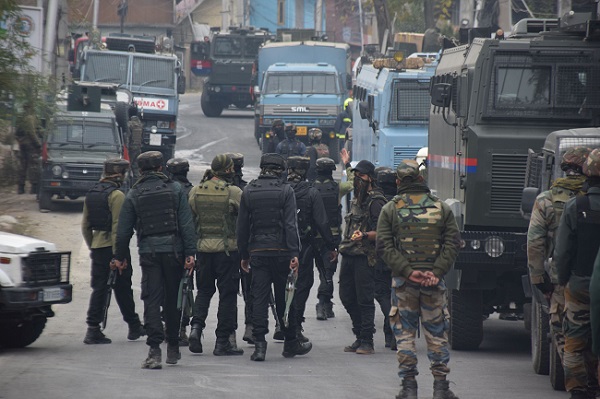
Rawalakot’s brave people deserve salutations for their heroic act. The brave people of Rawalakot foiled attempts to forcibly abduct a man in POK (Pakistan-occupied Kashmir) by the occupying state’s intelligence personnel and handed these ISI agents to the police.
It’s not the first case where the intelligence and security agencies of the occupying state tried to kidnap a citizen, but the hitherto “unknown” is now known to all. The occupying state (of Pakistan) has been historically involved in a spate of extrajudicial killings, enforced disappearances and dumping of mutilated dead bodies. These criminals are known to everyone and the people of Rawalakot can drag these culprits to the police station. The Baloch freedom fighters in Balochistan can bring them in public courts. In Khyber Pakhtunkhwa, the PTM (Pashtun Tahafuz Movement) can raise their voice against them.
Since very long we have been requesting the world to pay attention to the role of Pakistan in terrorizing people across historic nations. The world needs to know that Pakistan is an unnatural state that indulges in the oppression of oppressed nations and the massacre of people across its occupied territories. It does not take into account international laws, humanitarian norms and regulations. This occupying state has had such a terrorist role in Bangladesh, Sindh, Balochistan and Waziristan. The main reason for this lawlessness and savageness is the power to these “unknowns”. These “unknowns” routinely trample national constitution under their boots.

After the incident of Rawalakot, we have to understand that in every city of the ten districts of this so-called “Azad Kashmir”, there are brigades of the occupying army and military barracks on all entry points of each city. What is the main reason for this? Why has every city been besieged so strictly? It’s only because they need to crush and suppress all organized voices of freedom and people’s rights. These occupying powers understand that whenever people of “Azad Kashmir” organize themselves on the philosophy of a united state, it will start a people’s movement. When people begin challenging the illegal occupation of Pakistan, these predators will create conditions similar to Balochistan. As the movement becomes more organized, their oppression will intensify. It will trigger extrajudicial killings and enforced disappearances.
Today we demand an end to siege of all cities by the army. We demand the immediate abolition of military barracks and brigades. We are under siege in the name of security. What the world sees here is peace, but it is not peace, rather a peaceful siege as a result of accepting slavery over freedom. Calling slavery as slavery and demanding freedom will lead to a wave of violence and terror. Because the history of these unknown occupiers is full of oppression, violence and genocide.
These “unknown” savages gave us the body of Arif Shahid in Islamabad. Sarfraz was shot in broad daylight in Karachi and we have received the bodies of a dozen talented and promising young students from their cities. After the Rawalakot incident, some people are saying that arresting these unknown persons and handing them over to the police is backing the culprit, which is completely wrong. If any of our citizens have committed any crime, they should approach the concerned district administration. The culprit can be arrested by the local police and the courts can punish them. Those in big boots and khaki uniforms should not have the option to pick up whoever they want and make him disappear. We have been witnessing this practice in Balochistan for the last three decades.
The families of missing persons have been protesting continuously and are now helpless, but they not heard by anyone. Because this brutal army is not bound by any rule, law and constitution, such unbridled power can be bound by only one court and one power and that is the power of the people. Whether the people are Baloch, Pashtun, Sindh or Rawalakot in POK, only organized people can and will hold them accountable.
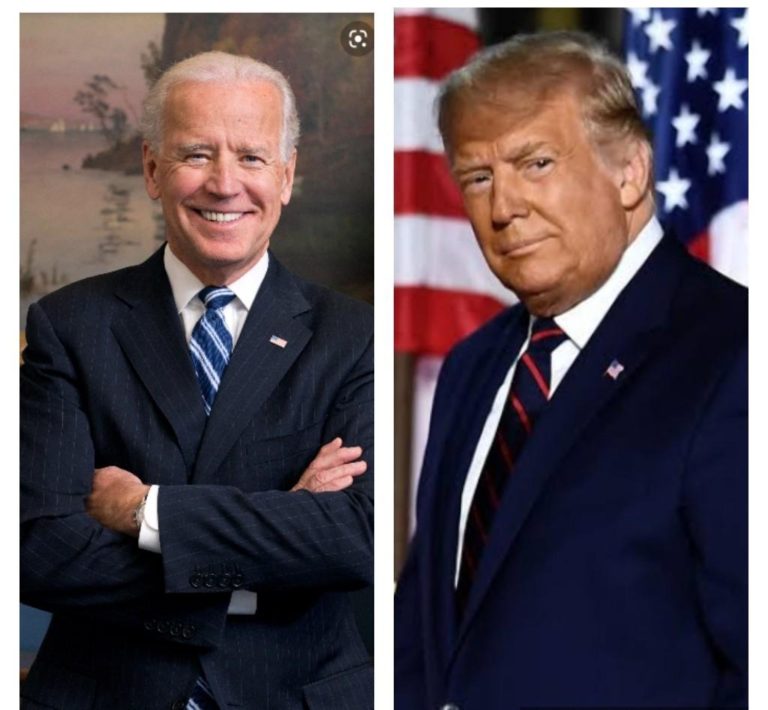
US President: Biden Or Trump? Who is better for India
Geo-Political Overview
The world is battling with COVID-19 while an increasingly belligerent China is using all domains of its comprehensive national power to break out from its self-imposed shackles and dominate international institutions, Asia and the Asia Pacific – thanks to an increasingly vulnerable, confused and directionless America. The emerging multi-polar world is in a state of disarray and engaged in strategic re-balancing. This naturally has fractured global stability and apart from the ongoing confrontations, the brinkmanship being played out between USA and its allies against China in the East and South China Seas, Taiwan Straits (with no formal/institutionalized agreements for crisis resolution), and along the India-China LAC could easily precipitate into a shooting war.
This has left the world on edge. Amidst these tumultuous times, the USA is engaged in selecting their 45th President after a very polarizing, contentious four years of President Trump, which will have significant strategic impact on India. Having said that, as we will see when analyzing the event sheet, that as a mature democratic superpower, US foreign policy has largely followed a steady pattern with India. It is India which is at a crossroad, and needs to evaluate its foreign policy and history of ‘strategic autonomy’.
General Trends
Indian Americans, the second-largest immigrant group in the United States, mostly support Democratic candidates, although support for Trump has reportedly grown in recent years. An Oct 20 YouGov poll found that 72 per cent of registered Indian American voters support Biden. By comparison, 77 per cent voted for Hillary Clinton in 2016 and 84 per cent for Barack Obama in 2012. The poll also claims that the number of Trump-supporting Indian Americans has grown to 22 per cent, from 16 per cent in 2016. The top three issues for Indian American voters are the economy, health care, immigration and racial discrimination. Foreign policy apparently does not rate high. India and Indian Indians must look at next month’s election only in terms of what matters to India.
Trump and India
For India, the Trump years have offered a mixture of spectacle and substance. President Trump did what no US leader had ever done before: Share a stage with his Indian counterpart PM Modi at rallies attended by tens of thousands of people in US and India. The events offered both a chance to curry home political points while cementing their bond as right-leaning nationalist leaders. While the rallies formed the public face of the relationship, defense planners and diplomats have worked behind the scenes to deepen security cooperation between the world’s two largest democracies. The Trump administration has largely continued the policies of its predecessors. The US views India as a useful counterweight to China, together with traditional allies in the region such as Australia and Japan[i].
Under Trump’s watch the focus has been primarily on the security arena with two issues being accorded foremost importance; weapons sales, and prodding it to serve as a counterweight to the PRC. Their bonhomie resulted in first-ever 2+2 dialogue between both the countries at defence and foreign ministry levels. Trump relationships are almost wholly transactional. The Indian government has found plenty to like about the Trump administration, including its emphasis on fighting Islamist extremism and its tough stance on Pakistan. Unlike many international and national voices, Trump has had little to say about Modi’s controversial moves over the past year, including abrogation of Article 370 and 35A, crackdown in Kashmir Valley, CAA and NPR.
In fact, Modi’s embrace of Trump has been so enthusiastic that it risks undermining the strong bipartisan consensus for better relations with India, which many interpreted as an implicit endorsement of Trump’s election campaign. Obviously, Trump wants to make significant inroads with Indian American voters, but politically and diplomatically it is important to keep it bipartisan. The only area of significant friction between Modi and Trump has been on trade practices, which Trump terms as unfair and has often tweeted vehemently against it, and his immigration policies. The two countries are almost engaged in a low-grade trade war. Trump victory cannot be to India’s disadvantage.
Biden and India
Biden has been an enthusiastic proponent of US-India ties for years, and as far back as 2006 as a Senator to an interviewer he said “My dream is that in 2020 the two closest nations in the world will be India and the United States. If that occurs, the world will be safer.” Biden once Chairman of the powerful Senate foreign relations committee, is an established friend of India, and has been instrumental in removing the sanctions on India post Pokhran-2 nuclear tests, while insisting on retaining curbs on Pakistan. As a democrat he continued to be a major force behind the US-India nuclear deal (123 Agreement). Some sections within India, seem convinced that a Biden presidency bodes ill for India. Their misgivings, it appears, stem from some adverse comments that both Biden and his running mate, Senator Kamala Harris, have made about the state of human rights in J&K, nationalist agenda (Hindu in their perception), CAA and NPR which seeks to move the country away from its secular founding ideals, quoting India’s ‘long tradition of secularism and with sustaining a multiethnic and multi-religious democracy’[ii].
Biden’s win will mean multi-faceted, potentially more favourable relationship specially in trade policies for India, predicts UBS Global Research. This should boost investors’ sentiment and push up markets after an initial hiccup. His approach will be more predictable and stable, suiting our diplomatic, political and bureaucratic culture. In all likelyhood he would involve India in US withdrawal from Afghanistan to ensure regional stability rather than implement it unilaterally. At other levels too things will get better. Biden is expected to have a technocrat/core specialists dominated administration, recognized practices will make a comeback, state-level ties will be more predictable, and India’s importance as a strategic counter to China in the Indo-Pacific will be re-affirmed. The flip side is that the benefits of change may be limited for India, as Biden may try and roll back tensions with China even if the ties will still be prickly. Washington may learn to live with China’s expanded influence in Asia which could moderate and reduce support to India against Beijings penchant for salami slicing. Pakistan, India’s implacable foe, will continue to be important to the US owing to the endgame in Afghanistan. Being moderates they may feel compelled to voice dissenting notes against PM Modi’s brand of nationalism and perceived ‘Hindutva’ card. However, geo-strategic interests, India’s size, population and markets could trump ethical considerations
The Indian American Dream — Immigration Policy.
If Trump wins the immigration regulations will be much stricter. Trump has always been vocal about his anti-immigration stand; be it border patrol, entry of skilled workers, family migration or deportation. The “Buy American, Hire American” Executive Order (EO) is a classic example of his anti-immigration rhetoric. Recent policy changes have had effects as we’ve seen a general increase in denial of visa petitions across the board and also heightened scrutiny at the consular level. In fact, his administration is proactively, through new rules and policy changes, tightening certain aspects of immigration, the H-1B program in particular. The two most recent changes, announced by the Department of Labour and Health Services (DOL and DHS), will have a devastating effect on the H-1B program.
If Biden wins, he will implement changes that support and recognise that “Immigrants bring tremendous economic, cultural, and social value to their new communities.” Biden is committed to working on immigration reform and keeping families together that could provide a pathway to citizenship for 5,00,000 residents from India. Biden has said that he will turn the clock back and eliminate the anti-immigration proclamations and executive orders issued by Trump.
Am almost Equal Party Scorecard for Republicans and Democrats: Based on Geo-Political Compulsions and Indian Responses.
It is useful to recall that it was a Republican Richard Nixon who not only supported Pakistan in the 1971 conflict, but even deployed the Seventh Fleet in the Indian Ocean Region (IOR). Republican Reagan strengthened Pakistan’s Inter-Services Intelligence (ISI) by providing support and funds through it for “militant jihad” to drive the Soviet Union out of Afghanistan. India has suffered a blowback ever since through Pakistan’s proxy war. Democrat Clinton supported India during the 1999 Kargil conflict, while Republican George Bush took the relationship to a high by signing the Civil Nuclear Cooperation Agreement. Democrat Obama was the first US President to articulate support for India’s permanent membership to the UNSC (United Nations Security Council) and made us a ‘major defence partner’.
Finally, while Republican Trump has been highly critical on trade issues, taken away GSP (Generalised System of Preferences) benefits, but has spoken highly of the relationship, and authorised niche technology releases. All Presidents have been committed to a stronger relationship with democratic India and recently signed four far reaching politico-military agreements (BECA, COMCOSA, LEMOA, ISA). What matters more, is the geopolitical context within which the bilateral relationship is placed. A Biden administration will explore common areas of work with China, on climate change and trade, but will be guided also by the deep recognition of economic and technological rivalry, and unfair Chinese practices. A Biden administration can also be expected to be more globally influential, with its declared intent to work with allies and partners, and in multilateral frameworks. Trump and Biden will present differing opportunities and challenges: on trade, climate change, and human rights; but similarities on Pakistan and China. Biden importantly has promised to work with India to combat terrorism (without naming Pakistan) and prevent China from threatening its neighbours [iii].
India-China-USA Relations: Strategic Dilemma for India
Both US and India will have an adversarial/ confrontationist relation with China for some time to come due to their own obvious geo-strategic compulsions. India faces a ‘strategic dilemma’; it can align with USA as a strategic partner; it can retain strategic autonomy and join hands on a case to case basis (this could lead to a lose-lose situation in today’s environment); or can cooperate/acquiesce with/to China with obvious adverse fallouts in the international geo-political arena.
Both China and USA in their own interest want India on their side (one within a liberal democratic mode while the other in an illiberal unequal order). Currently India is rapidly improving its strategic and military relations with USA and its allies, without aligning permanently, keeping options open. Time only can tell the road chosen, and whether it was a geo-politically prudent one.
Conclusion.
Foreign Minister Dr S Jaishankar when asked by Hindustan Times on September 6, 2020 on who will be better for India said “I actually believe that India has bipartisan, or in a sense non-partisan, support in American politics. Our footprint is very wide and so is our acceptability. Different sets of politicians who disagree on many things agree on India. And I think that is a very good place to be”. Both Trump and Biden need India to balance China and counter its rising global stature. Interestingly and happily the future relations with the USA depends on India, and how India wants to geo-politically balance the global equations or align on one side of the emerging bi-polar world.
Mature handling of foreign policy demands a certain balancing of
objective moral judgment and national interest. The absence of this judicious
mix prompts sellout allegations, as in some South American republics or Asian
client states of the US like Syngman Rhee’s South Korea or the Philippines
under Ferdinand Marcos. That is not how Indians see their national future.
[i] ‘What the US elections mean for India’ by Joana Slater, Washington Post, 29 Oct 2020
[ii] ‘Why Modi Will Prefer a Trumpian World Order, Rather Than a Biden-Harris Presidency’ by Sushil Aaron for The Wire on 02 Oct 2020
[iii] In Biden’s outreach to Indian Americans, a clear reference to Chinese aggression and Pak’ by Yashwant Raj for Hindustan Times, 25 Oct 2020; Biden also wrote in an Op-Ed in India West, a news publication focused on the Indian diaspora.
POK journalist Tanveer Ahmed starts hunger strike in jail
Dadyal/ POK: Senior journalist Tanveer Ahmed who was arrested on August 21 from POK (Pakistan-occupied Kashmir) for taking down Pakistani flag at Dadyal has begun a hunger strike against the oppressive actions of authorities who continue to deny him basic legal options available to political prisoners.
On October 29 Tanveer Ahmed’s case came up for hearing at the Supreme Court of Pakistan-occupied Kashmir (POK). However, the two-member judicial panel did not even bother to record the court proceedings. The judges of “Azad Kashmir” (POK) adjourned the court without even listing the court proceeding details of Tanveer Ahmed.
“We did not get any concrete reply from Tanveer’s lawyer. We went to the Mirpur Supreme Court (in POK) and checked the records and found that there was no record of the October 29 proceedings and no date has been fixed for the next hearing,” a Dadyal resident told News Intervention requesting anonymity.

Tanveer Ahmed’s family members and friends were later on told by the authorities that due to a strike against the decision to turn Gilgit-Baltistan into a Pakistani province there was limited staff in the courtroom and so the court proceedings could not be recorded. Tanveer Ahmed’s friends rejected this reasoning and termed them as “baseless”.
“With the help of this “limited staff” present in the courtroom, all other court proceedings on October 29 were typed and recorded. Why didn’t they record Tanveer Ahmed’s case proceedings?,” asked the Dadyal resident, his voice furious.
Later on Tanveer Ahmed’s family was verbally informed that the Supreme Court panel would hear Tanveer’s case on November 18.

Tanveer Ahmed started his fast from November 1 to protest against this mental harassment.
At the time of writing this report Tanveer Ahmed’s condition had turned critical and his friends said they fear that the ISI might try to eliminate him.
Tanveer Ahmed’s wife has requested the deputy commissioner for his medical checkup. The deputy commissioner asked for the police personnel to be deployed and also wrote to the jail superintendent to arrange for medical examination of Tanveer Ahmed at the hospital.
Tanveer Ahmed’s friends and relatives are trying hard to persuade him to end his hunger strike but he has not yet agreed. “Tanveer says that he respected and trusted the judiciary but the judiciary does not seem to respect itself. He says that if he has been imprisoned on political grounds, then he should also be given political facilities,” said the Dadyal resident.
In August this year, Tanveer Ahmed had demanded that Pakistani flag be removed from his country but after his demands were not met he himself removed the Pakistani flag from Maqbool Bhat square at Dadyal. Tanveer’s argument was that Pakistan calls this as “Azad” Kashmir so why should the flag of another nation be hoisted in a free country, he then pulled down the Pakistani flag citing international rules. Subsequently, Tanveer was arrested on August 21.
Tanveer Ahmed’s actions have irked Rawalpindi and its rogue intelligence agency ISI who now wants to silently eliminate Tanveer Ahmed.
Why Bharati Ghosh is tough to beat in Bengal?
For almost five months, a female functionary of the Bharatiya Janata Party (BJP) has criss-crossed Bengal to address rallies packed to brim, many times overflowing with thousands of ardent fans.
Every time her convoy reaches the venue, women blow conch shells and shower flower petals to welcome her, men stand in rapt attention, children run with her motorcade like crazy fans after filmstars. For them, Bharati Ghosh is indeed special. Her power-packed rallies are indeed unique. Many call her Agni Kanya, which literally translates into Fire Girl. It is the same title Bengal had given to Mamata Banerjee when she swept to power in 2011.
On paper, she is among the many vice presidents of BJP. On the ground, her popularity is sky high but strangely, she hardly figures in the media, both print and electronic. Some say it is because of bitter rivalry within the state unit of the BJP. It has not deterred Ghosh, she has kept the prestige of the party intact by raising issues of both national and local importance in meetings at Hooghly district, east Midnapore, West Midnapore, Jhargram Bardhaman, North 24 Parganas, South 24 Parganas, Kolkata, Howrah Gramin, Jalpaiguri, Siliguri and Raiganj.

Political cognoscenti in Bengal say Ghosh has huge connectivity with people in Bengal.
In her speeches she raises issues which matter the most in a weak state that shares an important international border and is low on economic growth. Ghosh talks about the per capita expenditure on healthcare by the state government. She quotes the Reserve Bank of India (RBI) and reminds everyone that Bengal spends just Rs 988 per capita on healthcare while the average spend by all states stands at Rs 1,482. In short, Bengal allocates just 67 percent of what is the average expenditure of the Indian states and Union Territories. She reminds the masses that health is wealth, the only other state that is worse than Bengal is Bihar, which had spent Rs 781 per capita on healthcare.
She reminds everyone that in Bengal economic activity is near dead and no new investment has come. She says the younger generation is forced to seek gainful employment outside the state. “This needs to change, this will change only if you want. You can bring the change. Stay with the BJP,” says Ghosh.
She reminds people of Bengal that she should protest against the unabated illegal immigration happening from next door Bangladesh.
For the masses, Ghosh is the lamp of Aladdin, many feel only she can turn things around in this intensely politicised state and its political cadre, supported by all sections of administration, police included, now survives on extortion. Ghosh says the state’s Tolabazi or Hafta culture needs to end because it yields no revenue to the exchequer.
A weak administration naturally breeds a weak economy, Ghosh reminds everyone.

A former decorated cop who worked at the United Nations and across strife-torn Africa, Jordan and Kosovo, Ghosh makes several broader points about national politics, explaining why states need to work closely with the government at the Centre. She says courage requires more than words, it requires action. She knows taking action with the full knowledge means there would probably be consequences, both personal and national. For her, true courage means a willingness to live with those consequences.
Ghosh, educated at Harvard and London School of Economics, has travelled across Bengal, a state gripped by the Covid-19 pandemic. She knows these are no ordinary times. She tells people why it is important to prioritise, communicate and support each other. She has a simple, catchy line for her Zoom conversations: Amar Poribar, BJP Poribar which translates into My Family, BJP Family.
She is the only BJP leader who has suffered tremendously at the hands of the rival Trinamool Congress.
Ghosh, who held simultaneous charge as superintendent of police of two Maoist districts of Jhargram and Paschim (West) Midnapore from 2012 to 2017 and initiated the surrender of hundreds of Maoists and restored normalcy in the region. Extremely popular in Junglemahal belt among the Adivasis & SC/ST belt, her relationship with the Bengal CM strained after Sabang bye-elections results were declared on December 24, 2017 when she, as SP was blamed for BJP’s increased vote share which rose from 2000 to 37000. Ghosh applied for VRS on December 26, 2017. The VRS was approved on January 2, 2018. She remembers when she resigned, she was on the verge of becoming a DIG, a very crucial and important rank for an IPS officer. But she did not compromise.
On 31st January 2018, she met BJP leaders in Delhi to join the party. Within 24 hours, her home was raided on February 1, 2018 by cops who did not even carry a FIR. Following the raid, Ghosh was implicated in a series of cases. Shockingly, rapists, criminals and history sheeters who were arrested and charge sheeted during her tenure as SP were invited by the state administration to come over and lodge false complainants against her in what appeared to be a deep rooted conspiracy to malign her image.
She has fought the charges meticulously in various courts.
What is surprising is that Ghosh hardly features in the BJP propaganda machinery, she is not even there in the leaflets issued by the state wing of the party. But that has not deterred Ghosh, she is a strong figure who doesn’t seem to worry much about being disliked, or tries to soften her ways to appear more feminine. She is not completely safe from sexist stereotypes and treatment. She is just a fierce leader who does not hesitate to test the limits of legality and democracy.
Her popularity is growing, she is being noticed by many.
What is extremely surprising is that a nation that is routinely dismissive of its women, diminishing and threatening them in the private sphere, is extremely comfortable with this kind of female power? Why are the crowds filling up her rallies? Many say Ghosh exudes both confidence and hope.
Bestselling author Amish Tripathi told Quartz: “India is one of the last surviving ancient pagan cultures,” Unlike other cultures, he said, Indians still carry the memories of the country’s ancient ways.
“Empowerment can only come from a woman. We once looked to Mamata Banerjee as a goddess. Now we see Bharati Ghosh as a saviour. She is rooted to this region, she knows our pains, sorrows,” Babu Paramanik, a worker at JangalMahal, said in a brief interview.
Another villager, Abhiram Sahu, said when Ghosh was in charge of Midnapur, she cared for the masses. “She was like our mother. If there was a violence free election, she would have won the Lok Sabha seat from Ghatal in 2019.” Ghosh polled 6,09,986 votes but lost to Deepak Adhikary, a filmstar who polled 7,17,959 votes, in a highly violence-marred election when paramilitary forces were repeatedly called to control the situation. She almost got killed but for her CRPF guards who fired to stave off her attackers. The incident happened in Keshpur, an assembly in the Ghatal constituency. Newspapers reported a high level of rigging by TMC in Keshpur.
For the records, political violence and deaths are high in Bengal.
“She cared for us, she was there for everything ranging from wedding to education. She was like our mother,” says Bharat Soren, a resident of Gidhni village. Samir Dhal of Jamboni says Ghosh still retains her grip in the Midnapur region, as also in other parts of the state. “She cared for us, we always remember her.” Satya Malick of Binpur village says people have high hopes from Ghosh, they know she is a rare leader who will always stand with the masses. Words that she would come to address rallies travel like jungle drums, women throng the venue in hordes.
The BJP high command, led by Prime Minister Narendra Modi and Home Minister Amit Shah, are in full control of developments in Bengal. The duo made several organisational level changes in the state BJP, putting veteran RSS leader Shiv Prakash in total control. BJP wants more ground to connect with the masses in Bengal for the 2021 assembly elections. Ghosh’s popularity with the masses could come in handy for the party in the 2021 assembly elections.
Political experts in Bengal say Ghosh is probably one of the rarest BJP leaders high on the TMC radar. The TMC also knows that only Ghosh has the potential to embarrass Bengal’s ruling party. Ghosh, a no-nonsense person, was once hailed as the daughter of Bengal CM Mamata Banerjee. Now, she is labelled as a carpetbagger by the TMC.
She was once the Insider, now she is an Outsider.
The Apex Court has restrained the Bengal government from arresting Ghosh, who has—actually—taken the battle to the trenches. Once she stopped Bengal’s big cow smuggling racket and was privy to many secrets of the state, including the death of Naxalite leader Kishenji on November 24, 2011. The state government had claimed Kishenji was killed in an encounter in Junglemahal though there were conflicting reports which said the Naxalite leader was shot dead after he had surrendered.
If Ghosh offers proof of such a killing, it could cause tremendous embarrassment to the state government. Staged encounters are not uncommon in Bengal; the state witnessed many such killings by cops during the tumultuous Naxalite movement in the 1970s.
Ghosh is now faced with what appears to be a big challenge: To take on the might of important ruling politicians in the state.
Seasoned Kolkata-based lawyer and author Arunabha Ghosh said it will be interesting to see how Ghosh fares in the forthcoming elections. “She has the willpower, she has tremendous grassroot support and she is not worried about any threats. It is clear there is a lot of political vendetta against her.
“Her flats were sealed illegally before she opened it through a court order, her salary account remains frozen without any court order and during the pandemic Covid-19 situation, CID, WB issued notices to Ghosh calling her for interrogation of old cases where she was not called for two years. On one occasion, the officer who examined her was a Covid patient.”
Ghosh has weathered it all.
In a few minutes, the former top cop will be off to one more rally to talk about the BJP and changes that the right-wing party could bring in Bengal.
World Intelligence Network Addendum I – Non-Defunct Societies Membership
This is Addendum I to the following six articles, links active:
A Review of the World Intelligence Network Sigma 1.33-3.07 Societies
World Intelligence Network Sigma 1.33-3.07 Societies “Second Pass”
The World Intelligence Network 3.13-4.8 Sigma Societies First Review
Second Pass of the World Intelligence Network 3.13-4.8 Sigma Societies
First Pass of the World Intelligence Network 5 to 7 Sigma Societies
Second Review of the World Intelligence Network 5 to 7 Sigma Societies
The World Intelligence Network composed 84 “active” high-IQ societies. The conclusion from six articles for first passes and second passes on the 1.33 sigma to 7 sigma societies of the World Intelligence Network found the construction of a novel list with the minimum or modest standard of non-defunct status for the high-IQ societies.
The World Intelligence Network was founded by Dr. Evangelos Katsioulis. Its President is Dr. Evangelos Katsioulis. Its Vice-President is Manahel Thabet. The editors of Phenomenon are Graham Powell and Krystal Volney. There were 24 non-defunct high-IQ societies between 1.33 sigma and 3.07 sigma.
There were 14 non-defunct high-IQ societies between 3.13 sigma and 4.80 sigma. There were 9 non-defunct high-IQ societies between 5.00 sigma and 7.00 sigma. These have been compiled and presented in a more organized, neat format with the claimed founder(s) and the title of the high-IQ group, shown below:
1.33 Sigma to 3.07 Sigma
1. The Cogito Society
2. The International High IQ Society of Nathan Haselbauer
3. The Deep Brain Society of Anna Maria Santoro and Vincenzo D’Onofrio
4. Mensa Society of Lancelot Ware and Roland Berrill
5. The High Potentials Society of Max Tiefenbacher
6. Intertel of Ralph Haines
7. The Top One Percent Society (TOPS) of Dr. Ronald K. Hoeflin
8. The Colloquy Society of Julia Cachia
9. The CIVIQ Society of Dr. Evangelos Katsioulis
10. The Glia Society of Paul Cooijmans
11. International Society for Philosophical Enquiries/International Society for Philosophical Inquiry (ISPE) of Christopher Harding
12. The Triple Nine Society (TNS) of Richard Canty, Dr. Ronald Hoeflin, Ronald Penner, Edgar Van Vleck, and Kevin Langdon
13. The AtlantIQ Society of Beatrice Rescazzi and Moreno Casalegno
14. The EpIQ Society of Chris Chsioufis
15. The IQuadrivium Society of Karyn S. Huntting
16. The Society for Intellectually Gifted Individuals with Disabilities of Nathaniel David Durham/Nate Durham with assistant Lyla Durham
17. The Encefálica Society of Luis Enrique Pérez Ostoa
18. The Greatest Minds Society of Roberto A. Rodriguez Cruz
19. The Mysterium Society of Greg A. Grove
20. The Sigma II Society of Hindemburg Melão
21. The Mind Society of Hernan R. Chang
22. The Infinity International Society (IIS) of Jeffrey Osgood
23. The Sigma III Society of Hindemburg Melão
24. The Milenija Society of Dr. Ivan Ivec and Mislav Predavec
3.13 Sigma to 4.8 Sigma
25. ISI-Society of Dr. Jonathan Wai
26. Epida Society of Fernando Barbosa Neto
27. SPIQR Society of Marco Ripà
28. Vertex Society of Stevan M. Damjanovic
29. Epimetheus Society of Dr. Ronald K. Hoeflin
30. HELLIQ Society of Dr. Evangelos Katsioulis
31. Prometheus Society of Dr. Ronald K. Hoeflin
32. Sigma IV Society of Hindemburg Melão
33. Tetra Society of Mislav Predavec
34. UltraNet Society/Ultranet of Dr. Gina Langan (formerly Gina LoSasso/Gina Losasso) and Christopher Langan/Chris Langan/Christopher Michael Langan
35. GenerIQ Society of Mislav Predavec
36. Mega Society of Dr. Ronald K. Hoeflin
37. Omega Society of Dr. Ronald K. Hoeflin
38. Pi Society of Dr. Nikos Lygeros/Dr. Nik Lygeros
5. Sigma to 7. Sigma
39. Mega International Society/Mega International of Dr. Gina Langan (formerly Gina LoSasso/Gina Losasso) and Christopher Langan/Chris Langan/Christopher Michael Langan
40. OLYMPIQ Society of Dr. Evangelos Katsioulis
41. PolymathIQ Society of Ron Altmann
42. Sigma V Society of Hindemburg Melão
43. Ultima Society of Dr. Ivan Ivec
44. GIGA Society of Paul Cooijmans
45. Sigma VI Society of Hindemburg Melão
46. Grail Society of Paul Cooijmans
47. Tera Society of R. Young
With an improved and clean presentation of the non-defunct societies, who is involved in them? Next, we cover them, as presented in the six articles:
1.33 Sigma to 3.07 Sigma
1. The AtlantIQ Society of Beatrice Rescazzi and Moreno Casalegno
The President is Beatrice Rescazzi. The Vice President is Graham Powell. Its honorary members and members are Moreno Casalegno (Co-Founder), Maria C. Faverio, Paul Freeman, Greg. A. Grove, Gaetano Morelli, Stan Riha, Vincenzo D’Onofrio, Giulio Zambon, Fernando Barbosa Neto, Alan J. Lee, Robert Birnbaum, Jacqueline Slade, Richard Stock, Greg Collins, Torbjørn Brenna, Noriyuki Sakurai, Zachary Timmons, Phil Elauria, Andrea Toffoli, Marios Prodromou, Duc Hong Le, Gianmarco Bartellone, [Omitted by request], Michael Thrasher, José Gonzàles Molinero, Mick Pletcher, Richard Szary, José Serrano, Pamela Staschik-Neumann, Nuno Baptista, Adam Kisby, Andrea Gelmetti, Faisal Alfagham فيصل الفغم, Gustavo Fabbroni, Shaun Sullivan, Gerasimos Politis, Gavan Cushnan, Pietro Bonfigli, Djordje Rancic, Jon Scott Scharer, Roberto A. Rodriguez, Jesse Wilkins, Rajiv Kutty, Nomar Alexander Noroño Rodríguez, Scott Poh, Miroslaw Zajdel, Stephen Getzinger, Nancy Vanstone, Guillaume Chanteloup, Karin Lindgren, Gary Song, Lim Surya Tjahyadi, Paul Laurent, Eric Anthony Trowbridge, Niels Christoffers, Michelle Anne Bullas, Jeffrey Lee Graham, Tahawar Ali Khan, Yuri Tovar, Jason Oliver, Jarl Victor Bjørgan, Bradley Hutchinson, Donald M. Fell, Gwyneth Wesley Rolph, Vicente Lopez Pena, Rudolf Trubba, Barry Beanland, Morie Janine Hutchens, Keegan Ray McLoughlin, Hever Horacio Arreola Gutierrez, Michael Backer, Jr, Aman Bagaria , Selim Şumlu, David Gordon Little, Victor Hingsberg, Anthony Lawson, Beau D. Clemmons, R. K., Alberto Bedmar Montaño, Paul Stuart Nachbar, Jim Lorrimore, Jakub Oblizajek, Gabriel Sambarino, Tony Lee Magee, Dorian Forget, Tom Högström, Elizabeth Anne Scott, Michael Donoho, Ernest Williamson III, Nicole Mathisen, Katarina Vestin, Christine Van Ngoc Ty, Jason Betts, Yu-Lin Lu, Nikolaos Solomos, Gracia Cornet, Richard Painter, Wyman Brantley, Yao Xu, Kevin James Daley, Stephen Maule, Birgit Scholz, Leif E. Ågesen, Mohammed Al Sahaf, Martin Murphy, Samuel Mack-Poole, Vuk Mircetic, Peter Radi, Marcin Kulik, Harold Ford, Thomas G. Hadley, Miguel Soto, Göran Åhlander, Evangelos Katsioulis, Anja Jaenicke, Roy Morris, Slava Lanush, Frank J. Ajello, Nicolò Pezzuti, James Dorsey, Massimo Caliaro, Michael Tedja, John Argenti, Therese Waneck, Bo Østergaard Nielsen, Sudarshan Murthy, Daniel Roca, Glikerios Soteriou, Kristina Thygesen, Miguel Jorge Castro Pinho, Tim G. Griffith, Claus Volko, Diego Iuliano, Elcon Fleur, Evan Tan, Dalibor Marinčić, Konstantinos Ntalachanis, Candy Chilton, Diego Fortunati, WeiJie Wang, Alessia Iancarelli, Cristian Vaccarella, Iakovos Koukas, Filippo De Donatis, Richard Ball, Zhida Iiu, R. Kent Ouimette, Marina Belli, Karim Serraj, Kim Sung-jin, Juman Lee, CHIANG LI CHING, Zhibin Zhang 张志彬, Andre Gangvik, Nikos Papadopoulos Παπαδόπουλος Νίκος, Jo Christopher M. Resquites, Ricky Chaggar, Félix Veilleux-Juillet, Michael Franklin, Michela Fadini, Fabrizio Fadini, Fabrizio Bertini, Cosimo Palma, Nobuo Yamashita 山下 伸男, Cristian Combusti, Mostafa Moradi, Xiao-ming CAI 蔡晓明,Fabio Castagna, Robert Hodosi, Francisco Morais dos Santos, Cynthia L. Miller, Hongzhe Zhang 张鸿哲, Serena Ramos, Nguyen Tran Hoai Thuong Nguyễn Trần Hoài Thương, Giuseppe Corrente, Sergey Dundanov, Andrea Casolari, Anthony Brown, Veronica Palladino, Yohei Furutono, Francesco Carlomagno, Emanuele Gianmaria Possevini, Joseph Leslie Jennings, Robin Lucas, Rosario Alessio Ronca, Oliver Dammel, Javier Rio Santos, Sebastiao Borges Machado Junior, Agasi Pietro, Taddeucci Nicholas, Andre Massaro, Mika Korkeamäki, Tor Arne Jørgensen, Dario Casola, Federico Statiglio, Vincent Li 李宗泽, Jewoong Moon 문제웅, Annelie Oliver, Nitish Joshi, Christian Sorensen, Simon Olling Rebsdorf, Marzio Mezzanotte, Paolino Francesco Santaniello, Edwin P. Christmann, and Nicos Gerasimou.
2. The Cogito Society
56 members while existing entirely online as a Yahoo! private group.
3. The International High IQ Society of Nathan Haselbauer
Approximately “30% of our members… from Europe, 30% from North America, 15% Asia, 10% South America, 10% Australia and 5% from Africa.”
4. The Society for Intellectually Gifted Individuals with Disabilities of Nathaniel David Durham/Nate Durham with assistant Lyla Durham
Members include Greg A. Grove, Shaughna Murphy, Annie Durham, Stanislav Hatala, John Russeell Sweeney, Millivent Y. Curtis, Maria Claudia Faveri, John Daniel Harrison, Robert Moore, Bruno Sampaio Alessi, Brian R. Johnson, Mary Britton, Masaki Yamauchi, Jeffery A. Mansfield, Peter Tyliszczak, Angela Johnson, Chris Mejo, Robert Dawson, Colin Aye, Bryan Sholtis, Cleo Love, Anders G. Hellstrom, Tracey Ward, Robbi Mounce, David Coldwell, Thomas Ossei, Issa Atoum, Clayton Michal Soucie, Katherine Linebaugh Elizabeth, Michael Rogers, Shaun Sullivan, Thomas J. Hally, Elizabeth Anne Scott, and Paul Nachbar.
5. The Deep Brain Society of Anna Maria Santoro and Vincenzo D’Onofrio
Members include Gianni Golfera, Felice Vinci, Jürgen Koller, Hernan Chang, Heidi Ursula Wallon Pizarro, Nicole Schneider, Haider Hussein Ali, Vincenzo Alfano, and Christian Sorensen.
6. The Encefálica Society of Luis Enrique Pérez Ostoa
Unknown at this time.
7. The Greatest Minds Society of Roberto A. Rodriguez Cruz
Unknown at this time.
8. The High Potentials Society of Max Tiefenbacher
The website members as stated 06/26: Dr. Max Tiefenbacher, Stephanie Erhard, Vicente Lopez Pena, Nate Durham, Kevin James Daley, Paul F. Kisak, Michael Rönnlund, Walid Sowaidan, Jesmond Debono, Simon Beugekian, Kris Natarajan, Louise Des Bois, Gerasomos Politis, Maria Claudia Faverio, Dr. Evangelos Katsioulis, MsMariel, Joao Rodrigo Coimbra, Sergio Silva, Javi Corres, Leonardo Gomes, Stefan Lindberg, Mateusz Kurcewicz, Kelly Dorsett, Alberto Matera, Michael D. Wolok, David Udbjorg, Mateusz Matysiak, Frank Albert, Baran Yönter, James Joseph Butters, Hubert Wee, Jan Antusch, Melanie Egetenmeier, David Giltinan, Mari Donkers, Jukka Mannonen, Herbert Kimura, Jan Erik Gausdal, Prof. Dr. Hans-Gert Bernstein, Brennan Martin, Christopher Westall, Mike Hess, Nileon Dimalaluan, Jr., Guner Rodop, Danny Milgram, Shane Scott, M.D., Robert Brizel, Paul Burman, Armin Becker, Randall Closson, Dylan Taylor, Kaj Forsell, Patrick Maitland, Athanasios Nikolakopoulos, Stefano Radovanovich, J., B., John D. Harrison, Dr. Greg A. Grove, Jan Snauwaert, Laurent Dubois, Daniel Schuler, Ryan Sloan, John M. Johnson, Jeff Prokop, Michael J. Humenny, Eduardo Fonseca, Thomas Riepe, Dr. Christian Hohenstein, Dr. Nishaut Sadana, Christoph Freiharr von Gersdorff, Dr. Michael Hensley, Henrik Raaberg, Karin Lindberg, Tommy Smith, Tetsuji Nishikura, Christopher J. Freeman, Shade H. Sanford, Bart Lindekens, Putong Ariel R./Ariel R. Putong, Larry J. McCollum, Sr., Egert Anslan, Norman Cruise, Marc Carter, Masaki Yaegashi, Jeremy Whitley, Romain Simoni, Zenaida Lima Barreiro, Isaak Ifrach, Dr. Eick Sternhagen, Pawel Bulacik, Bruno Alpi, Keith Harmer, Gilad Skyte, Avraam C. Gounaris, Namit Gaur, William T. Clark, Millicent Curtis, Michael Fassbender, Victor Hingsberg, Larson Walton, Lucas Thung, Julie Ferguson, Kenneth Myers, Andrew Zukoski, David Offenwanger, Brian R. Johnson, Miguel Castro, Mick Dempsey, Bruno Alessi, Thomas Naether, Kirk R. Butt, William Handyside, Michael Abrams, Reinhard Matuschka, Stefan Majoran, Stefan Baumer, Christos Spiromitros, Edin Andelic, Wen Bin Jaw, Chris Ksioufis, Russell Kirkland, Dan Heibult, Alan Rich, S B, Jens Nittel, Masaaki Yamauchi, David Holler, Xavier Estrada, Andreas Wold, Geoffrey Wayne Roach, Etienne Forsström, Christopher J.F. Galiardo, Monte C. Washburn, Dieter Wolfgang Matuschek, Jackson Itikawa, Ashish Vaswani, Frederic Lion, John Gwinn, Jean Philipp Paquin, Matthew Campbell, Glenn Talbot, Allan Christensen, Mike Gilkinson, Dr. Ralph Halder, Warren Tang, Christos Apostolidis, Clemens Gut, Christopher Michael Mejo, Raul Godoy Mayoral, B.R., Adam William Kisby/Adam Kisby, Mattias Törnquist, Irene Alexandra Taboada Estrada, Vincenzo Iozzo, James Parkhurst, Robert Mestre, Achim de Vivie, Robert Blais, Pamela Staschik Neumann, Brendon Thomas, Sharon Wong, Paul Tighe, Felipe C. Abala, Shaun Patrick Sullivan, ‘johnnyvirtual,’ Anders Hellström, Robert B. Dale, Jason Boyens, Andres Gomez Emilsson, Alex Camperlino (Magnus), Robbi Mounce, Issa Ali Atoum, Alexandra Patricio, Quinn Malory, Mike Ridpath, Alexis Petit, Frederick Goertz, Kim Nygren, David H. Wilson, Raymond Plischke, Ioannis Chondrobilas, Walter van Huissteden, Fivos Drymiotis, Stergios Chatzikyriakidis, Elizabeth Anne Scott, Susan Nigro Gelsomino, Etta Dunn, Kathrine E. Linebaugh, Mads Holm Andersen, Zakariya Belal, Clyde H. Hedgcoth, Serge (?), Gautham Sekar, Edward S. Nacua, Wes Curry, John Payawal, Romi Khanna, Charlotte Jensen, Gregor Brand, Albert Lee, James Dorsey, Liu Rijing, Konstantinos Dalachanis, Ivan Suarez Gomez, Afsin Saltik, Admund Tay, Gustavo Bellon, Javier Riu Santos, Shailendu Shroff, Jeffery Lincoln, Gautam Balaram, Didier Desse, Cesar Lobo Perez, Jesse Buckley, Luke Harbaugh, Thomas Ossel, Martin Jacobsen, Christian Kissling, Felix Melber, Oscar Östlin, Andreas Albihn, Andre R., David Lubkin, Andrew Frye, Matias Exequiel Perez Artuso, Owen Cosby, Michael Tokayer, Andreas Edwin Juarso, Richard Welch, George Walendowski, Christos Arvanitis, Angelica Partida, Norm Chesler, Osama Basta, Christian Sohl, Damiano Belluci, Daniel Solis, Mauro Antonielli, Amanda Rogers, Bram van Kaathoven, Hermann Michael Scherder, Peter S. Kim, Julia Zuber, Miguel Angel Gonzalez Rodrigo, Sebastian Grijalva, Igor Jeremic, Lisa Meesomboon, Patrick Münzinger, Christopher James Garcia, Paul Laurent Miranda, Luis Enrique Perez Ostoa, Anthony Lawson, Joshua Jurgen Weber, Shinji Okazaki, Cedric Johnson, Henning Droege, Ming Zhang, Hans Göran Anas, Okay Karakas, Rolland Vilar, Davide Piffer, Wing Chi Chan, Marios Prodromou, Joseph Gama, Caroline Walter, Mohd Faeiz Pauzi, John McGilvra, John Martinez, Marin Filinic, Robert Andersson, Allan Markovic, Henrik Hjort, Gonzalo Sanchez Pia, Ernie Marasigan, Jason Munn, Gerry Marasigan, Burak Yulug, Peter Lisowski, Sunder Rangarajan, Justin M. Cruz, Jose Gutierrez Saez, Dennis Roldan A. Castillo, James Marshall, Ricardo Borges, Tayo Sandono, Adil Suhail Rehman Butt, Leif E. Agesen, Nomar Norono, Dave Hacht, Sage Kuhens, Stefano Zanero, Justin William Ziljstra, Mus Murium, Jacek Lewkowicz, Mus Murium, Jacek Lewkowicz, Christoffer Collin, Gonzalo Pena Fernandez, German Gonzalez, Perry Choi, Dany Provost, Antonio Rada, Anastasios Chatziargiriou, Yusaku Hori, Alexis Petit, David Hunter, Mateusz, Zukowski, David Barsky, Jesse Wilkens, John Kaspo, Mae Ann de Leon, Ahsan Zaheer Shaikh, Alexandre Costa, Stephen Maule, Asais Ashfaq, Tapio Kortesaari, Eduardo Rangel, Flor Argenti, Pedro Oliveira, Whayne Zhang, Sanzio Ambrosini, Joseph Anthony Tomlinson, Alex Brown, Dr. Amit Mahesh Shelat, Thuy-Vi Ton That, Torbjörn Brenna, Jose Raul Alava, Luca Banic, Alan Lee, Jose Gonzalez Molinero, Adam Farmer, Patrick J. McShea, Viorel, Silvana Paredes, Carlos Oliver Alvarez Gonzalez, Marcelo Eyer Fernandes, Sunil Maitla Josh Mills, Tom States, Varun Rawat, Ken Olsen, Flo Pressi, Subir Bakshi, Nancy Vanstone, Jay Aubrey Jackson, Sebastian Stolze, Tiago Santos, Ignacio Barraza, Juho Kärenlampi, Leon M. Hostetler, Victor Odtuhan, [Omitted by request], Eugenio Correnti, Virginia Marasigan, Jorden Rex Olson, Lulu Sukhabut, Necie Gamo, Jarl Victor Björgan, Santanu Sengupta, Daniel Eriksson, David Horvat, Bill Kruse, Tony Lee Magee, Philip Heffington, Fernando Sanchez Serrano, Kripanshu Pant, Harris Senin, ‘royfancoolguy,’ Jan Flour, Suman Gaurab Das, Panagioitis Bertes, Erikos Liberatos, Ali Ouattou, Yoshiyuki Shimizu, Dr. Jürgen Koller, Paul E. Thompson, Eileen Reitmaier, Nuno Baptista, Robert Birnbaum, Alberto Bedmar Montano, Juha Starck, Vincente Fernandez Sanchez, Joseph M. Ferraro, Andrei Zaharescu, Karl Manthey, Jennifer Solomon, Graham Powell, Fernando Barbosa Neto, Devon Surian, Simon Mezgec, Caleb van Duinen, Paul Freeman, Shantanu Gadkari, Baransel, Saginda, Olaf Bühler, Kirsten M. Cruz, Jhonata Ramos, Dawn Towensend, Lauri Katainen, Karl G. Reitmaier, Adams Rosales, Birgit Scholz, Nicolas Bodereau, Murat Hancer, Marco Ripa, Guohua Gao, Mario Marella, Bo Ostergaard Nielsen, Beatrice Rescazzi, Deron K. Holmes, Phil Elauria, Gerasimos Papaleventis, Christel Grieten, Srika Darisetty, Michael Baker, Vedran Glisic, Paz Marasigan, Nikhil Dhamapurkar, Richard Szary, Marty Karpinski, Moreno Casalegno, Paul Davies, Pascale E. Qureshi, Harry Blazer, Kamil Hendzel, Tobias Martin Lithner, Jose Antonio Polo Hernandez Michael Thrasher, Chenwenjin AlenEinstjin, Zachary Edward Timmons, Duc Hong LE, Michelle Anne Bullas Unit Soygenis, Rudolf Trubba, Andrea Toffoli, Yvonne Brown, Gustavo Fabbroni, Jipa Vlad, Alex Beyer, Etienne Laurin, Cameron Hopkins-Harrington, Gary Song, Giorgio Milani, AMANDA Cudnohosky, Alexander Herkner, Roberto Rodriguez, Landon T. Bennett, Barry Beanland, Stephen Getzinger, Lim Surya Tjahyadi, Juri Tovar, Joseph Andrews, Cary Sheremet, Aman Bagaria, Beau Clemens, Omar l. Hamade, Morie Janine Hutchens, Akshay Goel, Gwyneth Wesley Rolph, Dr. Tahawar Ali Khan, Kathryn McLean, Goran Ahlander, Darb, Yao Xu, James Lorrimore, Jakub Oblizajek, Willian Talvane da Silva, Joao Aleixo, Tom Högström, Gordon Little, Khy Donovan Logan, Akshay Quadir, Gaetano Morelli, Kimmo Kostamo, Lu Yu Lin, P.R., Tilman Danker, Harold Ford, Osrox Fabella, Silvio Di Fabio, Rafal Sycinski, Gudrun Röpke, Jeremy Buras, Jefferson Lee Humphrey, Anthony Daniel Pisano, Jorge R. Martinez, Bulmaro Jimenez, Frank Aiello, Rüdiger Ebendt, Slava Lanush, Dr. Claus-Dieter Volko, Nicolo Pezzuti, David Testerini, and Bisson.
9. Mensa Society/Mensa International of Lancelot Ware and Roland Berrill
Highly functional and active under Björn Liljeqvist with 134,000+ members — far more than any other society known to me.
10. The Mysterium Society of Greg A. Grove
Unknown at this time.
11. The Sigma II Society of Hindemburg Melão
Unknown at this time.
12. The Mind Society of Hernan R. Chang
Membership includes Clark Jarrett, Renaissance Society of Scholars, Susan L. Nigro, WD3P, Divine Madness, The Geek Community, Chris Eichenberger, Sergio Silva, Martin M. Jacobsen, Ph.D., Marios Prodromou, Morgan Hansen, Luis Enrique Pérez Ostoa, Pantelis Papageorgiou, Sage Kuhens, Robert Alan Riley, Katie Cesaro, Danny W. Corwin, Allan Derum, James Dorsey, Angel Duré, Thomas Hally, Luke Harbaugh, Charlotte D. Jensen, Okay Karakas, Pika Kofol, Ernie T. Marasigan, Chris Nielsen, Dwight Payne, Sunder Rangarajan, Don Robinson, Robert Rose-Coutre, Tayo Sandono, Drew Sanner, Mark Taylor, Godfrey Turnbull, Reuben Villanueva,
Nomar A. Noroño R., Leif E. Agesen, Brett Bissonnette, Tapio Kortesaari, Brennan Martin, and Evangelos Katsioulis.
13. Intertel of Ralph Haines
More than 1,300 members.
14. The Top One Percent Society (TOPS) of Dr. Ronald K. Hoeflin
The listed members’ links include the following: The Mind Society, OATHS, Albert Frank, Bill Bultas, Donna Blasor-Bernhardt, Frank M. Lopez, Susan L. Nigro, Ludomind Society, Genius Society, Don Stoner, Omega Society, Epimetheus Society, Chris Eichenberger, Divine Madness, Morgan Hansen, Sage Kuhens, Marzena A. Broel-Plater, Brennan Martin, and Martin T. Lithner.
15. The Colloquy Society of Julia Cachia
Its member webpages as follows: Julia (JCC), Andrea (ALP), Kevin, TimeLord (KB), William: African-American resource pages (WRJ), Eric: Tales of the Mine Country (EM), Laura (LDL), Kevin’s Domain (TM), Ulf’s Artwork … Read about the Greatest Geniuses of history, Ed’s Radio Resume (ES), Frank presents the Pragmatism of C. S. Peirce (FPP), Video Mike (ME), Bill: Website Kafejo (WPP), Alex (TsC), Derrick (DPG), Juan (JRG), Frank (FT), Mick (MoR), Carl (CRS), David (DGH), T.M. Lukas Hughes (TLH), Kate (KJ), Dan (DLT), Jeff (J2K), Ken (KCB), Yuri’s photo (YuM), Olivier (OCG), James (JLL), Wyman (JWB), Christopher (SeeWy), Dana (DM), and Steve (KSH).
16. The Infinity International Society (IIS) of Jeffrey Osgood
Unknown at this time.
17. The EpIQ Society of Chris Chsioufis
Unknown at this time.
18. The CIVIQ Society of Dr. Evangelos Katsioulis
Its presidents have been Androniki Dalkavouki, Marc-André Groulx, Julie T., Irene Alexandra Taboada, Thomas B., Evangelos Katsioulis. Its vice presidents have been Marc-André Groulx, Evangelos Katsioulis, Isaac Ifrach, Étienne Forsström, Julie T., and Maria Claudia Faverio. Its web officers has been Evangelos Katsioulis, Chris Chsioufis, and Mári Donkers. Its membership officers has been Evangelos Katsioulis, Marc-André Groulx, Djordje Rancic, Karin Lindgren, and Michael Dempsey. Its subscribers as follows: Anonymous C.S.1, Ashraya Ananthanarayanan, and Tor Arne Jørgensen. Its current members sit at 367. Officers have been present. Its presidents have been Androniki Dalkavouki, Marc-André Groulx, Julie T., Irene Alexandra Taboada, Thomas B., and Evangelos Katsioulis. Its vice presidents have been Marc-André Groulx, Evangelos Katsioulis, Isaac Ifrach, Étienne Forsström, Julie T., and Maria Claudia Faverio. Its web officers have been Evangelos Katsioulis, Chris Chsioufis, and Mári Donkers. Its membership officers have been Evangelos Katsioulis, Marc-André Groulx, Djordje Rancic, Karin Lindgren, and Michael Dempsey.
19. The Sigma III Society of Hindemburg Melão
Hindemburg Melão Jr., Petri Widsten, Alexandre Prata Maluf, Peter David Bentley, Rauno Lindström, Bart Lindekens, Joachim Lahav, Marc Heremans, Staffan Svensson, Will Fletcher, Marko Korkea-Aho, Kevin Yip, Kristian Heide, Patrick Allain, Muhamed Veletanlic, Albert Frank, Enrico di Bari, Richard Crago, José Antonio Francisco, Brian Daniel Appelbe, Reinhard Matuschka, Emilio López Aliaga, Donald A. Martin Jr., Gustavo Marcel Borges Monzon, Daniel Lapointe, Herbert Kimura, Tetsuji Nishikura, Mikael Andersson, Marc Fauvel, Christian Hohenstein, Anton Nadilo, Dieter Wolfgang Matuschek, Michael F. Hensley, Dylan Taylor, William T. Clark, Esko Härkönen, Matthew James Reginald Wright, Evangelos Georgios Katsioulis, David Udbjorg, Tuija Kervinen, Rafael Zakowicz, Geoff Rabeau, Francisco Javier Corres Achaga, Darko Djurdjic, Guilherme Marques dos Santos Silva, Lloyd King, Juha Varis, Ulf Westerlund, and Marcelo Penido Ferreira da Silva.
20. The Glia Society of Paul Cooijmans
Several hundred claimed members.
21. The IQuadrivium Society of Karyn S. Huntting
Unknown at this time.
22. International Society for Philosophical Enquiries/International Society for Philosophical Inquiry (ISPE) of Christopher Harding
ISPE Board of Trustees include Daniel J. Schultz, Ph.D. (Chair of the Trustees, Diplomate and Philosopher of the Society), William L. Hoon, D.M.D. (Pennsylvania, Diplomate), Pierre A. Rioux, M.D. (Minnesota, Diplomate), and Robert J. Skinner, D.Min., MSOM, CIW, CWP (Tennessee, Diplomate).
ISPE Founder (1974) is Christopher Harding (Australia, Diplomate and Philosopher of the Society).
The elected officers and key appointed volunteer officers include President Stephen Levin, Esquire (Pennsylvania), Vice President Roger Brown (Georgia), Treasurer Scott Harrigan (New York), Auditor Mark van Vuuren (South Africa), Officer Dr. Robert Campbell (Kingdom of the Netherlands, Harstenhoekweg 184 2587 RS Den Haag NETHERLANDS), Director of Admissions Roger Brown (Georgia, 1020 Rockingham St Alpharetta GA 30022 USA),
Telicom (the official Journal of ISPE) editorial staff are Kathy Kendrick (South Dakota, Telicom Editor-in-Chief), Kate Jones (Telicom, Sr. Proofreader, Maryland), and Harish Vallury (Telicom, Proofreader, New York).
The Immediate Past President is Dr. Patrick M. O’Shea. The Psychometrician is Vernon Neppe, M.D., Ph.D., FRSSAf (Washington).
The Global Strategic Initiatives and Planning Committee is comprised of Roger Brown (Chair, Georgia), Thomas W. Chittenden (Massachusetts), Lalaine Durand (California), Shannon D. Hasenfratz Gardner (Kentucky), David J. Levin (Pennsylvania), Goran Pettersson (Sweden), Erryca Robicheaux (Louisiana), Joerg Steinhaus (Germany), Stephen Levin (ex officio, Pennsylvania.
The Chief Statistical Sciences Advisor has been Thomas W. Chittenden, PhD., DPhil, PStat (Massachusetts).
The Committee on Ethics has been comprised of Thomas W. Chittenden, PhD., DPhil, PStat (Massachusetts), Simon Olling Rebsdorf (Denmark), Dr. Patrick M. O’Shea (Minnesota), Kathy Kendrick (South Dakota, ex officio), and Bill Smith (Deputy General Counsel, South Carolina), ex officio).
The Recruiting Officer is Cindy Smith (Georgia). The Database Manager not explicitly stipulated, except with the instructions: “Changes to any member’s database entry is accessed by each member online at www.thethousand.com.” The Elections Officer is Vernon Neppe, M.D., Ph.D., FRSSAf (Washington). The Educational Consultant is Dr. Greg A. Grove (Oregon). The Historian/Back Issues of Telicom responsibilities have been given to Patrick M. O’Shea, D.M.A. (Minnesota). The Special Projects Officer is Darrell L. McLaughlin, PMP (Illinois). General Counsel are Stephen Levin, Esquire (Pennsylvania), Bill Smith, Esquire (Deputy General Counsel, South Carolina). The Public Relations and Media Representative is Erryca Robicheaux (Louisiana). The New Member Welcome Program Manager is Dr. Norman Pillsbury (Florida, 736 Westminster Drive Orange Park, FL 32073). The Social Network Administrator is Simon Olling Rebsdorf (Denmark). The IT Team are Brendan Bardy (Michigan), Michele Lovaas (Michigan), and Julia Vaughn (Michigan). The Webmaster is Stephan Wagner Damianowitsch (Serbia). The Mentors of the Society are Aaron D. Gitler, Ph.D. (California, Stanford University) and Alexandra York (Pennsylvania).
23. The Milenija Society of Dr. Ivan Ivec and Mislav Predavec
Unknown at this time.
24. The Triple Nine Society (TNS) of Richard Canty, Dr. Ronald Hoeflin, Ronald Penner, Edgar Van Vleck, and Kevin Langdon
Its Executive Committee is comprised of Regent Thorsten Heitzmann, Editor Natalia Malysheva, Ombudsman David Auernheimer, Membership Officer Dave Stubbs, Financial Officer Bobby Hood, and Member-at-Large Tess Stanhaus, Tom Chantler, Werner Konik, and Ina Bendis.
3.13 Sigma to 4.8 Sigma
25. ISI-Society of Dr. Jonathan Wai
Its current administrators are Stanislav Riha and Braco Veletanlic. Its distinguished members are Laurent Dubois, Hindemburg Melao Jr., Philip J. Carter, Evangelos G. Katsioulis, Petri Widsten, Carlos P. Simoes, Xavier Jouve, David Udbjorg, Hernan R. Chang, Umit Soygenis, Vernon M. Neppe, Luis Enrique Pérez Ostoa, Edward Close, Marco Ripà, Paul Freeman, Paul Moroz, Mark van Vuuren, Adrian Klein, Niranjan C. Bhat, Jason Betts, Beatrice Rescazzi, and Simon Olling Rebsdorf.
Two categories not included in these listings were hidden members and removed members because these provided zero data, except an additional n to the N. Full members of the ISI-Society include Bruno Alpi, Mari Donkers, Paul F. Kisak, Mateusz Kurcewicz, Dieter Wolfgang Matuschek, Jesmond Debono, Roger Kircher, Robbie Dawson, Mike Hess, Alberto Matera, Karl Wilhelmson, Andre Valentic, Michael Ronnlund, Santanu Sengupta, Djordje Rancic, Barry Howard, Anna-Karin Burman, Enrico di Bari, Grant J. Fisher, Glenn Prince, Florian Schroder, Reinhard Matuschka, Edward Vanhove, Terry Strobaugh, Nileon Dimalaluan Jr., Mick Dempsey, Antoniou Constantinos, Torben Sorensen, Jörg Zurkirchen, Marc Heremans, Maria Casillas, Tommy Smith, David Bergman, Keith Takishita, Arne Blak, Marco Roger Graf, Andreas Gunnarsson, Martin Dresler, Robert Brizel, David Giltinan, Stefan Lindberg, Pawel Bulacik, Karin Lindgren, Dylan Taylor, Jonathan May, Jan Merolant, Gilad Skyte, Christian Hohenstein, Tetsuji Nishikura, Georg Michael Strasser, Andrew McGowan, Jean-Eric Pacaud, Rahul Horé, Bart Lindekens, Eric Avendaño, Matthew Dascombe, Bill Clark, Magnus Adamsson, Patrick Allain, Uros Petrovic, Alan O’Donnell, Thomas B., Kirk Butt, Mikael Andersson, Juha Varis, Xavier Reinhard, Pawel Janic, Isaac Ifrach, Vidar Sinding, Chris Chsioufis, Joseph Tomlinson, Richard Stephenson, Robert Bergelson, David Holler, William Handyside, Peter Ingestad, Achim de Vivie, Denis Quéno, Ulf Westerlund, Tommi Salokivi, Christopher Galiardo, Dan Duval, Ashish T. Vaswani, Ian Dowling, Walter Yazdani, Reejis Stephen, Hideharu Kobayashi, Chris Wales, Koji Ito, Adam William Kisby, Jan Glowaski, Ryan Sloan, Collette Carlson Kisby, Kasper Olsen, Romain Simoni, Kaj H. Forsell, Frédéric Lion, Richard M. Riss, Masaaki Yamauchi, Pamela Staschik Neumann, Christos Apostolidis, Thierry Bourret, Jean Loup Agache, Patrick J. Maitland, Joseph Limpert, Andrzej Figurski, Gary Robinson, Gerasimos Politis, Thomas Faulkner, Pedro López, Frederick Fritz Reitz, Shi-hyung Lee, André Ruo, Andreas Wolf, K.Siong Eng, Joe Fitzgerald, William F. Hamilton III, Walter van Huissteden, Papageorgiou G. Pantelis, Konstantinos Ntalachanis, Waddaah, Ivan Ivec, Marcus Gemeinder, Armin Becker, Peter Uebele, Chivorn Kouch, Henrik Hjort, Vittorio E. Lestat, Jani Kristian Savolainen, Panuwat Srimuang, Fivos R Drymiotis, Neil Z. Miller, Thomas Hally, Wayne Guy Butterfield, Aris Giachnis, Sandra Schlick, Alan Willis, César Tomé-López, Chris Haerringer, Wayne Zhang, Serge Miserez, Tobias Lindberg, Athanasios N.Nikolakopoulos, Todd H. Fox, David Lubkin, Ole Mose, Paul Laurent, Maco Stewart, Greg A. Grove, Andrés Leonardo Gómez Emilsson, Okay Karakas, Todd Emslie, Jyrki Leskelä, Martin M. Jacobsen, Daniel Solis, Dallayce Bright, Blake Woodward, Julie Tribes, Eric Lionel Pratte, Gérald Grossmann, Heo Hoon, Didier Jacquet, Justin Benedict, Jamie Stroud, Anna Ayanova, Han-Kyung Lee, Aaron Light, José Gutiérrez Sáez de Castillo, Robert Herceg, Nate Durham, Frederik Kerling, Erik Dellcrantz, Rudimar Schmitz, Anirban Bhattacharyya, Don Watson, Gi Beom Bae, Jan Snauwaert, Dong Su Ryu, Rodrigo Garcia Kosinski, Burak Yulug, Chris Liggett, Jan Antusch, Anthony William Lawson, Dany Provost, Thuy-Vi Ton That, Hope Hanson, Robin Bourbon, Antonio Rada García, Takeshi Amagi, Jeff Goldman, David Quint, Yusaku Hori, Pablo Fernández González, Hakan Erdil, Craig Albrecht, Perry Choi, Stefan Majoran, Gabriel Silvasi, Shinji Okazaki, Christian Croona, Ivo Rubic, Christoph Gersdorff, Jeff Leonard, Øyvind Torsen, Ernie Marasigan, Paul Landuyt, Aleksandra Vidanovic, Richard Lemyre, Richard Sharp, Joshua Sparks, Maciej Slowinski, Luka Banic, Afsin Saltik, Jarl Victor Bjørgan, James T. Keating, Patrick J. McShea, Shack Almon, Wesley Sampson, Leonardo Casetta, Francisco Rodriguez, Carlos Lourenco, Jürgen Koller, Elizabeth Anne Scott, Dong Khac Cuong, Yoshihito Niimura, Torbjoern Brenna, Ryan Jackson, Andrea Gelmetti, Lasse, Theodosis Prousalis, Fernando Sánchez, Silvana Paredes, José González Molinero, Gary Barnett, Jonatas Müller, Nikhil Dhamapurkar, Gary Song, Jérôme-Olivier Billet, Jacqueline Slade, Warren Tang, Martin Tobias Lithner, Alex Stamatiades, Baku Saito, Kaloyan Kraev, Grant Meadors, Adam Robert Kowal, Darb, Ivan Yovev, Cui Bingyu, Patrick John Kreander, Jon Scharer, Eddie Sudzilovsky, Michael Baker, Andrew Aus, Martijn Tromm, Jingzhi Yang, Rodrigo Mate, Zhiyong Tu, Alexander Herkner, Hever Horacio Arreola Gutierrez, Brad Schmaltz, Akshay Goel, Sunder Rangarajan, Adílio Gomes da Silva, Wang Yue, Hiromitsu Tsugawa, Robert Rose-Coutré, Andreas Andersson, Ina Bendis, Jeffrey Rosenthal, Wang Yang, Brennan Martin, Shi Li, Victor Sanchez Martin, James Gordon, Sérgio Duarte da Silva, Jingbo Zhang, Miguel Angel Soto-Miranda, Clement M. Lee, Silvio Di Fabio, Nikolaos Ulysses Soulios, Yui Yamaguchi, Tom Högström, Kimmo Kostamo, Ryuta Arisaka, Ting Fu, Bo Østergaard Nielsen, John Argenti, laolu Osunbayo, George Walendowski, Andrew Rigg, Nguyen Thai Hoang, Wayne Cooper, Peter D Rogers, Jonas Hiller, Liu Jiapeng, José Zumaquero, Anja Jaenicke, [Omitted by request],Göran Åhlander, Louis Sauter, Kim Chow, Julio Machado, Claus-Dieter Volko, David B. Olson, Panagiotis Karabelas, Konstantinos Ntatsis, Nicolò Pezzuti, Konstantinos Kolokotronis, Arjan van Essen, George Ch. Petasis, Yuki Yamanaka, Jonathan Englert, Igor Dorfman, Vicente Lopez Pena, Paul Merino, Ivan Rasic, Erik Hæreid, Kei Suzuki, Raymond Mulvey, Iakovos Koukas, Kamil Tront, Romeo Cairme, Jr., Dalibor Marinčić, Theo Leworthy, Victor Hingsberg, Johnathan Machler, Alexandru Georgescu, Gareth Rees, Burkan Bereketoğlu, Noriyuki Sakurai, Jeremy Buras, John Kaspo, Jakub Oblizajek, Alican Yavuz, Dimitrios Sourlas, Charles Rykken, James McBeath, Thom Devine, Woo Chun Onn, Mohd Faizal Bin Azman, Lukáš Puškáš, Vsileios Nikolousis, Filippo de Donatis, Sai Praveen Srinivasan, Andre Gangvik, Måns Kämpe, Emmanuel F., Trevor Simpson, Frederick Goertz, Alessandro Campana, Alessia Iancarelli, Ujjwal Dey, Jérôme Kelber, Rabi Rashmi Roy, Samyak Shrestha, Daniel Fourie, John Zadeh, Simon Chatzigiannis, Jung-su Yi, Robert T. Bucci Jr., Niko Vilhunen, Taher Hansen, Sung-jin, Kim, Michael D. Mehlman, Saif Lalani, Antonio Fortunato, Andreas Olausson, Marcus Olander, Lee Sunggil, Gabriel Garofal, Seiryu Yamane, Hiroki Fujiwara, Kim Jin Seok, Logan Smith, Ed Fernandez, Christopher Angus, Joachim Lahav, Yuhui Sun, Chuanchuan Li, Bruce Nye, Javier Río Santos, Dionysios Maroudas, Rodrigo Cerqueira Cunha, Altuğ Alkan, Shota Miura, Igor Bogdanic, Waichiro Horiuchi, WeiJie Wang, Zhang Yang, Koyo Yoshihara, Soojung Bae, Ashraya Ananthanarayanan, Elcon Fleur, Taemin Song, Naoki Kouda, Guocheng Wu, Richard Sheen, Jan Claes, Natalie de Clare, Kathy A Kendrick, Nobuya Nakagawa, Sam Thompson, Stefano Pierazzoli, Kaishi Terashima, Shuji Yamada, Anders Hellström, Yun Dong Yeo, Makoto Takenaka, Naomi Takenaka, Wang Zhangyuan, Federico Calarco, Daisuke Fujimori, Kenzou Oohashi, William J. Novalany, Steven Grieco, Haoran Zhang, Giulio Cosio, Edison Yin, Oscar Holtner, Jiwhan Park, Luca Fiorani, Naoki Kawabe, Danfei Gu, Hanane Benfreha, Takahiko Kei, DongSu Kim, Kazuhiko Watanabe, Tomohiko Nakamura, Mikihiko Fukunaga, Maciek Matys, Stergios Protogerou, David Espinoza, Keith Blanton, Niels Ellevang, Yuri Matsuo (Hosaka), Akinori Oomoto, Gheorghe Alin Petre, Xiaoming Cai, Chihiro Hamazaki, Fernando Pardo, Alessandro Canzonieri, Hua Weixiang, Shenglei Chen, Iwane Hiroyuki, Johan Kennebjörk, Takashi Egawano, Georgios Kyriakakis, Fabio Castagna, Gildas Sidobre, Qiwei Qin, Roberto Giammattei, Hidenori Ohnishi, Alexi Edin, Valeria Chiara Lanari, Kiyoshi Sasamoto, Takayuki Hiraga, Satoshi Aoki, Ryo Kawai, Konstantinos Vlachopoulos, Francesco Carlomagno, Satoki Tsuji, Jaidip Singh Chauhan, Shinobu Kakimoto, Noah, Kyung Suk Min, Arturo Escorza Pedraza, Wakamatsu Tomohiro, Taisuke Uchida, Christopher Travis Park, Veronica Palladino, Yohei Furutono, Hong xu Zhu, Suei Ting Jhao, Terence P Blackburn, Shojun Yamazaki, Tetsuhito Karasumaru, Song Yuan Zhuang, Anthony Brown, Lorenzo Malica, Sao Yoma, Wong Tai Wai, Xu Chen, Andrea Dalboni, Zhengxinxin, Mark Strobl, Denis Manuel Walch, Ensong Zhang, Bryne Tan, Kenjirou Uesaka (kamisaka), Masahiko Okamoto, Michinori Ando, Marios Prodromou, Yushi Iwai, Anshika Ashok Verma, Tsukimi Yuki, Chiho Jimba, Kounosuke Oisaki, Chihiro Takeuchi, Jewoong Moon, Kentaro Takiguchi, Ziyuan Wang, Joe Bolognese, Ryuichi Onuki, Christian Sorensen, Akihiro Yamada, Annelie Oliver, Jiahao Wang, Jo Christopher M. Resquites, Yukun Wang, Nicos Gerasimou, Alessandro Zerillo, Weng Yang, Joseph Hayes, Jinhua Ren, Huanyun Chen, ZhongLin Leo, Ryoji Tanaka, Hiroki Hirabayashi, Thomas J Hally, Tin Chun Bun, David Kelly, Junxi Niu, Akitomo Kibihara, Byunghyun Ban, Junshuo Chang, Wang Yang, Deng Yue, Qichen Huang, Zhang Wenxuan, Shaopin Wang, Takumi Omote, Masashi Asano, Aníbal Sánchez Numa, Wing Yuk Wong, Maximilian-Andrei Druta, Tatsuki Chiba, Yaoita Kento, Yingyi Ding, Nitish Joshi, Hiroki Kaya, Kenta Onoda, Sheng Hu, Akira Miyamoto, Silva Huang, Ritoprovo Roy, Lee Junho, Genki Sugiura, Wei Lai, Maki Hashida, Koji Takahashi, Hiroyuki Shigeta, Keigo Morishita, Tatsuhiko Ogata, Masumi Kawauchi, Carlo Maina, Nam Kyu Ha, Koki Morioka, Toshihiro Kawasaki, Frank Aiello, Zhuohao Yuan, Jonas Haas, Yao Xu, James Dorsey, James Richard Lorrimore, Barry Beanland, Yu Lin Lu, Gaetano Morelli, Nikolai von Boetticher, Eugene Kim, and Jeffery Lee Humphrey.
Also, there are a smaller number of subscribers including Leonardo Gomes, Stanislav Hatala, Guner Rodop, Phil Randolph, Bruno Alessi, Jeremy Whitley, Michael Fassbender, Kelly Dorsett, Alan Wong, Ingerid Annette Huseby, Matthew Campbell, David Coldwell, David Testerini, Robert Blais, Neoclis Neocleous, Lars Lowe Sjösund, L. Lin Ong, Shawn Clinton, Miguel Castro, Christian Sohl, Andreas Sjöstrand, Shailendu Shroff, Kai Verh, Jim Calkins, Samantha Hamblin, Shaun Sullivan, Eric Stillwachs, Alisa Meesomboon, Michael Tedja, Cedric Johnson, Steve Sunabacka, Julia Zuber, Richard Cadle, Omar Abdallah, Jean Bai, Drew Sanner, James Marshall, Tayo Sandono, Scott Silveria, Nomar Alexander Norono, Rodríguez, Henning Droege, William Heacock, Nuno Jorge Mesquita Baptista, Mike Tarnower, Lim Surya Tjahyadi, Jonathan Childers, Tonny Sellén, John Thomas McGuire, Shailaja Suresh, Chaena Lee, Therese Waneck, Jaegyeong Park, Mathias Dedic, Daisuke Inami, Sajan Bhaskaran Nair, Zhang Shijian, Sudarshan Murthy, Masao Shimada, Layne Walton, Teruyuki Mochizuki, Wang Ziyu, Sriram Balasuramanian, and Baosong Chen.
26. Epida Society of Fernando Barbosa Neto
President Andrew Aus, Member Officer Erdem Yilmaz, vice-membership officers Michael Baker and Phil Elauria. The stipulated members from the website as follows: President: Andrew Aus (ENG), Membership Officer: Erdem Yilmaz (TUR), Vice-Membership Officers: Michael Baker (USA) and Phil Elauria (USA), Honorary Members: Martin Tobias Lithner (SWE), Brennan Martin (NZE), Mislav Predavec (CRO), Marco Ripà (ITA), and Evangelos Katsioulis (GRE), Full Members: Fernando Barbosa Neto (BRA), Adam Kisby (USA), Paul J. Edgeworth (USA), Michael Baker (USA), Nikhil Dhamapurkar (IND), Zachary Timmons (CAN), Gerasimos Politis (GRE), Pamela Staschik-Neumann (GER), Joshua Sparks (USA), José González Molinero (SPA), Deron K. Holmes (USA), Jonatas Müller (BRA), Brendan Harris (CAN), Thiago Cruz Silva (BRA), Giulio Zambon (ITA), Leif E. Agesen (NOR), Giorgio Milani (ITA), Phil Elauria (USA), Armin Becker (GER), Marios Prodromou (CYP), Yusaku Hori (HKG), Rudolf Trubba (CZR), Edmund James Koundakjian (USA), Jon Scott Scharer (USA), Francisco Rodriguez (HON), Yoshiyuki Shimizu (JAP), Gary Song (CAN), Alexander Herkner (GER), Paul Laurent Miranda (SPA), Guillaume Chanteloup (FRA), George Stoios (GRE), Lim Surya Tjahyadi (INA), Juan Gonzalez Liebana (SPA), Erdem Yilmaz (TUR), Hever Horacio Arreola Gutierrez (MEX), Ron Winrick (USA), Torbjorn Brenna (NOR), Ken Jarlen Olsen (NOR), Aaron Ellison (USA), Hidden Member, Kyodou Lee (CHN), Gaetano Morelli (ITA), Sunder Rangarajan (IND), Bowen Wang (CHN), James Richard Lorrimore (UNK), Willian Talvane Arestides Ferreira da Silva (BRA), Yu Lin Lu (TWN), Jarl Victor Bjorgan (NOR), Vjeran Misic (B&H), Joseph Anthony Tomlinson (USA), Christine Van Ngoc Ty (FRA), Ryoji Honda (JAP), Jadesom Leonardo Haenich (BRA), Igor Dorfman (ISR), Graham Powell (ITA), Ting Fu (CHN), Solomos Nikolaos (GRE), Beau Clemmons (FRA), Barry Beanland (DUB), John Argenti (USA), Nicolò Pezzuti (ITA), George J. Walendowski (USA), Nuno Norte de Sousa Silva (POR), Ole Mose (DEN), Martijn Tromm (NLD), and Jorge Del Fresno Viejo (SPA), Prospective Members: Aman Bagaria (IND), Constantí Cabestany (SPA), Nomar Alexander Norono Rodríguez (VEN), Andrea Toffoli (ITA), Lena Carlota Ruiz (CAN), Julia Zuber (GER), Subscribers: Nuno Jorge Mesquita Baptista (POR), and Nathália Geraldo (BRA).
27. SPIQR Society of Marco Ripà
The Full Members List constitutes 130 members with hidden members removed with a rarity of 1/5,443 per member: Adrian Wojcik, A. G. Gonzàlez, Alessandro Campana, Alessandro Caruso, Alessandro Guardascione, Alexandru Georgescu, Andrea Casanova, Andrea Casolari, Andrea Dalboni, Andrea Gelmetti, Andrea Forti, Andrés Robles Jimenez, Andrew Aus, Anthony Brown, Antonio Del Maestro, Arne Andre Gangvik, Arturo Escorza Pedraza, Bernhard Junker, Christian Sorensen Feliu, Christine VNT, Claus-Dieter Volko, Dalibor Marincic, Daming Gao, Dan-Yang Sun, Deron K. Holmes, Didier Jeandrevin, Didier Jacquet, Dionysios Maroudas, Donatello Puliatti, Edoardo Perrone, Eirini Skliva, Emmanuel F., Enrico Rossetto, Enrico Strona, Eric Salinas Garcia, Erik Haereid, Evangelos Katsioulis, Fernando Barbosa Neto, Filip de Meulenaere, Filippo de Donatis, Francesco Concas, Francisco A. Retamal Reinoso, Frederick Goertz, Gabriel Garofalo, Gabriele Tessaro, Gaetano Morelli, Gary Song, Gaspare Delle Fave, George Ch. Petasis, Gerasimos Politis, Gianluigi Lombardi, Gianmaria Ruozi, Giulio Coci, Giuseppe Di Nunzio, Göran Åhlander, Hever H. Arreola Gutierrez, Iakovos Koukas, Ivan Ivec, Javier Rio Santos, Jawdat Wehbe Wehbe, Jiseong Kim, Jo Christopher M. Resquites, John Argenti, José Gonzalez Molinero, Juan Gonzalez Liebana, Juho Karenlampi, Kamil Tront, Keni Gripshi, Klemens Großmann, Kota Akishige, Liu Jianpeng, Lorenzo Malica, Luca Codeluppi, Luca Farinelli, Luca Fiorani, Manahel Thabet, Marc-André Nydegger, Marco Ripà, Marios B. Prodromou, Mattia Pedota, Michael Baker, Jr., Michele Sergi, Miroslav Radojevic, Nicholas Hadjiyiannis, Nicola di Bona, Nicolò Pezzuti, Nikolai von Boetticher, Nikolaos Soulios, Pamela Staschik-Neumann, Paul Laurent, Pietro Ferraro, Raymond Walbrecq, Ricardo Rossello, Rick Farrar, Roberto Enea, Roberto Farah, Roberto Mattei, Roberto Stella, Rudolf Trubba, Samyak Shrestha, Sandra Schlick, Shenglei Chen, Simone Mazzoccoli, Simon Olling Rebsdorf, Sriram Balasubramanian, Stanislav Riha, Stefano Pierazzoli, Steffen Bode, Stephan Wagner Damianowitsch, Sudharshan Moorthy, Takatsugu Muroya, Thomas Fishbeck, Tim Roberts, Tomohiko Nakamura, Torbjorn Brenna, Valeria Chiara Lanari, Valerio Stancanelli, Varidh Katiyar, Vasileios Nikolousis, Victor D. Sanchez Martin, Vincenzo Iovino, Watcharaphol Chitvattanawong, WeJie Wang, Yaniv Hozez, Yan Leduc-Chun, Yao Xu, Yohei Furutono, YoungHoon Kim, Yui Yamaguchi, Zhang Yang, and ZhiHang Li.
The Prospective Members Listing is a rarity of 1/70 people with 85 members where the hidden members have been removed: Alessandro Canzonieri, Alessandro Pacitto, Alessia Iancarelli, Alexander Herkner, Alican Yavuz, Andrea Tesone, Andrea Toffoli, Andrew Hayles, Annelie Oliver, Barry Beanland, Beau Clemmons, Burkan Bereketoglu, Cesare Mazzaferro, Christopher Angus, Chiang Li Ching, Cindy Smith, Clifton Palmer McLendon, Constantì Cabestany Monge, Corinna Mazzillo, Donato Stolfa, Emanuele Gianmaria Possevini, Fabrizio Bertini, Fabrizio Fadini, Fatih Kiratli, Ferran Pericay Turnes, Flavio Furlan, Gabriele Nunnari, Gianmarco Bartellone, Giorgio Poli, Gregor Carter, Gyuri Kim, Hiromitsu Tsugawa, Hyunsik Matthew Cho, Ivan Siano, Jakub Oblizajek, Jaysal Bhatt, Jeremy Christian Buras, Jewoong Moon, Jihwan Han, Jin Young Park, Johnathan Machler, José Gutierrez Sáez, Juha Starck, Jung-su Yi, Juwone M. Gim, Karim Serraj, Kei Suzuki, Kim Chow, Landon Tyler Bennett, Leonardo Caregnato, Lorenzo Buschi, Martina Bonciani, Masaaki Yamauchi, Massimo Caliaro, Michela Fadini, Michele Tedesco, Mike D., Miriana Lallo, M. K. Benazzi Jabri, Moreno Casalegno, Nicos Gerasimou, Nomar A. Norono R., Norberto Costa, Noriyuki Sakurai, Nuno Silva, Okay Karakas, Roberto A. Rodriguez, Roberto Canino, Romeo Cairme, Jr., Ronen Sabo, Rosario Alessio Ronca, R. K., Savvas Tsigas, Simone Forchiassin, Sung-Jin Kim, Teresa Denora, Therese Waneck, Tim Griffith, Troitsky Nemovich, Vincenzo D’Onofrio, Vitaliano Di Grazia, William Smith, and Yu-Lin Lu.
28. Vertex Society of Stephan Wagner-Damianowitsch
29 members in its 14 years in existence.
The Vertex Society Distinguished Research Fellow is Angelica Partida Hanon. Its research fellows are Martin M. Jacobsen, Evangelos Katsioulis, Thomas Chittenden, and Silvio Di Fabio. Its Distinguished Fellow is Stephan W.D. Its society fellows include Stephan W.D., Joshua A. Patterson, Vittorio Emanuel Lestat, Eduardo Correa da Costa, Angelica Partida Hanon, David Lubkin, Nathan Bourgoin, Paul Laurent, Stephen D. Flax, Marios Prodromou, Martin M. Jacobsen, Joseph Getti, Bernhard Junker, Milos Tatarevic, C. Vnt, Thomas Joseph Hally, Wayne Zhang, Evangelos Katsioulis, Hideharu Kobayashi, Aubrey Ellen Shomo, John Argenti, George Christos Petasis, Thomas W. Chittenden, Kevin J. Curley, Jeremy Leland Hauger, Dr. Jürgen Koller, Thomas Dalsgaard Nielsen, Andreas Kounis-Melas, and Silvio Di Fabio.
29. Epimetheus Society of Dr. Ronald K. Hoeflin
Its membership listing as follows: Don Stoner, Genius Society, The Mind Society, alliqtests.com, Guilherme M. S. Silva, Chris Eichenberger, Enigmadness.com, Stevan Damjanovic, Victor Lestat, Richard May, Kevin Langdon, Dallayce Bright, John C. Fila, Ph.D., Patrick J. Maitland, Thomas R. Caulfield, Jr., Terry Stickels, Adam Kisby, Dany Provost, Jyrki Leskelä, Richard M Riss, Bruno Alpi, Andreas Albihn, Jan Antusch, Kenneth E. Ferrell, Dan Hogan, Jeff Christopher Leonard, Brennan Martin, Ron Padova, Martin Tobias Lithner, and Thomas Imondi.
30. HELLIQ Society of Dr. Evangelos Katsioulis
Its presidents have been Marc-André Groulx, Thomas B., Stephan Wagner Damianowitsch, and Evangelos Katsioulis. Its vice-presidents have been Wayne Zhang, Evangelos Katsioulis, Djordje Rancic, D.T., Ph.D., and Thomas B. Its web officers have been Evangelos Katsioulis, Stephan Wagner Damianowitsch, and David Bergman. Its membership officers have been Evangelos Katsioulis, Bruno Alpi, and Tan Kaijie.
Its members listing as follows: 01. Dr Evangelos Katsioulis, MD, MA, MSc, PhD, 02. Bart Miles, 03. Laura N. Kochen, 04. Andy Wininger, 05. Jean-Eric Pacaud, 06. Thomas A. Smith Jr., 07. L. K., 08. Thomas B., 09. Andrzej Figurski, 10. André Valentic, 11. J. W., 12. M. T., 13. Ira Gibson, 14. George Ch. Petasis, 15. Alexandre Prata Maluf R.I.P., 16. Stephan Wagner Damianowitsch, 17. Mateusz Kurcewicz, 18. Tan Kaijie, 19. Alberto Matera, 20. Marcus Voyer, 21. D. X. J., 22. Anonymous H22, 23. Jason Young, 24. Joseph Tomlinson, 25. Michael Rönnlund, 26. Muhammad Faisal Tajir (prospective member), 27. Jonas Högberg, 28. Djordje Rancic, 29. Marc-André Groulx, 30. Robert Brizel, 31. F. S., 32. Henrik Eriksson, 33. Marc Heremans, 34. David Bergman, 35. Arne Blak, 36. Steve Schuessler, 37. Thomas Hallgren, 38. Maria Casillas, 39. A. F., 40. Jan Willem Versluis, 41. D.T., Ph.D., 42. Bruno Alpi, 43. Francisco Javier Guerra Prieto, 44. Dr Jason Betts, 45. Rudolf Trubba, 46. Hever Horacio Arrreola Gutierrez, 47. Wayne Zhang, 48. Chris Harding, 49. Santanu Sengupta, 50. Brendan Harris, 51. Didier Jacquet, 52. Martin Tobias Lithner, 53. G. U. L., 54. Jean-Loup Agache, 55. Marios Prodromou, 56. Yoshiyuki Shimizu, 57. Rodrigo Erazo Hermosilla, 58. Miguel Angel Soto-Miranda, M.D., 59. Anonymous H59, 60. Dong Khac Cuong, 61. Eduardo C. da Costa, 62. Jan Antusch, 63. Eva, 64. Wang Peng, 65. Bertrand Frederic Evertz, 66. Bernhard Junker, 67. Yan Detao, 68. Anonymous 30, 69. Minjae Kwon,70. Ruediger Ebendt, 71. Afsin Saltik, 72. Liu Jiapeng, 73. Satoki Takeichi, 74. Tadayuki Konno, 75. John Argenti, 76. Jiseong Kim, 77. Xu Hanwen, 78. Kila Lau, 79. Chen Jingjing, 80. Anonymous 34, 81. Erik Hæreid, 82. Thomas W. Chittenden, PhD, DPhil, 83. Dr Manahel Thabet, PhD, 84. Zhongzhen Wu, 85. Sherwyn Sarabi, 86. Noriyuki Sakurai, 87. Jaime, 88. Erikson dos Santos, 89. Anonymous H89, 90. Sandro Zanin, 91. Dario C, 92. Jung-su Yi, 93. Anonymous H93, 94. Anonymous H94, 95. Youngjin Kim, 96. S. B., 97. William Michael Fightmaster, 98. Jinsung Kim, 99. Yi Junho, 100. JooYoung Kim, 101. Gabriele Tessaro, 102. Frederick Goertz, 103. Gabriel Garofalo, 104. Nikolaos Katevas MDs, BSc, MSc, PhDc, 105. Naoya Kitano, 106. Gaetano Morelli, 107. WenGao Ye, 108. Wittawas Ratchatajai, 109. Anonymous H109, 110. Cho Sanghyun, 111. Bae Gibeom, 112. Seung-Su Lee, 113. YoungHoon Bryan Kim (김영훈), 114. Hiroki Tsubooka, 115. Haakon Mathias Dedic, 116. Anonymous H116, 117. Anonymous H117, 118. Lu Junhong (卢俊宏), 119. Moto Kobayashi, 120. Waichiro Horiuchi, 121. Anonymous H.121, 122. Xie Yanxi, 123. Anonymous H123, 124. Masahiro Nishimura, 125. Ryo Taniguchi, 126. Koyo Yoshihara, 127. Anonymous H127, 128. Dao Thanh Chung, 129. Tetsukimi Brian Beppu, 130. Ryo Matsui, 131. Motohiro Goto, 132. Zhong Jinshuo, 133. Qin Bin, 134. Nobuo Yamashita, 135. Jeongtae Kim (김정태), 136. Robin Spivey, 137. Yoshitake Yamamoto (山本 祥武), 138. Mario Angelelli, 139. Yu Wakabayashi (若林友), 140. Sawayanagi Yosirou, 141. Yoon Dong Yeo, 142. Sam Thompson, 143. Sadateru Tokumaru, 144. Makoto Takenaka (竹中 誠), 145. Daichi Hashimoto, 146. Yuxiang Dai (戴宇翔), 147. Mikihiko Fukunaga (福永幹彦), 148. Eri, 149. Hiroki Yoshizawa, 150. Keita Nakano (中野 恵太), 151. Roger Dagostin, 152. Hua Weixiang (华为翔), 153. Edison Yin, 154. Anonymous H154, 155. Gouichi Motoyoshi, 156. Shiroyuki Hori, 157. Onishi Yozo, 158. Morita Shiga (志賀 盛太), 159. Akihito Tanaka, 160. Liu Xin (刘欣), 161. Koichi Omura (大村 光一), 162. Weiming Xie, 163. Haoran Zhang, 164. Danfei Gu (顾单飞), 165. Anonymous H165, 166. Masanao Otaka, 167. Hiroshi Araki, 168. Dr. Soumei Baba, Ph.D., 169. Hiroaki Hatano, 170. Susumu Ota, 171. Kihiro Inno (印野 希宏), 172. Yuta Yamamoto, 173. Tomohito Yamada, 174. Takahiko Kei, 175. Koichiro Kimura, 176. Kanae Matsumoto(松本 香苗), 177. Naoki Kawabe (川辺直樹), 178. Yoshihisa Kimura, 179. Tomo Hirasawa (平澤 朝), 180. Gheorghe Alin Petre, 181. Naoto Tani, 182. Tatsuya Maruyama, 183. Marina Inamoto, 184. Kyoichi Yamanaka, 185. Takamitsu Endo (遠藤貴光), 186. Yuta Miyamoto, 187. Makoto Takahashi (高橋 誠), 188. Snježana Štefanić Hoefel, 189. Tomohiko Nakamura (中村 友彦), 190. Yukino Asayama (ユキノ アサヤマ), 191. Kuniho Takahashi, 192. Weida Feng (冯威达), 193. Keishi Ishii (石井啓嗣), 194. Andrea C., 195. Anonymous H195, 196. Rickard Sagirbey, 197. Shintaro Michi (道 慎太郎), 198. Ryota Yuasa, 199. Shino Sawai, 200. Kazuma Takaishi, 201. Shinji Morihiro, 202. Ryunosuke Nakamura, 203. Flaviano Cardella, 204. Christopher Garcia, 205. Yoshihiro Maki, 206. Hiroko Tanaka (田中裕子), 207. Takumi Kitajima, 208. Yuna Fumioka (文岡佑奈), 209. Yusuke Hayashi, 210. Naofumi Ohmura (おおむら なおふみ), 211. Lunavidere Yuki Tsukimi (月見裕貴), 212. Yohei Terashima, 213. Satoshi Aoki, MD, 214. Yoshihiro Seki ( 関 佳裕 ), 215. Kento Masuno, 216. Anonymous H.216, 217. Daiki Shuto (首藤 大貴), 218. Junlong Li (李俊龙), 219. Michio Oyama, 220. Hirofumi Ohta (大田 浩史), 221. Yohei Furutono, 222. Kohnoshin Miyajima, 223. HaYoung Jeong, 224. Shouchen Wang (王首辰), 225. Entemake Aman (阿曼), 226. Takashi Egawano, 227. Hiroyuki Kataoka, 228. Ogawa Yoshiyuki, 229. Shoya Taguchi (田口 将也), 230. Anonymous H230, 231. Masaharu Kurino, 232. Hayato Kusuno, 233. Naoki Tanaka, 234. Arata Osaki (尾﨑 新), 235. Kyung Min Kim, 236. Masao Shimada (島田マサオ), 237. Masahiko Kudo (工藤 昌彦), 238. Yosuke Ito, 239. Yuta Suzuki, 240. Satoshi Sakuma, 241. Yuki Suzuki, 242. Daniel Persson, 243. Adrian Wójcik, 244. Makoto Nishi, 245. Mitsutoshi Kiyono, 246. Shohei Nagayama, 247. Ngoc Minh Nguyen, 248. Hong Jin, 249. Kotaro Narita (成田 幸太郎), 250. Kazuya Maeda (前田 一弥), 251. Takashi Imahiro, 252. Tiberiu Nicolas Sammak, 253. Anonymous H.253, 254. Cristian Birlea, 255. Noah (のあち), 256. Ryota Abe (阿部 涼太), 257. Takayuki Okazaki, MD, PhD, 258. Ayaka (朱花), 259. C. D., 260. Watcharaphol Chitvattanawong (วัชรพล ชิตวัฒนวงษ์), 261. M. S., 262. Anonymous H.262, 263. Saori.Y, 264. Ryuichi Sameshima (隆一 鮫島), 265. Yuze Chen, 266. Vikramdip SIngh Chauhan, 267. Naoki Kouda, 268. Serge Korovitsyn, 269. Tetsuhito Karasumaru, 270. Huiquan Liu (刘慧泉), 271. Mitsumasa Okamoto, 272. Dr Yatima Kagurazaka, MD (やちま), 273. Aki Okabayashi M.D., 274. Michael Lunardini, 275. Yukihiro Takahashi (Lotta), 276. Anthony Brown, 277. Shinichiro Ishii, 278. Y Hamaguchi, 279. Yusaku Matsuda, 280. Kodai Minami, 281. Stian Eiesland, 282. Nozomu Kimura, 283. Katsumi Takahashi, 284. ZhiHang Li, 285. K. Suto, 286. Suyeong Lee (이수영), 287. Kamil Tront, 288. Ivan Yovev, 289. Kohei Tsutsumi (堤 昂平), 290. Hiroki Onodera, 291. Kazusa Shobu, 292. Kevin Wang (王凯文), 293. Chan-Young Hong (홍찬영), 294. Nicola Di Bona, 295. Toshizou Horii, 296. Anonymous H.296, 297. Anonymous H.297, 298. Leszek Mazurek, 299. Takao Shiotsuki (塩月崇雄), 300. Jin Nozawa, 301. Kounosuke Oisaki (生長 幸之助), 302. Anonymous H.302, 303. Jewoong Moon, 304. Yukun Wang (王宇坤), 305. Wu Siqian, 306. Mizuki Ejiri (エジリミズキ), 307. Go Tanuma (田沼 豪), 308. Shuichi Watanabe, 309. Narise Saara, 310. Kazuma Matsudo, 311. Kota Akishige, 312. Makoto Hida, 313. Moe Uchiike, 314. Kento Yaoita, 315. Ryoji Tanaka (田中 良治), 316. Takayuki Inada (稲田 喬之), 317. Tin Chun Bun (田俊彬), 318. Zhang Wenxuan(章文暄), 319. Benoit D., 320. Satoki Sugiyama (杉山怜希), 321. Dae Galjangguun, 322. Chihiro Nishiyama (西山 千尋), 323. Kohei Kikuchi, 324. Masakaze Mizutani (水谷 優風), and 325. Håkon Rosén, 326. b327. Kazuki Maeda,328. Shuji Kikuchi, and329. Jiaxin Kowk.
31. Prometheus Society of Dr. Ronald K. Hoeflin
Its current President is Maco Stewart. Its current Editor position is vacant. Its current Membership Officer is Maco Stewart. Its current Treasurer is Brian Schwartz. Its current Internet Officer is Karyn Huntting Peters. Its current Ombudsman(/woman/person) is Shannon Hasenfratz Gardner.
Its listed past presidents, past editors, past internet officers, past treasurers, past membership officers, past ombudsmen, and appointed positions as follows: The past presidents have been Ronald K. Hoeflin, Ph.D. (Founder) from May 1984 to July 1984, Jeffrey Ward from July 84 to August 1987, Patrick Hill from August 1987 to February 1988, David Wyman from February 1988 to February 1990, Grady Towers from February 1990 to April 1990, Richard May from April 1990 to October 1998, Fred Vaughan from October 1998 to February 1999, Fredrik Ullen, Ph.D. from February 1999 to April 2001, Steve Schuessler from April 2001 to March 2003, Fred Britton from March 2003 to October 2017*, Karyn Huntting Peters from September 2016 to October 2017**, Karyn Huntting Peters from October 2017 to March 2018**, and Wallace Rhodes from March 2018 to November 2019.
* Britton on sabbatical Sep 2016 — Oct 2017; resigned Oct 2017
** Acting while Britton on sabbatical Sep 2016 – Oct 2017
*** Resigned without completing term in Nov 2019
The previous editors have been Richard May from May 1984 to April 1985, Gregory Scott from July 1984 to April 1985, Anton Anderseen, J.D. from April 1985 to April 1989, Robert Dick from May 1989 to January 1990, Grady M. Towers from January 1990 to April 1991, Robert Dick from April 1991 to June 1991, Monty C. Walker from June 1991 to May 1993, Robert Dick & Dan Barker from May 1993 to September 1994, Robert Dick from September 1994 to August 1996, Fred Vaughan from August 1996 to June 1999, James C. Harbeck from June 1999 to April 2001, Michael Corrado from April 2001 to March 2002, Fred Vaughan from March 2002 to February 2005, vacant from February 2005 to October 2006, Steven Damjanovic from October 2006 to September 2008 (Guest Editor)*, vacant from September 2008 to January 2009, Greg Decubellis from January 2009 to May 2011, vacant from May 2011 to August 2012, Dan Hogan from August 2012 to June 2014, Karyn Huntting Peters from June 2014 to October 2017**, Andrew Clark from October 2016 to March 2018 (Acting), and Andrew Clark from March 2018 to April 2019****.
* Indicates a non-Member holding the position of Editor/Officer
** Appointed by Britton to fill vacant position
*** On becoming Acting President, Peters appointed Clark as Acting Editor
**** Resigned without completing term in Apr 2019
The past internet officers have been Fred Vaughan from November 1996 to November 1999, Fredrik Ullen, Ph.D. from January 1999 to March 1999, and Steve Schuessler from March 1999 to April 2001.
Past Treasurers have been Gregory Scott from May 1984 to August 1984, Gary R. Bryant from August 1984 to January 1986, Richard Adams from January 1986 to November 1987, Jalon Leach from November 1987 to August 1996, Barry Kington from August 1996 to October 1997, and Fred Britton from October 1997 to March 2003.
Past membership officers have been Robert Dick, Ph.D. from May 1984 to February 1999, Gina LoSasso, Ph.D. from February 1999 to November 1999, Bill McCaugh from November 1999 to April 2001, and Alfred Simpson from April 2001 to March 2018.
Past ombudsmen have been Richard May from August 1984 to December 1994, Harold Nickel from December 1994 to November 1997, Guy Fogleman from November 1997 to December 1999, vacant from December 1999 to January 2000, John D. Martinez from January 2000 to January 2001, Jeff Plew, M.D. from January 2001 to March 2003, John C. Fila, Ph.D. from March 2003 to June 2014, and Maco Stewart from June 2014 to March 2018.
Appoint positions included the co-chairs for the Membership Committee, Maco Stewart and Thomas Baumer.
32. Sigma IV Society of Hindemburg Melão
Its membership list as follows: Hindemburg Melão Jr., Petri Widsten, Alexandre Prata Maluf, Rauno Lindström, Peter David Bentley, Bart Lindekens, Joachim Lahav, Marc Heremans, Staffan Svensson, Will Fletcher, Marko Korkea-Aho, Kevin Yip, Kristian Heide, Patrick Allain, Muhamed Veletanlic, Albert Frank, Enrico di Bari, Richard Crago, José Antonio Francisco, Brian Daniel Appelbe, Reinhard Matuschka, Emilio López Aliaga, Donald A. Martin Jr., Gustavo Marcel Borges Monzon, Daniel Lapointe, Herbert Kimura, Tetsuji Nishikura, Mikael Andersson, Marc Fauvel, Christian Hohenstein, Anton Dilo, Dieter Wolfgang Matuschek, Darko Djurdjic, Guilherme Marques dos Santos Silva, Lloyd King, Juha Varis, Ulf Westerlund, and Marcelo Penido Ferreira da Silva.
33. Tetra Society of Mislav Predavec
Its “functionaries” are membership officer Frandix Chun Him Chan and the founder & president Mislav Predavec.
Its 80 members listed as follows: Glenn Alden (NOR), Takeshi Amagi (JPN), John Argenti (USA), Andrew Aus (UK), Gi Beom Bae (KOR), Michael Baker (USA), Cedric Bernadac (FRA), Jérôme-Olivier Billet (FRA), Li Bingming (CHN), Torbjörn Brenna (NOR), Tomasz Bucki (POL), Dario C. (ITA), Frandix Chun Him Chan (HKG), Christoffer Collin (SWE), Eduardo Correa da Costa (BRA), Eugenio Correnti (FRA), Milan Čebedžić (SRB), Jesmond Debono (MLT), Giuseppe Di Nunzio (ITA), Vincenzo D´Onofrio (ITA), Ladislav Dubravský (SVK), Rüdiger Ebendt (GER), Paul J. Edgeworth (USA), John Fahy (USA), Kenneth E. Ferrell (USA), Marin Filiniæ (CRO), Frederick Goertz (USA), James Huntley Gordon (USA), Erik Hæreid (NOR), Heo Hoon (KOR), Yusaku Hori (HKG), Leon Hostetler (USA), Ivan Ivec (CRO), Liu Jiapeng (CHN), Yi Junho (KOR), Bernhard Junker (GER), Adam Kisby (USA), Iakovos Koukas (GRE), Vasyl Kovalchuk (UKR), Domagoj Kutle (CRO), Tomas Lagerberg (SWE), Jeff Christopher Leonard (USA), Jim Lorrimore (UK), Johan T Lindén (SWE), Patrick J. Maitland (AUS), Stefan Majoran (SWE), Dalibor Marinèiæ (BIH), Paul Laurent Miranda (ESP), Jose Gonzalez Molinero (ESP), Tomohiko Nakamura (JPN), Caspar Nijhuis (NED), Gaetano Morelli (ITA), Marc Andre Nydegger (SUI), Jakub Nowak (POL), Konstantinos Ntalachanis (GRE), Shinji Okazaki (JPN), Papageorgiou Pantelis (GRE), Thalis Papakonstantinou (GRE), Chris Park (USA), Luis Enrique Pérez Ostoa (MEX), Nicoló Pezzuti (ITA), Nikola Poljak (CRO), Mislav Predavec (CRO), Marios Prodromou (GRE), Theodosis Prousalis (GRE), Denis Queno (FRA), Caner SaKar (GER), David James Smith (USA), Moon Seong Soo (KOR), Dong-Su Ryu (KOR), Franco Sent (MLT), Charles Schatz (SUI), Santanu Sengupta (IND), Jorge Antonio Sosa Huapaya (PER), Satoki Takeichi (JPN), Gabriele Tessaro (ITA), Joseph Tomlinson (USA), George Walendowski (USA), Yui Yamaguchi (JPN), and Wayne Zhang (CHN).
34. UltraNet Society/Ultranet of Dr. Gina Langan (formerly Gina LoSasso/Gina Losasso) and Christopher Langan/Chris Langan/Christopher Michael Langan
Under the Aegis of the Mega Foundation, it has been, or is, called the “Global Ultra-HiQ Network.” Membership unknown at this time.
35. GenerIQ Society of Mislav Predavec
Not stipulated in the articles, however, please see here: Rudifer Ebendt, Martin Alejandro Monzon, George Stoios, Henrik Hjort, Richard Lemyre, Patrick Maitland, Patrick Zimmerschied, James H. Gordon, Kenneth E. Ferrell, Eugeno Correnti, Heo Hoon, Caner Sakar, John Faky, uis Enrique Perez Ostoa, Ivan Ivec, Mislav Predavec, David James Smith, Joseph Anthony Tomlinson, Frandix Chun Him Chan, Jeff Leonard, Glenn Alden, Charles Schatz, Vasyl Kovalchuk, Jen-Loup Agache, Vincenzo D’Onofrio, Masami Saitoh, Wayne Zhang, Eduardo Correa da Costa, Gi Beom Bae, Christoffer Collin, Theodosis Prousalis, Milos Tatarevic, and Shinji Okazaki.
36. Mega Society of Dr. Ronald K. Hoeflin
Its officers include Administrator Emeritus: Jeff Ward, Administrator: Brian Wiksell, Editors: Richard May and Ken Shea, and Internet Officer Daniel Shea. The Omega Society of Ronald K. Hoeflin seems functional and longstanding with unknown activity level.
Some of its listed members and qualifiers, and/or contributors (running back to early 2000s) to Noesis: The Journal of the Mega Society, Circle, Titania, and Titanic in the past several years include Werner Couwenbergh, Marcel Feenstra, YoungHoon Kim, Kevin Langdon, Richard May or “May Tzu,” Daniel Shea, Jeff Ward, Rick Rosner, Ken Shea, Mark Kantrowitz, Chris Cole, Marilyn vos Savant, John H. Sununu, (the late) Solomon W. Golomb, Brian Wiksell, Chuck Sher, David Seaborg, Kevin Kihn, Jeffrey Matucha, James Kulacz, Jadzia Bashir, Tal Brooke, Rex Hubbard, Ray Faraday Nelson, Andrew Beckwith, Sam Thompson, Ruediger Ebendt, Carl Masthay, David Minster, Miriam Berg, Darien De Lu, Howard Schwartz, Jay Wiseman, Marcel Feenstra, Ron Yannone/Ronald M. Yannone, Wallace (Dusty) Rhodes/Wallace Rhodes, Bob Griffths, Richard Badke, Tal Brooke, Richard Ruquist, Charles Schwartz, Garth Zietsman, Michael Edward McNeil, R. Fred Vaughan, Patt Wilson McDaniel, Brian Schwartz, Chris Harding, Joseph Chieffo, Albert Clawson, Dale Adams, Tom Hutton, Rev. Dr. George Byron Koch, Ian Williams Goddard/Ian Goddard, Frank Nemec, Daniel Heyer, Robert Dick, Karyn Huntting Peters, A.W. Beckwith, Valerie Zukowski, Michael C. Price, Glenn Morrison, Glen Wooten, Edward O. Thorp, Lenore Langdon, Nicholas C. Hlobeczy, John Ostendorf, Dean Inada, Christopher Harding, Lee, Charles W. Trigg, Joe Griffith, Myrna Reid Grant, GFS, NPR, Fred Metcalf, Paavo Airola, David Niven, John Burrows, Joe Griffith, Eugene Jackson and Adolph Geiger, Alfred S. Posamentier and Ingmar Lehmann, Ed Harshman, Des MacHale, Paul Sloane, Dai Takeuchi, Linda S. Gottfredson, Neil J. A. Sloane, John J. Watkins, Nancy Melucci, Marcus Hanke, N. E. Genge, Joe Griffith, Rand Lewis, Arthur S. Hulnick and Oleg Kalugin, Stephen J. Spignesi, Joey Green, Laura Bush, Nadya Labi, Jill Perry (Caltech Media Relations), Robert W. Allen, Lorne Greene, and George Henry Moulds, Patric Hadenius, Betsy Hills Bush, Rhonda Hillbery, James Bamford, Don C. Johnson, Ellen Simon, Don Walsh, Bryan Curtis, Michael Holt, H.W. Corley, J. R. O’Neil, Michael Erard, Holbrook L. Horton, Lewis R. Aiken, Jean Kumagai, Jim DeBrosse, Colin Burke, Ron Knott, Gerald E. Bergum, David von Drehle, Layman E. Allen, Russell Ash, Joseph S. Madachy, Albert Frank, Mac Anderson, Rob Fess, Jerzy Luberda, Yaron Givli, Bill Corley, Miodrag Petkovic, Eugene Ehrlich, Albert Frank, Brian Schwartz, Chris Langan, Jeffry R. Fisher and Karen Ferrara, Nikos Lygeros, Gary Sockut, Grady Tower, Jim Ferry, Mike Hess, Sol Waters, Charles Petrizzi, Charles Tart, Robert Low, Miriam Berg, Hank Pfeffer, Celia Joslyn, James Randi, Darryl Miyaguchi, Paul Cooijmans, Bob Park, Celia Manolesco, Paul Maxim, Cyril Edwards, Anthony Robinson, Ludmilla Stukalina, Melih Yalcinelli, Robert Hannon, William Sharp, Alan Aax, Peter Schmies, H. Scott Morris, Pete Pomfrit, LeRoy Kottke, D.H. Ratcliffe, Clive Price/Mike Price/ M. C. Price, Norman Hale, Marcel Feenstra, Kevin L. Schwartz, Philip Bloom, Geraldine Brady, Anthony J. Bruni, Chris Cole, Robert Dick, George Dicks, Eric Erlandson, Marcel Feenstra, James D. Hajicek, Ron Hoeflin, Kjeld Hvatum, Johan Oldhoff, A. Palmer, Dr. P. A. Pornfrit, Carl Porchey, Keith Raniere, Steve Sweeney, S. Woolsey, Jeff Wright, Carlos Biro, N. Harvey Lavery, Kevyn Vander Jeenius, Geraldine Brady, Robert D. Russell, Norman Hale, Carlos Biro, N. Harvey Lavery, Kevyn Vander Jeenius, Geraldine Brady, Robert D. Russell, Norman Hale, Jeffrey Wright, M.N. van der Riet, Ken Wood, Donald Scott, Marshall Fox, Daryl Inman, John Mathewson, Andrew Egendorf, Louis K. Acheson Jr., John McAdon, William H. Archer, H. Herbert Taylor, Johannes D. Veldhuis, H. W. “Bill” Corley, Arval Bohn, Donald E. Frank, Hughes Gervais, Dirk E. Skinner, Donald Scott, Ferris Alger, Carl J. Porchey, Cedric Stratton, ‘James Tetazoo,’ Phillip Bloom, Avrom A. Rosen, John Springfield, Stefan Giesecke, Ray Wise, Karl G. Wikman, Edgar M. Van Vleck, Avrom A. Rosen, William I. Hacker, William Sharp, Steve Hoberman, A. Palmer, Willy W. van Roosbroeck, Steve Sweeney, Peter Adrian Wone, William H. Archer, Jane Clifton, Bill Irvin, Grace LeMonds, Dean L. Moyer, Gina Kolata, Andy Soltis, Darlene Wade, Donald McFarlane/McFarlan, Roland S. Phelps, Robert D. Russell, Barry Kington, Eugene H. Primoff, Daniel L. Pratt, Marvin Lee, Gary H. Memovich, Joshua Taylor, Rush Eikine, Christine E. Splan, Uri Wilensky, Keith Andrew Tuson, Joseph O’Rourke, William Hacker, Leonard R. Weisberg, Sherry Haines, David W. Kelsey, Jane V. Clifton, Francis Simon, Ferris E. Alger, Laura van Arragon, Norris McWhirter, and others, probably, who I missed — with some as co-authors, article submitters, or letter writers to Noesis: The Journal of the Mega Society, Circle, Titania, and Titanic (working with the resources available). Also, some organizations republished or published materials in there, too.
37. Omega Society of Dr. Ronald K. Hoeflin
Omega Society’s listed members as follows: Adam Kisby, Angell O. de la Sierra, Brian M. Schwartz, Brian Wiksell, Dany Provost, David Michael Fabian, David Smith, John Fahy, Kemin Tsung, Patrick J. Maitland, Richard May, a.k.a. May-Tzu, Robert S. Munday, and Ken Shea.
38. Pi Society of Dr. Nikos Lygeros/Dr. Nik Lygeros
Unknown at this time.
5. Sigma to 7. Sigma
39. Mega International Society/Mega International of Dr. Gina Langan (formerly Gina LoSasso/Gina Losasso) and Christopher Langan/Chris Langan/Christopher Michael Langan
In former iterations, the stated board of directors have been Christopher M. Langan (Chairman), Gina Lynne LoSasso, Ph.D. (Executive Director), and Robert N. Seitz, Ph.D. (Grant Director); officers have been Christopher M. Langan (President), Gina Lynne LoSasso, Ph.D. (Vice President and Treasurer ), and Michael A. Corrado (Program Coordinator); volunteer staff have been Gina Lynne LoSasso, Ph.D. (Website Coordination/Graphic Design) and Kelly Self (Coordinator, Volunteer Services); Ultranet people have been Jo-Anne Sullivan (Executive Editor, Ubiquity), Nik Lygeros, Ph.D. (Membership Committee); Michael A. Corrado (Membership Committee), and Gina Lynne LoSasso, Ph.D. (Contributing Editor, Ubiquity). Others involved have been Margaret Cohn, Ph.D. (Dean Emeritus, Honors Program), Hugh Currie (Accountant, Bridge/Chess expert), James Harbeck, Ph.D. (Writer/Editor, Designer), Philip Hardwick (Philosopher), Mike Hess, M.B.A., M.A. (Marketing Research Executive), Kate Laverents, BA (Art, Literature, Child Development), Andrea Lobel (Freelance Writer), Nik Lygeros, Ph.D. (Mathematician), Juan D. Martinez, B.Sc. (Developmental Psychologist), Heather Preston, M.S. (Astrophysics Researcher/Lecturer), and Kerry Williams (Researcher). There were Foundation Fellows, Program Consultants, Mentors, and Benefactors. Also, there was the UltraBoard and the UltraChat. There was a BookSource grant program, NetHelp, Mega Foundation Challenge Grants, a documentary film project, the journal Ubiquity, and the Ultranet as the “Global Ultra-HiQ Network.”
40. OLYMPIQ Society of Dr. Evangelos Katsioulis
Presidents have been Evangelos Katsioulis and Thomas B. Its Vice presidents have been YoungHoon Bryan Kim, George Petasis, Jonas Högberg, and Jonathan Wai. Internet officers have been Evangelos Katsioulis and Jonas Högberg. Its membership officers have been Evangelos Katsioulis, Jonathan Wai, and Jan Willem Versluis.
The members include Dr. Evangelos G. Katsioulis, MD, MSc, PhD, Bart Miles, Laura N. Kochen, D.X.J., Christophe Dodos, Steve Schuessler, George Ch. Petasis, A.F., Jonas Högberg, Mari Takishita, J. W., Thomas B., Jan Willem Versluis, Alexander Prata Maluf, Dr. Christopher Philip Harding, Oliver Q., Wayne Zhang, Martin Tobias Lithner, Miguel Angel Soto-Miranda, M.D., Hever Horacio Arreola Gutierrez, Wang Peng, Takahiro Kitagawa, Andreas Andersson, Lee HanKyung, M.D., Julio Machado, Misaki Ota, Erik Hæreid, Santanu Sengupta, Qiao Hansheng, Dr. Benoit Desjardins, MD, PhD, Wen-Chin Sui, Yaron Mirelman, JMoriarty, Fan Yiwen, Zhibin Zhang (张智彬), Chen Anping, Dr. Yasunobu Egawa, Ph.D., Raymond Walbrecq, Junlong Li(李俊龙, Prof. Vernon M. Neppe MD, PhD, Nth Bar-Fields, Susumu Ota, Li Shimin, Marios Prodromou, Rickard Sagirbay, Dan Liu (刘丹), YoungHoon Bryan Kim (김영훈), W. C., Jo Christopher Montalban Resquites, Entemake Aman, Daniel Shea, Yaniv Hozez, Ζeu Ζoug(宗震), and Sio.
Its Subscribers are Gaetano Morelli, Anonymous O.S.2, Anonymous O.S.3, Yi Junho, Frederick Goertz, Iakovos Koukas, Anonymous OS.007, Altug Alkan, James McBeath, Anonymous O.S.10, Anonymous O.S.11, Nikolaos Katevas MDs, BSc, MSc, PhDc, Jose Gonzalez Molinero, Frank Aiello, Watcharaphol Chitvattanawong (วัชรพล ชิตวัฒนวงษ์), and Sandra Schlick.
41. PolymathIQ Society of Ron Altmann
Its website notes the Founder is Ronald Altmann, the full members (180 IQ) as Adam Kisby, Martin Tobias Lithner, and David Smith, prospective members (164 IQ) as Hever H. A. Gutierrez and Jose González Molinero, and subscribers (152 IQ) as Fernando Barbosa Neto and Juan González Liébana.
42. Sigma V Society of Hindemburg Melão
Members include Hindemburg Melão Jr., Petri Widsten, Alexandre Prata Maluf, Rauno Lindström, Peter David Bentley, Bart Lindekens, Joachim Lahav, Marc Heremans, Staffan Svensson, Will Fletcher, Guilherme Marques dos Santos Silva, and Lloyd King.
43. Ultima Society of Dr. Ivan Ivec
Unknown at this time.
44. GIGA Society of Paul Cooijmans
Its members include Andreas Gunnarsson, Thomas Wolf, Evangelos Katsioulis, Rick Rosner/Richard Rosner/Richard G. Rosner/Rick G. Rosner, Matthew Scillitani, Heinrich Siemens, Scott Ben Durgin/Scott Durgin, Dany Provost, Rolf Mifflin, Paul John — possibly others. Cooijmans serves as the “psychometitor,” since 1996.
45. Sigma VI Society of Hindemburg Melão
Its members and prospective members include Hindemburg Melão Jr., Petri Widsten, Alexandre Prata Maluf(Prospective member who is waiting for the new norm of the Sigma Test VI), and Peter David Bentley(Prospective member who is waiting for the new norm of the Sigma Test VI).
46. Grail Society of Paul Cooijmans
Unknown at this time.
47. Tera Society of R. Young
Unknown at this time.
Photo by Aziz Acharki on Unsplash
Second Review of the World Intelligence Network 5 to 7 Sigma Societies
The World Intelligence Network contains a reasonably long list of “active” high-IQ societies with a wide range of sigmas, titles, hyperlinks, founders, dates of founding, statistical rarities, listed per high-IQ society. The last of the first set of six articles, expanded from 4, examines the second pass of the 5 to 7 sigma high-IQ societies.
Duly note, as a background to the entire environs here, intelligence seems most reasonably measured and extrapolated by comprehensive mainstream IQ tests with an extension into a phenomenon entitled g or the general factor in intelligence, which seems strongly correlated with tests including the WAIS or the Stanford-Binet, or the RAPM, which produce reasonable scores on adults because the test scores seem more solid, less fluid as in children, with correlations with g as high as 0.80, on a correlation range of -1.00 to +1.00, on the verbal sections of tests. One of the best predictors of g.
Which is to state explicitly, the general factor intelligence becomes controversial outside of the field of psychology for socio-political reasons and inside of psychology more for empirical-theoretical or, perhaps, hypothetico-deductive, reasons, as well as interpretive ones, where the latter becomes more substantive, intriguing, and an ongoing piece of research and remains controversial inside and outside of the hallowed halls of academe for the aforementioned reasons, respectively.
In short, among those most qualified to provide a response, who understand the nuances, comprehend the larger image, and convey this to the public, the existence of general intelligence seems uncontroversial in the science of the factorizations to come to the general factor of intelligence, g. The debated question: What does this mean now? Hence, we come to the external socio-political controversies and the internal empirico-predictive controversies.
“…a hypothetical source of individual differences in general ability, which represents individuals’ abilities to perceive relationships and to derive conclusions from them. The general factor is said to be a basic ability that underlies the performance of different varieties of intellectual tasks, in contrast to specific factors,” the American Psychological Association states, “which are alleged each to be unique to a single task. Even theorists who posit multiple mental abilities have often suggested that a general factor may underlie these (correlated) mental abilities… [postulated in 1904 by Charles Spearman].”
The Association for Psychological Science, in “Cognitive Abilities Seem to Reinforce Each Other in Adolescence,” states:
One of the most striking findings in psychology is that almost all cognitive abilities are positively related – on average, people who are better at a skill like reasoning are generally also better at a skill like vocabulary. This fact allows scientists and educational practitioners to summarize people’s skills on a wide range of domains as one factor – often called ‘g’, for ‘general intelligence’. Despite this, the mechanisms underlying ‘g’ and its development remain somewhat mysterious.
“What this so-called ‘g-factor’ means is still very much up for debate,” explains researcher Rogier Kievit of the Cognition and Brain Science Unit at the University of Cambridge. “Is it a causal factor, an artefact of the way we create cognitive tests, the result of our educational environment, a consequence of genetics, an emergent phenomenon of a dynamic system or perhaps all of these things to varying degrees?”
In a new study, scientists from Cambridge, London, and Berlin led by Kievit directly compared different proposed explanations for the phenomenon of ‘g’ and how it develops over time. Data was used from a Wellcome-funded longitudinal cohort (NSPN), where 785 late adolescents, ages 14 to 24, were tested on two occasions approximately 1.5 years apart. They focused two subtests reflecting key domains of ‘g’, namely fluid reasoning (solving abstract puzzles) and vocabulary (knowing the definitions of words). Their findings are published in Psychological Science, a journal of the Association for Psychological Science.”
PsychologyWiki in “General intelligence factor” states:
Charles Spearman, an early psychometrician, found that schoolchildren’s grades across seemingly unrelated subjects were positively correlated, and proposed that these correlations reflected the influence of a dominant factor, which he termed g for “general” intelligence. He developed a model where all variation in intelligence test scores can be explained by two factors. The first is the factor specific to an individual mental task: the individual abilities that would make a person more skilled at one cognitive task than another. The second is g, a general factor that governs performance on all cognitive tasks.
The accumulation of cognitive testing data and improvements in analytical techniques have preserved g’s central role and led to the modern conception of g. A hierarchy of factors with g at its apex and group factors at successively lower levels, is espoused to be the most widely accepted model of cognitive ability. Other models have also been proposed, and significant controversy attends g and its alternatives.
Encyclopedia Britannica in “Human Intelligence” (by Robert J. Sternberg) states:
One of the earliest of the psychometric theories came from the British psychologist Charles E. Spearman (1863–1945), who published his first major article on intelligence in 1904. He noticed what may seem obvious now—that people who did well on one mental-ability test tended to do well on others, while people who performed poorly on one of them also tended to perform poorly on others. To identify the underlying sources of these performance differences, Spearman devised factor analysis, a statistical technique that examines patterns of individual differences in test scores. He concluded that just two kinds of factors underlie all individual differences in test scores. The first and more important factor, which he labeled the “general factor,” or g, pervades performance on all tasks requiring intelligence. In other words, regardless of the task, if it requires intelligence, it requires g. The second factor is specifically related to each particular test. For example, when someone takes a test of arithmetical reasoning, his performance on the test requires a general factor that is common to all tests (g) and a specific factor that is related to whatever mental operations are required for mathematical reasoning as distinct from other kinds of thinking. But what, exactly, is g? After all, giving something a name is not the same as understanding what it is. Spearman did not know exactly what the general factor was, but he proposed in 1927 that it might be something like “mental energy.”
The American psychologist L.L. Thurstone disagreed with Spearman’s theory, arguing instead that there were seven factors, which he identified as the “primary mental abilities.” These seven abilities, according to Thurstone, were verbal comprehension (as involved in the knowledge of vocabulary and in reading), verbal fluency (as involved in writing and in producing words), number (as involved in solving fairly simple numerical computation and arithmetical reasoning problems), spatial visualization (as involved in visualizing and manipulating objects, such as fitting a set of suitcases into an automobile trunk), inductive reasoning (as involved in completing a number series or in predicting the future on the basis of past experience), memory (as involved in recalling people’s names or faces, and perceptual speed (as involved in rapid proofreading to discover typographical errors in a text).
Although the debate between Spearman and Thurstone has remained unresolved, other psychologists—such as Canadian Philip E. Vernon and American Raymond B. Cattell—have suggested that both were right in some respects. Vernon and Cattell viewed intellectual abilities as hierarchical, with g, or general ability, located at the top of the hierarchy. But below g are levels of gradually narrowing abilities, ending with the specific abilities identified by Spearman. Cattell, for example, suggested in Abilities: Their Structure, Growth, and Action (1971) that general ability can be subdivided into two further kinds, “fluid” and “crystallized.” Fluid abilities are the reasoning and problem-solving abilities measured by tests such as analogies, classifications, and series completions. Crystallized abilities, which are thought to derive from fluid abilities, include vocabulary, general information, and knowledge about specific fields. The American psychologist John L. Horn suggested that crystallized abilities more or less increase over a person’s life span, whereas fluid abilities increase in earlier years and decrease in later ones.
As the British Psychological Association’s Alex Fradera, in “New cross-cultural analysis suggests that g or “general intelligence” is a human universal,” stated:
Thanks to work pioneered by Charles Spearman, we know that in Western populations performance on a range of mental tasks seems to reflect a more basic mental ability, a “general intelligence” or simply g.
You can’t see g – it’s a statistical reality more than anything else, but it’s very robust, and modern research suggests that the g factor accounts for roughly half the variability in performance within and between people on all kinds of mental tests. Being strong verbally doesn’t guarantee you will be mathematical too, but it tips the odds strongly in your favour…
…The analysis covered nearly 100 datasets from 31 cultures including Thailand, Uganda, Papau New Guinea, Guyana – from every inhabited continent and world region save Europe and Australia. The median sample size was 150, but due to some very large samples Warne and Burningham were working with 50,000 participants in all. They wanted to explore which cultures and which sets of tasks featured performance variation that could be reduced down to one factor akin to g, and which would firmly resist…
…Using Warne and Burningham’s rules, between three quarters and four-fifths of the datasets immediately yielded just one factor that explained variability in participants’ performance across different tests. In other cases, two underlying factors emerged, but these were similar enough to also end up reducing to one factor in a second round of analysis, saving one single exception.
Therefore, even with the marginal concern of some, or general interest (including myself), in these qualitative analyses, the societies exist for serious and for trivial reasons, while the fundamental basis behind them becomes substantive in psychology and in the empirics gathered for a significant amount of time by mostly honest, serious, and sincere researchers. If an individual dismisses the existence of g, probably, the conversations seems not worth it, except for education of the more ignorant interlocutor or comprehension of where some misunderstandings exist, as the grounds for empirical and serious discourse lose substance without an admission of the facts (see above statements, of which there remain countless others).
On intelligence alone, as a concept rather than a psychological construct, the American Psychological Association states:
Intelligence refers to intellectual functioning. Intelligence quotients, or IQ tests, compare your performance with other people your age who take the same test. These tests don’t measure all kinds of intelligence, however. For example, such tests can’t identify differences in social intelligence, the expertise people bring to their interactions with others. There are also generational differences in the population as a whole. Better nutrition, more education and other factors have resulted in IQ improvements for each generation.
It’s controversial because everyone reveres or envies intelligence in others, and assume the higher levels of it in themselves. To the main dish today, and to repeat, as before, the Founder and President of the World Intelligence Network is the ubiquitous psychiatrist Dr. Evangelos Katsioulis and the Dubai giftedness advocate Manahel Thabet (who taught me the correct image, function, and title of an “astrolabe” years ago – thank you). Its flagship publication is Phenomenon with co-editors Graham Powell and Krystal Volney.
The first pass process uses the links given on the World Intelligence Network website. The second pass or review uses search engines. A third review would incorporate more substantive measures of investigation. This is the second review of sigmas 5 to 7:
At 5 sigma, the “Mega Foundation Society” should be the Mega Foundation[1] of Gina LoSasso (Dr. Gina Langan) and Christopher Langan/Chris Langan/Christopher Michael Langan. It contains the Ultranet. It used to host Ubiquity, a journal, and the Telemach Network for gifted youth. Its first pass links to a dead Facebook link. On a second pass, it has off-loaded to Patreon for the virtuous aim of the support of the severely gifted and their ideas. It is alive and functional on second pass. The OlympIQ Society of Evangelos Katsioulis connects to an internal World Intelligence Network website. It is alive and functional on first pass and second pass. The presidents have been Evangelos Katsioulis and Thomas B.; the vice presidents have been YoungHoon Bryan Kim/YoungHoon Kim/Bryan Kim, George Petasis, Jonas Högberg, and Jonathan Wai; the internet officers have been Evangelos Katsioulis and Jonas Högberg; the membership officers have been Evangelos Katsioulis, Jonathan Wai, and Jan Willem Versluis.[2] The Pars Society of Baran Yönter looks dead on the first pass. On the second pass, the society is defunct. However, its old website stated:
The Society
The Pars Society was founded in 2002 by Baran Yönter as a High Intelligence Society. Main goal of the Society is to provide a private, intellectual and peaceful cyberspace among its members. Pars Society offers an absolute liberty of speech, and encourages exchange of ideas and projects. According to our International Membership Structure, our exceptionally gifted Members represent more than 17 countries in Americas, Europe, Asia and Australia. Members of The Pars Society have a broad spectrum of educational and professional backgrounds. Common properties of The Society can be summarized as giftedness, kindness and the enthusiasm of cooperation and dialouge among every other Society in HIQ Land. Pars proudly lodges Founders and Directors of more than 20 High IQ Societies and warmly welcomes everyone who wish to cooperate.
The word “Pars” is the name of The Anatolian Leopard panthera pardus tulliana, which is known for its Power and Rarity. Pars symbolises BrainPower and Rarity of our Members…
…Membership
Founders and Presidents of recognised High IQ Societies are welcomed as Honorary Members. Individuals with a proof of their intelligence level at or above +5 standard deviations can apply for Membership. For Application Form and further information about admission procedure, please send a message to: admin+theparssociety.org and introduce yourself.
Acceptable Tests for Admission
Wechsler Adult Intelligence Scale (WAIS-IV), Fourth Edition, 2008
Wechsler Adult Intelligence Scale (WAIS-III), Third Edition, 1997
Stanford-Binet Intelligence Scales (SB5), Fifth Edition, 2003
Stanford-Binet Intelligence Scales (SB4), Fourth Edition, 1986
916 by Laurent Dubiois, Ph.D., 2001
G-Test by Nik Lygeros, Ph.D., 1999
The Sigma Test by Hindemburg Melao Jr
It had a recognizable membership[3]. PolymathIQ Society of Ron Altmann seems defunct on the first pass. On the second pass, we have a functional website with individual names listed. It is not defunct on the second review. Its website notes the Founder is Ronald Altmann, the full members (180 IQ) as Adam Kisby, Martin Tobias Lithner, and David Smith, prospective members (164 IQ) as Hever H. A. Gutierrez and Jose González Molinero, and subscribers (152 IQ) as Fernando Barbosa Neto and Juan González Liébana. Its website states:
Polymathiq Society
The Polymathiq Society was founded by Ronald Altmann in 2009. Polymathiq stands as one of the most exclusive high-IQ societies in existence. Its purpose is to identify and gather living polymaths with profound intellectual ability. Membership requires: (1.) an IQ at or above 180 IQ (SD=16), corresponding to a theoretical rarity of 1 in 3,500,000; plus, (2.) polymathic learning, as defined by expertise across a wide range of disciplines. As of February 25, 2011, only three individuals have met both of these rigorous requirements. Membership in the Polymathiq Society is free for all who qualify.
Marcus Tullius Cicero was a Roman philosopher, statesman, lawyer, political theorist, and Roman constitutionalist – a true polymath. He came from a wealthy municipal family of the equestrian order, and is widely considered one of Rome’s greatest orators and prose stylists…
…Qualification
1. Score report documenting qualifying IQ.*
Cattell Culture
Fair III (A+B) by Raymond Cattell: Score 98/100
Stanford Binet V/VI by Alfred Binet: 180 IQ (SD=16)
WAIS-R/WAIS-III/WAIS-IV by David Wechsler: 175 IQ (SD=15)
Bonnardel BLS4-2T by R. Bonnardel: Score 30/30 (ceiling)
Test For Genius by Paul Cooijmans: 175 IQ (SD=15)
916 by Laurent Dubois: 180 IQ (SD=16)
*This list does not necessarily reflect all of the currently accepted tests.
2. Portfolio evidencing polymathic learning.
a. Five examples of original
theories, representing distinct disciplines
b. Two examples of original artistic, poetic, and/or musical compositions
3. Biographical information.
Full Name:
Date of Birth:
Country:
Occupation:
High-IQ Society Memberships:
Biography (>300 words in *.pdf):
To apply for membership, send all of the above data to:
ronaldaltmann@yahoo.com
The Sigma V Society of Hindemburg Melão/Hindemburg Melao seems online. Unsure as to the level of activity, its members include Hindemburg Melão Jr., Petri Widsten, Alexandre Prata Maluf, Rauno Lindström, Peter David Bentley, Bart Lindekens, Joachim Lahav, Marc Heremans, Staffan Svensson, Will Fletcher, Guilherme Marques dos Santos Silva, and Lloyd King. The Unicorn Society of Hindemburg Melão appears online. It looks inactive on second pass.
At 5.33 sigma, the Ultima Society of Ivan Ivec seems defunct on the first pass. On second pass, it seems active with a rich number of links to texts, norm statistics, and more. The main website for Ivec states:
High Range IQ Tests – Difficult IQ Tests
Dear visitors!
This website is mainly devoted to measuring very high intelligence by means of untimed high
range IQ tests. Besides my tests, you will find tests by other authors who
influenced my work in this way or another: Mislav Predavec, Paul Cooijmans,
Jason Betts, Theodosis Prousalis, and some others. Of course, I do not
guarantee the quality of all those tests. The quality analysis of my tests can
be found at http://ivec.ultimaiq.net/quality.htm.
I’ll also try to promote good and free IQ tests,
to offer some of them, and to offer IVIQ puzzle competition.
The average IQ is 100 and high range
IQ tests mainly measure IQ from 120 up to 190. Only one out of 30,000 people
possesses IQ 160 or above, and so scores on that level are very rare. Most of
the tests are either spatial, numerical or verbal. Possible answers are mainly
not given, and you must find the most logical missing elements.
The website also offers five IQ
societies. Grand IQ Society gathers individuals with IQ in
the range from 130 to 169, and you need at least one score on 170+ level to
join more elite Ultima IQ Society. If you have good
scores on different kind of tests, you’ll probably want to join Intruellect IQ Society or Universal
Genius Society, while Real IQ Society will give you a deep
confirmation of your performances.
World Famous IQ Scores link
gives you quick insight into some of the best IQ scores on my and many other IQ
tests. I also try to maintain the list of favorite IQ tests,
collecting your votes.
Religion – Art
However, I’m
not interested only in IQ tests and mathematics, which is my profession. I
believe in God and try to live my faith. As I’m pretty bad theologician,
under Religion link
I’ll only try to help people in need. I pray God to give me enough humbleness
to maintain this site in the productive way. Finally, under Steven Fell’s Art link
I’ll promote one American artist, who did my portrait for this website.
Sincerely,
Ivan Ivec
It’s hard to read where the society ends and the personal webpage begins. They seem merged in some manner. Nonetheless, given the extensive coverage on the site, no doubt, it’s active to some degree, not defunct, though conflated in purposes with individual or personal endeavours of Ivec. Ivec has some YouTube videos, too, now.
At 6 sigma, the Giga Society of Paul Cooijmans seems highly functional on the first pass and the second pass. Its website states:
Introduction
Membership of the Giga Society is ideally open to anyone outscoring .999999999 of the adult population on at least one of the accepted tests. This means that in theory one in a billion individuals can qualify. Please do not confuse this criterion with popularly published scores on childhood tests (which are mental/biological age ratio I.Q.’s that are not comparable with deviation I.Q.’s and tend to be much higher), estimated I.Q.’s of famous people, or self-claimed I.Q.’s of megalomaniacs. You can not join by simply listing your real-life achievements, diplomas and the like, even though you are, of course, of greater value to society because of those than you would be because of a high test score.
Main goal of the Giga Society is to further the establishment of mental ability test norms in the very high range. This is done by recognizing high-scoring candidates for their effort in taking the tests (not for being intelligent), Giga Society membership being one of the incentives for test-taking. Into the bargain, this also promotes the general goals of high-range I.Q. testing, as well as the study of creativity and genius in terms of personality features. Inspired by the prospect of membership, many take the tests, thus bringing in much research data. This is explained so explicitly in this paragraph because experience has shown that some otherwise misunderstand the nature of the society, and mistake it for a cult of megalomania.
The society was founded in 1996 by Paul Cooijmans, who has served as its Psychometitor since, and has a journal named Nemesis which appears after every enrolment, the first of which occurred in 1999. The Giga Society is not a member of any networks or umbrella societies other than GliaWeb.
Warning
It has been known to occur that social media “groups” started by impostors made unauthorized use of the name “Giga Society” or some variant or misspelling thereof. Such groups are not affiliated with the Giga Society, and membership in them under no circumstance entitles one to call oneself a member of the Giga Society. Contact the society’s Psychometitor to verify whether any particular group is bona fide.
Its members include Andreas Gunnarsson, Thomas Wolf, Evangelos Katsioulis, Rick Rosner/Richard Rosner/Richard G. Rosner/Rick G. Rosner, Matthew Scillitani, Heinrich Siemens, Scott Ben Durgin/Scott Durgin, Dany Provost, Rolf Mifflin, Paul John – possibly others. Cooijmans serves as the “psychometitor,” since 1996. The Nano Society of Ivan Ivec seems defunct on first pass leading to a dead website. On second pass, an article by Scott G. Halford noted the only member, circa 2009, of the Nano Society was Mislav Predavec. It seems defunct. The Sigma VI Society of Hindemburg Melão seems online. The activity level appears low or static. Its members and prospective members include Hindemburg Melão Jr., Petri Widsten, Alexandre Prata Maluf (Prospective member who is waiting for the new norm of the Sigma Test VI), and Peter David Bentley (Prospective member who is waiting for the new norm of the Sigma Test VI).
At 6.27 sigma, the One in Five Society of Huck Nembelton leads to a dead website and seems dead on the first pass. Its old website, on second pass, stated:
There are more than 60 High IQ societies listed on the www.iqtest.sk IQ Test site!
These include Mensa, Asnem, Triple Nines, Grail, The Prometheus Society, the Mega Society, the Sigma Society, etc.
Asnem is the only one of the 60 that lists “NONE” under the Other acceptable test category
If you want to get into Asnem, You’ve got to have what it takes!
Even so, there is a society that’s above Asnem….
“The One in Five society, commonly called….”
“1”
Membership is limited to the “one” smartest person in 5 Billion!
And, for all we know, it might be you!
The One in Five society was envisioned by Huck Nembelton
when he heard about Paul Cooijman’s Giga Society.
Cooijman defines society as a group with one or more members,
claiming to be the most exclusive High IQ group in the world.
The Gigas are people who have scored in the One in a Billion IQ range (195 IQ)
and presently have 5 members, all of whom just happen to live in the United States and Europe.
Where about 90% of the worlds population does not happen to live!
Huck, as smart as he is, suggested that we start a “One in Five Billion group”
and that the smartest person in 5 Billion would be the only member, and get “The Card”.
(This person, of course would be the smartest person in the world)
As long as the worlds population stays under 10 Billion, there can only be one member.
This would mean that the member would be… I don’t know what it means.
Anyway, if you are the one, please submit proof, “The Card” will then be sent to you!
(“The Card” hermetically sealed in pure Lucite will be valid until around 2065*)
A “The Card” advantage: Whether you leave home with or without it wont make any difference!
*The worlds population, depending on wars, famine, asteroids, acts of God, etc., will exceed 10 Billion by 2065.
and “One in Five” could have 2 members thereby becoming null and void!
At that time, the “One in Ten” group will pick up the torch, and “One in Five” will come to an end!
As always, in the event of a tie, the judges, Huck & Reggie’s, decision is final!
The inspiration, in essence, came from the Giga Society of Paul Cooijmans. On second pass, the One in Five Society is defunct. The Universal Genius Society (UNIGEG) of Brennan Martin leads to a dead link and appears defunct on first pass. It claimed membership under the umbrella organization “RAINBOW BRIDGE.” Its image design on the page was designed by Papageorgiou Pantelis in 2008. Its website stated:
DO YOU
QUALIFY
FOR
THE
UNIGEG?
Be part
of the 0.00000000015% group.
(not
affiliated with Giga or
the Mega)
Official Membership Titles
Universal Genius (UG)
—> IQ 200+ (16sd); UNIGEG member.
UNIGEG
World I.Q. Champion
—> Highest current cumulated IQ scores overall rating on FIVE
of its accepted entrance tests (mean average) by a member.
UNIGEG World I.Q. Record
Holder
—> Highest current IQ
test score by member on ONE of its accepted entrance tests. TOP
RANKING member by test performance on a single test (not averaged).
Non-Membership Titles
RESULTS: UNIGEG World I.Q. Championship 2010 (Spatial)
Download test –> Human Intelligence Test
UNIGEG Q*E*D* TOOLS FOR MENTAL ABILITY
UNIGEG will grant the title of Universal
Genius for any disclosed I.Q. test score
SUPER INTELLIGENCE or SUPER PSI application
listed below and verified at or succeeding the level of:
200
(16=sd) or 194 (15=sd).
~*~ 99.99999998 or σ 6.27 ~*~
This is an award achievable by approximately 1 in 6’500’000’000 of the
unselected HU-MAN adult population living on this dimensional plane
(vibrational level); an estimated 1 person…
…Currently
there is 1 member!
Universal Genius Guild member is conferred with the official title and prestige
of
Universal
Genius which he is known by.
E.g.
Universal Genius John Doe, or abbreviated, John Doe U.G..
UNIGEG will confirm accredited use of this title in diploma and verification
letter documentation.
The Universal Genius is at the 100% mind usage level; at the modern summit of
HU-MAN cognitive processes evolution representing a kind of “divine
perfection”. Who has died and become reborn again an ascended being.
In other
words, who has arisen from the ashes and become a god!
[1]
There is NO SUBSCRIBER MEMBER option offered as the society’s aim concerning
intelligence qualification is the out-and-out dimension of quality above quantity.
For this
reason membership fees are negligible.
[2]
There is NO HONORARY MEMBER option offered as the existing standards with
meeting the quality criterion
named above is solely counted by the candidate’s benchmark intelligence
performance under the organisation’s strict internal parameters, and not via
externally existing mediums; i.e., other websites, real-world achievements, and
the like.
This is
not a vanity organisation!
These features set a whole new “standard” for the existing (very more
popular and very less qualitative) International High I.Q. Societies’ to
follow…
…The
World’s Most Exclusive High I.Q. Society.
Selecting at the highly experimental and controversial level of
1 out of 6.5 billion people on Earth.
UNIVERSAL GENIUS TITLE
UNIGEG is the first official granting world accreditation body of the most
avant-garde designation in intelligence:
Universal Genius.
FOUNDER
Brennan Martin (COMiQ) :: A professional psychic from New Zealand,
conceived of the UNIGEG concept sometime in 2002-2003 while still a teenager.
Although it wasn’t until several years later on November-6-2009 that
UNIGEG made an official presence on the internet.
PURPOSE
UNIGEG primarily exists to recognise and honour in concrete historical
testimony and importance, the mental abilities collective of the greatest mind
potential to have ever lived on Gaia in grace, the cosmic planet being Earth –
BIG MOTHER – within 3rd dimensional density parameters, uniquely qualified
through one of a selection of cutting-edge 21st century high-range intelligence
detection tools.
On second pass, it appears defunct.
At 6.66 sigma, the Grail Society of Paul Cooijmans appears functional and inactive with a website on the first pass. On second pass, the same website, it states:
Goals
A goal of this society is to acknowledge you are the most intelligent person ever on Earth. The word “Grail” symbolizes the concept of g or “general intelligence”, defined as the common factor in mental ability test score variance, personified in you. In the process of qualifying, you will contribute to the higher goal of enabling the norming of the very highest score levels on I.Q. tests for the high range.
Qualification
Since it is estimated that roughly a hundred billion of the species Homo sapiens have lived until now, the ideal admission level is an I.Q. test score reached by one in a hundred billion persons, which theoretically takes place about 6.7 standard deviations above the mean, so around I.Q. 200 when the standard deviation (σ) is set at 15.
For several reasons this value can not be correct; for instance, the mean and σ of the group of all humans that have lived will not be the same as those of the current adult Western population to which our norms refer; projected onto today’s I.Q. scale, the level of 1 in 100 billion Homo sapiens is logically somewhat below 200 but higher than 190. And a normal distribution of that total group may be incompatible with normal distributions with different means and σs of the subgroups that comprise it, such as sexes, historical eras, subspecies, or peoples (although on the other hand, amalgams of normal distributions do tend toward normality themselves). And an actual distribution is never exactly “normal”, let alone at such an extreme distance from the mean (actually it can on good grounds only be expected to approximate normality within plus or minus about 2 σ from the mean). So that is why the admission level is called “ideal”.
For reasons of simplicity and symbolism though, a straightforward “.99999999999” or “1-10-11” will suffice to become the Grail Society’s member. Qualifying tests: all of the tests by Paul Cooijmans with norms at or above that level, as well as a score on the (free of charge) Test for extrasensory perception exceeding or equal to a probability of 1 in 1011.
It looks non-defunct and active as with the other societies of Cooijmans.
At 7 sigma, the Tera Society of R. Young of New Zealand on the first pass contains an active, functional website, i.e., seems non-defunct. Its website states:
The Tera Society was founded by Roddy Young in 2009. The pico Society, founded by The same person, was incorporated into the new over all platform of humans’ ever conceived and those with IQ scores on the One in one trillion range as out layers on the left and right of the bell curve were acted for (IQ 200-201 SD15 and IQ 0-1 SD 15) or more or less were invited to join. (The Genotype qualifying score was subsequently raised higher than the current phenotype high Ceiling tests; official scoring of the Tera/pico tests started developing at the end of 2009, after the test was composed to address the alleles and gene loci available in the human genome for high IQ ). A number of different tests are developing with the mapping of the human genome and during the first few years of Tera’s existence the membership was antidotal. Later, the Tera/pico test was expanded to one in 10 trillion and one in 100 trillion as future conceptions were projected out into the coming 500,000 years and Roddy Young’s Tera Test became the sole official entrance tests, awaiting vote of the membership. Later, The Young pico Test was added. (The Tera and pico tests have not been compromised, so scores after 2009 are currently accepted; the Tera test and and pico test cutoff is now 1 in 1.0 * 10^12—but either the 1 in 1.0 * 10^13 cutoff or the cutoff 1 in 1.0 * 10^14 tests will maintain the same premise, as they are extrapolatable to 1 in 1.0 * 10^15 and 1 in 1.0 * 10^16 )
Tera publishes an irregularly-timed journal. The society also has a (low-traffic) members-only e-mail list. Tera members, please contact the Editor to be added to the list.
For more background on Tera, please refer to Darryl Miyaguchi‘s ―A Short (and Bloody) History of the High-IQ Societies‖—(it’s not yet included but follows a polemic tradition.)
The society appears functional and active, even with a music video of Kevin Langdon. For some of the other analyses, please see the articles here, links are active below:
A Review of the World Intelligence Network Sigma 1.33-3.07 Societies
World Intelligence Network Sigma 1.33-3.07 Societies “Second Pass”
The World Intelligence Network 3.13-4.8 Sigma Societies First Review
Second Pass of the World Intelligence Network 3.13-4.8 Sigma Societies
First Pass of the World Intelligence Network 5 to 7 Sigma Societies
“World Intelligence Network Sigma 1.33-3.07 Societies “Second Pass”” concluded, “Thus, we can consider first pass defunct and second pass defunct 21 societies of 45 between sigmas 1.33 and 3.07 of the World Intelligence Network with 9 of 45 in an apparent paralytic state, while 15 have a range of functionality, activity, i.e., non-defunct status based on first pass and second pass review. Even with those 15, some may, in fact, have an online listing while being truly defunct if a more robust and comprehensive third pass analysis went forth.” Which is to state, 84 minus 45 equal 39, so 39 of the high-IQ societies existed between sigma 3.13 and 7.
Between 3.13 and 4.8 sigma, the societies included Ludomind Society, SesquIQ Society, ISI-Society, Smart People Society, Epida Society, sinApsa Society, SPIQR Society, Coeus Society, Hall Of The Ancients (HOTA), Vertex Society, Camp Archimedes Society, Epimetheus Society, Ergo Society, HELLIQ Society, Prometheus Society, Sigma IV Society, Tetra Society, Platinum Society, Eximia Society, UltraNet Society/Ultranet, GenerIQ Society, Incognia Society, Mega Society, Omega Society, and Pi Society, comprising an additional 25 societies bringing the total from sigma 1.33 to 4.8 to 70 high-IQ societies.
Between 5 and 7 sigma, the societies included Mega International Society/Mega International, OLYMPIQ Society, Pars Society, PolymathIQ Society, Sigma V Society, Unicorn Society, Ultima Society, GIGA Society, Nano Society, Sigma VI Society, One in Five Society, Universal Genius Society (UNIGEG), Grail Society, and Tera Society, comprising 14 high-IQ societies. An interesting, though a reasonable, trend comes from the decreasing numbers of high-IQ societies at each of the three defined strata – 1.33 to 3.07 sigma, 3.13 to 4.8 sigma, and 5 to 7 sigma.
For the high-IQ societies between 3.13 and 4.8 sigma, there are 11 defunct societies and 14 non-defunct societies. The defunct societies as follows: Ludomind Society, SesquIQ Society, Smart People Society, sinApsa Society, Coeus Society, Hall Of The Ancients (HOTA), Camp Archimedes Society, Ergo Society, Platinum Society, Eximia Society, and Incognia Society. The 14 non-defunct societies are ISI-Society, Epida Society, SPIQR Society, Vertex Society, Camp Archimedes Society, Epimetheus Society, HELLIQ Society, Prometheus Society, Sigma IV Society, Tetra Society, UltraNet Society/Ultranet, GenerIQ Society, Mega Society, Omega Society, and Pi Society. This makes for 15 of 45 non-defunct societies from sigma 1.33 to 3.07 and 14 of 25 non-defunct societies from sigma 3.07 to 4.8 for 29 of 70 high-IQ societies as non-defunct with various levels of activity, where 9 appear outright paralytic, for 38 as non-defunct.
For the high-IQ societies from sigma 5 to 7, the non-defunct societies comprise 9 of the 14 high-IQ societies with 5 as defunct in stature. The non-defunct societies include Mega International Society/Mega International, OLYMPIQ Society, PolymathIQ Society, Sigma V Society, Ultima Society, GIGA Society, Sigma VI Society, Grail Society, and Tera Society. The defunct societies include Pars Society, Unicorn Society, Nano Society, One in Five Society, and Universal Genius Society (UNIGEG). Some societies, naturally, such as Grail Society or Tera Society will be low in active status if not outright paralytic. One reason for the messiness of some of the presentation of the content is managing more of a graveyard than a pond of fish.
From sigmas 1.33 to 7, we come to 24 non-defunct high-IQ societies between 1.33 and 3.07 sigma, 14 non-defunct high-IQ societies between 3.13 and 4.8 sigma, and 9 non-defunct high-IQ societies between 5 and 7 sigma, for a total of 47 non-defunct high-IQ societies with wide variation in longevity and activity, where some even exist in limbo or in a paralytic state. So, the strata numbers should be 45 for the first, 25 for the second, 14 for the last, as follows, in the original 84 “active” societies listed for the World Intelligence Network:
1.33 Sigma to 3.07 Sigma
4. International High IQ Society
6. Society for Intellectually Gifted Individuals with Disabilities
8. Alta Capacidad Hispana (ACH)
11. BPIQ Society
16. Ingenium Society
17. IQUAL Society
18. Mensa Society
20. Sigma II Society
21. Chorium Society
23. Intertel Society
24. Mind Society
25. Top One Percent Society (TOPS)
26. UNIQ Society
27. Colloquy Society
28. Poetic Genius Society (PGS)
29. HispanIQ International Society (HIS)
30. Infinity International Society (IIS)
32. EpIQ Society
33. ExactIQ Society
34. Neurocubo
36. CIVIQ Society
38. Genius Society
39. Glia Society
40. International Society for Philosophical Enquiries (ISPE)
42. LogIQ Society
43. Milenija Society
3.13 Sigma to 4.8 Sigma
46. Ludomind Society
47. SesquIQ Society
48. ISI-Society
50. Epida Society
51. sinApsa Society
52. SPIQR Society
53. Coeus Society
54. Hall Of The Ancients (HOTA)
55. Vertex Society
58. Ergo Society
59. HELLIQ Society
61. Sigma IV Society
62. Tetra Society
63. Platinum Society
64. Eximia Society
65. UltraNet Society
66. GenerIQ Society
67. Incognia Society
68. Mega Society
69. Omega Society
70. Pi Society
5 Sigma to 7 Sigma
71. Mega International Society
72. OLYMPIQ Society
73. Pars Society
75. Sigma V Society
76. Unicorn Society
77. Ultima Society
78. GIGA Society
79. Nano Society
80. Sigma VI Society
82. Universal Genius Society (UNIGEG)
83. Grail Society
84. Tera Society
If we parse the non-defunct from the total list, we can produce the non-defunct society listing, as follows:
1.33 Sigma to 3.07 Sigma
- The Cogito Society
- The International High IQ Society of Nathan Haselbauer
- The Deep Brain Society of Anna Maria Santoro and Vincenzo D’Onofrio
- Mensa Society of Lancelot Ware and Roland Berrill
- The High Potentials Society of Max Tiefenbacher
- Intertel of Ralph Haines
- The Top One Percent Society (TOPS) of Ronald K. Hoeflin
- The Colloquy Society of Julia Cachia
- The CIVIQ Society of Evangelos Katsioulis
- The Glia Society of Paul Cooijmans
- International Society for Philosophical Enquiries/International Society for Philosophical Inquiry (ISPE) of Christopher Harding
- The Triple Nine Society (TNS) of Richard Canty, Ronald Hoeflin, Ronald Penner, Edgar Van Vleck, and Kevin Langdon
- The AtlantIQ Society of Beatrice Rescazzi and Moreno Casalegno
- The EpIQ Society of Chris Chsioufis
- The IQuadrivium Society of Karyn S. Huntting
- The Society for Intellectually Gifted Individuals with Disabilities of Nathaniel David Durham/Nate Durham with assistant Lyla Durham
- The Encefálica Society of Luis Enrique Pérez Ostoa
- The Greatest Minds Society of Roberto A. Rodriguez Cruz
- The Mysterium Society of Greg A. Grove
- The Sigma II Society of Hindemburg Melão
- The Mind Society of Hernan R. Chang
- The Infinity International Society (IIS) of Jeffrey Osgood
- The Sigma III Society of Hindemburg Melão
- The Milenija Society of Ivan Ivec and Mislav Predavec
3.13 Sigma to 4.8 Sigma
- ISI-Society of Jonathan Wai
- Epida Society of Fernando Barbosa Neto
- SPIQR Society of Marco Ripà
- Vertex Society of Stevan M. Damjanovic
- Epimetheus Society of Ronald K. Hoeflin
- HELLIQ Society of Evangelos Katsioulis
- Prometheus Society of Ronald K. Hoeflin
- Sigma IV Society of Hindemburg Melão
- Tetra Society of Mislav Predavec
- UltraNet Society/Ultranet of Dr. Gina Langan and Christopher Langan
- GenerIQ Society of Mislav Predavec
- Mega Society of Ronald K. Hoeflin
- Omega Society of Ronald K. Hoeflin
- Pi Society of Nikos Lygeros/Nik Lygeros
5 Sigma to 7 Sigma
- Mega International Society/Mega International of Dr. Gina Langan and Christopher Langan
- OLYMPIQ Society of Evangelos Katsioulis
- PolymathIQ Society of Ron Altmann
- Sigma V Society of Hindemburg Melão
- Ultima Society of Ivan Ivec
- GIGA Society of Paul Cooijmans
- Sigma VI Society of Hindemburg Melão
- Grail Society of Paul Cooijmans
- Tera Society of R. Young
Given the above, we can provide an updated and more accurate listing of the non-defunct high-IQ societies from the “active” 84 high-IQ societies listed by the World Intelligence Network with a novel listing of 47 high-IQ societies with a more modest non-defunct statement of status while providing a footnote of the wide range of the level of activity of the high-IQ societies. Unfortunately, this matches a widespread trend of paralysis or death for a number of high-IQ societies. Addendum I and Addendum II will cover the World Intelligence Network listing as a whole in terms of membership – the who, while Addendum III will provide the accepted tests for the non-defunct societies.
[1] In former iterations, the stated board of directors have been Christopher M. Langan (Chairman), Gina Lynne LoSasso, Ph.D. (Executive Director), and Robert N. Seitz, Ph.D. (Grant Director); officers have been Christopher M. Langan (President), Gina Lynne LoSasso, Ph.D. (Vice President and Treasurer ), and Michael A. Corrado (Program Coordinator); volunteer staff have been Gina Lynne LoSasso, Ph.D. (Website Coordination/Graphic Design) and Kelly Self (Coordinator, Volunteer Services); Ultranet people have been Jo-Anne Sullivan (Executive Editor, Ubiquity), Nik Lygeros, Ph.D. (Membership Committee); Michael A. Corrado (Membership Committee), and Gina Lynne LoSasso, Ph.D. (Contributing Editor, Ubiquity). Others involved have been Margaret Cohn, Ph.D. (Dean Emeritus, Honors Program), Hugh Currie (Accountant, Bridge/Chess expert), James Harbeck, Ph.D. (Writer/Editor, Designer), Philip Hardwick (Philosopher), Mike Hess, M.B.A., M.A. (Marketing Research Executive), Kate Laverents, BA (Art, Literature, Child Development), Andrea Lobel (Freelance Writer), Nik Lygeros, Ph.D. (Mathematician), Juan D. Martinez, B.Sc. (Developmental Psychologist), Heather Preston, M.S. (Astrophysics Researcher/Lecturer), and Kerry Williams (Researcher). There were Foundation Fellows, Program Consultants, Mentors, and Benefactors. Also, there was the UltraBoard and the UltraChat. There was a BookSource grant program, NetHelp, Mega Foundation Challenge Grants, a documentary film project, the journal Ubiquity, and the Ultranet as the “Global Ultra-HiQ Network.”
[2] The members include Dr. Evangelos G. Katsioulis, MD, MSc, PhD, Bart Miles, Laura N. Kochen, D.X.J., Christophe Dodos, Steve Schuessler, George Ch. Petasis, A.F., Jonas Högberg, Mari Takishita, J. W., Thomas B., Jan Willem Versluis, Alexander Prata Maluf, Dr. Christopher Philip Harding, Oliver Q., Wayne Zhang, Martin Tobias Lithner, Miguel Angel Soto-Miranda, M.D., Hever Horacio Arreola Gutierrez, Wang Peng, Takahiro Kitagawa, Andreas Andersson, Lee HanKyung, M.D., Julio Machado, Misaki Ota, Erik Hæreid, Santanu Sengupta, Qiao Hansheng, Dr. Benoit Desjardins, MD, PhD, Wen-Chin Sui, Yaron Mirelman, JMoriarty, Fan Yiwen, Zhibin Zhang (张智彬), Chen Anping, Dr. Yasunobu Egawa, Ph.D., Raymond Walbrecq, Junlong Li(李俊龙, Prof. Vernon M. Neppe MD, PhD, Nth Bar-Fields, Susumu Ota, Li Shimin, Marios Prodromou, Rickard Sagirbay, Dan Liu (刘丹), YoungHoon Bryan Kim (김영훈), W. C., Jo Christopher Montalban Resquites, Entemake Aman, Daniel Shea, Yaniv Hozez, Ζeu Ζoug(宗震), and Sio.
Its Subscribers are Gaetano Morelli, Anonymous O.S.2, Anonymous O.S.3, Yi Junho, Frederick Goertz, Iakovos Koukas, Anonymous OS.007, Altug Alkan, James McBeath, Anonymous O.S.10, Anonymous O.S.11, Nikolaos Katevas MDs, BSc, MSc, PhDc, Jose Gonzalez Molinero, Frank Aiello, Watcharaphol Chitvattanawong (วัชรพล ชิตวัฒนวงษ์), and Sandra Schlick.
[3] Its possible membership included Ahmet Cetinbudaklar, Albert Frank, Alexandre Prat Maluf, Baran Yönter, Barry C. Howard, Carlos Paula Simoes, Chris Ksioufis, David Udbjorg, Evangelos G. Katsioulis, Georgios Ch. Petasis, Greg Grove, Hindemburg Melao JR, Jonas Högberg, Jonathan Wai, Julie Tribes, Laurent Dubois, Maria Claudia Faverio, Max Tiefenbacher, Nikos Lygeros, Paul Laurent, Robert Brizel, Owen Cosby, Stefan Radovanovich, Stevan M. Damjanovic, Steve Schuessler, Thomas Baumer, Thomas Ossel, Thomas Wolf, and Torbjorn Brenna.
Photo by Drew Graham on Unsplash
Good Cop, Bad Cop/Point Counterpoint 2 – On “Good Cop, Bad Cop”
By Scott Douglas Jacobsen and Rick Rosner
Rick Rosner: Good cop, bad cop refers to two cops. Someone is in an interrogation room. Bad Cop steps in, rattles the chair, pushes him up against the wall, and says, ‘We’re going to take you down. We’re going to take you whole family down.” He tries to scare the shit out of the suspect.
Good Cop comes in and says, “Jerry, Jerry! Get a Coke.” Jerry leaves, Bad Cop. Tom says, “He’s a hot head. He’s got stuff going on at home. I’ll keep him away from you. Just, you and me talk, do you want a beverage, a cigarette?” So, Bad Cop tenderizes the suspect. Good Cop comes in and makes friends.
This was, I guess, an established interrogation technique. Except now, everyone knows about it, because it has been on every cop show ever, for decades. However, given the current context, when you think of a bad cop, you don’t think of a Jerry who rattles the chair in the interrogation room.
You think of the asshole who stood on George Floyd’s neck for almost 9 minutes.
Scott Douglas Jacobsen: Those are good points. However, we have been doing these sessions before the unfortunate murder of George Floyd and the rise, or the coming to prominence, of these political-social movements. Why would we even need to change the title of the series if we have been doing this longer than this has been ongoing?
Rosner: Imagine, you’re talking to George Floyd’s family, or even somebody like Amber Ruffin who is this lovely and writer-performer for Seth Meyers. She has had a series for months, where she talks about run-ins that she has had with the cops.
She is an adorable young black woman, who is the farthest thing from suspicious or criminal you could be. Yet, she has had a number of crazy run-ins with cops shaking her down or abusing her, because she is a black person. Let’s say, you are talking to her. You’re talking about “Good Cop, Bad Cop.”
Somebody who has lost a family member or who has a family member in prison. They’re like, “Yeah, but…” Or Good Cop, Jerry, gets in there and slaps the suspect, but Tom is all nice. Yet, Tom is complicit. Tom is enabling. Tom know what Jerry does.
Tom goes along with it. So, Tom who goes along with a bad cop while not the bad cop is still a bad cop because he is allowing bad cop to do what they do, and probably covering for them.
Jacobsen: What if Tom & Jerry other than having a cartoon show and being cops are black, while all the other cops are white?
Rosner: The arguments being made – and I buy it – is the police culture in America is insidious and corrupting regardless of what race you might be. It won’t necessarily corrupt everybody. But it might make most cops explicit.
Regardless of what race you are, if you have been a cop for 12 years and have been steeped in cop culture, all your friends are cops. This is not a fair characterization. But we have two girl dogs in the house. Our previous dog was a girl.
They’re more dogs than they are girls. There is more behaviour about them that is doglike than is girl-like. There is almost nothing that our dogs do, except, maybe, how they pee; that is really strongly gender-specific. They’re mostly dogs.
Most of the stuff they do is dog-specific. I would assume being a cop is so life-defining that a lot of people have an identity tied to what they do rather than whatever race they belong to. I am guessing this is true or a lot of cops.
Jacobsen: What would be a more appropriate title with a similar meaning for a series?
Rosner: When it became a genre in the 70s to have two people argue on TV, I think the first might have been “Point Counterpoint.”
Jacobsen: I like it. Also, it is not saying, “One person is bad. One person is good.” Also, it’s not implying too many other things.
Rosner: I think someone should do a show with a bit called “Count Pointercount.”
—
*High range testing (HRT) should be taken with honest skepticism grounded in the limited empirical development of the field at present, even in spite of honest and sincere efforts. If a higher general intelligence score, then the greater the variability in, and margin of error in, the general intelligence scores because of the greater rarity in the population.*
Rick Rosner: “According to some semi-reputable sources gathered in a listing here, Rick G. Rosner may have among America’s, North America’s, and the world’s highest measured IQs at or above 190 (S.D. 15)/196 (S.D. 16) based on several high range test performances created by Christopher Harding, Jason Betts, Paul Cooijmans, and Ronald Hoeflin. He earned 12 years of college credit in less than a year and graduated with the equivalent of 8 majors. He has received 8 Writers Guild Awards and Emmy nominations, and was titled 2013 North American Genius of the Year by The World Genius Directory with the main “Genius” listing here.
He has written for Remote Control, Crank Yankers, The Man Show, The Emmys, The Grammys, and Jimmy Kimmel Live!. He worked as a bouncer, a nude art model, a roller-skating waiter, and a stripper. In a television commercial, Domino’s Pizza named him the “World’s Smartest Man.” The commercial was taken off the air after Subway sandwiches issued a cease-and-desist. He was named “Best Bouncer” in the Denver Area, Colorado, by Westwood Magazine.
Rosner spent much of the late Disco Era as an undercover high school student. In addition, he spent 25 years as a bar bouncer and American fake ID-catcher, and 25+ years as a stripper, and nearly 30 years as a writer for more than 2,500 hours of network television. Errol Morris featured Rosner in the interview series entitled First Person, where some of this history was covered by Morris. He came in second, or lost, on Jeopardy!, sued Who Wants to Be a Millionaire? over a flawed question and lost the lawsuit. He won one game and lost one game on Are You Smarter Than a Drunk Person? (He was drunk). Finally, he spent 37+ years working on a time-invariant variation of the Big Bang Theory.
Currently, Rosner sits tweeting in a bathrobe (winter) or a towel (summer). He lives in Los Angeles, California with his wife, dog, and goldfish. He and his wife have a daughter. You can send him money or questions at LanceVersusRick@Gmail.Com, or a direct message via Twitter, or find him on LinkedIn, or see him on YouTube.”
Photo by Gift Habeshaw on Unsplash