BJP’s Pramod Sawant willl be the new chief
minister of Goa, party sources said Monday. The swearing in ceremony is likely
to be held at 11 pm Monday.
Two MLAs from the BJP alliance partners will be made deputy chief ministers as part of the compromise reached with allies.
The BJP managed to break the deadlock in Goa,
offering key allies their pound of flesh, by accepting their demand for deputy
CM’s posts. “We have managed to convince the alliance partners and
finalised the formula of two deputy chief ministers for the state, a senior BJP
functionary said. The two would-be Dy CMs are Goa Forward Party chief Vijai
Sardesai and MGP MLA Sudin Dhavalikar.
Sawant is now Speaker of Goa Legislative
Assembly. He will succeed Manohar Parrikar who died Sunday.
Pakistan should desist from using the Kartarpur Sahib Corridor project for stoking fires of Sikh separatism. There is absolutely no inclination in the Sikh community for creation of a separate state like Khalistan, except for some small and insignificant foreign-based lobbies. Any devious tactic in name of the revered Gurudwara will lead to a strong backlash from Sikhs, which Pakistan will find it difficult to sustain.
Sikh community, at the time of partition of Indian subcontinent
into India and Pakistan, suffered immeasurably in terms of lives lost,
displacement and financial ruin. In addition to these worldly factors, the community
also lost to the newly formed state of Pakistan its revered shrines and holy
places, especially those associated with the first Sikh master, Guru Nanak Dev Ji.
The trauma for the Sikh community due to disassociation with
these holy shrines is so much that their Ardas
(holy prayer) now includes reference of getting united with the holy shrines. This
fervent appeal is made by the community to the divine every time that it offers
prayers.
Very significant among these shrines is Gurudwara Darbar Sahib,
Kartarpur that lies in the Shakargarh Tehsil of Pakistan Punjab, just a few
kilometres from the international border.
Guru Nanak Dev Ji funded Kartarpur in 1504 CE and
lived there till the end of his life in 1539. The Gurudwara that he built there
had four doors (one in each direction) to denote the universality of the Sikh
religion that he propagated. Once he left his mortal body, both Hindus and
Muslims claimed him as their own and raised co-located mausoleums in his
memory, in accordance with their respective religious practices. The changing
course of River Ravi led to partial submersion of this location, which
compelled the followers of the Guru to erect a different habitation on the left
bank of River Ravi, which was named Dera Baba Nanak. Gurudwara Dera Baba Nanak
now falls in the Gurdaspur Tehsil of Indian Punjab.
The distance between the two Gurudwaras’ is only a few
kilometres but they fall in different countries, such has been the unfortunate
fallout of a hastily conducted partition. Post partition, efforts have been
made on a number of occasions to open Kartarpur Sahib for pilgrims from India but
were stalled for some reason or the other.
Pakistan has, for reasons best known to the country, been
stalling the Indian association with Kartarpur Sahib. On the occasion of 500th
birth anniversary of Guru Nanak Dev Ji in 1969 the government of India,
under the premiership of Indira Gandhi, attempted to work out a land swap with
Pakistan but the idea was rejected by the neighbouring country. Once again, in
1974, Kartarpur Sahib was excluded by Pakistan from a protocol signed between
the two countries for visits to each other’s religious places, even as some
other Sikh shrines like Gurudwara Nankana Sahib were included. An update of this
protocol in 2005, by which the number of religious places opened for visits were
increased, yet again witnessed the exclusion of Kartarpur Sahib.
The matter came up for discussion between Prime Ministers Atal Bihari Vajpayee and Nawaz Sharif as a part of the “Bus Diplomacy” in 1999 but the Kargil War paid put to further efforts in this direction. The Gurudwara, however, was renovated and opened to view through binoculars from India by cutting down the greenery between the same and Gurudwara Dera Baba Nanak Sahib. General Pervez Musharraf, as military dictator of Pakistan, is believed to have given a go-ahead for a corridor but the matter could not be pursued.
Devotees look through binoculars at the Gurudwara Darbar Sahib, Kartarpur, across the border in Pakistan from the Gurudwara Dera Baba Nanak in Indian Punjab.
Prime Minsiter Manmohan Singh intensified efforts and made
the issue a part of the Composite Dialogue process with Pakistan. The efforts
went on through both of his terms and led to the feasibility study for a visa
free “peace corridor” between the two countries. The 26/11 Mumbai terrorist
attack that emanated from Pakistan put a hold on these efforts but the idea was
germinated.
The matter has gained momentum once again in August 2018
against the backdrop of Punjab cabinet minister Navjot Singh Sidhu’s visit to
Pakistan for the swearing in of Prime Minsiter Imran Khan. During the function,
Pakistan Army’s all powerful chief, General Qamar Bajwa, is said to have
expressed willingness to open the corridor on the occasion of 550th
birth anniversary of Guru Nanak Dev Ji in November this year. The ball
was set rolling and after a series of political and social moves the Government
of India agreed to set up the corridor and appealed to Pakistan to do the same.
The Pakistan government agreed and foundation stones were
laid on both sides.
Politics on the issue, however, has continued! Pakistan’s
Foreign Affairs Minister, Shah Mehmood Qureshi, made an immature statement by
terming the initiative as a “Googly” bowled by his Prime Minsiter, Imran Khan.
“Imran delivered a Googly and India sent two ministers to Pakistan,” he said. A
Googly in cricket is a leg spinner’s ball that is very difficult to detect and
forces the batsman to retract. Qureshi said the same in the context of having
forced the Indian government into engagement with Pakistan, despite the Indian
policy of not engaging in dialogue till Pakistan does not take credible steps
to destroy terrorist structures operating on its soil. The Indians naturally
took umbrage to this statement, an embarrassed Imran Khan disassociated with the
same and Qureshi has tried to sheepishly overcome.
There were some more similar attempts to heckle India but the Indian government chose to ignore them in the larger interest of seeing the initiative move forward. It was, however, clarified by India that forward movement on the Kartarpur Corridor would not mean resumption of talks with Pakistan for which the laid down caveat of “terror and talks not going together” remained.
Indian and Pakistani officials during a bilateral meeting held on March 14, 2019 in relation with the construction of Kartarpur Sahib Corridor that will allow Sikh pilgrims to travel to the Gurudwara Darbar Sahib in Pakistan. (Photo: PTI)
Even as the matters were progressing, an incident of Pakistan
sponsored terror took place in Kashmir. A barbaric terrorist attack at South Kashmir’s
Pulwama in mid-February led to the killing of more than 40 Indian soldiers of the
Central Reserve Police Force (CRPF). Responsibility for the attack was taken by
Jaish-e-Mohammad, an internationally banned terrorist organisation that is
operating openly from Pakistan’s soil. The Indian riposte came in the form of
an incisive air strike on terrorist modules operating deep inside Pakistani
territory. Pakistan attempted to retaliate the very next day with an air strike
on Indian military infrastructure along the Line of Control but the attempt was
thwarted. An ensuing dog fight led to the loss of one aircraft of both India
and Pakistan.
The tension created by this aforementioned face-off led to
speculations about the future of the Kartarpur Corridor. The government of
India has exhibited great maturity in isolating this emotional and
internationally acclaimed gesture from the tensions in Kashmir and decided to
keep the ball rolling so far as the project was concerned. Pakistan
reciprocated in a similar manner and the initiative survived despite the
apprehensions.
On March 14th, delegations of India and Pakistan met at
Attari in India for the first time to work out modalities of the project and
reach to a consensus on the draft agreement. Pakistan once again played
politics by leaking out the draft agreement to its press and also blaming India
of “childishness” by not allowing Pakistani journalists to cover the event and
also insisting upon the talks being held on the Indian side. India, very
rightly, refused to be provoked and the meeting was held in a “cordial
atmosphere.” Some more meetings to chalk out the technical details like the
alignment etc. are proposed in the near future.
Indian viewpoint of allowing at least 5000 pilgrims a day
with the number increasing on days of religious significance, as also the need
to open the door to not only Indians but also to Overseas Citizens of India
(OCI) holds merit. Pakistan’s reluctance to allow more than 500 to 700 pilgrims
per day is also understandable in view of the logistics involved. The neighbouring
country has given an indication that it may consider the request to allow OCI’s
to visit the shrine, which is a step in the positive direction. The other factors like travel documents etc.
have also witnessed differences of opinion but not of a type which cannot be
circumvented in case there is a will to do so.
Pakistan has not gone into the project in a spur of the
moment as it would like the world to believe. It is widely believed that the
meeting and conversation between General Qamar Bajwa, Chief of the Pakistan
Army, and Indian politician Navjot Singh Sidhu was not “by chance” but well-orchestrated
and engineered by the Pakistani side. The Pakistan Army with the government in
tow, in fact, have been working out the modalities of the project much before
the meeting took place and were quite ready to move forward when they did so.
It is quite apparent that Pakistan would aim at winning the
goodwill of the Sikh community, especially those settled abroad who have the
capacity to pump in a lot of money, something that the cash strapped country
would welcome. The project will also allow Pakistan access to certain
separatist tendencies that some Sikhs, mainly those living abroad, hold. It is
being said that stoking fires of Sikh separatism is the prime objective of Pakistan
Army in the project. This is in accordance with what is called the Bajwa
Doctrine. This Doctrine, named after the present Pakistan Army chief, envisages
opening a front of separatism in Indian Punjab, now that the going for Pakistan
and the Jihadists that it nurtures is getting tough in Jammu and Kashmir.
India need not be overly worried of such hidden Pakistani
agendas, except for being aware and slightly wary. There is absolutely no
inclination in the Sikh community for creation of a separate state like
Khalistan, except for some small, insignificant foreign based lobbies. The
interest of the community in the project is purely religious in nature and that
sentiment overrides everything else. It is from this objectivity that the
Indian government should derive the confidence to go ahead with an open mind.
It is, however, for the better that the Indian government
has, in the very first meeting, cautioned Pakistan against using the project
for the spread of propaganda. The matter can be laid to rest albeit with a
constant eye on the situation. Vigilance when dealing with Pakistan is
imperative.
The international community is also viewing the development
with a fair degree of interest. There is a hope that it may lead to a thaw in
the India-Pakistan relationship with people to people contact paying certain
dividends. Such sentiments have been expressed by international media organisations
like the BBC and many foreign think tanks of repute. Here it is important to
understand that India holds nothing against the neighbouring country except for
the proliferation of terror activity from its soil. India will therefore stick
to its “terror and talks not going hand in hand” policy while going ahead
wholeheartedly with the Kartarpur Corridor project. It would, in fact, be in
Pakistan’s interest to leverage the goodwill being earned by this forward
movement to contain the terror activity and get on to improving relations with
India. Pakistan should also realise that by raising the hopes and aspirations
of the very strong and vibrant Sikh community it has set itself a greater
challenge. Any let down now will lead to a backlash at the international level from
the Sikhs that will be difficult for the country to sustain.
Creating the corridor is essentially a political decision
made in the interest of the vast number of followers of a highly venerated Guru
whose religious influence transcends many communities. It would be best for
both countries to deal with the same at a highest political leadership level
and not allow it to be derailed by bureaucratic myopia or petty politics. The
bottom line is that despite the pin-pricks, the project should remain on course
to be completed well in time before the 500th birth anniversary of
Guru Nanak Dev Ji that falls on November this year.
The Indian Institute of Technology Bombay
(IIT-B) will hold a condolence meet on Monday evening to pay tributes to their
alumnus, Goa chief minister Manohar Parrikar, who died yesterday after a long
illness. The meeting will be held at 5 pm at the institute’s P C Saxena
auditorium here, an IIT-B spokesperson said.
The institute in its condolence message said
Parrikar’s demise came as a shock to them. “He was the institute’s
distinguished alumnus and keenly involved with many initiatives at IIT Bombay.
He was also deeply involved with the launch of IIT Goa,” it said.
Parrikar had graduated in metallurgical
engineering from IIT Bombay in 1978. On the Alumni Day in 2014, IIT-B
felicitated him in recognition of his contribution to the development of the
country.
In the modern history of the sport, the world had great difficulty in the acceptance of what has now been termed mental sports, including chess and other non-contact, mostly non-physical competitive activities.
People devote their entire lives to these competitions out of sheer love of it. Some of the chess world came to a head with the long-time world champion Garry Kasparov competing against the supercomputer — super for the time at least — named Deep Blue.
Since this time, the interest in what may best be termed, for now, mental sports has simply grown a lot. This is particularly true for the number of those who have entered into the competitive gaming realm earning — and no word of exaggeration — hundreds of thousands of dollars (USD) in their professional careers, akin to professional skateboarders who you can appreciate in the artistry of their excellence in their chosen craft.
Akin to other sports worlds, some of the interesting aspects of the world of this new domain of sports gone mental-digital is the, yes, often well-known and substantiated instances of open misogyny within some sectors and amongst some members of the video gaming or gamer community.
But there may also be other facets to this dialogue not entirely covered. One is the win for the transgender community, likely, with the inclusion and non-controversy in the inclusion of a trans individual in the ranks of one of the more prominent and long-time famous real-time strategy or RTS games: Starcraft II.
Sasha Hostyn, born in December of 1993, is a professional Starcraft II player amongst the highest ranking in the world in addition to playing Dota 2 to some degree. The questions here relate to the ways in which a Canadian gamer is anything new.
It’s not.
What is newer, especially given some of the regressive aspects of some of the community some (in-)famous incidents over the years in the world of professional video gaming, Hostyn, or “Scarlett,” has been the only woman to win an international Starcraft II tournament.
More significantly, she is known as the queen of Starcraft II and, potentially, one of the most accomplished women video gamers in the land today, as well as being a trans woman.
What has been especially noteworthy in the world of professional video gaming here, Scarlett’s gender identity is a non-issue within the community of announcers, gamers, and, as far as I can tell, the wider community of professional Starcraft II video gamers, which sets a tone and timbre on the world of professional video gaming different than before — not simply symbolically but in a display of recognized excellence in performance based on rankings and winnings.
India’s former Defence Minister and present Goa Chief Minister Manohar Parrikar has passed away at the age of 63. Mr Parrikar was battling with pancreatic cancer for the last one year. He was diagnosed with advanced stage of pancreatic cancer in February last year. He was being treated for cancer across various hospitals in Goa, Mumbai, Delhi and New York.
A metallurgical engineering graduate from IIT, he was known for his clean administration and simplicity. He has been credited in bringing the Bharatiya Janata Party (BJP) to power in Goa.
Mr Manohar Parrikar was a no non-sense man who had launched a campaign against rampant illegal mining during earlier Congress-led governments in Goa. His campaign became the rallying-point for anti-Congress sentiments in Goa.
The strategic community in India has remained preoccupied with Pakistan in the aftermath of the Pulwama terrorist attack on a convoy of the Central Reserve Police Force (CRPF). The unfolding situation in Kashmir, in the interim, has been dynamic in nature. The security forces moved swiftly and within 100 hours of the terrorist attack they have eliminated the entire ground leadership in Kashmir of the terrorist organisation Jaish-e-Mohammad (JeM) that had claimed responsibility for the attack. Among those killed was one Kamran who was a top commander of JeM and the chief architect of the attack on the CRPF convoy. Security forces have kept the pressure on and have achieved great success. The desperate terrorists have attempted to reduce the pressure by launching a grenade attack in Jammu. Once again the desired result has not been forthcoming and the determination to rid the state from the curse of terrorism once and for all persists.
Alongside the security operations, the democratic process has remained
intact. The tense security situation in the state has not been allowed to
impact the polling schedule for the forthcoming parliamentary elections, for
which dates of polling in the state have been announced along with the rest of
the country. Elections will be held in the state for all six constituencies in
seven phases from April 11 to May 19, and the result will be declared on 23,
May.
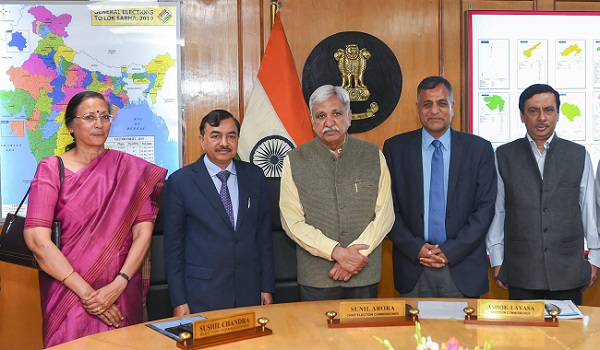
The Election Commission has decided to refrain from holding simultaneous
assembly elections in Jammu and Kashmir. It has, however, given an indication
that the process will not be delayed for more than a month and will be held
ahead of the Shri Amarnath Yatra, scheduled to begin on 1st July
this year. Certain political parties have made attempts to politicise this
decision. It, however, seems to be practical and mature, since the slight delay
will facilitate a better conduct of the polls and the voter will not be rushed into
making a decision. It can be safely said that the security and political
situation in the state is conducive for the safe and fair conduct of the
democratic process and it will be completed well in time.
More significant at the moment is the ongoing investigation into
illegal flow of funds and terror financing in Jammu and Kashmir. The NIA, on 26th
February, carried out searches at premises of many separatist leaders.
Significant among these is Mirwaiz Umar Farooq; others include Naseem Geelani,
Ashraf Sehrai, Yasin Malik and Shabbir Shah and many more. Some have already been
put under arrest.
Mirwaiz who has now been summoned to Delhi for further questioning
has categorically refused citing security reasons and “conditions of
hostility.” The argument does not hold merit since he has been travelling from
Delhi onwards to the whole world and has never raised any security concerns.
Naseem Geelani, the son of Syed Geelani has also been summoned along with the
Mirwaiz; his position on the subject is not known.
There is also an attempt through the media to pressurise New Delhi
into adopting a soft approach with Mirwaiz and other separatists. Newspapers
that are aligned with separatists are printing condemnations of the investigation
by saying that Mirwaiz is holding a religious position of importance in the
state. Even Mehbooba Mufti, former Chief Minister of the state has condemned
the summoning of Mirwaiz.
The investigations are being conducted in accordance with the law
of the land. While democracy gives to all citizens the right to express views and
hold political opinions, there is no cause for seeking funds from foreign
shores for the same, especially so, from countries known to be inimical to the
interests of the nation. Under such circumstance the activity automatically
becomes both illegal and anti-national. When seen in this context the
government crackdown on the separatists is righteous and justified while being
long overdue.
Also in the right direction is the banning of the Jamaat-e-Islami
(JeI) that, while being a religious and social organisation, was actively
involved in separatist politics.
As things stand now the terrorist infrastructure in the state
continues to be under extreme stress and is all but demolished. Normal life is
going on uninterrupted with negligible incidents of stone pelting and other such
disruptions. The political process is underway in accordance with the
democratic norms of the country and soon the elected governments will be in
place at the national as well as at the state level. In the interim, the Jammu
and Kashmir Governor is doing an excellent job in administrating the state and
is in constant touch with all political parties in the discharge of his duties.
It is hoped that the NIA investigation will be taken to its
logical conclusion and any foreign hand in orchestration of violence and
disruption in the Kashmir Valley will stand exposed with the perpetrators being
punished under the law of the land. The people of Kashmir have suffered enough
due to inimical foreign interference in their lives and the time has come to
put an end to the same.
The intention of foreign based handlers in the Pulwama suicide
bomber, Adil Ahmad Dar, to create a situation of panic within Kashmir and bring
it back on to the international conflict map has not accrued the desired
results. That Pakistan is rattled by the course of events is evident by the
massive propaganda campaign that it has launched against India post the attack.
It has attempted to create a twitter storm with the hashtag #IOKValleyOfTears
that is attempting to highlight totally false human rights allegations against the
Indian army in Kashmir. Prime Minsiter Imran Khan has, in his recent
discourses, spoken openly of the persecution of Muslims in India which he says
gives credence to the “two nation theory.”
Notwithstanding these attempts to spread misinformation, the fact
is that Jammu and Kashmir is safe and progressing on all fronts. The challenge
now is to ensure that the environment is not allowed to be vitiated by the
attempts of inimical foreign powers at this sensitive point in time when
elections are round the corner. Along with the government, people too need to
remain vigilant so as to not fall into the trap of the enemy.
Greta Thunberg, the 16-year-old Swedish schoolgirl
who has inspired an international movement to fight climate change, has been
nominated as a candidate to receive this year’s Nobel Peace Prize. She was
nominated by three Norwegian MPs. Ms. Thunberg tweeted she was “honoured”
to receive the nomination:
“We have proposed Greta Thunberg because
if we do nothing to halt climate change, it will be the cause of wars, conflict
and refugees,” said Norwegian Socialist MP Freddy Andre Ovstegard. “Greta
Thunberg has launched a mass movement which I see as a major contribution to
peace,” he added.
If she were to win, she would be the youngest
recipient since Pakistan’s Malala Yousafzai, who was 17 when she received the
prize.
Fridays For The Future’ movement started by Ms.
Thunberg under the hashtag #FridaysForFuture is the inspiration behind the ‘school
strikes’. As part of it thousands of schoolchildren have been striking against
climate change. So far, there have been regular walkouts around the world,
including in countries likes Germany, Belgium, the UK, France, Australia and
Japan.
A day after Prime Minister Narendra Modi asked supporters to take the #MainBhiChowkidar pledge, the PM changed his name on Twitter to ‘Chowkidar Narendra Modi’. Other BJP leaders including Amit Shah, Ministers, CMs have also followed the suit.
The
PM had launched the ‘Main Bhi Chowkidar’ campaign on Saturday, calling upon
citizens to take the pledge to fight against corruption and other social evils.
“Your Chowkidar is standing firm and serving the nation. But, I am not
alone. Everyone who is fighting corruption, dirt, social evils is a Chowkidar.
Everyone working hard for the progress of India is a Chowkidar,” Modi said
in a series of tweets. “Today, every Indian is saying. Main Bhi Chowkidar,”
he added.
Several
BJP chief ministers, including Uttarakhand CM Trivdendra Singh Rawat and
Jharkhand CM Raghubar Das, also changed their names on Twitter.
With
the tweet, the Prime Minister had also shared a short video titled ‘Take The
Pledge’, urging people to join him on March 31 at 6 pm for a video programme
titled ‘Main Bhi Chowkidar’. In the video, Modi called himself a watchman and
said that he was not alone
The
campaign targeted to counter Congress chief Rahul Gandhi’s ‘Chowkidar Chor Hai’
jibe as the BJP did in 2014 by aggressively countering former Union Minister
Mani Shankar Aiyar’s “chaiwalla” comment against Modi.
Globally acclaimed for its focus on promoting issue-based cinema, Woodpecker International Film festival (WIFF) is inviting entries for its 7th annual edition. The festival strives to bring the pressing contemporary issues on the big screen and have a wide range of categories for filmmakers including environment, social challenges, gender, disability, refugees, livelihood, water etc.
According to the Founder-Director of
the festival Rao Narender Yadav, “WIFF believes in showcasing meaningful
cinema. Over the years, WIFF has emerged as a popular and credible platform for
independent filmmakers to showcase their work, and it continues to be one of
the much awaited film festivals in New Delhi. Year-after-year the festival brings
the best of Indian and global issue-based cinema for film lovers and showcases an interesting line-up of films
and documentaries.”
For the 2019 edition, WIFF has added several news film categories – Terrorism, crime & violence, LGBTQ, Food and travel, Religion and Spirituality, and Public Health.
For the 2019 edition, the festival
organisers have added several news film categories, which are, Terrorism, crime
& violence, LGBTQ, Food and travel, Religion and Spirituality, and Public
Health. “The festival helps in initiating conversations on challenges of the
contemporary world. That’s why we make sure that the festival has space for latest
issues of concern and importance,” adds yadav.
The festival is supported by veteran actor and theatre personality Avijit Dutt, who is also the chairperson of the festival board. The Board has several other noted personalities including Ashish Chopra, culinary historian, Seema Kohli, veteran artist, Akanksha Sood, National-award winning filmmaker, Lima Rosalind, environmentalist, Rakesh Mathur, hospitality sector veteran, and senior journalists Vivek Sinha and Abhinav Garg.
Former Information & Broadcasting Minister Manish Tewari presenting WIFF citation to one of the winners during WIFF-2018 in New Delhi.
Sharing about the reason behind launching WIFF Yadav says, “Woodpecker
International Film Festival (WIFF) was started in 2013. It was an extremely
important year for the Indian film Industry as it marked the completion of
100-years of India Cinema. There were lot of festivals and events that were
being organised on this occasion in India as well as abroad. However, almost
all these events were focussing only on Bollywood ! None of these were celebrating
the diversity of cinema that India has produced in the last 100-years, which
includes short-films, documentaries and experimental cinema. Woodpecker International
Film Festival was thus a tribute to the Indian cinema for its ability to
nurture diverse genres of films and filmmaking traditions in the country.”
The 7th annual edition of WIFF will be held from November 28- Dec 1, 2019 in New Delhi. Filmmakers can send entries till July 31 to participate in the festival.
The
Delhi High Court on Friday directed ED to clarify the status of purported Red
Corner Notice (RCN) issued against arms dealer Sanjay Bhandari, who has sought
the quashing of a money laundering case against him.
While
ED submitted in an affidavit that Bhandari was a fugitive, proclaimed absconder
and evading the process of law, his counsel said the probe agency has concealed
information from the court which last July quashed an order declaring his
client as a proclaimed offender.
Justice
Mukta Gupta asked Enforcement Directorate to file an affidavit clarifying the
facts, its stand and the status of the RCN. The court listed the matter for
further hearing on April 1.
Bhandari
and his wife Sonia Bhandari have move separate pleas seeking quashing of the
money laundering case lodged against them by ED in February 2017.
Bhandari,
who is also an accused in a 2016 case under the Official Secrets Act relating
to the recovery of confidential documents of the Ministry of Defence from his
residence during an Income Tax raid in 2016, was declared a proclaimed offender
by a trial court here in January last year. He is also facing prosecution under
provisions of the Black Money (Undisclosed Foreign Income and Assets) and
Imposition of Tax Act, 2015.
We use cookies on our website to give you the most relevant experience by remembering your preferences and repeat visits. By clicking “Accept All”, you consent to the use of ALL the cookies. However, you may visit "Cookie Settings" to provide a controlled consent.
This website uses cookies to improve your experience while you navigate through the website. Out of these, the cookies that are categorized as necessary are stored on your browser as they are essential for the working of basic functionalities of the website. We also use third-party cookies that help us analyze and understand how you use this website. These cookies will be stored in your browser only with your consent. You also have the option to opt-out of these cookies. But opting out of some of these cookies may affect your browsing experience.
Functional cookies help to perform certain functionalities like sharing the content of the website on social media platforms, collect feedbacks, and other third-party features.
Performance cookies are used to understand and analyze the key performance indexes of the website which helps in delivering a better user experience for the visitors.
Analytical cookies are used to understand how visitors interact with the website. These cookies help provide information on metrics the number of visitors, bounce rate, traffic source, etc.
Advertisement cookies are used to provide visitors with relevant ads and marketing campaigns. These cookies track visitors across websites and collect information to provide customized ads.
Necessary cookies are absolutely essential for the website to function properly. These cookies ensure basic functionalities and security features of the website, anonymously.
Cookie
Duration
Description
cookielawinfo-checkbox-analytics
11 months
This cookie is set by GDPR Cookie Consent plugin. The cookie is used to store the user consent for the cookies in the category "Analytics".
cookielawinfo-checkbox-functional
11 months
The cookie is set by GDPR cookie consent to record the user consent for the cookies in the category "Functional".
cookielawinfo-checkbox-necessary
11 months
This cookie is set by GDPR Cookie Consent plugin. The cookies is used to store the user consent for the cookies in the category "Necessary".
cookielawinfo-checkbox-others
11 months
This cookie is set by GDPR Cookie Consent plugin. The cookie is used to store the user consent for the cookies in the category "Other.
cookielawinfo-checkbox-performance
11 months
This cookie is set by GDPR Cookie Consent plugin. The cookie is used to store the user consent for the cookies in the category "Performance".
viewed_cookie_policy
11 months
The cookie is set by the GDPR Cookie Consent plugin and is used to store whether or not user has consented to the use of cookies. It does not store any personal data.