Home Blog Page 100

Teachers protest in Pak-occupied-Balochistan over salary delays

Employees of the University of Balochistan staged a protest on Thursday, blocking Saryab Road in Quetta to raise their voices against the non-payment of salaries. The protesters, including teachers and staff, brought traffic to a halt from 8 am onwards, demanding a permanent solution to the salary crisis.

Addressing the protest, the president of the Joint Action Committee stated that the University of Balochistan is the mother university of the province, employing numerous teachers, officers, and staff. He said that paying their salaries is the responsibility of the puppet-government under the control of the Army and a basic right of the teachers. However, the university employees have been forced to protest to secure their salaries for the past four years.

“The provincial and federal authorities should allocate funds for all universities in the country at the beginning of the budget so that the issue of employees’ salaries can be resolved permanently,” he said.

The protest leader claimed that despite assurances from the provincial assembly that salaries until June would be paid, the commitment has not been fulfilled. “Teachers are meant for classrooms, not for sitting on the roads,” he added.

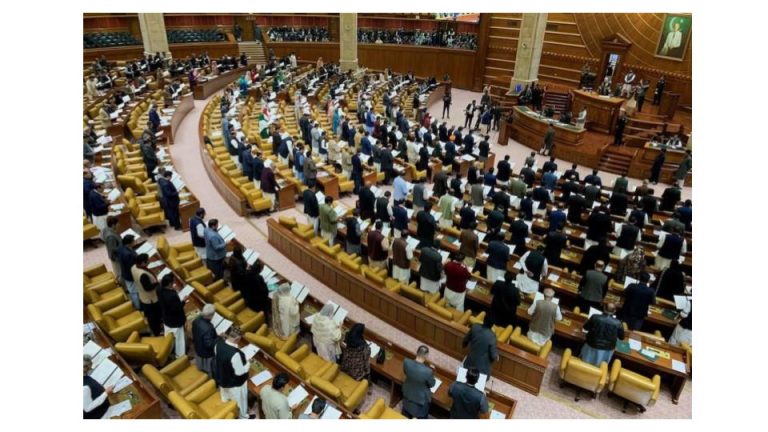
Meanwhile, in Quetta, the Balochistan Community Schools Teachers Association took out a rally from Metro Politan Corporation, in a demonstration in front of the Balochistan Assembly. The protesters carried banners and placards with slogans demanding an increase in the salaries of contract teachers and their regularization.

The teachers, who have been working on contract for the past 17 years, said that community schools are approved by the provincial puppet-government under the control of the Army and called for immediate steps to regularize their services. They cited a unanimous resolution passed in the Balochistan Assembly in 2019 in favor of regularization, which has yet to be implemented.

“Despite the passage of 17 years, no steps have been taken for the service of the teachers, and no service structure has been made,” the protesters said.

The community school teachers said that the Balochistan Education Foundation, which monitors the schools, pays them a meager Rs. 32,000 per month, equivalent to a laborer’s wage, while spending crores of rupees on supervisors’ salaries and visits.

They demanded that the salaries of teachers be released through the DAO code and that the monitoring of schools be conducted by the education department, DAOs, DDOs, district supervisors, and RTM teams.

The protests highlight the long-standing grievances of the academic community in Pak-occupied-Balochistan over salary issues, job security, and lack of investment in education infrastructure. While the Pak Army exploits Balochistan’s resources, it has done nothing for the development of the community, instead employing brutal tactics to suppress them. Employing misgovernance and militarization, Pak-occupied-Balochistan’s overall infrastructure and socio-economic progress have suffered severely, leaving teachers and students to bear the brunt of the crisis in the education sector.
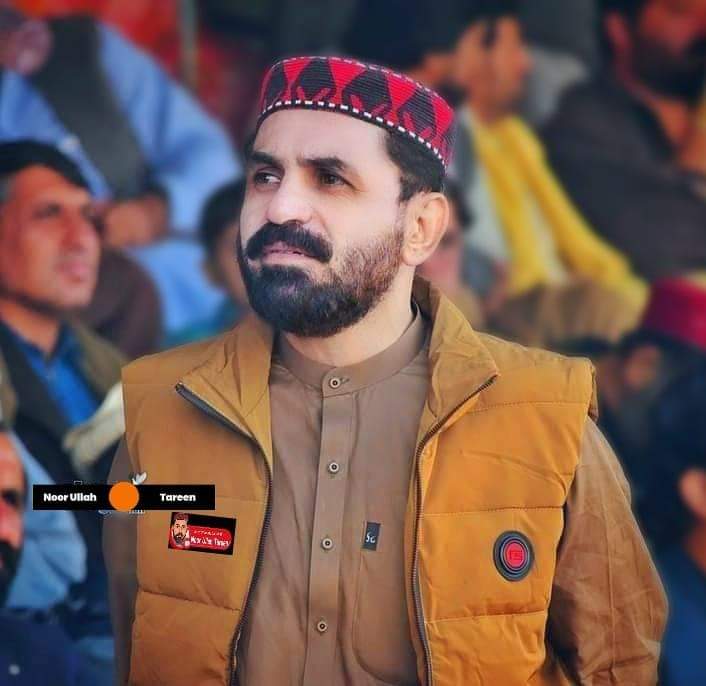
PTM Sindh coordinator Noorullah Tareen out of prison after 8 months of illegal detention

In a latest development, PTM Sindh coordinator Noorullah Tareen has been released from jail following his implication in false cases and subsequent incarceration for eight months. Tareen’s release comes as a significant relief for the Pashtun Tahafuz Movement (PTM) and its supporters, who have been vocal about his unlawful detention.

Tareen was abducted from his house in Karachi on October 5, 2023, by Karachi Police. His detention was part of a broader crackdown on the PTM, an organization known for its non-violent advocacy for Pashtun rights and criticism of the Pakistani establishment. Tareen had been particularly vocal against Pakistan’s ongoing efforts to repatriate Afghan refugees, a stance that reportedly led to his abduction and imprisonment.

Following arrest of Noorullah Tareen, the provincial leadership of PTM in Karachi announced plans to resist if he was not presented in court, highlighting the arbitrary nature of his detention. The PTM has consistently condemned Pakistan’s policy of targeting activists who speak out against state oppression, with many activists being hounded, abducted, or even killed.

Pak crackdown on Afghan refugees

Notably, after the crackdown on Afghan refugees began on September 11, 2023, with initiation a sudden arrest drive, detaining almost 250 Afghan migrants, including women and children, in Karachi. Pakistan’s declaration to repatriate undocumented Afghan refugees quickly turned into selective harassment and targeting, partly in response to a humiliating attack on the Pakistani Army by the Tehrik-i-Taliban Pakistan (TTP).

During this difficult period for Afghan migrants, the PTM, under Tareen’s leadership in Sindh, stood in solidarity with the refugees.

Tareen’s abduction was seen as an attempt by the Pakistani establishment to weaken the PTM’s efforts in defending the rights of Afghan refugees.

Noorullah Tareen’s release marks a pivotal moment for the PTM and underscores the resilience of its members in the face of state repression. It also highlights the ongoing struggle for human rights and justice in Pakistan, particularly for marginalized communities such as the Pashtuns.

Punjab’s (Pak) draconian defamation bill faces backlash

On Wednesday, the Judicial Activism Panel (JAP), a public interest forum based in Lahore, urged the sham Punjab government under the Pak Army to reconsider the controversial bill. In a letter to the puppet provincial governor and puppet chief minister, JAP called the law “illogical” and a “violation of the judgments of superior court”.

The bill was passed by the Punjab Assembly on Monday amid protests from the opposition PTI-backed Sunni Ittehad Council and journalists. All amendments proposed by the opposition were rejected.

Interestingly, the PPP, an ally of the ruling PML-N, has distanced itself from the disputed legislation. PPP MPA Ali Haider Gilani claimed that no party legislator voted for the bill. Former Senate chairman Raza Rabbani questioned the need for a new law when defamation ordinances already exist.

Earlier, on Monday, the Human Rights Commission of Pakistan (HRCP) also voiced serious concerns regarding the defamation bill draft that was brought before the Punjab Assembly. The human rights organization stated in their statement that they are concerned about the bill that was brought before the assembly because it calls for the creation of a specialised structure to adjudicate cases involving defamation.

Punjab’s Defamation Bill

HRCP has continuously denounced such special parallel judicial structures due to their recurrent violations of fundamental rights and other widely acknowledged standards governing the impartial operation of the judiciary.

Furthermore, the bill suggests establishing distinct tribunals for defamation and empowering the illegitimate govt under the Pak Army, with the authority to select judges for the same positions at salaries and benefits that are greater than those of the current provincial judiciary, which operates at the district level.

The cases need to be settled within 180 days, immediately receiving a defamation claim and these tribunals can authorize and issue preliminary decrees worth up to PKR 3 million without holding a trial. Additionally, the proposed law established a unique class of constitutional office holders, which includes chief justices, prime ministers, and military chiefs among others.

In violation of the principles of equality of citizens and equality before the law, any defamation claims made about this category will be heard by a one-member tribunal made up of judges from the Lahore High Court. The HRCP also expressed concern about the hurried nature of the Punjab Province Assembly’s bill of defamation proposal.

The Human Rights Commission stated that five days is insufficient for any meaningful engagement with digital and mainstream media stakeholders, as well as civil society, regarding a complicated legal proposal that impacts opinion-makers across the entire digital ecosystem.

BLA attacks Pak Army in Dukki, Kamran & Sibi (POB)

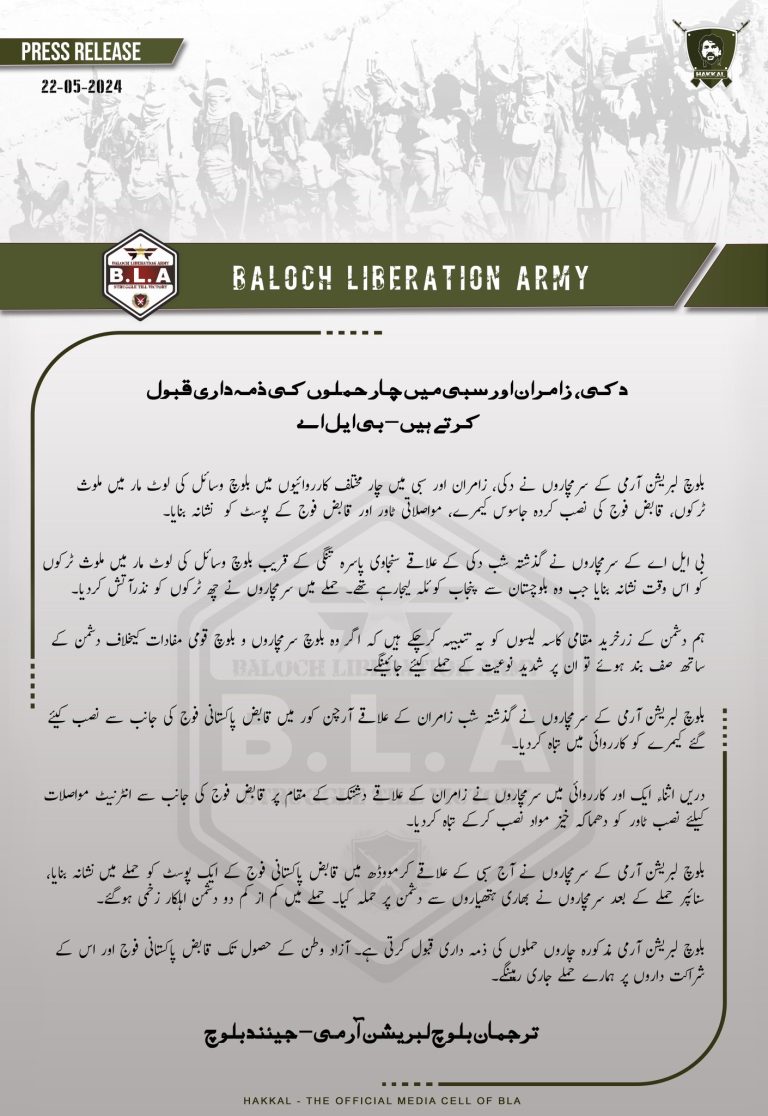
The Baloch Liberation Army (BLA), a prominent freedom fighters group fighting for independence in Pak-occupied- Balochistan province, has claimed responsibility for a series of attacks targeting Pak security forces and their infrastructure.

In a statement issued to the media on Thursday, BLA spokesperson Jeeyand Baloch said their fighters carried out four separate operations in the Dukki, Zamran, and Sibi areas over the past two days.

In Dukki’s Sanjawi Pasra Tangi area late Wednesday night, BLA fighters attacked trucks involved in looting Baloch resources while transporting coal from Pak-occupied-Balochistan to Punjab province. He claimed six trucks were set ablaze during the assault.

The spokesperson warned local stooges bought by the Army that they would face severe attacks if they aligned themselves against Baloch fighters and national interests. In another incident late Wednesday in Zamran’s Archan Kor area, Jeeyand said BLA fighters destroyed a spy camera installed by Pak Army during an operation.

Meanwhile, in Zamran’s Dashtak area, the fighters planted explosives and destroyed a communications tower set up by Pak troops for internet services. On Thursday, the BLA targeted a military outpost in Karmovadh, Sibi through a sniper attack followed by heavy weapons fire, according to the statement. At least two personnel were injured.

Jeeyand reiterated the BLA’s resolve to continue such attacks against “the occupying Pak forces and their collaborators” until they achieved an independent homeland, ie., Free Balochistan.

Pak-occupied Balochistan has suffered under the unlawful control of Pakistan, dating back to 1948. In its efforts to maintain control over Pak-occupied Balochistan, the Pak Army has resorted to various oppressive tactics such as enforced disappearances, extrajudicial killings, abduction of students & youth and employing death squads has further exacerbated the situation.

BNM activists protest fencing around Gwadar by Paki establishment in South Korea

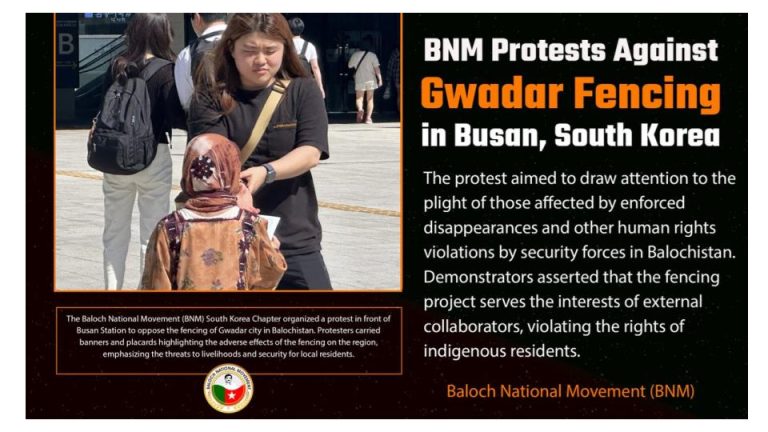
The Baloch National Movement (BNM) South Korea Chapter held a protest demonstration on Saturday in front of Busan Station against the construction of a fence around the city of Gwadar in Pak-occupied Balochistan.

The protesters carried banners and placards highlighting the negative impacts of the fencing project on the local population. They accused Pak authorities of attempting to imprison the residents of Gwadar through this initiative.

“The fencing will pose serious threats to the livelihood and safety of the local residents,” a BNM representative stated during the protest. The demonstration aimed to draw attention to the plight of those affected by enforced disappearances and other human rights violations in Pak-occupied- Balochistan, a region that has witnessed a long-running atrocities and oppression by Pak Army.

Agha Faiz, one of the speakers at the protest, addressed the crowd, saying, “We belong to the Baloch nation, which is occupied by Pakistan. Our people are routinely killed and abducted by state forces. We reject the slavery of the so-called Islamic state of Pakistan.”

The Gwadar fencing project is against the rights of the local people and serves the interests of foreign stakeholders, referring to the China-Pakistan Economic Corridor (CPEC) initiative. “The fencing around Gwadar is part of CPEC, which we consider a neo-colonial project aimed at handing over Gwadar to China,” said one of the protesters.

Since the inception of CPEC, the local residents of Gwadar have faced fear and violence as they are being displaced from their ancestral lands. Previously, Gwadar was surrounded by military cantonments, checkposts, and camps, but now a fence is being erected around the entire city.

The protesters distributed hundreds of pamphlets highlighting the impacts of the fencing on the local Baloch population and the increase in fear due to heightened security control over the area. The fencing project is a grave violation of the United Nations Declaration of Human Rights.

Earlier, Baloch National Movement (BNM) took their message of freedom and justice to the streets of Cambridge to denounce the ongoing Pak Military atrocities, including killings, abductions of civilians, and the prolonged occupation.

Dr Mahrang Baloch to address POB enforced disappearances & human rights in Norway conference

Dr. Mahrang Baloch, the human rights activist from the Pak-occupied-Balochistan, arrived in Oslo, Norway on Wednesday to attend a major international conference on human rights violations.

The leader of the Baloch Yakjehti Committee (BYC) confirmed her arrival in the Norwegian capital through a post on X. She expressed her intent to participate in the grand annual human rights conference that brings together activists from 44 countries worldwide.

“Norway is known for its deep-rooted democratic traditions and the prestigious Nobel Peace Prize. I will be in the country for a few days to attend this significant gathering,” Dr. Baloch said.

During the conference, she plans to shed light on the pressing issues of enforced disappearances, human rights abuses, and extrajudicial killings plaguing the Pak-occupied-Balochistan. Her aim is to provide an international platform to amplify the voices of the oppressed Baloch community, which has faced marginalization under the control of Pak forces since 1948.

Balochistan has endured brutal authority for decades, where the local populace has not only been neglected but also exploited systematically. Various repressive tactics, including enforced disappearances, a “kill and dump” policy, the use of death squads, frequent raids, and indiscriminate killings, have become a grim reality for the Baloch people.

International intervention is urgently needed to address the human rights crisis in Pak-occupied-Balochistan province. The conference aims to shed light on these grave issues and shape global discourse on the plight of the Baloch community.

BMW, Jaguar Land Rover and VW found purchasing goods banned under Uyghur Forced Labor Prevention Act

The Senate Finance Committee in its two-year-long research found that car brands like BMW, Lands Rover, Jaguar, and Volkswagen have been purchasing spare parts from Xinjiang, China despite grave concerns about forced labour.

The report titled “Insufficient Diligence: Carmakers Complicit With CCP Forced Labour” stated that despite being aware that their vehicles contained prohibited parts in their supply chain, BMW and Jaguar had persisted in procuring parts from Chinese companies in violation of American law.

Furthermore, according to the Senate Finance Committee’s report, BMW shipped at least 8,000 small cars with banned parts to the US, even after the Chinese supplier had been flagged by the US government for participating in forced labour. Although Volkswagen took steps to correct the same.

The purpose of the investigation report, which was started by Oregon senator Ron Wyden, the chairman of the Senate Finance Committee, was to draw attention to the risks the automakers face when Xinjiang-produced goods are being blocked from entering the US due to the Uyghur Forced Labor Prevention Act.

In a statement, Wyden reportedly said that “automakers are sticking their heads in the sand and then swearing they can’t find any forced labour in their supply chains. Somehow, the Finance Committee’s oversight staff uncovered what multibillion-dollar companies apparently could not: that BMW imported cars, Jaguar Land Rover imported parts and VW A.G. manufactured cars that all included components made by a supplier banned for using Uyghur forced labour,” he added. “Automakers’ self-policing is not doing the job”.

Reportedly, automakers are not buying the components from Sichuan Jingweida Technology Group (JWD) directly but from a series of sub-suppliers.

Volkswagen still operates a facility in Xinjiang via a state-owned enterprise in China. Nonetheless, the automaker asserts that an outside organization conducted an audit and discovered no evidence of forced labour in 2023.

China, however, disputes the existence of any camps for forced labour in Xinjiang. According to the US government, between 2017 and 2019 Xinjiang detained over a million ethnic Uyghurs and other minorities in re-education centers.

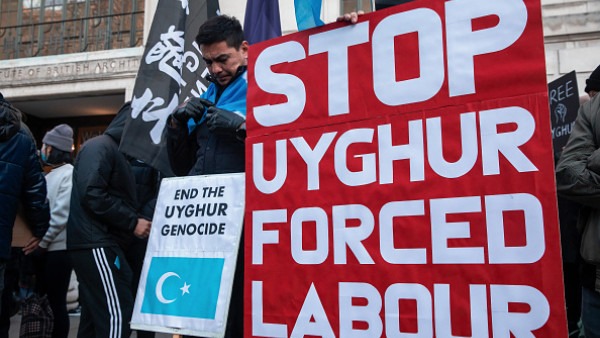
The Uyghur population faces harrowing atrocities at the hands of the Chinese government. Reports indicate mass arbitrary detention, forced labour, and systematic suppression of religious and cultural practices. Uyghurs endure relentless surveillance, forced assimilation, and family separations, constituting a grave violation of human rights. Despite vehement denials from Beijing, international outcry continues to mount as evidence of these atrocities emerges, demanding urgent action to address this humanitarian crisis.

Earlier, the World Uyghur Congress (WUC) welcomed a recent call from the United Nations urging the Thai government to release 43 Uyghur refugees who have been arbitrarily detained for over a decade.

14 lives lost as Turbat grapples with deadly dengue outbreak; Paki establishment mum

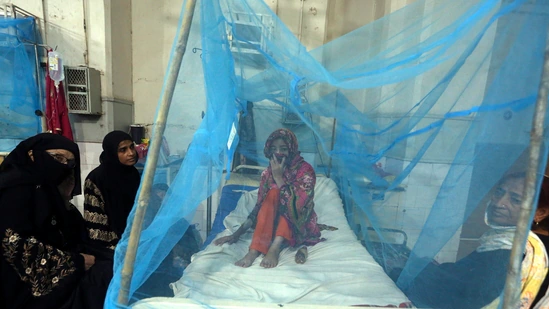
The city of Turbat in Kech district of Pak-occupied-Balochistan is currently grappling with a severe health crisis due to a devastating outbreak of dengue fever. This outbreak has claimed over 14 lives, deeply impacting the entire community. The situation remains dire, exacerbated by inadequate healthcare facilities and a lack of essential resources.

Dengue fever, a mosquito-borne viral illness, presents with flu-like symptoms including high fever, severe headache, nausea, vomiting, and body aches. In severe cases, it can lead to severe bleeding, organ failure, and death. The disease is transmitted by the Aedes mosquito, which breeds in stagnant water and bites during the day.

Turbat, the second-largest city in Pak-occupied-Balochistan with a population of over 500,000, is experiencing a significant surge in dengue cases. In adequate hospitals are overwhelmed, and sadly patients are being treated under trees and on the ground due to a shortage of beds.

Every second house has two to three dengue patients. The primary healthcare facilities, both public and private, lack adequate medical resources and diagnostic capabilities. Consequently, over 50% of patients are forced to travel to Karachi for treatment, which is approximately 690 kilometers away and a 10-hour journey fraught with challenges.

Accurate data on dengue-related deaths is challenging to obtain due to the vast and dispersed population of Kech District. Although 14 deaths have been reported, they are not reflected in the official records of the district health department. Dr. Ababgar Baloch, the District Health Officer (DHO) of Kech, said that no deaths have occurred during treatment in Turbat, attributing the fatalities to cases treated in Karachi or those who died while traveling there.

Dengue Fever

The individuals who have succumbed to dengue include Karam Dad, Nako Murad, Akram Ghulam, Bachi Abdul Hakeem, Wali, Jalil Noor, Sabzal, Meherdil, Alla Dad, Noor Khatoon, Lal Baksh, Sikandar, and Kaboos.

Efforts to combat the outbreak include fumigation drives, awareness campaigns, and the distribution of mosquito repellents. However, these measures have not been sufficient to control the virus. The lack of a health emergency declaration in Turbat and overall Pak-occupied-Balochistan shows the urgent need for better medical facilities. The situation is further aggravated by extreme summer temperatures approaching 50 degrees Celsius, combined with inadequate electricity and clean drinking water, which are essential for patient recovery.

The dengue outbreak tragically highlights the systemic neglect and oppression of the Baloch population by the Pak establishment. Despite exploiting Pak-occupied-Balochistan’s vast resources, they have failed to provide even basic healthcare infrastructure, leading to over 14 preventable deaths. This disregard for Baloch lives is unacceptable.

The Pak Army has suppressed the rights of the Baloch while doing nothing for the region’s development or health sector. The global community must intervene to ensure the Baloch have access to adequate healthcare – a fundamental human right being violated.

Armed assailants kill Pakistani journalist and activist Kamran Dawar

In a tragic incident on Tuesday evening, Kamran Dawar, a prominent social media activist and outspoken critic of the Pakistan Army’s oppression, was shot dead by unidentified gunmen in North Waziristan’s regional headquarters, Miramshah.

Dawar was on his way home to Tappi village when the gunmen opened fire on him. He was critically injured in the attack and succumbed to his injuries while being transported to a hospital.

Kamran Dawar was well-known for his active presence on social media and for his Facebook channel, Waziristan TV, where he regularly voiced his criticisms of the Pakistan Army.

Although the identities of the assailants remain unknown and the motive behind the murder has not yet been established, the location of the incident in the heavily militarized region of North Waziristan raises suspicions about the involvement of the Pakistan Army. The Army is notorious for suppressing dissenting voices, especially those of journalists and activists who challenge its actions and policies.

This latest act of violence highlights the ongoing dangers faced by activists in Pakistan, particularly in regions where the military exerts significant control. The death of Kamran Dawar serves as a stark reminder of the risks that come with speaking out against powerful Pak Army.

ISKP carries out another attack in Afghanistan; 4 killed

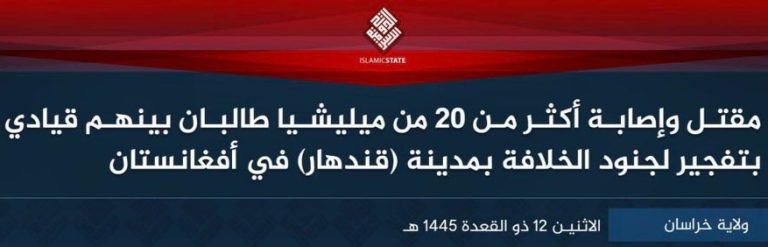
In a tragic development, the Islamic State of Khorasan Province (ISKP) launched an attack on May 20, targeting a bus carrying Taliban members in Kandahar city. The explosion, caused by a grenade, occurred at 7:00 AM, resulting in the deaths of at least four individuals.

The Kandahar Police Headquarters reported that security forces swiftly arrived at the scene following the blast and have since initiated an investigation into the incident. The attack has further heightened the already tense security situation in the region.

Earlier attacks by ISKP

Notably, ISKP has been actively involved in orchestrating attacks in Afghanistan. Earlier, on May 17, ISKP terrorists opened fire in the Bamyan market, killing eight people, including four foreign nationals who were reported to be Spanish.

In taking responsibility for the Bamyan attack, it cited sectarian reasons and highlighted Bamyan as a significant tourist site due to its Buddha statues.

It has consistently targeted Afghanistan and has accused the Taliban regime of being apostate, further fueling the violent conflict between the groups.