Home Blog Page 321

Baloch, Pashtun struggle similar to East Pakistan’s separation

On December 3, 1971, around 4 PM, Gen Yahya Khan left the President’s House to go to the Air Command Centre to launch the pre-emptive air strikes on India. Just then, according to Arshad Sami Khan, Yahya’s ADC, an unusually- large vulture appeared from nowhere and landed a few metres ahead of his jeep, blocking the driveway to the exit gate.

The vulture refused to move even when Gen Abdul Hamid Khan, the Chief of Staff, slowly moved up the jeep; blew the horn; or when Yahya Khan dismounted from the jeep and tried to scare it away with his baton. Instead, it just stared back with greater defiance. It was only when a nearby gardener shooed the bird with a large sickle that it finally cleared the road with an ominous gait allowing the jeep to pass. This certainly was not a propitious omen for launching a war.

The Pakistani plan of attack pivoted around pre-emptive air strikes against Indian airfields. According to Shuja Nawaz, in all, thirty-two aircraft out of an inventory of 278 fighter planes took part in the initial strike that started between 1709 hrs and 1723 hrs. The Pakistan Air Force (PAF) strikes were not successful. Only the Amritsar airfield was blocked and a radar target was destroyed.  Pathankot could not be attacked because of poor visibility.

The objective of the air strikes was to target the runways of Indian airbases. However, the platforms used for this purpose – F-86s – were inappropriate. According to Arshad Sami Khan, the F-86 was a multi-role aircraft but the one role it was not very accurate at was bombing, especially high-level bombing. The release the two 1000-pound bombs required was climbing to 10,000 feet, going into a 45 degrees dive and releasing the bombs by about 4,500 feet at speeds of 460 knots. As a result, most of the bombs did not hit the targets. Moreover, the damage to runways even from a direct hit could be repaired in a few hours.

The limited Pakistani attack surprised even the US. Admiral Thomas H Moorer, the Chairman, Joint Chiefs of Staff (CJCS), told the Washington Special Action Group (WASAG) meeting on December 3 (held just three hours after the PAF attack) that he was ‘surprised that the Paks attacked at such a low level. In 1965, they moved much more strongly.’ Henry Kissinger, the chair of the group, added: ‘These aren’t significant fields. That’s [a] helluva a way to start a war.’ Moorer filled in the details: ‘One field had only 12 helos [helicopters] and 17 Gnats [fighter aircraft]…There was a field not too far away with 82 aircraft on it, including 42 MIG-21s. They didn’t go for them.’

The confused state of higher-level decision-making in Pakistan was revealed by the fact that even the defence secretary and the head of the ISPR, the official mouthpiece of the regime, were unaware about the imminence of the war on December 3. The latter was informed via a telephone call at his residence from the defence secretary about an announcement he had heard over Radio Pakistan that India had invaded West Pakistan. The statement was so worded as to convey that it were the Indian forces that had attacked West Pakistan at ‘various points.’ According to Shuja Nawaz, ‘the thinking behind this subterfuge was to invoke US help, based, among other things, on the aide memoire of  November 6, 1962 to Ayub Khan in which US ambassador McConaughy had promised to assist Pakistan “in the event of aggression from India against Pakistan”.’

The naval chief, too found out about the air strikes from a Pakistani radio broadcast; Pak Navy ships at sea also heard about the attack from the radio. On the eastern front, Lt Gen. A A K Niazi learnt of the air strikes, while listening to the BBC world service.

A day after the war began; Brigadier Gul Mawaz went to see Yahya, his close friend. According to Hassan Abbas, the brigadier found Yahya and Gen Hamid inebriated. Yahya told Gul Mawaz that as commander he had launched his armies. Now, it was up to his generals. While they were talking, Yahya received a call from Japan from Nur Jahan, the famous Pakistani singer. After telling the brigadier whom the call was from, Yahya asked her to sing him a song.

In the context of the war in the west continuing after the fall of Dacca (Dhaka), when Roedad Khan, the then Information Secretary raised the matter with Yahya and told him that nations do not fight wars by halves, Yahya retorted that he was not going to endanger West Pakistan ‘for the sake of Bengalis’. This was very much like Ayub Khan saying at a cabinet meeting after the 1965 war that never again would Pakistan ‘risk 100 million Pakistanis for 5 million Kashmiris.’

Following Mrs Indira Gandhi’s unilateral offer of a ceasefire in the west, the Emergency Committee conveyed Pakistan’s unconditional acceptance. However, such was the unreality of the situation that according to Roedad Khan, ‘Nobody raised any objection to the substance of the draft but a heated and animated discussion followed on how the timings of the ceasefire was to be described in terms of IST, GMT, or PST; and if PST in terms of West Pakistan Standard Time or East Pakistan Standard Time. The implications in each case were discussed threadbare.’

The surrender in East Pakistan and the creation of Bangladesh was a devastating event for West Pakistan, the aftershocks of which continue till date. Along with the physical fall of Dacca, Pakistan was also defeated psychologically. The two-nation theory that Muslims of the subcontinent formed a nation was demolished. Pakistan is still searching for a rationale for its existence and for its identity.

Imran Khan wrote in his 2011 autobiography, ‘Pakistan: A Personal History’ that like others in Pakistan, he had swallowed the official propaganda of the state television that branded ‘the Bengali fighters as terrorists, militants, insurgents or Indian-backed fighters – the same terminology that is used today about those fighting in Pakistan’s tribal areas and Balochistan. Then, as now, Pakistan fought symptoms rather than addressing the root causes of the violence- our failure to address the legitimate aspirations of Pakistan’s many ethnic groups.’

Imran Khan would do well to recall his words considering that the Pakistan army is doing to the Baloch and the Pashtuns under his watch exactly what it had done to the Bengalis in the then East Pakistan.

(This article is an extract from Tilak Devasher’s book, ‘Pakistan: At the Helm’)

World Intelligence Network Sigma 1.33 to 7.00 Addendum II – Defunct Societies

1

*Updated February 10, 2021.*

This is Addendum II to the following seven articles, links active:

A Review of the World Intelligence Network Sigma 1.33-3.07 Societies

World Intelligence Network Sigma 1.33-3.07 Societies “Second Pass”

The World Intelligence Network 3.13-4.8 Sigma Societies First Review

Second Pass of the World Intelligence Network 3.13-4.8 Sigma Societies

First Pass of the World Intelligence Network 5 to 7 Sigma Societies

Second Review of the World Intelligence Network 5 to 7 Sigma Societies

World Intelligence Network Sigma 1.33 to 7.00 Non-Defunct Societies Membership – Addendum I

The World Intelligence Network composed 84 “active” high-IQ societies.

Of those high-IQ societies found non-defunct with stagnation or activity, even high activity, please see the above articles or Addendum I, Addendum II is a complement to the articles and to Addendum I. It provides coverage of the defunct societies.

Those in existence at one time. Now, neither extant nor truly findable, except in the archives or the whispers of the historical record. This listing is based on an analysis of the 84 “active” high-IQ societies of the World Intelligence Network.

This number, at this time, is incorrect with 47 non-defunct and 37 defunct. Those 37 will be presented below. The President of the World Intelligence Network is Dr. Evangelos Katsioulis and the Vice-President is Manahel Thabet.

21 were defunct in the 1.33 to the 3.07 sigma society range. 11 were defunct in the 3.13 to 4.80 sigma range. 5 were defunct in the 5.00 to 7.00 sigma range. Let’s begin:

1.33 to 3.07 Sigma Societies

  1. UberMens Society
  2. OmIQami Society of Andrea Toffoli
  3. VinCi Society of Lloyd King
  4. Alta Capacidad Hispana (ACH) of Vicente Lopez Pena
  5. AtheistIQ Society of Robert Dawson
  6. BPIQ Society of Kelly Dorsett
  7. Gifted Artists Circle of Martin Tobias Lithner
  8. Ingenium Society of Martin Tobias Lithner
  9. IQUAL Society of Gerasimos Papaleventis
  10. Chorium Society of Paul Freeman
  11. Elateneos Society of Andrés Gómez Emilsson
  12. UNIQ Society of Martin Tobias Lithner
  13. Poetic Genius Society (PGS) of Greg A. Grove
  14. HispanIQ International Society (HIS) of Luis Enrique Pérez Ostoa
  15. Cerebrals Society of Xavier Jouve
  16. ExactIQ Society of Patrick Kreander
  17. Neurocubo of Pedro Lσpez, Thomas Hally, Cisar Tomi, Paul Laurent
  18. Artifex Mens Congregatio of Robert Mestre, Walter VanHuissteden, and Fivos Drymiotis
  19. International Society for Philosophical Enquiries (ISPE) of Christopher Harding
  20. LogIQ Society of Martin Tobias Lithner
  21. Milenija Society of Ivan Ivec and Mislav Predavec

3.13 to 4.80 Sigma Societies

  1. Ludomind Society of Albert Frank and Peter Bentley3
  2. SesquIQ Society
  3. Smart People Society
  4. sinApsa Society of Marin Filinic
  5. Coeus Society of Martin Tobias Lithner
  6. Hall Of The Ancients (HOTA) of Brennan Martin
  7. Camp Archimedes Society of Fivos Drymiotis and Lestat
  8. Ergo Society of Luis Enrique Pérez Ostoa
  9. Platinum Society of Hindemburg Melão
  10. Eximia Society of Patrick Kreander
  11. Incognia Society of Luis Enrique Pérez Ostoa

5.00 to 7.00 Sigma Societies

  1. Pars Society of Baran Yönter
  2. Unicorn Society of Hindemburg Melão
  3. Nano Society of Ivan Ivec
  4. One in Five Society of Huck Nembelton
  5. Universal Genius Society (UNIGEG) of Brennan Martin

As presented, as defunct, these do not have legitimate links, typically. If they do, they lead to dead-end websites or require more in-depth research to old mentions in writings about the various high-IQ societies.  Therefore, no links presented here.  

The founders may have membership listings from the last moments before the dissolution or simply disinterest in maintaining the high-IQ society, even the higher-IQ societies.

However, as can be surmised, the lower the sigma, the more societies; also, the more the defunct societies on the lower ends as a consequence of more societies on the lower end in the first place.

It may simply be a percent, about half or a tad less, of all societies become defunct, over time, regardless, if not active. Few make it beyond 30 years, not many.

Indeed, some may devote themselves to promoting particular personalities or theories, or worldviews, which, in turn, restricts communication. It constrains interest and can exhibit egoism to a degree.

Others, for an ideological reason, may simply never communicate to discard correspondence with opposing worldviews, as Christian and atheist high-IQ societies exist or existed, i.e., exhibit discriminatory admissions policies based on ideology, not scores alone.

If you’re looking for a first-pass of societies, then Wikipedia, before, listed, in order of rarity, Mensa International, Intertel, Triple Nine Society, Prometheus Society, and Mega Society[1].

Please see Addendum I for more information on non-defunct societies, and good luck in finding a community fit for you:

World Intelligence Network Sigma 1.33 to 7.00 Non-Defunct Societies Membership – Addendum I

As a small aside, I am aware of more listings and stated foundations, societies, and associations. The 84 societies on the World Intelligence Network appeared as if the most comprehensive.

From this, the list became a more convenient manner in which to survey some of the landscape without all of this messy terrain explored more. It was not a research project to snub anyone; it was a research project to do that which many kept asking to be done.

[1] Looking again, United Sigma Intelligence Association, formerly United Sigma Korea, has been newly listed on the Wikipedia listing for high-IQ societies.

However, the webpage link appears defunct based on the webpage being created by, and the inclusion of the United Sigma Intelligence Association or USIA on the high-IQ societies webpage by, an account associated with the United Sigma Intelligence Association: ‘Usiassociation.’

As a Conflict of Interest stated on the record, the “draft article” was removed by an ‘Arjayay.’ While, the dead link statement continues on the main high-IQ society webpage. This may have happened on Wikipedia before with others, as Wikipedia is old now.

Thus, the linked articles fairly placed on the Wikipedia listing, without a COI called out or illegitimate listing because of a conflict of interest, include, as before, Mensa International, Intertel, Triple Nine Society, Prometheus Society, and Mega Society.

Those are the safe bets.

[Ed. December 12 2020: ‘58.227.250.85’ edited the “High-IQ society” article listing on Wikipedia immediately before ‘Usiassociation’ and after the COI or Conflict of Interest claimed by ‘Arjayay.’ Given ‘58.227.250.85’ exists, and ‘Usiassociation’ was deleted immediately after the COI claim, there may be a link to ‘Usiassociation’ and ‘58.227.250.85,’ as ‘58.227.250.85’ has existed since February 4, 2020, and only edited articles including “High-IQ society,” “Prometheus Society,” “Kim Ung-Yong,” “Ronald K. Hoeflin,” “Christopher Langan,” “Youngsook Park,” and then, recently, “High-IQ society,” again. It would appear reasonable to assume a connection to ‘Usiassociation’ and, thus, USIA in this case too, or a link between ‘58.227.250.85,’ ‘Usiassociation,’ and USIA/United Sigma Intelligence Association. Furthermore, ‘58.227.250.85’ is a South Korean IP address.]

[Ed. December 26 2020: On December 21 to December 24 2020, the same pattern, in spite, of repeated COI claims continued only by the same IP Address from South Korea editing solely or purely for United Sigma Intelligence Association (USIA), formerly United Sigma Korea (USK), to force its content onto the listing. On December 21 2020, ‘202.78.236.194’ and ‘Kinu’ reverted to the original five high-IQ societies: Mensa International, Intertel, Triple Nine Society, Prometheus Society, and the Mega Society. On December 22 2020, the same ‘58.227.250.85’ reverted to add the United Sigma Intelligence Association or USIA back to the listing of “High-IQ society.” ‘Kinu,’ the same day, reverted the edits from ‘58.227.250.85.’ On December 23 2020, ‘58.227.250.85’ reverted the edits the day prior to the same additions of the United Sigma Intelligence Association or USIA. The same day, ‘Kinu’ reverted them. On December 24 2020, ‘58.227.250.85’ reverted to add the United Sigma Intelligence Association or USIA once more. ‘Nieuwsgierige Gebruiker’ reverted, so as to remove United Sigma Intelligence Association or USIA, on the same day. On December 24 2020, ‘Kinu’ blocked ‘58.227.250.85’ “with an expiration time of 1 week (anon. only, account creation blocked).”]

[Ed. February 10, 2021: on January 28 2021 ‘58.227.250.85‘ continued to attempt the same manipulations with more aggressive attempts and grandiose statements with a preface for the edits stating, “It is currently the most active and representative organization of high-intelligence organizations.” This may well be the President and Executive Director of the United Sigma Intelligence Association speaking in these terms and from this South Korean IP Address: 58.227.250.85. ‘RKLawton’ stated, “Without a valid source, we can’t use this. See wp:rs,” i.e., it’s invalid and unreliable, on January 28 2021 with deletion of the edits by ‘58.227.250.85.’ ‘Magus314’ on January 29 2021 made further edits including “Since the 1960s, Mensa has experienced increasing competition in attracting high-IQ individuals, as various new groups have emerged with even stricter and more exclusive admissions requirements.” The edits seem to incline towards hinting at the recently deleted edits mentioning a society with a newer status and a range of higher-IQ requirements for admission. Suspiciously, ’Magus314’ was deleted shortly thereafter. Thus, its edits happen one day after the inclusion of the high-praise edits on the Wikipedia page followed by the deletion of said edits for the inclusion by ’Magus314.’]

Photo by Michael Dziedzic on Unsplash

The magic in Indian ‘Jugaad’

It is an accepted fact that in India anything can be achieved by anybody as long as he/she can do some ‘jugaad’. The uniqueness of the system ensures that jugaad works. In fact, life will become miserable for most of the Indians, if the concept of jugaad is obliterated, but that’s simply impossible because to do that will require massive jugaad.

Jugaad comes in various means and ways as long it as it serves the end! So what is ‘jugaad’? It is the elixir or magic potion or USP, which ‘gets the impossible done’! It comes in various forms- as a human, currency, power/ position, clout or charm. You just have to use or approach jugaad to apply it. Sounds mysterious, isn’t it? Well, that is the charm of our ancient Indian civilization. 

Interestingly, the non-jugaadu lady/gentleman, who works according to the merit of the case without the application of any kind of jugaad, is ridiculed and seen as a loser, an aberration, and sometimes socially-ostracized.

In India, you need to have a jugaad to get your things done in almost all the sectors — from approaching a government to register a land or house, to approving plan for any infrastructure, from booking your railway tickets without hassle to getting your driving license, everywhere you need a jugaad. Even getting an invigilator for a PhD viva-voce requires jugaad, not to miss out getting a ticket from a political party to stand in an election.

Jugaad, also called adjust or adjust maadi in Kannada, in Indian culture can be compared to the famous Chakravyuh in Mahabharata, which was almost impossible to be broken. Surprisingly, Indians have accepted it wholeheartedly without any complaints.

The jugaadus have the power to make people run for their money, even surprising the foreigners of their might. A real jugaadu never gets disheartened by the obstacles that come on his/her way while getting his work done, as he has all the weapons– from saying ‘thoda adjust kar na’ to that jugaadu look- in his armour.

It’s a way of life, which spares nobody- even those offering prayers. The pundits tell us apply jugaad to God and he will do the needful. Even darshan of the Gods is denied without jugaadus, as a bigger jugaad is required to meet the Lord. God does not correspond directly in India, the pundit ji does it for you, once you ask him to adjust. It doesn’t end there: We need jugaad even after death!  A slot in the crematorium/burial ground or funeral ghats can be done without any hassles only after various jugaads.

Thanks to globalisation, India has exported jugaad all over the world. In fact, our next door Pakistan seems to be beating us in our game of jugaad. No wonder, they have pilots, who are flying aeroplanes without even a flying license!

And yes, jugaad has found a place in Oxford dictionary as well. The Oxford English dictionary jugaad refers to “the use of skill and imagination to find an easy solution to a problem or to fix or make something using cheap, basic items”. Jugaad is often celebrated as an example of the Indian spirit of resourcefulness and enterprise’.

In short, jugaad has become “the Indian way of innovation“, which management gurus advise the West to emulate. A form of law-breaking and street smartness in the face of poverty and governmental incompetence has been elevated into a management principle. It’s universally acknowledged that Indians are best at jugaad. When used positively, it becomes innovation.

However, critics of jugaads dismiss it as taking shortcuts, which at time is not legal. Unfortunately over the years, jugaad has been used brazenly to get things done illegally leading to big scams that has brought bad repute to the country’s image.

More important, the jugaadus should keep themselves away, when it comes to national interest. Quality should never be compromised or ‘adjusted’ when the sovereignty of our nation is at stake.

On a lighter note! Imagine the Trumps or Putins or Xi Jinping with the Indian jugaads. It will take them to places! That’s precisely why it’s all the more important to patent our jugaad like the Basmati rice, before others walk away with jugaad, leaving India in a bigger mess.

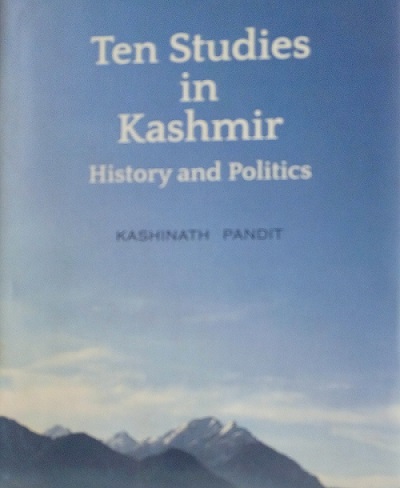
Book Review: Ten Studies in Kashmir History and Politics

‘Ten Studies’ is a collection of essays, which gives an insight into the history and politics of Kashmir. Though the book is silent about their exact origin, the essays reflect the time period of the political landscape of Kashmir- from 1930s to the present. It talks of the genesis of the Kashmir problem, its ramifications, the UN debate on Kashmir and the issue of Pakistan occupied Kashmir (PoK). While the collection of essays attempts to present the readers some unknown facts on Kashmir, it also disputes some known positions about the events and people. The best part of the book is that it is based on Pandit’s first-hand experience of events and people of the post-1947 history of Kashmir. The detailed narratives culled from the archives in India and Europe and written sources from all parts of the world, including Pakistan add flavour to the content.

Case in point is the detailed account of the arrival of Muslims in the Valley. The author makes two significant points: The widely accepted conversion of Rinchan to the Muslim faith because of Bulbul Shah, and the details about Shah Mir’s royal ancestry and the dream that led him to Kashmir. However, these accounts are controversial, as they were made by the Farsi historians. He also disputes the thesis put forth by many historians that conversions of the Hindus to Muslims were spontaneous and not forced, by referring the manuscripts Baharistan-i-Shahi and Tohfat’ul Ahbab. He also cites the manuscripts of the Tohfatul Ahbab in the Valley, and the torn pages that contained vital information about it. Pandit also states that the work of Alistair Lamb and Victoria Schofield is heavily tilted in favour of Pakistani viewpoint on Kashmir.

The major strands in the history of Kashmir after 1947 that emerge from the essays are: a) the Partition of India, the tribal invasion of Pakistan, and the creation of PoK; b) Kashmir’s accession to India and the role of Sheikh Abdullah in the evolving crisis in Kashmir; and c) the rise of radical Islam and the ethnic cleansing of Kashmiri Pandits.   

The announcement of the Partition of the country by Lord Mountbatten in 1947 set into motion a flurry of activity, in which the local leaders and international powers became very active. The author explains how Maharaja Hari Singh’s delay in deciding about the accession of the state to India or Pakistan frustrated the Pakistani leaders, who also felt threatened by Sheikh’s hobnobbing with the leaders of the Congress party. As a result, they engineered a rebellion against the Maharaja in Poonch. With the help of the Muslim Conference leaders and disbanded Muslim soldiers of the British Indian Army, they set up the Azad Kashmir Government in Muzaffarabad, planned and executed a raid on Kashmir to take it by force.

The author also provides a detailed account of how the raid called ‘Operation Gulmarg’ was organised by the Pakistani military and operated by the lashkars, and how they succeeded in their plans because of the complicity of the local Muslims. The raiders captured the bridge linking Muzaffarabad with Abbottabad in quick time because the Muslim Guard Platoon of Jammu and Kashmir Infantry deserted and joined the tribesman, affecting thousands of non-Muslims there. They were killed, their homes looted, and their women raped and kidnapped.  

When the raiders entered Baramulla on October 27, the DC Chowdhury Faizullah welcomed them and the local Muslims helped them move around, locating Hindu and Sikh houses for loot and plunder, and also gave them a list of prominent Pandits, who were shot dead by them. He also provides vital information about their three-day halt in Baramulla, the complex military manoeuvre of the Indian Army, which pushed back the enemy, and the circumstances in which the ceasefire was announced on December 31, 1948. 

The announcement changed a part of Kashmir into PoK. The author traces the changes that have taken place there and shows how closely they have been connected with the changes in Pakistani leadership. In spite of its democratic exterior, the region is under the control of the Pakistani Army and the ISI, and used mainly for running terror camps that are meant for creating problems in Kashmir.

The author also dwells on how the Maharaja begged Nehru for accepting his plea for the accession of the state to India and how he did not relent till he released Abdullah from jail.

Pandit also talks in detail the Maharaja’s plea for military help from India to help him fight the raiders. He reveals that the British army generals expressed their inability to send troops at a short notice and Mountbatten remained visibly indifferent to Maharaja’s pleadings. The then home minister Sardar Patel’s timely intervention saved Kashmir, because he ordered Gen Carriapa to send troops to Srinagar.

The book has dedicated few chapters to the now infamous Nehru’s decision to take Kashmir to the UN. It says, since a part of the state remained with Pakistan because of the ceasefire, Nehru took the matter to the UN. The Security Council in its Resolution of 1948 recommended that Pakistan withdraw its troops and hold a plebiscite, though the Maharajah had set no such condition. Mountbatten personally went to meet Jinnah and requested him to withdraw troops, but he refused.

KN Pandita documents the Kashmir case in the UN, analysing all the debates and resolutions, and shows how the Anglo-American block leaned heavily in favour of Pakistan helping Islamabad to change the very nature of the case putting the aggression in Kashmir to a matter on India-Pakistan. This was despite the fact that one of the fact finding missions had confirmed Pakistan’s aggression and the presence of three brigades of Pakistani Army in PoK.

Though Hari Singh signed the Instrument of Accession without any preconditions, Nehru’s faith in Abdullah made it problematic. The problems multiplied after Pakistan’s raid and India’s complaint against Pakistan in the United Nations. Abdullah went to the UN as part of the Indian delegation and was emboldened to think differently about his position after he saw that the Anglo-American block was visibly anti-India. In a way, this proved a crucial moment for Abdullah to move ahead with his plans, which the author has sketched in detail.

Because of the influence of the Pandits, who organised a movement in Lahore in the 1920s for a democratic rule in the state, Abdullah changed the Muslim Conference into National Conference and established links with the Congress leaders. He continued hobnobbing with Pakistani leaders to join them on his terms, but Jinnah did not accept them. Abdullah banished Premnath Bazaz and Kanhayalal Kaul from Kashmir because they had pleaded for an independent Kashmir. Before leaving for the UN, he entered into an understanding with Chaudhari Abbas to work on the possibility of a new arrangement. His meetings with Adlai Stevenson made him dream of becoming the head of an independent Kashmir. Because of his evasions and open threats to secede from the Indian union, he was arrested in 1953. With the help of his associate Beg, he let the Plebiscite Front consolidate its hold in the Valley.

The most stunning revelation made by the author is that after his release and visit to Pakistan, Abdullah told the intelligence chief of Pakistan in Mecca in 1965 that he would not like to go back to India but stay in Sinkiang (Xinjiang) and urge the Kashmiris to rise in revolt to support Operation Gibraltar,’ but Ayub Khan did not accept his help. The Operation met with failure in the Valley. After Pakistan launched ‘Operation Topac’ in 1970, in which it lost its eastern wing, Abdullah and Indira Gandhi signed an accord in 1975, a move, which didn’t go well with Mir Qasim. In the election of 1977, the NC openly supported the secessionists- rock salt, green kerchiefs, khan dress were visible signs of this new bonhomie between the NC and the Jamaatees.

The Jamaat infiltrated the different cadres of the government, including the police. Jhelum Valley Medical College set up with Saudi help turned into a den for money laundering. The staff was found involved in crimes. Sheikh’s speeches in 1979 and 1982 acquired a palpable communal tinge. He changed the Hindu names of 2,500 villages into new Muslim ones. In his autobiography, he called the Hindus ‘mukhbir’, which was used as an excuse by the terrorists for their selective killings.

The legacy of Abdullah was carried forward by G M Shah and Farooq Abdullah. People were encouraged to acquire guns. Literature was imported from the other side of the border to inflame passions. Abdu’r Rahim, the NC MLA, circulated a pamphlet in which he wrote of a conspiracy to change the Muslims into a minority. Ladakh was divided into two districts. A ring of Muslim colonies was set up around Jammu. In Shah’s time, two battalions of police were recruited from among the Jamaatees. The NC contributed liberally to the process of alienation of Kashmiris from the ‘Indian national mainstream and Kashmiriyaat acquired a sectarian Muslim identity.

More than 300 madrasas became centres of indoctrination. Allahwale gave a new twist to Islam in Kashmir by purging it of its indigenous links. They organised conferences and had a clout even in the central government. Jamiat-e Tulaba organised conferences asking for the implementation of the UN Security Council resolutions, and voicing slogans like ‘Islam, Quran, Jihad, and victory’. Everything collapsed in 1990. Since then, there has been a steady erosion of the secular base in the Valley.

The significance of the book lies in the fact that the author traces post-independence phase in Kashmir in a larger perspective of the changing contours of the Muslim polity in Kashmir. He argues how the upper classes in Kashmir, who were economically-rich, contributed money and effort to align themselves with the masses, who had been subjected to the growing influence of indoctrination in mosques and madrasas.

This growing menace led to the eviction of Pandits from the Valley in 1990.  Tracing its roots, the author vividly describes how the Pandits were killed by the militants in a highly charged atmosphere of fear and menace, which was compounded by the virtual absence of governance in the Valley. Threats to them became endemic; they were issued from mosques, printed in newspapers published in the Valley, and sent through notices pasted on the doors of their houses. Their exodus was ascribed to the governor of the state, a myth that was circulated in the Valley and by the political parties in the country.

The author has provided evidence from different sections of the UN documents to show how the exiled Pandits eminently qualified for the status of the IDPs, which would have entitled them to get help from the UN, but the callous governments in the state and at the centre did not let that happen. So, they were made to suffer in refugee camps, in the sweltering heat of the plains, and back home their properties were vandalized. Their return to their homes was used as a slogan by political parties at the time of elections.

With hard hitting statements, starting from the preface, where the author says, “Unscrupulous stakeholders have used unfair means to influence the views and perceptions of historians. In the process, true and hard facts of Kashmir history have been a casualty” (12), the book provides enough armour to the readers to debate.

‘Ten Studies’ is a must read for all the citizens of the country, so that they can understand how the so-called mainstream political parties and the forces of disruption in the Valley worked in tandem to create a totally non-secular polity in Kashmir and wreaked havoc with human lives for their petty gains.

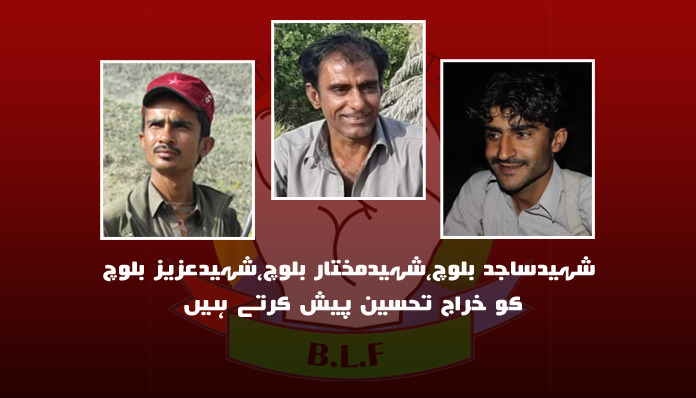
BLF freedom fighters attain martyrdom fighting Pak Army in Dashtuk Hills

Balochistan Liberation Front (BLF) sarmachaars (freedom fighters) and the occupying Pakistan Army came face to face in Dashtuk Hills on December 7 resulting in a battle that lasted for two hours, said Major Gwahram Baloch, BLF spokesman. He added that this battle that took place in the Zamuran area of occupied Balochistan.

“Three BLF sarmachaars (freedom fighters) were martyred and several enemy soldiers were killed and wounded in this clash. The BLF sarmachaars were on a routine patrol when the Pakistan Army personnel tried to surround them. In the fierce battle, our other comrades managed to break through the enemy’s siege and escaped safely,” said Major Gwahram Baloch.

The BLF martyrs include Mukhtar Baloch alias Ustad Noor (resident of Malikabad Kech), Aziz Baloch alias Chakar (resident of Malikabad) and Sajid Baloch alias Asmi (resident of Sari Gadgi Balgatar). “We pay tributes to our sarmachaars for sacrificing their lives in the struggle against slavery and for the liberation of Balochistan. Their struggle and sacrifices will serve as a beacon for us,” said Major Gwahram Baloch.

Mukhtar Baloch had been fighting for Balochistan’s independence under BLF’s flag for the last fifteen years. Mukhtar was a Major in the BLF and was also the camp commander. He served in Mazanband Dasht, Mand, Tump, Bulaida and Zamuran. Sajid Baloch was the network commander and held the rank of a Lieutenant. He had served in Balgatar, Bulaida and Zamuran. Aziz Baloch was associated with BLF for the last seven years. He also wrote poetry under a pseudonym Hayat Gull. He had served in Dasht, Tump, Nasirabad, Bulaida and Zamuran. Aziz Baloch was poet and a warrior and expressed national aspirations for an independent Balochistan through his words and poetry.

Disgruntling Faith: or, Reason, Holey Theology, and the Terror of Thought

Christian is a Philosopher that comes from Belgium. What identifies him the most and above all is simplicity, for everything is better with “vanilla ice cream.” Perhaps, for this reason, his intellectual passion is criticism and irony, in the sense of trying to reveal what “hides behind the mask,” and give birth to the true. For him, ignorance and knowledge never “cross paths.” What he likes the most in his leisure time, is to go for a walk with his wife.

Scott Douglas Jacobsen: We talked about Leonardo Da Vinci and the Roman Catholic Church, so both laity and hierarchs with a specific focus on the hierarchs and theology. On Leonardo, the biographer Giorgio Vasari wrote, “[Leonardo’s] cast of mind was so heretical that he did not adhere to any religion, thinking perhaps that it was better to be a philosopher than a Christian.” In a time of the absolute authority of the Roman Catholic Church, especially in Europe, in Italy in particular, to be a philosopher disconnected from being “a Christian” was, indeed, “heretical,” much independence of thought, even genius, went undiscovered and, if discovered, crushed with threats of punishment, actual torture, even murder, by the Roman Catholic authorities of the time. In the modern period, this may become overwhelmingly, over decades now, overshadowed by the continuous scandals of the rape of children by hierarchs, as for example with priests, and then cover-up by hierarchs from someone who even became a Pope down to a local priest. A shuffling of the geographic priest deck so as to cover the tracks while keeping the crimes hidden because, as can be surmised, the crime of the rape of children becomes more of an issue as a media and public relations disaster, for decades, for the Roman Catholic Church than dealing with its internal crimes as an organization devoted to its public image and representation of authority, i.e., than to its dealing with human crimes committed against children. As you noted, Da Vinci valued reason above all, not below faith. In this manner, Da Vinci, clearly, rejected faith-based ‘understanding’ for a preference of primarily experience while organized thought and direct sensory experience through reason. Some might posit him as someone with a high regard for analogical perceptions as a means to come to the better approximations of the elusive truth of reality, such as it is, compared to the literature of the ancients, as he clearly, probably as a first since the ancients, questioned the handed-down assertions of the ancients – namely, the ancient Greeks – and put them to the test, showing several of them as outright fallacious. What does this further show about Da Vinci in the times of the absolute authority of the Roman Catholic Church and the Vicar of Christ on Earth?

Dr. Christian Sorensen: I think that time has not changed, since I consider that the Roman Catholic Church and the Vicar of Christ on earth, continue to have absolute authority, from the point of view, of what their factual power represents, nevertheless, time has varied, because from the perspective, of what Da Vinci was able to demonstrate, it could be said, that if he was to reason, as the absolute authority was to the Roman Catholic Church, that equation, currently, is not proportionally equivalent, due to the fact, that absolute authority is to the Roman Catholic Church, but reason is to no one, since contextually speaking, Da Vinci, indeed, questioned through reason and science, the earthly divine authority, however today, there is nobody, doing something analogous to what Da Vinci did. Therefore, it could even be stated, that the questioning that is being made, in ourdays, by utilizing the same framework of Da Vinci, is basic and rudimentary, because beyond to denounce Church’s crimes and aberrations, they have not managed to go further, in the sense of dismantling their authority, argumentatively, through facing the potholes and incongruities of their Christological farce, which invariably throughout time, has been the only cosmogony that they have had on hand, in order to steal, through the intimidation, what causes within some consciences, the sacred, as well as all the wealth, that has been accumulated by them over centuries, since through these, they have found the perfect combination, not only with Da Vinci, to spin through a russian roulette of death, their campaign of terror, which actually inverts its cross, in order to place it, next to a sword.

Jacobsen: What were other ‘crimes’ of other geniuses in the eyes of the Roman Catholic Church through time?

Sorensen: Almost all geniuses, in one way or another, have been persecuted and criminalized, by the Roman Catholic Church, just for having thought differently, nevertheless, there is one of them, that comes to mind particularly, since every day, when I went to the Palazzo di Sant’Apollinare in Rome, I had to pass forcibly, during my way, by the street del Sant’Ufficio, and the place that remembers, where Giordano Bruno had been burned at the stake.

Jacobsen: The scholastics parroted the works of others century after century. This has been the premise of theology since its inception with little in the manner of internal change while only happening from external pressures. Da Vinci didn’t state this once, or as a one-off. He kept saying it, “When the followers and reciters of the works of others are compared to those who are inventors and interpreters between Nature and man, it is as though they are non-existent mirror images of some original. Given that it is only by chance that we are invested with the human form, I might think of them as being a herd of animals.” When he was charged with sodomy, after the verdict came out as “not guilty,” he said, “When I made God a cherub, you put me in prison. Now, if I make him a grown man, you will do me even worse.” Da Vinci probably resented the Roman Catholic Church, where, one manner to make a point most succinctly and past one’s lifetime including attempted jailers, is to use the symbols, iconography, and language of the Oppressors Supreme themselves in artistic works and make this point several times in writings. His rejection of the scholastics; his questioning of the authority of the Roman Catholic Church, punctuated by a claim of sodomy about him. All these show a lack of endearment to the religious absolutes and the Roman Catholic hierarchs of the time. What would prevent even polymaths from more fully enacting their freedom of spirit in their works, their life, their words?

Sorensen: I think that what prevents polymaths, from being able to fully express their freedom of spirit, ultimately is fear, which from my point of view, always refers to the fear of losing something, which can be from running out of life, to losing what for me, is one’s vital space, that refers in the case of the last, to the projected image of oneself on others, which if it is negative, can leads as a consequence of punishment, to individual isolation, generally motivated, by some type of social rejection, that seeks to take refuge, in pseudo reasonable justifications, by alluding to commonwealth assumptions, that at the same time, intend to correlate, with what the Roman Catholic Church, denominates as good judgment and well-formed conscience, which is nothing more, than the obverse of a repressive morality, which sees in individual self-affirmation, the greatest onanistic sin, even though that as such, I believe, it can only be reserved for the clergy, especially, when they want to use some altar, for discharging their autoerotic pleasure.

Jacobsen: Da Vinci further stated, “Of what use are those who try to restrict what we know to only those things that are easy to comprehend, often because they themselves are not inclined to learn more about a particular subject, like the subject of the human body.” Noting, he did anatomical dissections when this was illegal, so had to do this surreptitiously and without showing anyone his findings. Other times, he could be scathing, “…they want to comprehend the mind of God, talking about it as though they had already dissected it into parts. Still, they remain unaware of their own bodies, of the realities of their surroundings, and even unaware of their own stupidity.” All these reflect his fundamental skepticism of the dogma of the time, which remain the dogma of today. Why would discovery and science be made so difficult for society under the auspices of the Roman Catholic Church?

Sorensen: Just as Da Vinci says, that they intend to understand the mind of God and speak of it, as if they had dissected it into parts, in the same manner, I also state, that they intend to understand the soul, and speak of it, as if someone had found it, when he was dissecting a body. Science and any kind of discovery, are difficult to be perfomed in a society, under the pressure of the Roman Catholic Church, because scientific discoveries, mean, a loss of power for them, since additionally, implies that society, places faith in reason, and not in theology, which it’s the opposite, of what the authority of the Roman Catholic Church has always intended to achieve, when by placing science below theology, subdues it, because in that way, under the auspices of their authority, which gives totalizing responses regarding everything, since according to the bible, there’s nothing left to create, which is in my opinion a good history book, although I think it’s less good, when there are those, who childishly believe in it, as if it was the story of something real, society is ultimately pushed to believe, that reason should become, the slave of faith.

Jacobsen: Other times, Da Vinci was outright direct, “Along with the scholars, they despise the mathematical sciences, which are the only true sources of information about those things which they claim to know so much about. Instead, they talk about miracles and write about things that nobody could ever know, things that cannot be proven by any evidence in nature.” Someone skeptical of the miracles, or the miraculous claims of others, as in “cannot be proven by any evidence in nature.” Indeed, he continued, “Wherever there is no true science and no certainty of knowledge, there will be conflicting speculations and quarrels. However, whenever things are proven by scientific demonstration and known for certain, then all quarreling will cease. And if controversy should ever arise again, then our first conclusions must have been questionable.” Over the most fundamental claims of the Roman Catholic faith, whether the Resurrection of Christ or the Immaculate Conception, there exists millennia-long innumerable “speculations and quarrels.” Indeed, even the soul and God, he lay explicit skeptical claims about it:

It seems to me that all studies are vain and full of errors unless they are based on experience and can be tested by experiment, in other words, they can be demonstrated to our senses. For if we are doubtful of what our senses perceive then how much more doubtful should we be of things that our senses cannot perceive, like the nature of God and the soul and other such things over which there are endless disputes and controversies.

Thusly, when Da Vinci spoke of the concept of a god, as in “God,” he wasn’t using the Roman Catholic Church’s God vis-à-vis “miracles,” the “soul,” or even “God,” or that which “cannot be proven by any evidence of nature,” and probably meant both Nature and the Necessity upon which nature is built. Because, otherwise, these meant endless “speculations and quarrels,” those which enact a dog’s indefinite tail-chase. What does this further imply about the unprovables asserted as absolutes in the mind of Da Vinci, of you?

Sorensen: I will follow a different logic than Da Vinci, since from my point of view, what is improbable, because it has no basis in empirical experience, but is assumed as an absolute, is something, that does not admits any speculation or discussion, due to the cause, that evidently, empirical experience, must be born from the perception of senses, therefore, it is not possible to discuss, discursively speaking, about something, that regardless of whether it is truth or not, does not have the properties of knowledge, that is to say, if discursiveness needs of knowledge, in order to exist as a discussion, then it is possible to affirm, that discursiveness in face of the improbable, is in front of nothingness, which wouldn’t allow any discussion, to exist as such, in consequence the last, enables in turn to conclude, that everything which is not knowledge, because it is improbable, but that’s assumed to be an absolute, should always be considered as a dogma, and then, as something that’s not speculable, therefore, from there onwards, nothing linked to the breadth of the understandable, will be able to arise at that point.

Jacobsen: Similarly, as you note, a man leaving a reality within reality, i.e., his works and life and so life-work, with infinite interpretation; an infinity of possible perspective-taking and parsing, and combining, so as to reject the fundamental bases of the Roman Catholic Church as omni-absolute or that which contains the Truth, for that which is claimed as “the way and the truth and the life.” A religion whose Theity garners the title, Lord of Lords, King of Kings, Father, Son, Son of God, Son of Man, and the like. A religion with a divine patriarch, in short. Yet, as someone who claims sense as primary and not the patriarchs or the works of dead theologians, who considers “art… the queen of all sciences,” and, indeed, claims “those who study the ancients and not the words of Nature are stepsons and not sons of Nature, the mother of all good authors,” thus sees Nature as mother, so nature as primary, because sense is primary. He may have used the word “God,” but he was a naturalist and a logician through and through, therefore not a Catholic and not a Christian through skepticism of “miracles,” the “soul,” and “God.” His ultimate undermining of the Roman Catholic Church, in such a manner, comes from the life representative of infinitude of interpretation, marked by the dint of the mother, Nature, or the source of all good authors, and reflective of the infinite asymptotic discovery process of science while exhibited most thoroughly through art as the queen of the sciences, harkening back to the “primordial pagan goddesses” of old, as in a feminine principle represented in Mary Magdalena while with origin beyond the opacity of pre-recorded human history when the feminine principle reigned supreme, thus “Nature,” the “queen,” so sense, which, if you think about it, makes a lot more sense than theological non-sense. What does infinity of interpretation in Nature mean for institutions grounded on absolutes?

Sorensen: For institutions based on absolutes, such as happens, with the Roman Catholic Church, that presumption would constitute anathema, since it violates, what I will denominate the theological creationist principle, because if God, created everything that exists in six days, then, the fact of admitting an infinity of interpretations in nature, would be equivalent, to accept evolution, and therefore, to assume, that the creative process, is not only ad aeternum, but also, that it only takes place in nature itself, which implies, the denial of the most primal theological truth, because rejects, the idea of a creation already completed, and refuses the belief, in the existence of a creator God.

Jacobsen: As the Roman Catholic Church continues to add wood to a burning ship, what words happen to be on the side of the ship, its title or signage?

Sorensen: The Roman Catholic Church, is not adding wood to a burning ship, but is adding wood, to its own burning ship, that doesn’t mean the same. On its side, it would be written as title, if from dust you came, then to dust you will return, because to fire, you have always belonged.

Jacobsen: What do you make of modern efforts by the Roman Catholic Church and its efforts to combat anti-Semitism? There are calls for Christians and Jewish peoples to work together. When is this sincere and historical? When is this sincere and ahistorical? When is this simply insincere?

Sorensen: I think that the Roman Catholic Church, has invariably always been anti-Semitic, in this sense, the only thing that has variably changed throughout history, until our days, is the cynicism, with which they have wrapped it, in order to make it look, like a gift. From my point of view, it constitutes a historical reality, the fact, that they have always blamed the Jewish people, for the death of Jesus, as well that, for nobody is anything new, that they perceive Judaism, as an archaic religion, which was surpassed by their New Testament, nor that the Church believes, that the end of time will come, after the Jews converted to Catholicism. In other terms, if not only, they accuse the Jewish people of murder, but also, they consider Judaism, not as a truth religion, and they are convinced, that some day, the Jews will repent and do penance, for all their sins, and therefore, they will surrender, at the feet of Roman Catholic Church’s authority, then I think, that the anti-Semitism of the Roman Catholic Church, is a fact of evidence, that since ever, has cried to them.

Jacobsen: You have Freemasonic family history. Any important points of contact for this particular interview?

Sorensen: What I internalize the most from them, is the value of social justice, that in the context of this interview, leads me to raise my voice, for the silence of all those innocents, who have paraded, in front of Roman Catholic Church’s, perfidious and dispiteous, impassive gaze.

Jacobsen: Why has the Roman Catholic Church been such a strong opponent of the Freemasons who number only a few million worldwide?

Sorensen: The Roman Catholic Church, has always fought the Freemasons, not from a numerical issue, but rather since a matter of principles and consequences, derivated from these, which leads in synthesis, to the fact, that this religious sect, sees them as a threat, and therefore, rejects from their guts, what Freemasons, defend as supreme value, in terms of equality, fraternity and freedom, at the same time that fight, with outrage, any trace of dogmatism. Therefore, if there is something that identifies Freemasons, above all things, is tolerance, and in consequence a principle, that I am going to denominate, as the intolerance of intolerance, which in front of the Roman Catholic Church, is exactly the opposite, since respect to them, it’s possible to translate that maximum, as the intolerance of tolerance, through which, it can be inferred, and easily respond, respectively, the question and the reason of why, this Church, has always wanted, to make Freemasonry, disappear from the face of world.

Jacobsen: The Congregation on the Doctrine of the Faith in Declaration on Masonic Associations stated in full:

It has been asked whether there has been any change in the Church’s decision in regard to Masonic associations since the new Code of Canon Law does not mention them expressly, unlike the previous Code.

This Sacred Congregation is in a position to reply that this circumstance in due to an editorial criterion which was followed also in the case of other associations likewise unmentioned inasmuch as they are contained in wider categories.

Therefore the Church’s negative judgment in regard to Masonic association remains unchanged since their principles have always been considered irreconcilable with the doctrine of the Church and therefore membership in them remains forbidden. The faithful who enrol in Masonic associations are in a state of grave sin and may not receive Holy Communion.

It is not within the competence of local ecclesiastical authorities to give a judgment on the nature of Masonic associations which would imply a derogation from what has been decided above, and this in line with the Declaration of this Sacred Congregation issued on 17 February 1981 (cf. AAS 73 1981 pp. 240-241; English language edition of L’Osservatore Romano, 9 March 1981).

In an audience granted to the undersigned Cardinal Prefect, the Supreme Pontiff John Paul II approved and ordered the publication of this Declaration which had been decided in an ordinary meeting of this Sacred Congregation.

Rome, from the Office of the Sacred Congregation for the Doctrine of the Faith, 26 November 1983.

Joseph Card. RATZINGER
Prefect

+ Fr. Jerome Hamer, O.P.
Titular Archbishop of Lorium
Secretary

What does this exhibit to you?

Sorensen: I think this statement, it’s a serious and plausible threat, that as such, demonstrates the way, in which the Roman Catholic Church, communicates with Catholics and exercises its authority over them, at the same time that exhibits, how the Lamb of god, and the Vicar of Christ, who represents it on earth, actually have little or no innocence. Likewise, it is deductible the kind of conflict, that the Roman Catholic Church put’s over the table, not only with the Freemasons, but also with anything that embodies reason, and therefore, that facilitates and promotes, the right for thinking freely. From the perspective of this sick logic, a threat of this nature, undoubtedly, must be mitigated through intimidation, that is to say, by the exercise of communicational means, that search to achieve control with the manipulation of fear, which implies, a sort of development proposal towards human beings, that’s supported, by messages implicitly loaded of superstitious images, that ultimately will be directly proportional, to what I will name as despotic and patriarchal authoritarianism, that instead of developing a spirit of service, among their faithful and the community, what explicitly does, is to restrict freedom, by confusing their parishioners to believe, that meekness, is equivalent to having a spirit of servitude.

Jacobsen: How does this reflect the centuries of reactionary history of the Roman Catholic Church to the Freemasons?

Sorensen: This is reflected, in the demonization, that the Roman Catholic Church has made of the Freemasons, over the centuries, and in the Christian charity, with which the Church, has always treated them, in such a manner, and so tangibly, that it’s possible to verify these, through such ordinary deeds, as are the signs, founded in the entrances of some European churches, where it’s possible to read, that dogs and Freemasons, are prohibited from entering that place of prayer, or as are the declarations of the popes, like Francis I, the current pontiff, who treats Freemasonry, as the black beast.

Jacobsen: What real threat, renewed in 1983, do the Freemasons, or others associated or of like mind, pose to the Roman Catholic Church? Why was this warning ‘resurrected’?

Sorensen: This warning arose, because it coincides, with the time when the Roman Catholic Church, through a communicational strategy, that had its origin in John Paul II, who tried to show itself, as an intellectual, by removing the ghost of Karol Wojtyla, wanted to demonstrate, a compatibility and harmonic relationship, between reason and faith, for which, in order to be convincing with their pseudo sincere intention, they decided to reconcile with science, by baptizing symbolically, some paradigmatic scientists, as Darwin and Galileo, who were condemned with their work as heretics, and were hidden in the Index of the Sant’Ufficio, as forbidden reading for the Catholics. In this context, it was naively believed, that the Roman Catholic Church, was exhibing with that gesture, a greater openness towards Freemasons and to other similiar associations, nevertheless, regarding these, the Church did the opposite, since they ratified their historical position, due to the fact, that they believe, that Freemasons, seek to destroy the Roman Catholic Church, question that I partially share, not since Freemasonry intends to do so, but because they postulate, that man, through the utilization of reason and the development of science, transforms in the only architect of himself, and of a better humanity, cause for which, from my point of view, there is no other possibility for the Roman Catholic Church, other than to collapse, since sooner rather than later, Catholics will become aware, of the deception, of which they have been victims.

Jacobsen: Thank you for the opportunity and your time, Dr. Sorensen.

Sorensen: My pleasure, Mr. Jacobsen.

India needs a fresh strategy towards Afghanistan

Geo-Political Overview of India-Afghanistan Strategic Relations
While the older generation will remember Tagore’s ‘Kabuliwallah’ with nostalgia, the current generation of Indians will think of war-torn Afghanistan with empathy, as Afghanistan has a special place for civilizational India (part of India till mid-nineteenth century) which supports the underdog, the exploited nation and simple people, caught up in a vicious ‘great game’ not of their making for centuries. History, culture, civilization and people to people contact have created commonalities thus making the past history a guide to the future. Although India has long chosen to refrain from putting boots on the ground in Afghanistan, India has always supported Afghanistan.

Our partnership resulted in the India-Afghanistan Strategic Partnership Agreement in October 2011 which in addition to emphasizing cooperation in the areas of security, law enforcement and justice, also included a joint commitment to combating international terrorist and criminal networks in the region. India has always advocated a reconciliation process owned and negotiated by Afghans themselves, its approach towards the Taliban has subtly shifted over the years. In the 1990s, India was vocal in its opposition to the Taliban regime and backed the Northern Alliance against it, a strategy also employed by Russia and Iran at the time. By the late 2000s, India supported the elected Afghan government in its reconciliation efforts, it was no longer entirely averse to engaging more substantively with the Taliban. India however, never opened an official communication channel with the Taliban.

Nation Building of Afghanistan by India
Our historical ties and vital national interest in Afghanistan, dictates that we strengthen the relationship with the government and people, and accordingly made substantial contributions in terms of infrastructure development, financial support ($2.2 billon), human capital (over 15,000 students in Indian Universities), security architecture (defence systems like 4 MI 26 helicopter, 285 vehicles, hospitals; basic and advanced military training) and in numerous other fields towards nation building and prosperity of Afghanistan.[i]

India’s economic assistance and support to democracy is a step to reduce Afghanistan’s dependency on Pakistan and helps India to establish links with energy rich Central Asia. Powers like United States welcome India as a key player in the stabilization process that agonizes Pakistan, who has adopted a zero-sum approach in the region creating a security dilemma.

A few of the completed major projects are: Afghanistan’s Parliament in Kabul;  restoration of the Stor palace; reconstruction of Salma Dam now known as the Afghan-India Friendship Dam; establishment of an electricity transmission line from Pul-e-Khumri to Kabul; financing the establishment of the Afghan National Agriculture Sciences and Technology University (ANASTU) in Kandahar; Chimtala power substation in Kabul; cricket stadium in Kandahar; upgrading and expanding many telephone exchanges and the national television network; building strategically important road (specially for India) Zaranj-Delaram road which connects the border town of Zaranj (leading to Iranian port of Chabahar) with the city of Delaram, thereby establishing better communication between the Iranian supply network and Afghanistan’s most important transport avenue, the Ring Road. Pragmatism dictated that the large projects were often realized in the area of the capital or the safer northern and western parts of the country, while many of the small projects initially were spread across Pashtun borderlands, directly challenging Pakistan’s influence.

Taliban: an Essential Player nobody wants but cannot be Ignored       Every stakeholder has their rationale for talking to the Taliban. All have had to recalibrate and renegotiate their terms of engagement with the Taliban as the group has persisted in the country, destined to be a fundamental player in war-torn Afghanistan.[ii] As the possibility of an American-led military victory appeared distant, negotiating with the Taliban became the only feasible path forward. America’s position on talking to the Taliban has transitioned from the maximalist preconditions including renouncing Al-Qaeda, laying down arms and accepting the Afghanistan Constitution, to a minimalist posture. The peace agreement dissolved the red line of preconditions that the United States had set. The conditions placed by the US were aimed at maximizing the limited gains it had achieved and minimizing its losses, thus paving a path for it to withdraw from Afghanistan. The Afghan government, after initially rejecting the US-led talks due to its non-participation, had to grudgingly declare support for the peace agreement and its conditions. President Trump’s announcement of more troop withdrawals (leaving only 2500 troops by Jan 2021) has further cemented the new geo-political situation.  The announcement has drawn adverse criticism from US military, security experts and politicians across the divide, but there is a non-partisan support with even Joe Biden during his election campaign clearly stating that “we don’t need those troops there. I would bring them home.” What actually transpires, we will know, ‘come Jan 21’. What is absolutely certain whatever the outcome, is that the Taliban are here to stay and will increasingly play a larger role in the political and security situation in Afghanistan.

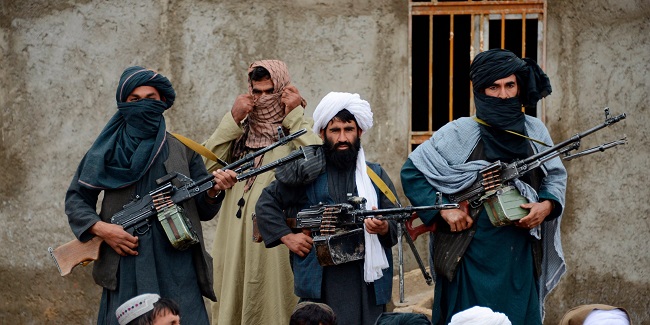
Taliban fighters in Afghanistan. (File Photo: AP)

India and Taliban: Hobson’s Choice
India for obvious strategic considerations (including the violently anti-India Haqqani terrorist group) has always supported the government in power, while condemning the Taliban. However, presented with a fait accompli, real politik dictated Foreign Minister Dr S Jaishankar’s speech at the inaugural Doha session this month indicating that our evolution on the Taliban continues. The Taliban, for their part, are unlikely to emerge as a strong partner of India, but the group has been signalling that it is not fundamentally inimical to work with the country. A few months ago, the Taliban refuted media reports that they had aligned with jihadi groups in Kashmir, declaring that they were not in favour of intervening in the internal matters of another country. That represented a subtle overture to New Delhi and gives the country an opportunity to secure a seat at the high table. As stated, peace agreement and US withdrawal pose a thorny dilemma for India as our assets in Afghanistan have been targeted by the Haqqani group, a major Taliban faction. Our considerable assistance was dependent on US military presence and the relative stability it brought.

The Doha Peace Deal with Taliban
On 29 February 2020, the US and the Taliban signed an agreement in Doha to end the war in Afghanistan. The agreement calls for a “comprehensive and sustainable peace agreement”, culminating in a “permanent and comprehensive ceasefire”.[iii] Whether observers like the agreement or not, it is a reality. The process addresses four main issues of; cease-fire; withdrawal of foreign forces (Trump outdid the agreement but all forces to withdraw within 14 months); intra-Afghan talks starting by March 20; and counter-terrorism assurance which seeks to halt terrorist activities in the country, including Al-Qaeda and the self-proclaimed Islamic State, or threaten the USA.

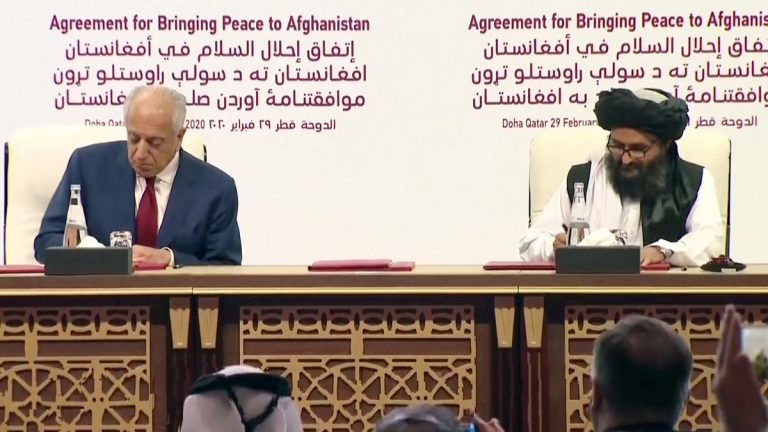
Zalmay Khalilzad, US Special Representative for Afghanistan and Mullah Abdul Ghani Baradar, Taliban's senior commander signing the US-Taliban peace agreement at Doha. (Photo: ANI)
Zalmay Khalilzad, US Special Representative for Afghanistan and Mullah Abdul Ghani Baradar, Taliban’s senior commander signing the US-Taliban peace agreement at Doha. (Photo: ANI)

Perhaps nothing reflects the challenges facing the intra-Afghan negotiations more starkly than the title “Agreement for Bringing Peace to Afghanistan Between the Islamic Emirate of Afghanistan” which is not recognized by the US as a state and which is known as the Taliban! The leader of the Haqqani Network, Sirajuddin Haqqani, the second-in-command of the Taliban is on the US wanted list with a reward of $10 million for information leading to his capture or death. To top it all, the US considers the Taliban a partner in counter-terrorism operations against the IS and other terrorist groups.

Implications of Agreement for India
While the Taliban agreed to prevent terrorist outfits from operating on Afghan soil, there is little clarity on how the agreement will be verified and enforced; second is the growing influence of Pakistan’s ISI, which controls/influences the Taliban, especially the Haqqani group. The third challenge to India’s long-term interests in Afghanistan has to do with the increasing political instability in Kabul. The power-sharing agreement signed between Afghan President Ashraf Ghani and former chief executive Abdullah Abdullah, on May 17, 2020 is nebulous at best, especially after the official emergence of Taliban. An interlinked set of mitigation strategies could help India protect its interests[iv]:

  • Border Diplomatic Engagement: Appointing a special envoy dedicated to Afghan reconciliation. The envoy to safeguard Indian interests at every international, regional and internal forum, and reaches out to Taliban representatives.
  • Enhanced Multi-Dimensional Assistance: Continue providing capacity and capability enhancement in defence, including training of Afghan National Army (ANA) and other para-military forces. Intelligence sharing specially of anti-India terrorist groups must be a priority. Given the unstable situation and impact of COVID-19 on the economy, India must spearhead developmental assistance.
  • Regional Cooperation: Broaden its engagements with Iran and Russia, explore opportunities for cooperation (as limited as they might be) with China, and find common ground with the US on Afghanistan’s future. This does not mean forcing competing interests to align; it means investing in a wider diplomatic initiative with the view to carve out areas of convergence.

Geo-Politics is never easy nor constant
Appointing a special envoy to interact with the Taliban, while assisting ANA (Afghan National Army), would no doubt invite opposition from the Ghani-led government (which itself is struggling with the question of Taliban negotiations), Pakistan, and other internal quarters. India will need to conduct a detailed net assessment of the political costs to its interests. The key will be to find an equilibrium to a strategy that is necessarily paradoxical. India ‘cannot let sleeping dogs lie’ but be bold and less dogmatic, and navigate unchartered territory to exploit the geo-political situation emerging, as the consequences are strategic.

Fortunately, the current Modi government has shown that it can break new ground; resolute but mature actions against China using multi-domains including the resolute faceoff along the LAC, willingness to use force in Pakistan; build stronger relations with the Middle East; recognize Europe’s importance in times of changing geopolitics; embracing technology as central to growth and international relations; and to demonstrate India’s clout as an emerging balancing power in the world; as Foreign Minister Dr S Jaishankar says “Taking risks is inherent to the realisation of ambition”. It is time for such ambition to be tested in Afghanistan. That Afghanistan is changing is a fact and there is a distinct probability of the Taliban returning to Kabul, in some form or shape. While the Agreement has given us a raw deal with ‘advantage Pakistan’, forcing us to reboot our approach to Afghanistan and engage with Taliban.

The Taliban are expected to constitute an integral part of the government in Kabul (whatever the situation, they are here to stay as a political entity with significant clout), and we need to establish diplomatic contacts with a politically empowered Taliban to safeguard our existing and future economic interests, including those linked with Central Asian energy markets and broader connectivity projects. It will also provide India with some leverage over Afghanistan’s future, which could offset China and Pakistan’s efforts aimed at sabotaging Indian stakes in the country. India undoubtedly has a long road ahead.

Necessity for Strategic Re-Orientation
India is slowly re-orienting its strategy to protect and promote its interests. Our Afghanistan policy continues to be assessed vis-a-vis Pakistan. India on its part has done little visibly, to meet the challenge, in the emerging political scenario of Afghanistan. While emphasizing an “Afghan-led process” India kept its hands away from the complicated peace talks. India’s official presence at the signing of the peace agreement in February this year did not convey any material change in India’s stance as it carefully avoided naming the Taliban entirely in the body of its statement. Even as several countries including Russia, China and the EU sent special envoys to Afghanistan, India refused to establish any diplomatic efforts to talk to the Taliban.[v] The policies of the countries underscore their understanding of the constantly changing reality of Afghanistan and demonstrate their efforts to stay relevant in the long run. India, on the other hand, has attempted to maintain the higher moral ground by not talking to a group it considers a terrorist organization. India’s decision makes it vulnerable in the long term, especially if and when the U.S. withdraws its forces from Afghanistan. 

Opportunistic Bedfellows: India-China-Russia-Iran      
China too is deeply concerned about stability in Afghanistan, new twist in the great game by other players, as also wary of geographical proximity of Xinjiang and Uighurs to Afghanistan, as instability can easily transcend borders. China has substantially increased its economic interests in Afghanistan, and included it as part of the BRI (Belt and Road Initiate). With the aim of securing its interests, it has created good equations both with the government and Taliban and has her permanent client state Pakistan to help out when needed. Strategic opportunity dictates that one of their primary strategic objectives will be to neutralise Indian influence. While this could add to the prevailing friction, there remains an opportunity for India to exploit the commons.

The competition between India and China may push New Delhi closer to Moscow and Tehran, which share some of India’s goals in the region. Although the Afghan government remains sceptical of any Russian links with the Taliban, Moscow’s involvement in the facilitation of past negotiations between various Afghan interlocutors is undeniable. As for Iran, even though it cannot reconcile with the Taliban’s anti-Shiite beliefs, Tehran has shown that it understands the importance of maintaining communications with the group. Given India’s relations with Russia and Iran, a three-way joint effort in Afghanistan cannot be ruled out.

Conclusion    

Within this complex loop, India’s USP, is that it is the only country that can engage with the US, Europe (EU) on the one hand, and Iran and Russia on the other hand and shares a relationship of trust with Afghanistan, which must be played to safeguard our strategic interests. As US troop presence and with its clout diminishing, the overarching goal is peace and stability in Afghanistan, specially for it’s neighbour India. The Afghan conflict is far from over, and India is well placed to play a pivotal role (despite being a low-key player so far) to form a consensus on how to shape the future of Afghanistan, which naturally depends on how we handle Taliban. Iran is wary of elements who are anti-Shia which suits India, as it places Pakistan in the opposite camp. India views Russia as a balancer in the regional security matrix, despite its proximity with China, due interests in CAR (Central Asian Republics) and Europe and the three can coalesce and act. Greater coordination between India, Iran and Russia besides convergence on regional security, is to develop cooperative mechanisms for commercial and economic ties with Afghanistan. This will also deny China and Pakistan an overarching influence in Afghanistan which is a long-term strategic victory, paving the way for our strategic growth towards CAR (Central Asian Republics), Europe and the Indo-Pacific region.


[i] 36 Things India Has Done for Afghanistan , The U.S. president might find it interesting to learn just what India has done for Afghanistan. By Krzysztof Iwanek, The Diplomat, 8 Jan 2020

[ii] Does India Have a New Playbook for a New Afghanistan? By Monish Tourangbamand Neha Dwivedi, The Diplomat, 10 Jun 2020.

[iii] ‘Dealing With the Taliban: India’s Strategy in Afghanistan After U.S. Withdrawal’; Rudra Chaudhuri, SHREYAS SHENDE, Carnegie India

[iv] ibid

[v] Does India Have a New Playbook for a New Afghanistan? By Monish Tourangbam and Neha Dwivedi, The Diplomat, 10 Jun 2020

Why does Pakistan target the Baloch intelligentsia?

Doctor Liaqat Sunni, Professor at the University of Balochistan and head of the Brahui Department who contributed extensively to the Balochi and Brahui literature was recently abducted by the Pakistani forces. Dr Liaqat is a brilliant writer who wrote about the ongoing oppression and suppression of Baloch people, especially about the ‘Missing Persons’ in his poetry. He was admired by the society for his brilliant poetry but unfortunately, we live in such a society where for our existence we have to go “Missing”, bear torture or get killed at the hands of Pakistani security forces.

It’s not unusual in Balochistan to hear about people getting killed or abducted by the state authorities. Professors, teachers, students, farmers, journalists even members of local police are being targeted by the ISI and its sponsored Death Squads. Anyone who demands basic human rights is a target for these authorities. Their is a ban on freedom of expression and anyone who dares to violate this law of the jungle is whisked away or killed.

Professor Liaquat Sunni was abducted and fortunately released later but our other leaders and intellectuals were not so lucky. The likes of Saba Dashtiari, Ghulam Mohammad, Lala Muneer, Sher Mohammad, Hameed, Fida and thousands of others were killed because Pakistan uses force against anyone who expresses themselves or speaks truth about Pakistani oppression in Balochistan. It is with tears in my eyes that I am writing their stories.

Dr Liaqat Sunni, chairman of Brahui department at the University of Balochistan has been abducted by Pakistani security agencies. (Photo: News Intervention)
Dr Liaqat Sunni, chairman of Brahui department at the University of Balochistan was abducted by Pakistani security agencies. (Photo: News Intervention)

Being a Baloch is a crime that every Baloch faces in Pakistan. I want to tell the story of a family who lives in Khuzdar, Balochistan. Their several sons were killed by Pakistan Army, ISI, and the Frontier Corps (FC). Asmat and Zubair Jan were cousins who belonged from Khuzdar. Asmat Jan was a servant at the Sheik Zayed Hospital, Khuzdar and Zubair Jan was a high school student. The brothers were going to their home for Eid holidays when they were abducted by Pakistani security forces on their way home. Thereafter the government officials informed the family that Asmat and Zubair are innocent and will be released soon. However, after Eid the distorted dead body of martyr Asmat Jan was found and later on the dead body of Zubair Jan was recovered.

Sami Baloch another resident of Khuzdar was abducted near the Khuzdar University on October 1, 2010 while he was on the way to his fields in the countryside. Sami Baloch was also abducted by Pakistan Army-sponsored Death Squads, and for 45 days he remained “missing”. All these days Sami Baloch’s family kept looking for him, they went to the local sardars (tribal chiefs) but in response they got only false assurances about his recovery. During this period an ISI officer telephoned the family and assured the release of Sami Baloch on Eid. However, on the day of Eid, Sami Baloch’s family received his mutilated body. “Eid Mubarak” was written on his dead body. On August 12, 2012 his father Ghulam Qadir was also martyred by the ISI hired targeted killers.

On October 18, 2010 Majeed Zehri a student in Karachi was returning home for Eid holidays when he was kidnapped and later his mutilated dead body was thrown away. The officials of Pakistan Army claimed that they have Majeed Zehri in custody yet they killed him in cold blood without bringing him to any court. Later, Majeed Zehri’s father was also martyred on February 2, 2012.

Naz Bibi, 6 year old child killed by Pakistani security forces at Harnai in occupied Balochistan. (Representative Photo: News Intervention)

Similarly, Zakaria Baloch another student who was studying in Polytechnic College, Quetta met with the same fate. Zakaria Baloch was also abducted by the Pakistan Army and later his mutilated dead body was found. Yaseen Baloch student at Khuzdar University was sitting at his shop in Anjeera when Death Squad members opened fire and martyred him. Ibrahim Baloch, a police officer and Fareed Baloch were also target killed by Death Squad members.

Ghaffar Baloch a shopkeeper and political activist of the Baloch National Movement (BNM) was targeted when he was sitting in his shop. In the same way Sarfaraz and Nisar Jan two teenage high school students were targeted by Death Squad members when they were returning from their exams. Yaqub Baloch and his 11-year-old son Abdul Rauf uncle of Sarfaraz shared the same fate.

Abdul Samad a brilliant and gifted student who got a golden scholarship of 75 thousand rupees per month at the Khuzdar University was target killed by the Pakistan Army-sponsored goons. All these students were from one family.

These are some cases which show the situation in Balochistan. There are thousands of stories of such crimes committed by Pakistan.

Why does SEBI want to eclipse the moon?

On a balmy December afternoon in Mumbai, the Securities and Exchange Board of India (SEBI) told 63 Moons Technologies that the company cannot offer it’s STP services. It was like sudden thunder, the STP services of 63 Moons had been operating for over seven years and was considered one of the best not in India but across the world. In India, it had 97 percent share of the markets.

STP, or Straight Through Processing (STP) services are used by financial firms to pass information electronically in order to optimise speed and eliminate hands-on re-entry of data.

India has four STP Service Providers: BSE, NSE.IT, NSDL and FTIL, the parent company of 63 Moons. But if 63 Moons is barred, it is obvious that the spoils will be shared by the rest.

The SEBI order triggered an immediate fall of shares of 63 Moons, down nearly five per cent at Rs 85.35 in afternoon trade on Friday, December 4, 2020, on the BSE. The market regulator, in an order that ran into 23 pages, said it rejected 63 Moons’ application seeking renewal of approval to provide STP services on the basis of “fit and proper” criteria.

63 Moons Technologies – which got three more months to offer STP to clients in order to avoid any possible disruptions for securities market participants said it will challenge the order on Monday, December 7, 2020 at the Securities Appellate Tribunal (SAT), Mumbai.

The country’s largest business daily, Economic Times, said in a terse editorial about the SEBI decision: “It is curious, to say the least, and matters because it reflects on the supervisory capacity and fairness of the market regulator.”

When the dust settled over the Arabian Sea and the markets closed, many wondered what triggered the SEBI action, especially after seven long years.

Market analysts said at the heart of this peculiar, no-need slugfest between SEBI and 63 Moons is the company’s chairman emeritus Jignesh Shah. The SEBI order makes it clear that it does not think Shah is fit and proper to be a part of the company which was embroiled in a payment crisis some years ago. 

Jignesh Shah, promoter of NSEL. Shah is popularly known as India’s Exchange Man, who had successfully launched 14 exchanges across six continents, a global record.

But the billion-dollar question remains the “fit and proper” order passed against the company in 2014 specifically dealt with barring persons or entities from holding equity stake in any exchange platform and has no bearing on providing technology services.

The company even said revenue from STP gate service is approximately Rs 4 crore, which is 1.56% of total revenue of 63 moons. “Odin and Exchange Technology are not affected by the Sebi order at all,” said Keshav Samant, President & CEO – Brokerage Technology Solutions, and Mehmood Vaid, Head-Exchange Technology, 63 Moons Technologies, in a statement.

It was clear to many that Shah, once again, was the target.

So let’s look at the SEBI order. 

The regulator noted that – while dealing with the application of renewal from 63 Moons – it found the erstwhile FMC Order dated December 17, 2013 as relevant in deciding that 63 Moons and Jignesh Shah were “not fit and proper” in the instant case of renewal of application. SEBI, very significantly, noted that 63 Moons and its Promoter do not carry good reputation, integrity and character in terms of Schedule II to Intermediaries Regulations.

In short, SEBI said even if Shah does not hold any executive capacity, the reputation, integrity and character of FTIL would be judged on the basis of the facts and conduct/role of 63 Moons and Jignesh Shah in the payment crisis at NSEL as described in the order of FMC, which was amalgamated with SEBI in September, 2015. 

Does that work in modern markets? 

Isn’t the market regulator aware that the government’s big move to merge NSEL and 63 Moons collapsed after the Supreme Court, in a landmark judgement, set aside on May 1, 2019, a three year-old government order to merge 63 Moons with NSEL? 

More importantly, isn’t it crucial for the market regulator to know and take into consideration that it was Ramesh Abhishek, the last chairman of FMC, who recommended the merger in public interest. And that very recommendation was eventually rejected by the division bench of Rohinton Nariman and Vineet Saran. So why stress tremendous value on a non-existent FMC after seven years?

Since SEBI showed concern about Shah’s reputation, the market regulator should have also taken into consideration this very serious fact that the Enforcement Directorate (ED), which probed the Rs 5400 crore NSEL payment crisis, said in a 23,000 page prosecution complaint in Bombay High Court that there were no money laundering charges against Shah?

And then, isn’t SEBI aware of the controversial role of FMC and Abhishek around the time when the NSEL payment crisis was detected? 

Shouldn’t the market regulator know Shah was not a stranger to the markets, having built 10 world class exchanges which functioned under different regulatory regimes, both in India and abroad? And those exchanges were not fly-by-night affairs, painstakingly built with scientific precision over a decade under the watchful eyes of global regulators?

SEBI must handle every crisis with clockwise precision, claim market analysts. 

It must know that an exchange is first seen by its users as it is in their business, which is why some exchanges work and some fail. For the records, out of the 10 FTIL exchanges, only one – NSEL – met with a payment default primarily due to artificially induced risk of closure and also because of induced regulatory risk and various trading malpractices by defaulters and brokers and connivance of some staff of NSEL that messed up the traders contracts. Both FMC and SEBI should have known that at NSEL, two of the three segments, namely, e-series and farmers’ contracts, functioned perfectly alright with a much larger number of clients and some brokers.

And finally, the market regulator should have known that the payment crisis did not happen while NSEL was functioning. It happened in July 2013 after its abrupt closure.

Contrary to what was propagated, NSEL was always a regulated exchange as brought out by the government’s various notifications. Regulatory concerns were being addressed by the highest financial sector body looking after risk, namely, the FSDC.

Many might argue about this talk about a regulatory vacuum? Well, it started only after the DCA ordered its abrupt closure presumably at the behest of the FMC resulting in the payment crisis in July, 2013. Even post-default, the FMC, instead of acting against the defaulters, acted against Shah and his FTIL though there was no evidence against either of them.

Though the FIU had raised the issue of non-compliances by brokers in NSEL, the FMC did not act against them when they indulged in rampant malpractices such as client-code modification and changing their clients KYC to trade without their permission.

Only last year, SEBI started correcting the wrongdoings committed by FMC and issued show cause notices to top brokerage firms on why they should not be declared ‘not fit and proper’ following their conduct on NSEL.

So why malign Shah? 

Also isn’t SEBI aware that Shah, who exited all his exchange businesses post the NSEL crisis, repeatedly said he was a target of political and corporate conspiracy but always maintained his faith in the judiciary. He said NSEL should not have been closed down abruptly. “I did not flee to London… And my stand has been vindicated by court orders one after another and none of the investigative agencies have found any wrongdoing on my part for even a single paisa,” Shah told the Press Trust of India in September last year. Shah even told the agency how he retained his faith in the judiciary.

But SEBI still feels Shah’s reputation must be questioned. It is the market regulator. It cannot be questioned.

The markets, expectedly, exploded with anger, disbelief. 

Remarked a top industrialist: “So in India there are two ways to compete: On merit or regulatory barbarism. We saw the latter in telecom, now in financial infrastructure. Remember one thing. Despite all regulatory and exchange discrimination, NSE.IT and NSDL have three percent market share.”

Another stock market analyst said he was shocked: “All fund houses, FIIs and institutional clients are clients of 63 Moons. It proves the credibility of the company and its genius of IP technology created. The rivals of 63 Moons could not beat the company in an open, competitive market so some political gameplay happened in some corridors of power. What is sad is such technical IP could have been invested in a new Google or Amazon but what do we see? We see 63 Moons again spending time in courts. The NSEL crisis was an annihilation attempt by the power brokers who wanted to get rid of a first-generation globally accomplished professional Shah, and his FTIL Group.”

The detractors are still at work.

POK Kashmiris start international campaign to #FreeTanveerAhmed

Kashmiris in the Pakistan-occupied Kashmir (POK) announced on Saturday a social media campaign for the release of senior journalist Tanveer Ahmed, who was arrested by the Pakistani authorities from Dadyal in August this year. Tanveer Ahmed continues to be imprisoned in the Mirpur Central Jail in POK.

“Tanveer Ahmed has been imprisoned by the so-called puppet government of Azad Kashmir at the behest of the occupying state,” said Habib-ur-Rehman, the coordinator of release Tanveer Ahmed campaign. He added that #FreeTanveerAhmed would be used by people all across the world to tweet and share their views through articles, photos, cartoons etc. with demands to release Tanveer Ahmed.

Tanveer Ahmed has been kept in the Mirpur Central Jail, POK where he is on a hunger strike. His health condition is very worrying and requires immediate medical help.

Habib-ur-Rehman added that human rights activists, social activists, democrats and humanitarian organizations across the world will take part in this campaign. The #FreetanveerAhmed campaign will continue until Tanveer Ahmed is released.

Habib-ur-Rehman is member Central Committee JKPNP (Jammu Kashmir People's National Party). JKPNP is a political outfit based in Pakistan-occupied Kashmir (POK) and Gilgit-Baltistan. (Photo: News Intervention)
Habib-ur-Rehman is coordinator of release Tanveer Ahmed campaign. He is also the central committee member of POK-based political outfit JKPNP (Jammu Kashmir People’s National Party). (Photo: News Intervention)

Tanveer Ahmed was arrested in August this year when he took down the Pakistani flag at Dadyal in Pakistan-occupied Kashmir (POK). His wife Fareezam Rajput recently met her husband in the Mirpur Central Jail and said that certain “invisible forces” want to give out a strong message to other Kashmiris through her husband’s case.

Tanveer Ahmed has been on a hunger strike since November 1 and his health has been deteriorating ever since. Interestingly, Tanveer Ahmed is a local Kashmiri from the POK and is also a British citizen. UK Prime Minister Boris Johnson has expressed concern about the ‘appalling treatment’ to a British national.

Lord (Tariq) Ahmad’s letter to British MP Bob Blackman explaining the efforts undertaken by UK government to secure Tanveer Ahmed’s release.

Legally, Tanveer Ahmed’s arrest and denial of bail is completely illegal. Tanveer Ahmed took down the Pakistani flag from an area which Pakistan itself calls as “Azad Kashmir” which implies that the Pakistani flag cannot be hoisted. However, the term “Azad Kashmir” is a misnomer as this part of Kashmir has been illegally occupied by Pakistan since 1947 and everything is run on the whims and fancies of Islamabad.

By taking down the Pakistani flag from Dadyal, Tanveer Ahmed was only trying to implement POK’s “Azadi” in letter and spirit that Pakistan says at every forum. But this did not go down well in Pakistan and Tanveer Ahmed was promptly arrested and has been denied all legal remedies. Now, the Pakistan Army wants to make Tanveer Ahmed as an example in POK and Gilgit-Baltistan.

Tanveer Ahmed soon after his arrest on August 21, 2020. His health has deteriorated since then. Tanveer Ahmed was arrested by Pakistan after he pulled down Pakistani flag at Dadyal, POK (Pakistan-occupied Kashmir) on August 21. (Photo: News Intervention)

This is the first case in the world where a citizen of an independent state has been imprisoned for removing the flag of another state from his country. Habib-ur-Rehman further explained that the rejection of Tanveer Ahmed’s bail by the Muzaffarabad Supreme Court was itself a testament to how “free” is this so called “Azad Kashmir”. He appealed to social activists from around the world and to all those who believe in freedom of expression to proactively campaign for the release of Tanveer Ahmed.

Tanveer Ahmed, Senior Journalist continues to be under arrest in POK (Pakistan-occupied Kashmir). (Photo: News Intervention)