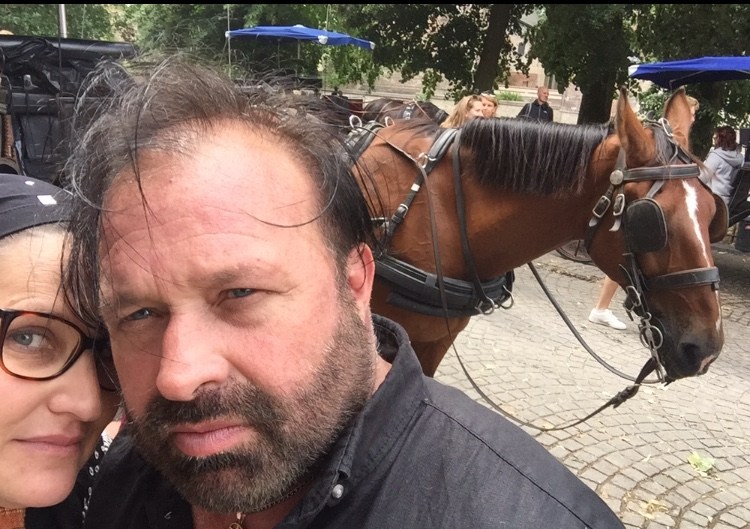
Christian is a Philosopher that comes from Belgium. What identifies him the most and above all is simplicity, for everything is better with “vanilla flavour.” Perhaps, for this reason, his intellectual passion is criticism and irony, in the sense of trying to reveal what “hides behind the mask,” and give birth to the true. For him, ignorance and knowledge never “cross paths.” What he likes the most in his leisure time, is to go for a walk with his wife.
Scott Douglas Jacobsen: I love much of Jewish culture. One for its longevity, akin to the Chinese or the Navajo. Another for the emphasis on the most demarcated exceptional trait of the hardy species Homo sapiens – bookishness, as a marker of verbal capacity, linguistic fluency, and rapid and agile mathematical ability. Something pointed out about being reached out to become a rabbi (for you). Or the short of it, literacy and numeracy, Jewish culture, in general, values these. For one reason or another, Jewish people have been and continue to be a deep part of life for me, in all domains. Another admirable factor is the resilience of the cultural values with humour. What characterizes Jewish humour?
Dr. Christian Sorensen: I would say, that with Jewish humor, the joke is to
complain. I think that one of the distinctive characteristics of this humor, is
that the Jews, unlike what occurs with the other types of humor, generally
laugh at themselves, nevertheless and also unlike the other humors, I believe that
deep down, they never accept that the rest, which are not Jews, dare to laugh
at them, in other words, they will only accept that only another Jew, can laugh
at a Jew, since otherwise they will always consider it offensive, and may even
qualify it as anti-Semitism. Jewish humor also tends to be critical of itself
as such, in fact it is said that the worst listener of a Jewish joke, is
another Jew, since most likely he will say that he already knew the joke, or
that he has a more humorous variant of it. I think that Jewish humor, from a
critical point of view, is the only one that due to its intellectual subtlety,
has an effect on the unconscious, because it makes laughter something
impossible to contain, and induces what I will name as the après-quo
understanding time of the joke, which means that it’s after the moment of
laughter, that its meaning is fully comprehended, question that from a purely
logical point of view, is difficult to explain.
Jacobsen: Jewish humour is multifaceted
too. There is a part focused on a recovery from direct trauma or reflection on
historical traumas, e.g., the Shoah or the Holocaust, biblical purported
catastrophes, exiles, anti-Semitism as a factor in ancient and modern politics,
etc. Why is humour in this manner important for individual and collective
healing and resilience-building?
Sorensen: Because the fact that they are able to laugh at their own defects and
misfortune, demonstrates that they have been able to assume them as such. In
turn, I think that the act of laughing at themselves as they do, is always an
effect or consequence of already knowing the answer or solution to a certain
problem. In consequence, it could be said, that both factors respectively, that’s
to say the consciousness and the resolutive capacity for solving problems,
linked in turn, with the ability to laugh at one’s own defects and
difficulties, is a form of social catharsis, and all this together, is the
essence of the sense of resilience.
Jacobsen: Other parts make fun of Jewish culture
and people themselves, e.g., Jewish grandmother jokes, making fun of the
various kinds of foods, making fun of stereotypic mannerisms or health issues,
etc. Why is this a brand of joking?
Sorensen: Because all those expressions, that represent a certain idiosyncrasy,
can be labeled as strange, grotesque, and extravagant, therefore since they can
be labeled as ridiculous and absurd, then they may be cause for mockery or
laughter.
Jacobsen: Another one is the one grounded
in a long-term reality of Jewish intellectual achievement. Anyone with a brain
can see the statistics and acknowledge this fact. Whether innate, cultural, or
both, as the reasons, that’s what anyone dealing reasonably with this is
arguing over. There are terms like “goyishe kop” or non-Jewish head to talk
about mental sluggishness, doltishness, of the gentiles, goyim, or non-Jewish
peoples compared to Jewish peoples. What are some examples of humour in this
manner?
Sorensen: I’ll give examples of short jokes without lining. For example, God will
give the Gentiles longevity. Why? Imagine someone’s donkey dies, they would
lose their money. Or why are the goyim dummies? Because they talk about what
they know. Or perhaps, what do you say to a goy with two black eyes? Nothing,
someone already tried to explain him things twice.
Jacobsen: What are some other genres, let’s
say, in Jewish humour?
Sorensen: I think religious and assimilation themes, are two other typical genres. Regarding the former the classic is the conflict between Ashkenazis and the Sephardim, since the first ones always make fun of the latter because they consider them intellectually inferior, and due to the fact that they estimate that their customs, are overloaded and lacking in sobriety, while the latter says that they give too much importance to study and neglect spiritual development, or that there is no food more insipid than the Ashkenazi’s. The aforementioned, occurs to the point that usually because of the quarrels between both, they say things like, Ashkenazis parents prefer that their daughter get married with a goy before than with a Sephardic, or that when an Ashkenazi and Sephardic are discussing religious topics, actually they’re three Jews instead or two doing so, since they never reach an agreement on anything. Likewise, assimilation is another humorous topic, but from an apprehensive perspective, due to the fact, that there is always the latent fear within the community, that the Jewish population will decrease more and more, because of mixed marriages, which is the reason why they tend to make jokes of converts, such as when it is said, that if you want to identify them inside a community, it is easy, since they are the only normal ones.
Jacobsen: What are the differentiating
factors of Jewish humour compared to other forms of humour?
Sorensen: I think that it is an humor, that fundamentally acts as a medium, to
vent the enormous historical burden of sufferings and frustrations of the
Jewish people. I also consider, that in its self-criticism, carries within, a
strong sadistic and projective unconscious streak, since I believe, that subtly
through that criticism, what they are doing is referring more to others than to
themselves.
Jacobsen: What are the overlaps,
non-differentiating factors, of Jewish humour compared to other forms of
humour?
Sorensen: I think that its character of black humor, and the linguistic ability
to play with words, was inherited from the style of humor characteristic of
Eastern Europe, especially before and after the Second World War, and which
later moved with the immigrants to America. There is also a burlesque aspect,
which was typical of Jewish humor before the expulsion from Spain, but that was
actually inherited from the troubadour way of making humor of the society at
the time.
Jacobsen: Who are the greatest Jewish male
comedians?
Sorensen: Actually, eighty percent of the best-known comedians in America, are of
Jewish origin. Some of the most notable, I think that have been Jerry Lewis and
Woody Allen, however there were others such as Morey Amsterdam and Charles
Chaplin, or more currently like Tom Arnold, and Hank Azaria. In my opinion
recently, the comedians that have become recognized for their sparkle and
freshness to make people laugh, are Simon Amstell, Ben Stiller and the Israeli
Roberto Moldawsky.
Jacobsen: Who are the greatest Jewish women
comedians?
Sorensen: I think there are notable women comedians, such as Gabriela Acher, Lisa
Arch, Joan Rivers, Bette Midler and Bea Arthur, nevertheless, personally the
Argentines Alicia Steimberg, Silvia Plager and Ana Maria Shua, they surprise me
with their narrative of humor throughout the twentieth century, particularly
regarding the topic of definition of gender identity and roles, as a means to
understand the cultural hybridity. Besides, I think it’s remarkable the fact
that they visualize humor, as a resource of catharsis regarding conflicts,
which at the same time, is a way to problematize the relationship between one’s
own and that of others, through a questioning of reality, in other words they
see with this medium, a form by which women may manifest themselves in relation
to their feelings of concern, responsibility and critical commitment.
Jacobsen: What the most famous Jewish jokes
(non-anti-Semitic) outside of the Jewish community?
Sorensen: I like these ones. A Jew goes to the newspaper to put an advertisement
about his wife’s death, and says: I’d like a death announcement.
What’s the ad going to say? Rachel died. Sir, says the newspaper clerk, the rate is the same for two or eight words … Worth the same? Then put: Raquel died, I’m selling cheap women’s clothing.
The bride tells her Jewish boyfriend:
These shrimp are delicious, do you want to
try them? Thank you, but you know I’m Jewish …
Don’t worry, they are free.
Two Jews fly over the Vatican and one says
to the other, dead with envy:
To think that these started with a manger
…
What is used to disperse a protest in
Israel?
A piggy bank.
Jacobsen: What are the most famous Jewish
jokes inside of the Jewish community?
Sorensen: I like these both. A Catholic priest, a Protestant pastor and a rabbi
make a bet because they want to know which of them is better at his job. They
decide that the best way to do it, is to go separately into a forest, full of
bears, and they try to convert each one of them to their religion. Said and
done. Afterwards, they meet in the same place to assess what happened:
When I found the bear, says the priest, I read him the
catechism and sprinkled him with holy water. Next week he will make his First
Communion.
I found a bear, says the Protestant pastor,
and I preached the word of God to him. The bear was so surprised, that he let
me baptize him. They both turn in unison to ask the rabbi, who lies on a
stretcher, and has his whole body in a cast.
On second thought, the rabbi exclaims,
before they asked him, maybe, I shouldn’t have started with the circumcision.
A Catholic priest invites a rabbi to
dinner. They sit down at the table and each one is served a plate of pork in
sauce. The rabbi excuses himself by saying:
I’m sorry, my religion doesn’t allow me to
eat pork …
The priest looks at him mockingly and says:
I’m more sorry; you don’t know what you are
missing.
At the time of leaving, the rabbi says
goodbye saying: Please say hi to your wife …
I’m sorry, I don’t have a wife. My religion
doesn’t allow me to have a wife … Says the priest.
The Rabbi looks at him mockingly and says:
I’m more sorry, you don’t know what you’re
missing!
Jacobsen: What defines an anti-Semitic joke
and differentiates such a joke from a non-anti-Semitic joke?
Sorensen: They differ in that the anti-Semitic joke, regardless of who says it
and who hears it, and therefore independently of a perceptual or subjective
question, has undeniably a second intention and a second message, that
evidently and explicitly intends to aggress the addressee to whom that joke was
directed when it was formulated, while the non-anti-Semitic joke, manages to
relativize its connotation, depending on the perception that the listener has
of the intention of who says it, and regarding the context in which it is said
by the latter.
Jacobsen: Thank you for the insight,
Christian.
Sorensen: I hope it’s well understood outsight.