Home Blog Page 350

What makes ‘144 Veterans’ qualified enough to force their views on Ladakh?

A group of 144 veterans have written a letter to the President of India and the Prime Minister, raising their concerns related to the stand off between Indian Army and People’s Liberation Army of China. Okay, I agree that it is a step in the right direction and it is a matter of great pride for India to see a group of veterans involved in military issues even after hanging their uniform.

The Chetwode Motto that places national interest at the top of an officer’s mind space is not a commitment meant only till they are in service, rather it is a way of life and approach that an officer is expected to adopt. It carries on till he or she lives. It is these ethos that a soldier is expected to live upto. In light of this it is important that the action by 144 veterans needs to be analysed and assessed for its righteousness.

Firstly, who are these 144 veterans and do the qualify to make the assertions that they have made? They have contended that the Galwan Valley incident happened “because of failure at one or more levels in the political, civil and military establishments.” On this, their demand is that an inquiry be carried out to fix the accountability.

The most important question is whether these veterans are competent enough to raise the issue of failure? How do they say whether the incident was a failure or a strategic success? Moreover, which arm do they belong to, whether they have tenanted appointments at strategic or operational levels and lastly, how much do they know about Ladakh and its operational dynamics? If they qualify on these counts then they would agree that intelligence and operations against Chinese is a completely different ball game. China is a closed society with political, social, cyber and media isolation. The information or intelligence about their military is not so readily available.

Moreover, PLA’s intention when it undertakes mobilization in the garb of training or other routine activities is difficult to discern. There are agreements, to which both India and China were expected to abide by and such an act was not expected from China. The mechanics of Chinese mobilization was such that initially they moved smaller body of troops into the PP14, 15, 17 and Pangong Tso areas. When these troops were challenged by the Indian Army or ITBP, they pushed in additional troops.

While all this was happening, Indian Army was not unaware or sitting tightly. Starting with forward mobilization of troops already present in Ladakh region. Very soon we started hearing about additional reinforcements of the Indian Army movement. Within no time India Army had more troops than Chinese and the Indian Air Force was poised to take on operations. It is this might which got reflected in the violent clash of June 15 at Galwan Valley.

With Chinese Army going back on their words about not deploying any of their troops or military infrastructure on Indian side of the LAC, Col. Santosh Babu led his patrol to express the resolve of ensuring territorial integrity to Chinese troops. Can an Army weak on ground, unaware about the strength and disposition of Chinese troops, take such a bold step. China once again broke the trust and reacted in an unruly and unethical way. Does an Army like India’s expect another Army like that of the PLA (People’s Liberation Army) about such response to the overture of peace? Even at this instant at Galwan Valley, did India Army take it lying down? No, it gave back to the PLA in stronger measures and the results are known. So, where was the failure in all this?

Secondly, any gentleman who has been part of this wonderful organisation called the Indian Army must know that even if there are mistakes or errors of judgement about enemy’s intentions, these are dealt with post the situation is over. The 144 veterans joining hands to question the Indian Army while it is still dealing with the enemy reflects the true nature of their intent. Why such a haste? Why such a hurry? Was some timeline to be followed by them? Such a behaviour smacks of some ulterior motives which the time will reveal.

Thirdly, their demand for release of the Henderson Brooks report of 1962 to be released and their demand that the “government expeditiously conclude boundary agreements with all neighbours, especially China and Pakistan” indicates two aspects. One, Henderson Brooks report is a document which has remained secret despite the change of several governments at New Delhi. Its contents may have patterns, mechanics and drills that should not be formally declared. They can rest assured that all measures that were reflected in the report must have been acted upon within the years after 1962, Indian armed forces have become at par with PLA, rather better. Two, their desire that New Delhi must conclude boundary dispute with China expeditiously is a function of both the countries. If it had not been a complicated one, 22 rounds of talks at Senior Representatives level would have headed for a conclusion. China is a country which in an environment of COVID-19 thinks it prudent to take several nations head on or venture to initiate World War-III. Veterans’ demand (expectedly with good intellect and reason) looks like an immature and childish act.

Resolution of boundary dispute calls for engaging China from the position of strength. Just because government or the Indian Army is not giving out the minute to minute commentary, it does not mean that there has been any let up. Who knows, at the end of the day, this entire act of aggression by China turns out to be strategic victory and the detractors, veterans or civilians have to bite the dust.

Fourthly, 144 gentlemen who have been in uniform for decades are expected to understand the nuances of having military, para military and Central Armed Police Force (CAPF). Their nuanced view that CAPF be employed for counter-insurgency operations or manning borders is an expression that does not indicate the view from professionals. Expressing such unprofessional outlook by these veterans simply means that even the common man should not pay any heed to them, what to talk about the Prime Minister or President. However, if they claim to be professionals then they must accept this act as a huge mistake, putting the reputation of this community at stake.

Fifthly, those who are expressing the views that Chinese mobilization of forces was an intelligence or operational failure need to grant that post Kargil, a lot of mechanisms, resources and organizations have come into existence. There’s a lot of horizontal and vertical sharing of information and assessment that takes place. While against china, the intelligence may not be as strong as it is against Pakistan, but no one should infer what the veterans are attempting to infer.

One of the serving officers had once said: “While veterans were in active service, we all granted that they did their job well and the nation trusted their leadership. When others are in their old boots and at the helm, why don’t they grant them a similar honor. Least, the current lot needs to be given the benefit of doubt, till things are over and the outcomes are known. This generation is equally capable and professional. This too has followed the dictum of Chetwode Motto.”

Two Asian giants in logjam: What after Ladakh blows?

It appears that China has played its pre-planned game on the Sino-Indian border in Eastern Ladakh on time. It synchronized with a particular situation developing in Pakistan. It will be remembered that China’s reaction to the Indian Parliament’s J&K State Reorganization Act 2019 was cryptic but very significant as we look at the hindsight. China had said that converting the Ladakh region into a Union Territory was a matter of concern for her. Commentators remained content with the simplistic explanation that China has never accepted the existing LAC as an international border in Ladakh and has been laying claims to large chunks of territory in Eastern Ladakh. It will also be recollected that in the Sino-Indian conflict of 1962, China grabbed a large chunk of Indian Territory in Aksai Chin and did not return it.

China waited just to gauge how much Pakistan could achieve on an international level to mould opinion against India’s reorganization plan in Kashmir. Major powers of the world accepted Indian argument that reorganization was an internal matter. Finding no takers of her lament in the comity of nations, Pakistan did some nuke-rattling allowing some minions in the Council of Ministers to boast of half a kilogram weighing nuclear weapons. India did not budge. In doing so Pakistan volunteered to become the laughing stock for the entire world.

Finally, Pakistan decided to intensify the only option of intensifying cross border firing, shelling and infiltration in Kashmir, making Kashmir Valley jihadists and gangsters pro-active and concentrating on media hype to malign India, as a “Nazi and Fascist regime” pursuing the policy of holocaust of Indian Muslims. Now PM Imran Khan has become an advocate of not Kashmiri but also of nearly 20 crore Indian Muslims. He managed to hook up the non-Semitic Islamic States of Turkey, Malaysia and Iran as supporters of his “Muslim Holocaust” theory. But it cut no ice either with the Western democracies or even with OIC (Organisation of Islamic Cooperation) with 53 Islamic States as its members.

Hence for several months by now, we have recurring firing and shelling from across the border on some sensitive posts to which Indian forces respond as per necessity. In the meanwhile, during the past four months, Indian security forces have liquidated 148 Pakistani infiltrators and Kashmiri armed jihadi insurgents.

Finding that Kashmiri separatist and secessionist leaders like Syed Ali Shah Geelani and Moulvi Umar failed to provoke large or small scale public protest rallies in Kashmir against the Reorganization Act, the ISI decided to sideline them. Instead, it picked up a younger group of Kashmiri Muslim Jamaat-e-Islami activists stationed either in Muzaffarabad or Rawalpindi. As the Modi government had come down with a heavy hand on the hawala transactions — primary funding channel for the Kashmir militancy — ISI inducted narcotics trafficking and drug pedaling in Kashmir as it had done during the Khalistan movement in Punjab. This starved Geelani and his lust for large funds and no accounts for expenditure hurt his ego. In utter desperation, he declared his disassociation with Hurriyat (G).

The gradual depletion of fresh recruits for militant cadres, effective implementation of “Operation All Out” by Indian Generals, a substantial reduction in hawala funding, increasing dissatisfaction of locals in the Kashmir valley with the lawless jihadis and their role in providing intelligence to the security forces about the hideouts of militants, all combined to assure China that Pakistan was on the verge of losing its game in Kashmir. In addition to an adequate response to Pakistan’s border shelling and pushing infiltrators into Kashmir, India issued a strict warning to Pakistan to vacate the parts of original J&K State illegally occupied by Pakistan.

These are the factors that became a catalyst to China’s sudden aggression in Eastern Ladakh. Somehow, Beijing began to believe that India has drawn up the plan of recapturing its areas under the control of Pakistan. China planned intrusion at a few points but it should be noted that she had bigger plans and different intentions. If India captured Gilgit, the world community will endorse India’s right to retrieve the part of the state under illegal occupation of Pakistan and China. That would jeopardize the entire scheme of Karakorum Highway as well as the CPEC. If that happened China’s boast of being a world power would sink to its nadir. Hence one can explain the logic behind China’s massive build-up in the Galwan region.

But Beijing hardly expected a mighty retaliatory jab by India. When PM Modi thundered that the era of expansionism was over, Beijing found that the entire democratic world stood behind the Indian Prime Minister. President Xi Jinping opened his eyes to a completely new strategic scenario in the Asian Continent. He began to realise what it meant to throw a challenge to the entire democratic world particularly India, the largest democracy of the world. The world stood behind the iron man of India who they found adequately qualified to lead the Third World War if unleashed by autocratic, theocratic and pro-military regimes on the globe.

Where do we go from here? Seven decade-old concepts of China that she can ride roughly shod over the borders of her neighbours stand shattered and rent asunder. The democratic world and their militaries have identified the enemy that tries to look at them with an eyeball to eyeball stance. Their policy vis-a-vis the dragon would be (a) to disable Beijing’s financial and economic hegemony over the world, and (b) to insulate India-Pacific region against Chinese belligerence. It could also mean naval blockade of China. In such a scenario China will be adorned with the so-called Necklace of Pearls. We know that China will desire to live as a peaceful neighbour of India but that will happen only when her wings are clipped and she is denied flight beyond her existing geographical borders.

Pakistan’s Kohala Power Project with China is to loot POK

The 4,000 square mile of the state of Jammu and Kashmir, which is under Pakistan’s control, has recently signed $2.4 billion deal with China and the Pakistani government for electricity generation. This project is called the Kohala Power Project. In Pakistan-occupied Kashmir (POK), there’s a government called the Azad Kashmir Government. Although puppet governments of the occupiers cannot be called a representative government of the people nor can they be recognized. But if any kind of project is based on 4,000 square miles, then the right to control it should be with the Azad Kashmir Government. That is, the state of Jammu and Kashmir.

On this basis, if any country enters into an agreement with the state of Jammu and Kashmir then it should be with the so-called Azad Kashmir Government and not with the government of occupying Pakistan.

What a shame that the Pakistani state, its rulers and its people call it “Azad Kashmir” and fool the world that Pakistan-administered Kashmir is free, the people here have the right to rule, while the reality is just the opposite. Part of the state of Jammu and Kashmir, popularly known as “Azad Kashmir”, is not independent but is completely occupied.

The role of the AJK government in all other mega projects, including the $2.4 billion Kohala Power Project agreement between China and Pakistan, is merely to facilitate the looting of state resources by the ruling classes of Occupying Pakistan. Generations have been playing the role of facilitators and flatterers.

The people have the right and control over the resources of the state. All such mega projects are the property of the people, but the tragedy is that the occupation of the ruling class extends. Lost rulers arrange the luxuries of their descendants by strengthening their ambitions. In return for this flattery and facilitation, the upper classes of the occupying state give them rule over the people. And this class is, the GHQ (General Headquarters).

Before implementing these projects, the lands, poverty, health etc. of the people are not taken into consideration. The already devastated people will suffer further humiliation and disgrace. In our slave society, the occupier has begun to give birth to new forms of looting.

POK’s state apparatus, which has the role to protect the property of people, is being sabotaged through such schemes. In this whole process, the leadership of all traditional political parties, including the government, is silent as their job is to flatter and facilitate.

The people of POK, and especially the youth, must resist the plunder of resources. They must demand public authority and control over state resources. To save their resources, they have to be organized, progressive and the nationalist organizations have to come up with a clear and solid policy such that all patriotic and people-friendly forces can be organized. Jammu and Kashmir People’s National Party (JKPNP) has started a campaign. The youth must debate about this campaign. They must raise questions, mobilize the people because if we do not do this today, tomorrow will not give us time, the water will pass through our head leaving only destruction and everything else will be washed away.

BLF Freedom Fighters attack Pak Army convoy, kill 20 personnel including an officer

Balochistan Liberation Front (BLF) Spokesperson Major Gwahram Baloch said the Baloch Freedom Fighters (Sarmachaars) attacked a convoy of five vehicles of the Pakistan Army in Gichk area of Panjgoor, occupied Balochistan on Tuesday. The BLF attack damaged all five vehicles and killed more than 20 Pakistani personnel, including the officer on board.

Major Gwahram Baloch gave details of this attack while talking to the media from an undisclosed location. He explained that this morning (Tuesday) Sarmachaars attacked a convoy of five vehicles of Pakistan Army in Gichk area of ​​Panjgoor district. “At Mok-e-Kandag, Sarmachaars (Freedom Fighters) ambushed the occupying forces with rockets and automatic heavy weapons.”

The BLF attack damaged all five Pakistani vehicles and killed more than 20 personnel, including the Pakistan Army officer on board. “The Pakistani Army came under heavy attack in a few minutes and later not a single bullet was fired by them. A few years ago, a BLF attack in the same area had killed several army personnel, including a Pakistani colonel named Waheed, whose video went viral, and because of this, all Baloch websites, social media pages and video channels were blocked in Pakistan. Video of today’s attack will also be released soon,” said Major Gwahram Baloch. He said that these attacks will continue till the independence of Balochistan.

Pakistan Army and its intelligence agencies have been killing Baloch people at their whims. Over the last several months Pakistan Army has used helicopter gunships and heavy machine guns to fire at the unarmed hapless Baloch people across occupied Balochistan. Pakistan’s human rights violations continue unabated as the world and UNO refuse to condemn Pakistan’s actions.

Punjab rejects SFJ and its flawed ideology

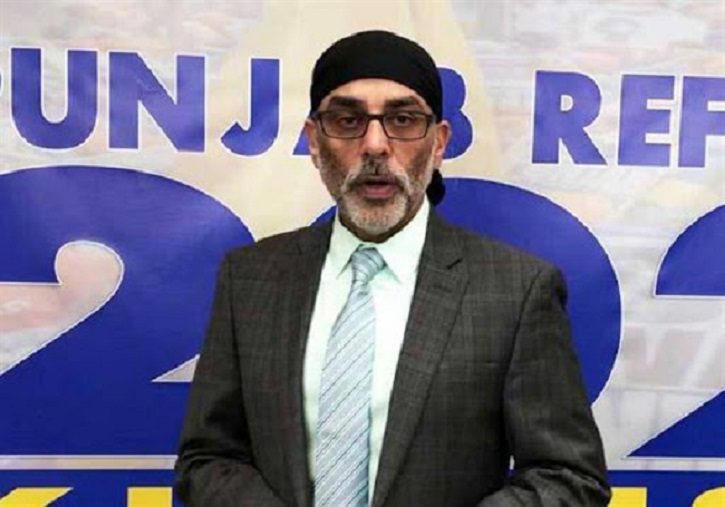
Sikhs For Justice (SFJ) is a maverick US-based organisation whose stated objective is to carve out Punjab as an independent nation from within the Indian Union. On July 4, in a most detestable and disgusting act, the organisation launched a website through a Russian portal. The website states that ‘indigenous’ people of Punjab, irrespective of the religion that they belong to and living anywhere in the world, can register themselves for ‘Punjab Referendum 2020,’ and avail an opportunity to vote on their future political status as an independent nation.

On September 20, 2019 the Indian government had declared SFJ an unlawful association under Sub-Section (1) and (3) of Section 3 of the Unlawful Activities (Prevention) Act (UAPA), 1967. On July 1, the government went a step further and declared Gurpatwant Singh Pannu, the prime mover and legal advisor of SFJ, an ‘individual terrorist’ under the fourth schedule of UAPA, 1967. Gurpatwant Singh Pannu is charged with making an attempt to revive militancy in Punjab through anti-national activities and involvement in the Khalistan movement.

As punjabfree.ru got activated the government banned 40 websites linked to the SFJ. “On recommendations of MHA, MeitY (Ministry of Electronics and Information Technology), has issued orders under Section 69A of the I.T. Act, 2000, for blocking 40 websites of SFJ,” stated a Union Ministry of Home Affairs (MHA) order on the subject. The Punjab and Haryana High Court, while disposing a Public Interest Litigation (PIL) seeking steps against SFJ, directed “necessary action” by the authorities concerned. The State of Punjab told the High Court that 16 FIRs had been registered against the organisation and 116 WhatsApp groups related to the organisation have been blocked.

Such is the abhorrence for SFJ in Punjab that, in an animating and unusual situation, all opposition parties fully supported the decisions of the central government to ban the organisation, designate Pannu an individual terrorist and block its communication tools.

“Intelligence reports had indicated that the SFJ was backed by Pakistan-based ISI. Terrorism has to be fought jointly,” said Sunil Jakhar, President Punjab Pradesh Congress Committee (PPCC).

 “Referendum 2020 was just a drama by those who hate India,” said Sukhbir Badal, chief of the Shromani Akali Dal (SAD).

It was in the year 2007, when Gurpatwant Singh Pannu, a New York-based attorney who provided legal services to asylum seekers in the US established the SFJ (Sikhs For Justice) with his brother Avtar Singh as the President. He set an absurd narrative of separating Punjab from the Indian Union, the largest democracy in the world. 

It is difficult to clearly substantiate whether ISI was the mastermind of the plan or became a part of it later. What is certain is that, as the activities of the group gained momentum, the signature of ISI became more visible. SFJ websites, sikhsforjustics.org and 2020referendum.org, shared domains and sourced content from a Karachi-based website “snip.pk”. The personal websites of several SFJ activists, including that of Gurpatwant Singh Pannu, were linked to the same Pakistani website.

The organisation could only garner negligible numbers of supporters from the Sikh community and, as such, existed in isolation for many years. It then hit upon the idea of leveraging online means to grow further and thus was initiated the concept of “Punjab Referendum 2020.” On Sunday, 12 August 2018, a handful of Sikh Diaspora campaigners assembled at London’s Trafalgar Square to unveil plans for the referendum.

Flush with funds from the ISI, the organisation went ahead with all kinds of anti-national activities and especially provoked the Sikh youth, to declare a war against India. It roped in many journalists to speak about its evil cause. It used social media optimally for its propaganda. The Indian media needs to be credited for not having fallen to the bait. Gurpatwant Pannu and SFJ faced strong criticism and ridicule by Indian media across the board.

In the meantime, ISI attempted to increase proliferation of drugs, arms and terrorism in Punjab. An investigation by the Punjab Police of SFJ’s involvement established that the organisation assisted ISI in the conduct of such subversive activities. A special effort was made to use the Kartarpur corridor as a conduit for all nefarious activities. However, alert intelligence agencies in Punjab as well as the NIA, R&AW etc. did not allow fructification of their designs.

Interestingly, Pannu is not ready to associate with the indigenous separatist elements of Punjab. He projects himself as the sole messiah of evil separatism and says that the Khalistan movement has commenced on July 4, 2020. Pannu avoids queries about its successful culmination by saying that he is not an astrologer. This posture is causing resentment among those like Simranjit Singh Mann who look upon the movement as their own brainchild nurtured over many years. Pannu prefers the individual path, probably due to financial considerations. With time he will declare the referendum as successful and then approach the UNO with a request for intervention. No such intervention is feasible but for him the pot will keep boiling and the money will keep coming in.

Punjabis will never accept any movement that seeks to separate them from the Indian Union. For them there can never be a repeat of 1947. Many like Simranjit Singh Mann and his political party Shromani Akali Dal (Amritsar) have fought elections on the grounds of separatism and have been consistently rejected by the people. 

The young Punjabis are too engrossed in their aspirations to be pulled into the murky waters of secessionism and separatism. Among the third and fourth generation Sikh Diaspora as well, there is hardly any attraction towards the calls for Khalistan. In fact, selection of the word “Khalistan” which has a distinct Muslim connotation is quire repulsive and objectionable to the Sikhs.

Due to the firm and timely action taken by New Delhi and support given by all political parties as well as the people of Punjab, the “Punjab Referendum 2020” has been reduced to an exercise in futility. Now, SFJ, under extreme pressure from the Indian media and intellectuals has said that the referendum is unofficial in nature and, as such, is not legally binding.

It is because of its flawed ideology and inherent contradiction that the SFJ movement has found no takers in Punjab. Its obnoxious tilt towards Pakistan has further exposed it as a stooge of the ISI with financial gain as its only objective. It is, therefore, no wonder then that the appeal to clip the wings of SFJ gained a universal political signature in Punjab.

Why everyone wants to smuggle gold to India?

Shantanu Guha Ray investigates why Indian traders are high on procuring illegal gold from African mines and routing such supplies through Dubai to make it look legal.

Worried about alarming rise in smuggling of gold through diplomatic channels, India has blanked out UAE airlines from chartering repatriation flights to India. Additional forces have been sent to the borders to check such smuggling. In Kerala, smugglers brought in over 220 kilos of gold since last September. 

Gold is reaching the Indian shores from Dubai, Myanmar, China, and far flung African countries where illegal mines thrive because of Indian traders.

There is a ready market for the yellow metal in India. Smugglers are trying hard to push more illegal supplies of gold in India, the world’s second largest consumer after China. India consumes approximately 850 metric tonnes of gold every year as compared to China’s tally of 990 metric tonnes. And every goldbug on the planet is excited and salivating at the mouth. Every day, Customs officials arrest people across the country for attempting to smuggle in gold by concealing it in bags, clothes, battery-operated table fans, laptop covers and even body parts. In one such case in Chennai last year, Customs officials caught as many as 30 passengers, each trying to smuggle in 7.5 kg of gold in their rectums.

The demand is on an all-time high. Expectedly, India is not taking any chances.

The Directorate General of Civil Aviation (DGCA) stopped issuing landing permits and cancelled the already approved ones for private jets from the UAE even as estimates showed over 60 tonnes of gold had already been smuggled to India, most from the UAE. The permission issued to UAE-based private jets scheduled to fly back UAE residents from India stands revoked until further notice.

“Private flights from UAE were bringing in gold. We have reports that smugglers were using Indians stranded abroad to ferry gold,” a senior DGCA official said in a telephonic interview.

DGCA hopes the decision to ban flights could check gold smuggling into India, mostly from Dubai. Reduced supply of smuggled gold could even drive the Indian spot prices to a premium, adding to bullish sentiment on the gold market.

Indian gold futures hit an all-time high of 49,045 rupees per 10 grams last week, taking gains to 25% in 2020 so far after they rallied by a quarter in the whole of 2019. Surendra Mehta, secretary at the India Bullion and Jewellers’ Association (IBJA), says he hopes smugglers will not be able to operate as they had previously.

Last week, the spot price of gold smashed through the $1,800-an-ounce barrier, the first time since 2011. Experts say it is a benchmark the yellow metal has not reached in nine years and it’s not that far from the all-time record spot price of $1,923.70 which it hit way back in September 2011. In short, gold has had an incredibly impressive year, first crossing the $1,600 mark in February, 2020. Experts say the gold’s rise is linked to the ongoing COVID-19 pandemic, especially its effect on the United States, where there has been a dramatic spike in cases this summer.

“Fears of further increases in infections and related lockdown fears have been driving demand and thus prices,” Carsten Menke, an analyst with Swiss bank Julius Baer, told the Financial Times. Interestingly, Bloomberg analysts were sanguine that the metal will cross the $2,000 mark before the end of 2020 if the number of US cases does not abate.

In two recent cases, a total of 31 kilos of gold was confiscated from passengers arriving at Jaipur’s Sanganer International Airport last week. The Customs officials arrested as many as 14 people from two flights reaching the Pink City from the UAE and Saudi Arabia. Officials of the Central Board of Indirect Taxes and Customs (CBIC) said this is the biggest case of gold smuggling in Rajasthan, emerging as a hub for gold smugglers.

The National Investigation Agency (NIA) is probing a recent case of gold smuggling in Kerala and has taken into custody two key accused, Swapna Suresh and Sandeep Nair, from Bengaluru. Swapna, a former employee of the UAE consulate in Thiruvananthapuram, is among the four accused booked by the NIA in the 30 kg gold smuggling through diplomatic baggage which arrived at the Thiruvananthapuram International airport on July 5, 2020. The gold, valued at around Rs 15 crore, is now in the custody of Customs (Preventive) Commissionerate, Kochi.

The NIA estimates that over 200 kilograms of gold has been smuggled into Kerala since September last year.

NIA said recent gold smuggling was done to raise cash to finance terrorism in India. Also, as the case pertains to smuggling of a large quantity of gold into India from offshore locations, threatening the economic stability and national security of the country, it amounts to a terrorist act as stated in the Unlawful Activities (Prevention) Act. Cops probing cases of gold smuggling in Kerala say around 2 kg of gold is smuggled daily to these four airports in Kerala alone.

The development came two days after Kerala Chief Minister Pinarayi Vijayan wrote to Prime Minister Narendra Modi seeking his “intervention for an effective investigation” and after the Union Home Ministry allowed the agency to probe it, saying the incident “may have serious implications for national security.”

Swapna Suresh, a former employee of the UAE consulate in Thiruvananthapuram, is among the four accused booked by NIA in 30 kg gold smuggling case in Kerala.

Swapna worked in the Kerala state IT department, a portfolio held by Vijayan, and was sacked after her name surfaced in connection with the smuggling. A quick inquiry revealed she had submitted a fake degree certificate for securing her job.

The state government has also removed senior IAS officer M Sivasankar, who was the secretary to the Chief Minister and the IT Principal secretary, following allegations that he had close links with Swapna.

“The Indian government is not taking any chances,” the DGCA official further said. The DGCA has also informed aviation companies that any UAE private jet that departs with a cancelled permit to India would be confiscated.

Smuggling has been on a high ever since the government increased import duty on gold from 10% to 12.5% in the Union Budget in 2019, making the yellow metal dearer in the domestic market. Gold traders say this was the trigger for increased entry of gold through the illegal route. Intelligence officials say Indians, for generations, have loved to store gold as an ideal investment. The rush for gold has existed since early 70s when smugglers pushed it over 500 metric tonnes of gold through the sea route.

According to industry estimates, around 100 -120 tonnes of gold enter into the country through the illegal route as Indians started parking black money in gold. Officials of the Civil Aviation say Indians stuck abroad are being used by the smugglers to ferry gold, especially through charter flights.

“From yesterday onwards, we have some issues going on. In fact, all the landing permits that DGCA had issued up to July 10 have been cancelled,” Ahmed Shajeer, head of chartered division, Hadid International Services told Gulf News. Shajeer, whose company provides permits and navigation-related flight support services to various aviation companies providing private jet services, told the newspaper that a few private jets that were chartered from different Indian cities to Dubai had been cancelled due to this.

The UAE is a high spot for gold with supplies coming in from all over the world, mostly Africa. The Directorate of Revenue Intelligence (DRI) has beefed up security at the airport in anticipation of an increase in cases of gold smuggling. The first six months of this year have seen an increase in the number of seizures made at Chhatrapati Shivaji Maharaj International Airport.

Worried about the rise in smuggling of gold into Kerala, Chief Minister Pinarayi Vijayan wrote to Prime Minister Narendra Modi seeking his “intervention for an effective investigation” into the seizure of over 30 kg gold at the Thiruvananthapuram International Airport. Vijayan, in his letter said, the case had serious implications as it undermines the nation’s economy. “The fact that the attempt to smuggle huge quantities of gold was concealed in diplomatic baggage makes the matter extremely serious. It is learnt that customs officials are conducting inquiry into the incident. The case has serious implications as this undermines the economy of the nation.In fact, it has more than one angle warranting a thorough investigation,” Vijayan said.

DRI officials in the Indian Capital say Indians have routinely sought gold from the Middle East countries, and also from the mines of Congo, Somalia, Sudan and Uganda which travel through routes that lie close to Lake Victoria.

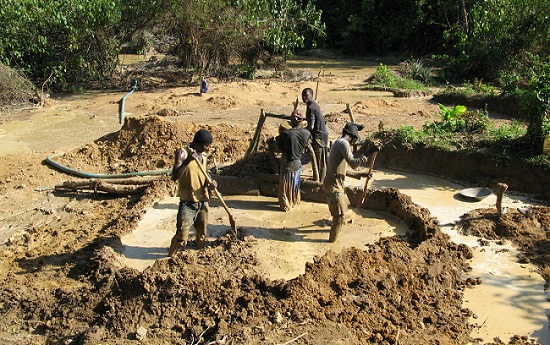
Initial preparations for gold mining in Africa. (Representative photo)

Stretching across a whopping 69,484 square km, Lake Victoria is also called Victoria Nyanza. It is the largest lake in Africa and the chief reservoir of the Nile, lying mainly in Tanzania and Uganda but bordering on Kenya. DRI officials say this is the route which is used by smugglers seeking gold for the big Indian market.

Detailed investigation by Impact, a Canadian think tank, showed India, which imports one third of the world’s gold supply, is picking up the metal from Congo, a nation where gold mines are linked to corruption. A portion of the artisanally-mined gold is exported from Tanzania, the bulk of the gold travels through Uganda. The biggest city in the region is Mwanza, a port on the southern coast of Lake Victoria that offers direct cargo service to Port Bell outside Kampala. The port also has direct road links with Kigoma, a town close to Lake Tanganyika from the mineral-rich Kivu Provinces that lie in the eastern parts of Congo.

Merchants of Indian origin use air and road links to Nairobi and then export the metal to the UAE and then to India. Somewhere in the route, illegal gold turns legal.

Indians are all over Mwanza, a town notorious for such illegal sales. Indians have an edge in Mwanza because they pay top prices, much higher than the London Bullion Market prices. The gold then travels from Mwanza to Kampala, Nairobi, Zanzibar and Dar Es Salaam and then lands up straight in Dubai. And then, the gold goes through an interesting process in Dubai to turn legal and eventually lands up in India. 

In some cases, the Indian refiners in Kampala trades as much as 200 kg of gold every week. During 2017-18, as many as eight Indian refineries imported over 200 tonnes of gold from Africa. 

The Impact report says Sameer Bhimji, a controversial gold importer on the radar of India’s Enforcement Directorate (ED) exports a little over 700 kg of gold from Uganda every week to Dubai for refining and eventual export to India. Thanks to this smuggling, surging gold prices are now becoming a major headache for the Central government.

The World Gold Council says the propensity to smuggle increases each time the taxes are hiked. 

A previous spate of smuggling occurred after India, which imports almost all of its gold, saw then Finance Minister P. Chidambaram increasing the tax three times in 2013. Illegal inflows peaked at 225 tonnes in 2014. 

In September and October 2019, nearly 40% more gold was seized than the same period in 2018, mainly from China, Taiwan, Hong Kong, Myanmar and Dubai. On December 10, DRI officials arrested one Sahil Jain in Mumbai for illegally importing over 180 kg of gold in the last ten months. Jain, a 23-year-old gold merchant, said there were many, probably thousands like him, doing the same.

And there lies the fear. 

DRI officials say there is no guarantee that the gold which is smuggled from China is pure. Kingold Jewelry, a NASDAQ-listed company based in the city of Wuhan (of coronavirus infamy), was once considered China’s largest gold jewelry, got into trouble after using gold as collateral in 2013. The company’s debt continued to climb every year. Eventually, Kingold pledged 2.7 million ounces of gold in total, worth about $4.8 billion. Kingold not only offered the gold as collateral, but even had its gold inspected by government certification offices and insured for US$4.3 billion by a state-owned insurance company. 

Everything seemed foolproof. But one day, the scam was unearthed. In late 2019, Kingold failed to repay a debt owed to a creditor, Dongguan Trust.

Like with all collateralized debts gone awry, Dongguan took possession of Kingold’s gold that had been pledged as collateral. When the Trust went to monetize the gold, they realised those bright shiny gold bars were actually copper bars wrapped in gold. Shocked, other creditors began checking their own collateral. They also found out the gold they held was also copper. The 2.9 million ounces of fake gold in question represent 22% of China’s 2019 gold output. 

Expectedly, many are asking, how much of China’s gold reserves are gold plated? And how much of it has been smuggled into India by Chinese traders through Kathmandu and Bangladesh?

India’s illegal gold rush is indeed a matter of concern for the DRI, Customs, and the government.

Two and a half front war: Continental strategy & scenario

“The art of war is of vital importance to the State. It is a matter of life and death, a road either to safety or to ruin. Hence it is a subject of inquiry which can on no account be neglected.”                                                                ― Sun Tzu, The Art of War

Part I covered the India-China civilizational connect which prevented a confrontation let alone a conflict during the pre-independence of both countries, and genesis of the boundary impasse. In Part II, the resolution/ way forward for resolving the issue was analysed which essentially calls for statesmanship, and atmospherics of ‘Give and Take’, out of box thinking, avoiding irritants, and focus on national objectives and interests for the long term. This Part provides a flavor of the much hyped ‘Two and Half Front War’, spoken of quite frequently whenever India’s sovereignty, integrity, security and strategic freedom of India is discussed. At the outset one would de-link the narrative from the ongoing tensions along the LAC, and most importantly it is imperative to understand that armed forces/militaries do not go to war but nations go to war, and this fundamental truth must be addressed accordingly by every citizen, political parties and leaders. Conflict scenario due to space constraints is discussed at the strategic level, to showcase the immense scope, multi-dimensional nature and its complexity.

Preamble

Emerging multi-polar world, multi-domain security challenges both kinetic and non-kinetic, rise of authoritarianism, nationalism and bilateralism, threat of climate change, economic slowdown leading to trade wars and barriers, contest for strategic space and alliances is compelling ALL countries to carry out dynamic strategic balancing, leading to a turbulent international and regional security environment. Nations will now remain in a state of ‘constant engagement’.

Geography and security related zones still conform except for the global players USA, China and to some extent Russia. 24X7 Multi-Domain environment/activity has changed the security landscape globally and blurred the distinctions between peace and war, scope of confrontational activities and even levels of conflict (blurring distinction between tactical to strategic). China has emerged as a global power with increasingly aggressive manoeuvres to expand its strategic space (from economic, political to military), ready to take on USA and allies in an ideological confrontation. It is a truism that it will brook no interference from India in its quest for Asian supremacy. With deliberately unresolved boundary disputes (Out of 14 boundary disputes only two with India and Bhutan remain unresolved) and collusivity with client state Pakistan, India needs to be prepared for a two-front conflict, however remote the probability may appear.

War/conflict is not a game of numbers, however, the current comprehensive power ratios especially armed forces of India vis-a-vis China and Pakistan are challenging. India ideally seeks to adopt a credible deterrent and punitive deterrent posture against China and Pakistan respectively. For this our CNP (comprehensive national power), the national security apparatus, economic positioning, military modernization structurally, hardware and software (including true integration and jointness in the form of Theatre Commands) NEEDS TO BE TRANSFORMED to create requisite capacities and capabilities to compete, confront and if necessary fight a two-front future war in a 24X7 Multi-Domain Environment (MDE). Assertive China’s other interests (existential importance of BRI (belt and road initiative) and CPEC), her relationship with Pakistan and South Asian nations, her suspicions about Tibet, dependence on Indian Ocean Region (IOR), India’s growing alliances (US, QUAD), and her desire to maintain levers in the relationship with India suggest that a boundary settlement is not a Chinese priority at present.

Emergence of Multi Domain Operations/Environment/War (MDO/E/W) and its impact on the Future Confrontations and Conflict

Multi Domain Operation envisions the nation deploying and employing all facets of comprehensive national power (CNP) including the military (not exclusively) and specially game changing technology, from diplomacy to economic leverages, fighters to destroyers, space shuttle to submarine, cyber to satellites, social media to psychological operations, AI (artificial intelligence), big data to networks, tanks to attack helicopters, munition factory worker to hacks— working together intrinsically as ONE, to overwhelm the adversary with attacks from all domains: land, sea (including sub-surface), air, space, cyberspace, psychological and networks centric operations, dense urban, information influence operations (IIO) including social media.

Future wars will blur the distinction between war, peace and confrontation. Battle space has expanded, converged and compressed all at once (truly oxymoronic!); tactically, by bringing kinetic and non-kinetic effects to bear from any place in the world and, strategically, by being able to challenge the deployment and echeloning of forces into the fight at all places simultaneously (even US homeland is no longer safe from kinetic and non-kinetic attacks; missiles, cyber, psychological, network attacks).

To illustrate, an ICBM (intercontinental ballistic missile) /PGM (precision guided munition)/ cyber virus/trade sanctions /HALE (high altitude long endurance) drone can be launched from any part of China and will impact the close support area/forward localities, military rear areas, and concurrently military and civilian targets across the length and breadth of the country. Similarly, an Indian ICBM (intercontinental ballistic missile) Brahmos/ Prithvi missile/perception management operations launched from near the LC/LAC can target an LAC bunker or a strategic/operational target in Tibet and even mainland China depending on range of domain/weapon system.

The Chinese seem to believe that ‘quantity has its own quality’ and so they mass produce and sell defence related systems. MDW (multi domain operations) calls for a change of thought process, ‘a transformation and not just modernisation’. We need to go beyond the current jointmanship and synchronization of operations, and thus the requirement of Theatre Commands. On the multi-dimensional chessboard, the facts of geography, the ambitions of strategy and the realities of politics and technology all interact.

In Indian context specially with reference to borders, use of land power remains the most conclusive instrument of strategy and ‘whether or not land constitutes the principal geographical medium on which combat is waged, strategic effect must ultimately have its way in a territorial context’. I would like to categorically state that from a strategic and military point of view, for India to take its destined place as a regional power in the mid-term and a global power in the long term, we need to be an economic, diplomatic, continental, maritime, air, space, cyber, military, economic, technological and information power– a Multi Domain Power. 

Important International and National Security Truisms

  • ‘No permanent friends or enemies, only permanent interest’; at best we may obtain intelligence, material and moral support; WE NEED TO BE PREPARED TO FIGHT ALONE.
  • Blurred distinctions between war and peace, and tactical to strategic operations.
  • Deterrence potency of even global powers have diminished, impacting their capabilities to dictate global affairs.
  • Non-kinetic verticals often stay below nation’s red lines, defy attributability, making proportionate response difficult.
  • Hostile remote LC/LAC regions provides impetus for adventurism.
  • Lack of a formal written/promulgated India’s strategic doctrine/National Security Strategy (NSS).
  • ‘The now permanent, strategic China-Pakistan collusive partnership has brought in a whole new equation, with a much more expanded assistance in multi domain expected from China even in case of an Indo-Pak war’, and also waging a proxy war.

The Statistical Ratios also provide a Narrative

Everyone understands that wars are not based on just numbers, however, today smaller nations with low populations are very unlikely to become major powers. Numerous Think Tanks provide data on a country’s CNP (comprehensive national power) specially military force ratios of which Lowy Institute, Australia provides very detailed interactive data. Readers should surf for very interesting deductions and can also read ‘The sobering arithmetic of a two-front war’ by Abhijnan Rej, ORF Special Report, 10 Jul 2018 It is apparent that even with partial force application by China (up to 30%) and full force application by Pakistan the numbers are challenging for India.

Two and a Half Front Scenarios.

Firstly, China initiating conflict against India with restricted political and military aim, as an all-out war is improbable due numerous considerations of international power equations, economic and political considerations, competing strategic alliances, status of nuclear weapon states, slow Chinese decline in economic growth and internal security compulsions, priority of other regions like South East and East Asian nations and seas, Taiwan, inability to control Indian Ocean Region and with Pakistan entering the conflict sensing a strategic opportunity specially regarding Kashmir. This is the most likely scenario.

Secondly, India carrying out pro-active operations against Pakistan and China joining the conflict (unlikely)/drawn in due to political or even existential considerations [while existential may sound ludicrous, I firmly believe that success of BRI of which CPEC is a pivotal part is existential to CCP to meet growing aspirations of a restless Chinese populace].

Thirdly, a planned orchestrated two-front war by China and Pakistan with synergy in all domains. All three being nuclear weapon states complicates the already combustible situation, and invites early global intervention. However, an unstable pre-occupied world security (COVID-19) and lure of ‘out of proportion strategic gains’ in a short swift war could create conditions for this scenario. This will provide the stiffest challenge for India. The Half Front refers to internal disturbance/insurgencies in union territories of J&K and Ladakh, North East states and real threat of LWE (Left Wing Extremism) that currently consumes 90 districts across 11 states as per government of India.

Strategic Overview of Conflict

Having highlighted challenging force ratios and the emerging MDO (multi domain operations) scenario, one should also understand that it is not 1962, and our current force structures coupled with the attrition filled Himalayan terrain where the scenario is likely to pan out, will allow our Armed Forces to adopt (limited) punitive posture against Pakistan and dissuasive posture against China with limited offensive capability.

The vital role of Air Force which enjoys a strategic advantage of operating from lower altitudes against China (with diminishing assets it needs an urgent push in numbers and technology to fulfil its role of counter air and counter surface operations which are both battle winning and battle changing capabilities), and of the Navy which can cause considerable attrition to both Chinese and Pakistan naval assets if they manage to draw them into the IOR (Indian Ocean Region) bears mention.

It is important to highlight that there is very little possibility to switch our forces and resources between fronts (applicable to both Army and Air Force while the Navy will need to be deployed along both the Arabian Sea and Bay of Bengal), and there will be almost total situational awareness with the adversaries given Chinese capabilities (our own capabilities are moderate unless we persuade USA to chip in as Russia is likely to remain neutral).

We discuss a well-orchestrated joint China-Pakistan pro-active operation.  The confrontation being political, it could be ‘to teach India a lesson and show the world’ her power projection potential of an ‘Arrived Super Power’ (in the process, humiliate India/impact India’s aspirations), while Pakistan would like to resolve the Kashmir Valley equation to her advantage. J&K is the only area where there is physical collusivity between China and Pakistan, and East Ladakh is vulnerable because of terrain, remoteness and sector segregation, mechanized forces operating conditions and own lack of infrastructure. Operations could start as an aggressive competition and confrontation using both kinetic and non-kinetic means but could easily escalate to a broader conflict. Deploying and employing land, maritime and air resources and routes and bases through other immediate neighbours cannot be ruled out.

Getting to more specifics, China and Pakistan operating along our Northern and Western Borders (both prosecuting MDO (multi domain operations) pan India in hinterland also), we anticipate their employment of fires across domains – cyber, computer, Information Influence Operations (IIO) specially social media, hybrid, electro-magnetic spectrum, space, application of PDIME (political, diplomatic, information, military and economic) during peace (constant competition) and imposition of their will with increasing tempo, focus and lethality just prior to conflict to try and achieve his political and military aims, without fighting. Shifting gears to actual combat both countries will employ their air assets including attack helicopters, ISR (intelligence, surveillance target acquisition) capabilities, special forces, rockets, missiles and artillery to degrade our strategic, operational and tactical assets and military forces, isolate the battle field, and then employ offensive forces to defeat our land and air forces in detail.

Permanent terminal objectives even in the event of a full-scale war are most likely to be Chinese perception of his traditional borders which in Ladakh are close to the current LAC and in the Eastern Front includes the state of Arunachal Pradesh. For Pakistan it would like to capture maximum territory in J&K and along our Western borders to use for strategic bargaining in the Valley. Except for the physical land boundary disputes, there is no other territorial or maritime disputes with China. However, terminal objectives would be dictated by their political aim translated into military objectives, battle field success in terms of real estate, domains, battlefield casualties (especially Chinese) and vulnerabilities.

India’s response especially military including resolve and war fighting potential, international reactions and the nuclear dimension; the same is being war gamed on a regular basis at the strategic and operational level within our Armed Forces. The intensity of hard and soft power would be nothing like the nation or our troops would have experienced. We have one of the most battle-hardened troops in the world, but the intangible effect of psychological and information operations, isolation, lack of situational awareness, operating in a degraded environment coupled with a 360-degree conflict with no front, rear and flanks will certainly impact them; if we do not train, prepare and have the capacity to counter and negate their design of conflict.

China will wage such a war; however just as a stalemate for India is considered a defeat, when we launch pro-active operations against Pakistan, the same is applicable to China. Their aim would be to achieve their political and military objectives swiftly. Our internal situation will be handled adequately by Central Armed Police Forces with Army deployed at more sensitive sites and in reserve. The logistic trains will be well protected and systems are in place to ensure smooth chain supply without disruption with ample contingencies.

For India, as already highlighted, formidable terrain friction along the LAC, LC and AGPL (actual ground position line) where the land wars will be fought (Pakistan or India could initiate conflict across the international border where the dynamics are in our favour) will consume troops of the attacker (high ratios of 6 to 9 times) and will be to our advantage. Our dug in well-fortified and stocked positions will continue to hold ground despite being encircled or bypassed and will need physical clearing, own effective general and close fire support (artillery, rockets, missiles, EW (electronic warfare), optimum use of attack/armed helicopters, cyber war), strategic and operational logistics, timely ammunition, equipment and troop reinforcements, synergized counter air and counter surface support, opening up of new/different fronts/areas, newly acquired strategic lift capabilities and most importantly conduct of Theatre MDO and keeping a major portion of our strategic strike forces (four strike Corps including the Mountain Strike Corps) largely uncommitted for limited offensive operations /riposte and continuously recreating reserves, will ensure a slow grinding attrition based defensive operations unbalancing and stalling their offensive. 

While it will be a challenge, we must keep increasing our military capabilities to impose prohibitive costs to deter this adventure. As of now it is appreciated, that in case of a two-front war, we can defend ourselves, launch limited offensive operations, and cause prohibitive degradation of aggressors’ Armed Forces to thwart their political and military objectives, given the proven ethos, training, combat experience, resolve, leadership and professionalism of our Armed Forces. 

The Way Forward

Given the international and regional dynamic security situation, our national economic situation, slow pace of indigenization (Make in India), the operational necessity of holistic capacity and capability building of our Armed Forces as a pivot of CNP (comprehensive national power) is a strategic imperative. It will be pragmatic to have a two-phase strategy to strengthen and optimize our national security apparatus viz Phase 1 – Immediate future (3-5 years) and Long-Term Plan (beyond 5 years). Some essential national and military measures are listed below.

Immediate Future Plan (3-5 years, which will automatically spillover into the long term)

  • Strategic Direction for the Nation and the Armed Forces and formal and if necessary government orders leading to true Tri-services integration and commencement of Theatre Commands raising (already on).
  • Increased Budgetary Allocations imperative for National Security. This will have to be done for a long period, as envisaged by experts to 3% of the budget.
  • Re-structuring MoD and all three Services. Impetus to ‘Make in India’.
  • Place ITBP (Indo-Tibetan Border Police) along LAC under operational control of the Indian Army.
  • Roadmap, planning and implementation to fight a two-front war in MD (multi-domain) environment.

Longer Term Measures (beyond 5 years)

  • Build requisite strategic air and sea lift capability.
  • Modernisation of the Armed Forces.
  • Minimum Stock Levels (MSL) of Munitions, Equipment and Spares and Setting the Stage for Technological Upgrade of Armed Forces.

Conclusion

Future wars are going to be very complex, intense, multi-dimensional with blurred distinction between competition, confrontation and conflict, with diminishing power of deterrence, and ambiguity of attribution and commensurate retribution. India must be prepared for a two and a half front escalating security and war scenario. Continuous building of CNP (comprehensive national power) of which the military is an inescapable and operational imperative needs to be done with focus, dedication and ‘whole of nation approach’. Our Armed Forces need to transform itself to deter and if necessary fight and win a two-front war, and ensure that both China and Pakistan will bear the consequences of military and national embarrassment. WE MUST CONTINUE THE PROCESS AS A NATIONAL ENDEAVOUR NOW.

“You can have peace. Or you can have freedom. Don’t ever count on having both at once.”                                                                                           ― Robert A. Heinlein

Click here to read the Part I
“Civilizational Connect and Genesis of India China Border impasse”

Click here to read the Part II
“Recommended way forward for boundary resolution between India & China”

Recommended way forward for boundary resolution between India & China

Part 1 discussed the strong civilizational connect (recorded formal interaction dates since 2nd Century BC) between India and China which prevented any sort of confrontation let alone a conflict, and India’s official position of the boundary between the two countries. History, geography, geo-politics and strategy, economy, technology, military potential, comprehensive national power and most importantly individual personalities (leaders) have a direct bearing on the way forward. The Part 2 in this series focuses on the ways to reach a decisive resolution to the boundary impasse and ignores the tactical and realpolitik irritants which should not impinge on national interests and objectives of nations being more permanent in nature.

There is however, a rising trend of nationalism either propped up by the government/regime or due to insecure and unstable security environment, which gets exacerbated in case of boundary disagreements/disputes, because a pivotal manifestation of nationalism is protecting one’s integrity and sovereignty. Just like a human can’t think of anything else till his/her basic needs like food and water are met, there will always be turbulent relations between two nations that have a boundary/border dispute. One can manage a complex boundary issue and focus on other mutual commons only for so long, but sooner rather than later, it is imperative that boundary differences are resolved expeditiously. Geography has dictated/destined that the two most populous nations China and India, with immense potential of human and natural resources, are contiguously located. Both China and India, ancient, proud civilizations with glorious histories are destined by their geography, size, population, resources and history to be great powers in the world order. While the debate on shared and contested strategic space can carry on, one indisputable fact remains that one of the primary irritants is the boundary dispute between China and India. The Century of Asia will initially see a lot of jostling and balancing for space, creating and dominating areas of interest and influence between nations within Asia, and intervention of global powers like USA, Russia and EU. This will lead to insecurity and potential conflict situations.

In the India-China context, however complex the boundary question may be in terms of history, and the firm irretrievable stance taken by both countries, it is imperative for world peace, and for prosperity and aspirations of China and India to resolve their boundary dispute with mutual understanding and cooperation, in atmospherics of ‘give and take’ in the near future, as time for procrastination is over. Everybody acknowledges the fact that the boundary issue is a political matter of state, and calls for visionary leadership and statesmanship of the highest order from both sides for its resolution.

Theoretical Context

International Relations Theory and Regional Security Complex Theory (RSCT) postulate that territorial pre-eminence (military) is more potent and powerful than non-territorial domains in the security calculus, and regional security zones are fairly independent of globalisation and global political trends due to their strong emotional, geographical and historical links. The central idea in RSCT is that, since most threats travel more easily over short distances than over long ones, security interdependence is normally patterned into regionally based clusters/security complexes. Thus despite globalisation, for majority of states (except for global powers), the main game of security is defined by their near neighbours. China the rising dragon has arrived, and is announcing her presence demonstrably by changing the status quo in Asia, to establish herself as the dominant power in Asia. India on her part has been acting with great maturity, responsibility and resolve through all the Chinese interventions and border stand offs along the LAC. China’s building of massive infrastructure projects along with a large Chinese workforce presence in PoK as part of CPEC, her stance regarding abrogation of Article 370 and Article 35A of the Constitution of India in the UNSC when the entire world has accepted that it is entirely an internal matter of India, her stubborn support to Pakistan in every issue, turning a blind eye to the relentless proxy war and acts of terrorism being conducted by Pakistan demonstrates the fact that China is not too concerned about Indian sensitivities, which does not help matters for a rapprochement on the border issue. 

Initiation of the Boundary Resolution Process

The 1993 Bilateral Peace and Tranquility Agreement (BPTA) was a political milestone post-independence, which created an expert group of diplomatic and military personnel to ‘advice on the resolution of differences between the two sides on the alignment of the LAC’. The September 7, 1993 Agreement effectively delinked settlement of the boundary from the rest of the relationship, and delinked it also from the maintenance of peace on the border. Both countries also formally renounced the use of force to settle the issue. It also spoke of confidence building measures (CBMs) to be mutually agreed to in the future, including restrictions on air activity and limits of size of military exercises near the LAC and possible redeployment of forces.

CBM (confidence building measures) should be based on the concept of ‘mutual and equal security’ rather than on parity or other simple formulas. Two portions of BPTA have yet to be implemented or discussed in detail by the two countries. One is the provision that “military forces in areas along the LAC will be kept to the minimum level compatible with the friendly and good neighbourly relations between the two countries”. The other is the provision for “mutual and equal security,” which has not yet been discussed conceptually or explored or implemented by China and India, even though it provides a theoretical basis for mutual and reciprocal security, which could prove valuable as security environment turns more volatile, and stronger military capabilities and increased military presence on both sides of the border make accidents and mistakes more likely.

What followed in 1996 was the Agreement on Confidence-Building Measures in the Military Field along the LAC. The primary objective of these measures was the commitment to the maintenance of peace and tranquillity along the border. The Declaration of Principles for Relations and Comprehensive Cooperation was signed in 2003 in which the Joint Working Group (JWG) that was set up and functional at a purely bureaucratic level was upgraded to a meeting of Special Representatives (SR), thereby providing much desired political impetus for resolution. These agreements led up to the adopting of the ‘Political Guidance Principles for the Settlement of Boundary Question’ signed in 2005.

The exchanges between training institutions, participating in sports and including cultural activities formed other CBMs (confidence building measures). A comprehensive push on promoting bilateral military relations remained on track following the visit of the then Indian Defence Minister Pranab Mukherjee, to China in May 2006. The visit led to the signing of a Memorandum of Understanding (MoU) that called for the institutionalization of frequent exchanges between the officials of the Defence Ministries and the armed forces through an Annual Defence Dialogue, in addition to developing an annual calendar for joint exercises and training programmes.

In April – May 2013, following three week long confrontation at Depsang valley in Ladakh, two sides signed Border Defence Cooperation Agreement (BDCA) to address tactical problems and to prevent their escalation. To further enhance mutual cooperation and promote understanding between the two armed forces, the two sides have also conducted low-level tactical military exercises whose scope is being increased to naval and air cooperation. A hotline between the Indian DGMO and equivalent appointee from the Chinese Central Military Headquarters has also been agreed to expeditiously resolve tactical and border crisis situations and avoid miscalculation and escalation of any border conflagration. All the committees/groups have held numerous meetings.

While the other groups mainly focus on maintaining peace and tranquillity along the border, the Special Representatives meeting does discuss political resolution methodologies of the boundary question. Despite the Special Representatives meeting numerous times (20 times), there has been very little forward movement/change in their respective stance regarding the boundary. Post the Doklam face off, PM Modi and President Xi Jinping met at Wuhan during April 2018, and they agreed to issue “strategic guidance to the respective militaries to strengthen communication to build mutual understanding and enhance predictability and effectiveness in managing borders”.

It is pertinent to mention that the Indo-China border/LAC is very different from the international boundary and Line of Control (LOC) with Pakistan. With Pakistan, India has for the most part an agreed upon international boundary. For the rest, the LOC delineated on a map signed by the DGMOs of both the armies of India and Pakistan, has international sanctity of a legal agreement behind it. Nevertheless, both the IB (international boundary) and LOC with Pakistan are “hot” or “live”, crossed by terrorists and militants (and even regulars by Pakistan, like prior to Kargil conflict) and regular cross border firing occurs. With China, the LAC is a concept; neither the LAC nor the boundary is agreed upon by the two countries, let alone delineated on a map or demarcated on the ground, yet this is one of the most peaceful contested borders in the last 43 years where not a single shot has been fired in anger.

The LAC is the basis of peace, and peace would remain fragile without an agreement as to where the line lies. The Indian side has always pressed for both sides to together clarify the entire LAC without prejudice to the final boundary agreement, which while agreed to initially by the Chinese yet it has not taken any action upon it.

Despite the lack of clarity both sides have maintained Peace and Tranquility along the LAC for three main reasons; firstly, each side has a fairly good idea about the other side’s patrolling patterns and other behaviour of where the other side thinks the LAC lies, secondly, both sides have, by and large, kept to their interpretation of the LAC, avoided provocation, and implemented the operating procedures and other CBMs that the Agreement called for, and lastly, both sides have not been in direct contact along most of the line. Even in the areas that both consider as lying on other side of the line, both sides generally refrained from establishing a permanent presence or changing the status quo significantly. A change of attitude and actions is discernible in Chinese actions and patrolling patterns; they have become more aggressive, more frequent and insistent on continuing even when confronted by Indian patrol. And as Chumar (2014), Doklam (2017), series of intrusions during summer of 2020 indicate, they have burrowed down and built permanent structures and even deployed.

The Way Forward

India is justified in feeling that China is keeping the issue in the back burner to pull it out for strategic, political, diplomatic and military considerations and advantages. While looking for political solutions, both sides must concurrently strengthen ‘commons, especially economic and diplomatic’ and focus on national aims and aspirations. Policy makers on both sides feel that it would be prudent to maintain the present course of multi-directional engagement with each other and their neighbours, and, simultaneously India focuses more on building and enhancing own comprehensive national power. That alone will gradually change the regional environment and provide incentives to cultivate a serious and strategic equation. We need to step out of the stated and irrevocable positions taken, think out of the box, accept existing ground realities, create the right atmospherics amongst the people and international community and come up with a pragmatic solution. The package deal as once offered by China for the boundary question or resolution sector wise, needs to be studied based on mutual understanding of the deal which can become a ‘win-win’ for both and find broad acceptance with the people of both countries. Both sides need to enlighten their citizens that old stands are not cast in stone. Shedding the old baggage would provide surprising breakthroughs.

It is pertinent to mention here, that closely related to the boundary issue is the question of Tibet. The British had sought to maintain Tibet as a buffer state, free of external influences, particularly Russian. Hence, they only acknowledged China’s ‘suzerainty’ – as opposed to sovereignty – over Tibet. In practice, this meant that British India maintained direct diplomatic ties with Lhasa, and enjoyed other privileges such as trading rights and armed detachments in Tibet. After independence, PM Jawaharlal Nehru in the interest of peaceful relations with China acknowledged Tibet’s suzerainty by China, despite enjoying independent diplomatic, economic and cultural relations with Tibet over centuries. In 1954 India signed an agreement with China on Tibet, renouncing its inherited prerogatives and recognising Tibet as a ‘region of China’. Neither side sought to discuss the boundary issue during the negotiations. India’s stately and generous action should have been acknowledged by China at a time when China was still settling down on the international stage facing numerous adversarial circumstances.

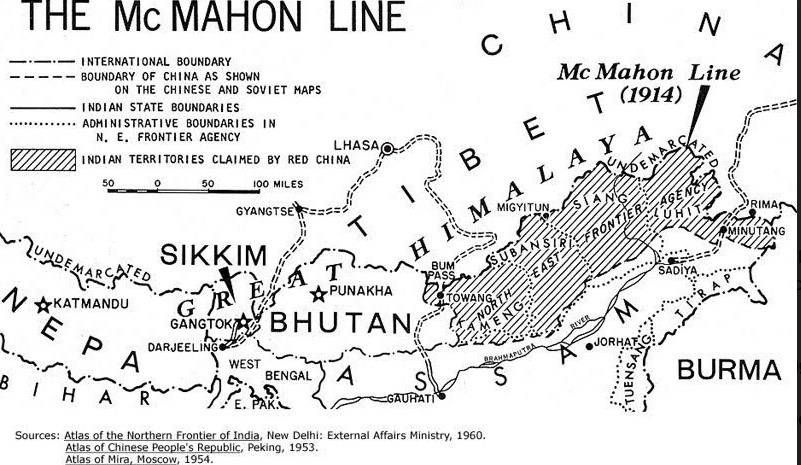
Another way is to provide a new name (other than McMahon Line) to the mutually accepted boundary along the lines of the Burma boundary resolution, which does away with the historical legacy and baggage specially of the imperial/colonial exploitative era.

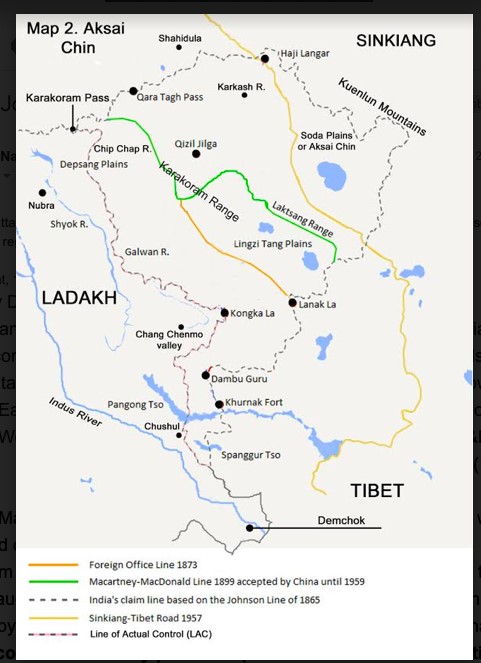
China has always considered the highway through the Aksai Chin (Highway 219) between Tibet and Xinjiang as a strategic road and non-negotiable. With another highway connecting both regions traversing through an area away from Aksai Chin, thus leading to diminishing strategic importance of the Tibet-Xinjiang National Highway, a possible reconsideration of stance by the Chinese may be advocated.

At the LAC and operational and tactical level numerous CBMs (confidence building measures) have been highlighted, followed by the Wuhan Summit that provides enough space to resolve any irritants on ground. It is recommended that actions along the LAC should remain within the military domain of peaceful resolution (which has endured) and needs political intervention only if it goes beyond military parleys, rather than get politicised (specially with media sensationalism and nationalistic uproar created) in the initial stages itself. This by itself will keep the tensions tempered and pave the way for political parleys. The expeditious fruition of the DGMO hotline would be a welcome move to ensure immediate military resolution of operational and tactical situations emanating along the LAC. Delineation and demarcation of the LAC as perceived by both sides on ground and map should be the next logical step, which will ensure peaceful borders.

Whether the solution lies via a package deal/whole of boundary approach or incremental/sectoral negotiations can be reviewed and both countries should re-evaluate. The Indian intelligentsia, for its part must enlighten the body politic and the public that its original claims to Aksai Chin are not sacrosanct. But India must also cast its gaze on global geopolitics and discern changing trends with a sober outlook and always with an eye on its own long-term interests. It would be a premature and even dangerous premise to visualise that India’s relative global position enables it to actively play triangular or quadrilateral geopolitics with China. To ‘swing’ towards an anti-Chinese alignment or be ‘weaned away’ by China is unlikely to work in practice. Neither country can afford to coerce the other given the current security environment and balancing alliances. Resolution of the boundary issue is surely a ‘win-win’ situation for both and will lead to peace, prosperity and stability in Asia and the World.

India needs to continually watch and study the developing situation, continue building her own comprehensive national power (CNP), build her external alliances, and ensure freedom to operate within her growing strategic space, and showcase herself as a mature balancing power.

Click here to read the Part-I
“Civilizational Connect and Genesis of India China Border impasse”

Click here to read the Part-III
“Two and a half front war: Continental strategy & scenario”

Civilizational Connect and Genesis of India China Border Impasse

Overview of the Security Environment in present COVID-19 times.
What does a big, unpopular, ‘different’ boy with very few friends do if he is suddenly picked on by most of the class. Admittedly he did something horrific bringing unimaginable misery to himself and to the entire class. But ironically the other big boys had also done innumerable equally nasty things without being castigated. He either comes out arms flailing at anyone or everyone, especially those in close proximity to him, or retreats into a shell. Sounds simplistic but astoundingly it rings true because destiny of nations has most often been shaped by rulers with power and authority (Hitler, Stalin, Roosevelt, Churchill).

In present times, there are three groups, anti-China led by the USA, pro-China a very small but still powerful group, and third the fence sitters (run with the hares and hunt with the hound’s variety) who surprisingly are the largest group, mainly because of geography and economic connect. Real Politik is being played out with Machiavellian ferocity, by ALL. No one can play above board or altruistically; national interests and future strategic space is the key for survival/growth/domination. Majority action, however, by no means guarantees either moral or legal sanction.

When you’ve got a house full of sick people you don’t usually go out looking for a fight. But China (Communist Party of China to be more precise) led by President Xi Jinping is doing exactly that. Like a high-stake gambler, he has rolled the dice – while Covid-19 epidemic rages – to see what he can win on the security and geo-political front. Muscle flexing has been impressive; intimidating or sinking fishing vessels (Vietnam, Malaysia, Philippines, even Japan); threatening South East Asia naval ships by locking missiles; conduct exercises to intimidate and develop specific skills needed to invade Taiwan; use belligerent language at all adversaries including stating intent of “reunification of Taiwan” openly; activities in exclusive economic zones of neighbours Japan included; closer home with obviously serious implications for India, engage in physical jostling, intrusions (presence of more permanent nature in Indian territory), force build up, digging in and building infrastructure at four/five locations in North Sikkim (1) and East Ladakh (3/4) thus changing the status quo of an already tense unresolved land boundary (more later in Part III of this series); and finally the ‘wolf diplomacy’ a recent phenomenon knowing its adverse impact (perhaps that’s the point!).

The situation is made worse by an equally belligerent USA and allies (and many other nations joining the crowd, but who dare not speak alone), who outwardly want reparation for COVID-19, but in strategic terms pull down the dragon before it breathes fire on them.

Within this turbulence this three-part article will dwell on India-China Relations.
Part 1: India-China civilization connect and genesis of the boundary dispute.
Part 2: Way forward for resolution of boundary impasse, and
Part 3: Probable two and a half front continental conflict strategy

India-China Civilisational Connect[

Two of the world’s oldest civilisations and largest nations of Asia, India and China are also immediate neighbours, that have enjoyed trade, cultural and spiritual two-way relations since time immemorial. This exchange was facilitated by four routes of communications; the Central Asian Route or the Silk Route; Assam- Burma and Yunnan Route or the Southern Silk Route; Tibet Nepal Route; and the Sea Route or the Maritime Silk Route. The first credible information about the India-China interactions is provided by Si Maqian (BC 145 – BC 90), the great Chinese historian in his masterpiece Records of a Historian: Foreigners in SouthWest. He narrates that while visiting Central Asia he saw Chinese and Indian products, confirming the fact that formal relations existed during 2nd Century BC. Subsequently at regular intervals historical writings by Ban Gu (32-92 AD) and others spoke of improved and increasing relations (including diplomatic) specially during Tang (618-907), Song (960-1279) and Yuan (1279-1368) dynasties.

Maritime activities were intense and it is reported in various sources that in Canton there were ships of Indian, Persian and Sri Lankan merchants. Calicut and Cochin in India rose to prominence as the new ports. References of other sea ports such as Mahabalipuram, Goa, Nagapattam, Quilon, Nicobar, Mumbai, Malabar, Calcutta and many more could be found in various Chinese literary sources. Indian astronomy, calendar, medicine, music and dance, sugar manufacturing technology etc. made their way to China.

The spiritual linkage transformed this relationship completely and took it to a new high. When exactly did Buddhism disseminate into China is a debatable proposition, however, most prevalent version is the famous dream of “golden Buddha” by Han Emperor Ming Di (58 AD–75 AD) when two highly proficient Buddhist scholar monks Kashyapa Matanga and Dharmaraksha visited China, and subsequently wave after wave followed. Of special mention are Kumarajiva (343 AD — 413 AD) who was accorded the honour of RajyaGuru by Emperor Yao Xing, and Xuanzang (7th Century).

Incredibly, Bodhidharma went to China in 6th century AD, and is believed to be the founder of Shaolin martial arts in China. School books talk of Faxian’s travels (monumental work Accounts of a Buddhist Country) to India and Xuanzang (The Journey to West during Great Tang) and Yi Jing who studied at Nalanda and became proficient in Sanskrit. Frescoes of Kizil and Dunhuang houses the portraits of many Hindu deities like Hanuman, Ganesha, Vinayaka, Laxmi and Shakti. Statues of Lord Krishna and Shiva have been unearthed from Quanzhou and Dali in China pointing to large settlements of the Indians in China. Owing to these cultural and material linkages, both India and China benefited immensely in the field of literature as also science and technology. Indian stories, fables, art, drama and medicine reached China. Along with Buddhist linkages, Hinduism also made inroads to China. This could be established from the discoveries of Hindu cultural relics at the sites such as Lopnor in Xinjiang, Kizil and Dunhuang grottoes in Gansu, Dali in Yunnan and Quanzhou in Guangdong provinces of China. There is no historical precedent of any confrontation between China and India for thousands of years up to their achieving independence, which is astounding and speaks volumes of the culture and spiritualism in both civilisations.

Gradual eastward expansion of western colonialism resulted in India being completely colonized by the British and China gradually transformed into a semi-feudal and semi-colonial society. The anti-imperialist efflorescence of the Indian and Chinese people manifested in a major way as a challenge to the colonial order for the first time during the First War of Indian Independence (1857-59) in India and the Taiping Uprising (1850-1864) in China, which was the first time Indian soldiers stationed in China switched over to the Taiping and fought shoulder to shoulder against the imperialists and the Qing government. This rapprochement continued when organized struggle for national independence was launched by the Indian and Chinese people.

Indian nationalists like Surendra Mohan Bose, Rash Behari Bose, M.N. Roy, Barakatullah Khan, Lala Lajpat Rai and many other outstanding pioneers of Indian freedom movement maintained good contacts and friendship with Sun Yat-Sen. Through Sun Yat Sen, the Japanese connection was cemented. The Indian National Army and the Ghadr Party prospered with material and moral support from Chinese and Japanese leaders. Chinese people identified with Mahatma Gandhi and freedom struggle and all events like the Non-Cooperation Movement (1920-22), Civil Disobedience Movement (1931-34) were covered and followed widely by the Chinese media and people.

However, most Chinese leaders never approved of the doctrine of ‘non-violence’. Nehru visited China in 1939 and after independence proclaimed those infamous words ‘Hindi -Chini Bhai Bhai’ (Indian-Chinese are brothers). He naively dreamt of a world order dominated by India and China. President Chiang Kai-Shek visited India in 1940 especially to break the ongoing deadlock between the British and the Congress, and met Gandhi. India was first non-communist nation to recognize China and establish diplomatic relations on April 1, 1950. India initiated and strongly supported China’s membership in the UNSC (United Nations Security Council), voted against China being labelled the aggressor in the Korean War and there was reciprocation from the Chinese side. The famous ‘Panchsheel’ was initiated by both. The geo-political and strategic equations of both India and China with the two super powers USA and erstwhile USSR, which waxed and waned was largely instrumental in shaping post-independence relations.

While India never had hegemonistic tendencies, China the ‘middle power’ always wanted to restore its past glory by any means, which included grabbing/occupying land and maritime zones based on its perception of past ownership. Independence exacerbated the grievances of China against India; unresolved borders, viewing India as a stooge of the West, and perception of Indian interference in Tibet.

India’s Perception of the Indo-China Border Issue

Colloquially, the terms boundary and border are used interchangeably, a boundary is the line between two states that marks the limits of sovereign jurisdiction. In other words, a boundary is a line agreed upon by both states and normally delineated on maps and demarcated on the ground by both states. A border, on the other hand, is a zone between two states, nations, or civilizations. It is frequently also an area where people, nations, and cultures intermingle and are in contact with one another. Three distinct steps are involved in boundary making. The first step is to have an overall political understanding of the basic boundary alignment. This step is referred to as allocation. The second is to translate this general understanding to lines on a map and this process is called delineation. The third and final step is to transpose the lines drawn on a map to physical markers on the ground. This step is called demarcation.

Quite clearly therefore a boundary settlement is not a simple drawing of lines on a map or a demarcation on the ground. It is a significant political act. The Principle of uti possidetis juris’ enshrined in international jurisprudence was invariably followed when it came to settling boundary claims. This principle states that whenever a state becomes independent, it automatically inherits colonial boundaries and that any effort to occupy or violate state territory after it became independent would be considered ineffective and of no legal consequence. This principle was recognised by the International Court of Justice (ICJ) as legally valid in the Burkina-Faso v Mali (1986) case. Further, if a state acquires knowledge of an act which it considers internationally illegal, and in violation, and nevertheless does not protest; this attitude implies a renunciation of such rights, provided that a protest would have been necessary to preserve a claim. This appears the only logical reason that Prime Minister Zhou en Lai rejected Nehru’s offer outright to take the dispute to the ICJ conveyed in his letter of January 1, 1963.

Specifics of the Disputed Border between India and China

The disputed areas between China and India can be divided into three Sectors: Eastern, Western and the Middle. The Indian stance is that the Sino-Indian boundary is 3,488 km in length [including the 523 km POK-China Section], with Western Sector being 1,597 km, Middle Sector 545 km and the Eastern Sector 1,346 km in length. Apart from the 5,180 sq km illegally ceded by Pakistan to China, namely the Shaksgam Valley in the Western Sector.

Eastern Sector (Refer Maps 1 & 1A) As regards the Eastern Sector, Tibet and India signed the Simla (now Shimla) Convention that gave birth to the McMahon Line separating Tibet from India on July 3, 1914 more than a hundred years ago at Simla. India accepts the McMahon Line as the international boundary between China and India with minor modifications in interpretation, in accordance with the internationally accepted ‘Watershed Principle’ which was the intent of the Chief British negotiator, Sir Henry McMahon.

The McMohan Line

Although the Simla Convention recognized that ‘Tibet forms part of Chinese territory’ (for purely political purposes by the British during the Great Game with Russia, but later on walked away from above stance), the then Chinese authorities did not sign the Convention as they objected specifically only to Article 9 of the said Convention that laid down the boundaries between Inner and Outer Tibet (viz proposed boundary between China and Tibet, which ipso facto implies acceptance of boundary between Tibet and India).

Other than that, the Chinese Authorities made it amply clear, on several occasions, that they did not object to any other Article, including that which showed the McMahon Line. From the time of signing of the Simla Convention on July 3, 1914 till January 23, 1959 when PM Zhou wrote a letter to Nehru, the Chinese never raised any formal objections to the McMahon Line; although they had many opportunities to do so. The Chinese representative, Ivan Chen, not only fully participated as a delegate, but on an equal footing with the Tibetan representative. One extremely pertinent and important observation is that China settled its outstanding boundary issues with Burma in 1960, along the Burmese sector of the McMahon Line (importantly, in 1914 when the Shimla Agreement was signed, Burma was an integral part of India), the settlement in physical terms is virtually an adoption of the same alignment, with some minor give and take. On resolution, the modified new line was ratified as “The Burma-China Boundary Treaty of October 1, 1960”. China is very sensitive about the historical imperial/colonial baggage specially involving boundaries and doing away with the moniker McMahon Line.

Middle Sector (Refer Maps 2 & 2 A) The boundary runs along the crest of the Himalayas. It is the least disputed Sector and differences exist in mainly four areas viz Spiti, West of Shipki pass, Nilang-Jadang and Barahoti. All these being South of the crest line, the Chinese claims are tenuous at best, keeping the internationally accepted watershed principle in mind. The disputed areas are under Indian control.

Western/Ladakh Sector (Refer Map 3). In the Middle and Ladakh/Western Sector the boundary was based on various lines agreed to by the Tibetan Government with the rulers of Jammu and Kashmir state and Himachal Pradesh from Seventeenth Century onward. There are three historical lines depicting the India Tibet boundary; the Johnson (1865), Johnson-Ardagh (1897) and the Macartney-MacDonald (1899) lines, apart from the Treaty in 1842 between India, Tibet and China which was signed by all three authorities. All lines are well documented and the historical narrative forming the basis of these lines and their relative acceptance / non-acceptance by the principle actors (British, China and Tibet) is not being recounted.

Upon independence in 1947, and accession of J&K to the Dominion of India by the then ruler Maharaja Hari Singh, the Government of India accepted Johnson Line as the basis for its official boundary in the West, encompassing Aksai Chin. However, India did not claim the Northern areas near Shahidulla and Khotan, for inclusion within Indian territory (Map 3). It is pertinent to point out that the Chinese have never provided a specific alignment along the Western Sector (specifically after their independence in 1949) and have changed their stance innumerable times.

Shaksgam Valley

The Shaksgam Valley (5,180 sq km) or the Trans Karakoram Tract is part of Hunza-Gilgit region of Pakistan Occupied Kashmir (POK), and is an integral part of J&K claimed by India, was controlled by Pakistan and ceded illegally to China in March 1963.

Click here to read the Part-II
Recommended way forward for boundary resolution between India & China”
Click here to read the Part-III
“Two and a half front war: Continental strategy & scenario”

Urgent steps needed to check drug addiction among Kashmir youth

Prolonged nature of the Kashmir conflict and the resultant trauma caused especially to the youth has largely remained unaddressed. Lack of focused post conflict healthcare services and increased proliferation of drugs from across the Line of Control (LOC) has exacerbated the problems multi-fold. The drug addiction has been on the rise for last few years and as of date over 2.5 lakh youth form part of addicted or affected population in the Kashmir Valley. With few mental healthcare facilities or de-addiction centres in the Valley, Kashmiris have been left to fend for themselves in case they or their kith or kin gets involved in this social and health evil.

A fresh data of the Srinagar police control room’s (PCR) de-addiction centre paints a grim picture. Out of the entire lot, most drug abusers fall in the age group of 18-35 years. While the numbers affected are very high, the patient flow at the de-addiction centre is alarming too. Last year, 633 were registered at the PCR, which has gone up to 1,978. Of these, while 81% were male, there were over 19% females suggesting that the number of female drug abusers too is on the rise in an otherwise conservative society. Started in 2008, the PCR’s de-addiction centre has treated around 10,000 drug abusers till date. It is high time to take steps to check this alarming rate of addiction in the Kashmir Valley.

Youth of Kashmir, faced with the larger issues of lack of education, capability building, unemployment and corrupt practices in the areas related to recruitment for government services, are taking refuge in drugs. The highest number of addicts belongs to the category of youth that was born in 1990s and has seen maximum violence. They are either adult youth or young adults, who needed opportunities and means to realise their dreams. “Conflict, high unemployment rate, relationship, peer pressures, family disputes, love breakups and death of loved ones and split families are main reasons behind addiction,” says a psychologist from the Indian Army who has recently been instrumental in starting a series of drug de-addiction centres in the Kashmir Valley.

“Suicidal tendencies were evident. Exam-related stress queries also topped among the callers, the PCR is grappling to address the increasing rush of patients. More than 55 patients are in the waiting list this month.
Another doctor from government hospital says “We don’t have enough space to accommodate all the patients. We treat them during the OPD hours,” said the psychologist.

Easy availability of drugs is causing an alarming rise in abusers. Drug addiction is getting very common in Kashmir because of its easy availability in the markets.

Commonly abused drugs are benzodiazepine, sleeping pills, cough syrups and Alprax. Besides opium, fluid, brown sugar and alcohol addiction is also common among the youth. More than 85% patients recovered through ‘social intervention plan’. It played a pivotal role in rehabilitation process.

The social intervention plan comprised individual sessions, family sessions, identification of stressor in the family, antagonist consent, work rehabilitation, relapse prevention education and pre-discharge counseling. Kashmir University directorate of lifelong learning is planning to initiate a one-month vocational course for rehabilitating drug addicts. This way many will earn livelihood and recover as fruitful citizens. Society must come forward and help these drug addicts to recover. There is need to accept them as normal citizens.

A patient’s mother said “Why is the drug problem of this magnitude? Why are the authorities not doing anything about it?” Several studies carried out on addiction in the Kashmir Valley reveal a strong correlation between conflict and drug abuse. The studies show that in Kashmir, drugs are not used for recreational purposes but as a coping mechanism to deal with the stress.

Apart from the immediate damage to drug abusers, the medium and long term corrosion to the very fabric of the society by the use of prescription drugs and banned narcotics has been well established in many other places in the world. In a study at the Government Psychiatric Diseases Hospital (GPDH) in 2002, doctors compared drug trends from 1980-88 and 2002 in patients. The figures not only show a shocking state of affairs, but also indicate how deep-rooted the scourge of addiction is. An alarming increase of over sixty percent was reported in the use of opioid-based preparations (9.5 per cent to 73.61 per cent), and an over twenty five percent increase in multiple substance-abuse (15.8 per cent to 41.6 per cent), from the 1980s to 2002.

It is difficult to break the nexus between the chemists, the peddlers and the police, admits a high-ranking police official. As per his estimation, Sopore and South Kashmir are the worst hit in the Valley. Experts say that the Kashmir situation is quite different from any other part of the world. Here, addicts avoid alcohol due to religious reasons and also because it is traceable (it has a strong smell); injectables also leave marks, and so they stick to benzodiazepines, codeine phosphate and opiates, which are easily available and can only be traced during the middle and the severe phases of addiction. Unless there are immediate measures taken from all quarters of society, and a long term effort is made to re-integrate this population into the mainstream, this youth of Kashmir will pass on this disease to their next generation.

After militancy, drug addiction in Kashmir is a new threat for youth in the valley. Prolonged militancy for more than two decades is being considered as one of the main reason towards increasing trend of drug addiction.

Hundreds of people, particularly youth are already trapped in this menace. There are only two drug de-addiction centers in the valley, one is being run by the J&K police and another by an NGO which makes it impossible for the treatment and counseling of the affected.