The exuberance of Indian culture and the astonishing diversity of people, nature, and cuisine make it a land worth exploring for tourists. Undoubtedly, India’s tourism potential is huge and every passing year there is an increasing influx of tourists in the country. Given the scenario, it’s not surprising that India’s rank in Travel & Tourism Competitiveness Index (TTCI) of World Economic Forum has moved from 65 in 2013 to 34 in 2019. Also, Foreign Tourist Arrivals (FTAs) during the period January- November 2019 were 96,69,633 as compared to 93,66,478 in January- November 2018, registering a growth of 3.2%. It also resulted in a significant increase in Foreign Exchange Earnings (FEEs). During the period January- November 2019 revenue generated from foreign tourists was Rs. 1,88,364 Crore as compared to Rs. 1,75,407 Crore in January- November 2018 registering a growth of 7.4%.
However, with increasing number of tourists, particularly in popular destinations, there has been a tremendous pressure on the natural ecosystem of a place. Be it depleting ground water table, increase in vehicular pollution or waste generation, various tourist destinations across the country are facing severe ecological crisis, which requires immediate steps to develop and practise sustainable tourism activities.
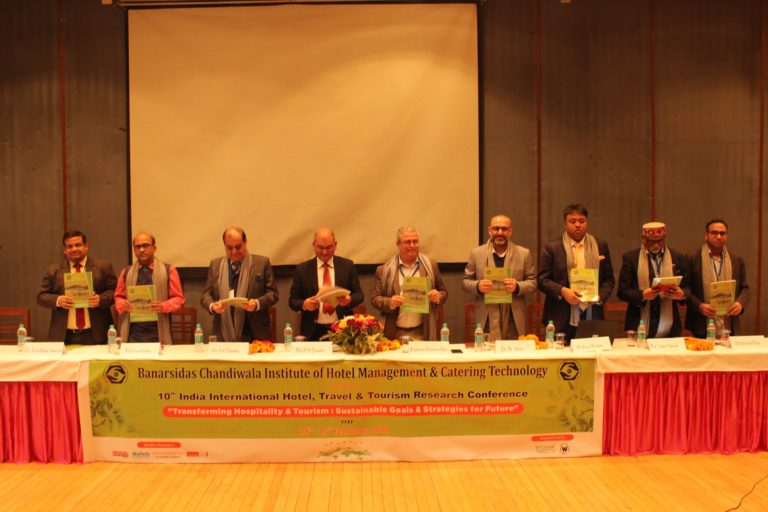
To explore various facets of sustainable tourism, Banarsidas Chandiwala Institute of Hotel Management and Catering Technology (BCIHMCT) recently organised 10th edition of its India International Hotel Travel and Tourism Research Conference series focusing on the theme “Transforming Hospitality & Tourism: Sustainable Goals & Strategies for Future”. The organisers were of the view that ‘with the rapid growth of hospitality, travel and tourism business, there is an urgent need to address all aspects of sustainability and to develop and incorporate strategies for achieving sustainable development goals’. “Through this theme, an effort is being made to include constructive deliberations on the issues related economic, social, environmental and technological sustainability in various aspects of hospitality, travel and tourism sectors,” said Prof. Raj Bhandari, Chairman, BCIHMCT.
During the two-day conference organised on February 14 and 15, 2020 several prominent international and Indian speakers participated. This included Prof. Francisco Dias from Portugal, Dr. Ali Afshar from Iran, Dr. Yanki Hartijasti from Indonesia, and Dr. Naira Mkrtchyan from Armenia. The conference included formal presentations, workshops, awards and other industry related activities and was attended by approximately 400 participants. Prof. Francisco Dias in his keynote address shared about the role of cinema and tourism and how it has a great potential to promote a particular destination or industry. Rahul Prabhakar from ITC Hotels shared about various steps taken by ITC group to promote sustainability in their hotels be it recycling of waste, energy conservation or tackling indoor air pollution. The chief guest of the inaugural ceremony was Anil Bhandari, former CMD, India Tourism Development Corporation (ITDC).
“The conference brought together a unique mix of experts, researchers and decision makers both from academia and industry across the globe to exchange their knowledge, experience and research innovations in Hospitality and Tourism Sustainable Practices. The future strategies need to be devised to achieve sustainable development goals aimed at creating definite impact on hospitality, travel and tourism businesses,” said Dr. Arvind Kumar Saraswati, Assistant Professor, BCIHMCT and conference convenor. He also informed that for the first time environment films were also screened as part of the conference, in collaboration with Woodpecker International Film Festival.
Every once in a while, we receive rather unexpected news at the most unexpected times! And often, such news reflects incomprehensible travesty of common sense, let alone macro-finance prudence.
Some years
ago, soon after the November 2016 Demonetisation saga, the Indian Government
decided to issue currency notes in the unprecedented denomination of Rs 2,000,
ousting the then dominant Rs 500 and Rs 1,000 notes, citing three
principal objectives, ostensibly to (1)
‘curb’ black money, (2) ‘deter’ counterfeiting and (3) ‘thwart” terror
financing.
Several official
government and RBI reports confirm and the ground realities prove that all three
objectives have failed. Also, the exact opposite results have come to be: (1)
unaccounted commercial transactions generating black money have risen sharply;
(2) the Rs 2,000 currency is the most counterfeited (being the most profitable)
Indian currency note; and (3) the exercise has had no impact on deterring
terror funding.
It is
therefore fair to surmise that this entire ill-considered, quixotic exercise of
introducing this high-value note has proved to be a serious and costly
misadventure, holding the prospect of eroding the government’s credibility.
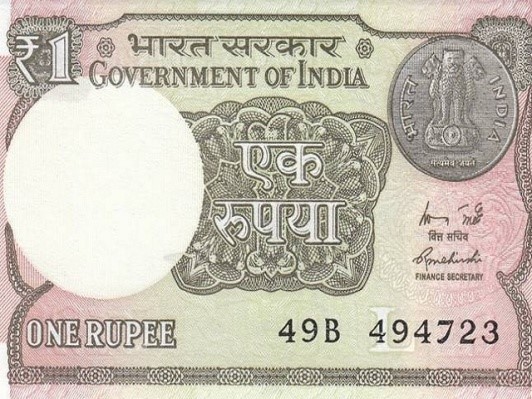
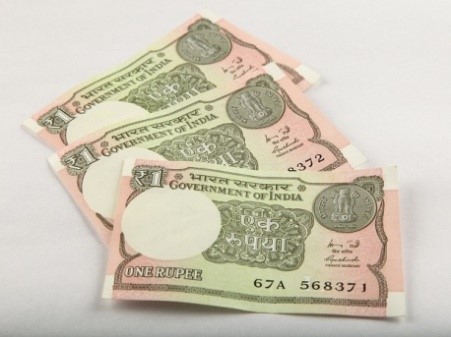
The One Rupee currency note would be rectangular (97 x 63 mm) and printed using 90 gsm indigenous rag content security paper, 110 micros thick. It will also have multi-tonal watermarks with Ashoka Pillar in the window. The overall colour of One Rupee Currency note will be predominantly pink green on obverse and reverse in combination with others.
A one rupee currency note carries the signature of the Finance Secretary as it is issued by the Government of India through the Ministry of Finance, while all higher denomination notes are issued by the Reserve Bank of India, bearing the signature of RBI Governor.
2. Rationale
No explanation is available from government sources up to the present time, hence the rationale for its introduction is left to the judgement of readers.
3. Historical Background, Nostalgia
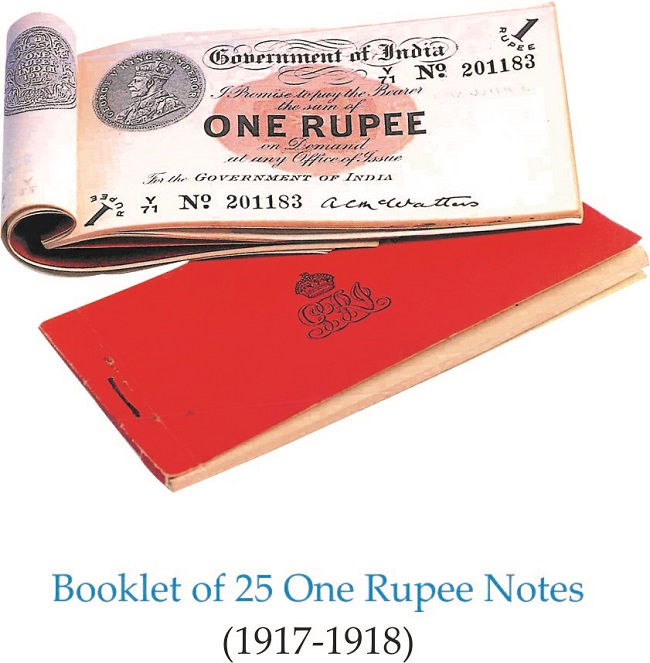
Currency notes were introduced in India in 1861, and the one-rupee note was introduced by the British on November 30, 1917.
According to the Reserve Bank of India, the printing of this note was first stopped in 1926 because its printing was costlier than its value i.e., it lacked seigniorage. After that, its printing was resumed in 1940 but discontinued in 1994. Yet again, it was reintroduced in 2015 after a gap of 22 years. A rather chequered existence!
The image below brings nostalgic memories of a bygone era, when a one rupee note was a prized possession owing to its considerable purchasing power. Few people in modern times would believe that they were issued in the form of perforated notes bound together, as the image below of the century-old version shows!
And now, we have this delightful news that the nostalgic One Rupee currency note is being re-introduced with effect from early February 2020! Is it another imprudent decision, devoid of merit and utility? People are free to draw their own inference.
4. Lifespan of Physical Money, Cost Benefit Analysis
The average lifespan of a currency note in India is about one year. It is less for lower denomination notes and more for higher denomination notes owing to their respective velocity of circulation as well as manner of handling.
Seigniorage is a specialised term which represents the revenue earned by a central bank from the issue of money – the difference between the face value of the coin or banknote and the cost to produce and issue it.
As far back as 1926, the one rupee currency note was discontinued as described in para 3 above owing to lack of seigniorage. It is rather strange that the government has chosen to re-launch this note at the present time, when the cost of producing the note is much higher and its usage inconsequential. As is well known, the lifespan of coins is over twenty years, they avoid frequent re-issue which is the case with banknotes, thus reducing administrative costs to the issuing bank. Issuance of coins generates true seigniorage which is not the case with low denomination currency notes. Finally, coins can always be recycled at ‘end of life’ and minted again with minimal loss of metal.
5. India’s emerging needs of Physical Money
Owing to the rapid decline in the intrinsic purchasing power of the Indian Rupee, the government decided several years ago to discontinue minting small denominations coins — lower than one rupee in unit value — that were in use historically. Thus, India is one of the few countries worldwide which does not have sub-units of its currency, unlike for example, the US Dollar or EUR where one euro equals 100 cents. Euro coins consist of eight denominations: 1, 2, 5, 10, 20 and 50 cents and 1 and 2 Euros. This is an existential reality we must get accustomed to and endure.
Notwithstanding the government’s ambitious thrust to migrate to cashless – or less cash – society, the make-up of commercial transactions across our vast country — especially in rural India — reflect a real, emerging need of physical money comprising currency and coins very different from what is presently offered. The sharply rising volume of currency notes in circulation in India from year to year since 2017 is testimony to this reality.
Thus, cash will undoubtedly continue to dominate, at least for the next 7-10 years, though the share of digital and mobile payment modes will continue to rise. The specific recommendations now put forth are summarised as follows:
1. Coins should continue to be issued in denominations of 1,2,5 and 10, with no currency issuance.
2. In addition, a new coin with denomination of Rs 20 should be issued. 1 and 2 both offer excellent seigniorage value.
3. Currency should be issued in just two standard sizes, one for lower values and the other for higher values, each of them in distinct colours, easily distinguishable even in poor light conditions and by people with poor levels of literacy.
4. Lower values would comprise four denominations: Rs 20, 50, 100 and 200.
5. Higher values would also comprise four denominations: Rs 500, 1,000, 2,000 and 5,000.
The valuable lessons learnt by commissioning Rs 2,000 (~ USD 27) denomination notes since November 2016 confirms that there is no real hazard in issuance of high value currency notes, including the new Rs 5,000 (~ USD 70) denomination now recommended. However, it is emphatically reiterated that significantly enhanced, technology based security features must be incorporated in all currency notes issued prospectively – far more stringent than the seriously deficient features of the now disfavoured Rs 2,000 notes in which 7 of the 9 security features have been consistently breached by anti-national elements producing and supplying counterfeit supplies of this much vaunted denomination.
Further, durable polymer based substrates with unique physical properties must be selected. Advanced printing processes and inks incorporating futuristic security elements must be adopted to ensure the authenticity and durability of the currency. These initiatives would significantly preclude counterfeiting even by skilled anti-national agencies – both within and outside our country – claiming expertise in this nefarious art.
On a lighter note, “The new Note will be equipped with several security features” mentioned in the government notification and alluded to at the outset are, in reality, unnecessary since there is no likelihood of counterfeiters wasting their talent and energies on mass producing a valueless denomination such as the one rupee note (~1.50 US cents) now launched. Quite frankly, it offers seriously negative seigniorage — and one would have expected concerned authorities to recognise this truth before announcing the launch of this distractionary ‘novelty’.
Conclusion
Having understood the real issues involved, people can gauge the merits of issuing the new one rupee currency notes vis a vis coins of the same denomination. Time will show who will use the new notes, where and for what purposes – and equally important, whether its issuance offers any advantage to the issuer.
It’s neither appropriate nor civil to accuse the judiciary
of being biased, but then, exceptions are always there and Pakistan is one such
example where just a year and a half ago, Justice Shaukat Siddiqui who was
then a sitting judge of the Islamabad High Court made some very shocking
revelations. The judge openly admitted that “…today the judiciary and media (in
Pakistan) have come in the control of ‘Bandookwala’ (Pakistan Army) and the
judiciary is not independent.” Then, Justice Siddiqui went into specifics and
indicted Inter-Services Intelligence (ISI) of Pakistan Army by saying that “…their
(ISI) personnel get benches formed at their will.”
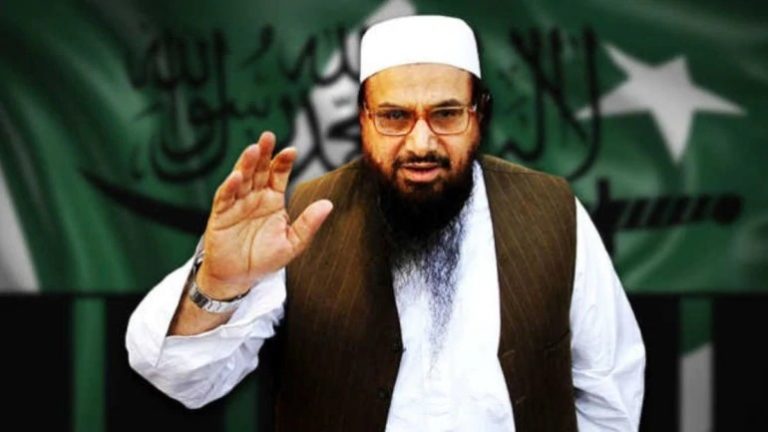
If Justice Siddiqui has exposed Pakistan Army’s proclivity for manipulating the judiciary, then by directing the government not to “harass” Lashkar-e-Taiba (LeT) co-founder and UN designated global terrorist Hafiz Saeed and permit him to undertake his “welfare activities,” Lahore High Court in its 2018 order demonstrated the judiciary’s brazen attempt to mollify a UN designated ‘Global terrorist’. But why blame the judiciary only when the Government of Pakistan (GoP) too has been dragging its feet in bringing Saeed to justice. Whereas it has placed him under house arrest many a times, but it was only because of international pressure and on each occasion the GoP ensured that public persecutors prepared such weak cases against the LeT founder that the courts promptly ordered his release.
So, while Acting Assistant Secretary of State for South
and Central Affairs, Alice Wells called the sentencing of Saeed who was found guilty of being “being part of a banned terrorist
outfit” and “having illegal property,” as
being “an important step forward”, this accolade may be pre-emptive. Wells
should not forget that Islamabad had virtually cocked a snook at Washington by
refusing to act against Saeed even though US State Department had announced a $10
million bounty on him for masterminding the 2008 Mumbai attacks in which 166
people (including six US nationals) lost their lives and 293 (including two US
nationals) were seriously injured.
Wells has probably hailed Saeed’s conviction by a court as
an ‘important step forward’ on the premise that this would act as a precursor
to “holding LeT accountable for its crimes” and help “Pakistan in meeting its
international commitments to combat terrorist financing.” But this could well
be a case of misplaced optimism because the way things are shaping, it’s very
unlikely that the all-powerful Pakistan Army will permit the ‘sacrifice’ of its
“strategic asset.”
With the Financial Action Task Force (FATF) meeting in a few
days to decide whether Pakistan should be ‘blacklisted’ for its inaction to
curb terrorist financing, the timing of Saeed’s trial, charge sheet filed
against him and quantum of sentence awarded all point towards a well-planned
strategy to deceive the international community.
The stratagem adopted by Rawalpindi vindicates this view.
With pressure from FATF to act against terrorist financing, Saeed has cleverly
been put on trial for using his charity organisations, Jamaat-ud-Dawa (JuD) and
Falah-e-Insaniat, as fronts for funding LeT and on being found guilty given a
prison sentence along with a fine imposed on him. The irony is that though
awarded a cumulative prison term of 11 years on two counts, Saeed will be a
free man in five and a half years as the courts have decided that these
sentences will run concurrently.
But since Saeed would be eligible for remission of sentence
on grounds of good behaviour, he could walk out of jail much earlier and paying
the measly fine of Rs 15,000 shouldn’t be a problem at all! Besides this, he
has the option of challenging his sentence in a higher court, which he’ll
certainly exercise after the FATF meeting and in all probability get it
quashed!
Yet all is not lost for Pakistan. Afghan Taliban, which is
fighting against the US-led NATO forces is another ‘strategic asset’ created by
Rawalpindi that could tip the scales in Islamabad’s favour. This is because
while Washington is anxiously trying to extricate itself from Afghanistan, it
can only secure an honourable exit if the Pakistan Army uses its sway over the
Taliban to hammer out an agreement. Remember Prime Minister Nawaz Sharif’s
advisor on Foreign affairs Sartaj Aziz’s 2016 admission that “We have some
influence on them (Afghan Taliban) because their leadership is in Pakistan, and
they get some medical facilities, their families are here.” By recounting
US President Donald Trump’s mention to Prime Minister Imran Khan that he wished
to see Pakistan out of the FATF grey list, and saying “So, we expect US
officials to work for it now,” Pakistan’s Foreign Minister Shah Mehmood Qureshi
has made Islamabad’s expectation of a quid pro quo evident.
Islamabad requires the support of three countries to avoid being
blacklisted and since China, Turkey and Malaysia will certainly vote in its
favour, Pakistan is not worried on this account. But it needs 12 votes out of
39 for being struck-off the grey list, which would obviously be a major cause
of worry for Islamabad and it’s here that Washington’s support would prove
invaluable. Therefore, New Delhi will have to present its case for blacklisting
(or at least retaining Pakistan in grey list) holistically and in a very
convincing manner by delving on specifics like Pakistan’s failure to take
action against those guilty of terror financing in the 2008 Mumbai attacks
could be highlighted to expose Islamabad’s duplicity.
Some shocking terror financing issues revealed by former
Director General (DG) of Federal Intelligence Agency (FIA) Tariq Khosa who
investigated the Pakistani angle in the Mumbai attacks that could reveal terror
financing details and convincingly establish ISI-LeT nexus are —
Source of money to buy the
fishing trawler used by the terrorists for hijacking an Indian trawler in which
they sailed to Mumbai (which Khosa acknowledges were “connected to the
accused”).
Khosa has stated that “the
engine of the dinghy abandoned by the terrorists near Mumbai harbour contained
a patent number through which the investigators traced its import from Japan to
Lahore and then to a Karachi sports shop from where an LeT-linked terrorist purchased
it along with the dinghy. The money trail was followed and linked to the accused
who was arrested.”
As per Khosa, “a couple of
foreign-based financiers and facilitators were arrested and brought to face
trial.”
Since nationals of 25 countries either lost their lives or
were seriously injured in the Mumbai attacks, India should muster international
consensus on making this barbaric terrorist act the touchstone for FATF
deliberations when Pakistan’s case comes up for discussion against its grey
listing. Trying and sentencing a UN designated terrorist like Hafiz Saeed who
has the blood of hundreds on his hands to just five-and-a-half-year prison term
on unspecified charges is travesty of justice. Furthermore, a prison term in
which he is eligible for parole as well as remission of sentence amounts to
insulting the victims of terrorism.
It needs to be emphasised that no compromise whatsoever on
the issue of terrorism related activities can be tolerated as this will only encourage
acts of terrorism and make the already feeble FATF into a toothless
organisation!
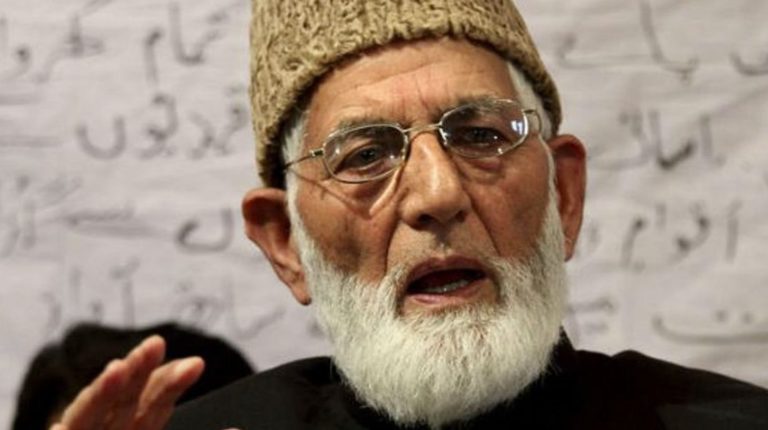
Exploited in good times and exploited in bad times. There can be no better way to explain Pakistan’s relationship with Syed Ali Shah Geelani, the Kashmiri nonagenarian, separatist leader. The 90-year plus Geelani is not in good health; he is under treatment at SKIMS Srinagar, a multi-speciality hospital that has state-of-the-art facilities. The Pakistan propagandist machinery, sadly, has gone into hyper-mode in spreading rumours of his death.
Quite obviously, Pakistan wishes to cash in on Geelani’s ill-health for their all important objective of spreading discord and disruption in Kashmir. The evil propagandist machinery of our neighbour is not bothered about the inhumanity of its sadistic gesture of pronouncing a live man as dead, all it cares about is its agenda to seize the narrative in Kashmir and convert the recent environment of peace into one of turmoil yet again. If Geelani’s ill-health can provide the catalyst, they have no compunction in using the same.
Pakistan wants the entire Kashmir Valley to erupt into strikes and shutdowns, it is spreading rumours of Geelani being admitted in SKIMS by the administration with mala fide intentions. What is conveniently being ignored is that, for many decades now, the government of India has been extending the best possible medical treatment to Geelani. On several instances in the past he has been flown under New Delhi’s expense for free of cost medical treatment at the All India Institute of Medical Sciences (AIIMS).
India has always treated Geelani with respect. Apart from the medical attention, security and other facilities, his children received the best possible education in Kashmir itself and are now well settled across the world and also in India. His one son is a doctor in Pakistan while his daughter resides in Saudi Arabia; he has family in New Delhi with a house in the posh Malviya Nagar. They all are far removed from the “Miseries of Kashmir.” His “selfless sacrifice” has definitely been good for his family.
What has Pakistan given to Geelani for all the loyalty that he has extended to the nation? In the late 1990s Pakistan’s Inter-Services Intelligence (ISI) became quite disenchanted by the lack lustre performance of All Party Hurriyat Conference (APHC). Its constant squabbling and internal dissension was not taking the separatist movement anywhere despite a colossal expenditure by the ISI. The conglomerate further lost credibility in the eyes of its masters after the successful conduct of the 1996 and 1998 Lok Sabha polls in Kashmir.
It was under these circumstances that the elevation of Syed Ali Shah Geelani as chairman APHC and the unceremonious ouster of Mirwaiz Umar Farooq came by. Geelani then went on to become the architect of the darkest, most turbulent period in the history of Kashmir. In order to remain relevant he proverbially “sold his soul to the devil.” He chose to become a stooge of Pakistan and started singing the tune that Pakistan’s Inter-Services Intelligence (ISI) wanted him to sing.
The complete radicalisation of the APHC, its subservience to Pakistan and to the terrorist cadre is the legacy of Syed Ali Shah Geelani to his organisation and to his people. He brought with him the self-defeating agenda of Jammu and Kashmir joining Pakistan and blatantly used the platform provided by the Hurriyat to propagate the same. He introduced into the separatist movement an element of religion by describing it as a part of the larger pan-Islamic struggle.
The pursuit for self-determination for the people of Kashmir was overshadowed by his open bias towards Pakistan which created doubts about his political motives. APHC however could not bear his rigid postures, abrasive politics and pro-Pakistan leanings and he was forced to resign in 2003. The Hurriyat leadership blamed him of having weakened the cause by bringing about a division in its ranks. He formed a separate entity, the Hurriyat (Geelani) that never gained political significance.
In Kashmir, even the most strident advocates of freedom, whose numbers are dwindling fast, do not look at Pakistan as an option to align with. Geelani thus stood isolated. Geelani stayed in the limelight for some time more and then Pakistan decided to unceremoniously dump him. The nadir came in 2015 with Geelani boycotting the Eid Milan Party at the Pakistan High Commission in New Delhi as a protest against non-inclusion of Kashmir in the talks between Prime Minister Narendra Modi and Nawaz Sharif at Ufa in Russia. It is astounding that, after being used like a puppet, he continued to show servility to Pakistan even after that.
One is compelled to say that Geelani as well as Pakistan pursued politics of opportunism with each other. While such an attitude can be expected from Pakistan, no self respecting leader who is fighting for the freedom of his people would bow before a foreign government that has no interest either in him or his people.
Geelani says that Kashmir should become a part of Pakistan while many in Pakistan themselves feel that the country should be trying to consolidate what it has rather than looking for other territories on which they have no claim whatsoever. Geelani says that he wants freedom for his people while the fact is that they are already enjoying the same as a part of the largest democracy in the world.
While maintaining the sensitivity of the situation and wishing a speedy recovery to Geelani, it becomes important to look at the life and times of Geelani with objectivity. If such an exercise is carried out with honesty the derivative is a life lost in pursuit of an impractical political dream and alignment with a country that has given to him absolutely nothing except disrespect and ignominy.
It is hoped that the people of Kashmir will keep themselves isolated from the notorious, shameful and evil exploitation of Geelani’s name by Pakistan in order to disturb their lives. It is time to give a strong message to Pakistan that the times when such canards could be spread to good effect. Once again, here’s wishing Geelani a speedy recovery.
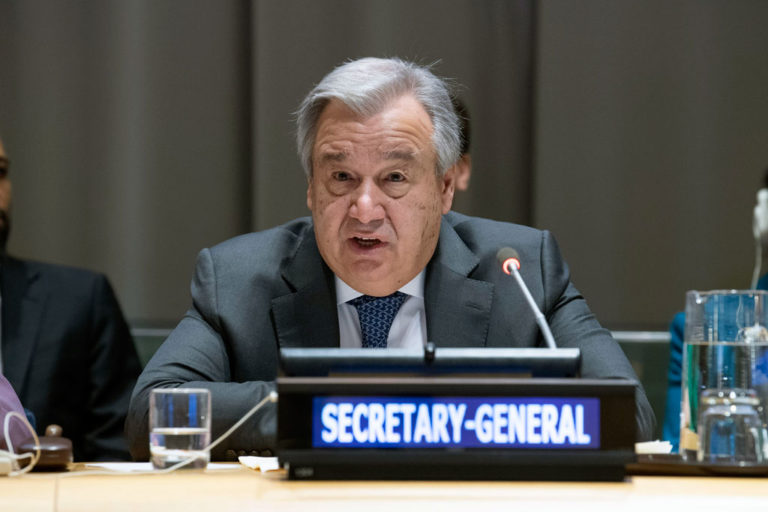
Chairman of Baloch National Movement (BNM), Khalil Baloch criticized one of the tweets of United Nations Secretary General, António Guterres and said that the tweet not only contradicts his position but also negates the fundamental aims and objectives of United Nations.
Pakistan is one of the most consistent and reliable contributors to @unpeacekeeping efforts around the world.
In fact, United Nations Secretary General in his tweet completely ignored the conflict in Balochistan and the ongoing massacres of Baloch, Pashtoons, and Sindhis at the hands of the Pakistan Army. This is negligence and tantamount to whitewashing the crimes of Pakistan as well as an act of providing impunity to Pakistani establishment. During the 1970s, Pakistan had received similar impunity in carrying out the genocide in Bangladesh. The Bengali genocide was the largest and most systematic genocide of any group of people in modern history after the Nazi genocides. As the UN and West had turned a blind eye to war crimes in Bangladesh they have now provided an impunity to the Pakistan Army to carry out war crimes in Balochistan.
“It is unfortunate that in this modern age the world allows rogue states like Pakistan to enslave and colonize other nations. The president of France, Emmanuel Macron set an example for the civilized world during his visit to African countries by helping them shun the name of their currency from the colonial Franc to their own name. Thus deleting the last symbol of French colonialism. On the other hand, the impunity to colonial states like Pakistan bestowed by the United Nations is the reason for increased genocide, a crime against humanity and war crimes against Balochs, Pushtuns, and Sindhis. We are convinced and we firmly believe that this statement by United Nations Secretary General António Guterres is a willful attempt to whitewash the war crimes of Pakistan which is contrary to the guidelines and laws of the United Nations, which was primarily formed to stop genocides,” Khalil Baloch said emphatically.
He further added: “We were not expecting such a statement from the head of the largest organization of the world and union of the nations without assessing the situation in Pakistan. All oppressed nations along with Balochistan were expecting that the UN Secretary General António Guterres would do justice with his prestigious position and alleviate their grievances by taking notice of the war crimes committed by Pakistan Army and will take initiatives which may facilitate dragging Pakistan into the International Court of Justice on the basis of cemented evidence of war crimes and crimes against humanity. But his statement shows his negligence, ignorance, and animosity towards oppressed nations which only made his visit more controversial.”
“I appeal to all oppressed nations to raise voice against this behaviour of the UN Secretary General and record their protests. Though we are not de jure state but we are counted as an alive nation seeking for the national freedom,” he urged emphatically.
“If this visit of the UN Secretary General was about Afghan refugees then he should had limited there, but he issued his statement collectively and expressed his partiality towards Pakistan in general. If we talk on the issue of Afghan refugees, the reason for the killing of millions of Afghan and turning them into refugees is rooted in the terror-supporting policy of Pakistan. In fact, it is not Pakistan that supports the Afghan refugees, but it is the Baloch and Pashtoons who are hosting them in their respective lands,” explained Khalil Baloch.
The Baloch National Movement (BNM) Chairman asserted that the UN Secretary General should have gone through the history of the last two decades before issuing his statement. He questioned whether the Secretary General is ignorant of the fact where the most wanted terrorist Osama bin Laden and Maulvi Mansoor Akhtar had been killed? Where the top figures of Al Qaeda and other terrorist organizations had been either arrested or killed? None of these terrorists were killed or arrested by Pakistan, rather they were intercepted and killed by the third state. Whether the United Nations Secretary General is oblivious to the fact that for what reason Pakistan had failed to satisfy Financial Action Task Force (FATF)? What are those reasons that Pakistan is still kept in the ‘grey list’ and Pakistan is inching towards being black listed by the FATF. If these events and incidents have no importance then it would be considered the worst joke with the oppressed and suppressed nations in the history of mankind.
The chairman of Baloch National Movement (BNM), Khalil Baloch said that the formation of United Nations after World War-II had brought new hopes that world’s problems will be solved through this institution. It was at this junction of history that many colonial powers weakened and could not maintain control over their colonies. Consequently, many new states came into existence. India was declared free from British colonialism.
Meanwhile, Balochistan had also gained its independence as a free state. But, unfortunately, after a small period, new-born Pakistan with its inherited British military power invaded and occupied Balochistan and forced us into slavery. This happened barely two years after the United Nations had been set up with much fanfare. Pakistan not only snatched away Balochistan’s freedom but also exploited their marine and land resources. It also started a systematic genocide of the Baloch people. Pakistan has incrementally increased the genocide of the Baloch nation for the last two decades. Like in the past, the UN’s position has been of a silent spectator. In fact, the United Nations is indebted with the blood of Baloch people, which is increasing with each passing day.
BNM Chairman Khalil Baloch further added: “One of the main objectives of the formation of the United Nations is to find lasting solutions to the problems between states and the nations, but the unnatural state that came into existence in the name of Pakistan does not either meet the definition of a nation nor the word “Pakistan” is the name of any nation. Today, Pakistan, the murderer of oppressed and persecuted nations, is not only a member state of the UN but also responsible for the occupation of Balochistan and perpetrating terrorism in the region. Wherever an incident of terrorism takes place in the world, its links directly or indirectly lead to Pakistan. Pakistan neither meets the historical and cultural requirements of a state nor does it have the legitimacy of a confederation that formed with a mutual accord among nations. It is established on the bases of religious fundamentalism and anti-humanitarianism. This is the main reason that Pakistan for the last seventy years has been wreaking havoc on its subjugated nations and in its neighborhood in the region. We want the UN and the global powers to be aware of this fact.”
“On the occasion of the visit of the current Secretary General of the United Nations Mr. Antonio Guterres to Pakistan, we would like to remind him that as an occupied nation, we have a strong hope that you will take notice of the ongoing genocide, war crimes and crimes against humanity in Balochistan and would take initiatives to resolve the Baloch national issue,” he added further.
Khalil Baloch said that if the visit of the UN Secretary General was limited to knowing only Islamabad’s narrative, the lies of Pakistani rulers and of some clauses of the constitution, it would not only be a historic injustice to the Baloch nation but it also will be considered through violating the aims and objectives of the United Nations.
He explained that the visit of the UN Secretary General is taking place at a time when Pakistani forces and intelligence agencies are committing the genocide in Balochistan. The ground for Baloch political voices has been narrowed down. Pakistan is committing human rights violations on a daily basis by placing checkpoints in every corner of Balochistan. The UN Human Rights Council’s Working Group on Enforced or Involuntary Disappearances has confirmed requests for thousands of forced disappearances of the Baloch people. These are the cases where families have filed their case with consent and identification through meeting the rules and requirements of this group. Otherwise, the number of forced disappearances has exceeded forty thousand.
In the past, the top government officials such as Federal Home Minister Aftab Sherpao, former Balochistan Home Minister Sarfaraz Bugti and Secretary Interior Akbar Hussain Durrani have accepted the arrest of more than 20,000 people in front the media, during their tenures but there is no evidence of the release of these innocent people or production before a court. More than 5000 Baloch are martyred in custodial killings, targeted killings, and fake encounters. BBC World Report from 2011 to 2016 has also verified the killing of 1000 Baloch. Similarly, in the previous regime, one hundred and sixty-nine bodies were recovered from three mass graves in Khuzdar. Only three of them were identified as “missing” those who were abducted from different areas by the Pakistani Army. The rest of the bodies were neither identified nor sent for the DNA test.
Khalil Baloch said that Pakistan is carrying out brutalities on all suppressed nations. Pashtuns and Sindhis are also suffering from genocide. Like the Baloch, thousands of Pashtuns and hundreds of Sindhis have been killed or imprisoned in Pakistani army prisons. Till date, two decades of military operation continues in Balochistan. As a result, thousands of homes and villages have been burnt, many properties including livestock and jewelry have been looted. Women, children and the elderly are being humiliated on a daily basis. A cemetery has been set up in Mastung, which has been named as the graveyard of unknown people. The fact is that these are the missing persons who are killed by the forces. It has also been reported in international media. The dead bodies are still being thrown, but to this day, the state of Pakistan has denied the DNA test of these bodies, because doing so will prove that they are the people who had been taken by the Pakistani Army and intelligence agencies in front of the people and transferred to the torture cells.
He said that the Pakistani atrocities have mounted twofold when China, in the form of China-Pakistan Economic Corridor (CPEC), became a partner with Pakistan for exploiting Balochistan’s resources and its strategic position. Along with the direct oppression of these two forces, the Pakistani Army has shifted its fanatical religious proxies to Balochistan to crush the Baloch national movement as well as to contaminate Balochistan’s secular society and religious tolerance. Many extremist organizations, including ISIS, have regular training and launch pads in Balochistan under the supervision of the Pakistan Army.
He said that CPEC has become a plan for the economic exploitation of the Balochistan. Baloch national resources are being looted under this guise. Another clear evidence of this is a recent statement by Pakistani Prime Minister Imran Khan, in which he says, that he will sell Balochistan’s resources and pay Pakistan’s debt. It is thus clear that Pakistan has been cheaply selling Balochistan’s resources for the past seventy years on the pretext of so-called Mega projects like Saindak, Rikodak, and Gwadar. The Baloch land has been leased out to China without the consent of the Baloch nation. The terms and conditions of this so-called project “CPEC” are so dangerous and inhuman that Pakistan is reluctant to present them in its own parliament.
Khalil Baloch explained that these so-called development projects are destroying the environment along with exploiting Balochistan’s natural resources. For example, environmental pollution, which is one of the burning issues in the world is dangerously being ignored in these projects. No initiative has been taken to protect the indigenous peoples’ environmental rights in these projects. Pakistan’s apathetic approach to the Baloch people can be seen after the nuclear tests which were conducted in Balochistan. The non-existence of environmental measures reduced the people of rich Balochistan into living below the poverty line and also thousands are suffering from various diseases including cancer caused by these nuclear tests. In fact, Balochistan has the highest cancer rate in the world and this is why the state does not allow any research and documentation with regards to cancer caused by these nuclear tests.
BNM chairman also said that under the China-Pakistan Economic Corridor (CPEC), there are plans to settle millions of people from China and Pakistan in Gwadar. This is to ensure a demographic change to bring the Baloch nation into a minority in their own land. In the first phase, the populations on the sides of the CPEC project have been forcibly displaced. Pakistani forces have transformed Balochistan into the “No-Go” area. Human rights organizations and social workers, including the neutral and international media, have been banned from entering Balochistan for the past twenty years.
“We request the UN Secretary-General to specially visit Balochistan on the issues of missing persons, extrajudicial killing, exploitation of Baloch national resources and ecological destruction,” urged Khalil Baloch.
Mr. António Guterres United Nations Secretary-General U.N. Headquarters New York, NY 10017
Dear Sir,
The news of your upcoming visit to Pakistan has come with great hope for the victims of state brutalities, ill treatment and suppression in the country. Most importantly for the people of Balochistan whose grievances have not only being ignored but the silence surrounding the grave human rights violations have encouraged the perpetrators to commit more crimes against humanity with absolute impunity and has sent a distressing message of abandonment to the millions of Baloch people who live in constant fear for themselves and their families.
The humanitarian situation in Balochistan is commonly unknown to the world due to the blockade of communication means and unannounced imposition of censorship on national media. The Baloch people have been systematically marginalized and deprived of their basic human rights. Moreover, those who stand against state’s discriminate and brutal policies towards Baloch people are subjected to enforced disappearance and most of the time executed extra-judicially. Over the years, Baloch human rights groups and international human rights institutions on the situation of Balochistan have reported serious human rights violations against Baloch people, which is increasing with every passing day.
For the last one decade, we are witnessing a barrage of indiscriminate attacks by the Pakistani state targeting civilians and crackdown against political activists, human rights defenders, journalists and intellectuals including member and leadership of Baloch Students Organization-Azad.
On June 9th 2009, Zakir Majeeb, Ex-Vice Chairman of Baloch Students Organization-Azad (BSO-A) was forcibly disappeared by Pakistani security forces and is still missing. On August 14th 2013, Ex-General Secretary of BSO-A, Raza Jahangir was extra judicially executed by forces in Turbat. On March 18th 2014, Ex-Chairman of BSO-A, Zahid Baloch was forcibly disappeared in daylight in front of several eyewitnesses from Quetta, the capital of Balochistan. His whereabouts are unknown till this date. Similarly, the Ex-Information Secretary, Shabir Baloch was abducted by forces on October 4th 2016.
The human rights institutions in Balochistan have reported more than 20,000 “enforced disappeared” persons in Balochistan. On the contrary, the Pakistan government and security establishment’s response to these documented reports have ranged from blanket of denials of any wrongdoing by security forces to numerous attempts to discredit reports of abuses by human rights organizations, eyewitnesses and survivors. Pakistan’s security forces have direct control over operations in Balochistan and are granted authority from the civilian government and immunity from justice. Till date, no one has been investigated, charged or tried for these offenses.
Students have always remained the most vital organ of any nation and considered future pillars of the society. For the last few years, with increase in deployment of Pakistani soldiers in Balochistan, forces have occupied the majority of school buildings in Makran region and running them for military purposes. Forces are present in almost all major educational institutions including the University of Balochistan which resembles a military camp more than an educational institution. The students are forced to continue their studies in deep distress.
Sir, your participation in the conference to mark four decades of presence of Afghan refugees in Pakistan will add the weight of your office on stake holders for Afghanistan conflict to come to an agreed resolution. However, the similar situation in Balochistan also requires your attention and commitment. The indiscriminate decades long military operations in Balochistan have compelled the people to abandon their settlements and ancestors land and migrate to other areas of Balochistan. Several hundreds have fled to neighboring countries where they are leading their lives in miserable conditions without recognition and legal status.
I urge you to unequivocally denounce the repressive practices of Pakistan military in Balochistan and proactively engage with the government of Pakistan through a visit to Balochistan. Please also convey your concerns about the gravity of the situation in Balochistan and strongly urge Pakistan to allow an international independent investigation into allegations of human rights abuses and enforced disappearances of thousands of activists by Pakistani security forces in Balochistan and effectively address the systematic genocide of Baloch people. I believe that your leadership on this matter would send a powerful message to the government and military and could prevent further atrocities and violations in Balochistan.
Sincerely,
Sohrab Baloch Chairman Baloch Students Organization–Azad
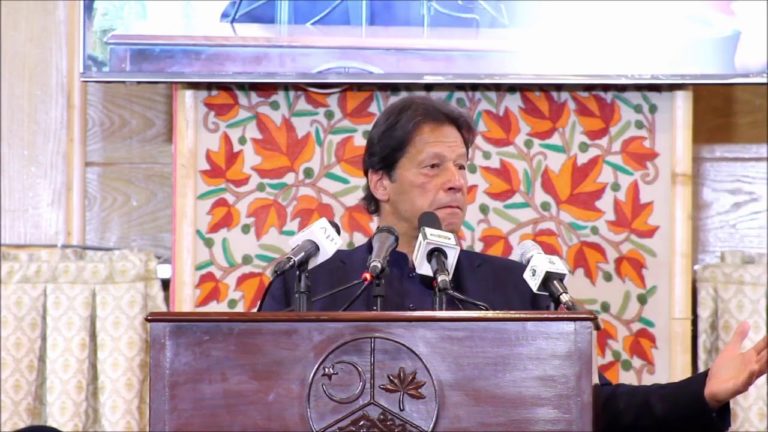
This year, Imran Khan, the “selected” Prime Minister of Pakistan, chose to celebrate the infamous “Kashmir Solidarity Day” in Pakistan Occupied Kashmir (POK). Predictably, a major part of his speech at Mirpur in POK was directed against India and specifically against Prime Minister Narendra Modi. He said that, “200 million people of Pakistan and its battle-hardened army will teach India a hard lesson.” He also termed recent changes brought about in the Indian state of Jammu and Kashmir as a “mistake.” In the tail end of his speech, he gave a weak assurance to the people that Pakistan would always stand by the people of Kashmir and fight alongside them.
At Lahore Imran Khan’s PTI leveraged Kashmir Solidarity Day to project an anti-Hindu agenda. Banners showing PTI General Secretary for Lahore, Muhammad Usman, Imran Khan and Mohammad Ali Jinnah and saying, “Hindu Baat Se Nahin, Laat Se Manta Hai” (Hindu does not understand with words he understands with kicks) were put up across the city. They were later removed but, by then, the message had been sent out and the purpose had been served.
https://www.youtube.com/watch?v=ANchheWmcaQ
This orchestrated ritual was followed by an escalation of tension along the Line of Control (LOC) in the Poonch region opposite Mirpur. Due to the ensuing cease fire violations in the sector, one brave Indian soldier lost his life and three were injured. The propagandist Pakistani information machinery was quick to put the entire blame on India; it termed the blatant violations as “retaliation against the targeting of civilians by Indian troops,” adding, for good measure, that ten civilians were injured due to Indian firing.
Having said his piece Imran Khan went back to his luxurious life and thus culminated the perfidious, propagandist game plan of Pakistan for the so-called Kashmir Solidarity Day 2020. The hapless people of the occupied territories were left wondering as to why he came to address them in the first case.
Pakistan observes February 5th, as Kashmir Solidarity Day every year. It is an annual ritual since 1990 whose stated objective is to support the so-called struggle of the people of Jammu and Kashmir towards self-determination of their political status. In actuality, it is downright propaganda.
The reality is that the travails of the people living in these occupied territories remains hidden from the world because of media strangulation. Journalists, bloggers, civil rights activists are targeted for speaking and exposing Pakistan’s real face to the world. There’s hardly any newspaper being published over there, what to talk about the electronic media. The world gets to see only a few video clips that are smuggled out and shown by freedom fighters of the area living in exile across the globe. The brutality of the establishment is clearly visible in these footage; people are seen protesting in vast numbers against the atrocities being heaped upon them.
The idea of Pakistan expressing solidarity with the people of Jammu and Kashmir is preposterous at the very outset. Where, one wonders, is the oneness of cause or interest that would ignite a feeling of solidarity? Imran Khan claims an emotional bond with the people of Kashmir. What exactly has he, his government and those before him actually done for the people of Kashmir except for causing bloodshed and untold misery to them through barbaric terrorism?
Pakistan also claims a cultural and ideological bond with the people of the state. This too is a fallacious claim. Jammu and Kashmir comprises of people with different ethnicity in its three regions of Jammu, Kashmir and Ladakh. So, how can Pakistan being an Islamic state claim cultural affinity with all of these regions?
Besides this, what solidarity can Pakistan foster when it is itself in the throes of an existential crisis? Even as Imran Khan was making his speech, the International Monetary Fund (IMF) was being begged by leading economists of Pakistan to go soft on its demand of increasing taxation, power tariff and interest rate in order to expand the narrow tax base. The reason given for this appeal was that such an action would further erode the political capital of the ruling party which is already in the eye of a storm due to burgeoning inflation. Opposition parties are baying for Imran Khan’s blood in view of the skyrocketing prices of food items. The charge is being led by Bilawal Bhutto who makes no bones of referring to the Prime Minister as “incompetent, incapable and selected.”
Imran Khan is projecting himself as a fearless leader ready to face any form of conflict with India. The fact is that if the two countries get into a military face-off, Pakistan will be financially ruined within a week. India too will suffer but she has the resilience to tide over the crisis. Further, India has the capacity to go in for a stretched-out conflict which is not the case with Pakistan.
Imran speaks of battle hardened troops but what of their morale? It is no secret that the extension given to General Bajwa, which now stands ratified as Army Chief till November 28th, 2022 has not gone down well with the army rank and file, especially, the senior leadership. In order to save his extended tenure General Bajwa resorted to a purge in the senior levels with many Generals being told to “resign.” Now there are disturbing reports of Major General Asif Ghafoor, recently removed from the all important post of Director General Inter Services Public Relations (DG ISPR), meeting with a serious accident along with his wife. Both have reportedly been sent to Saudi Arabia, ostensibly for better treatment but it could also be in order to keep the matter under wraps.
India is well within her rights to discuss all options, including use of force, to take back from Pakistan the occupied territories. Imran Kahn would be well advised to opt for a balancing act and look for ways and means to resolve the issue peacefully. His hostility and outlandish statements against India are definitely counterproductive.
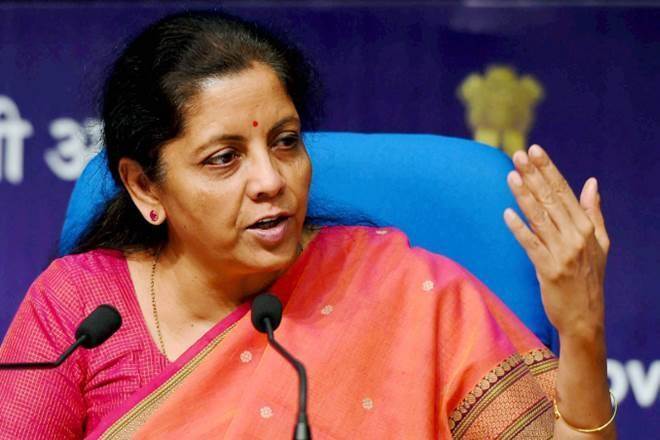
Amid widespread fear that the deadly Coronavirus could dent global economy, finance minister Nirmala Sitharaman, just a few days ago, said that green shoots of economic revival were visible in the country. Is the government underplaying the impact this virus could have on the country’s economy?
China is India’s largest trading partner. In 2018-19, India’s inward shipment of goods from China was over $60 billion, accounting for about 20% of the total non-oil, non-gold imports. Imports from China has practically come to a halt with the spread of the Corona Virus.
Thousands of retailers across the country besides key industries, which import raw materials from China have already started to feel the heat.
However, the Finance Minister tweeted that her ministry will hold a meeting on February 18 to assess the impact of Coronavirus on disruptions to Make in India programme and to the imports and exports.
On the impact of #CoronavirusOutbreak and any disruptions to #MakeinIndia or to Indian export/import @FinMinIndia is scheduled to hold a meeting on Tuesday 18 Feb. Stakeholders welcome. If unable to attend please email your inputs at fmo@nic.in
In the current financial year, India is expected to grow at 5%, the slowest in 11 years — or even below 5% as estimated by the International Monetary Fund (IMF). However, the spread of this killer virus COVID-19 (Coronavirus) has posed fresh challenges to the Indian economy and the government must act fast to arrest its impact. The new virus would make economic recovery even more difficult and even lead to further erosion of jobs.
India imports mobile phones, electronic equipment, chemicals, iron and steel, plastics, fertilizers, textiles among other things. Importantly, India also imports substantial chunk of active pharmaceutical ingredients (API) for production of medicines including antibiotics and lifestyle drugs. This will have far reaching impact on the Rs 1.75 lakh-crore drug industry. Not only will this make medicines more expensive but in many cases there could be shortages too.
While the Indian authorities need a pat on their back as they have successfully managed to contain the spread to this virus in India despite detection of a few cases, the government must chalk out a concrete plan to ensure that the virus does not leave its mark on the economy. The country’s factory output contracted by 0.3% in December primarily due to a decline in the manufacturing sector compared to a provisional growth of 1.8% a month ago. The country’s index of industrial production (IIP) witnessed contraction for three consecutive months in August, September and October. Besides, retail inflation uncomfortably inched upward at 7.59% in January against 7.35% in the previous month.
The Indian economy is in a fragile state and the spread of this new virus has created a flutter across the globe. It is important to take note of this fact and act. There is no time for complacency, Ms Sitharaman.
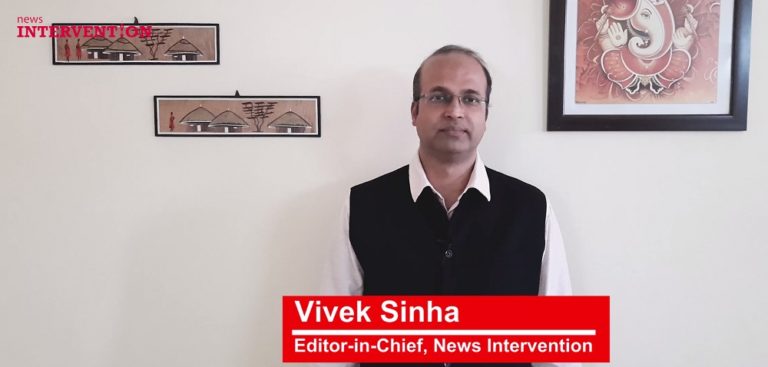
Digital medium offers creative independence and more power to freedom of expression. But, with great power comes greater responsibility. The OTT (over the top) video streaming platforms need to self regulate the content being doled out online. Vivek Sinha explains why self regulation will be best in this scenario.
We use cookies on our website to give you the most relevant experience by remembering your preferences and repeat visits. By clicking “Accept All”, you consent to the use of ALL the cookies. However, you may visit "Cookie Settings" to provide a controlled consent.
This website uses cookies to improve your experience while you navigate through the website. Out of these, the cookies that are categorized as necessary are stored on your browser as they are essential for the working of basic functionalities of the website. We also use third-party cookies that help us analyze and understand how you use this website. These cookies will be stored in your browser only with your consent. You also have the option to opt-out of these cookies. But opting out of some of these cookies may affect your browsing experience.
Functional cookies help to perform certain functionalities like sharing the content of the website on social media platforms, collect feedbacks, and other third-party features.
Performance cookies are used to understand and analyze the key performance indexes of the website which helps in delivering a better user experience for the visitors.
Analytical cookies are used to understand how visitors interact with the website. These cookies help provide information on metrics the number of visitors, bounce rate, traffic source, etc.
Advertisement cookies are used to provide visitors with relevant ads and marketing campaigns. These cookies track visitors across websites and collect information to provide customized ads.
Necessary cookies are absolutely essential for the website to function properly. These cookies ensure basic functionalities and security features of the website, anonymously.
Cookie
Duration
Description
cookielawinfo-checkbox-analytics
11 months
This cookie is set by GDPR Cookie Consent plugin. The cookie is used to store the user consent for the cookies in the category "Analytics".
cookielawinfo-checkbox-functional
11 months
The cookie is set by GDPR cookie consent to record the user consent for the cookies in the category "Functional".
cookielawinfo-checkbox-necessary
11 months
This cookie is set by GDPR Cookie Consent plugin. The cookies is used to store the user consent for the cookies in the category "Necessary".
cookielawinfo-checkbox-others
11 months
This cookie is set by GDPR Cookie Consent plugin. The cookie is used to store the user consent for the cookies in the category "Other.
cookielawinfo-checkbox-performance
11 months
This cookie is set by GDPR Cookie Consent plugin. The cookie is used to store the user consent for the cookies in the category "Performance".
viewed_cookie_policy
11 months
The cookie is set by the GDPR Cookie Consent plugin and is used to store whether or not user has consented to the use of cookies. It does not store any personal data.