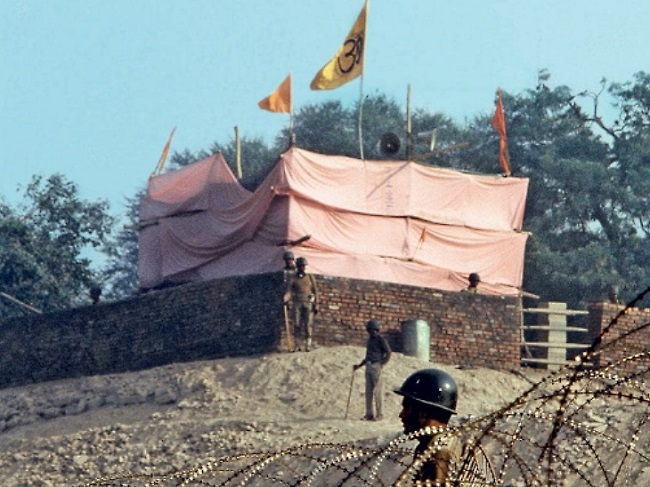
It is only natural for Muslims in India to be a little
anxious as the country awaits the Supreme Court verdict on the Babri Masjid-Ram
Janam Bhoomi dispute at Ayodhya to be delivered in a few days. A variety of
rumours are floating which do not bear repetition in any responsible section of
our media. But these are making many Muslims restive.
However, every challenge is also an opportunity. The
demolition of Babri masjid on 6 December 1992 presented Muslims with an
opportunity. Now that the masjid was no more and Muslims do not worship bricks
and mortar or plots of land, they could have forgiven the miscreants who
demolished the mosque and moved on, gifting the land for building a temple. I
made this point in an article entitled “Opportunity for Muslims,” published by
The Hindustan Times, New Delhi, on 13 Jan 1995. This was reproduced on
NewAgeIslam.com on July 1, 2009.
Let me give you here some relevant excerpts from this article written almost 25 years ago.
“… This brings me to my main plea—forgiveness. Forgiveness
is the essence of both the Muslim and Hindu spiritual traditions. It is the
only way out of the vicious and very debilitating grip of bad karma. It is our
belief that one has to always pay individual or collective karmic debts in this
or any subsequent incarnations or on the Day of Judgement. Both Hindu and
Muslim spiritual traditions consider God as the greatest teacher, this world a
great school, the events that involve us in this mayajaal (illusionary
world) as messages.
“What could this Great Teacher be teaching us in this
section of the school through the great Babri Masjid-Ram Janambhoomi drama?
Perhaps the all-important lesson of forgiveness. It may take us years, decades,
centuries or millennia to learn this lesson. But learn we will. There is no
escaping. God is a very determined teacher. We have the option to learn the
lesson now. Let us exercise it.”
Then I had gone on to conclude: “…. If this mutual
forgiveness and reconciliation does not take place — and if present Hindu and
Muslim leaders are considered representatives of their respective communities,
it is not likely to happen — ordinary people of both communities must make
their presence felt and come out openly for peace at all costs. If that too
does not happen, we Muslims should thank God for providing us with this unique
opportunity to exercise our option of forgiveness and making a gift of a piece
of God’s land on the specific condition that it be used for nothing but
building a place of worship, so that its sanctity is maintained.
I know this is not going to be easy. Forgiveness is never
easy, except for the spiritually evolved. But I don’t think we have any other
option. We have many things, important things to do. We cannot afford to remain
embroiled in inconsequential disputes. The renowned Islamic scholar, Maulana
Ali Mian Nadwi had reacted to the opening of Babri Masjid locks (for all Hindu
worshippers by Rajiv Gandhi government on 1 February 1986) the following day in
these very sensible words: “Many mosques are in the possession of other
people.” And indeed, they are.
“There were many
mosques in East Punjab of the pre-Partition days? But very few are left as
mosques today? A Punjabi Hindu friend of mine complained of so many mosques
having been converted into gurudwaras and temples. His Muslim friend (not me,
some great soul) reacted: “But they are still places of worship. There is only
one God, after all. No matter what you believe in, you cannot but worship the
same God.” Amen.”
However, guided by short-sighted, self-styled leaders as
they are, Muslims did not take that opportunity. Now another opportunity
beckons. The highest court in the land is about to give its final judgement.
First of all, Muslims should make it clear that they would abide by the
judgement and accept it willingly no matter what the verdict is. This is what our
leaders have already done. But this bears repetition, particularly in view of
the divisive, almost Rwandan nature of most of the media, print, electronic and
social that has taken control of nearly all means of communication in north
India. Unfortunately, some ignorant, greedy Mullahs too participate in the
cockfights at prime time that go in the name of television debates, giving
legitimacy to the palpable efforts to divide the society. The very least
Muslims could have done to combat this national security threat was to socially
boycott those treacherous Jahils who are respectfully called Ulama by
our media. But this is a subject for another day. The silver lining in these
darkening clouds is that the secular, pluralistic foundations of Indian society
are too deep to be shaken by these charlatans who are projected by the media as
representatives of the Muslim community. The credit for pluralism in our
society, I must add, goes largely to the broadmindedness of Hinduism that is
willing to accommodate all religions.
Another reason Muslims should reiterate their faith in the
Supreme Court now is that they have already committed once the cardinal mistake
of pressurising a government to overturn a Supreme Court judgement delivered on
23 April 1985, based on the compassionate nature of Islam as the judges
understood our religion. The Supreme Court invoked Section 125 of Code of
Criminal Procedure, which applies to everyone regardless of caste, creed, or
religion to rule that a divorced Muslim lady with no means of sustenance,
70-year-old Shah Bano, be given maintenance money, similar to alimony. Supreme
Court concluded that “there is no conflict between the provisions of
section 125 and those of the Muslim Personal Law on the question of the Muslim
husband’s obligation to provide maintenance for a divorced wife who is unable
to maintain herself.”
Considering the Holy Quran as the greatest authority on the
subject, the court held that there was no doubt that the Quran imposes an
obligation on the Muslim husband to make provision for or to provide
maintenance to the divorced wife. But the Muslim leadership, both Mullah and
non-Mullah, refused to accept it.
With this background, it is imperative that Muslims
reiterate repeatedly their faith in the Supreme Court and declare that they
will accept the judgement even if it goes against them, as this is the highest
court in the land.
This also accords well with the exhortations in Quran and
Hadith. All schools of Islamic thought accept that Islam requires Muslims to be
loyal to their country’s institutions, regardless of the ruler’s faith. The
Holy Quran states, “O ye who believe, obey Allah and obey the Prophet and obey
those in authority from among you” (4:60). Prophet Muhammad declared, “Who so
obeys the ruler obeys me, and who so disobeys the ruler disobeys me” (Muslim);
“Listen to and obey your ruler, even if you [despise him]” (Bukhari).
Prophet Muhammad and his few followers endured bitter
persecution for about 12 years in Mecca. But they did not defy the Meccan
Establishment. They peacefully left Mecca, following the Quranic ruling,
“Create not disorder in the earth” (2:13). Indeed, Islam not only requires
Muslims to obey their government, but also to love their country. In a
well-known Hadith, Prophet Muhammad instructed, “Love of one’s country is a
part of faith” (Sakhavi; Safinat al-Bihar, vol. 8, pg. 525; Mizan al-Hikmah,
Hadith # 21928).
Secondly, it is time Muslims use the next few days to introspect and consider what they would do if the judgement comes in their favour. It’s not just that they will find it impossible to build a mosque on that plot of land in the present atmosphere of heightened tensions and shrill Hindu demands and preparations to build a temple on that plot of land where the masjid stood for nearly five centuries. The important question is: Is it even necessary for Muslims to do so? Babri mosque was a heritage building. Like the Bamiyan Budhas in Afghanistan, it is now lost forever. It simply cannot be rebuilt. So common sense dictates that Muslims donate this piece of land for the building of the temple that our Hindu brothers and sisters want so badly. The argument that the faith in Lord Rama having been born exactly on that spot is a manufactured faith does not hold water. It doesn’t matter how a faith has taken hold. Now it is the Faith, and as Muslims themselves demand that their Faith, even the irrational parts of it, is given due deference, they too should respect the Faith of others regardless of its historical validity.
(This article was first published in New Age Islam)