This budget is unique. Beyond numbers, the underlying current is an overwhelming vision to change the direction of economy, towards virtuous and qualitative economic growth.
Focus is to activate ‘virtuous-spiral’ of economic-growth –
the “shubh-labh” as stipulated in ancient Bhartiya culture, as
opposed to the domination of ‘easy-money’. This deserves the highest
commendation by one and all. And the means identified to achieve this goal, is
“entrepreneurial-drive”, which if correctly implemented, would be revolutionary
and transformational. Looking back, the first four decades of Independent India
as entrepreneur-killing license-raj (1947-1991), and the past five decades
(1970-till about 2014) as gradually corrupting society, this year’s budget
brings a fresh breeze, calling upon the nation to move towards an
honest-and-entrepreneurial-era.
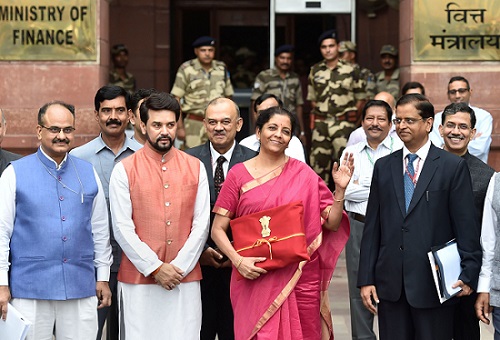
What is remarkable is that the Finance Minister Nirmala
Sitharaman did not miss the importance of grass-root level initiatives. For
instance, the provision of Rs 5,000/- overdraft facility for a rural woman in
self-help-group and the plan to create 75,000 skilled rural entrepreneurs in
agro-rural industry are noteworthy. The Finance Minister (FM) has also
simultaneously referred to empowering social entrepreneurs, start-ups,
private-public partnerships and high-tech space-ventures, among others.
Moreover, the research-drive for high-tech and sustainable technologies, can
open doors for innovative talents as the way ahead.
Nurturing entrepreneurs and creativity at all stages is the
real basis to growth of virtuous-spiral of wealth creation, is the key message
from the Narayani-FM.
The implementation challenges of ground realities, however,
require strategic caution against hijacking of major initiatives by the power
brokers, speculative capital and privileges, rather than identifying and
advancing genuine entrepreneurs.
Here are a few strategic pointers, in terms of process and
systems.
● Rural/Artisan Initiatives It requires careful
designing and monitoring by professionals (both in the Organized and the
Unorganized), sensitive to local culture without compromising the reliability
of quality and delivery. This is where nation can expect double-digit growth
and large-scale employment prospects, through value-added rural economy,
arresting migration from villages to cities.
● MSME (Micro, Small and Medium Enterprises) Sector The
realpain-points are not capital alone, instead, disconnect between
old-time entrepreneurs with their new generation. A great number of second
generation MSMEs are currently engaged in employment within the larger sector. Furthermore,
most opportunities remain untapped, due to neglect in creating domain-specific
ecosystems. This is the real backbone of economy, generating maximum
employment.
● Private-Public-Partnership (PPP) It has been tried,
yet it has not fully succeeded during the past few years. It requires consideration
from two specific issues (a) method of resolving conflicts-of-interest, and
empowering an honest government officer, to exercise personal discretion in
favour of efficient and honest private entities, beyond just lowest bids (b)
avoid entry barriers for smaller enterprises having great caliber but not
enough capital prowess. These two corrections can result in major gains for
Make-in-India in defence, aviation, space, and high-tech sectors, besides
infra-structure industries. Correct implementation of strategies may even lead
to a reverse brain drain such that talented professionals living abroad may
start coming back to country, in decades ahead.
● Social-Enterprises While capital availability and
visibility are sure to increase through the SEBI, the institutional supports
are warranted in matters of marketing, professional management and availability
of high-end knowledge inputs. Attitudinal limitations towards profit making in
socially conscientious entrepreneurs require careful moderation to avoid errors
in decision making. Or else, these avenues may be hijacked by large scale
manipulators or speculators, as is currently happening in the case of tax exempted
rich farmers.
● Real-Estate Defining the affordable housing price
limit at Rs 45 lakh, misses two crucial aspects (a) speculative increase in
land prices of 1000% or even more during the 2004-2014 period across all parts
from urban to rural. The market price considered by government agencies are way
high in relation to real income levels of 95% of the population. Necessary
corrections in land price speculations would automatically make housing
affordable for all of society, provided state governments and agencies shed-off
their greed for yet another revenue source through artificially jacked-up stamp
duties. Central government needs to take lead in correcting market price
indications. This one act alone would lead to phenomenal increase in housing
economy which is a basic need for all. And, (b) affordable price of land and the
housing need are related with specific locations as per type and level of
cities or villages.
● Targeting a $5 trillion Economy & Forex-rate Setting
the goal in dollar terms reflects a leader’s conviction to compete and succeed
in global ranking. Larger purpose alone drives creative entrepreneurs to excel so
the goal of $5 trillion economy in 5 years is appropriate. However, it should
not be achieved through conventional approach of devaluing rupee to achieve
higher exports, for two reasons: (a) firstly, a strong rupee with stronger
domestic economy would anyway mean greater in dollar economy (eg. a 20%
appreciation in value of rupee in today’s exchange-rate, would appreciate our
economy by 20% in dollar terms). So, India needs to opt for forex rates to be
set through bilateral arrangements with each nation rather than leaving it to the
mercy of speculative currency markets and, (b) India needs to experiment with
fixing dual-forex rates, for imports and exports, to achieve higher exports at
competitive prices while absorbing difference values in national forex reserves
account.
The nation has given a clear mandate to the current
government in recent general elections with a hope for better times ahead.
Faith posed in honest and decisive leadership is reflected in the tone and
spirit of this budget. However, the challenge lies in building knowledge teams that
can clearly visualise nut-bolt detailing and potential pitfalls so the
implementation may actually lead society as a whole towards ascending
prosperity during the next five years.