Home Blog Page 51

Busting myths in Pakistan’s Kashmir narrative

0

While addressing a press conference at the UN in March 2023, Pakistan’s then Foreign Minister Bilawal Bhutto Zardari lamented that “We face a particularly uphill task to try and get Kashmir onto the centre of the agenda at the United Nations.” Given the fact that Pakistan continues to repeatedly peddle its monotonous Kashmir narrative with missionary zeal, the Bhutto-Zardari scion’s admission raises the obvious question- why doesn’t Islamabad’s extraordinary effort to garner international support for its take on Kashmir succeed?
 
The answer isn’t too hard to find.

The biggest negative in Pakistan’s Kashmir narrative is that rather than being based on a holistic analysis of facts and logical deductions thereof, it’s a typical product of cherry-picking as well as relies heavily on presumptions and is thus fraught with inaccuracies and distortions. To make matters worse, Islamabad is under the wrong impression that rhetoric and bombast can make up for the factual deficiencies of its Kashmir narrative. This explains why Pakistan’s Kashmir discourse doesn’t find many takers.

Peddling Disinformation

Despite its weak position on the Kashmir issue, Islamabad probably believes in the “repeat a lie often enough and it becomes the truth” hypothesis propagated by Nazi Germany’s infamous Propaganda Minister Joseph Goebbels. However, many analysts feel that while Islamabad knows that its Kashmir narrative is untenable, domestic compulsions force it to keep raking up this issue. Whatever be the reason, Pakistan needs to be complimented for not giving up.  
 
Pakistan’s Foreign Office [FO] supported by Pakistan Army’s spy agency Inter Services Intelligence [ISI] continue to work overtime in peddling Islamabad’s weak Kashmir narrative. Islamabad has in the past used a variety of means like sending parliamentarians to various countries to to apprise them about alleged human rights abuses in J&K” and even organising a fully paid trip for a US Senator to Pakistan occupied Jammu and Kashmir [PoJK].
 
On its part, ISI has contributed substantially by ‘cultivating’ people of Kashmiri origin like Kashmir to lobby on behalf of pro-Pakistan separatist groups in Kashmir as well as Government of Pakistan. Readers would recall that in 201, Kashmir born founder of American Council Ghulam Nabi Fai pleaded guilty for concealing the receipt of USD 3.5 million from ISI to lobby and influence the US Government on siding with Islamabad on the Kashmir issue.

Pakistan’s ‘Disputed Territory” Claim

Pakistan’s Kashmir narrative is based on two assumptions. One, J&K is a UN recognised “disputed territory” and as such it’s not an integral part of India; two, the Kashmir issue needs to be resolved in accordance with UNSC resolutions that envisage holding a plebiscite to ascertain whether people of J&K wish to stay with India or merge with Pakistan and this makes Islamabad a stakeholder.

Purely for the sake of progressing discussion on this issue let’s for a moment, accept Pakistan’s narrative of J&K being “disputed territory.” It’s common knowledge that as long as an asset is disputed, the parties involved have no ownership rights over the same. Hence, as long the Kashmir issue is under dispute [as Pakistan claims], neither India nor Pakistan has any right to change the status this territory.
So, if this is indeed the case, then on what basis did Pakistan unilaterally cede the approximately 5,200 square km Shaksgam tract in Pakistan occupied Jammu and Kashmir [PoJK] under its illegal occupation to China in 1963 under the Sino-Pakistan agreement? Similarly, how could Islamabad ink the China Pakistan Economic Corridor [CPEC] project allowing Beijing to undertake infrastructural development in what it claims is “disputed territory”? Isn’t this a case of Pakistan wanting to eat the cake and have it too?
 
Though Islamabad keeps boasting about what it refers to its “principled stand on Kashmir,” these arbitrary actions that violate international law unambiguously debunk Pakistan’s “disputed territory” claim and exposes the sheer duplicity of its Kashmir narrative. It also provides a reason as to why the international community isn’t at all enthused by Islamabad’s unending theatrics on Kashmir.

Implementing UNSC Resolutions on Kashmir

While Islamabad accuses India for refusing to implement UNSC resolutions on Kashmir, ground realities explicitly indicate that it’s not India but Pakistan that is responsible for the same. UNSC Resolution 47, which Islamabad is so fond of referring to, outlines the sequential two stage process of resolving the Kashmir issue- firstly, ensuring restoration of peace and order by fulfilling certain mandatory obligations and followed by plebiscite.  
 
As per UNSC resolution 47, post the Pakistan Army orchestrated and executed tribal invasion, the Government of Pakistan was required to kick-start the process of peace and order restoration and subsequent plebiscite by securing “withdrawal from the State of Jammu and Kashmir of tribesmen and Pakistani nationals not normally resident therein who have entered the State for the purpose of fighting, and to prevent any intrusion into the State of such elements and any furnishing of material aid to those fighting in the State.” [Emphasis added].
 
Only after it was confirmed that Pakistan had commenced withdrawal of its nationals from J&K that India was required to commence withdrawing its “own forces from J&K and reducing them progressively to the minimum strength required for the support of the civil power in the maintenance of law and order.” [Emphasis added].
 
However, instead of complying with this basic direction contained in UNSC resolution 47, Pakistan inducted and permanently stationed a large size regular force in PoJK that continues to remain in situ till date. Hence it’s abundantly apparent that its Pakistan’s failure to fulfill its mandatory obligation contained in UNSC Resolution 47 that is solely responsible for its non-implementation and blaming New Delhi for this is utter nonsense.
 
By refusing to honour the fundamental provision of UNSC Resolution 47, Pakistan has effectually of scuttled the scope of a fair plebiscite in J&K. As per Para 12 of UNSC Resolution 47, the Government of India is required to ensure that “all subjects of the State of J&K, regardless of creed, caste or party, will be safe and free in expressing their views and in voting on the question of the accession of the State.”
 
However, due to Islamabad’s unconscionable control over PoJK citizens, this crucial and inescapable stipulation cannot be fulfilled. Article 7[3] of PoJK Interim Constitution 1973 decrees that “No person or political party in Azad Jammu and Kashmir shall be permitted to propagate against, or take part in activities prejudicial or detrimental to, the ideology of the State’s accession to Pakistan.” [Emphasis added].
 
Herein lies the paradox. While on the one hand Islamabad contends that whole of J&K is “disputed territory,” on the other hand it makes the ludicrous claim of PoJK’s so-called “accession” to Pakistan  without even producing any evidence. This is why Pakistan’s Kashmir narrative doesn’t find meaningful traction within the international community.
 
On the issue of plebiscite, one encounters another serious contradiction. When citizens of PoJK are constitutionally debarred from expressing views against PoJK’s so-called “accession” to Pakistan, how on earth can it be ensured that they are “safe and free in expressing their views and in voting on the question of the accession of the State”? [Emphasis added]. So, while Islamabad accuses India of denying fundamental rights to people of J&K, it’s actually the Government of Pakistan that has used the constitution to muzzle freedom of speech of PoJK residents.

India’s Response

While India has been effectively countering Pakistan’s disinformation-based propaganda on Kashmir with hard facts, there’s a need for New Delhi to shed its seemingly defensive approach and instead, vigorously demolish Islamabad’s hare-brained Kashmir narrative supported by elaborating on the reasons for its rightful rejection of Pakistan’s Kashmir narrative and UNSC resolutions.
 
Pakistan lost its right to refer to J&K as “disputed territory” way back in 1963 when it unilaterally ceded the Shaksgam tract in PoJK to China. Furthermore, by allowing a third country [China] to undertake infrastructural development [CPEC project] through this area without obtaining the concurrence of either UNSC or India which is a party to this so-called “dispute”, Islamabad has hammered the final nail on its “disputed territory” coffin!
 
That agreements and accords lose their sanctity the moment an involved party willfully violates its provisions is an internationally accepted norm. While UNSC resolutions seek peaceful resolution of the Kashmir issue, by launching a military campaign [Operation Gibraltar] with the sole objective of forcibly annexing J&K in 1965, Pakistan knowingly violated UN resolutions on Kashmir both in letter and spirit. A subsequent attempt in 1999 to change the Line of Control [LoC] alignment in Kargil sector of J&K has left no room for doubt whatsoever that Pakistan has scant regards for UN resolutions.
 
By destroying the inviolability of UNSC resolutions on Kashmir and hasn’t made any efforts to fulfill its mandatory obligations to facilitate their implementation, it’s Pakistan that has rendered these resolutions irrelevant. And if Pakistan can violate these UNSC resolutions at will and demand their implementation whenever it suits Islamabad, then isn’t India well within its rights to unconditionally reject them?
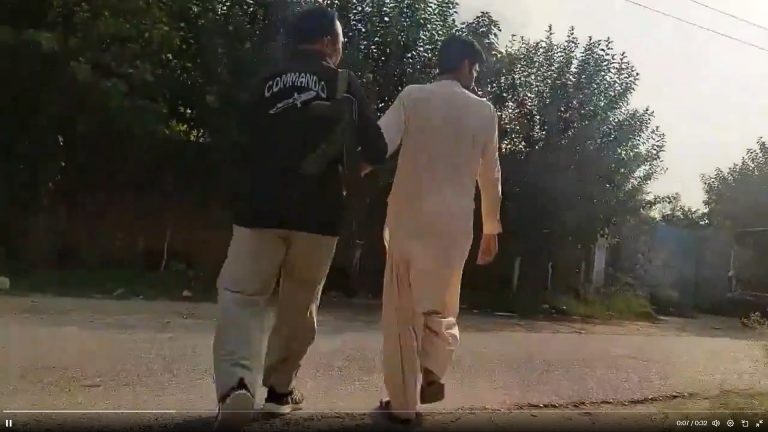
Pak police raid PTM member’s home, arrest son ahead of October 11 gathering

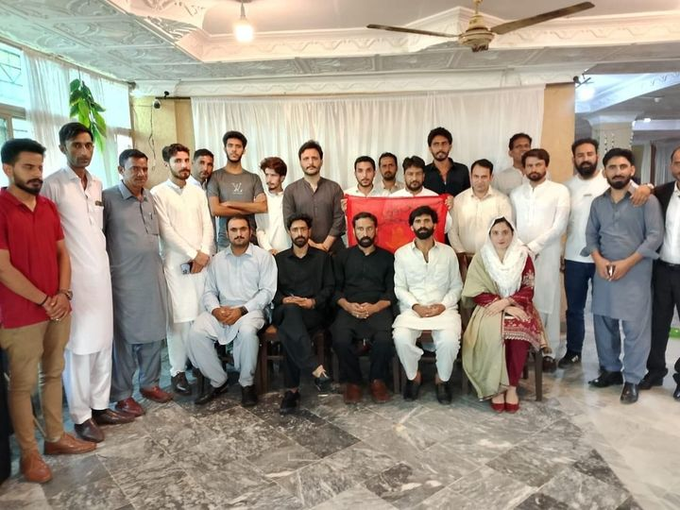
Police in Swabi have launched a renewed crackdown on Pashtun Tahafuz Movement (PTM) members, raiding the home of CC member Liyaqat Yousafzai and taking his son into custody. This latest action underscores the Pakistan Army’s ongoing efforts to silence Pashtun voices critical of the regime’s policies as the PTM prepares for a significant national gathering scheduled for October 11.

The PTM’s campaign against the Pakistan Army’s heavy-handed and often brutal tactics has intensified in recent months. The movement’s struggle for justice has been met with a systematic campaign of intimidation, abductions, and extrajudicial killings orchestrated by the Punjabi Pak Army. This crackdown is not only a blatant violation of human rights and international law but also a stark reminder of the Army’s disregard for the rule of law and the fundamental rights of the Pashtun people.

Since the Punjabi Pak Army’s forceful occupation of the region in 1947, it has consistently used oppressive measures to maintain its grip on power. The recent actions against PTM members further reflect this long-standing pattern of abuse, aimed at stifling dissent and suppressing the Pashtun community’s legitimate demands for autonomy, justice and accountability.

The PTM’s upcoming national gathering on October 11 is expected to be a major platform for raising awareness about these human rights abuses. However, the Pakistan Army’s brutal crackdown serves as a stark reminder of the lengths to which the military establishment will go to prevent such expressions of dissent and maintain its oppressive control over the region.

Attaullah Rehman group joins TTP, marks 61st militant faction

The Tehrik-i-Taliban Pakistan (TTP) has announced the incorporation of the Attaullah Rehman group, also known as Naeem Bukhari’s faction from Karachi. This development marks the 61st militant group to merge with the TTP since the series of mergers began in 2020. Notably, Bukhari, the commander of the banned Lashkar-e-Jhangvi (LeJ) group, has been in custody since 2016.

The inclusion of Bukhari’s group further solidifies the TTP’s role as an overarching umbrella organization for various terrorist factions across Pakistan. This alarming expansion reflects the Pakistan Army’s continued failure to effectively combat and contain the growing threat of terrorism within the country.

Despite the rising influence of the TTP and its affiliates, the Pakistan Army remains focused on silencing human rights activists who speak out against the military’s enforced disappearances, abductions, extra-judicial killings, and Army operations. The Punjabi Pak Army’s efforts to suppress dissent have not only failed to address the escalating terrorist actions but have also contributed to the climate of oppression and violence.

Unprovoked Pak firing injures BSF soldier in Jammu ahead of elections

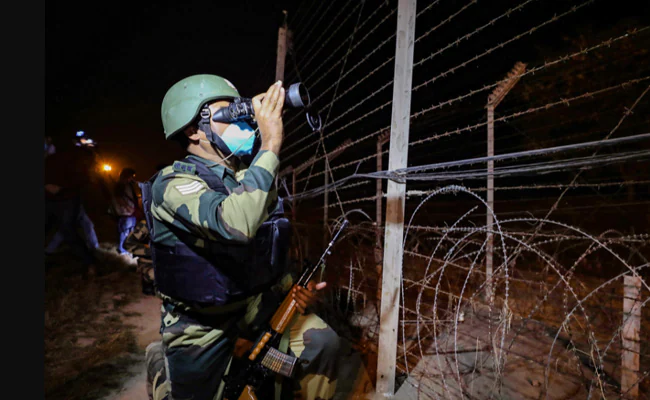
A Border Security Force (BSF) personnel was injured in the Akhnoor area of Jammu on Wednesday following unprovoked firing by Pakistani troops on Indian posts, marking a violation of the ceasefire agreement between the two countries. The incident occurred around 2:35 a.m. on September 11, 2024.

According to a BSF statement, “On September 11, 2024, at about 02:35 a.m., an incident of unprovoked firing occurred in the Akhnoor area from across the border, which was befittingly responded to by the BSF. One BSF personnel sustained injuries from the Pakistani firing. Troops are on high alert.”

The firing came despite a relatively calm period since India and Pakistan renewed their ceasefire agreement on February 25, 2021. The last recorded loss of life on the Indian side was a BSF jawan killed by Pakistan Rangers in the Ramgarh sector last year, marking the first such fatality in over three years.

The timing of this ceasefire violation is particularly concerning as it precedes the first phase of Jammu and Kashmir’s assembly elections scheduled for September 18. The elections will be conducted in three phases, with the second phase on September 25 and the final phase on October 1.

In response to the increasing security challenges, including a recent surge in terror attacks in the Jammu region, the Union government has mobilized additional paramilitary forces. This follows reports of 60 to 80 terrorists infiltrating the region earlier this year. The security measures include retaining approximately 450 companies of paramilitary forces initially deployed for the Amarnath Yatra, with nearly 450 more companies added for election duty.

BSF Director General Daljit Singh conducted a security review of the Jammu border on August 22, underscoring the heightened alert and preparedness of security forces in the region.

J&K Students Federation to march to LOC protesting repressive policies in POJK

The Jammu Kashmir National Students Federation (JKNSF) has announced a long march towards the Chakothi Line of Control on October 22, driven by mounting frustrations over Punjabi Pak military dominance and its repressive policies in Pakistan-occupied Jammu and Kashmir (PoJK). The announcement, made at Kotli Chowk by prominent leader Israr Yusuf, highlighted a series of grievances that have pushed the community to take the action.

The primary reasons for the march are the enforced disappearances of Kashmiris, the region’s persistent underdevelopment, the suppression of the PoJK community, and the skyrocketing prices of wheat and electricity, which have crippled everyday life. Most concerning to the marchers is the recent abduction of over 20 Kashmiris in 2024, including key figures like Raja Mudassir, reportedly taken by the Pak Army. Mudassir was abducted by security forces during Ramadan, and his whereabouts have remained unknown, adding to a growing list of enforced disappearances in the region.

The Pak Army is treating the people of PoJK as second-class citizens, with no regard for their rights or welfare. The region remains economically stagnant, with no meaningful development in key sectors like industry or tourism, both of which are tightly controlled by the military. These frustrations have festered for years, but the recent wave of abductions, along with the worsening economic conditions, has brought the community to a breaking point.

Armed men shoot dead Jamiat Ulema-e-Islam leader Zahoor Badini

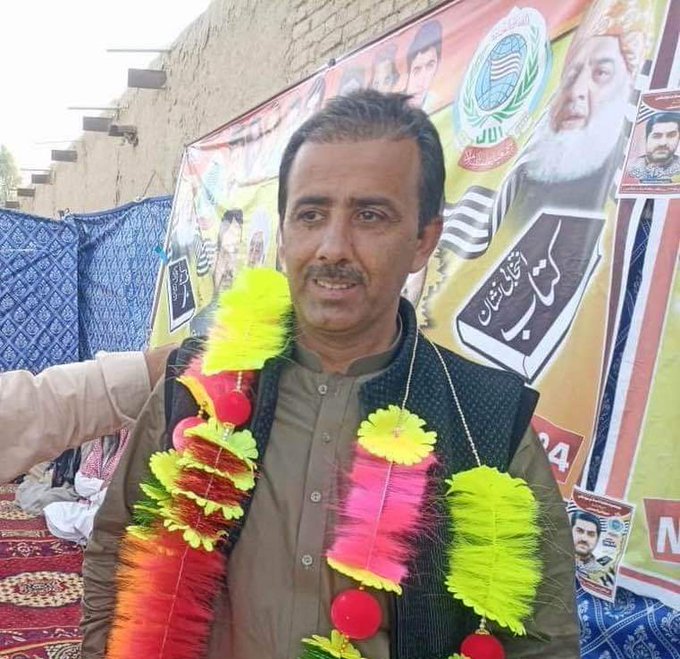
Jamiat Ulema-e-Islam (JUI) leader Mir Zahoor Badini was shot dead by unidentified gunmen near Nushki Boys’ College. The attack, which also left his bodyguard injured, highlights the ongoing security crisis in the region, exacerbated by the destabilizing presence of the Pakistan Army and its operations.

Reportedly, the assailants managed to flee the scene after the attack. The injured bodyguard was rushed to the hospital for treatment, while occupied authorities arrived at the site and launched an investigation into the incident.

No group has claimed responsibility for the attack so far.

Pak-occupied-Balochistan has long been a hotbed of conflict, where the Pakistan Army’s heavy-handed tactics have contributed to an atmosphere of unrest. The military’s constant interference, often under the pretext of combating insurgencies, has left civilian life in chaos, with political leaders and activists regularly targeted.

POB: Protest continues as Pak Army converts girls’ college into military base

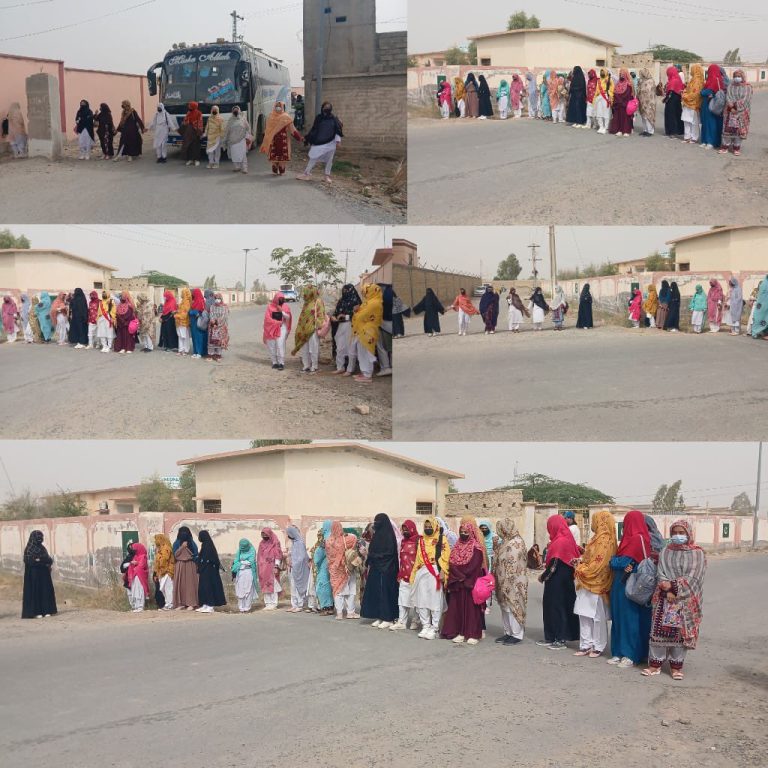
In yet another blatant disregard for the rights and well-being of Baloch students, the Frontier Corps (FC), a paramilitary force controlled by the Pakistan Army, has established a camp within the premises of a Girls’ College in Kharan district, Pak-occupied-Balochistan. This move has triggered widespread protests from students, who took to the college grounds to voice their outrage.

The protesting students condemned the construction of the military camp inside the educational institution, calling it a gross violation of their right to education and personal safety. Chanting slogans against the occupation of their college by military forces, they expressed deep frustration over the continuous militarization of civilian spaces in POB.

“This camp has severely disrupted our academic life,” said one of the protester. “Our studies are being gravely affected, and the presence of armed personnel within a women’s educational institution violates our traditions and privacy,” she added.

According to the latest report from the Balochistan Department of Education, the number of closed schools has surged to 3,694 across 35 districts as of September 2, up from 3,152 in May. The Paki establishment is continuously attempting to limit educational opportunities for the Baloch community, not only to keep them marginalized but also to suppress the spread of pro-independence sentiments.

Recently, Pak forces encircled Turbat University and launched a search operation in the women’s hostel, targeting students in their pursuit of information on Mahil Baloch, a fidayeen fighter involved in BLA’s Operation Herof, which resulted in significant casualties for the Pakistan Army.

This is the reason for the increased militarization and the presence of Pak Army forces in girls’ schools and universities, aiming to monitor and limit the rise of nationalist sentiments. However, these actions violate international human rights norms, educational institutions should be safe havens for students, not military outposts.

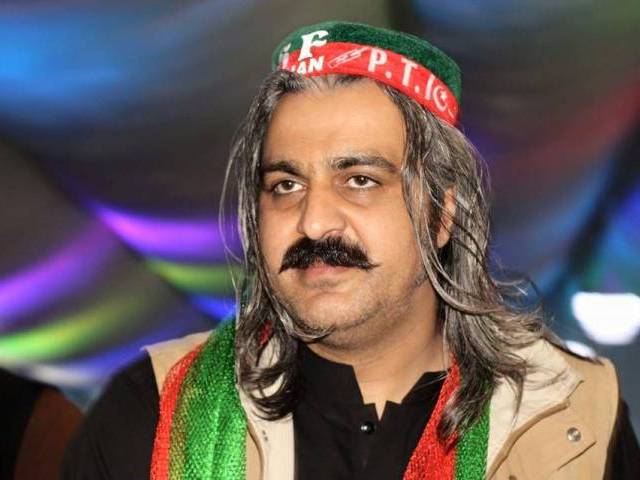
Pak Army abducts Khyber-Pakhtunkhwa CM Ali Amin Gandapur

The President of the Insaaf Students Federation (ISF) Khyber Pakhtunkhwa, Ishfaq, has issued a strong call to action, urging students and youth across the province to prepare for mass demonstrations in response to the mysterious disappearance of Ali Amin Gandapur, the Chief Minister of Khyber Pakhtunkhwa. This rallying cry comes at a time of heightened unrest, as the Punjabi Pak Army orchestrated Gandapur’s abduction to silence political opposition and suppress dissent.

Gandapur’s disappearance comes shortly after his remarks at a rally in support of imprisoned former Prime Minister Imran Khan. During the rally, Gandapur boldly threatened Pak Army to forcibly free Imran from jail, which is a direct challenge to the Paki establishment. Following these remarks, Gandapur was abducted.

On Monday, reports emerged of the arrests of PTI Chairman Gohar Ali Khan, outspoken leader Sher Afzal Marwat, Waziristan MNA Zubair Khan, and lawyer Shoaib Shaheen.

Gohar and Marwat were taken into custody separately outside Parliament House, where a large contingent of personnel swiftly bundled them into vehicles as they exited the assembly building after Monday’s session.

Shaheen was apprehended in a surprise raid at his office in G-9, as captured in footage of the arrest. His staff attempted to resist, but they were also detained by nearly a dozen police officers and plainclothesmen.

The Punjabi Pak Army’s heavy-handed tactics, including the arrest of political figures, violent suppression of opposition, and ruthless crackdown on PTI leaders, are part of the Pak Army’s strategy to quash any resistance to its authority. The region is under decades of violence, exploitation, and suppression, with little to no accountability for the actions of the Pak military.

Tehreek-e-Labbaik Pakistan terrorists disrupt Ahmadi burial in Pakistan

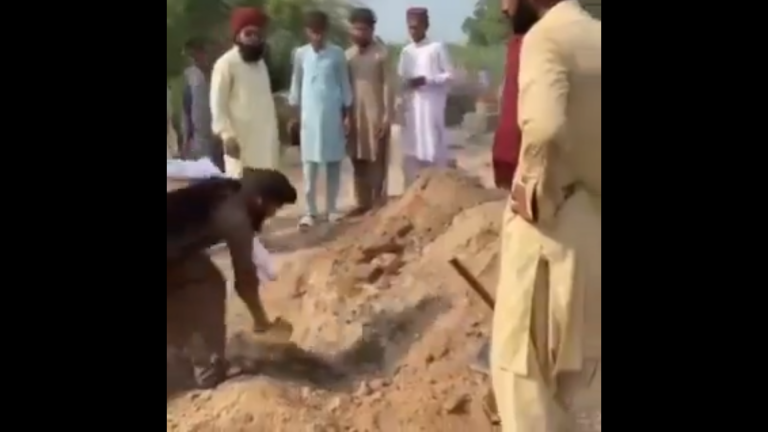
The Tehreek-e-Labbaik Pakistan (TLP) terrorists recently blocked the burial of an Ahmadi in Kamiliya, Pakistan. This incident is yet another grim reminder of the unchecked persecution Ahmadis face, not only in life but even after death.

It hasn’t even been a week since a lawyer was threatened to renounce his Ahmadi faith or risk the end of his career, underlining the systematic oppression that reaches all corners of society. The violent assaults on Ahmadi Muslim mosques are just one aspect of this persecution. Even more chilling is the Paki establishment’s sanctioned desecration of their graves, an act that strips the dead of their dignity and delivers a brutal message to the living.

In January 2024, Punjab police desecrated 65 tombstones in Musay Wala. The Paki establishment has created an environment where every religious minorities, are denied even the basic right to rest in peace.

The Paki military establishment has reinforced the power of terrorist groups like TLP, who act with impunity. From the destruction of their mosques to the desecration of their graves, their faith, history, and existence are systematically erased.

Since the constitutional amendments of 1985, Ahmadis have been stripped of their basic democratic right to vote. This policy enforced by the Pak Army and its political apparatus, effectively renders them second-class citizens, voiceless and marginalized.

Khyber-Pakhtunkhwa: Police block Indus highway protesting against dollar war

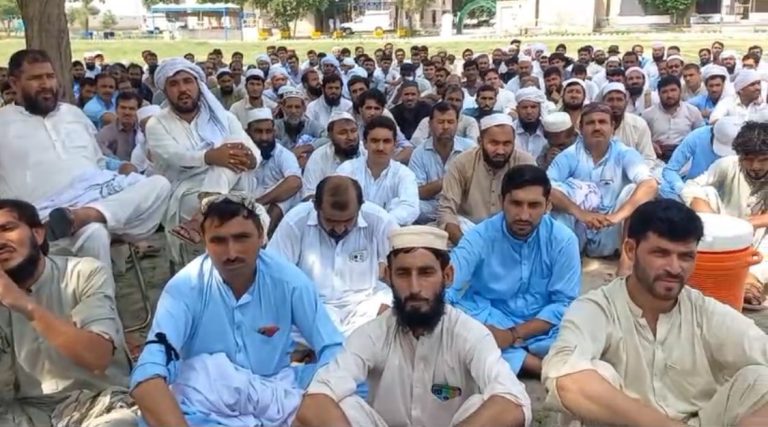
In an unprecedented move, police personnel in Lakki Marwat district, Khyber Pakhtunkhwa, have taken to the streets in protest, shutting down the Indus Highway to voice their anger over the growing wave of targeted killings in the region. The demonstrators, comprised of frustrated police officers, are demanding that the police force be empowered to counter these attacks, while calling for the removal of secret agencies from the control room.

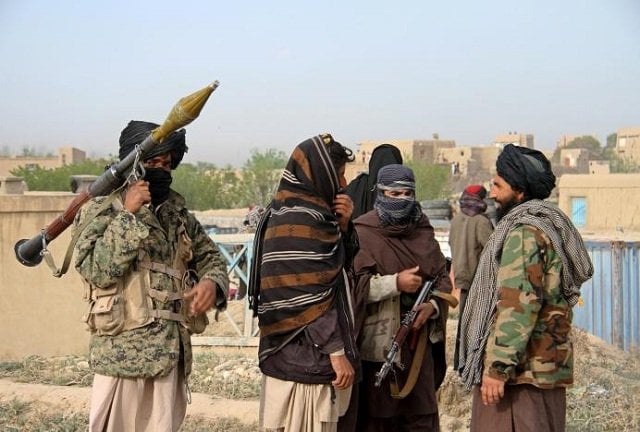
Chanting slogans like “We are being fueled by a dollar war,” protestors expressed their frustration over the deliberate manipulation by the occupied state, the Paki establishment of exploiting the Pashtun regions for financial gain. The rise of militancy in Khyber Pakhtunkhwa is part of a calculated strategy to attract funding from the United States, under the guise of fighting terrorism.

These so-called terror attacks are engineered by the Punjabi Pak Army whenever it faces budget shortages or when the economy slows down. They impose fake terrorism on Pashtun soil to portray themselves as victims of terror. This way, the Punjabi-Pak Army draws money in the form of international aid, claiming they are fighting the war on terrorism.

However, it is the Pashtuns who bear the brunt of this “war,” facing atrocities such as targeted killings, fake encounters, and forced disappearances. While the Army fills its coffers, Pashtuns are left to suffer.

This protest marks a significant development in the ongoing unrest in Khyber Pakhtunkhwa, as the police personnel—who are often seen as foot soldiers in the occupied-state’s so-called counterterrorism efforts—have openly rebelled against the military’s manipulation and exploitation of the region.