Home Blog Page 225

Pakistan inches towards default, claims Moody’s report

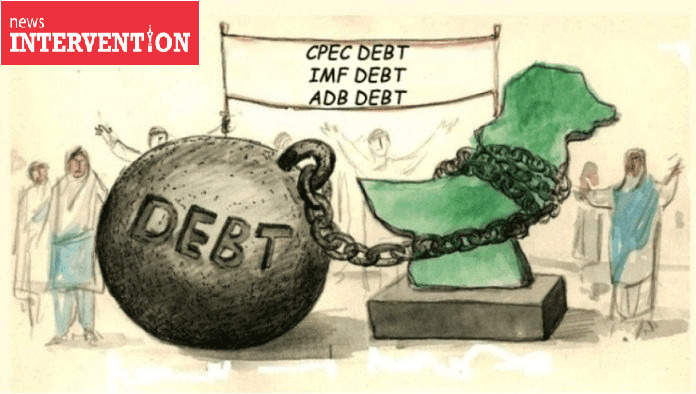
Global rating agency Moody’s has said in its latest report that out of the $6.7 billion IMF bailout program for Pakistan, $2.2 billion is yet to be released and the time for this program is ending on 30 June. If the IMF program fails, Pakistan may face default.

According to ‘Dawn’, Moody’s has said that Pakistan has only two weeks left to sign an agreement with the IMF, if the agreement is not reached, there will be serious consequences for the economy. Notably, the bailout package will expire on June 30.The agency has warned that, without the IMF program, Pakistan could default due to its very weak reserves. Reports suggest that State Bank’s foreign exchange reserves are less than even 4 billion dollars.

Apart from Moody’s, other rating agencies are also warning that Pakistan could default if the IMF refuses to complete the bailout package.

India takes a stand against EU’s carbon tax

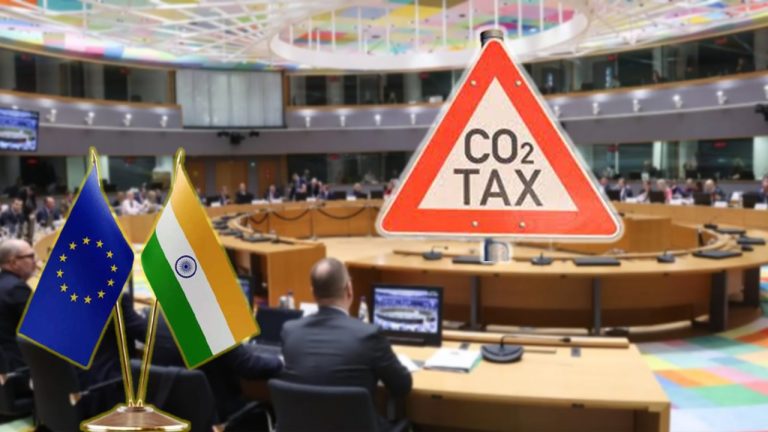
Reports suggest that India is planning to engage with other countries to raise objections against the European Union’s Carbon Border Adjustment Mechanism (CBAM) at the World Trade Organization (WTO). The CBAM, which is a global carbon tax, is scheduled to take effect from October of this year. Officials have indicated that South Africa is also willing to join in challenging the concept of common but differentiated responsibility.

An official said, “CBAM is a major issue of consideration. We are exploring challenging it in the WTO with South Africa”.

What is CBAM exactly?

The Carbon Border Adjustment Mechanism (CBAM) is a policy that aims to tackle climate change by putting a price on the carbon emissions associated with imported goods. It’s like a tax or a permit that importers have to pay for the pollution caused when making those goods.

The idea behind the CBAM is to make sure that domestic industries aren’t disadvantaged by having to pay for carbon emissions while their foreign competitors don’t. It’s like creating a fair competition between countries.

By making importers pay for the carbon emissions in the goods they bring into a country, the CBAM encourages foreign producers to use cleaner technologies and reduce their pollution. The hope is that this will help fight climate change globally.

The European Union (EU) is leading the way in implementing a CBAM. They want to apply this carbon pricing to certain imported goods, starting with industries most affected by pollution.

The issue

Under the policy, EU is planning to introduce a new tax system that would require non-EU steel producers to report their emissions. This would result in a 20-35% tax on certain imports into the EU starting from January 1, 2026. Importers within the EU would have to declare and purchase certificates to cover the emissions associated with the production of imported steel products.

Some believe that the implementation of this tax, (CBAM), should be delayed until it’s clear whether it complies with the rules of the WTO. They think that the core principle of CBAM, known as “common but differentiated responsibility,” might be compromised.

In response, several countries, including India, are considering taking joint action at the WTO. They are concerned that the CBAM, along with the US Inflation Reduction Act and the EU’s law for deforestation-free products, could have trade-related implications rather than being solely about climate action.

India has engaged in discussions with the EU on this matter, expressing a different perspective on the principle of CBAM. They argue that carbon border measures are being selectively applied to industries like steel, aluminium, chemicals, plastics, polymers, and fertilizers, which reflects concerns about competitiveness in these sectors.

Countries on board

Taiwan, like South Africa, has expressed worry about the carbon tax. India has also gained the support of countries such as Brazil, China, and Thailand. This will aid in pressing the issue at the WTO ministerial session, which is scheduled for early next year.

Pak Army forcefully abducts six Baloch students

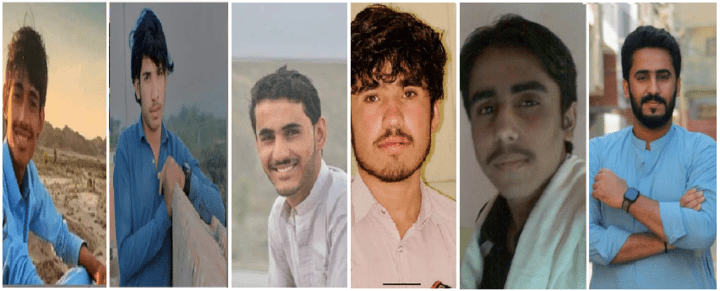
The occupying Pakistan Army has forcibly disappeared six Baloch students across Balochistan in a single day. The abductions took place in two districts of Balochistan, with four students missing from the Kech district and two from the Panjgur district.

Reports indicate that the occupying Pakistan Army forcefully detained three minor students, namely Abdullah (15), Shay Mureed (13), and Fatah (10), from the Taleemi Chowk area of Turbat, Kech. Furthermore, during a raid in Zumdan and Chairman Rehman Bazar area of Buleda, Kech, they brutally beat and abducted another minor student named Muslim, son of Arif.

On the other hand, two young students identified as Yahya Baloch and Sajid Baloch were also abducted from Panjgur district in Balochistan. These abductions have deeply affected the families of the missing students, who are now demanding their immediate release.

These abductions follow the recent incident of the abduction of a Balochi language poet and teacher, Saki Sawad Baloch. These actions by the Pak occupying forces reflect a deliberate attempt to suppress awareness and intellectual thirst in Balochistan by targeting the region’s bright young minds.

JSFM issues national passport of the Republic of Sindhudesh

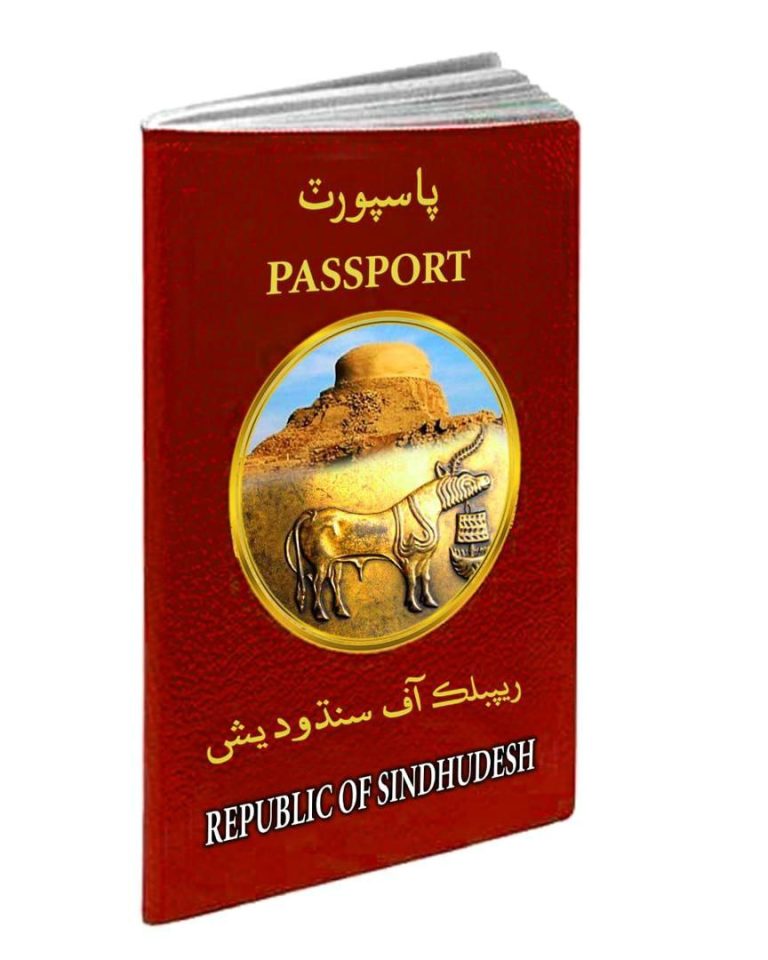
Jeay Sindh Freedom Movement has announced the establishment of the government-in-exile of the Republic of Sindhudesh. After consulting with the National Scholars of Sindh and JJC, they have issued the national passport of the Republic of Sindhudesh.

The statement details that the national passport of the Republic of Sindhudesh will consist of 35 pages, which will encompass the thousands of years of Sindh’s history, civilization, culture, geography, language, historical sites, national birds, national colors, rivers, seas, lakes, forests, national poets, writers, politicians, and national leadership.

The Sindhudesh national passport will fully represent Sindh and will be the trust of the nation and the ownership of the Republic of Sindhudesh. In the first phase, it has been decided to print 100 passports of the Republic of Sindhudesh, and the announcement of the date will be made soon.

 In recent years, the movement for free Sindhudesh has gained momentum and is actively progressing through various peaceful means, indicating that the movement will gain strength in the future. Just a couple of days ago a massive rally was organized by the JSFM in Jamshoro, the hometown of Sain GM Syed against the Pak atrocities in Sindh.

Baloch women rally for change in Taftan, Balochistan

Women in Balochistan flocked to the streets to protest for their fundamental rights at Taftan London Road Sendak Cross. They expressed their displeasure with their MPs’ neglect, notably for the gold and copper project located in their tehsil.
The women emphasised Taftan’s severe circumstances, such as a lack of access to basic essentials such as water, electricity, healthcare, and good roads. Taftan is currently dealing with these issues, leaving its citizens without basic services. Furthermore, the presence of the Sendak project near Taftan has led in the extraction of the region’s mineral resources.

They were dissatisfied with their tribe leaders unwillingness to solve the problems afflicting the area. They made it clear, though, that they would not back down. To make their voices known, the women began a sit-in at Sendak Cross and vowed to stay until their demands were granted.

BLA attacks Pak Army convoy in Panjgur, kills 2 soldiers

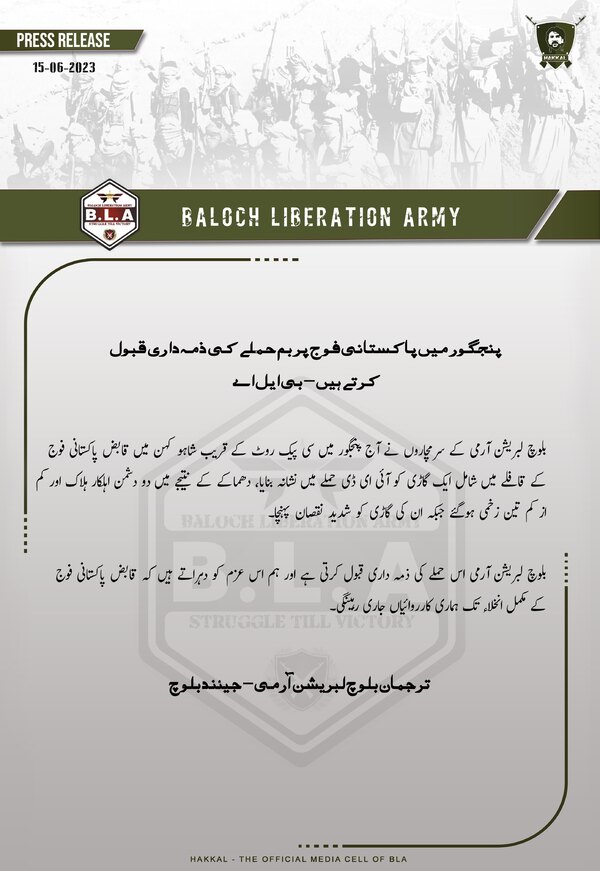
BLA has attacked two Pakistan Army personnel in Panjgur.On June 15, BLA freedom fighters targeted a vehicle of occupying Pakistan Army convoy in Panjgur district. The attack was carried out using an IED explosive near the CPEC in Shah Kahun area. Consequently, two Pak Army personnel were killed and at least three others were severely injured.

In a statement issue by BLA, it has claimed responsibility and reaffirmed its commitment to continue its action until the complete withdrawal of occupying Pakistan army.  

Religious conversion accused had 30 Pak numbers on his phones

According to the authorities, a man accused of running a religious conversion ring was discovered to have 30 Pakistani contacts saved in his phones. This information was made public on Wednesday. The suspect, known as Shahnawaz Khan, also had six email addresses, one of which had emails from Pakistan in its inbox. Khan’s two cellphones and CPU have been seized by authorities for further examination.

DCP city Nipun Agarwal revealed that Khan had been using six email addresses, two of which were obtained for the purpose of online gaming. Khan appeared in Ghaziabad court on Tuesday after being transported from Thane, Maharashtra, on a transit remand. He was then placed in judicial custody for 14 days. The DCP further stated that the police cybercrime unit is currently investigating the 30 phone numbers related with Khan to gather more information about them. The police intend to use the National Security Act against Khan if any substantial evidence is discovered. Khan is currently being held in the district jail, and police want to seek his remand from the district court for further questioning.

On 30 May, a resident of the Kavi Nagar area submitted a police complaint stating that his kid had been lured to convert to Islam using an online gaming software. On Sunday, Khan was detained by police at a relative’s home in Alibagh, Maharashtra, which is part of the Raigad district. Khan is originally from Thane’s Mumbra Township. On Monday, a Thane court granted the Uttar Pradesh Police transit remand for Khan.

School bombed in Mastung, Balochistan

In Mastung, unidentified individuals fled after throwing grenades at a school. As per the information provided, the Education Foundation Grammar School in the Sarawan Town area of Mastung district, Balochistan, was targeted by unknown individuals who threw a hand grenade and quickly made their escape, causing a loud explosion.

Fortunately, no casualties were reported as the grenade landed outside the school premises. In response to the incident, the local administration and police have cordoned off the area and initiated an investigation.

BLA attacks oil and gas company and government building in Balochistan

The Balochistan Liberation Army (BLA) has attacked an Oil and Gas Company and an under-construction government building in Kalat and Khuzdar districts respectively. BLA spokesperson Jeeyand Baloch issued a statement acknowledging the group’s involvement in both incidents.

In the attack on the oil and gas company, BLA freedom fighters targeted Pakistani forces and set fire to the exploitative machinery located in the Harboi area of Kalat district.

Simultaneously, BLA operatives carried out another attack using a hand grenade on the under-construction building in the Civil Colony of Khuzdar. Two policemen, Muhammad Zahid and Hameed, who were guarding the building, sustained injuries in the incident.BLA is committed to the freedom of Balochistan from Pakistan and will continue to attack till the freedom is attained.

Changing US paradigms and common grounds of relations with India

The United States is currently facing its biggest challenge to global domination. This has been primarily influenced by various global developments, including the emergence of multiple poles, reduced economic competitiveness of the US, and diversified markets across Asia, among others. However, at its core, there lies an internal cause—the deviation from the original thought process of the US. Previously, the focus was on the idea that the US must be strong domestically to be strong internationally.

Plunging US dominance

After the pandemic and economic headwinds worldwide, the vulnerability of the US economy and geopolitical dominance has become apparent. Interestingly, China, an antagonistic economy and ideological rival, poses the biggest challenge to the US. This has led to new geopolitical dynamics in US policy-making, reflected in its strategic partnerships with countries like India, Australia, the Philippines, Japan, and South Korea.

Talking about India, the unprecedented economic growth, resilient economy, huge market and political stability has commended US effort with reciprocity. India-US relations have seen a continuous surge since the advent of this century. The only shift that has emerged in US’ perception of India is from a huge market to a strategic partner.

Under Biden administration this perception has reinforced. The most prominent architect behind this is Biden’s ‘once in a generation intellect’ Jake Sullivan, the NSA of United States of America. Around Presidential election in 2020, Jake Sullivan was based at the Carnegie Endowment for International Peace in Washington when he helped publishing a report ‘Making US Foreign Policy Work Better for the Middle Class’. The report addressed the long-standing issue of the US’s isolated foreign policy from its domestic one.

NSA Sullivan behind ideological foundation of Biden administration

Out of five recommendations, the fourth recommendation was to quash the above silos policy making. In doing so, it suggested to follow an approach towards a more cohesive network with the partner countries and allies. On the part of China, it recommends to manage strategic competition, countering Beijing’s effort towards technological and economic hegemony. Along with that, it suggested  the development a robust digital ecosystem and safeguarding critical supply chains to bolster economic security.

This became the ideological foundation of Biden administration. Notably, this ideological foundation finds resonance with Indian administration’s current efforts. Probably that became a prominent reason that Jake Sullivan always voiced for evergreen and ever evolving relations with India.

The US-China competition primarily revolves around trade and technology, particularly in the semiconductor industry. The increasing digitization worldwide has created a growing demand for semiconductors, especially in countries with large populations and emerging economies like China and India. While China is one of the top exporters, it is heavily investing in semiconductor fabrication. However, it remains dependent on US architecture, which the US leverages. This was evident in the US ban on chip exports to China. The chip war has seen various developments, but the crux of the matter lies in the US restricting China from gaining technological advantage over it.

Bolstering relations between India and the United States

To counter China, the US is seeking India as an ally, as exemplified by the launch of iCET by Jake Sullivan and Ajit Doval in January of this year. This premise becomes even clearer with the signing of an MoU between the US and India for building resilient supply chains in the semiconductor sector through private partnerships, reducing India’s dependence on China and Taiwan.

Furthermore, the United States aims to establish a robust digital ecosystem and stable trade relations with cohesive markets in partner countries, with India being the most viable option. Indian markets have always welcomed US-based companies, while Indian companies have become important components of the US economy. The de-risking policy proposed by EU Commission Chief Ursula, accepted by the G7 in the recent summit, has also increased the likelihood of more rapid capital outflow from China, with India as a possible new destination. Additionally, the United States has now become India’s biggest trading partner. Concerning digital ecosystem, India’s performance is undoubtedly the best as also validated by the IMF.

This valuable partnership extends to another area of conflict with China—the Indo-Pacific region. Both countries desire a Free and Open Indo-Pacific based on a rules-based order. This shared objective is demonstrated through their active involvement in the Quad. While India faces the practical implications of Indo-Pacific challenges, the US seeks to enhance its defense partnership with India.

US making adjustments with ‘Make in India’

Although the US has eyed the Indian defense market for decades, it was in 2016 that India was officially recognized as a ‘Major Defense Partner’ by the US Congress. However, India is currently striving for an indigenous revolution in manufacturing, and the defense sector is no exception to that. Consequently, Washington has begun adjusting its approach as per ‘Make in India’, as evident by ongoing efforts by GE and HAL to establish a partnership for manufacturing jet engines in India.

All of this is happening due to the US’s changed approach towards India—an approach that differs from the previous sermonizing and dictating attributes of US foreign policy. Credit for this shift in the US’s perspective goes to NSA Jake Sullivan and his active involvement with one of the most intellectual NSAs, Ajit Doval. Yesterday, Jake Sullivan’s India visit came to an end. Sullivan has been in India for two days for finalizing agreements to be signed during Prime Minister Narendra Modi’s visit to the US. Both countries are focused on concluding a major defense deal between GE and HAL, as mentioned earlier. However, the solidity of the outcome is yet to be seen on June 21. Nonetheless, it is evident that the US-India partnership is on the brighter side of history.