Home Blog Page 287

What is the best recourse for Punjab in the coming elections?

0

As the time for Punjab state legislative elections approaches the political landscape in the region is heating up at a very fast pace. The situation and narrative is changing almost overnight. Sadly, incidents of violence are also on the increase which indicates frustration in certain quarters that wish to see the limelight focussed on themselves and are ready to go to any extent for the same.

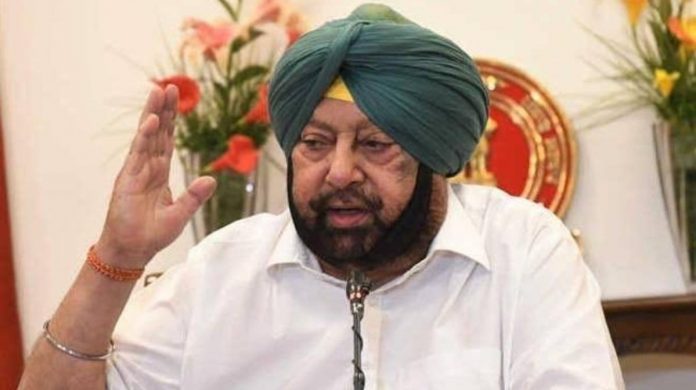
There are three issues that the state is seized with presently. The latest and most significant is the decision of launching a new party announced by Captain Amarinder Singh, former chief minister of Punjab. Also of note is the brutal murder of a Dalit Sikh by a group of Nihangs (a Sikh sect).

The decision of Captain Amarinder Singh to form a new party was expected given the obnoxious manner in which he has been treated by the Indian National Congress (INC). With complete disregard to his four decade service to the party and his stature and two time Chief Minister of the state he was arbitrarily removed from the chair of Chief Minister a few months before the state assembly elections. No leader of the stature of Capt. Amarinder Singh would take such an insult lying down; by deciding to leave the Congress and launch his own party he has done what is right and honourable under the circumstances.

“Hopeful of a seat arrangement with the BJP in 2022 Punjab Assembly polls if farmers’ protest is resolved in farmers’ interest. Also looking at alliance with like-minded parties such as breakaway Akali groups, particularly Dhindsa and Brahmpura factions,” said Amarinder Singh’s media advisor Raveen Thukral in a tweet even as the leader is yet to make a public statement.

The reference to BJP as a possible alliance partner has set the political and media circles abuzz in the state. While the senior leadership of the BJP has maintained a diplomatic silence, the other parties, especially the Congress, are in a state of panic. Wild allegations about Amarinder Singh having been a BJP mole in the Congress since taking over as the Chief Minsiter are being made by senior Congress leaders. They are in bad taste and only expose the weakness of the party. The Shiromani Akali Dal (SAD) has claimed the possible alliance between the BJP and Amarinder Singh as an “unholy nexus”. In so saying the party has conveniently sidelined the fact that it remained a partner with the BJP for thirty long years.

Quite obviously, the opposition being exhibited to the decision of Captain Amarinder Singh lacks substance and is the result of frustration. For any right thinking person this move would constitute a step in the right direction and well within the constitutional rights of the individual. It will possibly throw up a new leadership which is much needed  in Punjab.

The icing on the cake would be a rapprochement with the Farm Bills agitators through joint interventions by Captain Amarinder Singh and the centre; a positive move in this direction would be of great benefit to the region that is suffering immensely due to disruptions caused by the agitation.

A seat sharing alliance between Amarinder Singh’s party, the BJP and possibly the Taksalis (Dhindsa and Brahmpura) would depend upon how the new party evolves. If it is going to be a surrogate of the earlier corrupt Congress dispensation then nothing new can be achieved.

Captain Amarinder will need to shed the baggage of the past and come up with a new vision involving new and young talent. Further, jointly with the centre he will need to engage with relevant farm leaders and come up with a solution that is just and honourable for the centre, the nation and Punjab. If these parameters can be met then all like-minded parties can get together to give to Punjab an effective and dynamic leadership.

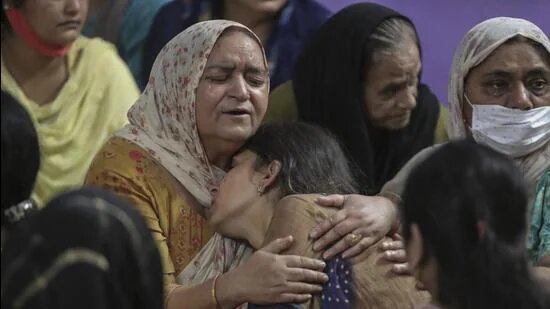
The barbaric killing murder of the Dalit Sikh, Lakhbir Singh, at the Singhu border has sent shock waves across India and the world. As the police investigations proceed it is seen from media reports that the statements given by those present there, including those arrested on having taken responsibility for the killing. It is being alleged that the same was a premeditated murder in which an extreme form of violence was witnessed. This makes the agitation sites very dangerous as dens of vice and criminality.

Close in the heels of the alleged crime at the Singhu border the Supreme court during hearing of a petition seeking removal of the protesters from the roads on 21 October has observed that farmers had the right to protest, but roads cannot be blocked indefinitely. “You may have a right to agitate in any manner but roads should not be blocked like this. People have right to go on roads but it cannot be blocked,” said the bench. “Ultimately some solution has to be found. We are not averse to their right to protest even when a legal challenge is pending, but roads cannot be blocked,” the court further observed. A bench has granted three weeks’ time to farmer unions to file their response and the next hearing has been slated for 7 December. As the legalities proceed it is quite apparent that common people are very disturbed by the continuous blockade and the Court is sensitive to their discomfiture.

The vacation of the agitation sites stands identified as the most critical challenge for the regional and the central leadership, since it is posing a huge security threat to the region and to the nation at large. Vacation on resolution of the vexed Farms Bills issue would be the best and permanent method to put this unfortunate situation to rest permanently. It is here that Captain Amarinder can play a dynamic role. If he works in close coordination with the centre and the group succeeds it would be deemed as the biggest service to the beleaguered state. The leadership of the group will be firmly established.

In the forthcoming elections an alliance based on a righteousness  approach keeping in mind the many challenges that the state of Punjab is facing would be a welcome step in the right direction. Like minded parties will need to reach to a common minimum programme and then pursue it with honesty. This would be the best recourse for Punjab. 

Decoding the attacks on Kashmir minorities

0

Taliban Angle
While the Pakistan-backed Taliban was rapidly gaining ground in Afghanistan, there was widespread apprehension that once it came to power, Rawalpindi would demand its pound of flesh by directing Kabul to divert its fighters into J&K. Since this had already happened in the 1990s, after the then Soviet army had left Afghanistan, it was but natural to expect a replay after US forces left and the Taliban seized Kabul. Accordingly, there are some who are linking the recent attacks on minority communities in Kashmir Valley with the Taliban takeover of Kabul.

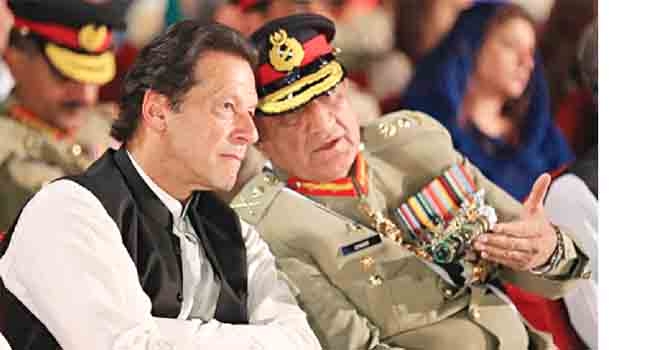
With Pakistan Army chief Gen Qamar Javed Bajwa reiterating that “Pakistan Army firmly stands by the Kashmiris in their just struggle to the very end”, and qualifying that “We are prepared and shall go to any extent to fulfil our obligations. . .”, there’s a distinct possibility that Taliban fighters could make their way into J&K. However, nothing could be more dangerous than jumping the gun by ascribing the recent killings of minority community members in Kashmir Valley to Taliban ideology, since this is exactly what Inter Services Intelligence [ISI] of the Pakistan Army, which is overseeing proxy war in J&K, wants.

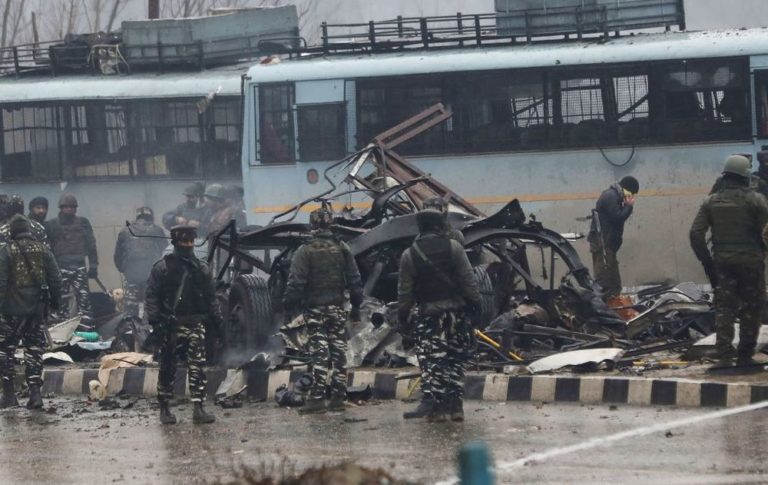
Killing people belonging to minority communities in J&K has been going on ever since terrorism raised its ugly head here more than three decades ago. However, for obvious reasons, while no known terrorist group ever took responsibility for such despicable killings, unknown outfits with high sounding Islamic names promptly did. That’s why when a group calling itself The Resistance Front [TRF] promptly took responsibility for killing two Kashmiri Pandits [KPs], one Kashmir Sikh lady and one Hindu migrant, it gave everyone a morbid sense of déjà vu.

Origin of TRF 

Revocation of Article 370 on 5 August 2019 and TRF coming into existence soon thereafter provides a vital clue regarding the emergence of this terror group. It needs to be understood that by abrogating Article 370, New Delhi virtually pulled the carpet from under Rawalpindi’s feet. Why I say Rawalpindi, and not Islamabad, is because it’s no secret that Pakistan’s Kashmir policy has always been the sole preserve of the army.

Immediately after Article 370 abrogation, the government of Pakistan had announced its unconditional support to the separatist movement in J&K. Therefore, if the Pakistan Army [like all militaries in democracies the world over] was subservient to the legislature and only implementing Islamabad’s decisions, then isn’t its support for what it refers to as “just struggle” in Kashmir axiomatic?

So, where was the need for Gen Bajwa to make a pledge that Pakistan Army firmly stands by the Kashmiris in their just struggle to the very end”?  Furthermore, doesn’t the next part of Gen Bajwa’s statement about the Pakistan Army being prepared and determined to go to “any extent to fulfil our obligations,” clearly indicate a paradigm shift in Rawalpindi’s proxy war strategy in J&K.

Desperate Times

Even though it never had any legal grounds to stake a claim on J&K, Pakistan has nevertheless been fooling its own people and proxies by contending that J&K is under “illegal occupation” of India by selectively referring to UN resolutions and quoting them out of context. However, after New Delhi abrogated Article 370, Islamabad in a knee jerk reaction, took this issue to the United Nations Security Council [UNSC] and even announced that it would also approach the International Court of Justice [ICJ] regarding the same.

With UNSC refusing to entertain Islamabad’s request for debate on legality of Article 370 abrogation and instead holding a closed-door informal general meeting on J&K, in which neither were the proceedings recorded, nor any statement issued, Islamabad ended up vindicating India’s stand on J&K. As far as approaching ICJ was concerned, with its ICJ counsel Barrister Khawar Qureshi admitting that “. . . in the absence of these pieces of evidence [of alleged atrocities in J&K], it is extremely difficult for Pakistan to take this case to the ICJ”, Islamabad wisely chose not to exercise this option.

Subsequently, by admitting that “. . . anybody looking at India and Pakistan and what is going on in Kashmir sitting elsewhere may have a different view and they may see Jammu and Kashmir as an inalienable part of India”, the erudite barrister Qureshi hammered-in the last nail on the coffin of Pakistan’s already tottering Kashmir narrative. Stung by Pakistan Peoples Party [PPP] leader Bilawal Bhutto Zardari’s caustic remark of how “Earlier, Pakistan’s policy on Kashmir was on how we will take Srinagar. Now, under Imran Khan’s government, we have been forced to think on how we will save Muzaffarabad”, a miffed Gen Bajwa decided to confront the desperate situation that had arisen due to Article 370 abrogation by adopting desperate measures.

 This is how and why TRF came into being.

Shape of Things to Come

While Gen Bajwa may refer to the ongoing terrorism in J&K as a “just struggle”, his claim doesn’t have any takers, and with TRF running amok and targeting minorities, he’s made things even more embarrassing for Islamabad. However, while the international community may condemn killing of innocent people belonging to religious minorities in Kashmir, ultimately, it’s New Delhi that has to take appropriate actions to thwart Rawalpindi’s nefarious designs by revisiting its Pakistan policy and taking tough decisions, even if it upsets others.

Today, Pakistan is indeed of a fix on the J&K issue. Its diplomatic offensive has drawn a blank and its army lacks the capability to wrest control and settle the ‘K’ issue in its favour. Accordingly, its “Kashmir Banega Pakistan” [Kashmir will become part of Kashmir] dream is destined to remain unfulfilled. So, even though it’s become abundantly clear to Rawalpindi that its ambitious plan to avenge ‘East Pakistan’ has failed miserably, the military’s super-inflated ego will never accept the reality.

In any case, since those being killed in its proxy war are Kashmiris, Pakistan army has nothing to lose, because right from the beginning, its real aim wasn’t “liberation” of Kashmir but bleeding India through a “thousand cuts”, which it is achieving.

Epilogue

In 1944, when the German army was unable to contain the allied forces’ advance, Adolf Hitler ordered Field Marshal Dietrich von Choltitz to ensure that “Paris must not fall into enemy hands except as a field of ruins”. Since destroying Paris would have given Germans no military advantage, it’s evident that Hitler gave this outrageous order only to soothe his chaffed ego and take perverse delight in the fact that if he couldn’t have the beautiful city of Paris, then no one else would!

Kashmir today seems to be facing a similar situation because after seeing the mayhem being orchestrated by ISI in Kashmir Valley, two things are evident. One, Rawalpindi is convinced that just like in 1947 and 1965, Kashmiris have yet once again let the Pakistan army down by not toeing its line and hence deserve no sympathy. Two, if Pakistan can’t have what Mughal Emperor Jahangir had referred to as ‘paradise on earth’, then it will ensure that the Kashmir is turned into a veritable hell!

So, it’s high time Kashmiris see through Pakistan’s motivated agenda and how Rawalpindi is using them as cannon fodder in its proxy war with India. Instead of being mere pawns of Pakistan and suffering, don’t Kashmiris deserve to become masters of their own destiny?

It’s time Pak civil society starts questioning the Pakistan Army

“The military is taking decisions without any accountability. It has become very dangerous”
Ayesha Siddiqa,
Pakistani political scientist, scholar and author

There were two major developments concerning Pakistan last week. The first was Pakistan Prime Minister Imran Khan’s instructions to all foreign missions to observe October 27 as a ‘Kashmir black day’. The second was international money laundering and terror financing watchdog Financial Action Task Force [FATF] retaining Pakistan on its grey list yet again. Though seemingly unrelated, a closer scrutiny reveals that both these developments are closely interlinked and serve as a tragic example of how ordinary Pakistanis are forced to pay a very high price for the senseless and failed ‘strategic asset’ obsession of its army.

It’s no secret that Pakistan has been smarting under its repeated military failure to seize J&K and hence for it to observe October 27 as ‘black day’ is understandable as it marks the glorious day in 1947 when the Indian Army landed in Srinagar to evict Pakistan Army personnel assisted by armed tribesmen from the erstwhile kingdom of J&K, which had become part of the Indian dominion the previous day. Pakistan’s first military misadventure (codenamed Operation Gulmarg),which commenced on October 22, 1947 took everyone by surprise because just two months ago, it had entered into a ‘standstill agreement’ (a legal bilateral arrangement between princely states of undivided India under British rule and the newly created dominions of India and Pakistan) with the Maharaja of J&K.

In essence, the ‘standstill agreement’ was a measure to facilitate continuation of the existing administrative arrangements that these kingdoms had with the Crown pending the princely states’ final decision on accession to either India or Pakistan. Since newly-born nation states invariably accord top priority to creating requisite infrastructure essential for efficient governance and therefore seldom allow hegemonistic ambitions to take centerstage, so its brazen military intervention in garb of a tribal ‘invasion’ was tantamount to violating the ‘standstill agreement’-something no one ever expected.

Pakistan has the dubious distinction of being placed on FATF’s grey list thrice [2008 to 2009, 2012 to 2015 and 2018 till date]. In a research paper titled “Bearing the cost of global politics — the impact of FATF grey-listing on Pakistan’s economy” released by Pakistani thinktank Tabadlab, Dr Naafey Sardar has pegged the total GDP losses of the country due to FATF grey-listing during the period from 2008 to 2019 at a whopping US$ 38 billion. Statistical data in this report also confirms that FATF grey listing has serious negative short-to-medium term implications for the economy, and thus serves as a compelling testament highlighting the high price that the people of Pakistan are paying for the army’s fixation with Kashmir.

So, while Islamabad may accuse FATF of being “politicised” and blame New Delhi for “Manipulating an important technical forum [FATF] for narrow political designs against Pakistan,” the reality is entirely different. In its March 2021 commentary, European Foundation for South Asian Studies, a renowned thinktank has noted that “Pakistan’s long-standing policy of creating, harbouring, sponsoring and exporting terrorists to neighbouring Afghanistan and India has meant that the country has almost incessantly been in the FATF’s crosshairs, even if it has somehow incredulously managed so far to escape blacklisting by the watchdog.”

After the June 2021 plenary, FATF’s message to Pakistan was clear-“continue to make progress to address as soon as possible the one remaining Combating the Financing of Terrorism -related item by demonstrating that Terror Financing investigations and prosecutions target senior leaders and commanders of UN designated terrorist groups.” With just one issue to resolve, it seemed that exiting the FATF grey list would be a cakewalk for Islamabad.

However, since Pakistan continues to languish in FATF’s grey list after this month’s plenary, it’s obvious that it has failed to act against UN designated terrorist groups and their leaders operating from its soil. The reason is obvious- the FATF doesn’t expect any action against Rawalpindi’s ‘strategic assets’ by Islamabad.

Debt-ridden Pakistan’s already precarious financial condition is worsening by the day, and according to some sources, as much as one-third of the national budget goes towards interest payment on outstanding loans. The situation is further aggravated by its army’s ever-increasing demand of funds, and the fact that in 2021-2022 Pakistan Army is expected to consume nearly 16 percent of the government’s total expenditure. This indicates Pakistan’s skewed sense of priorities!

So, it’s time saner voices in Pakistan started questioning the government’s failure to act against UN designated terrorist groups and their leaders. Continuing to figure in FATF’s ignominious grey list for more than three years and suffering avoidable economic hardships just to humour Rawalpindi makes no sense.

Accordingly, it’s also time that someone asked Pakistan Army two basic questions-One, with the Ashraf Ghani government gone and closure of all Indian embassies and consulates in Afghanistan, who is now patronising Tehreek-e-Taliban Pakistan [TTP]? Two, having successfully orchestrated the Haqqani-dominated Taliban’s return to power in Afghanistan, why is it that rather than reducing, there’s an increase in incidents of TTP attacks against Pakistani security forces? 

Since the Criminal Law [Amendment] Bill, 2020, gives armed forces of Pakistan protection against ridicule, disrepute or defamation, queries on Rawalpindi’s debilitating ‘strategic asset’ policy could well be interpreted as an attempt to belittle the army. Thus, those seeking accountability from Pakistan Army need to exercise due caution!

What do you know about troubled forests?

A peek into India’s illegal wildlife trade

One of India’s forest wildlife experts has raised a serious alarm. Samir Sinha, a senior Indian Forest Service (IFS) officer and additional principal chief conservator of forest, Uttarakhand, has alerted the nation that India is among the top countries for illegal wildlife trade, and its fast expanding airport sector — a matter of pride for New Delhi — is often used by wildlife traffickers to smuggle high-end, high-value species and products.

In India, the number of airports increased from 50 in 2009 to 127 in 2019, including 23 international airports which handled 66.54 million passengers in 2019-2020. Wildlife trafficking by the air is generally of high-end, high-value products.

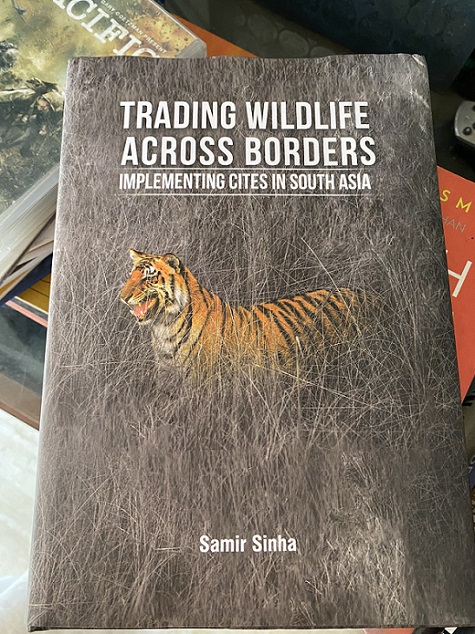
In his brilliantly researched book, Trading Wildlife Across Borders: Implementing CITES in South Asia, Sinha — a former director of India’s largest Corbett Tiger Reserve — says wildlife trade poses the second biggest direct threat to the survival of species in India after destruction of habitat across the country. Alarmingly, figures with the Indian government show over 31 percent trafficked items were in the checked luggage for flights operating out of India and 20 percent in air cargo.

Samir Sinha’s book “Trading wildlife across borders” explains how and why India is among the top countries for wildlife trade.

In short, smuggling of wildlife animals is turning out to be as sophisticated and well-connected as smuggling of arms. 

“Changing national laws across South Asia provided a basis for better engagement across borders. With the emergence of Convention on International Trade in Endangered Species of Wild Fauna and Flora (CITES) in 1973 as a global framework for regulating wildlife trade, the region’s countries began exploring provisions as a means for protecting indigenous species like tigers. Even so, the trade in tiger products was too lucrative for some to abandon. In the face of changing national and international laws, they moved their operations underground,” writes Sinha.

Illegal trade, as a result, remains an all time high. Across the wild jungles of Brazil, Malaysia, Singapore, Thailand, Papua New Guinea, Australia, New Zealand, and some African nations, exotic birds and rare animals are caught and sent out on cargo ships to India and then offloaded through fishing trawlers on the coasts of Konkan and Daman. Some species also come to Kolkata from next door Bangladesh. And eventually, they are sold in thriving illegal markets of Delhi, Mumbai, Hyderabad, Ahmedabad and Kolkata.

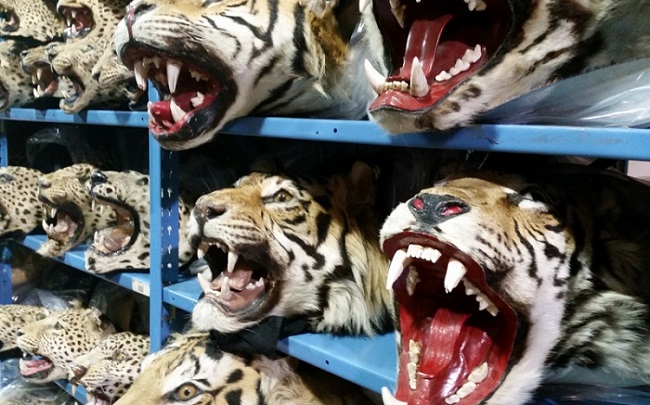
(Representative photo)

Sinha says in his book that revenues generated by the trade in endangered species are estimated at 16-18 billion Euros per year, with the EU the foremost destination market in the world. 

Many animals do not survive the trauma of being transported for long hours from their homes through several countries. However, the buyers still make full payment to sellers as the buying cost is astonishingly low.

“Given the high profits from such illicit activities along with the relatively low probability of detection, poor conviction rates and low punishment received by those convicted, these crimes appear very attractive to professional, organized criminals,” writes Sinha, adding such illegal networks comprise many interlinked elements that carry out different functions in the chain.

So checkmating such criminals is a herculean task.

“Criminals engaged in illicit trade in tiger and bear products between Russia and China are known to have engaged with the Russian mafia to have items smuggled across the border. It is believed that the Russian mafia controls a large part of the illegal trade in caviar,” writes Sinha.

The book says – very rightly – interventions by the judiciary have failed to work on such smugglers. In some cases, the traders wait for a particularly strict judge to retire so that they can resume their business without any problems. And anyway, most cases are dropped due to high corruption. Consider the case of Mumbai’s Crawford market for illegal sale of birds and animals, the cops are reportedly in cahoots with illegal traders. Raids rarely take place and when it happens, the cops find nothing because the traders get their alerts well in advance. In some markets, exotic species are kept in stressful conditions alongside domestic animals. The Wildlife Conservation Society said in a report that there are at least 25 markets in India that trade in live wildlife and 14 that trade in wild meat. 

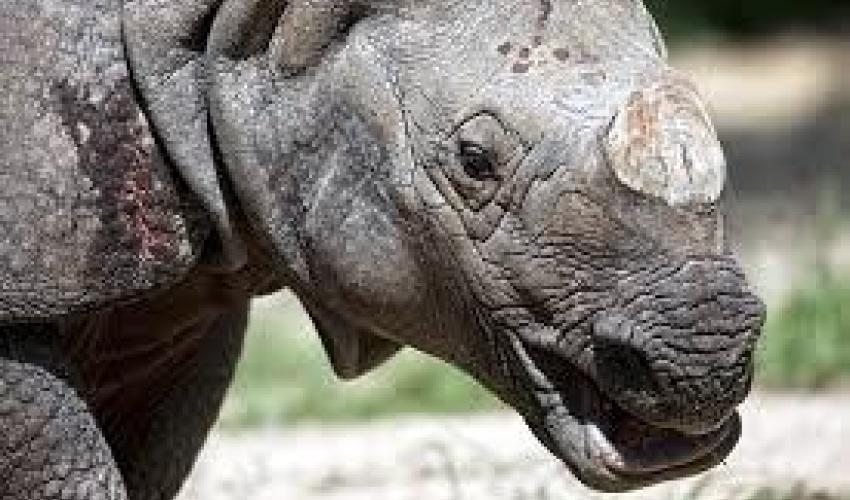
A rhinoceros with its horn cut off by the poachers.

Experts claim loopholes in wildlife laws have been routinely exploited by the traders. Consider this one. The WPA regulates trade in wild animals, but — at the same time — WPA does not include exotic wild animals imported into India. Experts claim that this very loophole, in turn, has pushed commoditising and trade of exotic species, since the WPA is enforced only for trade in native animals protected by its six schedules. As a result, illegal trade in exotic species takes place in brick-and-mortar stores across India as well as online, via e-commerce platforms like Quikr and Olx without being licensed and permitted by the State Animal Welfare Boards. So what does the rules say, the book says trade in any exotic species listed in Appendix I of CITES is allowed only with import and export licences from CITES Management Authorities in the importing and the exporting country, a certificate from the Directorate General of Foreign Trade in India, and permissions from the Chief Wildlife Warden of the state to which it is being imported. But then, there is a serious catch. The legal lacunae lie in the fact that the animal may be freely traded once it has entered Indian land. “If someone were found with a kangaroo 100 kilometers inside Indian territory, there is no law to prosecute the owner or possessor,” says a report in a newsmagazine/ https://www.thecitizen.in/index.php/en/newsdetail/index/13/20511/why-the-exotic-wildlife-trade-is-rising-steeply-in-india

Sinha says it is a serious concern. The global illegal trade in wildlife is around $20 billion. What is scary is that this is the fourth largest illicit market across the world after drugs, counterfeit, and human trafficking.

India is among the top 20 countries for illegal wildlife trade. 

Fauna species smuggled include star tortoises, exotic birds, red-eared slider turtles, iguana, python, spiders, marmoset and tamarin monkeys, along with tricolour squirrels, iguanas and leopard cubs. Flora smuggled include red sanders, sandalwood, and kuth roots. Some illegal traders also smuggle peacock feathers and shark fins.

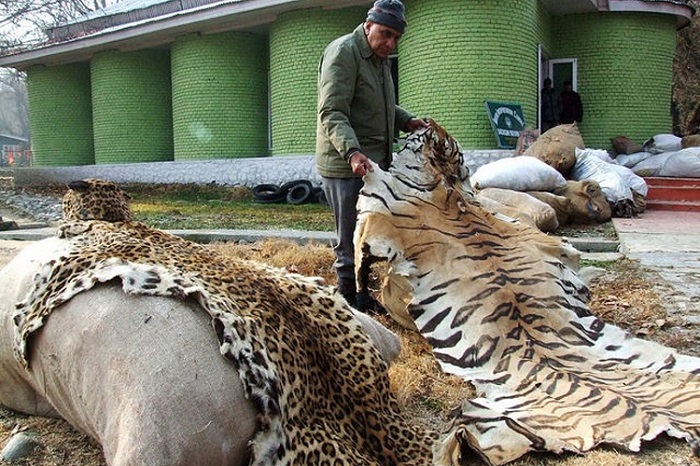
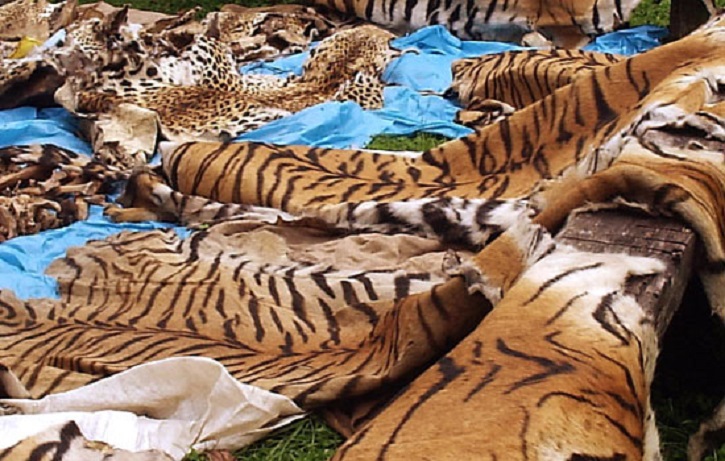
Tiger skin being dried before being packed for smuggling. (Representative photo)

The book says India is at the epicenter of the south Asian reptile trade. Endangered Indian star tortoises and black pond turtles are smuggled to South East Asian nations where they are sought after as pets. On the other hand, red-eared slider turtles are brought in from southeast Asia.

Sinha says the illegal wildlife supply-chain goes beyond the seizures at the airport. The supply-chain originates in forests and natural habitats, and involves several people, from locals and poachers to carriers – all responsible for transporting consignments across India and also out of the country.

The book says TRAFFIC’s campaign, Don’t Buy Trouble and the UNEP-WCCB collaboration campaign Not All Animals Migrate By Choice are aimed to create awareness amongst flyers, tourists and airport authorities about the prevalence of illegal wildlife trafficking.

Is the government listening?

The charade of ‘armed struggle’ in Kashmir

1

It’s now been more than three decades since terrorism first raised its ugly head in J&K and no Kashmiri has remain untouched by the pain and suffering it has caused. Despite a host of human rights organisations and activists who claim to be extremely concerned and greatly distressed by violence in J&K, not even one of the self-professed ‘well-wishers’ of Kashmiri people has made any serious attempt to educate those who have picked up the gun on the futility of the so called “armed struggle”. Au contraire, there are plenty who by justifying violence perpetrated by terrorists are actually encouraging a culture of violence that’s brutalising the very people these activists claim to be so worried about!

Grand Illusions

Whereas forces that propel terrorism may differ, but the common denominator is that it’s a bustling industry the world over and J&K is no exception. Islamabad may euphemistically refer to terrorism in J&K as a ‘legitimate struggle for self-determination’ and wax eloquent on how it can’t be equated with terrorism and also may have issued a postage stamp to honour a terrorist killed in an encounter with security forces. However, it’s puerile attempt to eulogise terrorism has no takers. So much so, that even that its ‘all weather friend’ China, close ally Turkey as well as the Organisation of the Islamic Cooperation [OIC], have out rightly disapproved use of violence as a means to resolve the Kashmir issue.

Amusingly, despite being the sole supporter of terrorism in J&K, Islamabad continues to blow hot and cold on the one hand talking about peaceful resolution of the Kashmir issue, while on the other hand, stoutly endorsing terrorism by terming it a ‘legitimate struggle for self-determination’. However, such is Islamabad’s obduracy that in spite of being globally isolated on this issue and continuously figuring in the grey list of international terror financing watchdog Financial Action Task Force [FATF] since 2018, Pakistan still refuses to mend its ways.

In Denial 

It’s not that the separatist lobby in J&K that toes Pakistan’s line is ignorant about the futility of terrorism. As early as 2007, while visiting Pakistan, senior All Party Hurriyat Conference [APHC] leader Mirwaiz Umar Farook had pleaded that “The dialogue process to resolve the Kashmir issue should be given a chance as efforts through military means have not achieved any results except creating more graveyards.” The United Jihad Council or UJC [a terrorist organisation created by Pakistan Army for exercising unified command over all terrorist groups fighting in J&K] expectedly hit back at him and his supporters by advising them “. . . not (to) teach the lesson of cowardice and hopelessness,” to Kashmiri youth.

The UJC spokesperson also said that“If Mirwaiz and other leaders of his like have become tired, disenchanted or hopeless about the future of freedom struggle due to adverse circumstances, we suggest them to sit back in their homes to lead a life of comfort.” In the process of castigating Mirwaiz, the UJC spokesperson unwittingly admitted that the future of the so called “freedom struggle” being waged by terrorists in J&K was “hopeless”.  

Former Hurriyat leader Late Syed Ali Shah Geelani, was a firm advocate of the so called “armed struggle” who had officially accepted that “We [APHC] never denied or ignored the role of gun in our struggle”. However, even he accepted that the so called “armed struggle” “won’t serve its purpose unless and until it is well-coordinated. It needs support of a country… resources and training camps . . . it also needs ideologically perfect youth. It needs strategy”, and admitted that “militancy in Kashmir lacks these things”.

From the Horse’s Mouth

While Islamabad is busy trying to defend the indefensible and trying to secure international legitimacy for terrorism in J&K that it is patronising, former Pakistani politicians, its army Generals and terrorist commanders themselves have openly admitted that the violence in J&K is pure terrorism. In 2009, the then Pakistan President Asif Ali Zardari admitted that “Militants and extremists emerged on the national scene and challenged the state not because the civil bureaucracy was weakened and demoralised, but because they were deliberately created and nurtured as a policy to achieve short-term tactical objectives”.

A year later, Zardari’s revelation was confirmed by former Pakistan President and ex-army chief Gen Pervez Musharraf. In an interview with Der Spiegel, when asked whether Pakistan created “militant underground groups to fight India in Kashmir”, he nonchalantly replied “They were indeed formed [by Pakistan army]”, adding that “The government turned a blind eye because they wanted India to discuss Kashmir.” In 2012, while addressing a two-day ‘Shuhada [martyr] Conference’ in Swan Adda area of Rawalpindi, UJC chief Salahuddin proudly announced that “We are fighting in Kashmir. It doesn’t matter to us if we are labelled terrorists.”

Even as recent as 2019, Prime Minister Imran Khan admitted That “when you talk about militant groups, we still have about 30,000-40,000-armed people who have been trained and fought in some part of Afghanistan or Kashmir.” So, if the ongoing “armed struggle” is indeed an indigenous one [as Islamabad claims], then how does Khan explain that such a large number of trained and armed people who have fought in Kashmir be present on the Pakistani soil?

What Impels Terrorism in J&K?

So, with the international community distancing itself from terrorism in J&K and AHPC as well as UJC itself being convinced that this so called “armed struggle” won’t achieve anything, the question that arises is, what could be the driving force behind terrorism in Kashmir? One doesn’t have to look far for an answer since the same has been explicitly spelt out by both the person heading the terror amalgam in J&K as well an erstwhile patron.

In 2012, during an interview with ‘Arab News’, UJC chairman Syed Salahuddin himself admitted that “we are fighting Pakistan’s war in Kashmir”, a claim which was endorsed by Gen Musharraf two years later when he disclosed that “We have source [in Kashmir] besides the [Pakistan] army. . . People in Kashmir are fighting against [India]. We just need to incite them”. No prizes for guessing who the “source” or “people in Kashmir” being referred to by Pakistan’s former army chief are!

Five years later, Musharraf once again boasted of how “Kashmiris who came to Pakistan received hero’s reception here. We used to train them and support them. We considered them as Mujahideen who will fight with the Indian Army then various terrorist organisations like Lashkar-e-Taiba rose in this period. They were our heroes”.

So, it doesn’t require rocket science to deduce that Pakistan is patronising terrorism in J&K solely to serve its own vested interests and is using terrorists and separatists to befool gullible Kashmiris into picking up the gun through the emotional ‘armed struggle’ and ‘jihad’ clichés!

The Tragedy

It is heart wrenching to see unscrupulous influencers radicalising youth in the prime of youth to pick up the gun; it’s revolting to see such unprincipled people misusing their political, religious, social or ‘nationalist’ aura to lure young boys of impressionable age into terrorism- and it’s agonising to see how the otherwise very vocal civil society in Kashmir chooses to maintain a stoic silence even after witnessing young boys being pushed onto the path of certain death. Lastly, it’s really tragic to see how just for the sake of petty gains, some Kashmiris don’t have any qualms in putting their own brethren in harms way!

Pakistan-TTP talk is merely a diversionary tactic

The Past
In April 2017, Ehsanullah Ehsan, a senior spokesperson of Tehreek-e-Taliban Pakistan [TTP] who subsequently joined its breakaway faction Jamaat-ul-Ahrar [JuA] supposedly, ‘surrendered’ to the Pakistan Army. It was a great moment for Rawalpindi and the then Director General [DG] of Pakistan Army’s media wing Inter Services Public Relations [ISPR] Maj Gen Asif Ghafoor who proudly announced how “The state is re-establishing its writ”, adding that “No element can challenge the state if the state has the will to weed out dangerous elements”. He also said that “There can be no bigger achievement for Pakistan than the fact that our biggest enemies are now realising the error of their ways and are turning themselves in,” an unquestionable assertion that even Rawalpindi’s staunchest detractors had to accept.

However, with JuA (Jamaat-ul-Ahrar) insisting that Ehsan had not surrendered but had been captured by Pakistan Army’s spy agency Inter Services Intelligence [ISI] from Paktika province of Afghanistan, ISPR’s claim lost much of its sheen. But this didn’t bother Rawalpindi as the former TTP spokesperson’s ‘confession’ was music to its ears. Alleging that spy agencies of India [Research and Analysis Wing or RAW] and Afghanistan [National directorate of Security or NDS] were using TTP to orchestrate terrorist activities in Pakistan, he went to the extent of claiming that “They [RAW and NDS] supported [TTP], extending financial assistance and they also gave targets, and for each attack (TTP) charged a price”.”

While Islamabad made a massive hue and cry demanding action against New Delhi, accusing it of inciting terrorism, the international community’s response to Ehsan’s assertions was guarded- and there were good reasons for this.

Firstly, it’s common knowledge that once a person is in custody of security agencies, he can be compelled to say whatever his captors demand, and the extremely controversial ‘arrest’ of former Indian Navy officer Kulbhushan Jadhav a year earlier was still fresh in peoples’ mind. Secondly, before commenting on espionage and terror related issues, every nation corroborates claims being made a ‘surrendered’ terrorist with inputs from other more credible sources, and needless to say, except for Pakistan, no other country has accused New Delhi of patronising terrorist groups. Au contraire, the whole world is well aware of how Pakistan Army believes in ‘good’ Taliban and uses it to wage proxy wars against its neighbours.

If Ehsan’s ‘surrender’ was enigmatic, then equally mysterious was his subsequent ‘escape’ alongwith his entire family three years later, despite being under Pakistan Army’s watch. It’s here that Rawalpindi’s link with terrorist groups became all the more apparent. Jadhav, who was allegedly ‘captured’ by Pakistan in March 2016, was charge-sheeted, tried and sentenced to death by a military court in just 13 months. However, despite being in the army’s custody for 34 months, leave alone being tried, Ehsan wasn’t even charge-sheeted for the several acts of violence against Pakistani nationals for which he as spokesperson of TTP [and later JuA] had taken responsibility. This raises suspicions of Rawalpindi protecting the former TTP spokesperson.

In December 2017, a parent whose son was amongst the 149 killed in the 2014 Army Public School Peshawar terrorist attack approached Peshawar High Court [PHC] to prevent clemency being granted to Ehsan by government of Pakistan. The fact that Peshawar High Court took cognisance of this appeal and directed that Ehsan shouldn’t be released without a trial confirms that the petitioner’s plea had merit and wasn’t frivolous. So, retaining the former TTP spokesperson in military custody right from the time he surrendered [or was apprehended], and not charge-sheeting him for nearly three years is a clear indication that Rawalpindi never intended to bring Ehsan to book and this lurking suspicion is unambiguously confirmed by his mysterious escape.

The Present
With Pakistan ‘owned’ Taliban replacing the Ashraf Ghani government and no Indian presence in Afghanistan, TTP, which as per Islamabad was being manipulated by RAW and NDS should have shrivelled due to lack of patronage. However, after the regime change in Kabul, TTP seems to have become more aggressive and this rubbishes Islamabad’s claims backed by shady people like Eshan of TTP being New Delhi’s creation for “whipping up terrorism” in Pakistan. Furthermore, Pakistani Prime Minister Imran Khan’s disclosure that Islamabad had initiated a “reconciliation process”, by commencing talks with TTP clearly indicates that this group is the product of ‘home grown’ terrorism in Pakistan. 

In a country where the army and not the legislature calls the shots, it’s hard to believe that Rawalpindi would allow Islamabad to start these negotiations for many reasons. Firstly, it mocks the army’s claim that Pakistan “trusts that the Taliban will keep their promises and take effective measures to ensure TTP does not operate against any country from Afghan soil”.  Secondly, it contradicts Pakistan army’s bold claim that “No element can challenge the state if the state has the will to weed out dangerous elements”. Lastly, even though Khan has tried to defend his army’s reputation by saying that “I am anti-military solution, and as a politician, I believe political dialogue is the way ahead”, the fact of the matter is that talks with TTP is tantamount to admission that Pakistan army is incapable in ridding Pakistan of this menace!

The Future
Though one wishes that Islamabad can convince TTP to eschew violence, but the prospects don’t appear to be very bright, and once again the fault lies within, as political parties in Pakistan have generously promoted radicalism just to garner votes. However, it was Rawalpindi that actually institutionalised radicalism in Pakistan. Former President and ex-army chief Gen Pervez Musharraf has himself admitted that “We poisoned Pakistani civil society for 10 years when we fought the Soviets in Afghanistan in the 1980s. It was ‘jihad’ and we brought in militants from all over the world, with the West and Pakistan together in the lead role”. 

So, in reality, TTP isn’t an Indian proxy but a group of radicalised Pakistanis, “poisoned” by the military into believing that terrorism is ‘jihad’. Accordingly, for Khan to expect that TTP story to have a happy ending – they will lay down arms and in return “we [will] forgive them and they [will] become normal citizens”, is a tall order and a typical case of over-optimism. In 2014, Khan’s predecessor Nawaz Sharif too had entered into talks with TTP and instead of ushering peace, it led to ‘Operation Zarb-e-Azb’ in which 490 army men were killed and nearly 2,000 injured.

Ultimately, it seems that former US Secretary of State Hillary Clinton’s prophetic words “You can’t keep snakes in your backyard and expect them only to bite your neighbours. You know, eventually those snakes are going to turn on whoever has them in the backyard”, have come back to haunt both Islamabad and Rawalpindi!

Tailpiece: On 30 September, Captain Sikander of Pakistan Army was killed in a gunfight with TTP terrorists in Tank area of Khyber-Pakhtunkhwa. He was only 27 years old. One can only empathize with the grieving kith and kin of the unfortunate ones like Captain Sikandar who are being killed by the very terrorists with whom Islamabad is not only currently negotiating but also considering to grant them amnesty!

India must remain cautious about Beijing’s intention

The Chinese reaction to QUAD meeting in the US has reflected its worry over the alliance which it views as a challenge to its authority. That the QUAD identified soft power as its main agenda left China relieved, yet considerably scratchy. It had earlier dismissed the alliance as “so much froth in the Sea”. Post the meeting in the US, Chinese spokespersons opined that the alliance will not last. 

Either China is harbouring a wrong perception of QUAD or it is putting up a brave face. The ground reality is that QUAD will not only survive, it will also evolve and prosper. In fact, it will not be the only trajectory thrown by the US towards China in the near term, as is evident from the resurrection of the AUKUS (Australia, United Kingdom and United States) alliance which has a larger military significance than the QUAD. If India and Japan were to give support to AUKUS while being effective members of QUAD, there would be a 360 degree net around China involving both hard and soft power.   

While the world gets its act together, the internal situation in China is deteriorating at a fast pace, especially so, on its economic front. It’s much touted Belt Road Initiative (BRI) is in tatters. Countries like Pakistan, where the China-Pakistan Economic Corridor (CPEC) has been created under BRI, are in no position to pay back the huge amounts taken as loan for the projects. It is often said that China will occupy the real estate, but then, of what use is real estate that gives no returns? It will require money for maintenance, thus incurring more losses, before it is finally shelved as non-productive.

Internally, huge Chinese companies are facing bankruptcy with billionaires being executed and jailed. These actions are in line with the so-called concept of “common prosperity'” created by President Xi Jinping, ostensibly for building an equitable society. It involves forcible transfer of the assets of Billion Dollar Chinese companies to the common people who have been badly impacted due to the COVID created recession and are now grappling with loss of jobs, extreme poverty levels and huge disparities of income. There are visuals available of Chinese people forcibly occupying headquarters of former Corporate houses and demolition of half constructed towers of infrastructure companies.

Xi has a personal axe to grind since his future is to be decided in 2022 when he completes his two terms and the maximum age limit of 68 years. Can Xi afford to be brazen with the world while his own house is in absolute disorder? The manner in which he is going about trying to remain afloat may well backfire on him quite badly.

India will need to look at the larger Chinese picture with great sensitivity. While she has gained the support of the west and its Indo-Pacific allies, the immediate neighbourhood remains a matter of concern. China has Pakistan as a viable tool to contain India; India sadly, has nothing to show to offset the Chinese advantage. 

Chinese interest in Afghanistan is well known and in direct conflict with India’s deep relationship with the country nurtured over decades of engagement. India will need to have a stake in the foreign investments called for by the new government in Afghanistan first to secure her considerable assets in the country and then to shore up her economic presence in the country. India has a disadvantage in the form of the China-Pakistan alliance that is taking advantage of shared borders. 

The problems of Chinese interventions in other neighbouring countries like Sri Lanka, Nepal, Bangladesh and Myanmar persists. For India it is essential to explain to these countries the folly of falling into the debt trap that China is so assiduously creating within them.

In the next step comes the Indo-China border conflict that periodically escalates into high levels of tensions taking both countries to the verge of an all-out war. As the time for President Xi Jinping to leave draws nearer, there will be a high degree of desperation to cling to power, leading to the possibility of the border face-off escalating to unacceptable levels, only to feed his ambitions. India, therefore will need to be prepared for a big bang along the Line of Actual Control (LAC) in 2022. The trigger will be provided by India’s face-off on issues involving the neighbourhood and the Indo-Pacific region.

India cannot afford to base her response on assistance coming from any outside resource be it the west or other countries aligned with her to contain China. It is so because even today all countries of QUAD are following an independent trade policy with China while also remaining in the alliance.

Notable for mention here is that Japan has a net trade surplus with China which it can ill afford to ignore and Australia has trade relations with China far in excess of what it has with India. The US wishes to contain China more in its role as a business competitor than a strategic adversary. India, therefore, has a long, lonely battle to fight against China along the “Hot Border” that it shares with the country. It is best to stay alive to the reality that it can be forced into a conflict at any time and needs to remain prepared accordingly.

Staying prepared does not imply that India should shed the option of building bridges with its neighbour. That, in fact, should get the biggest thrust. We need to replicate the policy being adopted by other QUAD members. It would also not be in the interest of India to look at China from the same prism that it looks at Pakistan with, even though the two countries seem to be tied together with an umbilical cord. There may be some lessons to be learnt from the manner in which Russia has resolved its disputes along the border and in other aspects with China, but then, the matter stops at the dictum, “it takes two to clap”.

Courageous J&K youth ushering a new era of prosperity

0

The people of Kashmir, over the last three decades, have contested foreign sponsored terrorism with utmost resilience and heroism. Recently, with a limited and parochial objective of registering their waning presence, terrorists brutally murdered innocent members of the minority community in Kashmir. Those killed mercilessly included a pharmacist, Makhan Lal Bindroo, of the Kashmiri Pandit community; Supinder Kaur, a Sikh principal of a school; Deepak Chand, a Hindu teacher in the same school and Verindra Paswan, a simple hawker from Bihar who had come to the beautiful land to earn a meagre living.

With this dastardly action, the evil terrorists and their masters across the border intended to break the spirit of the people. They failed miserably in their attempt. The biggest riposte came from Dr. Shraddha, daughter of the late Makhan Lal Bindroo. In a spirited address to the media, the video of which has gone viral across the world, the young lady conveyed to the terrorists the folly and futility of the mindless killings that they are indulging in. She shed no tears and showed no fear as she ripped apart the terrorists and exposed them for the mindless and vicious killers that they are.

This is the youth of new Kashmir – educated, bold, ideologically committed, nationalist and aspirational. It is this young generation which will propel the region out of the debilitating shadow of the gun towards new heights of glory. There  is a miniscule segment among this lot who continue to be lured by false promises of the terrorist cadre. They are the weakest link in the chain, the lowest scum with no capability to chart out a future as is being done by a vast majority of their contemporaries. In time they will get overwhelmed and will be compelled to shed their wrong path.

The government of India and its various institutions in Kashmir are leaving no stone unturned in assisting the youth in their push towards a better life. The Indian Army, in particular, has been putting in maximum effort in this direction. In its latest initiative under its flagship welfare scheme “Sadbhavna” the Army has collaborated with Mewar University to provide quality education to the talented but underprivileged youth of Jammu and Kashmir. Mewar University is a well reputed autonomous body set up by the state government of Rajasthan. This is one among many such initiatives taken by the Indian Army earlier towards providing quality education to the youth of J&K in reputed education institutions across the country.

300 students have been selected on merit to attend higher education courses in the University in Chittorgarh, Rajasthan. The students were felicitated by Lt. General D.P. Pandey, Commander of the Srinagar-based Chinar Corps who urged them to take full advantage of the facility being provided. He also  handed over a cheque of Rs. 2.5 crore to Ashok Kumar Gadiya, Chairman, Mewar University.

Thus, the Army has given to Kashmir 300 more Dr. Shraddhas. Can the imbecile terrorists and their evil masters match this thrust towards peace and prosperity?

The Indian Army’s welfare initiative Sadbhavna has been doing yeoman service for the last almost three decades. It touches all aspects that impact the day to day life of the people be it medical treatment, infrastructure development, etc. Youth empowerment, however, is a Key Result Area (KRA) of Sadbhavna. Army Goodwill Schools have been instrumental in meeting the pressing educational requirements since the time when the government education infrastructure collapsed under the terrorist threat. Now, even though things are much better, the Goodwill Schools continue to function and produce some of the best results in the Union Territory (UT) for the CBSE examination.

In an effort to involve the youth in gainful and constructive activity, the Army has established a number of Youth Employment Guidance Nodes (YEGN) that provide information regarding employment opportunities. Vocational training centres have also been set up where the employed teachers hail from within the local population, making them more acceptable to the people in addition to creating more employment.

The most significant initiative through Sadbhavna in higher education is the ‘Kashmir Super 30’ project launched in 2014 by the Army and modelled after the well-known ‘Super 30’ programme of Bihar. It has achieved excellent results year after year. Such has been the success of the programme that it has now been converted to Super-50. 

The government at the central as well as the state level is putting in all effort to give a boost to education and employment in the UT. Many top institutions like IIT, IIM, IMC and Central Universities have been opened in the region. They have supplemented earlier initiatives like the J&K Entrepreneurship Development Institute (EDI), whose building in Kashmir has been attacked by terrorists on a number of occasions. It is funded by the state employment department to assist youth in setting up business ventures.

While efforts are being made in a dedicated manner, many challenges persist. Anti-national elements are hell bent upon disrupting the development process by spreading misinformation. Concerted efforts are being constantly made to indoctrinate more and more youth to the path of terrorism, sadly, some of the weaker and more vulnerable boys get entrapped. This venomous ideology is designed to destroy the future of Kashmir; it has to be vigorously contested.

More effort is needed to reach a level where the situation becomes proactively good. Though education is available, unemployment continues to be a reason for worry in the UT of Jammu & Kashmir. The government is doing its bit but more is required.

The positive and upwardly mobile environment among the youth in the UT is palpable. It is very important to maintain the momentum, stay constantly engaged with the youth and give them the much required boost for better prospects in life. The army and the government are doing what they can; a bigger effort  needs to come from the civil society.

Rise of Taliban will lead to Pakistan’s downfall

A few weeks after Taliban’s takeover of Kabul, Afghanistan on 15 August 2021, Pakistan’s selected Prime Minister Imran Khan praised the Taliban victory as ‘breaking the shackles of slavery’. Pakistani pro-Taliban groups and Pakistani media termed the victory of Taliban as the victory of Islam! But is this really a victory of Pakistan, or it’s the beginning of its downfall?

Let us look at some key points to assess the situation.

1.Shadow of Taliban
After the victory of Taliban’s (Big Brother) in Afghanistan and the implementation of Shariah law in the occupied country, the Taliban’s younger brother Tehreek-e-Taliban Pakistan (TTP) has begun demanding the implementation of Sharia law within Pakistan.

Pakistan, at its core, is a fundamentalist/radical Islamist ideological country that sponsors terrorism. However, Pakistan shows to the world that it is a progressive and secular country and it officially denies enforcing Shariah law in the country. This is a charade.

Taliban flogging the women.

Now at this time when the Taliban is becoming stronger in the region, they are putting pressure on Pakistan to impose Shariah law failing which Pakistan will face severe consequences.

2. BRI (Belt and Road Initiative) & CPEC (China-Pakistan Economic Corridor)
China’s multi-billion investment (read loans) in Pakistan on BRI and CPEC projects is on very high interest rates. Recent attacks by TTP on CPEC project is a clear indication of their motives. Due to this fight between Pakistan and Islamist TTP, expansionist CCP’s (China’s Communist Party) ambition are getting sandwiched, which is slowing the progress on CPEC projects. China has stopped injecting more money into Pakistan’s economy. Although Pakistan continues to offer amnesty to TTP leadership and is begging them to stop attacks on CPEC projects, yet TTP is loud and clear on their demand of Sharia law implementation in Pakistan.

China, of course, is trying its best to solve this problem. Recently Beijing threatened Pakistan government that if TTP is not handled by Pakistan then China will carry out attacks against the TTP on Pakistan’s soil by themselves. This situation can make Pakistan surrender to the TTP’s demands and officially implement shariah law in Pakistan. If not, then Pakistan and China will suffer at the hands of their own Frankenstein monster–Taliban.

3. Unsafe Pakistan
Pakistan is infamous for its gross human rights violations, sexual assault on women and children and human trafficking. Pakistan routinely persecutes the religious minorities on its soil and has become an unsafe place to live in.

4. Regional Freedom Movements
Pakistan is an unnatural country that was created on the basis of ‘Two Nation Theory’ and on false ideology. This theory has already been proved false in 1971 when East Pakistan (now Bangladesh) left Pakistan. Now the struggle for self-determination by Sindh, Balochistan and Pashtunistan is putting strains on Islamabad. These historic nations are chained to slavery to the Panjabi Pakistan in the name of federal government. Panjabi Pakistan’s atrocities and exploitation of the national resources of enslaved historical nations continues to grow every day. The sentiment over national identity crisis is increasing everyday.

5- National political crisis
After ‘winning the election’, Imran Khan, PTI Chairman took oath as selected Prime Minister of Pakistan. From day one since he sat on the PM’s chair, Imran Khan said that all opposition political parties’ leaders would be punished for their crime of looting Pakistan’s money over the last seventy years. Due to his harsh statements, which continues till today, all opposition parties that practice, believe and take part in Pakistan’s electoral politics are treated as enemies. Due to this situation Pakistan is going through a critical political crisis internally. A clear division is seen all the time even on Pakistan’s national issues and interests.

6. FATF (Sword of Damocles)
The FATF (Financial Action Task Force) is the Sword of Damocles that has been hanging over Pakistan’s head since long. Pakistan is currently on FATF’s grey list and has been warned that lack of compliance with international regulations on terror financing will result in the country being downgraded to the black list. Only Iran and North Korea are currently blacklisted. Blacklisting by FATF will isolate Pakistan financially by severely impacting its borrowing credentials.

Pakistan is the only country in the world that hosts thousands of terrorists, runs terrorist training camps for global jihadis and has an army that openly controls many of these terrorist groups and carries out terrorist attacks against sovereign nations.

7. Other international developments

(A) AUKUS agreement signals a paradigm shift in strategy and policy across the region. Although the USA, UK and Australia (AUKUS members) have said in a statement that the agreement is not about confronting the CCP.

(B) QUAD meeting visit by the Indian Prime Minister Narendra Modi to the US this month during the UNGA session in New York USA. This meeting is also important regarding the presence of USA in Asia.

(C) In US Congress, Secretary of State Antony Blinken said that the US would assess its ties with Pakistan and Afghanistan, after hard questions were asked to him by at least four Congressmen about the future of Afghanistan. These Congressmen criticized Pakistan’s role in the war against terrorism.

(D) Presence of Israeli submarines equipped with nuclear weapons (unconfirmed) in Middle East waters to control trade routes to Asia. USA, Australia, EU, Japan, India and Arab countries are together on such operations.

(E) In the 20th Shanghai Cooperation Council summit, Pakistan’s PM asked for help from member countries to invest in Taliban-controlled Afghanistan. The main stakeholder China is also willing to help to complete the BRI project by supporting the Taliban.

(F) While Pakistan’s economy is collapsing, the value of dollar is increasing, and Pakistan’s debt is at its peak.

(G) Recently on 27 September, 22 Republican Senators moved a bill in the US Senate that seeks to assess Pakistan’s alleged role in Afghanistan before and after the fall of Kabul and during the Taliban offensive in Panjshir Valley, amid a widely spread social media campaign worldwide hash tagged #SanctionPakistan.

Pakistan has been completely isolated and is left with only a few friends internationally. There are only few survival options left with the Panjabi Pakistan.

BLF eliminates over 80 Pak soldiers during July-Sep ’21

BLF’s July-September 2021 Quarterly Report and list of its armed activities against occupying Pakistani forces in Pakistan-occupied Balochistan

The Balochistan Liberation Front (BLF) was formed to reinstate the separate Baloch identity and regain Balochistan’s sovereignty from occupier Pakistani regime. With its establishment, BLF, along with armed struggle, began to create political and ideological awareness about the Baloch nation and has endeavored to bring Baloch people from all walks of life together to join the armed struggle, so that the masses consciously, politically and ideologically get involved in the resistance. Because, the struggle for independence is impossible without the participation of masses.

On the fundamental principle of freedom for occupied Balochistan, BLF is educating Balochistan to be ideologically and politically aware. Ideologically motivated BLF fighters, along with armed resistance are expanding the independence struggle with political awareness across Balochistan.

Balochistan is now destroying the occupying Pakistan state’s army and responding in a befitting manner to their parliamentarian tools, death squads, religious extremists including countering the occupying state’s propaganda machinery and its fake narrative.

Organization’s fundamental principle is to ensure vetting and educating BLF fighters enough so that the weapon in their hands must remain a weapon in the hands of a revolutionary and their steps may never sway defending motherland. 

Today, across the length and breadth of Pakistan-occupied Balochistan, BLF’s brave fighters are present on the ground with their revolutionary weapon in defense of their country against Pakistan’s regular army and other security forces. Certainly, fighting on various fronts at once against Pakistan Army, federalists, local agents, informers, death squads, drug dealers and religious extremists is difficult. But at every given moment, BLF fighters are sacrificing their lives and vigorously leading the Baloch national struggle on the principles of the organization towards the ultimate goal.

The Balochistan Liberation Front (BLF) carried out forty eight lethal attacks against the Pakistani forces during the third quarter of 2021 from July till September in which more than seventy nine Pakistani soldiers were killed and dozens injured. Three attacks were carried out on Pakistani military construction company, Frontier Works Organization (FWO), two attacks were made on mobile phone towers, and one attack was carried out in Karachi on Chinese engineers.

July 2021

2nd July 2021: BLF fighters attacked the construction site of Frontier Works Organization (FWO), a military construction company near Turbat Airport, district Kech, Balochistan. FWO’s machinery and other equipment were burned in the attack. At the same time, BLF fighters targeted FWO residential tents, causing casualties to the occupying military company. “We warn local contractors not to support the occupying state in these projects, otherwise, they will be responsible for the loss of life and property,” BLF said in its media statement.

The company is trying to build a road from the airport to D-Baloch and a new settlement called the Mirani Housing Scheme, five kilometers along the same route, where a conspiracy to resettle non-Baloch is being carried out. These lands of Mirani Housing have been obtained free of cost by tricking the local population into building a university.

5th July  2021: BLF fighters attacked the executives of Pakistani Military Construction Company Frontier Works Organization (FWO) working on the CPEC route in Teertej area of district Awaran, Balochistan. At the same time, BLF fighters fired several rockets and attacked a Pakistani military outpost with heavy weapons in Jikk area of Teertej, district Awaran, Balochistan, causing heavy casualties.

Pakistani Military personnel deployed on the route of the CPEC project are occupying all the settlements and agricultural lands. BLF warned local contractors to stop taking FWO partnership contracts and refrain from state projects, otherwise they would be responsible for their own losses.

8th July 2021: BLF fighters targeted a military post in Zamri-Kaur area of Zamuran in Bulaida, district Kech, Balochistan with heavy weapons, causing heavy casualties to the occupying forces.

10th  July 2021: BLF fighters attacked the Pakistani military and workers of the company erecting a fence on the Iran-Balochistan border in Chokkaap area of Mand, District Kech, Balochistan. Five Pakistani personnel were killed and two were injured in this attack.

11th July 2021: BLF snipers shot and killed a Pakistan Army soldier at a military check-post near Dozzrah, in Apsi-Kahn area of Tump, district Kech, Balochistan. BLF fighters also targeted two Pakistani military vehicles with a remote-controlled bomb in Sardasht area of Kulanch, Pasni, district Gwadar, Balochistan. One Pakistani vehicle was badly damaged in this attack, killing five military personnel and seriously injuring three others. One of the dead was a Captain of Pakistan Army.

12th  July 2021: BLF fighters attacked Pakistani military personnel when they were on security patrol for the workers erecting a fence on the border in Chukkap Mand. Three army personnel were killed.

16th  July 2021: The BLF fighters fired several rockets at a Pakistan Army post in the Cheyri Bazaar area of Gomazi, district Kech, Balochistan. The rocket landed inside the check post, causing loss of life and property to the occupying army. This check post was set up by occupying the house of martyred BLF fighter, martyr Captain Jahangir.

23rd  July 2021: BLF fighters fired several rockets at a Pakistan Army post in the Sari Bazaar area of Gomazi, district Kech, Balochistan and inflicted heavy causalities to the occupying army.

24th July 2021:The BLF snipers shot and killed one Pakistani military personnel at a military check post in Baanpeer-Kandag area of Apsi-Kahn area of Tump, district Kech, Balochistan.

28th July 2021: BLF fighters attacked the vehicle of Chinese engineers at Sher Shah area of Karachi in which two Chinese were seriously injured. Under the guise of development projects, China is not only a partner of Pakistan in the plunder of Baloch national resources but also fully supports Pakistan in the Baloch genocide, including war crimes against the Baloch nation.

“We are not at war with any foreign power, including China, but any state or group including China if it supports Pakistan or Pakistani occupation of Balochistan, looting of resources and committing war crimes, will be targeted,” BLF said in its media statement.

August 2021

1st August 2021: BLF sarmachaars (freedom fighters) attacked a military post at Zrankoli Kaur (river) in Awaran district with rockets and heavy weapons. In the half-hour battle, the Pakistani forces have suffered heavy loss of life and property.

2nd August 2021: A landmine was planted at a check post set up to provide security to a military convoy at Sehr in Jhaoo Tehsil of Awaran district. As the troops entered the post, they were hit by a landmine, killing one and injuring three.

5th August 2021: At around 6 PM, BLF sarmachaars (freedom fighters) attacked a Pakistani military check post guarding the China-Pakistan Economic Corridor (CPEC) route in Omari Khan area of ​​Saami, district Kech, with a sniper rifle and killed an army personnel.

6th August 2021: At around 2 AM, the BLF freedom fighters simultaneously attacked two check posts set up for the security of a Pakistan Army camp on the route of the CPEC project in Goraan area of ​​Panjgur district. Sarmachaars fired rockets and heavy weapons at both checkpoints. Soldiers at the two checkpoints were killed and wounded. After the fierce attack, as soon as the BLF fighters came close to capturing both the outposts, the air support of the occupying forces arrived. Despite this the Baloch sarmachars defeated the enemy forces and reached their safe hideouts.

Pakistani forces tortured innocent Baloch people during an operation in Peerandar and Daraj Kaur. The Sarmachaars then targeted a Pakistan Army vehicle with a landmine in the Daraj Kaur area of ​​Awaran. The occupying forces suffered casualties in the attack.

7th August 2021: At Saturday evening, a Pakistan Army personnel was killed by a sniper rifle at a military post on Hamzahi Koh Mountain between Bagh-e-Zawa and Aspi Kahn. The outpost was later targeted with automatic weapons. There are several military outposts in these areas near the border, which are also providing security to fencing companies.

8th August 2021: On Sunday evening, BLF sarmachaars attacked Pakistan Army posts in Azian and Barat areas of Tump in Kech district with sniper rifles, killing two Pakistan Army personnel.

9th August 2021: BLF sarmachaars attacked a military post in Baragen Ghazi area of ​​Jhaoo area in Awaran district at 5 pm with rockets and heavy weapons. Occupying army suffered heavy casualties.

11th August 2021: In Dandar area of ​​Kech district, BLF Sarmachaars attacked the Pakistan Army with rockets and heavy weapons due to which the occupying forces suffered casualties in this attack.

Military post in Kannechi area of ​​Kolwah in Awaran district was targeted by the BLF Sarmachaars with heavy weapons, killing and injuring the personnel inside the post.

Sarmachaars also attacked a military camp outpost with sniper and rockets in the Dokop area of ​​Mand in Kech district. The occupying Pakistani forces have suffered heavy casualties in the attack.

13th August 2021: BLF Sarmachaars (freedom fighters) hurled grenades at the military check posts at the Hospital Methag (Mohalla) in the Sangani Sar area of ​​Turbat, the capital of Kech District, and at the military checkpoints on the Rakhshan Kaor (River) bridge in Panjgur. Occupying forces have suffered casualties in these attacks. Sarmachars detonated a remote-controlled bomb in Dasht area of ​​Quetta at a vehicle of enemy Pakistan Army. The vehicle was completely destroyed and four personnel on board were killed on the spot and the rest were seriously injured.

The Pakistan Army camp in Manguli area of ​​Wadi Mashkay, district Awaran, was targeted by BLF Sarmachaars with rockets and heavy weapons. Three rockets landed inside the camp, while personnel guarding the camp’s security fronts were hit by heavy weapons, killing two personnel on one front. The rocket also caused heavy casualties to the forces.

At 9 PM, BLF Sarmachaars fired rockets and A-1 shells at the check post of the Pak Army main camp at Buleda, Bit, killing three soldiers.

14th August 2021: BLF Sarmachaars hurled a hand grenade at a military check post at Apsar Apdork River in Turbat, Kech. The grenade fell inside the check post, killing and injuring military personnel at the check post.

In the industrial city of Hub Chowki in Balochistan, Pakistani military check post, at the Meenar along the bridge at Hub Chowki was targeted by Sarmachaars with automatic weapons. Occupying forces suffered casualties in the attack.

15th August 2021: BLF freedom fighters attacked Frontier Works Organization (FWO) personnel with heavy weapons on the CPEC route near Faiz Hotel in Hoshab, district Kech, killing two personnel.

19th August 2021: Five Paki soldiers were killed and several others were injured in a half-hour battle with the Pakistan Army in Chibi area of Jhaoo in Awaran district.

20th August 2021: BLF Sarmachaars targeted the Ufone Tower in Ziarat Machi in Gwadar, at 2 AM, and set fire to all the machinery and equipment.

21st August 2021: BLF Sarmachaars ambushed a convoy of Pakistan Army in Solair area of ​​Washuk district and attacked it with heavy and modern weapons. After the attack, BLF freedom fighters laid a landmine on the way of the vehicles coming to the aid of the enemy army, which completely destroyed a Vigo vehicle of the forces and killed all the eight personnel on board. Several troops were also killed and wounded in the attack on the military convoy.

22nd August 2021:BLF snipers shot dead a military personnel at an army post at Chatuk-e-Dun area of Buleda Bit, district Kech.

23rd August 2021: BLF Sarmachaars shot dead a military personnel with a sniper rifle, at a military check post on Nokain Raah in the Dasht area of ​​Kech District.

26th August 2021:A military man was shot dead by a BLF sniper at an Pakistani check post in Pensin Kaur area of ​​Dasht in Kech district on Monday evening.

Major Gwahram Baloch, spokesman of the Balochistan Liberation Front (BLF) paid rich tributes to Ssarmachaar (freedom fighter)Imam alias Daggar. Major Gwahram said that Imam had been associated with the BLF since 2010. “He had been ill for some time and died under treatment. We appreciate his sacrifice and his hard work for the defense and liberation of the Baloch land.”

September 2021

1st September 2021: BLF Sarmachaars targeted a military post in Gajjali area of ​​Mashkay Valley with rockets and heavy weapons, completely destroying the post. The Pakistan Army men at the checkpoint were killed and wounded.

2nd September 2021:In Gwadar’s Ziarat Machi area, Ufone tower was attacked once again damaging cell phone tower and other machinery.

Two weeks ago, the tower was attacked and machinery was burnt. It had been repaired and its security was being handled by the Pakistan Army. The BLF sarmachaars attacked it at 5 PM and set it on fire once again.

6th September 2021: On Monday morning, BLF Sarmachaars detonated a landmine at a Pakistan Army vehicle between Rodka and Ashal in Kolwah. A pick-up truck in a military convoy was hit, killing four soldiers and seriously injuring three others.

7th September 2021: A Pakistan Army personnel was killed by a sniper rifle attack on a military check post at Jhal Jhaoo, Soor Ata Muhammad Bazaar in Awaran district. A sniper rifle attack on a military post in the Bakaad area of ​​Buleda killed an occupying army personnel.

9th September 2021: BLF Sarmachaars ambushed a convoy of five Pakistan Army motorcycles and a vehicle at Sardakin Aap, an area between Buleda and Parom. The motorcycles in the convoy came under heavy attack, killing six personnel and injuring others. After the attack, three combat helicopters arrived in the area to assist the convoy and pick up the deaf bodies.

14th September 2021: BLF Sarmachaars attacked a military post in the Marwar area of ​​Gomazi with rockets and automatic heavy weapons. The occupying Pakistani forces suffered heavy casualties in the attack.

16th September 2021: BLF snipers killed an army personnel at Gushanag Army camp check post and targeted the adjoining post and the camp with heavy weapons and rockets. Rocket shells fell inside the camp, causing heavy casualties to the forces. Sarmachaars ambushed a convoy of Pakistan Army consisting of three vehicles and two motorcycles in Turbat city. Two Pak army men were killed and three injured in this attack.

18th September 2021: BLF Sarmachaars hurled a grenade at a Pakistani military post at Cinema Chowk in Turbat, killing two army personnel. A military check post at Noko Hotel in Nondarah area of ​​Jhaoo was attacked with heavy weapons, killing the occupying Paki army personnel.

19th September 2021: BLF Sarmachaars fired rockets and heavy weapons at a Pakistan Army check post on the CPEC project route near the Peri Hotel in Balgatar, causing heavy casualties to the forces.

25th September 2021: Balochistan Liberation Front (BLF) spokesman Major Gwahram Baloch claimed responsibility for the attack on a military convoy in Awaran district and said in a statement to media that the Baloch freedom fighters ambushed a Pakistan Army convoy in Kannera, Peerandar area of ​​Awaran district. Sarmachaars targeted four vehicles and four motorcycles of the military convoy. A vehicle came under heavy attack and the soldiers on motorcycles also came under attack. Eleven personnel were killed on the spot. The Sarmachaars then fired heavy weapons and rockets at other vehicles in the convoy. Eleven personnel were killed and several others were injured in the attack.

28th September 2021: BLF Sarmachaars killed four Paki soldiers and wounded another in the Kech district. Major Gwahram said that Pakistan Army was erecting a fence on the border in Chukap Kaur (river) area of ​​Mand. Throughout the day, military personnel provide security to the fencing personnel and return to the military camp in the evening. On Tuesday morning, the Sarmachars occupied the military front in Siah Kaur. Four Pak Army personnel coming to the post were attacked. One soldier was killed and another fell into a nearby mountain stream.