Home Blog Page 315

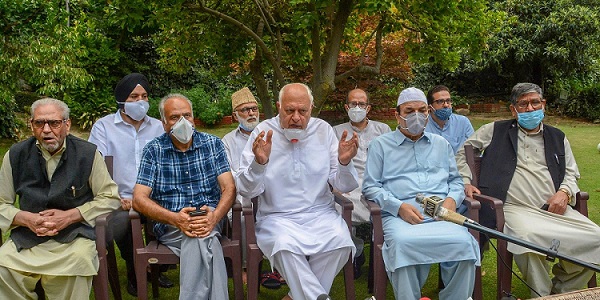
Whither Kashmir Valley’s Leadership?

The decision of the Peoples’ Alliance for Gupkar Declaration to participate in the grassroot election process, viz., DDC, local bodies and Panchayats in the Union Territory is a sensible and a pragmatic one. What has made them break the jinx is the realization of the damage they chose to inflict on their respective political parties by adopting an indifferent attitude towards the democratic process in the past. By abandoning the negative approach, the alliance partners have shown political maturity which the masses of people have appreciated. It also indicates lessening of pressure hitherto exerted by the separatists in the context of elections. The mainstream political leadership should feel emboldened to take a considered decision particularly at crucial stages like the one at present. That is perhaps the healthiest sign for the revival of democracy.

Some political analysts are of the view that the mainstream political parties have abandoned their earlier reticent and even non-cooperative attitude because of the lurking fear of the erosion of their popularity in a prospect of the boycott call. By leaving the political battlefield vacant for the BJP, as was done in the previous Panchayat elections, the mainstream political parties in the valley have unwittingly given space to BJP for upturning the turf to facilitate their game plan. The gunning down of no fewer than 18 BJP activists across the length and breadth of the valley over the past one year by gun-wielding “freedom fighters” and the unwillingness of the mainstream parties to share the grief of the victims of violence will take its toll in the impending elections.

We are aware that Kashmiris are eager to dovetail their cause to a wider Islamic resurgence phenomenon in the Asian region. Of course, most Muslims are conscious of various Islamic resurgence movements and the Arab Spring is its latest manifestation. On a psychological and historical basis, there is nothing wrong in that. But the point is that Kashmiri Muslims cannot underestimate that after independence India adopted the path of democracy, secularism and egalitarianism as the political arrangement of the Indian nation with a Hindu majority. The travesty is that some valley-centric leaders, blind to the dynamics of history, would go to the length of accusing India for not talking to Pakistan because “the latter is a Muslim State”. They forget that Bangladesh, a Muslim dominated region separated from Pakistan mainland became a country by sacrificing millions of people.

For a country like India with immense diversities, the adoption of secular democracy is of utmost significance. It indirectly means conceding the rights and privileges of the minorities of various hues in the country. No Islamic country has any commitment of that kind with its minorities. Rather, the history of the Caliphate is clear about the state policy towards religious meaning non-Islamic minorities.

Apart from this, the political environment in the South Asian region at this point of time is not comparable to what it was during the previous elections for the assembly, or the parliament or the local bodies in our country. The fissures in the unity among the members of the OIC and the revolt of some non-Semitic Muslim nations spearheaded by Turkey, Pakistan and Malaysia pose a serious challenge to the influence of the OIC. Being a creation of Saudi Arabia, the centripetal force for the Muslim world, a revolt directed against the OIC cannot be expected to sail smoothly through the disturbed waters of the Middle East politics.

The expectations aroused by Pakistan for the Kashmir Valley majority group that the OIC’s resolutions on Kashmir would bring solace and strength their “freedom movement” are difficult to materialize in given circumstances. There is a new and realistic view of the Kashmir issue with many Arab Islamic States. Western powers, including the US assess the Kashmir issue from a different trajectory after the UN and the US State Department slapped a ban on some terrorist organizations based on Pakistani soil. Osama bin Laden was found hiding in a residential complex not far away from the GHQ in Rawalpindi. Pakistan Prime Minister was honest in conceding that 30,000 to 40,000 radicalized terrorists were roaming the length and breadth of that country. Moreover, owing to Pakistan’s failure to contain and control illegal funding to the home-based terrorist organizations, she has not been able to escape from the “grey list” syndrome of FATF.

Perhaps the time has come for the ordinary Kashmiris to look around and also inwards rather than become euphoric about chasing an unattainable wild dream. Unfortunately, it has been the bane of most of the less developed West Asian and Middle East societies to remain glued to a politicized rather than a reformative religion. Though belatedly, even Saudi Arabia, the known bastion of orthodoxy, has begun to feel the necessity of keeping pace with the fast advancing scientific and technological achievements of the developed countries with tremendous impact on life.

Religious, emotional and social connectivity apart, the people in the valley need to make a dispassionate and realistic appreciation of the evolving socio-political construct in the neighbouring country and dovetail it to their perceptions. The first onslaught of modernism or the age of advanced science and technology on the Islamic mind is that it throws a serious challenge to the exclusivist ideology of any community because of geo-economic constraints. Nations do not and cannot work with an exclusivist hangover.

The argument that by embracing inclusiveness, the Kashmirian or for that matter the Indian muslims will lose their identity or distinctiveness is only a figment of the imagination. Democracy and openness are contrary to exclusiveness, rather its antithesis. Since the economy is the sheet anchor of survival for any society, Kashmiris need to think of long term policy particularly when the economy of the region is not only fragile but entirely dependent on external boost up.  

Efforts are made in several Islamic countries to water down the fundamental criteria of the Westminster type democracy or at least to dovetail it to what is obtainable from the skullduggery of interpretation of the Quranic verses. The kid-glove treatment to the scriptural fundamentals seems difficult to succeed. Democracy, secularism and egalitarianism are deskbook versions of long experience through which the political theoreticians have journeyed.

Often, a question is asked by the younger generation that if India was partitioned in 1947 based on religion, why the Muslims should continue to be in India and in such large numbers? The answer is simple. The Indian National Congress-led the freedom struggle against the colonial power, not based on religion but on the basis of democratic rights of the people of India. The Muslims of India contributed to the national struggle as ardently as the people of any other faith did, the Sikhs, the Parsees, the Buddhists, etc. How could they be ignored or sidelined if they desired to continue to live in India and not migrate to the newly formed Dominion of Pakistan? After all, Pakistan was the new avatar of colonial ideology where the landlords, either living in Pakistan or migrated from India, harboured feudalist mentality and the construct of that society. Kashmiris had waged a freedom struggle of forty long years to get rid of feudalism. How come they would find comfort and reconciliation with a feudalist system evolving after the British left India?

Unfortunately, Kashmiri mind has been polluted to the extent against democracy that it cannot think beyond a half-century or a century from now. It is very uncharitable on the part of the propagators of political philosophy to be on the wrong foot.

Democracy is a long and trying process. It has no quick fixes and no cut and dried solutions. Democracy is an experiment undertaken with patience and forbearance. After a thousand years of democratic rule, the UK continues with its history of bringing amendments, new laws, discarding the old ones and reforming the society just because they have a living, vibrant and result-oriented democracy. India is also pursuing the same path and expects the same results.

What Kashmiris need to do is to study the Islamic history dispassionately and find out if there was any Islamic regime at any point of time in the history when such regimes ruled in a democratic and secular manner? I don’t think there was any. The Saracens, the Turks, the Ottomans, the Timurids, the Mughals, the Safavids, the Mamluks, take any of them; none ever practised democracy and secularism as the loadstar of statecraft. Not only that. The non-muslim communities called the dhimmis were treated outside the pale of ordinary subjects of the Islamic State. Numerous restrictions were imposed on their religious practices; they were to wear a specific black or green armband to distinguish them from the rest of the populace and hence entitled to a different treatment. The history of the Caliphate is replete with such sordid stories.

Islam polarized human population into two broad segments – the Ahl-e Imaan meaning the faithful and the kafirs meaning the heretics. The treatment meted out to the heretics was universally followed by the moments or the pious Muslims. Therefore, in such a prospect the question of giving equal treatment to non-Muslims in an Islamic State did not arise.  Consequently, democracy and secularism were not choices. 

A significant change ushered in by modernism is that the importance has shifted from religion to economy. The relationship among nations essentially depends on the quality and quantity of economic transactions that take place between or among them if the trade is multi-cornered. The Industrial Revolution of 1688 A.D in Europe is a landmark event in the evolution of modernity and the age of reason.

Secular and democratic India is making the greatest experiment ever made in the 14 century-old Islam. It is to bring about slow, silent, rational and hurtless reform in the very mindset of the Muslims of India. There are many takers and there are many who oppose it. However, the consolation is that all these changes though touching the bottom of social structure, are undertaken silently and without fanfare. That is the right way how the reforms can be absorbed and how their impact can be indisputable. We also need to learn from the Soviet experience in the Central Asian Islamic States. Of all Islamic countries, the Central Asian Republics have shown remarkable maturity in putting religion and politics in their respective compartments.
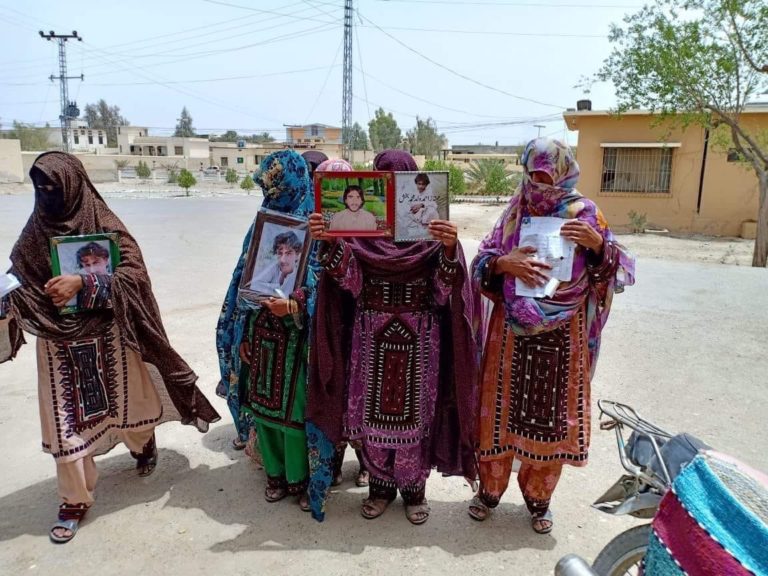
Enforced abductions continue unabated across Balochistan

Balochistan has for long remained in the grip of violence. Reports of atrocities being committed on innocent civilians by the Pakistan Army and its sponsored terrorists are received frequently, despite an attempt to keep them under wraps. The root of the problem lies in the fact that the people of Balochistan have never accepted their forcible merger as a province of Pakistan. The beleaguered nation has been fighting for independence for many decades now.

On 29 November, 2020, Dr Liaquat Sunni, Chairman of the Brahvi Department of Balochistan University, left Quetta on an official duty to Khuzdar along with two other professors. Unidentified armed men intercepted their car in Mastung and took them away at gunpoint. The two other professors, Prof. Shabbir Shahwani and Prof. Nizam Shahwani were released soon after but Dr. Sunni remained missing for some more days. He was let off by his abductors after about five days.

Activists within and outside of Balochistan termed the disappearance as a part of the “enforced abduction” policy of the Pakistan Army. It is being said that he was released only because of the massive protests by the students and faculty of Balochistan University and international disgust that the incident generated. The pain that the situation caused to the people is well expressed by a tweet from Baloch student that said: “The policies regarding #BalochMissingPersons and #EnforcedDisappearances of any #Baloch are still continued whether he belongs to any field of life in #Balochistan. Raise your voice to end this inhuman act and #ReleaseProfessorLiaqatSunny#”.

This incident has been followed by another report of nine people including women from Gichk in district Panjgur being abducted. Among these is an elderly lady named Bibi Maryam and her two grandsons. They were removed from the bus that was carrying them and simply taken away. They have now joined the long list of “missing persons from Balochistan.” The remaining six persons were also picked up in similar mysterious circumstances and for no tangible reason.

Balochistan has a long history of enforced abductions leading to mysterious disappearances. Normally those picked up were social activists, intellectuals or those looked upon as opposing the Pakistan establishment. However, recent cases like the one concerning abduction of nine people from Gichk show that the abduction policy has attained an indiscriminate signature, every Baloch faces danger of being picked up with ease. The reason behind this could be the need to spread terror among the common people to keep them subjugated; it could also be a result of monetary gains through the organ transplant business or a consequence of blood feuds. It is a known fact that the Pakistan Army has, for long, supported criminals for creation of what the locals call “death squads.” An overwhelming view is that the entire exercise has a political connotation.

Relatives of people who have disappeared have been gathering outside the Press Club, Quetta daily for more than a decade now. The daily sit-in protest began on 28 June 2009, after a doctor, Deen Muhammad, was abducted by unknown men. Muhammad’s two daughters are regular members at the sit-in. The protestors only wish to know about the situation of their close family members – whether they are still alive and in custody or have been done away with.

It is notable here that the Balochistan National Party (BNP) joined the ruling Pakistan Tehreek -e-Insaf (PTI) party of Prime Minister Imran Khan on the express understanding that the federal government would take affirmative action to locate more than 5000 people listed as missing in Balochistan. Since no action has been taken by the Imran Khan Government, the BNP has quit the coalition. “If you cannot recover people, at least stop disappearing more people,” said Akhtar Mengal, president of the BNP.

In her new book Balochistan: Bruised, Battered and Bloodied (2020), Francesca Marino, an Italian journalist, has termed the current insurrection in Balochistan as the most complex and bloody since the forced annexation of the region by Pakistan. She considers it to be the outcome of the “brutal, repressive policies and strategies” of former Pakistan President Pervez Musharraf. The most abhorrent form of brutality is the enforced abductions and disappearances.

Francesca Marino further states that the Baloch people have long been trying to draw international attention to what is happening to them and their homeland and the book is another attempt to do so. “For years now, the world, to its shame, has silently ignored the ethnic and cultural genocide carried out in the region,” she says.

The struggle for rights within Balochistan has taken the shape of an open rebellion and a demand for independence. The Baloch leaders look upon the policy of enforced abduction followed by rape and murder as a form of “collective punishment” aimed at crushing the freedom movement by breaking their will. Many have lost their lives, honour and property in an environment of deplorable violations of human rights. Leaders and activists, including Mir Suleman Dawood Jan, the 35th Khan of Kalat, are living in self imposed exile and fighting in international forums for the rights of their oppressed people.

The Baloch leadership in exile is consistently highlighting the plight of their people across the world and especially at forums associated with the United Nations. Pakistan needs to be compelled by the international community to stop the systematic and organised violence that is specifically targeting women and children through enforced abductions. India needs to take a lead in this regard. Pakistan also needs to be stopped from tinkering with the culture, identity and way of life of the Baloch people. Once atrocity is stopped then the issue of the constitutional rights of the Baloch people can be arbitrated in accordance with the historical realities that govern the region. The time to act is now, before it is too late.

Trouble brews for Imran as united opposition forms an alliance to oust government

They say, ‘politics make strange bed fellows’- and this situation is truly applicable in Pakistan now. Eleven political parties with widely different ideologies, including the PML(N) and the PPP, the well-known political opponents, have come together under an umbrella organisation named Pakistan Democratic Movement (PDM), created by Maulana Fazal-ur-Rehman, the leader of the Jamait Ulema-e-Islam (F) to topple the Imran Khan government.

On December 13, the PML (N) hosted a massive rally at the historic Minar- e-Pakistan along with its constituents to display its popularity among the people.

The beleaguered and besieged Imran Khan used all the official machinery to scuttle the rally. In fact, the Punjab government denied them the permission to hold the rally, citing terrorist threat and second wave pandemic threat.

Prime Minister Imran Khan himself ruled out the possibility of the government granting permission to the PDM for holding the rallies with warnings of legal cases against the organisers. “We will file FIRs against everyone from the Kursiwala (supplier of chairs) to the sound system handlers but won’t stop them (opposition leaders) from going there,” he said. Several political workers were arrested ahead of the rally, the government also flooded the Minar-e-Pakistan lawns to stop it. The arrests elicited widespread condemnation.

The Lahore police sent an advisory against holding a public gathering to the PDM chief Maulana Fazlur Rehman, Maryam Nawaz, Bilawal Bhutto-Zardari, among others. “TTP terrorists are coordinating to carry out a terrorist activity on December 13, 2020. Although details regarding the place of terrorist activity and likely targets are not available, the date (December 13, 2020) appears to be significant, as a huge public gathering is expected at Minar-e-Pakistan,” said the advisory.

The PDM, however, remained undeterred and made massive preparations for the rally. A huge stage was erected and all essentials like lights and sound systems were arranged, much to the consternation of Imran Khan.

Even though the organisers of the rally had asked the attendees to reach the venue at 2 pm, hundreds of supporters started gathering there early braving cold weather, enthusiastically chanting slogans and carrying flags.

The leaders, who addressed the rally, raised a voice against the incumbent government on issues of its legitimacy, stating that 2018 witnessed a fraud election that is not acceptable. “Due to the massive rigging in 2018 elections, Imran Khan was picked on, so that he could easily be dictated. Time has come to get freedom from this selected set-up,” said former Prime Minister Nawaz Sharif in his address to the gathering through a video link. JUI-F chief and president of PDM, Maulana Fazlur Rehman, warned that  the growing resentment and anger of the people against the “illegitimate government” can lead to anarchy in the country. Bilawal Bhutto Zardari said that the PTI government is not cognisant of the difficulties being faced by masses “because it did not come into power through people’s mandate.”

More significantly, the leaders made a direct attack on the Pakistan Army by saying that the various elements of the state should function within the “limits of their own jurisdiction.” Maulana Fazlur Rehman openly urged the ‘establishment’ to stop meddling in the political affairs of the country and let the leaders chosen by the people govern the country. “If people’s rights continue to be abrogated, then the national unity cannot remain intact,” he warned.

The leaders also raised the issues of burgeoning inflation and unemployment, whereby people are burdened with unchecked and spiralling prices of essentials like edible items, petrol and even medicines. “Ever since Covid-18 (PM Imran) has formed government, sugar, wheat, electricity and people’s livelihood have been quarantined,” said Maryam Nawaz Sharif, while referring to Imran Khan as the “Tabedaar (obedient) Khan playing a fixed match.” The speakers said that Imran Khan was hand in glove with the mafia that is indulging in stocking of essential commodities leading to creation of false demands.

The massive rally is a clear indication that the political leadership of Pakistan has finally felt the pulse of the people and garnered enough courage to unite and challenge the all powerful Pakistan Army. This is evident from the fact that they refer the prime minister as a stooge of the establishment and say that all troubles in Pakistan are due to his inability to function freely. 

Attacks on the beleaguered Imran Khan are going to increase in coming days. Next on the agenda of PDM is the tendering of mass resignations from the National Assembly by all members of the opposition. Such a move will make running of the government untenable for Khan, who is trying to put up a brave face but can see the ground sliding away under him.  PDM will also keep the momentum of mass agitations going.

The combined opposition seems to be determined to not only topple the government being led by Imran Khan but also to free the country from the stranglehold of the Pakistan Army. It is something that Nawaz Sharif and other senior political leaders have wanted to do since long and are now becoming a reality. Pakistan is finally moving from virtual dictatorship to actual democracy. A change of this nature in the political ecosystem of Pakistan would benefit the country since true democracy has remained elusive since its creation as a Nation.

The Curious Case of ‘Attack’ on UN Vehicle Along the LoC

In fictional novels, a clue or even the answer to a mysterious occurrence often lies so well concealed within the copious narrative itself that it deftly escapes the readers’ notice. However, this is also true in real life when it comes to Inter Services Public Relations [ISPR], which besides being Pakistan Army’s public relations wing, also doubles up as the country’s principal media agency. In the aftermath of the 26 February 2019, airstrikes carried out by Indian Air Force (IAF) against a terrorist facility in Balakot area Pakistan-occupied Kashmir (PoK), while refuting India’s claim of having destroyed the terrorist facility at this location, Director General [DG] ISPR denied the same. To add more credibility to his claim, he promised to take media persons to the site so that they could themselves ascertain facts on ground and thereby ably expose India’s “bluff”.

DGISPR told media persons that though he wanted to clear the air on this issue by taking them to the site immediately, but this wasn’t feasible due to the prevailing adverse weather conditions. He assured journalists that this trip would take place the moment weather conditions improved. But even though the skies cleared up a couple of days later, yet it still took ISPR more than a month to conduct this much hyped visit. This inexplicable delay in itself provided a clue that something was amiss, and so it was not surprising that the visiting media persons didn’t see any sign of physical damage (except for a crater and some fallen trees, which DGISPR alleged had been caused by the air strike).

But the BBC, in its report [‘Balakot air strike: Pakistan shows off disputed site on eve of India election’, Published on 10 April 2019], mentions “While the media were allowed to take interviews, they were told to keep them short and it was clear that the tour was being restricted.” [Emphasis added]. So, it finally emerges that both clues and answers to the burning question of whether the IAF airstrike did destroy a terrorist facility [as claimed by New Delhi] or was it an abysmal failure [as averred by Pakistan Army] lies in the DGISPR’s puerile narrative about bad weather hindering media visit to the attack site for more than a month.

Whereas Pakistan Army is remarkably quick when it comes to rebutting any news that adversely affects its professional image, but in this particular case, it took journalists to Balakot after 43 days. The only plausible reason for Pakistan Army’s uncharacteristic tardiness in exposing New Delhi’s false claims could be an inescapable need to buy time to enable restoration of the attack site to its pre- airstrike condition by carrying out necessary reconstruction work to conceal the damage caused by the IAF attack. So, this nearly one-and-a-half-month delay is a clear indication that the destruction caused at Balakot must have been quite extensive. This is exactly what an Indian External Affairs Ministry official implied when he said “The fact that media was taken on a conducted tour to the site only after a month and a half after the incident speaks for itself”!

The next such incident happened the very next day after the Balakot air strike, when DGISPR announced that Pakistan Air Force [PAF] had shot down two Indian fighters without suffering any losses. He went on to claim that out of the three IAF pilots of these downed aircrafts who had bailed out over Pakistan territory, one had been taken into custody while a search was on for the other two. Subsequently, DGISPR announced that another IAF pilot had been caught and being in an injured condition, was undergoing treatment at a combined military hospital [CMH]. But just hours later, DGISPR created a mystery of sorts when he backtracked by saying that Pakistan Army had only one IAF pilot [Wing Commander Abhinandan Varthaman] in its custody.

Whereas DGISPR denied that PAF suffered any losses and scoffed at New Delhi’s claim that Wing Commander Abhinandan had shot down a PAF F16 fighter, the clue of whether New Delhi’s claim was true or false again lay in his own narrative of the incident. Because, even though DGISPR simply avoided any subsequent mention about the pilot under treatment at a CMH, his silence could not counter the fact that a second pilot had also ejected on that day and was undergoing treatment in a military hospital. So, if this pilot wasn’t from IAF, then he obviously belonged to PAF and this would only have happened if his plane was shot down- unless of course, Pakistan army wants us to believe Gen Pervez Musharraf’s infamous remark made to a CIA officer about how “in Pakistan, things fall out of the sky all the time”!

The circumstances surrounding the alleged targeting of a UN vehicle near the Line of Control [LoC] on Friday is yet another mystery. In a series of tweets, DGISPR wrote, Indian troops deliberately targeted a United Nations vehicle with 2 Military Observers on board… It must be noted that the UN vehicles are clearly recognisable even from long distances due to their distinct make and type and clearly visible markings...  .” He went on say that “Such illegal and unlawful acts against all established international norms, signify mal-intent of Indian Army to target not only innocent civilians residing along the Line of Control but UN Peacekeepers as well” [Emphasis added] and adding that “This act only goes to show Indian Army’s complete disregard to principles enshrined in the UN Charter,” went onto exceed his brief by opining that“It is indeed a new low for Indian Army” [Emphasis added].

But being fair to DGISPR, one has to accept that he has rightly mentioned that “UN vehicles are clearly recognisable even from long distances due to their distinct make and type and clearly visible markings,” [Emphasis added] and as such it’s inconceivable that the highly disciplined Indian Army would commit such an irresponsible and self-incriminating act and so this incident becomes all the more enigmatic. But by mentioning that “Indian troops deliberately targeted a United Nations vehicle…,” of how this act goes to “signify mal-intent of Indian Army to target…UN Peacekeepers” and Indian Army’s complete disregard to principles enshrined in the UN Charter” [Emphasis added], the DGISPR’s tweet does confirm the building up of a motivated narrative and this in turn provides a credible clue that is further reinforced by the recent ‘relapse’ of Islamabad’s incurable “false flag operation” obsession.

Pakistan Army’s proclivity in staging incidents in order to malign the Indian Army is so well known to all concerned parties that they seldom take its allegations at face value. So much so, that in the current case, even the UN is treading very cautiously on DGISPR’s assertion that Indian Army had “deliberately targeted a UN vehicle”, lest it be misled by this patently unconvincing insinuation. Perhaps that’s why deputy spokesman to UN Secretary General, Farhan Haq has taken care to disregard ISPR’s allegation of the UN vehicle being hit by bullets by clarifying that “At this stage, we’re simply aware that a vehicle was hit by an unidentified object [Emphasis added] and saying that “The [UN] Mission is currently investigating the incident”.

Most importantly, by mentioning that “We are aware of what both sides have been saying”, [Emphasis added], the UN spokesperson has made it amply clear that despite the DGISPR’s exhaustive narrative, the UN is not willing to swallow his unsubstantiated allegations against Indian Army, hook-line and sinker, because given Pakistan Army’s dubious past record, this could well turn out be a “false flag operation” orchestrated by the Pakistan Army!

Sindh Sabha on a hunger strike at Pak’s Hyderabad Press Club

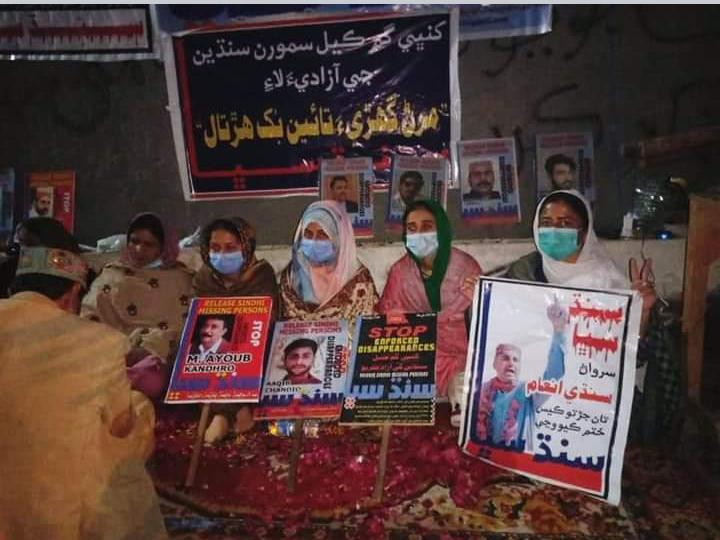
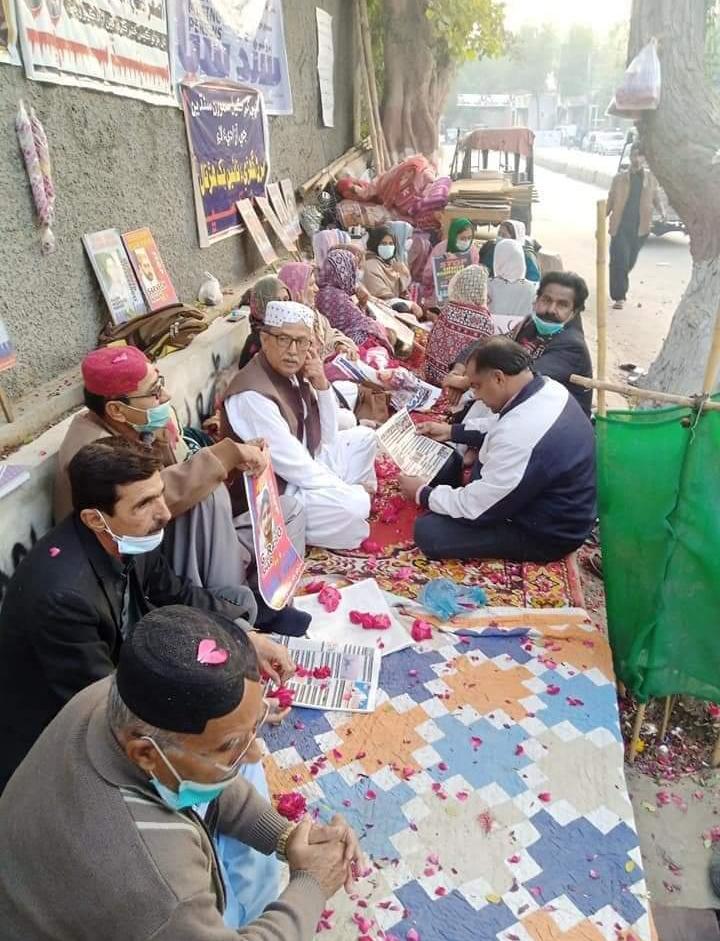
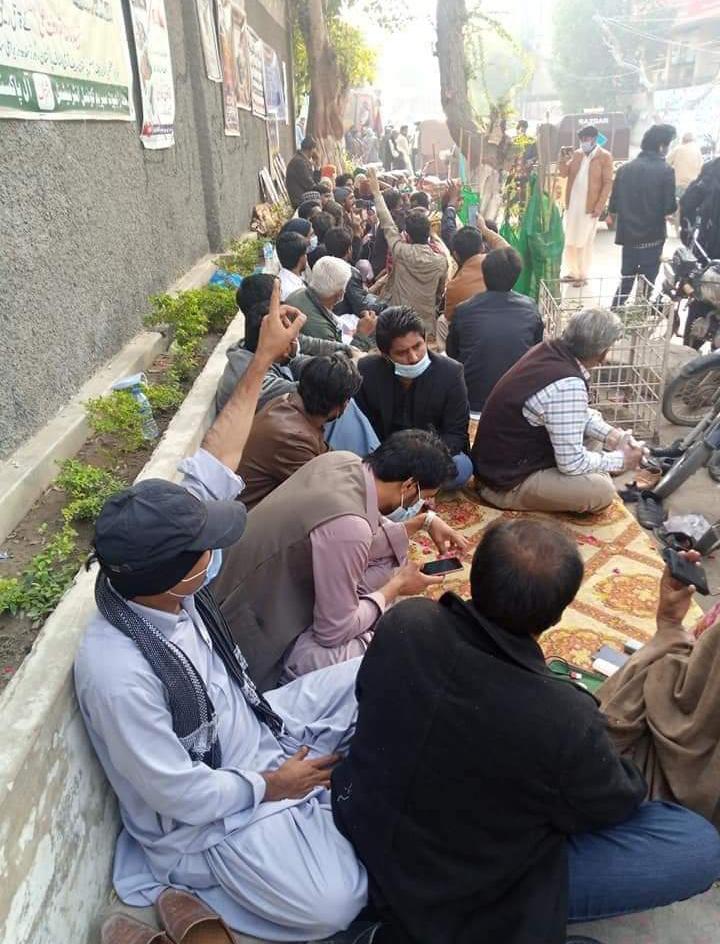
Sindh Sabha members and the families of “missing persons” have begun their hunger strike in front of Hyderabad Press Club in Pakistan against violence and arrest of Long March participants. The 1,412 km Long March from Karachi to the headquarters of Pakistan Army at GHQ, Rawalpindi started on November 10 from Karachi under the banner of Sindh Sabha. Women, children and elderly had been walking towards the headquarters of Pakistan Army to press for their demand to release the “Missing Persons”, who have been abducted from Balochistan and Sindh.

However, a week ago, dozens of police vans of the Ghotki District Police prevented the Long March participants from crossing the Sindh border and enter Punjab province in Pakistan. The Ghotki Police did not want Long March participants to reach Rawalpindi and did not let them cross the Sindh border. Left with no choice the participants of Long March staged a sit-in on the National Highway. Thereafter the Pakistani Police and their Rangers violently attacked this peaceful sit-in on December 29 and several leaders were arrested.

Sindh Sabha and the Voice for Missing Persons of Sindh called for a nationwide protest against the arrest of participants which was followed by protests in different cities. “A large number of women participating in the protest are now on a hunger strike. Four people are on hunger strike till death,” said a Sindh Sabha leader.

Sindh Sabha members on hunger strike at the Hyderabad Press Club, Pakistan.
(Photo: News Intervention)

The Long March participants have demanded that Sindh Sabha leaders be released along with the missing persons.

“We were protesting peacefully for the recovery of missing persons in Sindh, but the peaceful march was stopped by force and our leaders were unjustifiably arrested,” said a Long March protester who is now on hunger strike till death.

The Sindhi and Baloch people had been protesting for the release of their “Missing” family members for several years but none of the Pakistani authorities listened to them. Family members and friends of these “Missing Persons” were left with no other option but to walk from Karachi to Rawalpindi to plead for the release of their loved ones.

Sindh Sabha members on hunger strike at the Hyderabad Press Club, Pakistan.
(Photo: News Intervention)

The Long March participants had announced that they would protest in front of the Pakistan Army Headquarters (GHQ) Rawalpindi and demand for the release of their family members abducted forcibly by the Pakistan Army.

As the women, children and elderly marched on foot braving extreme cold and harsh weather conditions they garnered enormous support from Sindhi, Baloch and Pashtuns. This worried the Pakistani generals who then resorted to threats and instructed the Ghotki Police to attack the Sindh Sabha Long March convoy.

Click on the YouTube link to watch

India must challenge China from a position of strength

As the eventful year 2020 came to a close, one is reminded about a huge public outcry that was triggered by the so-called Chinese intrusions in eastern Ladakh mid-year. Suddenly a bevy of self appointed “strategic experts” surfaced to give an impression that China was rapidly engulfing Ladakh. The matter excited media and public interest as suddenly as it came making it very apparent that we, as a nation, lack strategic depth in our thought process. For many in India, national security is no more than a TRP generating media hype that gives an opportunity to make a fast buck, mainly by hounding the government.

This piece is being written as a reminder that despite the media meltdown on the subject, not much has changed along the Line of Actual Control (LAC) in Eastern Ladakh, except that extreme control conditions are making it more challenging for the deployed troops to man their posts. The Chinese are sitting where they were earlier and showing no intention of moving back despite Indian insistence for restoration of the status quo ante.

Undoubtedly, China is losing diplomatic space globally while India is gaining ground for her righteous stand. The apprehensions that India voiced about the Belt and Road Initiative (BRI) are today being accepted globally, much to China’s discomfiture. Anti-China sentiment has gained traction over the preceding year with friction witnessed in the country’s relations with the United States, Japan, Australia and, of course, India. US President Donald Trump has played out his last card against China recently with the US Congress passing  the Tibet Policy and Support Act (TPSA). The big takeaway of the Act is that it will  block Chinese intentions of controlling the succession plan of the Dalai Lama. The TPSA also gives to India an opportunity to rethink her Tibet policy and put in place the necessary course corrections.

Despite the aforementioned diplomatic accretions, for the serious thinkers, the Chinese threat to India continues to be very real and very potent. In hindsight, considering the mdi-2020 intrusion it becomes necessary to give due credence to the Indian refusal to cow down to Chinese pressure. It was so because Indian military infrastructure in the Ladakh region has grown to an extent where thwarting Chinese expansionism has become feasible. The build up of Indian infrastructure was, incidentally, the main reason for the Chinese aggression in the first case. It was something that China did not like and continues to not like. Increased volatility on the LAC therefore is very much on the cards once the weather opens up.

For India, the threat remains more potent since the collaboration between China and Pakistan is becoming stronger by the day. With the US and Middle East countries like Saudi Arabia and UAE cooling towards Pakistan, the economic dependence of the country on China has increased exponentially. In recent time the two countries have joined together to corner India on the Kashmir issue. The hawkish posture that Imran Khan has adopted on Kashmir is largely based on Chinese support. China will continue to use Pakistan as a cat’s paw against India and up the ante at will.

Such aggressive and collaborative military presence on two fronts leaves India with no choice but to keep its military deployment along the crucial frontiers at a very high level. Open conflict can be discouraged only with a credible deterrent on ground.

It, however, has to be admitted that all is not well with Chinese expansionism in Pakistan. Recently attempts by the federal government of Pakistan along with the China CPEC authority to cordon off large sections of the Gwadar port with a barbed wire fencing on the pleas to improve security were thwarted by the Provincial Government of Balochistan. “The local people will not be kept away from decision making about Gwadar and a decision about fencing would now be taken after taking the local people into confidence over the issue,” said Ziaullah Langove, the Home Minister of Balochistan while reversing the plans to create Pakistan’s first “sealed city”. Pakistani intelligentsia has, since long, been cautioning against too much dependence upon China. “Chinese assistance in the development of the province’s infrastructure and the port of Gwadar has been significant but involvement of its people in projects and sense of ownership is crucial,” says Talat Masood, a senior geo-political analyst of Pakistan, while adding that the nation should make serious attempt to develop a self-sustaining economy.

Pakistan may be the most significant protagonist in the Chinese game plan against India but it is not the only one. China is playing a larger game at the regional level. It has greatly increased efforts to isolate India in her own neighbourhood. The degree of success being achieved can be gauged by the tensions that India is facing in her relations with Sri Lanka, Nepal and even Maldives and Afghanistan. So, while the West, US, Japan, Australia, etc., can rest easy with Indian support, India is facing a host of problems created by China.

The situation can blow up into full scale hostilities at any time. India therefore needs to have credible military counter measures in place. This is the best time for the government to act since there exists across India a strong anti-China sentiment. The spate of foreign visits by the Indian Army Chief, General M.M. Naravane along with the restructuring of the armed forces and equipment procurement are positive steps in the right direction, but more needs to be done on an urgent basis.

The issue at hand is lack of strategic foresight. Will the fractured Indian political environment stand together at least for national security? The earlier examples do not give much confidence in this regard. The backlog in equipment is so large that unprecedented measures are required to cover it. Would the government be able to generate the will to face the challenge?

India cannot legislate what China and Pakistan will do, she can only be prepared to respond to Chinese malevolence with strength. The challenge is to create the required strength to do so.  

Kashmir Valley shuns Pakistan’s efforts to derail DDC elections

0

The Union Territory of Jammu & Kashmir has witnessed a paradigm shift in its socio-political environment in recent times. Of great importance is the successful and incident free conduct of the District Development Council (DDC) elections that began on 28 November and culminated with the counting of votes on 22 December. This period and some time before it witnessed extensive cross border firing by Pakistan quite obviously with the intention of infiltrating terrorists and disrupting the elections.

“There are terrorist launch pads and terrorists across the Line of Control (LoC) making desperate attempts to infiltrate into Jammu and Kashmir to disrupt normal democratic processes,” said Army Chief, General M.M. Naravane in a press conference on 28 November. The overwhelming response of the Indian Army put paid to whatever the enemy sought to gain from his misadventures.

The terrorists operating in Kashmir were instructed by their masters sitting across the border to intimidate the people from casting their votes and also to increase the threshold of terrorist initiated violence. Accordingly, on 1 December, unknown terrorists lobbed a grenade on a CRPF location in Sopore, district Baramulla, the grenade exploded outside the main gate and caused no injuries. Again on 6 December terrorists struck at a police party of Zadibal police station, Srinagar and injured one policeman and a civilian. This was a clear indication that the terrorists were attempting strikes to ward off the pressure from their masters but these were half-hearted attempts. They were obviously scared of launching head on operations. The polls continued undeterred. Security forces maintained the pressure and many hideouts were busted during this period leading to seizure of weapons, explosives and war like stores that were to be used to disrupt the elections.

The first major counter terrorist operation during the period took place on 9 December, at Tiken area of Pulwama in which three terrorists were killed. They were said to be affiliated with the al-Badr terror outfit. The killed terrorists were identified as Merajuddin Lone, Umer Ali and Owais Farooq. One of them was from village Dadsara in Tral, that is known to be a bedrock of terrorism with many known terrorists hailing from there.

Earlier the death of a terrorist from the village led to massive funeral processions with thousands of people joining in. In a significant departure from earlier times there was no activity witnessed in the village this time. Nobody demanded burial of the body in the local cemetery and no shut down was called. Reports suggest that not many people even visited the family of the terrorist to offer condolences. The bodies were buried as per COVID protocol in Baramulla.

Earlier, on 26 June, the Jammu and Kashmir Police had tweeted that for the first time since 1989, there were no Hizbul Mujahideen terrorists left in the Tral area of Pulwama district thus putting a lid upon the Burhan Wani and Zakir Musa era when this region resonated of separatist tendencies. The present response in village Dadsara indicates that the changeover is complete and irrevocable.

With terrorists unable to impact the poll process the terror masters activated their over ground workers and told them to dissuade the people from voting. On 10 December, reports were received that some miscreants in Anantnag were dissuading people from voting. “Some miscreants were found dissuading people from voting in Anantnag during the fifth phase of the DDC elections today. When the media reached, miscreants started to worsen the situation. The police separated the media from the area and the situation was brought under control”, said Jammu & Kashmir State Election Commissioner (SEC) K.K. Sharma at a press conference. An FIR was registered by the police and investigations initiated.

Beyond the aforementioned incident, there was no Syed Geelani and his ilk seen on the streets provoking people to fail the elections, there were no violent demonstrations leading to crowd control actions by the police. Even the social media was not as active in bullying the people as it used to earlier, it is so because hundreds of accounts have been closed due to proactive surveillance by the Cyber Cell of the JK Police and restriction on use of spectrum. The active accounts were being operated from Pakistan as a part of the propaganda campaign of ISI. 

However, a setback came by on 14 December, when terrorists opened indiscriminate fire on a leader of the Peoples Democratic Party (PDP) and killed his Personal Security Officer (PSO), Manzoor Ahmad. It was quite apparent that with the polls almost coming to an end the terrorists were desperate to show results. The best that they could do was to attack a single political leader and that too in a stand-off manner.

Thus, the DDC polls culminated successfully with no major incident of violence reported and voter turnout registered at an all time high in J&K. “I congratulate all the candidates who have won the DDC elections. With the active participation of people, the voting percentage was higher, and polling was peaceful. Results were declared for 278 seats and deferred for two seats,” said State Election Commissioner K.K. Sharma while heralding the culmination of this very challenging project.

Lieutenant Governor Manoj Sinha, had a special word of appreciation for the security forces led by the Indian Army. “I am happy that except for one or two very small incidents, District Development Council (DDC) elections were conducted in a very peaceful, free and fair manner. Despite cold weather, Jammu and Kashmir Police and Armed Forces contributed in a big way during these elections,” he said.

The successful conduct of DDC polls suggests that Kashmir has changed for the better; the people are now pursuing their aspiration in a secure and free environment. Even places earlier steeped in separatist ideology due to misleading inimical forces are witnessing a change of heart. The positive changes and stability that the region is witnessing are raising hopes of an early switchover from the status of Union Territory to statehood as has been promised.

Public anger brewing against Pakistan Army, interior minister Sheikh Rashid threatens critics

With the announcement of Pakistan’s Minister for Interior Sheikh Rashid that, “cases will be registered against people using foul language against the armed forces within 72 hours” makes two things evident. One, that public criticism of the armed forces, [which till very recently was something unheard of in Pakistan], has now reached tipping point, and two, that the people have started rejecting Rawalpindi’s self-assumed role of being Pakistan’s exclusive conscience-keepers.

Rashid’s threat of throwing the book at those who use “foul language” at Pakistan Army also indicates that despite compelling evidence regarding the rampant use of strongarm tactics to ‘discipline’ detractors through abductions [and at times even assassination] by its spy agency Inter-Services Intelligence [ISI], such intimidatory measures are no longer scaring the public.

However, the Interior Minister’s warning of legal action against those demeaning the armed forces comes as no big surprise. Readers may recall that in September 2019, PTI senator Amjad Ali Khan tabled a proposed amendment to Pakistan Penal Code [PPC] seeking to criminalise any act that “intentionally ridicules, brings into disrepute or defames the Armed forces or a member”.

The statement of objects and reasons submitted alongwith proposed PPC amendment bill elucidated that “The purpose of this amendment is to prevent hatred and disrespectful behaviour against the Armed Forces”. But what this document hasn’t clarified is the necessity for adopting such a drastic measure that could well curb freedom of expression guaranteed to Pakistani citizens by Article 19 of the Constitution!

One doesn’t have to be a Sherlock Holmes to deduce that in actuality, the PPC amendment bill has been prepared by the government on the obvious instructions of the army and then tabled in the senate as a private member bill. The reason for following such a convoluted process too is not very difficult to discern. Currently, the main issue that purportedly “ridicules, brings into disrepute or defames the Armed forces” is its alleged role in manipulating the 2018 General Elections to ensure that Pakistan Tehreek-e-Insaf [PTI] party comes into power so that its protégé Imran Khan becomes Prime Minister.

The ongoing political controversy in Pakistan centres around the issue of whether Khan has been elected by people or ‘selected’ by the Pakistan Army. Hence, introducing PPC amendment bill to protect the army from slander in effect amounts to a serious conflict of interest, since through it, the PTI government is seeking to defend its own legitimacy by silencing criticism of Rawalpindi’s dubious role in this issue. But by going ballistic and publicly threatening legal action against those criticising the army, the Interior Minister has unwittingly also accepted that intensity of public anger against the army is such that the situation is desperate, which justifies institution of desperate measures like stifling freedom of expression.

Rashid’s awkward attempt of saving Pakistan Army from disparagement must have certainly caused immense embarrassment to an army, that despite its long history of unconstitutional acts like overthrowing democratically elected governments, had still remained beyond reproach for more than seven decades and got used to the same. But now, with Khan’s efforts to divert public attention from the ‘elected’ versus ‘selected’ debate by saying that “the sort of language that is being used for the army today is the kind that India’s propaganda machine uses against the army” finding no takers, the ‘army can do no wrong’ cookie has finally crumbled!

But while Khan is certainly playing Pakistan’s emotive and age-old anti India rant, Nawaz Sharif too isn’t an  angel of virtue and there’s no doubt he certainly has an axe to grind with the army. After all, he has been ousted from office by the military twice- the first time, by a military coup, and the second time in what may believe indirectly [through the judiciary]. So, while his broadside at the military may be motivated, still his allegations can’t be summarily dismissed as the unjustified ranting and raving of a prejudiced person seeking vengeance and political rehabilitation. The reason for this is elementary- if Sharif’s allegations genuinely lacked any substance, then why would the 11 political parties that have come together under the Pakistan Democratic Movement [PDM] umbrella, jeopardise their own credibility as well as antagonise the military establishment by endorsing a false claim?

However, the million-dollar question that remains unanswered is whether the PDM’s allegations of the army’s involvement in manipulating election results are true? While it would be naïve to expect finding any concrete evidence to either substantiate or disprove this allegation, there’s no dearth of credible indicators as evident from a few references of the many post-election observations made by very respected organisations and personalities as enumerated below:

  • Reputed Pakistani journalist, scholar and author Ahmed Rashid mentioned that “For the first time, not just the elite, but the public is aware of the Army’s major role. It’s now talked about at the village level.”
  • Human Rights Commission of Pakistan reported that military’s security agencies had put pressure on candidates of Nawaz Sharif’s PML-N party to switch loyalties and return their tickets.
  • According to BBC, nearly 17,000 PML-N party members face criminal cases for breaking ‘unspecified’ election rules.
  • Justice Shaukat Siddiqui, a senior sitting judge of Islamabad High Court revealed that the Chief Justice of Pakistan [CJP] had asked him to ensure Nawaz and Maryam Sharif were denied bail until the 2018 elections were over. Though the CJP [expectedly] denied the same, but by saying that, “The real power appears to rest with Pakistan’s military and the judiciary, which sees undiluted democracy as a threat”, Ahmed Rashid has buttressed Justice Siddiqui’s assertion.

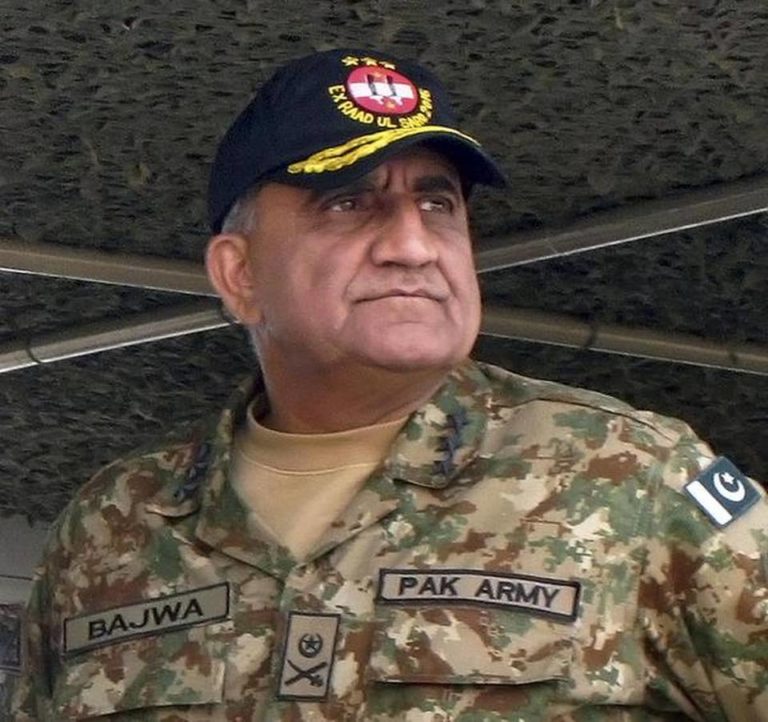
By saying that Pakistan’s Armed Forces have never indulged in politics and would not do so, Interior Minister Rashid has outrightly dismissed Justice Siddiqui’s admission that “Today the judiciary and the media have come in the control of the ‘bandookwala’ [army]” and that the “judiciary is not independent.” But Imran Khan’s allegation that Sharif became chief minister of Punjab by “polishing General Zia’s shoes” not only belies his Interior Minister’s claim, but is also an unambiguous reaffirmation of the fact that Pakistan Army has a long history of filling political posts with their ‘selected’ candidates. So, if such manipulation [as per Khan’s own admission] could take place in Gen Zia’s time, then why couldn’t this have happened during Gen Bajwa’s tenure?

But all said and done, there’s a need for Islamabad to put extraneous issues aside and ensure that justice is done and Sharif is brought to book. Accordingly, it’s heartening to hear Rashid telling the media that in order to facilitate the former prime minister’s deportation, his passport, which would expire on 16 February wouldn’t be renewed. However, the bad news is that according to PTI, “[when] asked about cancelling retd. Gen Pervez Musharraf’s passport, Rashid said his department had not received any such application”. Since just like Sharif, Gen Musharraf, too is a ‘proclaimed offender’, Rashid’s puerile excuse justifying non cancellation of Gen Musharraf’s passport exposes a clear discriminatory bias against the former prime minister and a definite benevolent concession to the former army chief.

This in turn goes to strongly suggest that Imran Khan may after all, actually be a ‘selected’ and not the elected Prime Minister of Pakistan!

Hazara slaughter at Bolan is Pakistan’s filthy act to play the victim

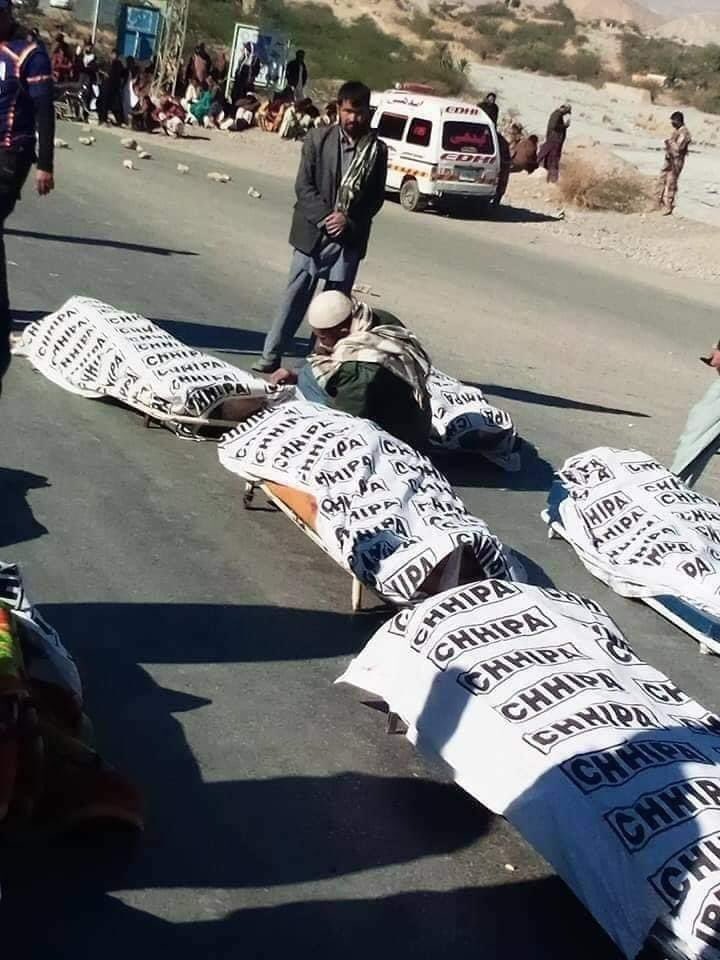
Pakistanis are adept in the art of being aggressors and playing the victim card simultaneously. Even their naked acts of mass slaughter are sold upon as ‘terror attack on Pakistan’ that eventually helps Rawalpindi continue with its nefarious activities. The butchery of Shia Hazaras, in a new year on January 3, at Bolan in occupied Balochistan is the latest in this series.

Pakistan Army directed its proxies in Islamic State (IS) to slaughter unarmed Hazaras in the Mach area of Bolan district in an effort to divert world attention from its ongoing military operations across occupied Balochistan, where it continues to kill unarmed Baloch people.

Let’s recount the sequence of events. The attack on unarmed Shia Hazara coal miners took place on Sunday morning at Machh in Bolan. This attack was swiftly condemned by Pakistan Prime Minister Imran Khan and almost immediately the Islamic State (IS) took responsibility for this attack on Shi’ite Hazara community. Media across the world reported it as a terrorist attack in Pakistan.

The real story is entirely different, however.

Dead bodies of Shia Hazaras lie on the road at Bolan in occupied Balochistan.

Over the last fortnight entire Balochistan had erupted in protests after the cold blooded murder of Baloch human rights activist Karima Baloch by the ISI in Toronto, Canada. When Pakistan’s usual tactics failed to deter Baloch people from holding massive rallies and protests against the killing of Karima Baloch it deployed its regular armed soldiers to fire upon unarmed Baloch people at Bolan.

Pakistan Army has been using helicopter gunships and sophisticated weapons to shoot and kill unarmed people at Bolan. Pakistani security forces also burnt vast forests of Gharbog Sujawal in Sarawan. A couple of days ago Pakistan Army demolished the entire Mehi village at Mashkay. Mehi village is the birth place of Balochistan’s pro-independence leader Dr Allah Nazar Baloch. Dozens of people from these areas have been picked up by the Pakistan Army and transferred to an unknown location. The Baloch National Movement (BNM) in its latest statement has confirmed these attacks.

The spokesperson of Baloch National Movement (BNM) said that ground and aerial operations of Pakistan Army has been going on for several days in different areas of Bolan and gunship helicopters have been shelling continuously. “This operation is being further expanded. Most areas of Bolan and Machh are under heavy siege by the Pakistani Army and all means of transportation are closed. So far, dozens of people have gone missing by the Pakistani military,” said the BNM spokesperson. He added that Pakistani barbarism has intensified across a wide area. “…the operation has been expanded in different areas of Bolan including Cheesan, Pod, Mian Kaur, Shahrag and surrounding areas in Mach and Bazgar, Jambro, Talang, Kaman, Jhalawan, Loni and Mejdari.”

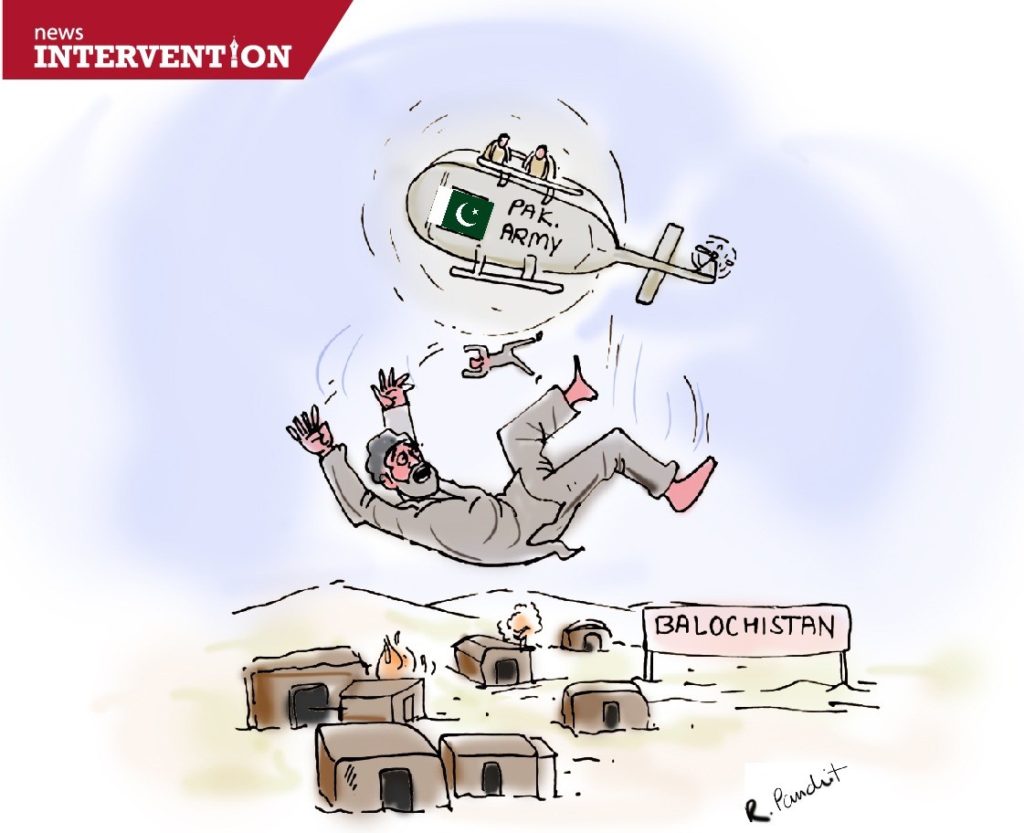
An illustration depicting Baloch people being thrown down form Pakistan Army helicopters in occupied Balochistan.
This is how Pakistan Army throws off alive Baloch people from helicopters to kill them in occupied Balochistan.

Despite internet blockade and a gag order on media all these news had begun to trickle to the outside world. Coming on the heels of Karima Baloch’s cold blooded murder Pakistan would have found it hard to defend itself on international forums.

It was in this situation that Pakistan decided to play its victim card and pulled its sympathizers in the Islamic State (IS). The hapless Hazaras around Bolan in Balochistan became the soft target for Rawalpindi. Hazaras were chosen as they are Shias and the slaughter of Shias would not garner much sympathy from the majority Sunnis, and so their killing would surreptitiously be labeled as a terrorist attack on Pakistan. This would then justify Pakistan Army’s atrocities in Bolan and other areas of Balochistan.

Shia Hazaras have always been the soft target of ISI’s Islamic jihadis that have killed Hazaras earlier at Quetta, Mustong and Bolan. Even earlier while on their religious pilgrimage to Iran, the Shia Hazaras had been slaughtered by Pakistanis.

It’s time the world wakes up to these shenanigans of Pakistan and labels it as a terrorist state. The Pakistani regime, Pakistan Army and its rogue intelligence agency ISI have fooled the civilized world for too long.
This is not the first time Shia Hazaras have been murdered by Pakistanis in occupied Balochistan and if the world stays mum then Shia Hazaras may be targeted yet again by Rawalpindi.

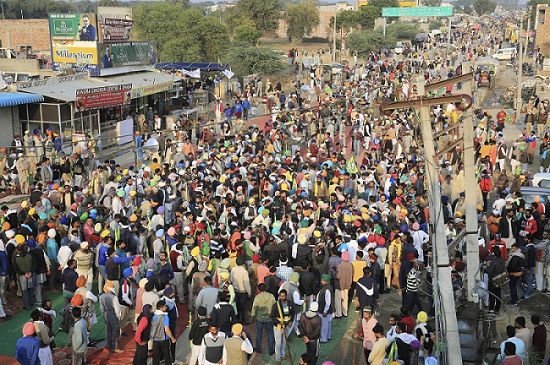
Modi must not concede to unreasonable farmer demands

0

Indian farmers, mostly from Punjab, parts of Haryana and western UP, are holding the nation to ransom. They have blocked road and rail access to Delhi from neighbouring states by lining up hundreds of tractors along the route and bringing people at the protest sites. The genie of mob-protest to settle grievances that the Punjab chief minister released so triumphantly has started taking its toll also on telecommunication networks and lives of misguided protesters. Worse consequences are to follow.

Strangely, agitators’ anger is against the Acts that allow farmers to sell their produce anywhere in India, engage voluntarily in contract farming and permit traders to stock unlimited produce to reduce wastage, export surplus and keep prices stable. Neither Minimum Support Price (MSP) nor Agriculture Produce Market Committee (APMC) have been abolished. Still, APMC bosses and middlemen won’t back off unless the Acts are repealed and MSP is protected by law.

Since the farm Acts are not cast in stone, they may have flaws but these need to be discussed and negotiated with an open mind. Issuing ultimatums won’t help.

Agitators also had the option of approaching courts to get the Acts declared unconstitutional or wait to replace NDA with a government that would repeal them. But they chose not to take these courses, for they neither had respect for public order nor believed in law, Constitution and judicial process. They must understand that their protest is causing a daily loss of ₹3,500 crore, and supplies of grains, fruits, raw material and movement of troops and fighting equipment for soldiers in forward areas are getting severely disrupted. Moreover, there is an urgency for the economy to stabilise so that it meets the twin threat from the coronavirus pandemic and Chinese aggression. The irony is that courts don’t want to restrain them from protesting and Prime Minister is too democratic to use tanks and artillery to clear roads of squatters.

The leaders behind the protests are rich and wield enormous political clout in their states. They can afford to carry on the spectacle until the Prime Minister loses his nerves. One has to visit the protest site to see their affluence, stockpile of supplies and how picketers are being pampered with choicest of cuisine, health food, warm clothes, massage chairs and cozy shelters. Their confidence has grown manifold from the support they draw from opposition political parties, kisan union leaders, civil right activists, Khalistanis, Naxalites and Muslim fundamentalists who have their own sinister agenda to pursue. Modi must not concede their unreasonable demands but should also not shy away from rectifying omissions and incorporating provisions that clarify misgivings. He can’t let down the promise of a second Green Revolution to usher in.