Home Blog Page 342

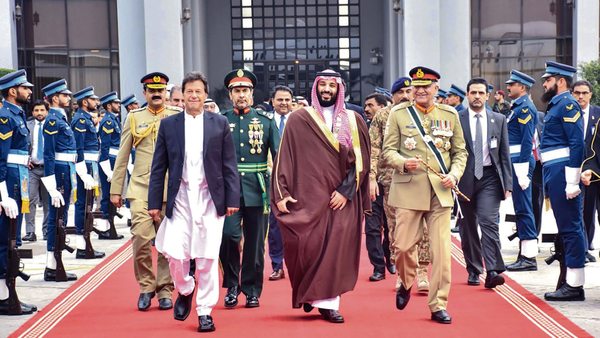
Saudi-Pak spat and the big churn in Muslim world

Has Kashmir issue become a catalyst to Saudi-Pak spat? That is what Pakistan wants the Kashmiris to believe. But there is more in Pak-Saudi row than what meets the eye.

The roots of rumbling in the Islamic fold are traceable in the Islamic resurgence movements that sprang during the cold war years. The Khilafat Movement of pre-World War-II era was the first sign of the rumbling in West Asia and elsewhere. Reminiscences of the glory of Ottoman Empire with the Muslims also generated their dislike for the western powers which had brought about its downfall. The phenomenon was replicated in the sub-continent with the liquidation of the Mughal Empire by the middle of the 19th century.

With Anglo-American dominance becoming pervasive during the cold war era the urge for recognition of identity began both as reaction and as a cherished theme of the masses of people in the Third World, especially in Asian and African continents. Muslims widely dispersed in the two continents showed unrest. The idea of a separate state for Muslims of the Indian sub-continent floated in early decades of the 20th century culminated soon after the end of World War-II. In the absence of a centripetal political and military power, it was evident that the mosque and seminaries (madrasas) would serve them as the power centre. It meant revival of orthodox Islam and, of course, the resultant direct or indirect confrontation with the forces of democracy and the epoch of scientific and technological enquiry and advancement.

The rise of Khomeini in Iran and of Osama bin Laden in Saudi Arabia (where from he shifted to strategically conducive geographical region as well as equally cooperative human force) was an expression of anger against the Saudi Kingdom for its sellout to the Americans. Many Arab countries in the Gulf or West Asia would not want to move far away from Saudi Arabia for the bare reason that the Islamic centrality of the Saudi Kingdom was major security against adversarial forces within or outside the region.

The inception of the Organization of Islamic Cooperation (OIC) in 1969 in which Saudi Arabia played a leading role was almost hijacked by Pakistan after it attained nuclear capability in 1998. Pakistan’s essential interest in OIC was to sell Kashmir issue to the 57-member strong group. For last two decades or more Pakistan has been moving an anti-India resolution on Kashmir in all of the summit sessions of the OIC. However, on the ground, the passing of these resolutions made negligible difference whatsoever in the bilateral relations between India and the member countries of the OIC.

PM Narendra Modi has been able to establish good relations with the Saudi kingdom as well as the UAE. There has been a phenomenal increase in bilateral trade, import of crude oil, tourism and above all work opportunities for millions of Indians in the Gulf States and the Saudi Kingdom.

Pakistan has been unhappy with it. UAE allowed Indians to build a temple on its soil which the Pakistanis considered a boost to heresy “kufr” on the Islamic land. India’s growing friendship with Israel and the defence deals between the two nations is projected by Pakistan as a challenge to the Muslim world, forgetting that Pakistan served a conduit for the supply of Israel’s arms and ammunition consignments to Iran during Iran-Iraq war. The invitation by the Saudi ruler to the then Indian External Affairs Minister, Sushma Swaraj, to address the OIC session upset Pakistan to the hilt. Islamabad thought the Saudi monarch was disregarding the fundamentals of Islamic Armageddon.

Thus Pakistan began to work with like-minded regressive Islamic states to bring about a change in the policy and functioning of the OIC. However, it had to move slowly owing essentially to Pakistan’s weakening economy, rising debts and defamation incurred by soft-peddling with the terrorist and Islamic radical organizations at home. In particular, Saudi monarch — familiar with the compulsions of modern scientific age, did not want Pakistan to join its voice with Iran or Turkey in upbraiding the US for “interference” in the affairs of regional Islamic powers.

It will be reminded that in the OIC summits many liberal Arab states would ask the members to discuss along with Kashmir the freedom struggles of Muslims elsewhere like Balochs, Pushtoons, and Uighurs. The Saudi monarch believes that India with the second largest Muslim population with democratic dispensation has a right to be included in the OIC since the welfare of Muslims world over is the objective of the organization.

Finding that it was difficult to break the solidarity among the Arab members of the OIC, Pakistan looked out of the box. Turkey, Malaysia and Iran, all of these non-Semitic Islamic States, could find a common cause of defiance against the Saudi and the UAE “hegemony” at the OIC. The medieval type orthodox Islam versus the liberal Islam argument seemed to be revived in the 21st century.

New Delhi’s J&K Reorganization Act 2019 landed Pakistan in a somewhat precarious situation. Kashmiris understood that Pakistan’s patronization of their separatism had become meaningless. Pakistan’s Kashmir bombast over the decades was blunted. Islamabad tried many options, UN, EU, British Parliament, nuclear threat, acceleration of terrorist attacks in the valley, intensifying bombing and shelling of the border to help infiltration by jihadis. Together with it, Pakistan undertook a massive propaganda campaign to the extent that Pakistan foreign ministry ceased its normal function and became its Kashmir cell.

Not able to settle the score with the US, Pakistan and the non-Semitic Islamic States now found it expedient to target Saudi Arabia. In 1979 Ayatollah Khomeini had declared that Islam disallowed monarchy and that the Saudis had no right to claim as the sole custodians of the haramayn-e-Sharief meaning the twin holy cities of Mecca and Medina. The non-Arab Islamists subtly began to move in that direction.

The Saudis condemned the last winter Kuala Lampur meet of 53 Islamic countries and even summoned Imran Khan to Riyadh to be chastised for becoming a party to anti-Semitic Islamic states and the OIC.

At the root of Saudi dislike for Turkey is that during the heyday of the Ottoman Empire Saudi Arabia had come under the suzerainty of Turks who also controlled the holy shrine of Mecca. Saudis had played a role in supporting Great Britain against the Ottoman Empire. Moreover, refusal of the EU to admit Turkey has also been taken as a snub by Turkey and thus she wants to assert via Islamic channel. As far as Mahathir of Malaysia is concerned, he is the classical running dog of hegemonic China. The case of Iran is different. Iran can be called the odd man in the non-Arab Islamic fold. Iran knows that she will never be accepted by the Muslims (to whatever fold they belong) as the leader of the Muslim world because of deep factionalism eating into the entrails of the Islamic body.

Frustrated that Saudi monarch was not prepared to call the OIC foreign ministers’ meet in which Pakistan would move a resolution against India on Kashmir, the Pakistani foreign minister has threatened that in case Saudi king did not call the foreign ministers’ meet, Pakistan would call the meet on its own. The battle lines are drawn. Saudi ordered stopping of oil supplies to Pakistan and demanded the return of the loan money to the tune of $3 billion. China has come to Pakistan’s rescue and given it one billion dollars to pay off the Saudi loan. If relations deteriorate, hundreds of thousands of Pakistani labourers working in the Saudi kingdom may be asked to go back home. Pakistan has openly taken up cudgels with Saudis and this could not be done without a subtle hint from Beijing.

The rumblings in the Islamic fold is deep and its consequences will be of far-reaching significance. This all explains that Kashmir is not the catalyst to the split between the Arab and non-Arab Islamic states. It is a war between radical and conservative Islam strongly supported and upheld by the non-Arab Muslims against the more westward-looking Arab Islamic states. The immediate question before the Saudi monarch is who should he invite to serve as the prestigious royal bodyguard as he is about to send back the Pakistani brigade. And for Pakistan, it appears that she itself is headed towards isolation among the Muslim countries. Pakistan Army higher echelons have realized the consequences of antagonizing the Saudis. The Pakistani Army chief called on the Saudi Ambassador in Islamabad and is trying to convince him that Pakistan will not be part of the split game. We have to watch what can be the impact of Pak-Turkey bonhomie that has developed recently.

India refuses to recognize medical colleges in POJKL

Srinagar/August 13: Separatist groups of J&K, better described as Pakistani stooges received a severe setback after Medical Council of India (MCI) declared that any qualification obtained from medical colleges located in Pakistan Occupied Jammu-Kashmir and Ladakh (POJKL) shall not entitle a person to practice modern medicine in India.

For the last so many years, Hurriyat leaders were seeking and getting money to recommend Kashmiri students for medical or engineering studies in Pakistan and POJKL.

National Investigating Agency (NIA) has already started a probe in this regard. 

It is an open secret that separatist leaders would charge anything between Rs 25-Rs 30 lakh to recommend names of Kashmiri students for studying in Pakistan and POJKL (Pakistan-occupied Jammu Kashmir and Ladakh).

“For more than a decade, Pakistan has reserved dozens of seats in its medical and engineering colleges for Kashmiri students, but they get admission only after a recommendation from Hurriyat leaders,” a senior government official told News Intervention.

From 1990, Hurriyat leaders have been sending Kashmiri youth to PoJKL and Pakistan for medical and engineering studies.

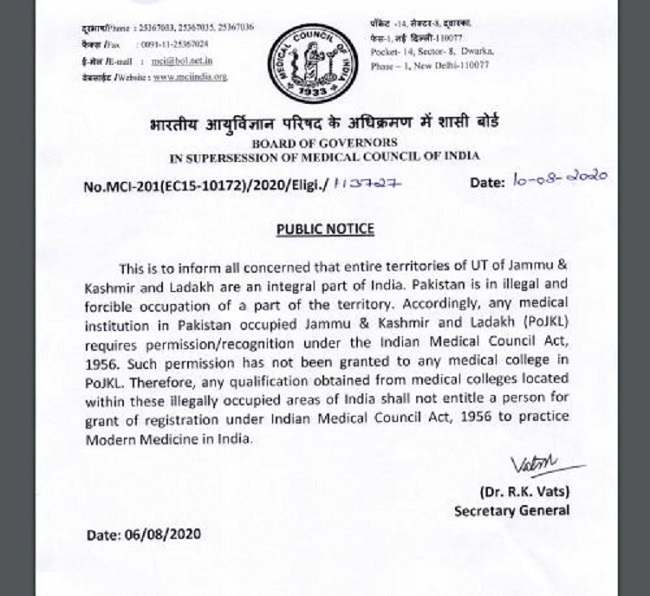
MCI in its notification made it clear that “This is to inform all concerned that entire territories of UT of Jammu Kashmir and Ladakh are an integral part of India. Pakistan is in illegal and forcible occupation of a part of the territory. Accordingly, any medical institution in Pakistan occupied Jammu Kashmir and Ladakh (POJKL) requires permission/recognition under IMC Act, 1956. Such permission has not been granted to any medical college in POJKL.”

“Therefore, any qualification obtained from medical colleges located within these illegally occupied areas of India” shall not entitle a person for grant of registration under the Indian Medical Council Act, 1956 to practice modern medicine in India,” added the MCI notice.

Security forces eliminate key terrorist in Pulwama

1

Srinagar/ August 12: Two days ahead of India’s Independence Day, security force on Wednesday shot dead a top terrorist in Pulwama district even as a soldier was martyred in gunfight.

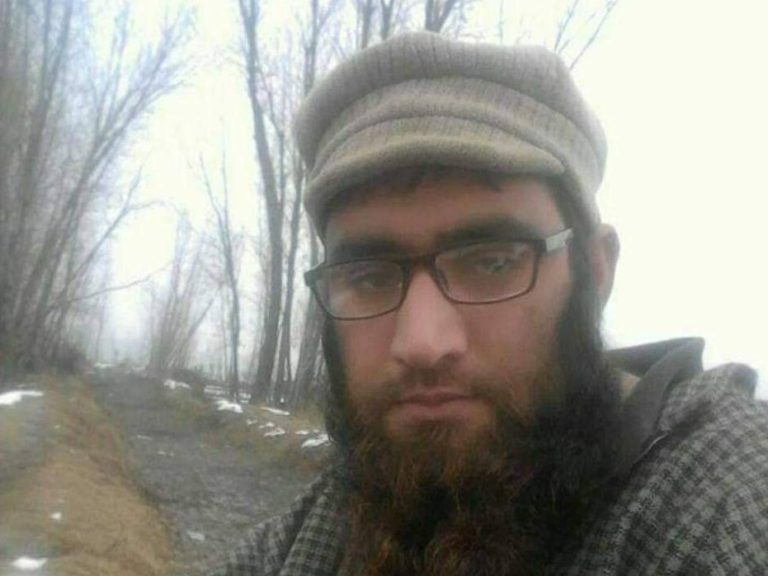
Director General of Police Dilbagh Singh on Wednesday said that Hizbul-Mujahideen terrorist Azaad Lalhari of Pulwama was killed in an encounter at Kamrazipora area in south Kashmir. “Azaad Lalhari was involved in the killing of police head constable Anoop Singh on May 22, 2020 at Prichu Pulwahma where he fired at a Naka party,” DGP Dilbag Singh said.

He said six FIRs were lodged against him for militant related killings. “Earlier he was detained under PSA (public safety act) as OGW (over ground worker) and he became active again,” the DGP said, adding that charge sheet had also been filed against him in two cases earlier.

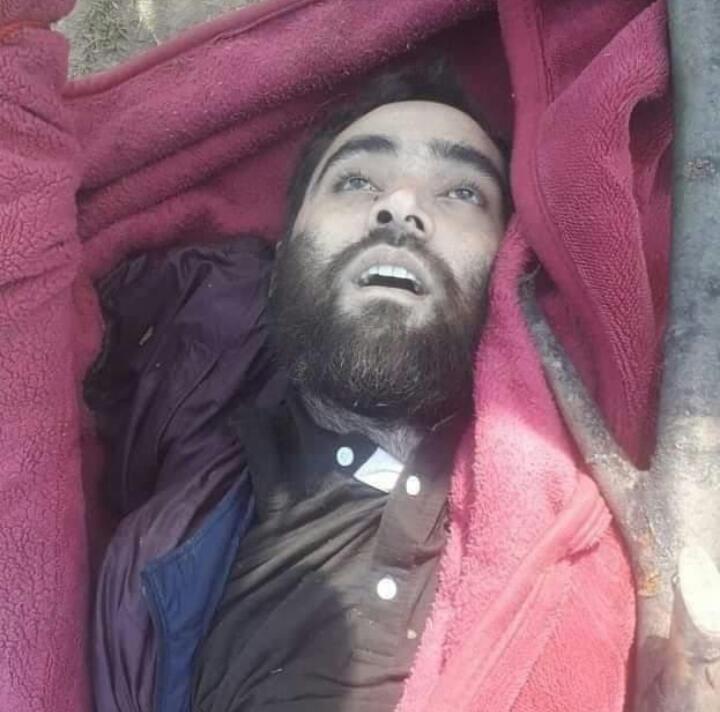
Body of Hizbul Mujahideen terrorist Azaad Lalhari after being shot dead by Indian security forces. (Photo: News Intervention)

Official sources said that the terrorists fired upon a joint team of police, army and CRPF’s 53 battalion after they launched a cordon-and-search operation at Kamrazipora area in the district.

In the initial exchange of firing, two army men were injured and were evacuated to 92 Base Hospital here where one of them succumbed to critical wounds. Meanwhile, the police said, the body a terrorist was recovered near the encounter site and was later identified to be Azaad Lalhari.

In another incident terrorists fired at a Quick Reaction Team (QRT) of the Indian Army near Trumgund Hygam crossing on Wednesday. The QRT was moving from Baramulla towards Gulmarg on the Srinagar-Baramulla National Highway near Trumgund Hygam crossing. One Army soldier has been injured and search operation is in progress.

Hila Graf Converses About “My Home is a Suitcase”

My Home is a Suitcase” is a play by Rzgar Hama about individuals who sought new lives as immigrants. It is based out of Vancouver, British Columbia, Canada. These are real stories. The next few interviews will be from some of the individual readers of their stories of beginning new lives in Canadian society. Hama is known for several plays, including “Soldierland” with some professional commentary by Dr. Marvin Westwood and Dr. George Belliveau of The University of British Columbia in “Dr. Marvin Westwood & Dr. George Belliveau on SOLDIERLAND a play Written and Directed by Rzgar Hama.” Here I speak with Hila on “My Home is a Suitcase.”

No description available.
Sky Theatre Group, “My Home is a Suitcase”

Scott Douglas Jacobsen: So, the play is “My Home is a Suitcase.” The playwright is Rzgar Hama Rashed. In another way, it is merely people telling their stories who are partial playwrights in a way because they are providing their narratives, their life stories. In terms of your involved with “My Home is a Suitcase,” Hila, what is the story with becoming involved with Rzgar, with Sky Theatre Group? Was this floating around the internet or knowing others within its social and professional orbit?   

Hila Graf: A little bit of both, my background is in theatre, directing, and teaching. I moved to Vancouver 2 years ago. I consider myself an emerging theatre artist and educator, so I was looking for opportunities to become involved with an artistic project. Especially something in a community setting, since an important part of my training was on community-based theatre. I really love working with different groups, which aren’t necessarily professional, but rather they use theatre as an instrument to tell their stories.

I met Rzgar through the research-based theatre collaborative at UBC, Then I saw a post of “My Home is a Suitcase” on LinkedIn, it was the first time I saw something on LinkedIn that was appealing to me and I got excited about this project. I reached out to Rzgar and we talked about the project. He asked if I wanted to be one of the participants to tell my story.

But because of my background in directing, I preferred to be part of the overall process and learn from Rzgar, in terms of how he works on the project from the beginning, from a director’s perspective. It has turned out to be a really beautiful learning experience for me.

Jacobsen: Now, when you’re looking at some of these stories and comparing it to some of the standard play repertoire that you’re teaching or see in some of the Downtown Vancouver area in the art scene, what are the comparisons and contrasts there? Either that are pieces around or the differences in content tone, where one produces a play with real narratives as opposed to ones that are invented and have that kind of truth infused into the parts that are imaginary.

Graf: The whole method of community theatre and devised theatre, is something that has been used around the world for many years. In Vancouver, it is still a relatively new concept. Traditional theatre usually focuses on producing plays that are based on an existing script. Then the cast and creative team come together and they work on bringing the script to from paper to stage. Even in community settings, sometimes, the choice will be, “Let’s all do Shakespeare together” for example, so the community will explore their identity or story through the lens of an existing play. It is an amazing method. But what is unique about “My Home is a Suitcase” is that it focuses on people’s true stories, so, what comes out is not filtered, the whole process is very, very personal for everyone involved. Basically, you’re asking people who don’t have a lot of writing experience in theatre context to write something based on their life experience. Often, the stories involve vulnerable experiences the participants had in their life.

And the goal of the project isn’t just artistic, it is c creating a community and empowering people as they are going through this journey of sharing their story, with the group and then with an audience.

Jacobsen: Were there any particular moments in the development of this project where individuals had to stop in the middle of telling their story because it was too hard?

Graf: I don’t remember people stopping, necessarily. But I do remember people debating which parts they should leave out of the piece, especially during the one-on-one sessions. It was three of us in the directing team, Rzgar as the director and Lennora and I as assistants, so at some point we split the group and each of us had one-on-one sessions with some of the participants. It was nice to get deep into the stories and hash out the exact part of the story the writers want to focus on. But because every person has a 20- to 40-year span of lifetime it is a challenging task when the goal is to have a 7-minute presentation, which was the goal of the first phase of the project.

When we did the one-on-one, I remember some people were deliberating whether they should include some parts of the story or not, and sometime they would decide to leave somethings out because that was too personal for them. It is a challenge, to try to be honest and share your truth and at the same time protect your privacy. It was very inspiring to witness that process.

So, the complete ownership of the story and how they want to present their story was of the participants. It is really, really important. Because in the end, they have not only written their story; they have also read it in front of an audience, which is a very courageous this to do.

Another part was how to approach the different information pieces coming into the room. People were sharing personal information, sometimes very traumatic. We had to figure out our group rules of when and how to ask questions about everyone’s stories, and when to leave it alone, so that each person will have the agency to share as much as they want. It was about making sure this was a safe space for everyone to explore and create.

Jacobsen: You are dealing with people who may not have much or any theatre experience. They are a self-selected group with putting out a call for refugees to come and tell their stories. What are the factors you’re taking into account in getting the narratives for those who may not have the theatre experience and may be the self-selected group with trauma stories in general?

Graf: That’s an interesting question. We worked with the group with the same tools we would use with professionals, but in a different way It’s the same tools that shape community theatre and professional theatre, and community theatre is a genre and an art form like many others, so it has its own style It is more authentic and intimate. It could be a little rough around the edges and that’s part of the beauty. We wouldn’t try to mask it. We would use different tools like voice work and body posture, breathing techniques, which everyone can do in order to support the cast to communicate their story in the best way possible.

We work with everybody to get comfortable in sharing their story in front of an audience. A lot of agency is given in terms of what the performers, feel comfortable with and what works for them. With this project we also want to show that anyone can perform and share their story, this is a part of being human –

we need water and food, and sleep, but also stories. We are always thirsty for stories. Even if we are not part of the professional world, as humans we understand storytelling, and we have a strong motivation to engage in storytelling – to share what we are doing and feeling and to learn about others. This goes beyond the professional performing arts community to every human.

It is inspiring to see how easy it is. It is something ingrained in each and every one of us. The only difference between the participants of My Home is a Suitcase and anyone else is that they have chosen to take the time and put their focus and energy on telling their story

I think that’s part of what is inspiring in that. These people have chosen to put that spotlight on themselves, on their history, and examine their own and life story and share it with others.

Jacobsen: What is the big takeaway from this project for you? Relative to a lot of Vancouver, these are stories about pain, dislocation, loss, and many times coming to a new place in triumph.

Graf: Some of the stories have traumatic components in them, but some of them are full of humour and full of the small intimate moments of life that we can all identify with. I think the important thing is people will be able to empathize with the people behind the stories and learn about the amazing diversity we have here in the community. The different stories of immigration are so different from one another and so unique

They are so specific and moving. The stories of resilience in the journeys people went through; the choices that they made in their lives. It is about choices in light of circumstances, which is something that I believe everyone can relate to. It is shedding some light on this part of our community, on immigrants and refugees, and making sure that all newcomers, immigrants and refugees are celebrated in the community

It is really tied to what we have been seeing in our society around the Black Lives Matter movement. Every person wants to be loved, wants to be celebrated, wants to have opportunities. I think My Home is a Suitcase piece is an excellent step in the way to make that possible.

Jacobsen: Hila, thank you so much.

Graf: Sure, thank you.

Photo by Blake Cheek on Unsplash

Image Credit: Soran Mardookhi, and Rzgar Hama/Sky Theatre Group.

India’s partition on religious lines has deprived us of our independence: Khalil Baloch

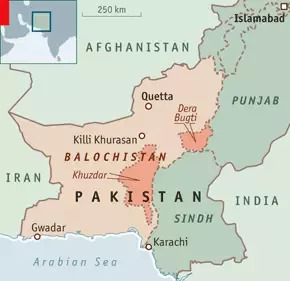
The eleventh day of August holds a special significance in the Baloch national history. It was on August 11, 1947 when Balochistan attained freedom from British colonial rule. This news was announced from the All India Radio that Balochistan is a free country. This freedom and its announcement came after a long history of struggle and sacrifices, said Khalil Baloch Chairman Baloch National Movement (BNM). From 1839 to 1947, the Baloch nation fought gory wars and sacrificed their lives against British aggression, but they never surrendered to them. That is the primary reason that Balochistan had a unique position in British India and Baloch land was autonomous in several ways.

BNM Chairman Khalil Baloch said that on 4th August 1947, Lord Mountbatten, the viceroy of India signed a treaty with Mohammad Ali Jinnah and Khan of Kalat, Meer Ahmed Yar Khan, which affirmed the freedom of Balochistan.

Later on, Mohammad Ali Jinnah and the British government backed from this agreement and started intriguing for the occupation of Balochistan. The illegal accession of Kharan and Las Bela was approved; which historically were integral parts of the state of Kalat. Kharan was under the direct control of the state of Kalat and had the position of a Special Area. In the same way, Mekkuran was also an integral part of the state of Kalat. As for the treaty made between the state of Kalat and British government it was agreed that after the withdrawal of British, these regions including the leased areas would have to be returned to the state of Kalat. But Pakistan disrespected all these treaties along with agreement between Jinnah and the Khan of Kalat and occupied Balochistan. The aggression of Pakistan and the expedience of Khan of Kalat was the prime reason for Pakistani occupation in Balochistan.

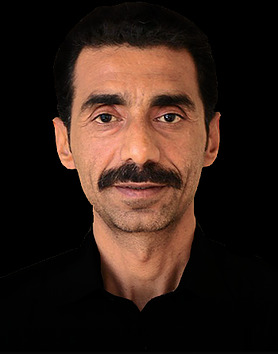
Khalil Baloch, Chairman Baloch National Movement (BNM).

Khalil Baloch added that when the issue of accession to Pakistan came under discussion in the Parliament of Balochistan, it was vehemently rejected by both chambers of the Balochistan Parliament, and they decided to fight back any aggression by the state of Pakistan. Kept aside from the armed struggle of Agha Abdul Karim Khan, the rest of the people, later on, could be seen on the floors of Pakistan. If the Baloch leadership had honestly played their due roles, then today, the situation in Balochistan would have been far different.

Historically Balochistan has never been a part of India and the British occupation could also not force Balochistan to be a part of British India, explained Khalil Baloch. However, the partition of India, a great nation, in the name of religion is the greatest mistake in history and today as a result of this partition not only India and Balochistan but also the entire region is suffering.

The western powers needed a client state to keep a check on the powers of the region. For this purpose, they started planning for the creation of Pakistan but on the historical and cultural grounds there was no logic for the creation of a state by cutting India into two halves, therefore for this, they used religion as a tool to further their cherished dreams.

After the creation of Pakistan, millions of people lost their lives in the name of religion and even today Pakistanis are proud of this bloodshed. On the contrary, during the demands being made to create a new state Pakistan let alone one sacrificing lives, no one went even behind the bars. This was simply because the decision was taken from somewhere else and Indian leadership could not timely and effectively respond against this decision. As a result, India was cut into halves. The result of this came in the shape of Pakistan being the center of terrorists, Islamic atomic weapons, the outsourcing of terrorism, and worsening situation in the region.

Chairman Khalil Baloch stated that Baloch, Sindhi, Pashtoons, and other minorities are enduring the outcome of a wrong historical decision. Pakistan is becoming dangerous for the region as well as for the entire world. The regional state and international powers should address this fault line; they should support the Baloch national struggle and take strong initiative for the freedom of Balochistan. Not only the fate of Baloch nation but also the regional peace is associated with the freedom of Balochistan. We have several times reminded that the path of peace and prosperity goes with the freedom of Balochistan.

11 August 1947: Balochistan’s Independence Day & Thereafter

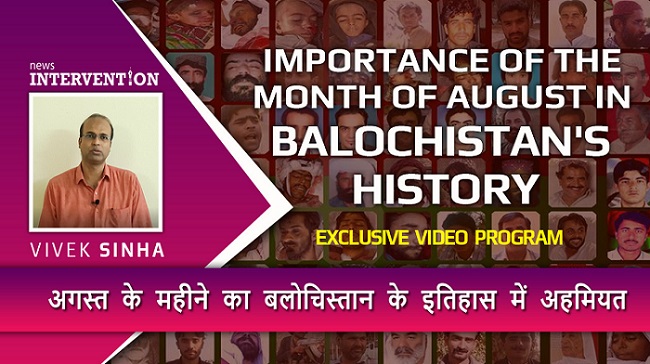
On 11th August 1947, Balochistan became independent but it’s independence was short lived. On 27th March 1948, Pakistan occupied Balochistan and continues to occupy it till today. August 11 is celebrated as Balochistan’s independence day across the world. However, the month of August is also important in Balochistan’s history due to numerous atrocities committed by Pakistan during this month. Watch the video report to understand more.

Click on the link to watch the video report

National Security: Deterrence in the Indian Context

You can distil deterrence down to two factors: capability and will—Chris Gibson.

In my article “Changing Dynamics of Deterrence in International Security and Strategic Paradigm”, which was Part-1, I explained the enduring and timeless nature of deterrence as a state policy, as also the changes in scope, dimensions and domains, where deterrence is more effective at the strategic and existential level rather than at tactical level. Some nations led by statesmen/strong leaders have always been ingenuous and creative enough to gain their objectives by operating below the red lines of adversary’s deterrent action. In this concluding Part-2, we will examine the contours and strategic compulsions of deterrence as applicable to India. Nations have their vision and aspirations and want to find their legitimate place amongst the comity of nations.

India the ancient, proud civilization too aspires for the same and we are destined by our geography, size, population, resources and history to be a great power in the world order, for which deterrence is an essential ingredient. While we understand the universal dictum of Lord Palmerston ‘in international relations, there are no permanent friends or enemies, only permanent interests’, it is also no secret that our adversaries in the near future are collusive China and Pakistan. 

China’s concept of local wars under modern high technology conditions envisions “a localized, short duration and high-intensity conflict using technologically advanced weapons for both conventional and asymmetric combat, including the much hyped ‘Three Warfare’s’ strategy of media, psychological and legal. Pakistan leaders feel that, ‘one way to prevent the early use of nuclear weapons is for a conventional capability (they feel tactical nuclear weapons are conventional) to be good enough to deny the adversary valuable strategic assets and maintain a stalemate for a reasonable time, assuming that the conventional pause would give the parties at war and the international community enough time to defuse tensions and negotiate peace’. Adequate space, thus, exists for a limited conventional war in the India-China-Pakistan (all three nuclear weapon states) context. The world’s first limited conventional conflict between two overt nuclear powers – USSR and China took place in 1969. This conflict could have led to the use of nuclear weapons, but after two weeks of clashes, the conflict petered out. The Kargil War of 1999 between India and Pakistan demonstrated the application of limited war between two nuclear power countries wherein India evicted Pakistani intrusions exercising strategic military restraint.

Deterrent Determinants

Glen Snyder an important scholar of international relations theory and security studies has explained that “power values are of three major kinds: strategic, deterrent and political. Strategic value is a function of the war-making potential; deterrent value is an attribute primarily of the act of responding to aggression, and political value is the effect of a response, and of its direct consequences on the alignment or attitudes of adversaries”. It implies that power values are extrinsic and their value lies in their contribution to intrinsic values. Deterrent Value amounts to establishing and maintaining a reputation. Extrapolating these values, the various determinants in the Indian context can be clubbed as follows:

  • Strategic Value Determinants include geography, economic strength, population, natural resources, and strategic culture.
  • Deterrent Value Determinants comprise nuclear, military and technological capability.
  • Political Value Determinants comprise foreign policy and diplomacy including international alliances/partnerships, leadership, smart power, and Indian diaspora.

Threat Assessment and Concomitant Deterrence

It is quite obvious that India’s power values comprehensive national power (CNP) is on the ascendant and all three values will accelerate post COVID-19, and based on our firm and resolute response to China’s current aggressive posturing and deployment along the LAC. Naturally, India needs to build deterrence capabilities commensurate to its stature in Asia and the world, especially against known and envisaged threats, including the low probability of facing a Two Front challenge.

Probability of China using the maritime zone in IOR (Indian Ocean Region) or even using territories of our immediate neighbours cannot be ruled out. Here too, our deterrent potency will come into play based on which our attackers and other neighbours will respond. Our strategic balancing with the rest of the world by bilateral and multi-lateral alliances/partnerships (QUAD, BRICS, SCO, USA, Russia, Australia, Japan) in multi-domain verticals (political, diplomatic, economic, trade, HADR and importantly military) will impact the adversary decision-makers’ perception and political will; the potentially long-lasting, harmful post-conflict multi-domain effects of taking on India. Allied and partner contributions to the joint fight are significant. For example, in case of an all-out war, USA, Japan and Australia could provide India peripheral security, fly additional combat and support sorties, supplement naval presence, stage forward specialized special and manoeuver forces, provide surge logistics capability including supply of critical and destructive weapon and munition systems, supplement ISR
(intelligence, surveillance and reconnaissance) inputs, to name just a few. They could however, stay short of providing ‘kinetic support’. These actions contribute significantly to deterrence, force protection and overall operational success. Even when military intervention of any of our strategic partners including USA is very tenuous at best, we must realise the unique potency of US and allies combined Global Strike capabilities: their nuclear and armed forces contribute uniquely and fundamentally to deterrence, through their ability to threaten to impose costs and deny benefits to an adversary in an exceedingly rapid and devastating manner (practice of imposing trade sanctions if adversary does not cooperate is a deterrent operation which has met with mixed success).

Reacting to recent Chinese aggression along our LAC, actions of USA to deploy two aircraft carrier groups in South China Sea, and thinning of troops from Philippines ostensibly to be employed elsewhere (India), and statement of kinetic support emanating from White House are significant. Many other countries have openly supported India like Australia, France, Germany. The above are clear manifestation of Indian deterrence capabilities using all three determinants stated above. China and Russia too possess such strike capabilities and even USA feels threatened and insecure. Knowing our main adversaries, they can and will operate with and through proxies, and attempt to achieve their strategic and operational goals below the threshold of armed conflict.

India faces the full spectrum of security threats across domains; proxy, hybrid, sub-conventional or low intensity conflict, 4G, conventional (localized to full), nuclear including the newer domains of space, cyber, water, resources (entire gamut), specially from collusive and collaborative partners China and Pakistan with some other neighbouring nations joining in. We have a rather tenuous ceasefire agreement with Pakistan from November 2003 (renewed in 2018) which in the last five years has been broken more often than not. That Pakistan is conducting a state sponsored proxy war since late 1980s is now internationally accepted. Pakistan’s strategic aim is to carry out destabilizing activities in India short of war.

Pakistan controls the violence levels in J&K and mixes it with agitational tactics and exploitative socio-political manoeuvrings. Pakistan’s acts of terrorism have spread pan-India. From a policy of strategic restraint, India is beginning to propagate and practice a more aggressive strategy to raise the cost for Pakistan’s mainstream and Pakistan Army.

Pakistan has an (some say deliberately ambiguous and irrational) undeclared nuclear policy aimed specifically at India, with the fastest growing insecure, nuclear arsenal and is developing tactical nuclear weapons (TNW) to close the conventional war space with India, as per its perception. Pakistan’s nuclear architecture is aimed at providing full spectrum of deterrence and prevent second strike capability to India. We need to ask ourselves, ‘will war stop Pakistan from continuing proxy war and make a weak Pakistan both militarily and economically a more dangerous neighbour than before the war’. The now permanent, strategic collusivity with China has brought in a whole new equation, with a much more expanded assistance in multi-domain expected from China in case of an Indo-Pak war. A worrying aspect is the increasing degree of inter-operability between China and Pakistan in soft and hard power (military and non-military) spheres which is being generated. This will be played out in any future conflict. The equations are changing. Even if China does not intervene militarily, unlike the earlier four wars China will carry out more focussed, effective but non-military MDW, and mobilise her forces (simulate/indulge in some border activities) along the LAC along with its PLAAF and PLAN, preventing our repositioning of forces (Army and Navy) from the Northern to the Western borders, diluting our offensive capacity and capability prohibitively.

We should be wary of the China-Russia strategic and security partnership mainly to counter USA and its Western allies. On top of the strategic encirclement (both continental and maritime) of India by China, Russia is also increasing strategic mating with Pakistan, and the Russia-China-Pakistan triangle is getting involved exclusively (except for Iran) with Afghanistan. While India enjoys a special relation with Russia, a faltering USA and rising China, coupled with few immediate neighbours like Nepal, Myanmar toeing Chinese line, creates a clear and present danger and serious strategic and security ramifications for India.

The Indian political and military leadership carries out regular net assessment exercises regarding potential adversaries, and constantly reviews the deterrent capabilities which needs to be put in place against potential adversaries specially against a probably two and a half front threat against a collusive China-Pakistan. For details of the relative comprehensive net assessments including military, of India and our adversaries, and a likely scenario for a Two and a Half Front War please read up on the links given in the end-notes.

In relation to Pakistan, we face a peculiar problem of whom to deter! If Pakistan suffers significant conventional losses or loss of territory, it may assess that escalating the conflict by employing weapons of mass destruction, could recapture the initiative or drive policy makers to the negotiation table to end the conflict on more favourable terms. Pakistan may also use tactical nuclear weapons if presented an appropriate target contributing to the attainment of operation or strategic objectives. This brings us to the strategic nuclear dilemma (faced by the major powers against each other like US, China and Russia) that India should not risk escalation for Pakistan to reach a perceived “use it or lose it” situation. India therefore, must conduct a very effective influence campaign against Pakistan and to the world, about the dangers of employing WMD, minimize vulnerabilities, and demonstrate the ability to continue operations if attacked.

If deterrence fails to preclude a tactical weapon of mass destruction or disruption attack, our influence operations must ensure isolation of Pakistan internationally and regionally. The option of exercising our stated nuclear policy is a constant. When it comes to non-state actors and terrorist organisations, it’s a different ball game. They differ in their susceptibility to our efforts to credibly threaten cost imposition. They have different goals/objectives, different values, and they employ different means to achieve them. Since India does not believe in using a hammer to kill a fly which is why planning and preparing for deterrence operations against specific targets (nation, non-state actors like corporates, agencies, terrorist organisations or even individuals) is important.

A terrorist organization relies on the following for its survival; organization’s leadership strata and commander; its military capability for carrying out terrorist attacks; its economic and financial support base; and the network of alliances with other organizations and states that provide support in the form of arms and financing. India must achieve deterrence by demonstrating our will to use military force to inflict damage on these assets. Our Army has identified the same, and turned pro-active, but been only partially successful in following this deterrence concept in entirety.

China is a past master and strong advocate of ‘unrestricted warfare’ in which deterrence forms a key component, and its currently engaging India in competition 24X7 to ensure that our comprehensive national power (CNP), strategic growth and space remains confined and restricted. In addition, China is increasingly discarding the rules based international system, and conventional defined norms of international behaviour and its opaque strategic thinking and decision making makes deterrence more difficult. Recently President Xi asked the PLA to prepare for war, and if China sees its rise plateauing or starting to decline, it might strike rather than wait. These proclamations should be taken very seriously by our leaders, and deterrence measures must be planned and put in place both military and non-military. While focussing on China and Pakistan we must not ignore other nations (friends or adversaries alike), and also address non-state actors on equal priority.

Nuclear Deterrence

Both China and India have been responsible, mature nuclear powers and both proclaim a no first use policy. Recently, there are a plethora of articles emerging from China (official and unofficial), questioning no first use or providing different interpretations, creating a sense of ambiguity. As an emerging nuclear power which is still striving to attain a robust second-strike capability, India needs to act expeditiously as we are dangerously behind the big three (US, China, Russia) in R&D and application of niche technologies. Our nuclear policy (no first use), massive retaliation if attacked by NBCW has stood the test of time. There is talk of urgent review which may not be bad idea for creating ambiguity, but ‘there is nothing in the present doctrine that prevents India from responding to a nuclear attack’.

Main Ingredients of India’s Military Deterrent Capability

We need to carry out a more realistic threat assessment of a probable two and a half front conflict scenario, leading to ‘theatrisation’, and fresh realignment, redeployment and repositioning of forces, with a stronger bias towards our Northern Borders. This act, will in itself send a strong military and deterrent message, may prevent any misadventure, as also strengthen our defensive and offensive response. Other pivotal military deterrents would be a credible nuclear triad with second strike capability (China has it and Pakistan claims full spectrum capability); strategic military/security alliances; capabilities of conventional ICBM/IRBM missile and rocket artillery; strategic lift; robust C5I2SRT (command, control, communications, computers, cyber, intelligence and information, surveillance, reconnaissance and targeting); BMD (ballistic missile defence); domination of Indian Ocean Region; and limited offensive multi-domain capabilities to provide credible deterrence and punitive deterrence against China and Pakistan respectively.

Conclusion

Our goal is to achieve punitive and credible deterrence capability against Pakistan and China respectively. While it will be a challenge, India has the capabilities and capacities to fight a two front war and ensuring a stalemate, which will be a strategic victory, with grave consequences to the aggressors. We have now entered the complex world of multi and cross domain competition and deterrence which needs to be developed and synergised at the apex level; PM/PMO – Cabinet Committee on Security (CCS) – NSA – Ministries – CDS – Service Chiefs and concerned agencies involved. At the military sphere, once the political directive (National Security Strategy) has been promulgated, strategic military deterrence will be planned and coordinated by the CDS and service chiefs, strategic at Services HQ, operational by Theatre Commanders. Deterrence building is happening independently and intrinsically by all domain holders but it needs to get institutionalised, specially the non-military domains. If US intervention to retain global supremacy and protect a liberal rules-based world order is not considered hegemonistic, India too needs to think, prepare, plan and execute strategy to dominate its area of influence and interest.

Even if we develop adequate multi-domain deterrence capabilities, a key ingredient is ‘Reputation’ (willingness to use deterrence arsenal including military, when nation’s sovereignty and integrity is challenged; a la Israel) to use it when national security is at stake. Admittedly our current deterrence value has not prevented nations from impinging on our security with tactical manoeuvres. I am sure we will show our steel when it comes to existential and strategic issues. This truly is a defining moment in India’s history where we face a direct threat from China and Pakistan and some neighbouring countries. This is the time to stand tall, proclaim our red lines and show credible intent, resolve and wherewithal to use our multi-domain deterrent capabilities especially military to ensure that red lines stated (LAC positions as on April 2020) if crossed will be restored by all means at our disposal. Concurrently India needs to further build deterrence capabilities and our reputation, national resolve and will to fight if necessary. In a sense ‘deterrence has become a victim of its own success’. India must rethink its deterrence strategy in changing geo-political and strategic environment including psychology of decision making. Even with diminishing returns enhanced multi-domain ‘Deterrence’ becomes the first priority for India.

“I don’t believe in War, I believe in the principle of Deterrence,” Bashar al-Assad.

Lowy Institute, Australia, Power Index; https://power.lowyinstitute.org/ ;
South Asia Monitor “India must prepare for a multi-domain war”, https://southasiamonitor.org/spotlight/india-must-prepare-multi-domain-war
South Asia Monitor, “India-China standoff: Need to be prepared for two-and-half front war (Part III of three-part series)”
https://southasiamonitor.org/spotlight/india-china-standoff-need-be-prepared-two-and-half-front-war-part-iii-three-part-series

Christian Sorensen on Measuring and Ranking the Highly Intelligent

Christian is a Philosopher that comes from Belgium. What identifies him the most and above all is simplicity, for everything is better with “vanilla flavour.” Perhaps, for this reason, his intellectual passion is criticism and irony, in the sense of trying to reveal what “hides behind the mask,” and give birth to the true. For him, ignorance and knowledge never “cross paths.” What he likes the most in his leisure time, is to go for a walk with his wife.

Scott Douglas Jacobsen: I wanted to cover some of the facts of the measurement of intelligence within the confines of the most tested and studied facets of intelligence with that which comes by the title “general intelligence” via measurement in the “intelligence quotient” or “IQ” without the psychometry or the theory, but, rather, the generally accepted facts and the notion, creation, and re-imagining of the ‘listings.’ Sociologically, why is there a fascination with ranking the who’s who of the high-IQ?

Christian Sorensen: Although it is effective that there are fewer women than men on the right extreme of the curve, I think that the fascination for high-IQ, statistically speaking, occurs much more frequently in men than in women, since it is typically related to masculine behaviours that through comparative and over-compensatory mechanisms, associated with competitiveness, seek social acceptance and recognition with a constant effort to publicly attract attention, which in turn is sustained and drifted by a sensible exhibition of what is owned, in the sense of something endowed with dimensions. Therefore it could be said, that literally what matters over anything else related to high intelligence, has to do with how large is the IQ, as a sign that symbolizes power, and which ultimately in my opinion, what intends to cover up, is the need to demonstrate sexual potency, by repressing at the same time, the homosexual feelings of attraction towards other men, and of pleasure derived for being attractive to individuals of the same gender.

Jacobsen: What are some of the serious efforts at compiling real score identities?

Sorensen: I think that the efforts, made by certain societies such as Triple Nine, Mensa and WGD, for verifying the validity of the scores, and demanding in the case of the first two, that these should be exclusively associated with professional measurement instruments.

Jacobsen: What are some considerations in listing a who’s who of the high-IQ world?

Sorensen: I think that it is necessary to verify the veracity of the documents provided, and to exclusively accept as valid, the psychometric reports issued by qualified professionals.

Jacobsen: What are the ethical issues in having such a ranking?

Sorensen: I think that depends on the world, and of what the world expects or needs from someone who has such a ranking, therefore in this context, I believe that it is the necessity that creates the ethical value, and not the latter who regulates the former, in consequence the dead one, I endorse it to someone else.

Jacobsen: There are a ton of online sources via articles including “The 40 smartest people of all time,” “30 Smartest People Alive Today,” “8 People with Higher IQs Than Einstein,” “Here Is The Highest Possible IQ And The People Who Hold The World Record,” “25 Highest IQ’s Throughout History,” “The 50 Greatest Living Geniuses,” “21 Celebrities With Surprisingly High IQs,” “World’s Most Intelligent People 2010 – Intelligent People – Highest IQ,” “Feeling accomplished yet? Here is a list of people whose IQ levels have created records time and again,” “Who has the highest recorded IQ of all time?,” “Of All Things: Which president had the highest IQ?,” “Talk About Hidden Genius: These Are The Celebrities Boasting The Highest IQs,” “24 of the smartest people who ever lived,” “Famous Historical Genius IQs,” “The Smartest and Least Brainy Presidents, by IQ Scores,” “An 11-Year-Old Just Earned the Highest IQ Score Possible,” “What Is The Highest IQ Possible You Can Achieve?,” “What is the highest IQ ever measured in a human?,” “Dr Evangelos Katsioulis has the World’s Highest IQ,” “The Time Everyone “Corrected” the World’s Smartest Woman,” “The 13 Presidents with the Highest IQ Scores,” “Who Has the Highest IQ in the World? 35 People Who Are Even Smarter Than Einstein,” “​TOP 10 PEOPLE HAVE HIGHEST IQ SCORES IN THE WORLD (P.2),” “Meet Marilyn Vos Savant, The Woman With The World’s Highest IQ,” “The World’s 50 Smartest Teenagers,” “These 26 Celebrities Have The Highest IQ In Hollywood… #17 Is Pretty Much A Genius!,” “10 People With The Highest IQ In The World,” “The Man With The Highest IQ In The World Doesn’t Think He’s Very Smart At All,” “Top 12 People with Highest IQ in the World,” “Top 10 Women with Highest IQ in the World,” “The Massive List of Genius – People With the Highest IQ,” “Highest IQ Scores in History,” “A 3-year-old boy has just become the youngest member of Mensa UK, the largest international high IQ society,” and others.  It comes down to partial and questionable listings, individual profiles, children, celebrities, and American presidents. Then it’s a smattering of probably truly more obscure materials. Outside of the straight gossip-level journalism, there are a number of listings such as GENIUS High IQ Network, Gifted High IQ Network, Hall of IQ scores, HRIQ Ranking List, Mahir Wu Ranking List, VeNuS Ranking List, World Famous IQ Scores, World Genius Directory, World Highest IQ Scores, GFIS IQ List, WIQF Listing, and Real IQ Listing. GENIUS High IQ Network only had 3 mainstream intelligence test scores listed out of 38 entries:

IQ 173 sd15 W. M. Fightmaster USA WAIS-R 4.87 www.linkedin.com/in/william-fightmaster

IQ 166 sd15 Thomas Hally Mexico WAIS-III 4.40 www.facebook.com/thomas.hally

IQ 161 sd15 Kota Akishige Japan WISC-IV 4.07 www.facebook.com/kota.akishige

Gifted High IQ Network only had 4 mainstream intelligence test scores listed out of 106 entries:

IQ 173 sd15 W. M. Fightmaster USA WAIS-R 4.87 www.linkedin.com/in/william-fightmaster

IQ 166 sd15 Thomas Hally Mexico WAIS-III 4.40 www.facebook.com/thomas.hally

IQ 161 sd15 Kota Akishige Japan WISC-IV 4.07 www.facebook.com/kota.akishige

IQ 135 sd15 Dragan Mlakic B&H RAPM II 2.34 www.facebook.com/NoNamedReal

Hall of IQ Scores only had 2 mainstream intelligence test scores listed out of ~157 entries:

Juan Carlos Delgado, Venezuela, WAIS IV, 155+

David Gerardo Espinoza Aviles, Mexico, WAIS IV, 155+

HRIQ Ranking List only had 1 mainstream intelligence test score listed out of 215 entries:

Christian Sorensen      Wechsler Adult Intelligence Scale – Revised (1981)   185/185+

Mahir Wu Ranking List had 0 mainstream intelligence tests out of 35 entries. VeNuS Ranking List on a different metric than singular score submissions from alternative and mainstream intelligence tests. World Famous IQ Scores lists tests with more than 3 test takers:

Numerus Delight
Numiracle
Vermentary
Verllectual
Vercenthon
Daster
Einplex
Elementary
FREE Fall
FREE Fall Part I
FREE Fall Part II
HI-Qlass
Lipt
LSHR
LSHR Classic
LSHR Light
NSE
Numerus
Numerus Classic
Numerus Light
Numerus Light 2
Pert
Simtollect
SPEED
Triplex
Triplex Light
WIC 2014

9I6
AGLT
Algebrica
Asterix
Asteroid
Common Sense
ETHER
EZIQ
FIQURE
GENE Verbal I
GENE Verbal II
GIFT Verbal I
GIFT Verbal II
GIFT Verbal III
GIFT Verbal IV
Gigi Pro Certified
Hieroglyphica
IO
LAW
LexiQ
L’Orange
LS 24
LS 36
Lux25
Mach
Mathema
NGT-B
NGT-F
NGT-X
NIT Abstract
NIT Numerical
NIT Spatial
NIT Verbal
NPRT
PerspectIQ
PerspectIQ Light
prNt
SATURN
Sequentia Numerica I
SLSE 48
SLSE I
SLSE II
SUN
Test For Genius
TLMT
VISION
Warp
WIQ
WIQ-II
WITT
WordIQ
World Intelligence Test

Then they list the tests with less than 3 test takers:

12345
AIR-16MC
AIT
Alchemix
Analogies #1
Alpha-Num 1
A Paranoiac’s Torture
ASIT
ASTER
BALZAC
bysl3x
Callidus
CFIT-S3
C.F.N.I.T
Comix
Concep-T
COSMIC
CUBE
E2H26
ESP
Female Intelligence Test
Flux
FRT-A
FRT-B
FSIA
GENE Numerical III
GENE Numerical IV
GENE Verbal III
GENE Verbal IV
GET Verbal
GIFT Numerical III
G Test
IQ-T
Logix
Mathodica 22
M-CSNA
MCST 32
NGT-F Short
Ninja
NIT Form I
NIT Form II
NIT Logical
NPRA 36
NUMDOT
PULSAR
Qoymans MC #4
RedBlue
Register
RIDDLES
ROTOR
S, T & H
SBM26
ScorPIonX I
ScorPIonX II
SEQS I
Spat -10
Star Cluster
TERO41
TETR-IQ
Vault
Verba 66
Verbatim
W.A.I
WIC 2016
WITTY
X Test
X&Y Test
Xpwmatrix
XV Lingua
Yjac

The World Genius Directory lists 27 mainstream intelligence test entries out of 383:

185+ Christian Sorensen, Belgium, WAIS, www.isi-s.iqsociety.org

185 Kirk Kirkpatrick, United States, Stanford-Binet, www.facebook.com/macrhino

180+ Dr Evangelos Katsioulis, Greece, WAIS, www.katsioulis.com

175 Takahiro Kitagawa, Japan, WAIS, www.facebook.com/marubake.no.shiwaza

175 Susumu Ota, Japan, WAIS, www.facebook.com/susumu.ota.5

166 Thomas Hally, Mexico, WAIS, www.booksofintelligence.com

164 Dr Manahel Thabet, Yemen, Stanford-Binet, www.smarttipsconsultants.com

164 Iakovos Koukas, Greece, WAIS, http://www.facebook.com/iakovos.koukas

[Ed. Added on September 13, 2020, based on a personal email from Wagner-Damianowitsch:
163 Stephan Wagner-Damianowitsch, Serbia, WISC, www.facebook.com/s.m.wagner.damianowitsch.]

163 Dr Jason Betts, Australia, WAIS, www.emeraldalchemy.com

161 Geoff Hammond, United States, WAIS, www.csiinternational.com

160 Rudolf Trubba, Czech Republic, RAPM, http://www.facebook.com/rudolf.trubba

160 Tom Imondi, United States, WAIS, www.facebook.com/tommcimondi

160 Carlos Simões, Portugal, RAPM, http://www.cpsimoes.net

157 Michael Sumners, United States, WAIS, www.facebook.com/michael.sumners.31

155 Julio Machado, Brazil, WAIS, www.julio.machado.info

155 Patrick O’Shea, United States, WAIS, www.thethousand.com

152 Arturo Ruiz, Mexico, RAPM, http://www.about.me/jart

151 Constantí Cabestany, Spain, WAIS III, www.rizomatismos.tumblr.com

151 Jason Robért, United States, WAIS, www.facebook.com/jason.r.robert.7

150 Jonathan Som, France, WAIS, http://www.facebook.com/jonathan.som

150 Jeffery Ford, United States, WAIS, www.facebook.com/HighOnIQ

149 Stephen Murray, Australia, WAIS, www.taotiger.com

146 Denis Walch, Austria, WAIS, www.facebook.com/Denis.Walch92

141 Jakub Oblizajek, Poland, WAIS, http://www.facebook.com/jakub.oblizajek

135 Tony Sparacino, United States, WAIS, http://www.facebook.com/tsparacino

135 Simon Rebsdorf, Denmark, RAPM, http://humanlifelab.wordpress.com

135 Dragan Mlakić, Bosnia & Hercegovina, RAPM, www.facebook.com/NoNamedReal

The World Highest IQ Scores lists some alternative tests:

ALGEBRICA

ANOTELEIA 44

Blue test

ESOTERICA

HIEROGLYPHICA

L.H.A.S.S.O. 31

Logical sequences assessment

Logima strictica 36

Logicaus strictimanus 24

Ls 60

Lshr Light

MATHODICA 22

Numerus

Numerus Classic

Numerus Light

Strict logic sequence examination I

VERBA 66

World intelligence test

XVLINGUA

Zen high range IQ test

GFIS IQ List has 0 mainstream intelligence tests out of 142 entries. WIQF Listing is defunct. Real IQ Listing uses a differential identity metric with “True IQ.” That is to demonstrate, in general, the ‘listings’ or the rankings of the highest measured IQ scores consist mostly or entirely of alternative intelligence test scores rather than mainstream intelligence test scores, i.e., reduced levels of reliability and validity, while the World Genius Directory demonstrates the highest number of mainstream intelligence tests with inclusion; even there, the vast majority of the intelligence test metrics taken for inclusion remain alternative tests. All “alternative tests” listed in some consist of lists of alternative tests and the relevant high scorers with some having less than 3 test takers per person. Thus, this provides one consistent image of the high-range testing environment in terms of the rankings or ‘listings.’ What does this state about the high-range testing environment to you?

Sorensen: I think that is a jungle with a rich multicolored flora and fauna, which although it is striking, due to the variety of exotic and chromatic species that are exhibited, is somewhat dizzying and saturating. In addition and concretely speaking, from a semantic methodological point of view, in my opinion the vast majority of the high-range testing environment scores, regardless of how spectacular they may seem, and despite that they can eventually represent the measurement of something else, they actually aren’t valid measurements of IQ.

Jacobsen: What does this state about the rankings to you?

Sorensen: That the only ranking that has objective validity, is the one above, and if it is expanded, it should be done based exclusively on the criteria that were followed to carry it out.

Jacobsen: If we take only the World Genius Directory and the Wechsler Adult Intelligence Scale, or the WAIS or the WAIS III, the listing, ranking really, becomes this:

185+ Christian Sorensen, Belgium, WAIS, www.isi-s.iqsociety.org

180+ Dr Evangelos Katsioulis, Greece, WAIS, www.katsioulis.com

175 Takahiro Kitagawa, Japan, WAIS, www.facebook.com/marubake.no.shiwaza

175 Susumu Ota, Japan, WAIS, www.facebook.com/susumu.ota.5

166 Thomas Hally, Mexico, WAIS, www.booksofintelligence.com

164 Iakovos Koukas, Greece, WAIS, http://www.facebook.com/iakovos.koukas

163 Dr Jason Betts, Australia, WAIS, www.emeraldalchemy.com

[Ed. Added on September 13, 2020, based on a personal email from Wagner-Damianowitsch:
163 Stephan Wagner-Damianowitsch, Serbia, WISC, www.facebook.com/s.m.wagner.damianowitsch.]

161 Geoff Hammond, United States, WAIS, www.csiinternational.com

160 Tom Imondi, United States, WAIS, www.facebook.com/tommcimondi

157 Michael Sumners, United States, WAIS, www.facebook.com/michael.sumners.31

155 Julio Machado, Brazil, WAIS, www.julio.machado.info

155 Patrick O’Shea, United States, WAIS, www.thethousand.com

151 Constantí Cabestany, Spain, WAIS III, www.rizomatismos.tumblr.com

151 Jason Robért, United States, WAIS, www.facebook.com/jason.r.robert.7

150 Jonathan Som, France, WAIS, http://www.facebook.com/jonathan.som

150 Jeffery Ford, United States, WAIS, www.facebook.com/HighOnIQ

149 Stephen Murray, Australia, WAIS, www.taotiger.com

146 Denis Walch, Austria, WAIS, www.facebook.com/Denis.Walch92

141 Jakub Oblizajek, Poland, WAIS, http://www.facebook.com/jakub.oblizajek

135 Tony Sparacino, United States, WAIS, http://www.facebook.com/tsparacino

(Source: World Genius Directory of Jason Betts.)

If we take only the Stanford-Binet or the SB from the World Genius Directory, we come to this two-part ranking:

185 Kirk Kirkpatrick, United States, Stanford-Binet, www.facebook.com/macrhino

164 Dr Manahel Thabet, Yemen, Stanford-Binet, www.smarttipsconsultants.com

(Source: World Genius Directory of Jason Betts.)

If we take only the Raven’s Advanced Progressive Matrices, or the RAPM, from the World Genius Directory, we get the ranking:

160 Rudolf Trubba, Czech Republic, RAPM, http://www.facebook.com/rudolf.trubba

160 Carlos Simões, Portugal, RAPM, http://www.cpsimoes.net

152 Arturo Ruiz, Mexico, RAPM, http://www.about.me/jart

135 Simon Rebsdorf, Denmark, RAPM, http://humanlifelab.wordpress.com

135 Dragan Mlakić, Bosnia & Hercegovina, RAPM, www.facebook.com/NoNamedReal

(Source: World Genius Directory of Jason Betts.)

If we combine these for the most reliable and validated mainstream intelligence tests – the WAIS, the SB, and the RAPM, we create the following revised ranking:

185+ Christian Sorensen, Belgium, WAIS, www.isi-s.iqsociety.org

185 Kirk Kirkpatrick, United States, Stanford-Binet, www.facebook.com/macrhino

180+ Dr Evangelos Katsioulis, Greece, WAIS, www.katsioulis.com

175 Takahiro Kitagawa, Japan, WAIS, www.facebook.com/marubake.no.shiwaza

175 Susumu Ota, Japan, WAIS, www.facebook.com/susumu.ota.5

166 Thomas Hally, Mexico, WAIS, www.booksofintelligence.com

164 Dr Manahel Thabet, Yemen, Stanford-Binet, www.smarttipsconsultants.com

164 Iakovos Koukas, Greece, WAIS, http://www.facebook.com/iakovos.koukas

163 Dr Jason Betts, Australia, WAIS, www.emeraldalchemy.com

[Ed. Added on September 13, 2020, based on a personal email from Wagner-Damianowitsch:
163 Stephan Wagner-Damianowitsch, Serbia, WISC, www.facebook.com/s.m.wagner.damianowitsch.]

161 Geoff Hammond, United States, WAIS, www.csiinternational.com

160 Rudolf Trubba, Czech Republic, RAPM, http://www.facebook.com/rudolf.trubba

160 Tom Imondi, United States, WAIS, www.facebook.com/tommcimondi

160 Carlos Simões, Portugal, RAPM, http://www.cpsimoes.net

157 Michael Sumners, United States, WAIS, www.facebook.com/michael.sumners.31

155 Julio Machado, Brazil, WAIS, www.julio.machado.info

155 Patrick O’Shea, United States, WAIS, www.thethousand.com

152 Arturo Ruiz, Mexico, RAPM, http://www.about.me/jart

151 Constantí Cabestany, Spain, WAIS III, www.rizomatismos.tumblr.com

151 Jason Robért, United States, WAIS, www.facebook.com/jason.r.robert.7

150 Jonathan Som, France, WAIS, http://www.facebook.com/jonathan.som

150 Jeffery Ford, United States, WAIS, www.facebook.com/HighOnIQ

149 Stephen Murray, Australia, WAIS, www.taotiger.com

146 Denis Walch, Austria, WAIS, www.facebook.com/Denis.Walch92

141 Jakub Oblizajek, Poland, WAIS, http://www.facebook.com/jakub.oblizajek

135 Tony Sparacino, United States, WAIS, http://www.facebook.com/tsparacino

135 Simon Rebsdorf, Denmark, RAPM, http://humanlifelab.wordpress.com

135 Dragan Mlakić, Bosnia & Hercegovina, RAPM, www.facebook.com/NoNamedReal

(Source: World Genius Directory of Jason Betts.)

In fact, one could separate the alternative intelligence tests from the mainstream intelligence tests. If working from all of the aforementioned rankings, while assuming reliability of the approval of the validity of the individual and the identification of the score on the mainstream intelligence test, we can incorporate a hybrid, strategically truncated, and revised high-range intelligence test score listing with greater validity than any in modern existence because of the far stronger validity and reliability and scientific bases of the mainstream intelligence tests compared to the alternative intelligence tests, i.e., a combination, in tactical parts, of the GENIUS High IQ Network ranking, Gifted High IQ Network ranking, Hall of IQ Scores, HRIQ Ranking List, Mahir Wu Ranking List, and the World Genius Directory, as follows:

185+ Christian Sorensen, Belgium, Wechsler Adult Intelligence Scale – Revised (1981), www.isi-s.iqsociety.org

185 Kirk Kirkpatrick, United States, Stanford-Binet, www.facebook.com/macrhino

180+ Dr Evangelos Katsioulis, Greece, WAIS, www.katsioulis.com

175 Takahiro Kitagawa, Japan, WAIS, www.facebook.com/marubake.no.shiwaza

175 Susumu Ota, Japan, WAIS, www.facebook.com/susumu.ota.5

173 W. M. Fightmaster, USA, WAIS-R, www.linkedin.com/in/william-fightmaster

166 Thomas Hally, Mexico, WAIS, www.booksofintelligence.com

164 Dr Manahel Thabet, Yemen, Stanford-Binet, www.smarttipsconsultants.com

164 Iakovos Koukas, Greece, WAIS, http://www.facebook.com/iakovos.koukas

163 Dr Jason Betts, Australia, WAIS, www.emeraldalchemy.com

[Ed. Added on September 13, 2020, based on a personal email from Wagner-Damianowitsch:
163 Stephan Wagner-Damianowitsch, Serbia, WISC, www.facebook.com/s.m.wagner.damianowitsch.]

161 Geoff Hammond, United States, WAIS, www.csiinternational.com

161 Kota Akishige, Japan, WISC-IV, http://www.facebook.com/kota.akishige

160 Rudolf Trubba, Czech Republic, RAPM, http://www.facebook.com/rudolf.trubba

160 Tom Imondi, United States, WAIS, www.facebook.com/tommcimondi

160 Carlos Simões, Portugal, RAPM, http://www.cpsimoes.net

157 Michael Sumners, United States, WAIS, www.facebook.com/michael.sumners.31

155+ Juan Carlos Delgado, Venezuela, WAIS IV

155+ David Gerardo Espinoza Aviles, Mexico, WAIS IV

155 Julio Machado, Brazil, WAIS, www.julio.machado.info

155 Patrick O’Shea, United States, WAIS, www.thethousand.com

152 Arturo Ruiz, Mexico, RAPM, http://www.about.me/jart

151 Constantí Cabestany, Spain, WAIS III, www.rizomatismos.tumblr.com

151 Jason Robért, United States, WAIS, www.facebook.com/jason.r.robert.7

150 Jonathan Som, France, WAIS, http://www.facebook.com/jonathan.som

150 Jeffery Ford, United States, WAIS, www.facebook.com/HighOnIQ

149 Stephen Murray, Australia, WAIS, www.taotiger.com

146 Denis Walch, Austria, WAIS, www.facebook.com/Denis.Walch92

141 Jakub Oblizajek, Poland, WAIS, http://www.facebook.com/jakub.oblizajek

135 Tony Sparacino, United States, WAIS, http://www.facebook.com/tsparacino

135 Simon Rebsdorf, Denmark, RAPM, http://humanlifelab.wordpress.com

135 Dragan Mlakić, Bosnia & Hercegovina, RAPM, www.facebook.com/NoNamedReal

Jacobsen: Does this reflect better the current robust standards of the mainstream intelligence tests more?

Sorensen: I think that it is not possible to sustain that the mainstream intelligence tests, reflect better the current robust standards, since for responding so, it would be necessary to establish a comparative relationship, which in this case is not factible, because what is intended to be compared, in one of the two variables cannot become the subject of comparison, therefore between both, there is nothing to compare. Said in other terms, the fact of alluding to alternative intelligence tests, is a counter-sense, since there aren’t enough evidence available, in order to scientifically establish, that what these instruments are trying to measure, is actually general intelligence and not something else, that their measurements are consistent and objective, and that mathematical positive correlations with professional intelligence tests may be proved. Therefore from my point of view, what is concretely conclusive, is that for nothing that has to do with general intelligence measures, high range tests are somehow any alternative.

Jacobsen: One limitation of this new list comes from the low number of individuals in such a list. Another is the need to utilize materials already in existence. A further limitation is the exclusion of honest efforts, limited though generally sincere, at the development of the high-range testing world. I could envision a two-part effort. One in the rankings of highest mainstream intelligence tests’ highest scorers for individuals who wish to become part of a rank and to further the efforts at the most accurate stipulations of the who’s who in the high-scorer world with a Highest Mainstream Intelligence Test Scores Ranking, where this could clear the air in the real misrepresentations of fact pervasive in most online articles written about this subject matter. Another in the rankings of the highest intelligence tests’ scorers on the alternative tests considered the most reliable and valid within the context of the alternative test world of the high-range with a Highest Alternative Intelligence Test Scores Ranking, where the former becomes represented in the “hybrid, strategically truncated, and revised high-range intelligence listing” above and the latter becomes implied via a combination of the aforementioned names, tests’ test-takers, and lists as well as the exclusion of the “Highest Mainstream Intelligence Test Scores Ranking” scores from the hypothetical “Highest Alternative Intelligence Test Scores Ranking” for distinct and mutually non-overlapping score sets without necessarily non-overlapping name sets. In this, we respect the difference in scientific reliability and validity of mainstream intelligence tests and alternative intelligence tests while incorporating more comprehensive and distinct efforts at the listings of both types of tests, test takers, and scores. Any thoughts on this?

Sorensen: We are not in an ethical sphere, therefore I think that to pretend to judge, whether the efforts of the test developers are honest or not, is irrelevant, since their good intentions may interest God, but in this context they matter little. I consider that these hybrid rankings, that mix test scores of different natures, are like a turkey in front of a dish of goulash, since although neither the components, nor the composition of these are clearly distinguishable, he just eats it, since is used to swallowing everything without chewing nothing when it is tasty.

Jacobsen: To further the development of the testing above 4-sigma, what would help entice individuals to submit alternative test scores and mainstream intelligence test scores to include in the future rankings with greater reliability and validity – power in accurate representation of the reality?

Sorensen: Reality.

Changing Dynamics of Deterrence in International Security and Strategic Paradigm

Deterrence is still fundamentally about influencing an adversary’s decisions. It is about a solid policy foundation. It is about credible capabilities. It is about what a nation and its allies as a whole can bring to bear in both a military and non-military sense. (Paraphrased from C. Robert Kehler’s quote)

Geo-Political Landscape

Change has always been the only constant in this dynamic world, but the rapidity of change in the global security environment accelerated ever since 9/11 and GWOT (global war on terrorism). In today’s globalised environment Thomas Friedman’s iconic book titled ‘The World is Flat’ is even more applicable to security; minor ripples anywhere in the world impacting ALL, whether it be localised conflicts, economic depression or national disasters.

Diminishing comprehensive national power (CNP) and power projection capabilities of USA starting the slide to a multi polar world; emergence of China as a peer competitor; resurgence of Russia under President Putin; state controlled narratives leading to signs of ultra-nationalism; authoritarian governments like Philippines, North Korea, Syria, Turkmenistan; emerging powers with regional aspirations like Iran, Saudi Arabia, South Africa, Nigeria, Turkey, India; rise of religious Islamic fundamentalism with a twist of occupying territory and establishing a caliphate like the ISIL; global warming and climate change indicators; transnational MNCs (multi national corporations) with their own agendas, drug cartels and international crime syndicates, and yes, an international disaster COVID-19 (man-made?) have changed the world scape.

There is a renewed political, ideological, economic and military competition due to globalisation which brought many good practices and developmental growth, but is a major driver of instability and conflict. While threat of full-scale conventional wars has gone down, correspondingly the span of conflict, its complexity, unpredictability, lethality, accuracy, reach and manifesting into many domains have emerged. The physical and nonphysical domains including the cognitive have expanded. There are no front, rear and flanks and there is no place to hide. Many new types of competition/confrontation/warfare have also emerged/emerging like hybrid, media, economic, cyber, network centric, information, electromagnetic spectrum, asymmetric, digital, waged either singularly or cross domains both in peace, no war no peace, or war. From time immemorial, and especially so in today’s troubled times, Deterrence has always been a key component of statecraft of a nation, to maintain internal and external stability and defend one’s integrity and sovereignty.

Definition of Deterrence

Let us first look at the definition of Deterrence, Compellence and Dissuasion. The etymology of the word ‘deterrence’ starts with the Latin word deterre – to frighten from or away. Oxford dictionary defines deterrence as ‘the action of discouraging an action or event through instilling doubt or fear of the consequences’, and compellence as a ‘direct action that persuades an opponent to give up something that is desired. The Complex Deterrence Theory, General Deterrence Theory (Immediate Deterrence Theory as applicable between USA and Russia during Cold War period) and a lot of papers have emerged on Deterrence in recent years.

Applied effectively, deterrence discourages an adversary from pursuing an undesirable action. It works by changing the adversary’s calculation of costs, benefits, and risks. A country can, for instance, convince its opponents that an attack is so unlikely to succeed that it is not even worth the attempt: deterrence through denial. Or a country may convince its opponents that defeating it would be so costly as to be a victory in name only: deterrence through punishment. The third is to encourage adversary’s restraint by convincing the adversary that not undertaking the action will result in an outcome acceptable to him: deterrence through incentives. In all cases, a rational adversary should decide to drop his plans.

Compellence, is active in nature and attempts to alter the status quo, while deterrence, in contrast, is passive and adjusting in nature and maintains status quo. Following the terrorist strike on Indian Parliament in December 2001, India unsuccessfully tried compellence strategy against Pakistan to give up its cross-border terrorism policy, while Pakistan successfully deterred India from waging a war.

Another term used alongside is dissuasion, which derives from the Latin words “dis+suadere, i.e. to advise or persuade against”. Dissuasion covers a wide spectrum of deterring actions other than military deterrence like economic threats and promises. Dissuasion is, therefore, more comprehensive than deterrence. The purpose of dissuasion is “to discourage others from developing capabilities and/or adopting courses of action that are hostile to a nation’s interests. Dissuasion and Deterrence are generally applied together to change the course of action of an adversary, which is how it is applied in this paper.

Deterrence Building and Management

Deterrence theoretically appears quite simplistic, but in its application, it is a vast subject guided by a number of theories, strategies, forms, types and numerous other factors. All countries are managing/ enlarging their strategic space to ensure freedom to conduct multi-domain (trade, influence, diplomacy, markets, security and stability) actions by a judicious combination of building bilateral and multilateral alliances, and increasing their comprehensive national power (CNP), which leads to increased deterrence capability. Deterrence is also enhanced through security cooperation, military integration and interoperability, security and intelligence agencies synergy. The deterrent impact of such cooperation and integration is both political and military in nature. The political impacts the adversary decision-makers’ perception and political will; the potentially long-lasting, harmful post-conflict political and economic effects of taking on a nation (India).

Allied and partner contributions to deterrence are significant. For example, they can provide host nation security, fly additional combat and support sorties, supplement naval presence, provide additional manoeuver forces, supplement ISR (intelligence, surveillance and reconnaissance) inputs, to name just a few. They could stay short of providing ‘kinetic support’ too. These actions contribute significantly to deterrence, force protection and overall operational success. Terrorism, proxy war, information and unconventional warfare (UW) are inherently difficult to attribute and subsequently to punish the originator, and, therefore, difficult to deter. Armed Forces do not possess the capabilities to carry out deterrence operations/deter in all domains specially non-military.

Deterrence requires a national strategy that integrates diplomatic, informational, military, and economic powers. We must develop strategies, plans and operations that are tailored to the perceptions, values, and interests of specific adversaries.

Deterrence strategies and actions must be developed for all phases of confrontation and conflict planning. Deterrence operations must therefore be planned and executed across all domains in concert with other elements of national and international power in order to achieve strategic objectives. A crucial aspect is that successful deterrence is knowledge-dependent and requires the ability to establish and secure communication access to adversaries in order to generate the desired decision outcomes. Human intelligence (HUMINT) naturally is essential in seeking to understand an adversary’s values, culture, decision calculus, risk propensity, and capacity for situational awareness as well as obtaining other information required for effective deterrence. Situational awareness is sine qua non for deterrence where political direction, intelligence community, diplomacy, law enforcement, military, and even economic inputs must get synergised.

Our military capabilities and potential must be visible and known to all as it’s a pivotal ingredient of deterrence. Effective deterrence combines military and non- military means. In some cases, military capabilities may not be an effective tool to deter a particular adversary’s action, making other instruments of power the primary deterrent. Additionally, support of strategic partners should be integrated to enhance deterrence credibility, but deterrence must be viable as a unilateral strategy.

Our deterrence will obviously be challenged by other affected nations. Military options/actions will always remain the final pivotal option to achieve national objectives both proactive and reactive. One very important factor which is being increasingly accepted, is the mind of the leader and people and their likely reaction to deterrence. I would like to re-emphasise here, that deterrence in security parlance covers a very wide spectrum of activities and domains, and not just kinetic employment of armed forces.

Current Ground Realities Regarding Deterrence

The cold war deterrence (mainly nuclear) is no longer effective today, leading to a lot of cynicism about the relevance and even effectiveness of deterrence specially on illiberal nations and terrorist organisations. Even given the tremendous CNP (comprehensive national power) of USA, increasingly many smaller nations from Iran, North Korea, Venezuela, Philippines, Pakistan etc. are thumbing their noses at USA with impunity. Deterrence effect finds it difficult to prevent strategic competition which falls beneath the threshold of traditional military force, allowing these adversaries to make operational gains without tripping the ‘go-to-war’ calculus of the adversary. Russia demonstrated some of these capabilities as part of its operations into Georgia, Crimea, and the Ukraine. North Korea demonstrated its advanced cyber capabilities on November 2014 when they launched a cyber attack on Sony Pictures, and China has declared its Nine-Dash-Line and built artificial islands in the South China Sea to advance its sovereignty claims on vital international waterways that are part of the busiest maritime trade routes in the world, and closer home, the proxy war being waged by Pakistan against India.

Nuclear Deterrence

During the cold war period, deterrence meant nuclear deterrence. Balance of power theory/balance of terror or mutual assured destruction (MAD) constituted conventional wisdom. The growing complexity of international nuclear order and emergence of more nuclear weapon holding states (China, India, Pakistan, North Korea, Israel) threw this theory off kilter. With the emergence of multiple domains, and preferred option of competing and confrontational options short of war, nuclear deterrence is increasingly being challenged by smaller states and even amongst nuclear states (China, Pakistan, India). Disruptive technologies like artificial intelligence (AI), surveillance capabilities, cyber domain, and hypersonic weapons have further eroded deterrence potential of big powers. It has led to creation and deployment of tactical nuclear weapons (TNWs), which some nations assume are part of conventional warfare.

Asymmetry of Stakes vs. Asymmetry of Power

Some adversaries may perceive their stake in the outcome of the crisis/conflict to be great enough to act regardless of adversary’s superiority (mainly military). The differential between stakes in the outcome can undermine the effectiveness of deterrence. Emanuel Adler reasons that the asymmetrical power relationship between or among actors in the international political arena following the Cold War has given rise to the so-called ‘deterrence trap’. A deterrence trap refers to a situation in which a major power is unable to deter the actions of a relatively weaker actor no matter whether the major power threatens the weaker actor with retaliation, or abstains from threatening and appeases the weaker actor. For example, even if America threatens to use force in order to deter Iran from nuclear development, there is a possibility Iran will turn America’s threat against it in order to fortify its position on its nuclear development plan.

Cyber deterrence is difficult to achieve, and deterrence by retaliation, in particular, has been thought of as unworkable. However, recently cyber deterrent forces are being established, including ones that identify the source of cyber-attacks and nations threaten to retaliate against such attacks. USA has stated that major cyber and space/anti-satellite attacks which will attrite its war waging capability will be considered as an ‘act of war’.

Human and Psychological Dimension

Recent studies and insights into the nature of human decision-making raise questions about the very logic of deterrence. As a theoretical concept, deterrence rests on the assumption that where risk is involved, humans act rationally, in the sense that they base their decisions on a cost-benefit calculus and act only when the expected gains outweigh the anticipated costs. Over the past 40 years, however, research in behavioural economics has cast great doubt on this assumption. Humans, it turns out, cannot be counted to always maximise their prospective gains. Even when they do, they are remarkably inept at understanding how the other side – the adversary in a conflict – calculates its own costs, benefits and risks. The reference point for leaders and nations impacts risk taking. After all political and military leaders specially in autocracies/dictatorships are the final decision makers and arbiters.

Decline of Deterrence

Adding to the complexity, the coupling and even deployment of conventional and nuclear delivery systems together (reports of both Russia and China doing so), technologies creating transparency compelling less technologically endowed countries to place their more destructive arsenal at a hair-trigger operational status or adopt the ‘use it or lose it’ concept, creating alarming implications for deterrence. The expansion of domains for confrontation from space and cyberspace to information and sea bed (energy ppls and data cables), and new capabilities and disruptive technologies are making it harder to accurately gauge the military balance of power. As already stated, advances in cognitive science are challenging the theoretical underpinnings of deterrence by upending our understanding of how humans behave in high-risk situations – such as facing the possibility of war. Taken together these developments lead to an inescapable – and disturbing trend. Security strategies built on deterrence may no longer assure peace as USA has found out to its consternation. It won’t be wrong to state that the greatest threat is not a multi-polar world, great power rivalries nor the spread of advanced weaponry, niche technology available commercially off the shelf (COTS) but the Decline of Deterrence.

Conclusion

Deterrence operations appear to be an abstract operation for most of us, but its impact, generates/prevents/initiates defensive or offensive action by the adversary. The US National Security Strategy states “The new strategic environment requires new approaches to deterrence and defense. Our deterrence strategy no longer rests primarily on the grim premise of inflicting devastating consequences on potential foes. Both offenses and defences are necessary to deter state and non-state actors, through denial of the objectives of their attacks and, if necessary, responding with overwhelming force.” One would not be wrong to surmise that today deterrence works better in strategic and existential plane rather than the operational and tactical plane. Possessing deterrence capabilities is an existential necessity for most nations in today’s unstable security environment. I end by quoting the mission statement inscribed in the National Defence Strategy of the USA, which says it all.

“The Department of Defence’s enduring mission is to provide combat-credible military forces needed to deter war and protect the security of our Nation” — National Defence Strategy of the United States of America (signed by Gen James Mattis, Secretary of State).

Civilian killed, woman among 5 others injured in Pak Army firing at Kupwara

Kupwara/ August 7: A 40 year old was killed and five others injured as Pakistani troops fired mortars and resorted to automatic weapon firing at villages along the Line of Control in Tangdhar and Machhal Sectors of north Kashmir’s Kupwara district. A senior Indian Army officer said that Pakistan Army resorted to ceasefire violation along the LoC by firing small arms and mortars, resulting in injuries to six civilians at separate places. “Army gave befitting reply,” he added.

Official sources identified the injured as Mohammad Arif from Shamspora, Mohammad Yaqoob from Baghballa Kachadiyan and Syed Rafaqat from Kachadiyan, 42-year-old Hamida Begum, Zakir Khan and  Nasser Ahmad Khan, all residents of Rangward. All three injured persons were shifted to hospital.

Later Mohammad Arif (4) succumbed to injuries while condition of the woman is stated to be serious, the officials said.

Meanwhile, army officials here said that Pakistani Army also violated ceasefire along the LoC in Uri by resorting to unprovoked firing.

The Pakistani troops fired small arms and mortar shells in the Boniyar sector of the Uri sector in Baramulla district, they said.

The Army gave a befitting reply to the “unprovoked aggression and retaliated in adequate measure”, they added. However, there were no reports about injury to any person so far.