Home Blog Page 351

Free Balochistan is the ultimate aim of all Baloch martyrs

In general, on the issue of respect for human rights, governments across the world seem to claim that their constitutions and laws protect full fundamental rights of the people or its citizens, but on the other hand, they also formulate legal regulations that do not guarantee the most important and basic democratic, political and economic rights of the people, and also establish an iron fence around human rights through laws that duplicate government claims.

According to some experts and educators, in all societies where political and economic systems and state structures have been established on the basis of national and class oppression and the exploitation of human beings by human beings, despite all government claims, the question of human rights in such societies has turned into a question of the fundamental rights of human groups. And nations and classes that have been victimised or forced into exploitation on national, ethnic, class and other grounds under a particular system and law becomes a cause of concern.

This exploitative practice made it clear that the issue of the restoration of rights in the colonial and capitalist system is not a matter of all human beings but about the dignified existence of the subjugated nations and the oppressed class and the working people, because the supreme forces are also a minority of human beings.

In this regard the promotion of human rights without identifying the disenfranchised forces sometimes obscures the real issues and the question of the rights of the oppressed and downtrodden people on which the ruling forces are also increasingly propagating human rights.

But when the question of fundamental economic and political rights of subjugated nations and peoples’ arise, the laws that the ruling powers call the protectors of human rights that are used to suppress the national and class question, and then this ruling ideology of violating fundamental rights is called national interest, and those who do not accept it are considered traitors and beheaded.

The current crisis situation in Balochistan is also demanding an accurate identification of the basic political and economic rights of the people here. And the real problem is that the Baloch national question does not emerge accurately.

Although the manifestation of ‘missing persons’, ‘enforced disappearances’, retrieval of mutilated bodies and irreparable loss of life and property to civilians in the operations of the forces are considered as human rights violations, they are in fact violations of basic Baloch national political and democratic rights but also the superficial expression of which only bringing it to the fore in its original form can accurately identify the basic problem.

In this regard, Baloch political circles have repeatedly stated that the real problem of Balochistan is not just the ongoing security operations here and the human tragedy that has arisen from it, but the fundamental question is the Baloch national right to sovereignty. Which has been trampled on since day one.

And with the passage of time, instead of shrinking and shrinking, this chain seems to be so widespread today that the whole of Balochistan has now taken the form of resistance, a glimpse of this is the conscious struggle of the Baloch nation that has come to the fore in shape of Baloch sacrificial attacks .

The Baloch have an enemy that lacks positive human values ​​and traditions. It would be unrealistic to expect them to abide by the laws of war, like living nations in war situations. A beast cannot be expected to abide by human and moral values ​​and international law.

In the struggle for independence, the Baloch nation has presented the testimonies of such gigantic personalities that language and pen seem incapable of speaking or writing on them. It is not possible to cover their character, their greatness with words and in this the Baloch sacrificial martyrs are also included.

Many nations in the world have succeeded in achieving their national independence through such bloody series and today this stage is also being faced by the Baloch nation.

The Baloch nation is second to none in the known history of the world for fulfilling its duty before history. Today, the Baloch nation is creating history through sacrifices without any hesitation, which is the hallmark of living nations. In front of the international community, Baloch has to some extent proved to the world that Balochistan is a disputed region and it is one of the biggest and most important issues in the world which cannot be ignored for long.

Today we have the Baloch national voice in every corner of the world. In every country of the world there are names of Baloch nation. The issue of Baloch is being discussed several corners of the world. This is a great achievement and credit for this success goes to the great personalities who have sacrificed their lives for Baloch national liberation.

There is no dearth of such leaders, teachers, comrades in the history of the world who have made their dead proud and gave new life to the young generation and comrades with their ideas and teachings. There is no shortage of the Baloch martyrs who have proved through their sacrifices that the only destination of their conscious struggle is an independent Balochistan.

THINK – A Call for Philosophers with Dr. Stephen Law

Scott Douglas Jacobsen: How did you become the editor of THINK?

Dr. Stephen Law: The Royal Institute of Philosophy decided it wanted a journal that would be aimed at laypeople some time ago and advertised for an editor. I was appointed. There were early difficulties, though – Cambridge University Press didn’t want to publish it (they publish the RIP’s other journal Philosophy) and so it looked like it might have to be online only – but then The Philosopher’s Magazine very kindly offered to publish it, which they did, very successfully. Some wanted to call it a journal; ‘for schools’ which would have been the kiss of death, I think. I asked Simon Blackburn if he’d mind us using ‘THINK’ as the title (he has a book of that name) and he agreed so we went with that. The Strapline is ‘Philosophy for Everyone’.

Jacobsen: You are searching for philosophers with an emphasis on women philosophers. Why the search for women philosophers in particular?

Law: Unfortunately we don’t get nearly enough unsolicited submissions from women to achieve a decent gender balance. So I specifically approach women philosophers. This has had some effect, but still not enough so I am really pushing very hard on trying to achieve a healthy gender balance now. There’s a forthcoming themed issue on women and philosophy too.

Jacobsen: How will these submitted pieces be used by RS teachers and students?

Law: The idea is that they will be useful resources helping teachers of RS better understand the material;, and they will be accessible enough to be read by pupils. However, I want to stress that these are all fascinating topics anyway, and will be of interest to a lot of people. I recently put together a themed issue on naturalism and theism which, while of interest to schools, has proved extremely popular with all sorts of people – theists, philosophers, skeptics, etc.

Jacobsen: You have proposed a number of possible topics including the “application of virtue ethics to embryo research and designer babies, abortion, euthanasia and assisted suicide, capital punishment, lying, theft, use of animals as food and intensive farming, xenotransplantation, vivisection, and blood sports,” and more. If any, what are the guiding themes behind the topics?

Law: In that case, the RS syllabi. However, they’re also fun topics. I am really looking forward to reading the pieces.

Jacobsen: Have any of these topics been particularly overdone or underdone?

Law: I don’t think so.

Jacobsen: How can people submit pieces or submit proposals for consideration of articles?

Law: They just email them to me: think@royalinstitutephilosophy.org

Jacobsen: What are you hoping will be the big takeaway from this issue of THINK?

Law: Well, these pieces won’t all be in the same issue – I will spread them out. But I think they will help make it clear how relevant philosophy is to a lot of practical questions – about our treatment of animals, assisted suicide, etc.

Photo by Tachina Lee on Unsplash

Bhagat Singh & Salman Hammal Baloch: Resemblance in their Aims and Operations

On June 29, 2020, four well-armed men attacked Pakistan Stock Exchange (PSX), Karachi. Reportedly ten men including four security guards and four attackers were killed in this attack and about a half dozen police personnel got injured. In a race for breaking news, Pakistan’s media termed the attack as an act of terrorism against civilians. Pakistan’s premier Imran Khan in his statement blamed India for planning and sponsoring the attack. Pakistan’s Army, its puppet prime minister, politicians, biased and controlled media tried to sell their traditional narrative of blaming India and portraying Baloch freedom fighters as Indian proxies against Pakistan but didn’t succeed.

Under pressure from Pakistan’s false propaganda, a trivial segment of the Indian media took a defending posturing and toed Pakistan’s version of the incident. However major international media platforms and organizations didn’t buy Pakistan’s narrative of the incident. Soon after the incident, Baloch Liberation Army (BLA) in a short statement, claimed responsibility for the attack. Washington Post, Khaleej Times, Reuters, CNN, Al Jazeera and numerous other prominent media organizations mentioned the attackers as Baloch separatist militants, not terrorists. Neutral media reported the incident as an attack on the economic interests of Pakistan and China.

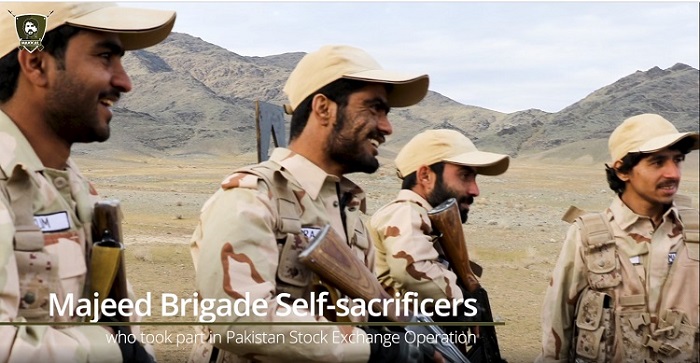
Later on Baloch Liberation Army’s spokesperson Jeehand Baloch, in a detailed statement, claimed responsibility of the attack on Pakistan Stock Exchange, Karachi and said that it was carried out by its Majeed Brigade, which carries out self-sacrificing missions. BLA’s spokesperson also revealed the descriptions of the attackers as Salman Hammal Baloch aka Notak, resident of Mand Town of Turbat (the Operation Commander), Tasleem Baloch aka Muslim, resident of Dasht Town Turbat, Shehzad Baloch aka Cobra, resident of Paroom town of Panjgoor and Siraj Kungur aka Yagi, resident of Shapuk town of Turbat.

In its detailed statement, BLA categorically refuted the blame for targeting unarmed civilians. The BLA spokesperson said “Targeting the civilians is not a part of our war-philosophy. Unlike our enemy, we do not measure the rate of success by counting the innocent lives taken but our success lies in targeting the defenders of the exploitative scheme and all its symbols. During the Pakistan Stock Exchange (PSX), Karachi attack, there were clear-cut orders for the attackers that do not target civilians, neither use high explosives which could jeopardize the lives of civilians, we instead chose the day when there were almost no civilians in the premises of the main building. Our fidayeen (self-sacrificing cohorts) accomplished their mission with least casualties to the civilian lives.”

BLA’s spokesman, while clarifying the purpose of attacking PSX, Karachi, said that target of their attack was Pakistan’s economy which is built on seventy two years long exploitation of the resources of occupied Balochistan and their organization views Pakistan Stock Exchange, Karachi as a base and symbol of exploitative machinery of Pakistan. He further added that “…attack was not only aimed at Pakistan’s, but also on Chinese economic interests. He said, “not only Pakistan but China is also involved in exploiting Balochistan’s resources. We have before warned China to cease expansionist and exploitative ambitions towards Balochistan. In the past, Majeed Brigade has attacked Chinese engineers in Dalbandin, the Chinese consulate in Karachi, and Chinese delegates at PC Hotel Gwadar. China holds about 40% equity in the Pakistan Stock Exchange through the Shanghai Stock Exchange, Shenzhen Stock Exchange, and China Financial Future Exchange. Jeehand Baloch warned, “If the Chinese continue to take part in Balochistan’s exploitation then they will face more attacks”.

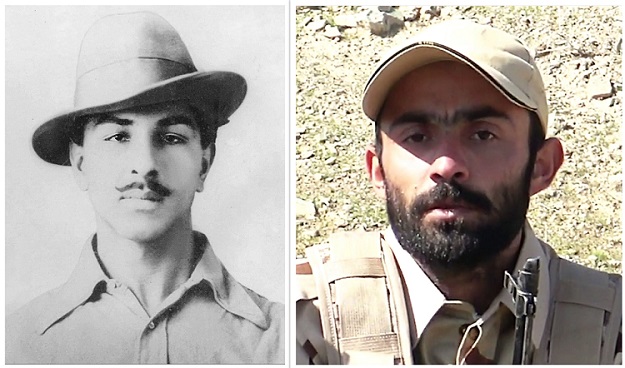
Shaheed Salman Hammal Baloch and his immortal comrades’ attack on the PSX, Karachi took me years back in history and reminded me of Shaheed Sardar Bhagat Singh and his selfless comrade Shaheed Batukeswar Dutt’s bombing of the British India’s Central Legislative Assembly on the 8th of April, 1929 during India’s struggle for independence.

Here I see certain resemblances in the missions carried out by Shaheed Bhagat Singh and Shaheed Salman Hammal Baloch and their immortal comrades which are discussed herein below:

1. Bhagat Singh and his comrades, by harmless bombing, wanted to draw the attention of colonial rulers and the world towards the plight of subjugated people of the Indian subcontinent. In the written statement filed by Shaheed Bhagat Singh and Shaheed Batukeshwar Dutt in the Court of the Sessions Judge, Delhi, in the Central Assembly Bomb Case, on 6th June, 1929 they disclosed aim behind their bombing and said: “Our sole purpose was ‘to make the deaf hear’ and to give the heedless timely warning.”

Similarly, Shaheed Salman Hammal Baloch and his self-sacrificing comrades wanted to draw the attention of the world towards the aspirations and struggle of the Baloch nation for independence. They also wanted to demonstrate Baloch resolve for the independence of Balochistan to the extent that they have self-sacrificed themselves to that noble cause. They also intended to show the extent of Baloch resistance to the Pakistan-China collusion of plundering the resources of Balochistan and building their economies on such unlawful and immoral colonial exploitation of Baloch national wealth.

2. Shaheed Bhagat Singh and Shaheed Batukeshwar Dutt didn’t intend to kill some individuals. Rather their intention was to expose the British colonial rule, the uselessness of the powerless Central Legislative Assembly that was only a tool into the hands of British occupiers and a disgrace to the great people of India. That’s why they threw such bombs in the Assembly which had been deliberately manufactured inoffensive. Even those harmless bombs were mostly thrown on empty spots in the Assembly intending to avoid harming anyone.

Similarly, Shaheed Salman Hammal Baloch and his immortal comrades also didn’t intend to kill or massacre innocent civilians. According to the police reports all of Pakistan Stock Exchange, Karachi attackers were heavily armed. They had a large amount of ammunition and hand grenades in their backpacks. Contrary to the baseless propaganda of Pakistan’s Prime Minister, and its biased and controlled media, Shaheed Salman Hammal Baloch and his comrades didn’t intend to harm civilians. If they had wanted to massacre more innocent people, they could have easily targeted a mall, mosque, railway station, public bus stops, parks or any other public places as the jihadists usually do, but they didn’t. They only wanted to hit the economy of the enemy which is built on plundering of Balochistan’s resources.

However, there’s a single but significant difference in ending their respective missions. Shaheed Bhagat Singh and Shaheed Batukeshwar Dutt, after throwing the bombs, surrendered themselves to police because they had no fear of torture and extrajudicial killings. Their British enemies belonged to a civilized country that believed in their laws and judicial system. Shaheed Bhagat Singh and Shaheed Batukeshwar Dutt wanted to exploit the British Indian judicial system and use the proceedings to make their aims public and promote their objectives.

Shaheed Salman Hammal Baloch and his comrades had no intention of surrendering because their enemy – Pakistan- is an uncivilized and lawless state. Pakistan’s authorities and law enforcement agencies don’t believe in the constitution, rule of law, judicial system, democratic norms, basic human rights and freedoms. Pakistan believes in dealing dissent with high handedness and savagery. Pakistan’s Army and law enforcement agencies are using torture, enforced disappearances, and extrajudicial killings as tools of strategy for combating the Baloch freedom movement. Though both, Bhagat Singh and Salman Hammal Baloch’s bands of freedom fighters chose similar ways to convey their message but due to difference in the norms and values of their respective enemies-Pakistan and Britain- both Bhagat Singh and Salman Hammal Baloch ended their missions in different ways.

Despite condemnation from then British India’s colonial rulers, their justice system, and collaborators, history has rightly placed Shaheed Bhagat Singh, Shaheed Batukeshwar Dutt, and all other Indian freedom fighters in the first row of national heroes. Surely the Baloch history will also give the same honor to Shaheed Salman Hammal Baloch and his comrades.

Europe-based group reinforcing Pakistan’s narrative on Balochistan: BRAS

Baloch Khan, spokesman for the Baloch Raji Ajoi Sangar (BRAS), an umbrella organization of Baloch liberation armed groups, issued a statement to the media from an undisclosed location, claiming responsibility for the July 7 attack on the Pakistan Army at Zamran Jalagi area in district Kech, occupied Balochistan.

Baloch Khan said in the statement that BRAS fighters targeted a convoy of five Frontier Corps vehicles, on July 7 at Nahing Kaor in the Zamran area of district Kech as they were heading to “Narom” military camp. The BRAS attack completely destroyed two Pakistan Army vehicles, killing five soldiers on the spot and injuring several others. “In this fierce attack, the fighters besieged the army for a long time. To save their lives, the enemy (Pakistan) Army had to call in combat helicopters. However, all our Sarmachars (fighters) managed to get out safely after the attack.”

Baloch Raji Ajoi Sangar (BRAS), adhering to the philosophy of national unity, is moving towards building a strong national army, which combines the Baloch resistance forces to launch the fiercest attacks on the enemy.

Baloch Khan further said that BRAS considers the June 29 attack of Majeed Brigade on the Pakistan Stock Exchange in Karachi as a great example of sacrifice and innovation in the history of Baloch resistance, and they fully support the attack of Majeed Brigade. “By their greatest sacrifice, the Baloch martyrs have illuminated new dimensions in the Baloch war of independence, by which the enemy could be defeated. BRAS salutes Shaheed Salman Hamal, Shaheed Shehzad Baloch, Shaheed Siraj Kungar and Shaheed Taslim Baloch,” said the statement.

BRAS further added that Baloch Liberation Movement is a purely ideological and autonomous people’s movement, which has been nurtured by the Baloch martyrs with their blood, the history of which is full of sacrifices. The enemy has always tried to make this long series of sacrifices controversial and to show the movement to the world as imports and proxies so that the legitimate and legal right of the Baloch to freedom can be questioned and on the other hand to justify export business of terrorists from Pakistan to neighboring countries.

“Now, contrary to the realities of Pakistan, this senseless statement is being propagated by some Europe based people, who are claiming to be friends of Baloch.” Recently, a group of such controversial individuals reinforced the statement of hostile Pakistan and reiterated the Pakistani accusation against BRAS that it is an Iranian proxy, the same controversial group in Europe that in the past has accused BRAS’s one ally of being an Indian proxy. It has also accused General Aslam Baloch and all Baloch Fidayeens (sacrificer) of being proxies.

BRAS describes the allegations as an attempt to reinforce the narrative of enemy Pakistan and to confuse the Baloch resistance forces into inter-party arguments instead of fighting the enemy, and BRAS strongly and vehemently denies the allegations. After BRAS’ denial, if the group repeats these allegations formally or informally in the future without providing fully credible evidence, we will be right to declare the group suspicious, said the BRAS in its statement.

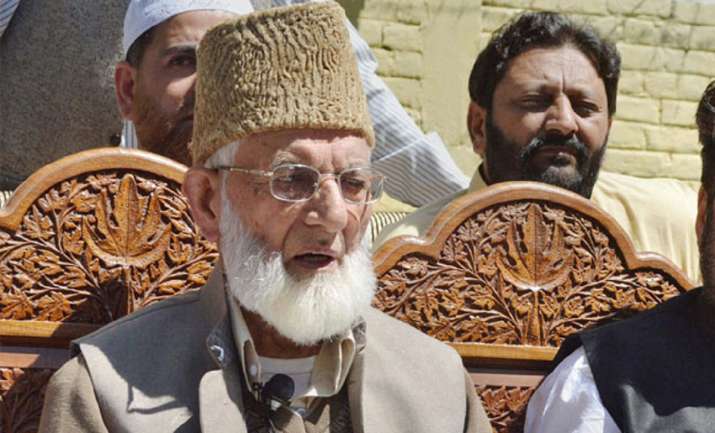
Geelani: Retired hurt from Hurriyat

For quite some time Syed Ali Shah Geelani was mute, maybe owing to advancing age problems like dementia. In a letter, scripted three months ago but released now to the heads of the eight units of his organization (Hurriyat – G), he made threadbare confession of his dissatisfaction with the units of his organization in both parts of the State.

A die hard Jamaat-e-Islami (JI) standard-bearer, who trained some  enthusiastic young Kashmiris in Jamaat ideology, like late Ayub Thukar and Ghulam Nabi Fai (respectively London and the US-based Jamaat-e-Islami (Kashmir) activists, Geelani has always been a blunt pro-Pakistani leader of old school. He fought and won three assembly elections in J&K and lost two parliamentary elections from the Baramulla constituency. In all these elections he had taken the customary oath of allegiance to the constitution of the Indian Union against which he waged a life-long unsuccessful war but succeeded in alienating Kashmiri Muslim youth from India. How far the ISI has been patronizing him is a moot point. ISI had not missed the piece of bizarre information that Indian agencies were instrumental in repatriating his son from Pakistan after nearly twelve years of life in self-imposed exile. He is now a doctor in the SKIMS, Srinagar. His second son was handpicked by the state government to be given a plum post. 

As long as Geelani could inspire Kashmiri Muslim militant youth to carry forward the armed struggle for secession, Pakistani establishment made him the beneficiary of its munificence. But Geelani could be critical of Pakistan also on issues more concerned with the Islamic ideology. For example he castigated General Musharraf for ordering military operation for flushing out the militants from Lal Masjid in Lahore. President General Pervez Musharraf never liked him.

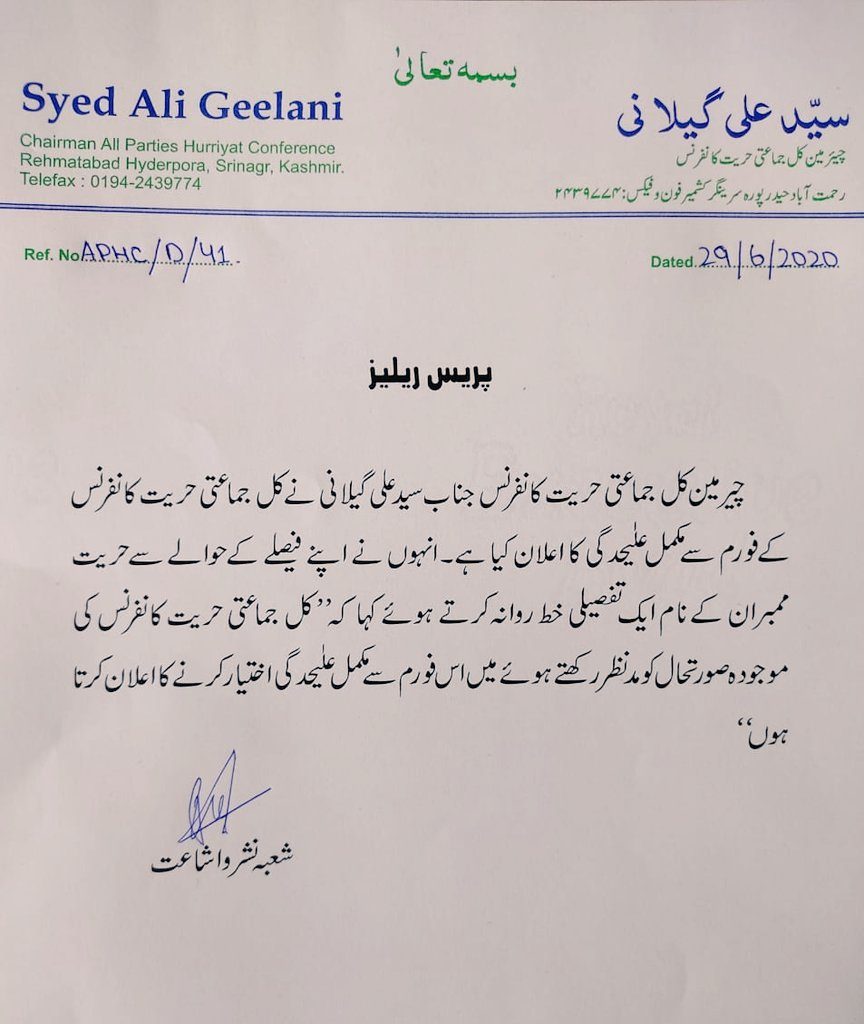
Kashmir watchers have written copiously on the subject why he disassociated with the organization which he created and nurtured laboriously in both parts of Kashmir. Actually, Geelani’s letter to his lieutenants on both sides of the LoC is self-explanatory. In our opinion it is a candid expression of some realities hitherto kept a closely guarded secret. The substance of the letter could be succinctly put as this: (a) it is a revolt of the younger aspirants of the organization on either side of the LoC, against his authoritarian style of handling the organization, and (b) recurring complaints of financial irregularities against some responsible members who have defied Geelani’s call for submitting expenditure reports.

Many Kashmir watchers have been skeptical from the very beginning about the validity of his pro-Pak line. Whether the Hurriyat (M), the JKLF, and other militant groups were or were not pro-Pak in ultimate analysis is a different matter but they cleverly adopted an ambivalent stance of sticking to the slogan of azaadi.

Geelani never condemned Kashmiris taking up the gun and fighting the Indian security forces. He never condemned violence and never showed any enthusiasm about India-Pakistan talks on Kashmir issue. When the ISI dumped JKLF for toying excessively with the azaadi slogan and patronized Hizbul Mujahideen (HuM) whose ideology of accession to Pakistan was precisely what Geelani stood for. Therefore people began to believe that the HuM was indulging in the butchering spree of JKLF activists at the behest of Geelani, which indeed was not the case. The Hizbul Mujahideen strictly carried forward the agenda set forth for it by the ISI.

Nevertheless, since the impression had become widespread among the people in the valley, it followed that Geelani began to be feared more than respected. The fear came from the fact that he could order elimination of his opponents at will, which was possible because he had been granted an unstated acquiescence by the political apparatus in the valley, including CM’s and JK Police chiefs. That is why he reigned supreme. Undoubtedly, Reorganization Act of the Parliament and transformation of J&K into the Union Territory took away his political and police leverage. The fear component lost its punch. He waited for nearly nine months expecting a forceful backlash and restoration of the element of fear aura. That did not happen and he categorically laments in his letter to his lieutenants that there was no concerted reaction from the general masses to the scrapping of Article 370 and Article 35A and dismemberment of the State of Jammu and Kashmir.

Syed Ali Shah Geelani's resignation letter quitting from Hurriyat Conference
Syed Ali Shah Geelani’s resignation letter quitting from the Hurriyat Conference

To add to Geelani’s dejection and defeat of his flawed Islamic ideology, he found to his surprise that the security forces had begun a wipe out campaign of the armed gangsters and South Kashmir was almost on the verge of being cleansed of all malevolent elements.

In analyzing his complaint about financial irregularities, the point is why did he raise the question of submission of account from the concerned in his outfit? For last thirty-two years he never asked for it. The truth is that the benevolence came from all the cash coming to him through hawala transfers. Its key handlers were Altaf Bukhari and Zahoor Shah Watali, both well-connected in Delhi, and hence untouchable. In a news report appearing in sections of press in 2017, it was revealed that the NSA had succeeded in hacking the mobile phone calls of a Pakistani ISI sleuth Lt. Col Tanveer to Ali Shah Geelani. It was found that this Pakistani conduit had been the key person arranging hawala transactions for both Geelani and Molavi Umar the Hurriyat (M) chief. Lt. Col Tanveer had been in contact with them for five years.

That was until Modi came to power in 2014. Things changed. One of the two hawala contacts turned into an approver against the other and was given the nod to create a pro-India party. The other is languishing in jail. Once the money pipeline dried up, Pakistan started pushing Afghan narcotics into Kashmir much like what they had done in Punjab. The job of creating the narcotic trade pipeline was given by ISI to the valley-based leaders languishing in Muzaffarabad who had to accept the responsibility that monies from narcotic trade would flow to Geelani for continuing his benevolent activities.

Geelani did not approve narcotic funding for the Hurriyatis and wanted Molavi Umar’s faction to keep Kashmiri youth away from drugs. But the question was how could the movement continue? The Hurriyat Council in Muzaffarabad (PoK) was in a rebellious mood. It would not give up control over huge narcotic funds nor on operational matters. The tailpiece was that the ISI hand-picked Muzaffarabad man called a meeting of APHC (All Parties Hurriyat Conference) in Srinagar, which was attended by all except Geelani. He was not even informed about it, and no one sought his approval.

Geelani realized he was a spent force. Therefore, he sat in seclusion in his palatial bungalow in Haiderpora, and in seclusion poured out his anger and disappointment in a letter the contents of which became the catalyst for this writer to script the analysis.

Sindhudesh Revolutionary Army eliminates Pak Ranger in Karachi

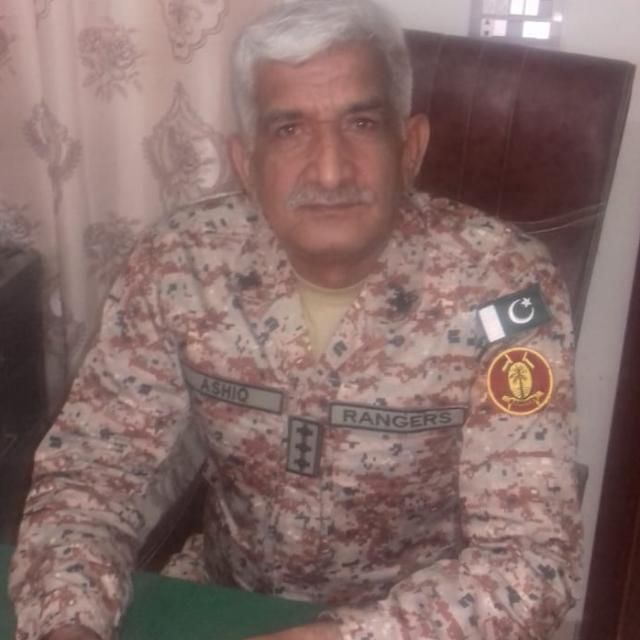
Sindhudesh Revolutionary Army (SRA) eliminated one Pakistan Rangers officer in a grenade attack at Sachal area in Karachi on Wednesday. The Pak Rangers officer named Ashiq was the main informer and facilitator of barbaric Rangers’ operations in Karachi, the SRA said in a statement.

This attack was meant to record the serious reaction of Sindhi nation against Punjab’s imposed illegal hold over Sindh and the ongoing state offensive operation against Sindhi nationalists.

“SRA (Sindhudesh Revolutionary Army) will eliminate all those local facilitators and informers of Pakistani forces,who are involved in state operation against the National Freedom Movement of Sindh and the genocide of Sindhi people,” said Sodho Sindhi, spokesperson Sindhudesh Revolutionary Army (SRA).

Ashiq, Pakistan Rangers officer who was eliminated by the Sindhudesh Revolutionary Army (SRA) at Karachi

Pakistan’s armed forces along with its intelligence institutions have unleashed a barbaric rein of terror on Sindhi nationalists. Pakistani forces have enhanced the rate of “enforced disappearances” of Sindhi nationalists and have started abusing Sindhi women and children through forcefully entering their homes.

“We are receiving the tortured dead bodies of our nationalist members. We had received the highly tortured and ill-treated dead body of JSQM (Jeay Sindh Qaumi Mahaz) worker Shaheed Niyaz Lashari, and recently we have received a severely tortured dead body of another JSQM (Jeay Sindh Qaumi Mahaz) leader Shaheed Masood Shah’s brother Shaheed Masroor Shah,” elaborated the SRA spokesperson.

This is the impact of forceful hold that Pakistan’s Punjabi establishment has over Sindhi resources, over Indus River, the Arabian sea and the trade hub of Karachi.

China is the co-partner of Pakistan’s Punjab province’ in exploiting Sindh that has tried to fulfill its own vested economic interests through the highly exploitative CPEC (China-Pakistan Economic Corridor). “We highly condemn all these vested acts and we will not let them allow to fulfill their vested interests in Sindh. SRA vows to continue its struggle till complete freedom and sovereignty of Sindhudesh,” said Sodho Sindhi, spokesperson Sindhudesh Revolutionary Army.

Occupied Balochistan under undeclared martial law: Dil Murad Baloch

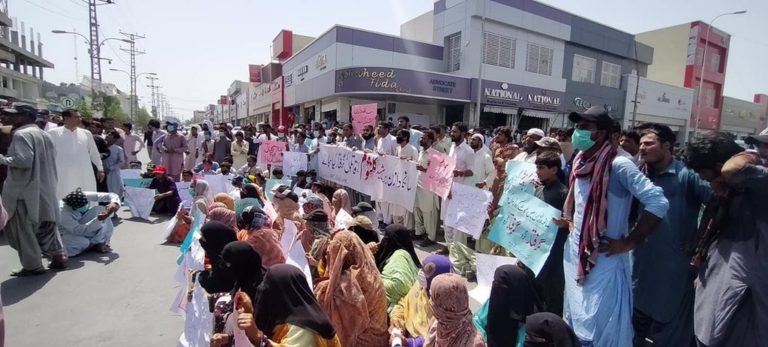
Undeclared martial law is in force across occupied Balochistan and all state administration is in the hands of Pakistan Army, said Dil Murad Baloch, Central Information Secretary Baloch National Movement (BNM) while releasing the June 2020 report about Pakistan’s atrocities in Balochistan.

Dil Murad Baloch said that the military operations, killings and atrocities by the occupying state of Pakistan continued during June. He explained that there have been 70 operations and raids, 42 people were forcibly disappeared and transferred to unknown locations. Eight people were martyred, two of them in direct firing by the Coast Guards in Gwadar. “In Dazin, a woman, Kulsoom Baloch, was martyred by state-backed Death Squads for resisting their robbery when they attacked her house. Four youths were martyred in Karachi. A sister of an ‘enforced disappeared’ person committed suicide after waiting painfully for years about any news of her brother. Such incidents have already taken place in different parts of Balochistan. The list of missing persons does not include those who were released within days of being detained by the military. In other incidents, seven people were killed, including four who were called by Sanaullah Zehri, the former Chief Minister of Balochistan, at his home and killed,” elaborated Dil Murad Baloch.

Dil Murad Baloch, Central Information Secretary of the Baloch National Movement (BNM)

Dil Murad Baloch further added that during the month of June, most areas of Jhaoo, Awaran, Mashkay, Geeshkor, Kolwah and Buleda Zamuran were targets of military aggression. “In addition to the ground forces, gunship helicopters shelled the area, killing hundreds of cattle and setting more than 50 homes on fire. The Pakistani Army and its local allies looted more than 300 cattle from various parts of Washuk district, Mashkay and Jhaoo. The Pakistani Army has also forcibly displaced inhabitants of several villages in different parts of Jhaoo and Zamuran in June. Pakistan’s military have evicted many villagers from their ancestral lands in the mountainous ranges across Balochistan and forced them to live near military camps and outposts in rural or urban areas. This trend continues to this day,” he added.

“An undeclared martial law is enforced in Balochistan. All state administration is in the hands of the military. There is a complete ban on political activities and the political process. The price of a political voice always has to be paid in the form of imprisonment, murder and barbarism. This has been happening for twenty years. Restrictions on political freedom can only be gauged by the fact that Baloch students are imprisoned for their demands of basic rights such as the restoration of the Internet. One can imagine, what could be the punishment for speaking out for national liberation?,” asked Dil Murad Baloch.

Last month police in riot gear stormed a rally, detained and removed hundreds of protesters by truck loads. The protesters only demanded the resumption of the internet in Balochistan to make online classes possible, as colleges and universities were closed due to the Coronavirus pandemic and internet access in most parts of Balochistan has either been completely shut or continues to remain extremely limited for several years.

Kulsoom Baloch was stabbed to her death during a robbery at Tump Dazin area of Kech and the robbers fled after looting all her belongings. A similar incident took place on May 26 in the Dannuk area of Kech, where Malik Naz was martyred and her daughter Bramsh was injured. Pakistan has formed hundreds of Death Squads by organizing petty criminals in Balochistan to crush the national movement. They are playing with the dignity and lives of the people.

Dil Murad Baloch added that Pakistan’s war crimes have created a human tragedy in Balochistan. “We can see different tactics of it. There are enforced disappearances. The tears of the bereaved are shaking the throne for the recovery of loved ones on the streets but for Pakistani state the cries of the occupied people and the tears of their daughters are meaningless. An incident took place in Kech where Fatima, a woman from Dasht Mazanband, committed suicide by hanging herself in her house in Gokdan area of Turbat. She was the mother of three children. Her brother, Imam Ishaq, was abducted two years ago by Pakistan Army from his home in Dasht and is still missing. Fatima had been suffering from mental stress for a long time due to her brother’s abduction and disappearance. Eventually, she could not bear the pain and grief and committed suicide.”

Burhan Wani was a terrorist, spin doctors branding him as Kashmir’s mascot

Oftentimes perceptions are contrary to the truth. This happens, when systematic efforts are made to create a smokescreen to hide the real picture and then dole out camouflage as reality. Nowhere is this more visible than in the Kashmir Valley. Over the years a ‘perception’ has been assiduously built that local Kashmiri, especially the youth of Jammu & Kashmir, is alienated with India and they support and endorse terrorist attacks on India and the Indian Army in Kashmir.

This ‘perception management’ has been going on for several years, thanks to the well-oiled network of spin doctors and opinion managers across media houses in the Kashmir Valley and in Delhi. The arrangement works in such a way that opinion, especially the Kashmiri Separatists’ viewpoint, is passed upon as news from the Valley. It is hardly reported that these Pakistan sympathiser Kashmiri Separatists are a mere handful and they do not enjoy the support of the masses.

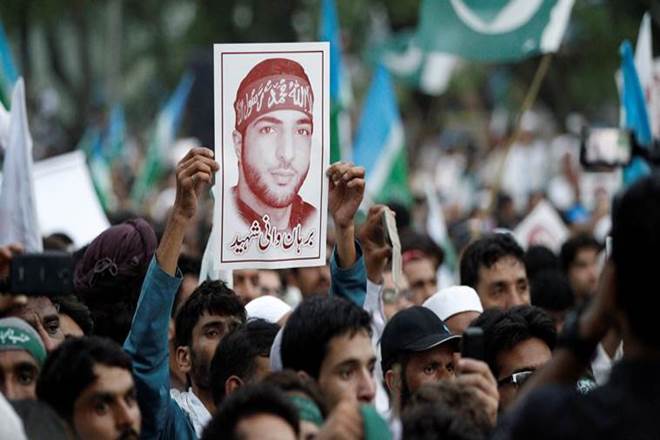
This misinformation campaign reached a crescendo after the killing of Hizbul Mujahideen terrorist Burhan Wani on July 8, 2016. It has to be borne in mind that these perception managers know about Pakistan’s weaknesses and their lack of support in the Kashmir Valley, so they do not expose the chinks in Pakistan’s armour, instead, they deflect the public perception. They drum up the propaganda about Kashmiri youth’s alienation after every terrorist encounter and the negative fallout of a nuclear war with Pakistan whenever India gets tough on Islamabad. Indian security forces neutralise terrorists across Jammu and Kashmir and that includes shooting any terrorist, who threatens peace and national integrity. Burhan Wani’s encounter was one of these operations. But, the ‘perception managers’ of Kashmir Valley and their cousins in Delhi sniffed an opportunity in Burhan Wani’s death.

So what happened immediately after Wani’s encounter? News breaks from Kashmir-Valley newspapers (read Pakistan sympathisers) reported that Burhan Wani was a ‘militant commander’ of Hizbul Mujahideen, who was killed by Indian security forces in cold blood. He was hailed as a ‘martyr’. This reportage from Kashmir was immediately followed by a section of mainstream media houses from Delhi. Soon, international media groups started referring to Burhan Wani as ‘commandant’ or ‘militant commander’. Over the years these perception managers have deftly shifted the public discourse to Burhan Wani’s hobbies, passion for cricket, and love for Facebook, Twitter, etc. etc.

The terrorist Burhan Wani, who was an anti-national, who supported radical Islam, and who preached violence in the name of Islam was shrewdly brushed aside. Discussions and debates shifted towards the use of pellet guns by Indian security forces and AFSPA (Armed Forces Special Powers Act). Several media houses from Delhi, Kashmir Valley and the international media still do not report that Burhan Wani was a radical Islamic terrorist rather they continue to refer him as a ‘commander’.

Well, Burhan Wani was a terrorist and he should be referred as a terrorist. Calling him as the slain commander, who represented Kashmir’s youth is akin to referring Osama bin Laden as the commander-in-chief of poor Afghan people. Radical Islamist newspapers may refer to Osama bin Laden with whatever name they fancy, but American and European media organisations prefix the word “terrorist” with Osama bin Laden. Ditto for Burhan Wani. He was a radical Islamic terrorist, who used his cyber prowess to preach the Wahabi ideology in Kashmir, which has always been known for its Sufi tradition.

Even a cursory glance at some of Burhan Wani’s tweets are enough to prove that he was a terrorist, who was simply furthering the violent ambitions of his handlers in Pakistan. Consider this: “There is only One solution Gun solution Gun Solution — Burhan Bhai” posted on Wani’s twitter handle @Gazi_Burhan2 on July 2, 2016. Days later his another tweet says “Support Zakir Naik or Time Will Come When Qur’an Recitation will be Banned— Burhan Bhai”. Wani’s aim was to “unfurl the flag of Islam on Delhi’s Red Fort”.

There are several other tweets from Burhan Wani that prove that he had adopted the path of radical Islam and was a tool into the hands of Pakistani terrorists like Hafeez Saeed and Hizbul Majahiddin chief Syed Salahuddin. In fact, none of the armchair reporters from Delhi bother to actually visit the Kashmir Valley and talk to real people on the ground before reporting on the developments in Kashmir. Even if they do, they go as embedded journalists, where their entire trip is planned and executed by Separatist sympathisers. Their visits are planned to the last detail that includes travel and boarding arrangements. So, where the ‘Delhi journalist’ would stay and whom will (s)he interview are all scripted well in advance. It’s precisely for this reason that a large section of mainstream media houses of Delhi and the separatist media of the Kashmir Valley sing the same tune.

Unfortunately, this is the smokescreen, which has been successfully created by these spin doctors for a long time. There is absolutely no widespread support for Wani among the Muslims living in the Kashmir Valley. Yes, you read it right. There is no widespread support, either emotional or logistical among the Muslims for terrorists like Burhan Wani or terrorist organisations such as Hizbul Mujahideen. The obvious question that could be asked is: What about large gathering of people in processions and hordes of stone pelters in Kashmir Valley?

Several Sunni Muslim families with whom I have had detailed discussions denied extensive support for the likes of Burhan Wani. They explained that there were only a bunch of sangh baaz (stone pelters), who had created the mayhem. These anti-social elements, who are otherwise relegated to the margins of the society sense an opportunity whenever a terrorist killed in an encounter. These anti-social types then wander through the villages ordering everyone to come out for the processions and for stone pelting. They earmark those households who defy their diktat.

The names of these families and their children are then handed over to terrorist groups across the border, who later on take revenge for their defiance. “It is the fear factor that forces an ordinary Kashmiri to come out, when these bunch of stone pelters gave their clarion call for protests. We know that these are anti-social elements and have direct links with the terrorist groups,” a Kashmiri Sunni Muslim explained. He spoke strictly on the condition of anonymity. The instructions from terrorist organisations such as Hizbul Mujahideen are very clear that whoever does not come out of their homes for the protest or at the funeral procession of the slain terrorists would be deemed as informers of security forces. And once the informer tag is pasted onto a family, then the miscreants get a free hand to conduct any kind of atrocity on them. The women in the family are raped, children abducted, and men are killed.

Yet another villager said that in order to create the perception that we are for the ‘Kashmiri cause’ the family members, especially young boys are forced to come out and be a part of sangh baazi– stone pelting whenever security forces cordon off an area to arrest a terrorist. He added that they are afraid to report the mater to Jammu and Kashmir police because this is taken as an act of war by terrorists and their sympathizers. The women in these families are then raped and men killed by the terrorists.

An average Kashmiri then quietly passes on the information of a terrorist’s whereabouts to the security forces. And it’s due to these pin pointed information about a terrorist’s location that Indian security forces have been able to hunt them down across the Kashmir Valley. But then the perception managers remain blinded in their love for anti-national forces. Even after the valley’s clean up of terrorists and a return of normalcy post the abrogation of Article 370 and Article 35A they continue with their anti-India tirade.

None of these armchair propagandists and perception managers have any realisation of the ground reality in Kashmir or have any genuine concern for the Kashmiri people. A common Kashmiri is more concerned about the well-being of his/her family and education of their children. They know that adherents of Wahabi ideology have become school teachers across Kashmir Valley, who urge school children to become sangh baaz (stone pelter).

The parents in Kashmir are well aware of these tactics and insist on de-radicalization of school teachers across the Kashmir Valley. This, they say, can be done by identifying and deporting teachers, who adhere to and instil Wahabi ideology in the impressionable minds of school children.

The need of the hour is to begin objective reporting from Kashmir Valley, such that perception managers and spin doctors are not able to camouflage truth about Jammu and Kashmir. It is time journalists stop choosing to be spoon-fed by the Pakistani sympathisers for information; they need to step out of their air-conditioned offices and visit Kashmir Valley—not as embedded journalists, but as honest reporters. They should talk to real people, understand the ground reality and then report.

Batang La to Chorten La: A narrative on Sikkim

Sikkim, the beautiful 22nd State of Indian Union in the lap of mighty Himalayas, hit headlines on May 9, 2020 when  Indian Army troops clashed with a Patrol of the Chinese People’s Liberation Army (PLA) at the Naku La post in the Northern District of the state near Dongkung village, at the dizzying height of 16,500 feet. This location is not very far from the Eastern Tri-junction between India, Chinese-Occupied Tibet (COT) and Nepal.

A Chinese patrol was challenged by alert sentries of the Indian Army as it approached the pass. Troops from both sides, numbering approximately 120 on each side, got into an argument with gestures since they could not understand each other’s language and showed banners, as is the norm under such a situation on the Line of Actual Control (LAC) with China. Matters got heated up and a fist fight started in which seven Chinese and four Indian soldiers were reportedly injured. Peace prevailed after discussion at the local commander’s level the next day after which the Chinese troops returned to base. 

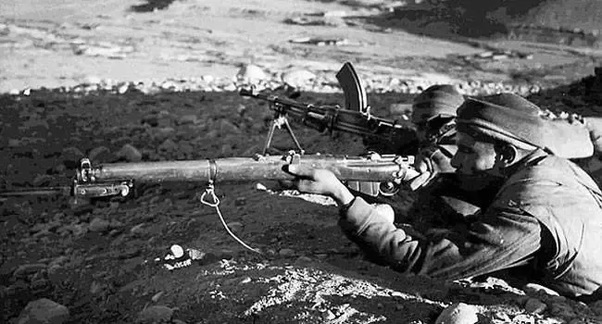
However, alarm bells rang in New Delhi since this region has remained peaceful since the famous Nathu La clash in September 1967 in East Sikkim. In the 1967 clash, the Chinese were given a befitting reply for their transgressions by 2 Grenadiers with full support coming from Major General Sagat Singh who was commanding the holding Division at that time. 

Later, Chinese attempted to occupy Jeplang La, but the holding infantry unit, 10 J&K Rifles, repelled the attack on October 1, 1967 at Cho La, North of Nathu La.

Notably, even in May 2017, after almost 50 years of the Nathu La clash, there was another 73 days standoff in adjoining Dok La or Doklam Plateau where also exists a Tri-junction between India, COT and Bhutan. After some tension and bad blood the PLA retreated. Today, the focus is on Ladakh but we should also remain on high alert in Sikkim and Arunachal Pradesh.

Vedic literature suggests that the ancient name of Sikkim was Indrakil, meaning “Evergreen garden of the King of Gods, Lord Indra;” Limbu clan called it “Su Khyim” (New Palace); Tibetan monks call it “Drenjong;” Bhutias called it “Hidden valley of Rice” and Lepcha, the original inhabitants called it “Paradise on Earth.” The celebrated Buddhist sage, Padmasambhava (Guru Rinphoche), visited this area in the 6th Century.

The beautiful erstwhile Kingdom was founded by the Namgyal Dynasty. Later, it was ruled by Buddhist priest Kings known as Chogyal. It faced number of invasions. Bhutan forces attacked Sikkim in 1700, but the monarchy was saved by Tibet. From 1717 to 1733, it was attacked and occupied by Nepal. Sikkim was annexed by British imperial lndia in 1890 and ultimately it became a Protectorate of independent India on November 1, 1950 around the same time when the Red Army overran Tibet. It was, thus, saved from suppression by Red China.

Sikkim–COT (China-occupied Tibet) border is seen to be settled on the basis of the historical Sikkim-Tibet convention of 1890. The treaty was based on the Principle of Watershed. Article-1 of the record stated that the frontiers between Sikkim and Tibet will be based on the crest of the mountain range separated by water flowing down to River Teesta and its tributaries in the South and Tibet Monchu Rivers in the North till it met the Nepal border. The Gazetteer of Sikkim, 1894 described Sikkim-Tibet border as running along Chorten La to Batang La in the East till the present day Tri-junction. All maps and records clearly identify watershed as the border. There exists no ambiguity. 

Sikkim then got embroiled in an anti-Royalist agitation that continued till 1975. Ultimately the monarchy was deposed and a referendum conducted. 95.5% voted in favour of amalgamation with India. Thus, on May 16, 1975 Sikkim became the 22nd state of the Indian Union.

In 2003, during the course of an important summit between the then Chinese Premier Wen Jiabo and Indian Prime Minister Atal Bihari Vajpayee, Beijing recognised Sikkim as an integral part of India and accepted the watershed as principle of boundary demarcation in COT-Sikkim Frontier. As a goodwill gesture, China opened Nathu La pass on July 6, 2006 for cross-border trade and the Mansarovar pilgrimage. This pass had remained closed till 1967.

Sikkim holds great strategic importance for India. It is the gateway to the narrow Siliguri corridor, a narrow strip of land located in West Bengal, approximately 180 km long and 22 km wide, which connects the rest of India with the 7 sisters (seven states) of North-East. At the Northern side of corridor are Nepal and Bhutan and towards the south is Bangladesh. This link has to be protected at all cost as a broad gauge railway line running here is joining New Jalpaiguri to Guwahati. Also, National Highway-31 that joins Kolkatta and Guwahati also passes through the Corridor.

Sikkim has approximately 300 km border with China-occupied Tibet (COT). There are a total of 14 Passes on Sikkim-COT border, some are known and manned and others are unknown to outside world except for the locals and the Indian Army. After Batang La in East, the other passes are Jelep La, Nathu La, Cho La, Tangkar La, Gora La, Khungyami La, Sese La, Karang La, Bamcha La Chulung La, Kongra La, Naku La, and Chorten La.

India is rapidly developing the required infrastructure to protect all important Sikkim heartland. 309 km of National highway and 3,700 km state road network connect all subdivisions. The main Airport linking Sikkim to the rest of India is Bagdogra where even fighter aircrafts can land. A new greenfield airport has been recently inaugurated at Pakyong where ATR turboprop aircrafts can land. There is regular Helicopter service from Bagdogra to Gangtok and Helipads are available for all towns and remote areas.

A new 53 km long railway project between Sevoke town in North Bengal to Rangpo in Sikkim has been approved; it will be connected to Gangtok in Phase-2 and will have 13 Tunnels through mountains and valleys of Teesta. The project is likely to be completed in 2021. It will be a marvel of Railway engineering and will provide the first rail link from mainland to Sikkim.

India has deployed sufficient troops to protect Sikkim frontiers. When Indian Tanks crossed Gangtok to go North, Sikkim masses cheered and children gifted bouquets to armoured crews. Infantry formations are well poised to counter any intrusion of Red Army in India through any of 14 passes on the Sikkim Frontiers. India must continue to ensure balanced development of Sikkim with due respect to culture and traditions while keeping military imperatives central in all policy matters concerning the state.

India must thwart the Dragon’s ambition

Now that China has firmly established itself as a formidable economic and military power, it seems to be more anxious to emerge from the shadows and secure what it feels is its rightful place in the international arena. Under normal circumstances, the global community would not have denied giving China its due, but it’s approach of spreading its influence by following a ‘debt-trap’ policy is unfair. It first extends generous loans to poor countries that it knows won’t be able to repay and then takes control over key assets belonging to the borrower like harbours and airports in lieu of outstanding payments. This unethical strategy being used by Beijing to increase its sphere of influence has rightly drawn very sharp criticism from the international community.

Beijing is ruthless when it comes to recovering outstanding loan payments. In 2017, China took over the Hambantota port in Sri Lanka for a lease period of 99 years after Colombo was unable to repay billions of dollars in loans. The very next year, Zambia had to hand over Kenneth Kaunda International Airport to China as it defaulted in debt repayment. Currently, the government of Kenya risks losing Mombasa port, which is considered to be the gateway to East and Central Africa on account of its inability to repay the massive loan extended by China. And though Islamabad is extremely bullish about the CPEC project, several financial organisations and experts of international repute have expressed the fear that Pakistan too will end up going the Sri Lanka or Zambia way!

Besides its despicable ‘debt trap’ strategy, Beijing’s response to its expected commitments too has been pathetic. By introducing laws that violate the provisions of its Hong Kong handover agreement with the UK as well as brutalising and confining those protesting against these black laws, Beijing has demonstrated that it has scant regards for honouring international conventions on treaties. But what has irked the entire world is Beijing’s irresponsible approach after outbreak of the Covid-19 pandemic. It kept the enormity of the crisis under wraps and put a very strict quarantine and lockdown regime in place internally, but allowed its citizens to travel abroad freely without any checks on their health conditions.

In the month of May, China moved a sizeable number of troops into areas of Eastern Ladakh and started laying claims on Indian territory, forcing India to take necessary steps to deal with the situation. In an unprecedented move, without any sort of provocation, PLA (People’s Liberation Army) attacked and killed Indian Army Commanding Officer and twenty soldiers of the Indian Army in Galwan Valley who had gone to monitor withdrawal of forces as agreed to by both sides. Even the reinforcements sent were ambushed by a huge PLA contingent armed with lethal implements, but yet our soldiers gave a befitting reply to the attackers and made us proud. Humiliated by the ferocity of Indian Army’s bold response which led to large scale casualties, the PLA is now trying to save face by putting up a strong front and reiterating its claim.

If Beijing had thought that India could be subdued into submission by its offensive approach and massive buildup of troops along the LAC, then it was sadly mistaken. While New Delhi has picked up the gauntlet, but unlike Beijing, it has exhibited great maturity by not resorting to any provocative action that could further aggravate the already tense situation. The Indian Army has built up its force levels along the LAC to counter any Chinese misadventure and by going ahead with the road construction activity, New Delhi has sent out a clear signal to Beijing that it won’t make any territorial compromises.

Situation on the LAC is tense but the general consensus of political experts and defence analysts is that the chances of an all-out Sino-Indian war breaking out are remote. The positive side of this standoff for India is that the murderous Chinese attack on Indian soldiers in Galwan Valley has ignited a public campaign calling for an end to the use of Chinese products. While this may not have an appreciable impact on the overall exports of Chinese products, but the movement to stop using Chinese products will offer a good chance to Indian manufacturers to tap the huge domestic market.

According to data from the commerce ministry, India’s bilateral trade with China was worth nearly $80 billion in 2019. Data posted on India’s Beijing embassy website, which it sourced to China’s customs department, showed total bilateral trade between January and November 2019 at $84.3 billion, a drop of nearly 3.2% from the previous year’s $ 95.7 billion. With the government reviewing the participation of Chinese companies in public sector projects, this figure could further drop.

US has been trying to woo India to become part of its ‘pivot’ against China and may try to exploit the current situation in order to further this aim through some sort of defence related gesture. In fact, reports that the White House is reviewing the global deployment of its forces to counter the threat posed by China to India, Malaysia, Indonesia, and the Philippines is one such move. Whereas this is a positive development, but New Delhi should not rush into Washington’s arms because past experience has proved that America isn’t a reliable ally. During Bangladesh’s liberation war of 1971, it had assured assistance to Pakistan and even though it dispatched its 7th fleet to the Indian Ocean, Washington didn’t come to Pakistan’s rescue.

Beijing is trying to use psychological pressure to prevent India from building its strategic roads along the LAC. It already has Islamabad on its side, but since Pakistan’s animosity towards India has always been there, New Delhi has effectively countered Islamabad’s intentions and thus, the situation on this front isn’t alarming. China has also manipulated the Oli government of Nepal into claiming its stake over Lipulekh, Kalapani and Limpiyadhura areas of Uttarakhand. However, since China has also encroached on Nepal territory and so, New Delhi should use this unbecoming Chinese action to wean away Nepal from Beijing’s influence.

The current situation looks like a repeat of the Doklam standoff or even the 1999 Kargil incursions by Pakistan where they occupied strategic heights and refused to leave. Nothing concrete emerged from the army level talks between the two countries and India must quickly get China on the table and resolve the matter before it flares-up, experts have warned. Most importantly, the pacifists should realise that when it comes to defence of the country, India has no other choice but to be ‘atmanirbhar’ (self-dependent)!