Home Blog Page 354

Two states, unused iron ore, a growing human crisis

Everyone in India has an answer as to why two Indian states are losing opportunities from rising global prices of iron ore. But no one is offering any solutions to what was India’s biggest human crisis before Covid-19 turned the world upside down.

The two states are Goa and Karnataka. One known for its pristine beaches, the other for its booming IT business. Both also produce ore, sorry they used to once. Not anymore. And now, they have somewhat similar problems revolving around the ban imposed by the Supreme Court and other regulatory bodies on iron ore mining. In Karnataka, mining was banned in 2011, in Goa the ban came in 2018.

Since then, the demand for resumption of mining has been growing in the two states. In a recent meeting with state chief minister Pramod Sawant, Goa governor Satya Pal Malik suggested resumption of mining at the earliest and asked Sawant to fast track the proposal before the central government for resumption of mining leases by way of legislative cure in the form of amendment to the mining laws, so as to get extension for leases upto 2037.

As many as 88 mining leases have been quashed by the Supreme Court, mining closed since February, 2018. If mining resumes, Goa will earn a whopping Rs 3500 crore.

Frustrated at the state of affairs in the Goa mining sector, representatives of 40 village Panchayats recently petitioned the state government and the Centre to take action against those not in favour of mining. In their petition, they argued that Goa’s loss is someone’s gain. 

The biggest beneficiary of the Goa shutdown has been two Australian mining companies which have taken over the Goan orders and sending their low-grade iron ore to China. New Delhi’s loss is Beijing’s gain. 

The Supreme Court move followed after Retired Justice Shah Commission said that illegal mining was spread over 550 hectares in Goa and caused a whopping loss of Rs 35,000 crores. Now, after many court cases, the actual loss is yet to be computed and the disputed area is not 550 hectares but just 5 hectares.

What is interesting is the country’s apex court dismissed the Shah Commission findings and asked the state government to assess the losses. But there were an estimated 1,000 non governmental organisations (NGOs) which said they wanted a six member committee supervised by the country’s apex court. The committee was formed and it said the issue of alleged illegal mining should be handled by the state government. The NGOs threw a spanner, saying they do not want the report, and the ban must stay.

What is disturbing is that arguments no longer revolve around environmental damage but mining acts and tweaking of the same as demanded by the miners and opposed by the NGOs, led by Goa Foundation. Equally important is the way the NGOs have lost their cases repeatedly, only to file similar appeals in other courts. “Liabilities are increasing by the day, soon there could be a social unrest,” says Ambar Timblo, president, Goa Mineral Ore Exporters Association (GMOEA).

GMEOA wants urgent resumption of mining, judicious implementation of projects under funds collected and avoid the dump sale of iron ore which is actually impracticable because of market requirement of better quality ores. New Delhi (read the Centre) has not responded.

In Goa, an estimated 300,000 miners are without salaries ever since February 2018. In addition, another 100,000 involved in ancillary business have lost their jobs. Mining was the largest employment generator in Goa. Many argue mining has been banned not because of environmental or health concerns but because of the interpretation of the laws: Extension of leases has been disallowed without an alternative solution in mind.
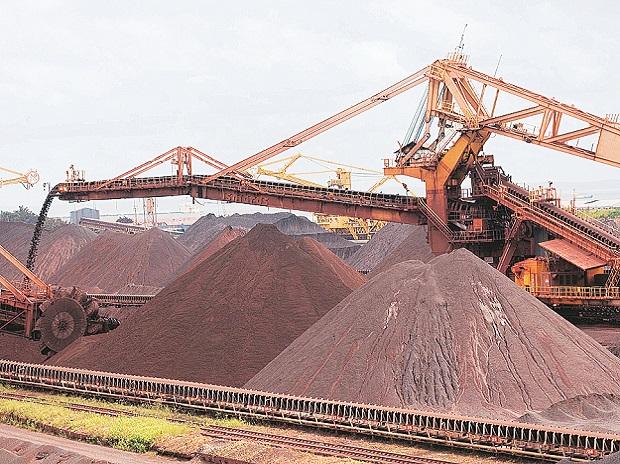
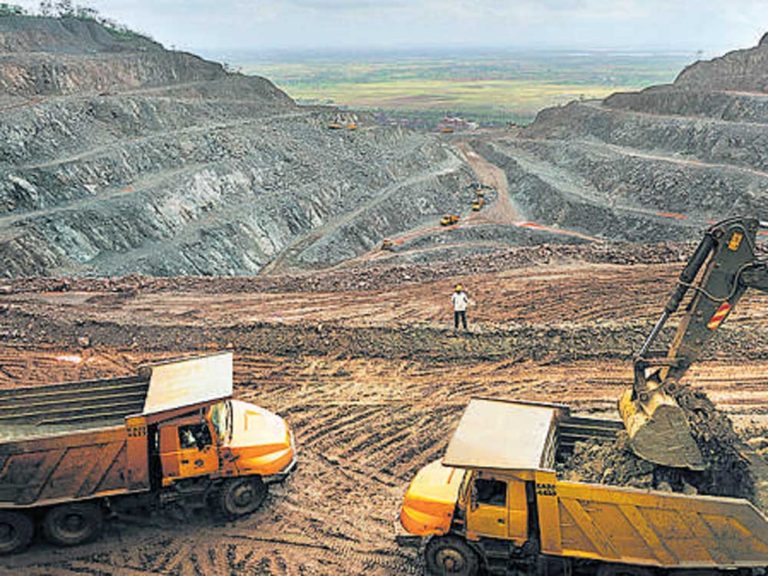
Iron ore mine (Representative Photo)

Putti Gaonkar, a leader among the miners, says someone must find a way out of this mess. “We just do not know what to do,” says Gaonkar, president of the Goa Rajya Kamgar Mahasang, a state level federation of 21 trade unions.

The state government is also in a mess. It has to rely on Sovereign Bond sale to meet its salary commitments to its employees. Shutting down of mining operations has caused a 40% slide in individual incomes, claim recent studies.

Before the first ban in 2012, mining contributed 25% to the state economy while effectively occupying only around 5% area in the state. After the ban, the contribution is less than 1%. Since mining was 100% export oriented, forex losses are significant, currently standing at a whopping $10 billion. Supportive infrastructure has also suffered. As per current estimates, more than 12,000 trucks and 150 barges and ancillary units are at a standstill.

This is not all. There is a deathly silence on why Karnataka is losing a huge opportunity from rising global prices of iron ore?

Consider this. Global prices of iron ore have reached a seven month high due to strong demands from Chinese steel mills and top exporters like Brazil and Australia are unable to push supplies. But one of India’s largest iron ore producing states is badly stuck.

Karnataka, which once produced one third of India’s total production of 231 million tonnes, has lost the race to states like Odhisha which took the biggest chunk of India’s iron ore production at 130.04 million tonnes, more than half of India’s total iron ore production. Chhattisgarh produced 35.72 million tonnes while Karnataka was at 29.87 million tonnes.

Unlike other states, Karnataka’s problem is unique because it could not produce more because of a Supreme Court order, nor could it contribute to exports because of restrictions. As a result, the state remains totally cut off from the world markets.

The country’s apex court has imposed restrictions on the state government to export ore from three iron ore rich districts. What is surprising is that on one hand, steel manufacturers are allowed to import iron ore despite ample supply of domestic resources. As a result, the miners are forced to sell only to the domestic steel manufacturers as per their terms of trade.

This is just one part of the problem.

The other issue revolves around steel players who, at any point of time, may discontinue purchase from domestic miners and resort to import. The miners say this is traditionally done to build pressure on the miners to reduce price even at a time when prices of iron ore are soaring in global markets. 

Imagine the plight of the miners in Karnataka who are further compelled when PSUs like NMDC, the largest iron ore miner in India operating under the Ministry of Steel, reduce its prices by Rs 900 within a month’s time. It slashed prices by Rs 500 per tonne in April 2020. A similar price reduction was done in May 2020 as NMDC again reduced prices by Rs 400 a tonne. 

Now see the crisis.

Due to the steep reduction in prices by NMDC, other Karnataka miners were also forced to sell the iron ore at reduced prices because exports to the global market is no longer an option. This not only affects the average sale price captured in IBM index but also devalues the domestic ore. At the same time, steel plants continue to gain from artificially low prices of iron ore and rising prices of steel. Very few know the entire process of lowering prices also causes loss to the state exchequer which earns 30% in taxes and levies from the ore’s sale value.

The issue is not triggering breaking headlines because the nation (read government) is busy saving the economy which has been battered beyond repair because of the lockdown triggered by COVID-19. Prime Minister Narendra Modi has urged India to become Atmanirbhar which translates into self-reliant and imports. Even as industry experts work overtime to boost exports, Karnataka lies like a prostrate, disemboweled Gulliver. If the state was allowed to export iron ore, Karnataka would have been able to enhance its revenue.

Industry sources say Karnataka has a surplus of 12 million tonnes of iron ore. At the same time, steel mills imported a record 6.1 million tonne of ore during 2019. This is not a small amount, this is a little over 50% of India’s total iron ore exports of 11 million tonnes. And see the net result, the unused stock resulted in a Rs 500 crore loss of royalty and tax revenues to the state exchequer.

Flip the pages and see what could have actually happened if the Supreme Court and other regulatory bodies had allowed iron ore exports. Karnataka miners would have derived the right price for their material and domestic prices hovered around the export parity. The value of the domestic consumption of state would have increased and the surplus iron ore would have been exported, adding around Rs. 3000 Crore to the state exchequer. 

But it is not happening. Worse, the lower sale value also includes the lower premium earning on auctioned mines due to suppressed prices. The losses are putting pressure on the ecosystem and infrastructure the miners built. The big question now is: Will the surplus material be ever sold? Worse, would it not create more  bottlenecks for further production of mines?

So what exactly is happening in Karnataka? The state imposed export restriction, Supreme Court-imposed E-auctions and production level cap of iron ore in the state coupled with artificially suppressed prices has deprived miners from their right of free trade. In these e-auctions, in absence of any traders (as per rules), a state of monopoly has emerged where the only integrated steel plant has the advantage and to large extent artificially suppress the price. 

Isn’t it gross unfair? Let us remember that the Supreme Court ban in July 2010 was imposed in the state due the conditions prevalent during 2011-12. But now, the state government should now take charge of the sector and push it on par with other states where there is no such restriction and the trade is market driven, transparent and growth based.

In the mining industry, miners generally sign time bound contracts with end users or traders at bilaterally negotiated prices. Since the market is competitive, both from domestic sources and imports, hence there is no room for miners to overcharge the steel mills. There is another advantage, these contracts also provide certainty to both – the producers and end users. It also helps plan up the investment. But it has not happened, the Karnataka’s steel industry continues to reap windfall benefits because of the ban on sale of state’s iron ore outside Karnataka and the mining companies remain pushed to a corner. 

And this is happening when there has been serious disruption of Iron Ore exports, especially from some of the world’s top major suppliers. 

There is a strong demand for steel mills across the world (including China) and the demand for raw material has gone up, global iron ore prices touching seven months high. Futures for iron-ore with 62% iron content jumped 10% to nearly $107 per tonne (highest in China’s Dalian Commodity Exchange since October 2019). In the wake of weak domestic demand India too had exported a total of 23 MT of ore & pellets from Dec 19 to May 20. Major iron ore rich states like Odisha contributed to the rise in export of iron ore from India even at a time during April 2020 when there was a huge dip in export from other sectors owing to the lockdown.

A study by Care ratings noted that outbound iron ore shipments rose 17.5% during April 2020. Unlike other states in India, Karnataka could not contribute to the iron ore export as it is totally cut off from the world markets due to restrictions in exports of iron ore prevalent in the state.

Is someone listening in New Delhi? Probably not.
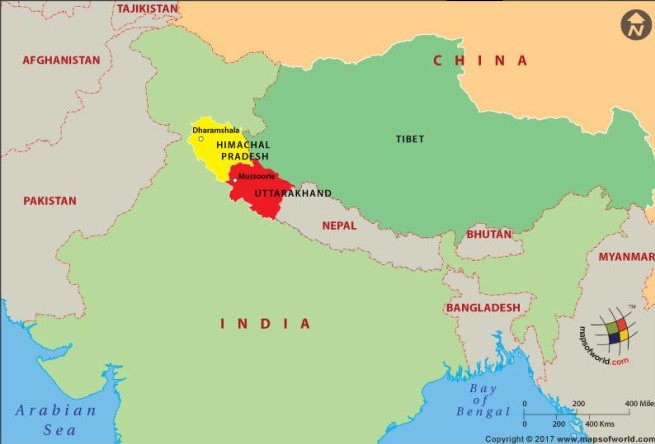
China has no claim on Tibet and East Turkestan, what to talk of Ladakh

The history of South Asia and China was dominated by the British broadly from the 17th century to mid-20th century. Today, almost seven decades after the exit of the British, India and China remain unable to reconcile to their new destinies and move ahead. Border demarcation done at the time of the British rule has become an issue and is dominating the political spectrum. After almost seven decades and even after fighting a full-fledged war, it has not seen settlement. To find a way forward  it is necessary to go briefly into the history.

Ladakh was conquered by General Zorawar Singh and amalgamated into the Sikh Empire in 1834. After the first Anglo-Sikh War, 1845-46, the British took Kashmir Valley, Ladakh and Gilgit-Baltistan as war indemnity from the Sikhs and, in accordance with the Treaty of Amritsar, sold the territories to Gulab Singh, the Dogra Rajah (King) of Jammu for a sum of Rupees 7.5 million. Thus was created the state of Jammu and Kashmir with the title of Maharaja bestowed upon Gulab Singh by the British. The royal Namgyal family of Ladakh was given Stok as Jagir, which it retains nominally to date. 

Jammu and Kashmir remained a princely state all through the British rule. The Dogras administered Ladakh as a Wazarat (principality) with an independent Governor on three Tehsils (Districts) of Leh, Skardu and Kargil. Ladakh was given two seats in a Legislative Assembly called Praja Sabha that was established in 1934 by Maharaja Hari Singh of Jammu and Kashmir in an attempt to usher democratic tenets into the monarchy.

Once India became independent, Maharaja Hari Singh signed the Instrument of Accession on October 26, 1947 effective October 27, 1947, making Jammu and Kashmir an integral part of India. Hence, there remains no doubt about Ladakh being a part of India.

China too has a diverse and interesting trajectory of evolution. In the 19th century (after 1932) the British had already started getting seriously involved in Chinese politics. As a consequence of the Opium Wars a fair degree of control over Chinese affairs came in the hands of the British. In 1912, the Qing dynasty declined in the face of challenges from abroad and internal revolts. And the British hold strengthened.

Around that time, the demarcation line between Tibet and the North-East region of India was created and named as the “McMohan Line.” It was ratified in 1914 by the Simla Convention between the British and Tibetan representatives.

With the decline of the monarchy, China embarked on to a tryst of becoming a Republic. The journey of transition was long and arduous, marked by a long struggle of power mainly between the Kuomintang (KMT) also referred to the Chinese Nationalist Party and the Communist Party of China that came into existence in 1921. After thousands being killed in debilitating civil wars ultimately, on October 1, 1949 mainly due to Soviet support, the communists gained control of mainland China in what is generally referred to as the Chinese Communist Revolution. Mao Zedong, became the founding father of the People’s Republic of China (PRC). Communist China moved swiftly to gain control over many neighbouring areas of which East Turkmenistan, Tibet and South Mongolia are the most prominent.

Significantly, India has borders only with the occupied territories of East Turkestan and Tibet and not with the mainland China. Also, the McMohan Line was not contested all through the period of political turmoil in China and Tibet, nor was it contested at the time when the British left India.

Two factors emerge from the foregoing. First, Ladakh was a part of India about 87 years before the PRC came into existence and 115 years before it gained power in China. Second, the government of China at the time when the British were leaving the sub-continent did not object to the McMohan Line. PRC was quite powerful even then, it could have raised an issue but it did not.

The first prime minister of India, Jawaharlal Nehru, having accepted the suzerainty of China over Tibet refused to be party to negotiations based on a perceived boundary dispute between the two countries. He insisted that the boundary stood resolved along the McMohan Line. In this he had the complete support of the Indian Parliament.

China, rejected and continues to reject the Simla Accord contending that Tibet was not a sovereign state and therefore did not have the power to conclude treaties. Chinese maps show some 65,000 sq km of territory south of the line as part of the Tibet Autonomous Region (TAR) and calls it South Tibet.

China, however, had tacitly accepted the Line of Actual Control (LAC) as it exists between East Turkestan and India. In a letter to Nehru dated October 24, 1959 Zhou Enlai proposed that India and China withdraw their forces 20 kilometers from the LAC. Even after the Indo-China War of 1962, Chinese unilaterally withdrew to the earlier demarcation of the LAC, except for Aksai Chin.

History is replete with instances of great Empires breaking due to over extension through forcible subjugation. The latest example is the breakup of the USSR. Communist China has forcibly occupied Tibet, East Turkestan, South Mongolia and other territories. There are voices being raised against this forcible occupation and against incidents of gross human rights violation of the people of these areas by the repressive Chinese regime.

Being unable to control what it has, one wonders as to why China is nibbling into Ladakh and Arunachal Pradesh where it has no jurisdiction or justification of claim whatsoever. For the sake of a few kilometers of territory that does not even belong to it, the country is jeopardising goodwill and billions worth of trade with India. It is unwilling to understand that the huge potential of Ladakh and Arunachal Pradesh can be best leveraged by both countries through friendly relations. In fact, East Turkestan and Tibet will contribute more to the prosperity of mainland China if they are freed from the existing shackles and blatant suppression.  Significantly, India and China are harbingers of the prosperous future of the region being super powers. They should understand their responsibility.

India needs to rework its posture on its borders on the basis of historical facts. If at all, borders can be discussed only with Tibet and East Turkestan as and when they gain independence. There is nothing to be discussed with the PRC (People’s Republic of China) and the McMohan Line remains the irrefutable border. Any attempt by China to change the same should be termed as aggression against the sovereignty of India and dealt with accordingly. Diplomatic and military attempts need to be made to get back Indian territories under forcible occupation of China.

Christian Sorensen: WAIS Unmeasurable Intelligence, William James Sidis

Christian is a Philosopher that comes from Belgium. What identifies him the most and above all is simplicity, for everything is better with “vanilla flavour.” Perhaps, for this reason, his intellectual passion is criticism and irony, in the sense of trying to reveal what “hides behind the mask,” and give birth to the true. For him, ignorance and knowledge never “cross paths.” What he likes the most in his leisure time, is to go for a walk with his wife.

Scott Douglas Jacobsen: How did the 185+ (S.D. 15) get calculated for the IQ score for you, as most will assume only reliable scores on mainstream IQ tests sitting between 40 and 160 (S.D. 15)?

Christian Sorensen: It was calculated “in the same way,” and with the same test: “WAIS-R,” as it was calculated the IQ score of “Evangelos Katsioulis,” when he earned “180+ (S.D. 15).” With the only difference, that I earned “at least” five points higher than him. Therefore, on account “of pears and apples,” of justice, and according to “one of the two” most reliable tests, for measurements of general intelligence in the world, the one who should be at “the first place,” on the list of World Genius Directory, “is me and not him.”

Since the question is on the mat, and for responding to “eventual ripping of clothes.” I want to take advantage, and to be clear, that I do not need to justify my IQ with any “silly games,” within the “almost infinite” that are in circulation, as if they were “candy businesses,” pretending to be high range IQ test, nor with the mainstream test that measures general intelligence. First of all, because I find them “silly, pedantic, absurd and misleading,” since at least the former ones, sell “false intelligence,” for making people believe, that they have an “IQ that is not real” or that does not belong to them, so ultimately they only serve to “inflate their ego,” as if they were “aero-static balloon.” And additionally, due to the fact, that my numerous interviews with you Scott, show actually and clearly, as a “fact of evidence,” who is who, since besides not being Wikipedia’s responses, they don’t have any support of bibliography. “Who ever likes it or bothers,” they have been elaborated, arisen and flowed naturally from my own “black box,” which lastly, is an issue that has brought me more displeasure than anything else… In synthesis, and to conclude, the point and “obvious fact” here, is that my general intelligence, is well above 185 (S.D.15), and “period.”

At the same time, I take the opportunity, to communicate that this is the last time I respond to something of this nature, since I feel that has “neither feet nor head,” and to which I have been forced to respond dizzily, throughout my life.

Jacobsen: Speaking of intellectual competitions, but in the realm of history rather than the present, what do you think of the case of Bill Sidis, in general terms?

Sorensen: Apart from the fact, that Sidis fulfills, what I will denominate as the “golden rule of three,” I think that regarding its capacities, is clearly represented “the universality” of these, which ultimately should be expected in relation to us, the unmeasurable geniuses, in other words, the fact that these abilities are “multifocally prodigious.”

Jacobsen: Of all of the people who have been mentioned with a sense of awe to some, semi-mystery to others, tragedy and pity to others, worship to still others, wonder and curiosity to yet another group, etc., what emotions or thoughts come to mind about the overarching narrative of the life of Sidis for you?

Sorensen: That of a man “committed to noble causes,” who was able to make his extraordinary capacities, available to the “most disadvantaged” and “for peace.”

Jacobsen: Any particular points of interest in his life for you, personally?

Sorensen: Sidis’s “atheism and communism.”

Jacobsen: Any points of appreciation and/or general commentary on the historical work on the Americas, on the intelligence level claims, on his ethical principles, or on his cosmology?

Sorensen: I agree with Sidis’s “cosmological” point of view, in relation to that the universe is “infinite and eternal,” and also with its application of “the first thermodynamics” law, which means that energy within the universe, is “neither created nor destroyed.” I personally would add, to its “cosmology,” and regarding “universe energy,” that this energy “does transform” as such.

Jacobsen: Any thoughts on Dr. Boris Sidis’s ideas about upbringing and making an experiment, more or less, of young Billy?

Sorensen: Sidis’s father, implicitly sought to experiment with his son, since he put into practice his knowledge of “abnormal psychology,” and also combined three elements, “affection, knowledge and precocity,” respectively, within the upbringing, which in his time and also currently, arouses “much controversy,” especially regarding the third of them.

Jacobsen: Why do so many in the gifted community look to the Sidis story?

Sorensen: I suppose that because Sidis, is seen as a sort “of oracle,” that arouses “ambivalent feelings” of admiration, in the sense of pretending to identify with him, as well of envy.

Jacobsen: Any lessons that can be drawn from this Sidis narrative?

Sorensen: The capacity of Sidis’s mind, despite its enormous “amplitude and variability,” to “be structured” in an orderly way, and without getting confused. In other words, its ability to mentally organize everything, by “napoleonically placing” each thing in its correct box, without mixing these last between each other.

Jacobsen: Who seems comparable in history to him?

Sorensen: From the point of view of its universalism and extraordinary capacity, “Leonardo Da Vinci.”

Jacobsen: Personally, what parts of the story seem, more or less, factual and extraordinary to you?

Sorensen: Sidis’s extraordinary “earliness,” “humanism,” and regardless of the fact that there is no documented evidence of its intelligence evaluations, the presence of objective facts, that give proof of his unmeasurable genius.

Jacobsen: If he lived longer than 46, what do you think he would have done with his gifts and talents?

Sorensen: I think Sidis would have formed, a “philanthropic intellectual society.”

Jacobsen: If he lived longer than 46, what do you think he would have done with his personal and professional life outside of general uses of gifts and talents?

Sorensen: Probably would have continued to live with his parents or sister, and would have been professionally associated with a university for academic and research purposes.

Jacobsen: Thank you for the opportunity and your time, Christian.

Sorensen: Thank you for the opportunity, Scott.

Image Credit: Christian Sorensen.

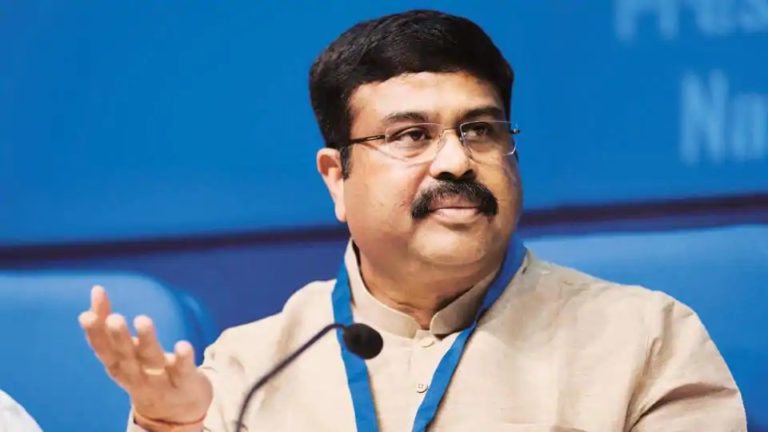
Dharmendra Pradhan tears apart Sonia Gandhi’s politics on petrol-diesel prices

Petroleum Minister Dharmendra Pradhan lashed out at Congress President Sonia Gandhi for raking up the issue of petroleum prices during times of COVID-19 pandemic when the government has been making efforts to help poor and needy with direct cash transfers. Minister Pradhan, without mincing any words, said that the Narendra Modi-led government directly transfers money into the accounts of poor through DBT (Direct Benefit Transfer) rather than depositing it into the accounts of “son-in-law” and Rajiv Gandhi Foundation.

“During the last three months government has directly transferred ₹65,454 crore into the bank accounts of 42 crore poor people through DBT (Direct Benefit Transfer). This cash transfer has been done directly into the bank accounts of poor people without any intermediaries. Modi ji’s scheme means distribution to poor, there’s no concept of filling the treasuries,” explained Dharmendra Pradhan.

Dharmendra Pradhan, Minister of Petroleum & Natural Gas castigating Congress President Sonia Gandhi for her comments on fuel prices in times of Coronavirus pandemic.

Dharmendra Pradhan castigated Sonia Gandhi that her idea of DBT (Direct Benefit Transfer) may be to have transfers done into her son-in-law’s accounts and to the Rajiv Gandhi Foundation. “Modi ji’s DBT idea is to transfer into the back accounts of poor,” said Dharmendra Pradhan.  

Sonia Gandhi has attacked the Narendra Modi-led government for raising fuel prices twenty two times since the lockdown, wherein the Congress President accused government of “extorting” people, and sought an immediate rollback of the hikes. Sonia Gandhi raked up the issue of fuel price in times of Coronavirus pandemic without knowing how the pandemic has affected economic demand and thrown up unforeseen challenges before the Modi government. Dharmendra Pradhan explained in clear terms that the tax money from petrol and diesel is being spent in providing health cover, employment and economic security to the people whose livelihood have been adversely affected due to prolonged lockdown after the outbreak of COVID-19 pandemic.

Sonia Gandhi must know that after a nationwide lockdown was announced on March 24, 2020 to contain the spread of pandemic a budget of ₹1,70,000 crore was sanctioned under the Pradhan Mantri Garib Kalyan Yojana that entailed direct cash transfers into the bank accounts of poor people and farmers. The free ration being provided under this scheme has now been extended by PM Modi till November-end. For three months poor families were also given LPG cylinders for free. In a democracy it’s the right of opposition to criticize government’s actions but playing politics on government schemes meant for the poor only means that Congress President Sonia Gandhi does not want benefits from welfare schemes to reach the poor people, rather she wants to cash upon the pandemic for political mileage.

Dharmendra Pradhan explained that entire global economy is under severe strain due to the pandemic and it has also posed demand issues for petroleum products. The common consumer has not been much affected by recent price hike in petroleum products as their demand had gone down by 70% in April and May before it revived in June after the lockdown was eased. “When a family faces a crisis, then members arrange financial resources to deal with it and the recent hike in oil products should be seen in a similar manner.” 

Dr Allah Nazar praises Baloch freedom fighters for Karachi stock exchange attack

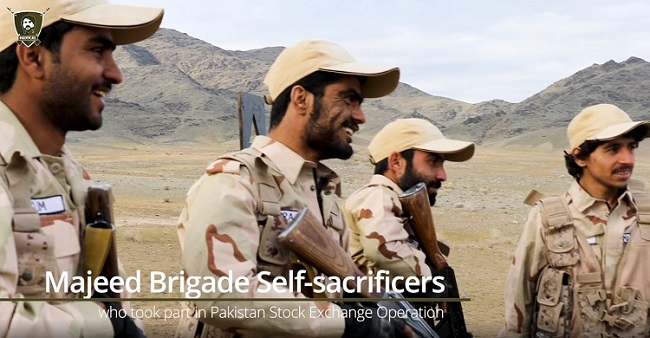
Baloch youth are sacrificing themselves to crush the colonial arrogance of the occupying enemy and not for fame and glory, said Dr Allah Nazar Baloch the prominent pro-independence leader of occupied Balochistan, as he paid tributes to the Baloch freedom fighters martyred in Karachi.

Dr Allah Nazar Baloch while paying his tributes to the freedom fighters martyred in Karachi said that the attack on Karachi Stock Exchange was a warning to Pakistan and China to quit Balochistan. “The Baloch nation has decided to take extreme steps to expel them from Balochistan. The great sacrifices of martyr Salman Hamal, Taslim Baloch, Shehzad Baloch and Siraj Kongar who hail from different parts of Balochistan will always be remembered not only by the Baloch nation in golden words but will also be remembered by all the oppressed nations who fight for their freedom in any part of the world.”

He said that China is a modern day imperialist and an aggressive power. China has made a long term hegemonic plan to use Gwadar as a launching pad by turning Balochistan into an undeclared colony to dominate the world. “Pakistan has cheaply mortgaged Baloch lands to China. China’s presence in Balochistan has become a threat not only to the Baloch national survival but it poses a danger to the entire world. We believe that the world is still unaware of China’s intentions and that the Baloch are the only ones fighting the modern imperialist monster. The attack on the base of Chinese moneylenders in Karachi after the attack on the Chinese base in Gwadar is a continuation of the attacks on its strategic assets. The Baloch will continue it, no matter what the cost,” Dr Allah Nazar explained with a firm determination.

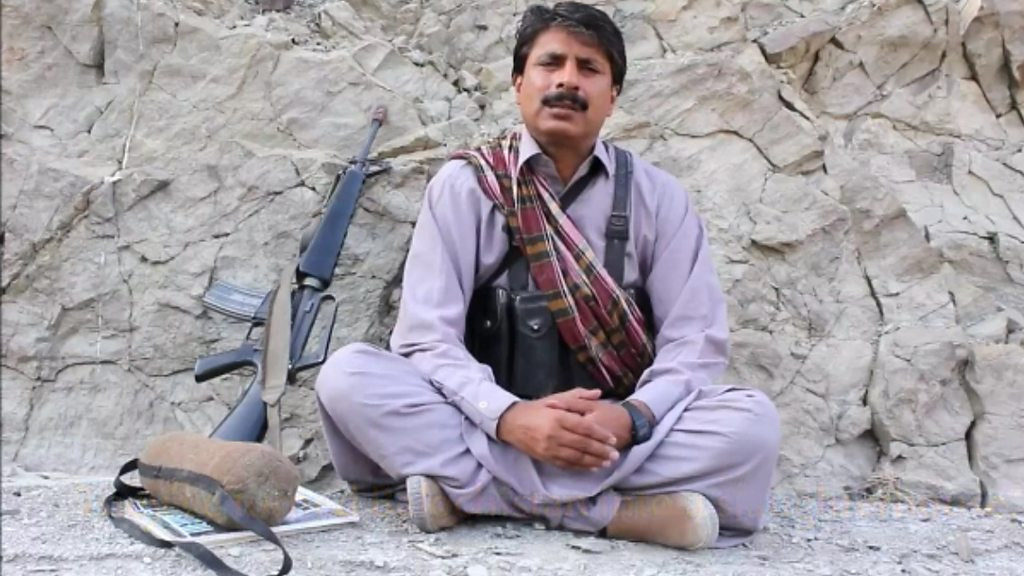
Dr Allah Nazar Baloch, Chief of Balochistan Liberation Front (BLF) and revered leader of Balochistan's Freedom Struggle against Pakistan.
Dr Allah Nazar Baloch, Chief of Balochistan Liberation Front (BLF) and revered leader of Balochistan’s Freedom Struggle against Pakistan.

Dr Allah Nazar Baloch further added that for some Balochistan may be a part of Pakistan but for us, Balochistan is our motherland. “We will not hesitate to sacrifice our lives for its sanctity, national identity and freedom. Pakistan not only occupies our land but has also leased our land to China under the guise of projects like CPEC. Agreements with China on Balochistan are concealed from the Baloch nation and they are so dangerous that Pakistan is not even able to present those agreements in front of its own parliament and senate. The fate of Balochistan is being negotiated with Chinese imperialists through the military generals in the GHQ, Rawalpindi. Nevertheless, if anyone insists on calling it development and economic projects for Balochistan, we consider them as partners in crime with the enemy.”

Dr Allah Nazar Baloch explained that the basis of violence comes from occupation and all the roots of violence are implicit in the occupation of Balochistan. “We learn the lessons of revolutionary war from the thoughts of personalities like Che Guevara and Ho Chi Minh and the Baloch national traditions. Today, few so-called intellectuals are critical of our revolutionary war, and according to them our attacks justify Pakistani violence. They do not see the tears of Hasiba and Seema whose innocent relatives continue to be forcibly disappeared for years. During which attacks were their loved ones caught red-handed by the state army and thrown in secret detentions? Why don’t they notice the fact that Pakistan and China have made a practical decision to wipe out the Baloch nation from Balochistan?” He added: “Pakistan’s barbarism and violence have been going on for seventy years now. Pakistan’s atrocities and barbarism, the tears of Baloch daughters on the streets are increasing the intensity of our war. These tears are to be avenged on Pakistan and its allies. I am well aware that Pakistan will increase Baloch genocide by using such attacks, but it will not be able to wipe us out.”

Dr Allah Nazar Baloch reiterated that the Baloch nation is fighting a revolutionary war. “The young who are treasures of their mothers do not go on an attack just for fame or due to madness but to convey the message of their oppression to the world and to break the pride of the enemy. They certainly hope that the Baloch nation will not let their sacrifice to go in vain. The attack on the moneylender’s base in Karachi is a link to this. The caravan shall continue. We must remember that we are numerically, militarily and technologically weaker against the enemy. Guerrilla warfare, among other factors, is an important weapon for the weak. This is the legacy of revolutionaries all over the world and the Baloch youth will contribute to this legacy.”

CFI – Cash Prize Increase to Show Magical Powers

Center for Inquiry has been a consistent and powerful bulwark against pseudoscience and supernatural powers claims in the history of the United States in particular and some other parts of the world in general. Many in the humanist, generally, and the secular humanist, particularly, community owe them a great debt and, in fact, are a part of the organizations in its orbit if not directly with it.

One extended grouping of the Center for Inquiry is the Center for Inquiry Investigations Group. An interesting cash prize proposal building off the legacy of the James Randi Educational Foundation. The prize comes to an astonishing $250,000. I believe in USD. The prize money, previously, was $100,000. So, certainly, this ups the ante on the entire endeavour.

It is a financial backing to a challenge to prove occult, paranormal, and supernatural abilities or powers. Based on the reportage of the Center for Inquiry Investigations Group, akin to the findings of the James Randi Educational Foundation, zero challengers have succeeded in passing the challenge of the group. Yet, we find an astonishing number continuing to proclaim superpowers, special powers, supernatural powers, and the like. Others have never been properly tested in a modern scientific setting to provide sufficient proof of the concept. No empirical evidence on this level.

James Underdown, the Executive Director and the Founder of the Center for Inquiry West (Los Angeles) stated, “We’ve been waiting for twenty years now for someone to come along and blow our minds, and while many have tried, no one has proven they can actually do what they say they can do… Maybe all the real superpowered folks were just waiting for us to raise the stakes. Hopefully a quarter million bucks will do it.”

Granted, it is a lot of money. It can raise some questions a to why so few takers/testers to earn such money. In addition to the quarter of a million dollars for an individual who can provide evidence of the paranormal or supernatural claims, there is, as well, a $5,000 prize money for the individual who can make the referral of an individual who can show the magical powers. (I believe “magical” is the appropriate colloquial term here.)

With files from Center for Inquiry.

Photo by chuttersnap on Unsplash

NCSE – Improvements on Evolution Via Natural Selection Education

Evolution via natural selection remains the singular foundation for the biological sciences and, presumably, the medical sciences by extension. Without an appropriate education in these matters and full comprehension and complete acceptance of its implications, a pupil or an aspiring biology or medical sciences student will be left worse off than educational peers.

With an NCSE/Penn State national survey, they have been looking into the “pedagogically appropriate treatment of evolution in state science standards,” according to the National Center for Science Education’s (NCSE) Glenn Branch, deputy director.

With the want of improvement in the standards of education across the United States of America, as we speak, three states are beginning to revise the state science standards: Texas, Pennsylvania, and South Carolina.

Branch stated, “More than half a million students take a biology course in the public schools of Pennsylvania, South Carolina, and Texas every year, to say nothing of the millions of students across the country whose textbooks might be affected by the content of the Texas standards.”

In “Teaching evolution in U.S. public schools: A continuing challenge,” by Eric Plutzer, Glenn Branch, and Ann Reid, one can find further details on the particular survey in question.  With the low rates of adherence to the foundations of the life sciences, the United States will continue to punch below its weight and remain a powerful while less than possible nation in terms of Science, Technology, Engineering, and Mathematics.

With files from the National Center for Science Education.

Photo by Eugene Zhyvchik on Unsplash

NCSE: New Jersey Revising Educational Standards

Some more positive work coming out of the National Center for Science Education or the NCSE with its Deputy Director, Glenn Branch, pointing out the situation in New Jersey.

With some of the issues in a poverty of critical thinking, at times, within the United States, some good events are more than welcome. The state board of education of New Jersey adopted the revisions of some education standards for the entire state.

These will be incorporating climate change in “a systematic and coordinated way.” Branch explained how every teacher within the public school system of New Jersey would be “encouraged” to discuss climate change in a proper context, educational environment.

Branch said, “…New Jersey’s climate is already changing… and it is to the state’s credit that its education standards are changing in response. But it will be necessary for the state to ensure that these latter changes have their intended effect by funding education appropriately: meeting the greenhouse effect with the greenback dollar.”

These kinds of educational advances can help work on the unfortunate scientific illiteracy in the United States as a leading scientific nation, as with other nations harbour large swathes of scientific illiteracy.

Whether consequential knowledge such as evolution via natural selection for biological sciences and medical sciences, or climate change for actionables on an urgent problem, or not, scientific illiteracy is an ongoing issue and state-by-state changes to educational curricula as a service to the next generations is greatly appreciated.

With files from the National Center for Science Education.

Photo by Saketh Garuda on Unsplash

Conscripted Chinese soldiers no match to battle-ready Indian military

Almost one third of the People’s Liberation Army (PLA) is made up of conscripted soldiers who are forced to serve in the military for two years and then retired. PLA’s conscripted soldiers hardly undergo the rigorous military training.

Ladakh continues to make headlines. Galwan Valley remains tense. And India continues to remain on high alert as it fortifies combat positions along the Line of Actual Control (LAC) to preempt any further Chinese misadventure. As far as territorial controls are concerned, there has been absolutely no change in the LAC positions despite both India and China building up their troop strengths. The two armies are in combat positions yet no shots are being fired. But China has begun its psychological warfare.

A large section of fifth columnists ensconced at plum positions across India are working overtime to create a fear psychosis about China’s military build up across the LAC. These fifth columnists make ample use of Photoshop images to prove that China has eaten up a few kilometres of Indian Territory in the Galwan Valley. This is far from truth. The fact remains that on June 15 the PLA (People’s Liberation Army) launched an unprovoked attack on Indian soldiers in an anticipation to see their backs, instead, the Indian soldiers hunted down the Chinese. In that fierce battle, more than 35 PLA soldiers were slaughtered by Indian soldiers thereby severely denting the image about PLA’s invincibility. China has since got into a damage control mode, and what better way than to wage psychological war against India.

Interestingly, Galwan Valley remains out of bound for all civilians including the journalists. India has been reiterating time and again that there has been no change in areas under its control. Curiously, this fifth columnist ‘coterie’ has been working overtime to dole out Photoshop satellite images of PLA tents, bunkers and camps at the LAC in order to prove that Chinese men have encroached inside Indian Territory, while the Indian Army continues to sleep. This modus operandi intends to create a fear psychosis in the minds of Indians while covering up for the shortcomings of China’s PLA (People’s Liberation Army).

This psychological warfare is critical for China as it covers up the chinks in their armour. Almost 30% ‘soldiers’ in the People’s Liberation Army (PLA) comprises of conscripted manpower, who are forced to serve in the military for two years and then retired. This effectively means that the PLA is continuously walking through a revolving door and around one third of the Chinese military is always on its exit route. The manpower serving PLA under compulsion merely adds to the headcount as they hardly undergo the rigours of military training and yet they are posted in combat positions. China’s conscripted herd is hardly a match to battle hardened and professional Indian Army. Moreover these conscripted youth brought up in cushy environment have never had any experience of real war. Almost for their entire term within PLA these conscripted soldiers wield guns in front of civilian populations. There’s a sea of difference when uniformed men wield guns at civilians and when faced with battle hardened soldiers. This differential turned the scales against PLA on June 15 during the battle at Galwan Valley, when Indian soldiers despite being severely outnumbered hunted down the Chinese, broke bones and smashed their skulls.

PLA’s remaining two third soldiers who have donned the battle fatigues know that they are mere cogs in the gambit of Communist Party of China who can be sacrificed at the whims of ‘high command’. A soldier’s passion to sacrifice himself for the nation is clearly missing in People’s Liberation Army where the uniformed men are only headcounts who are used as cannon fodder for communist party’s agenda of grabbing land and expanding its borders. In comparison, Indian military is largely rustic where able bodied men from across the nation willingly join ranks, undergo tough training and are brimming with nationalism. The People’s Liberation Army, in contrast, serves more as the private army of China’s Communist Party rather than for China as a nation.

Feeling of nationalism can be a major differentiator between warring armies when soldiers have to choose between life and death within a fraction of second. Even during the June 15 battle, every Indian soldier knew that if they die in their line of duty they will be remembered as heroes, their martyrdom celebrated, bodies will receive state honours and their family members will be honoured by the Indian society. And India did honour the twenty soldiers martyred on June 15, who were cremated with full state honours.

Sepoy Chandan Kumar being cremated with full military honours at his village Gyanpura in Bhojpur, Bihar. Sepoy Chandan Kumar was martyred during the June 15 battle with PLA at Galwan Valley

Nothing of this sort has happened in China. The Communist Party of China has not even officially acknowledged the names of PLA soldiers killed on June 15. The ‘Dragon’ is too embarrassed to publicly acknowledge that despite being armed with barbed wires, knuckles and nail-studded batons they were hunted down by Indians. Weibo, China’s equivalent of Twitter, is still abuzz with angry comments from the family members of slain PLA soldiers who had expected some official honour and a recognition that their kin had sacrificed their lives for the country. But then this was not forthcoming, simply because in the worldview of communist China, a human life holds no value. And here lies the difference of approach between the Indian Army and People’s Liberation Army.

China’s Economic woes

Ever since the outbreak of COVID-19 pandemic, China’s economic troubles have been worsening. China’s macro-economic numbers reveal the abyss that it has fallen into.

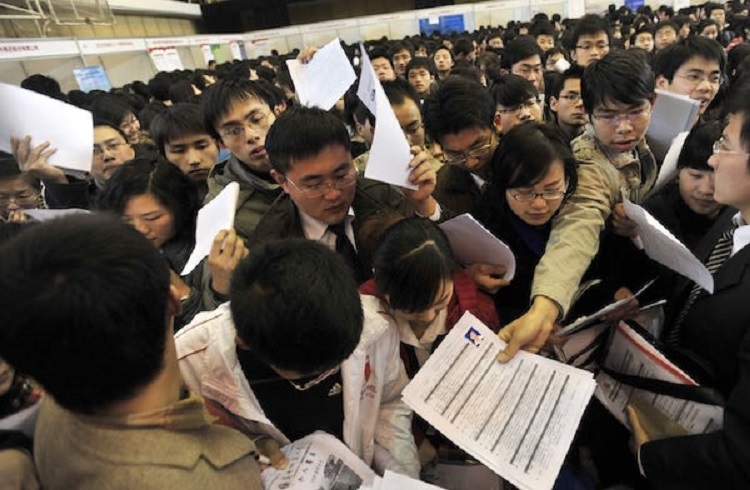
China counts 900 million people as its active workforce, of which close to 80 million are unemployed today. China also needs to create 11 million newer jobs every year to gainfully engage the fresh workforce. Around 40% Chinese population– almost 600 million people– earn an average of 1000 yuan (Rs 10,600) per month, which is subsistence level income. China’s per capita income has declined by 4% in January-March quarter of 2020 when compared with same period a year ago.

China’s three growth engines also point towards underlying problems within its economy. Consider this: Consumer spending in China has plunged by 19%, exports are down 13%, and fixed asset investments have dipped by 16%. And it doesn’t end here. Roughly 200 million jobs in China come from businesses connected to foreign trade. As China gets into trade brawl with the US and big corporations shift their production bases out of China, most of these jobs could just vanish. All of this is making Chinese population restless and angry, very angry.

Unemployed youth with their job applications in China. (Representative photo)

President Xi Jinping is aware of these troubles and communist party mandarins have sniffed the groundswell of public resentment. However, rather than take constructive steps to steer China’s economy towards course correction they have resorted to censor dissenting news and redirect anger on the ground towards aggressive nationalism. This is what explains China’s breach of trust with Hong Kong, its bravado with Taiwan, the ongoing Ladakh standoff with India and the latest tussle with Japan over Senkaku Islands in the Pacific.

Ironically, China is not succeeding on any of these fronts. And in order to stay afloat China has initiated “wolf warrior” diplomacy through its foreign office that has unleashed sharp attacks on anybody and everybody who doesn’t toe China’s line. It’s sad that a section of Indian media and self-proclaimed ‘experts’ have become enablers for China’s “wolf warrior” diplomacy.

Photoshop satellite pictures of PLA tents, bunkers and Chinese military presence in Galwan Valley and other parts of LAC is leaked to this section of pliable cabal and then a well concerted attack ensues. The sole purpose of this exercise is to mould the narrative in China’s favour and create a fear psychosis within India about Chinese invincibility.

Revealing details of India’s troop deployment will only help China

In combat zones the lines of conflict are often blurred. Indian population needs to rest assured that martyrdom of twenty Indian soldiers and their fierce fight back wherein they slaughtered at least 35-40 PLA soldiers has not been in vain. There is no fresh Chinese transgression post the Galwan clash on June 15.

Indian Army battalions and tanks continue to be deployed along the LAC in Ladakh. India’s troop mobilisation is taking place in accordance with threat perceptions along the LAC. India’s fighter aircraft are on high alert. We need to trust our armed forces. They are in combat positions. They have not gone to the LAC for a picnic!

Geostrategy and combat readiness must be secret. Every military strategy and military movement cannot and must not be discussed in public. Pressurizing the Indian government to reveal finer details of our military strategy will only help China. Writing detailed accounts of our troop deployment will only help China. Indian needs to bury the ghosts of 1962. Barely five years after 1962, Indian Army slaughtered around 900 Chinese soldiers at the Nathu La and Cho La battle in Sikkim and chased away the intruding PLA to its base. China knows it cannot wage a direct fight with India but it will indulge in psychological warfare.

In the coming days China will step up its efforts to spread rumours about Indian Army, Indian Air Force and the Indian Navy. This is dragon’s psychological war. Sadly, all those fifth columnists, self-proclaimed ‘defense experts’ and communists will side with China in this psychological war. In 1962 they sided with China, and they will do so again.

Franklin Templeton draws flak abroad, nudge at home

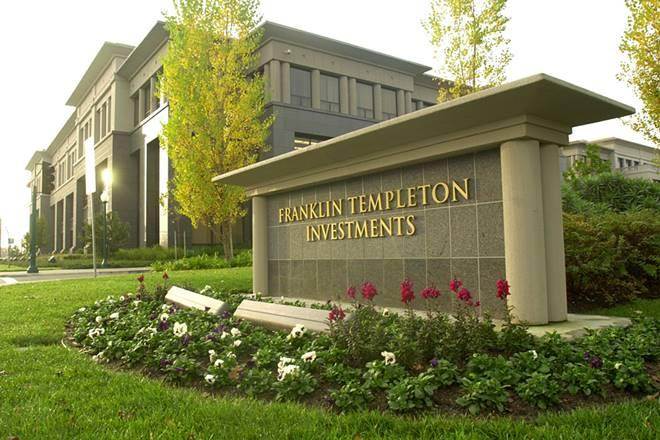
Fined heavily by three global regulators in Canada, Hong Kong, Korea for more than a year for serious regulatory violations, Franklin Templeton is sitting pretty over a Rs 28,000 crore alleged scam in India. So far, it has faced a simple nudge from the Securities and Exchange Board of India (SEBI). The market regulator, according to reports reaching the Indian Capital, has fined Franklin Templeton Rs 10 lakh and extended the time limit for forensic audit by auditor Chokshi & Chokshi.

The move has, expectedly, rattled the country’s financial markets.

The FT group is facing several serious litigations and strong proceedings for illegally winding up six schemes in India. As many as 40,000 investors have got an estimated Rs 28,000 crore stuck because of the group’s decision to wind up the schemes that experts claim violate regulatory guidelines.

Reports circulated by Washington says the FT group has — for long — indulged in regulatory breaches and shoddy practices for which global regulators fined it heavily. The matter has been reported to the United States Securities and Exchange Commission (SEC), since Franklin Templeton is headquartered in Washington DC. As such, the US SEC has also reprimanded Franklin Templeton several times in the past.

As per the US SEC Report of 2019, three global regulators, the Financial Supervisory Service (FSS), Korea, the Securities and Futures Commission, Hong Kong, and the Ontario Securities Commission, Canada, have severely castigated and fined the Franklin Templeton group for serious regulatory violations over the past decade.

But in India, the group has escaped unscatched.

As per the earlier timeline, Choksi & Choksi, a chartered accountant and forensic audit firm was to complete the investigation by the first week of July. Now, the same report will be submitted by the first week of August, 2020. 

People whose investments are stuck with FT feel a low fine by SEBI and delay in forensic audit by the auditor could send “strong and wrong signals” to those whose cash is stuck with those schemes FT wants to dilute.

At stake is a whopping Rs 28,000 crore of 40,000 investors. 

FT had initiated an e-voting process to seek unitholders’ nod to wind up the schemes. Initially, the e-voting process was scheduled to be held between June 9 and 11, 2020. However, the process was delayed after certain investors approached various high courts (HCs) against the fund house.

The petitioners said voting should not be allowed until the audit report is made public so that investors can make an informed choice. A SEBI council had argued before the Gujarat HC that the forensic audit report was for internal information of the regulator and cannot be a ground to delay the voting. The court had still granted a stay on the voting process till the forensic audit report was made available in public domain.

On June 20, 2020 the Supreme Court directed that all matters related to winding up of FT MF schemes be heard in the Karnataka High Court. Franklin Templeton had prayed before the apex court to vacate Gujarat HC’s stay on e–voting. The SC, however, didn’t intervene in Gujarat HC’s stay order on the e-voting process.