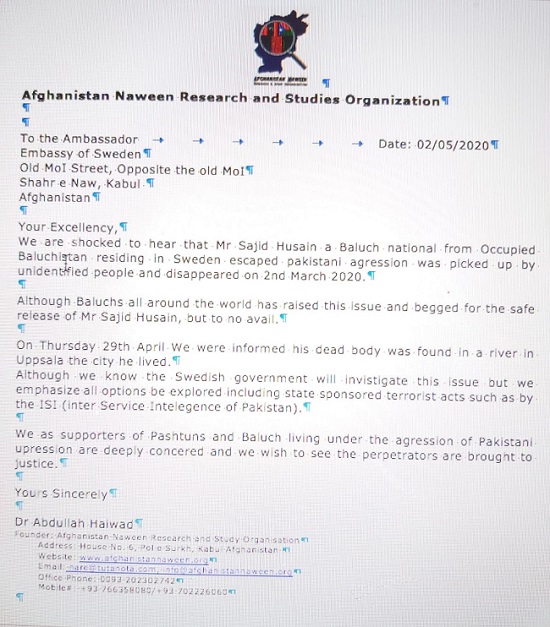
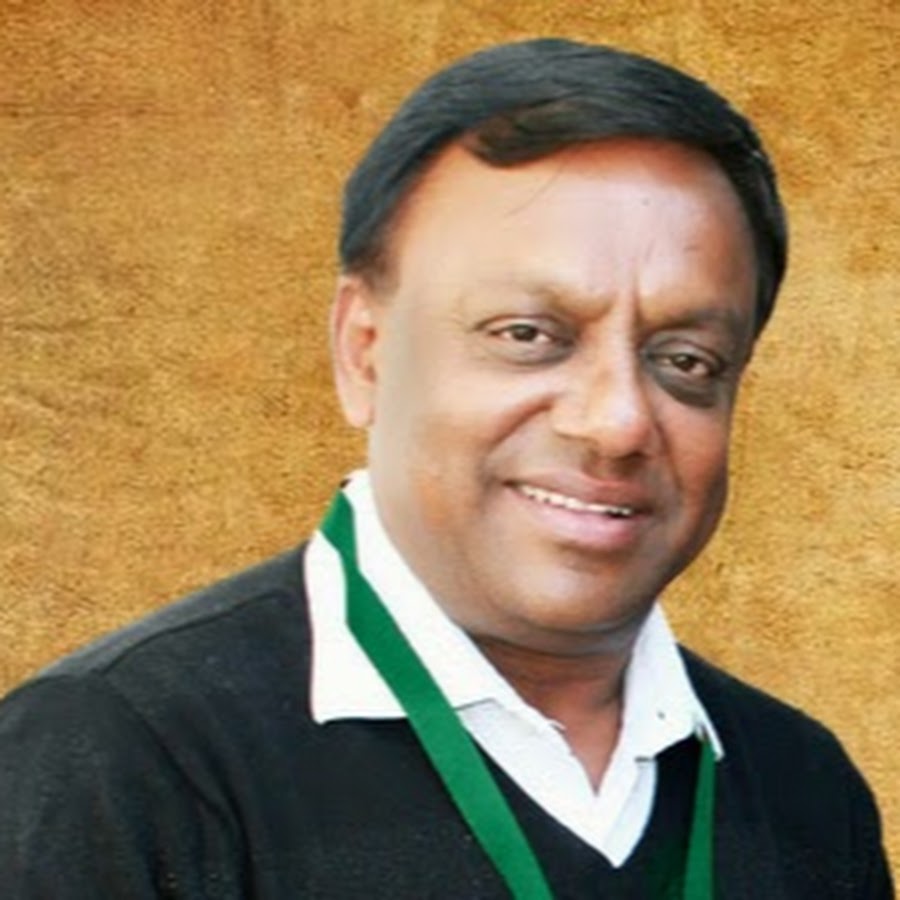
Dr Abudullah Haiwad, President of the Afghanistan Governor’s Assembly, has urged the Swedish Ambassador in Afghanistan to investigate possible links of Pakistan’s Inter-Services Intelligence (ISI) in the death of Baloch journalist Sajid Hussain. “We are shocked to hear that Mr Sajid Hussain, a Baloch national from occupied Balochistan residing in Sweden was picked up by unidentified people and disappeared ….his dead body was found in a rive in Uppsala, the city where he lived,” Dr Abdullah Haiwad wrote in his letter to the Swedish Ambassador in Afghanistan.
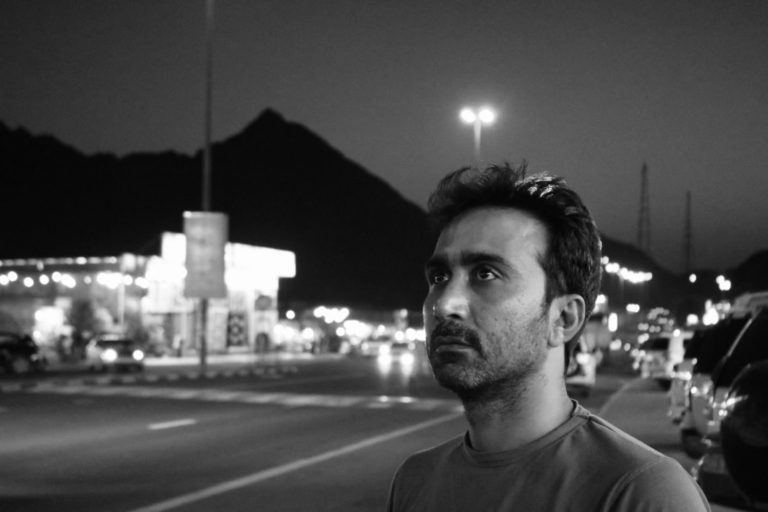
Sajid Hussain, was the Chief Editor of Balochistan Times who was abducted from Uppsala in Sweden on March 2, 2020. The Swedish authorities initially refused to register a case of abduction saying it was natural for people in Sweden to go in isolation. It was more than a month later, after massive protests by journalists and human rights activists across the world that the Swedish authorities registered a case to find Sajid Hussain. However, on April 29, Swedish authorities found the dead body of Sajid Hussain along a river side in Uppsala.
“Although we know the Swedish government will investigate this issue but we emphasize all options be explored including state sponsored terrorist acts such as by the ISI (Inter Services Intelligence of Pakistan),” wrote Dr Abdullah Haiwad in his letter to the Ambassador of Sweden in Kabul Afghanistan. Dr Abdullah Haiwad is also the founder of Afghanistan Naween Research & Studies Organization, which is an independent Afghanistan-based research NGO. “We as supporters of Pashtuns and Baloch living under the aggression of Pakistani oppression are deeply concerned and we wish to see the perpetrators are brought to justice,” Dr Abdulah wrote in his letter.
Dr Abdullah Haiwad’s letter to the Ambassador of Sweden in Afghanistan. Dr Abdullah Haiwad is President of Afghanistan Governor’s Assembly, which is an association of 66 former and present Governors of Afghanistan.
Pakistan has been targeting intellectuals, human rights activists and journalists in Balochistan by abducting and killing them to silence the demand for Balochistan’s independence. Sajid Hussain was forced to flee Pakistan in 2012 leaving behind his wife, daughter and son. For the next couple of years he took refuge in Dubai, Oman and Uganda and finally sought asylum in Sweden in 2017. It was in Sweden that Sajid Hussain started Balochistan Times to write and report about the atrocities in Balochistan. But Pakistan’s ISI that has spread its tentacles across several countries abducted him from Uppsala in Sweden, killed him and later on dumped his body.
Large crowd turnout at funeral procession of militants, killed by security forces in Kashmir, makes news headlines at a regular frequency. Recently there was news of a large body of people attending the funeral procession of three local militants killed in the Keran Sector of Kupwara, Kashmir in April 2020. It was then that I decided to write about the Jinaza-e-Karobar—the underlying machinations of the funeral procession of terrorists in Kashmir.
Sometime during
February this year, I developed a desire to get first-hand experience of attending
the funeral processions of a militant. I had heard all kinds of stories about these
funeral processions that ranged from “death of a militant causes martyrdom frenzy
among people across age groups” at one extreme, to the extreme where it was being
said that “it’s just one of the many businesses in Kashmir such as protests and
stone pelting that thrive during conflicts”. Between these two extremes, there
were plenty of explanations and question such as Why was a particular
methodology adopted? Why is the dead body draped in green? Why always do a
particular group of youth or maulvis are visible? Why women beat their
chests in a particular manner or sing songs of blood and valour?
Since a majority of these questions and explanations therein were beyond the scope of my logic, I shared the desire for attending a few of these processions with my close friend Iqbal. Iqbal lives in Kashmir Valley, is an activist by nature but a critique of violence and conflict. He empathised with my interest to know and understand these issues. Iqbal advised that I grow my beard. Iqbal also said that in the intervening period before I could actually attend a funeral procession he would explain me about the various contributing components in the procession.
A few weeks
later, on 13th March, after hearing the news that Mudasir Ahmad, a militant
from Shutloo, village Rafiabad in Baramulla was killed by the security forces, Iqbal
told me that he will take me to another village Rahama which is in the vicinity
of Shutloo, this was the village from where the slain militant belonged.
I was anxious
and curious to understand about what I would witness. Iqbal explained that we would
go to the house of Mukhtar (name changed), one of the locals who was his close
family friend and who would not mind sharing facts and truth. Few hours after
we reached, a Jamat-e-Islami activist called Nasir (name changed) came to his
house and informed that Namaz-e-Janaza of the martyr will start and at least
two members from each family must attend.
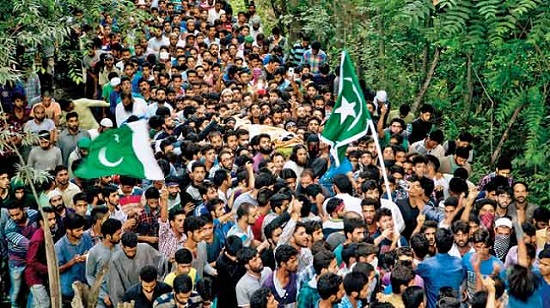
Pakistan flags being waved at the funeral procession of Hizbul Mujahideen militant Burhan Wani. (Photo: PTI)
Soon
after the Jamat-e-Islami activist left, Mukhtar told us as to what was the
diktat given by him. I asked him whether he would abide by the directive. Mukhtar
said that he can’t avoid because someone sitting at a shop next doors or at some
another corner will be taking note of who is going to attend the procession and
who is not.
“Those
who don’t attend the funeral procession of the militant, will face retribution,”
Mukhtar said.
I got curious
and tried to seek more information about the credentials of the messenger. I soon
learnt that this “activist” from Jamat-e-Islami was some sort of a contractor
who had been paid to generate crowds from the village.
“These
contractors or persons on payroll of Jamat-e-Islami use threat and action by
militants, religious punishment or social pressure against the people to
mobilize them for funeral procession,” Mukhtar explained.
There was a network of hundreds of other Nasir(s) who work like the parts of a well-oiled machine to ensure that crowd gathering at funeral procession of slain militants in Kashmir Valley looks like a natural and voluntary phenomenon. I was startled at the revelation. “But who pays for it and why?” I asked. I was promptly told that the Jamat-e-Islami is a key element of the Kashmiri separatist movement. Processions being an extremely vital part of the effort to keep the Azadi sentiment alive, it was very critical that this ‘cause’ is seen as just and youth keep getting incited to join militancy and above all, an element of honour is attached with Jihad.
These
efforts are well funded by the ISI (Inter-Services Intelligence) of Pakistan,
local religious bodies and even business community that owes allegiance (either
forced or coerced) to the cause.
During
yesteryears, when sentiment of Azadi was genuinely high, large crowd gathering
for procession could have been natural. But, with the passage of time, people
are no more interested in wasting time on a youth who has gone astray and tend
to avoid funeral processions. Moreover, this has now become lucrative business
because there are contractors and sub-contractors. So there are ‘Funeral
Brigades’ comprising groups of men and women who coordinate crowd gathering,
specific procedures, sloganeering, chest-beating and crying out loud, thereby
presenting a good sight for videos recordings. These videos are then fed to
Pakistani social media handles for propaganda. As these layers peeled off, my
curiosity was multiplied manifold and I wanted to be a part of such funeral procession.
The
occasion came soon. My friend Iqbal indicated that he would take me to Shutloo from
where the procession of slain militant Mudasir was due to take off. We reached
the village well before time, when even the dead body had not been handed over
to the family by local police. So, as a mourner, I got a chance to sit next to
the father and mother of Mudasir and could listen to the conversation. The air
was filled with sadness and people were remorse.
Like any
other parent who had lost their son, Mudasir’s parents also recalled the lifetime
of their son. How Mudasir grew as a child, how the environment played on his psyche
of Mudasir, how radicalisation in society affected his mind at an
impressionable age, and so on. Mudasir’s mother blamed her husband about how he
as Mudasir’s father failed to check him when he started to get attracted
towards fundamentalist thoughts of some ulemas. She also quoted an
instance when she had picked up a fight for asking Mudasir’s father to stop him
from meeting separatist leaders who were corroding sanity from his mind.
Mudasir’s
mother said that if he had played the role of a strong father, their son would have
been alive. She even quoted the instance when their son broke the news about
his wish to join the Azadi tanzeem. How she had pleaded with her son
Mudasir and his father to leave Kashmir Valley forever and settle down
somewhere else so that Mudasir gets out of the clutches of Azadi movement
but they didn’t pay any heed to her calls.
Listening
to these talks, there was no doubt in my mind that parents remain parents after
all. So what if the son is a militant. Their hearts bleed for the child and
they are as helpless as anyone else. By now, there was no doubt left in my mind
about the reasons why young men pick up guns. It had nothing to do with the Azadi
movement, it had nothing to do with the conscious call, and rather it had
everything to do with the emotional fallout of what is played before them. It is
all to do with false sense of manhood that they acquire by holding guns and it
has all to do with lack of hope and dream.
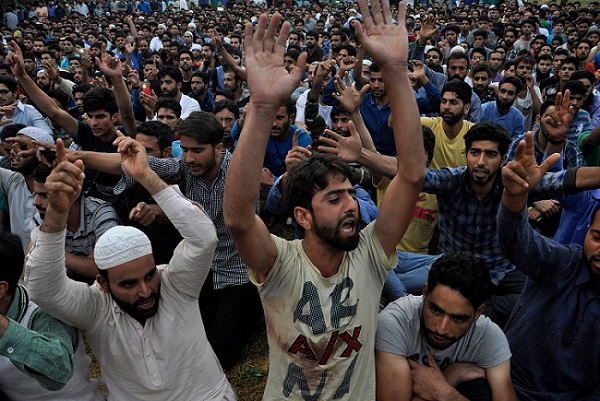
Women mourners at the funeral of a slain militant in Kashmir. (Representational picture)
While I was engrossed in my thoughts, people kept trickling in slowly. A sense of loss prevailed in the environment and till now there were no Azadi slogans, no martyrdom or even religious purpose of death. It was pure mourning because those who were around, were real well wishers, genuine friends and relatives.
Soon the time came for the dead body to arrive. Minutes before the police brought the body, a group of around fifteen youth and adults arrived. They carried a special aura around them, and there was a feel of professionalism. Few of them reached out to Mudasir’s parents, whispered into their ears (I later on learnt that the parents were being directed as to how they have to behave and what they have to say during the course of preparation and actual procession), few others reached out to friends and relatives while the rest got into the act of making a makeshift platform high enough to be visible to maximum people who had congregated. My friend Iqbal whispered into my ear that these ‘people’ were part of the ‘Funeral Brigade’ meant to orchestrate entire proceeding, while adding the effect and emotions about Azadi.
The likes of Nasir were busy pushing people from the adjoining hundreds of villages and townships. The crowd started to swell. Soon the ambulance carrying the mortal remains of the militant arrived, which was duly escorted by police. The crowd made way for the body so that it can be taken to the newly built platform. Suddenly, a loud voice thundered “hamei chahiye”? (what do we want). “Azadi”,was the reply.The response was faint and this annoyed the leader of the “Funeral Brigade”.
Strong
gestures were made by one individual, who looked like the gang leader of
Funeral Brigade towards the other members of Brigade to ensure high intensity
sloganeering. The effect was immediately visible in terms of pitch, intensity
and the acerbic content. This was quickly followed by the arrival of a group of
veiled women and some other young men. The body language of these newly arrived
veiled women and the already present group of Funeral Brigade indicated that all
of them were part of the same Brigade.
The men
from this group pushed through the jostling crowd and reached the body of militant
to kiss the militant’s forehead, touch his feet and rub their hands on their
body while women started crying in loud voices with extreme emotional
outpouring. It was quite evident that while the men were busy giving some kind
of reverential treatment to the militant, the women were making it appear as a feeling
of personal loss to those present at the funeral. Soon these women started chest
thumping with loud cries that was so strong that even the most dissociated
person like me felt some kind of an impact.
The crowd continued to swell with every passing minute. Slogans of Azadi was turning more aggressive and with every passing minute, the environment was getting charged up. Soon, a group of teenagers took to the microphone, exhorting mourners to continue their “azadi struggle” by singing songs of defiance. The mood had changed into a “celebration of martyrdom.”
I then drifted
towards the place where the militant’s parents were sitting. I could clearly
make out that the members of ‘Funeral Brigade’ were constantly putting words
into their mouth, thereby changing the entire line of expression. Poor parents
were not even allowed to mourn the death of their child in peace.
The funeral procession was being deliberately delayed, perhaps in the wait for more crowd to gather. The policemen on duty were constantly urging the slain militant’s parents to start the procession. Perhaps they had orders from their bosses to ensure an early funeral.
Finally,
the funeral procession started. ‘Funeral Brigade’ was in full action. People mobilized
by the Jamat-e-Islami keep joining en-route and the crowd kept swelling. I
could clearly see the local village people making gestures and communicating
through silent shrugs saying that who the hell wants to be part of such
engineered events when they had their own issues to attend to.
Members
of the ‘Funeral Brigade’ remained busy clicking photographs and videos that
they forwarding to their masters for further propagation. A local villager who seemed
to have insights about the conflict dynamics explained to me that “…these
visuals are also the proof for Funeral Brigade to claim their remuneration for
the job well done. They send them to masters within Kashmir, who in turn send
these visuals to people sitting across the border as proof for payment and for
propaganda to the audiences within Pakistan, OPEC countries and rest of the
world.” Amidst these Azadi slogans, praise for Pakistan, abuses for
the occupational forces and all sorts of filthy phrases for India the
procession finally reached the burial ground.
At the burial ground, a yet another strange activity drew my attention. A fat middle-aged woman, draped in ‘burqa’ appeared at the funeral site of the militant. She had a green polythene bag under her arm and claimed to have come from some far-off place just to say goodbye to her militant son (anyone who is a militant becomes her son, I learnt). Such stories of devotion towards those who lay down their lives for Azadi, draws a lot of media attention and sympathy from people. All the acts put together, enough mileage is generated among youth and they get drawn towards joining militancy.
I verified from the near and dear ones of slain militant, this lady was not even remotely related to the militant biologically, yet she claimed that she had breastfed him when he was an infant. I also learnt that this act was also part of the many machinations constituting the Jinazah-e-Karobar or the business of funeral procession. The optics such as withered plastic sandals, tired look justifying long distance walk and expressions indicating how tormented she was on hearing the news about the militant’s killing, add immense value to the Azadi propaganda.
As if the members of Azadi or funeral brigade knew about her and were waiting for her arrival, they lost no time and lifted her onto their shoulders and carried her to the militant’s bullet-hit body. Once there, she kissed his bullet-pocked, deformed face, took a handful of candies from the bag and threw them on his body, a tradition observed when Kashmiri grooms return home with their brides.
She then addressed the crowd.
“Would you like to become a doctor?” she began, to which the angry crowd chanted back, No, we won’t!” “Would you like to become a Police Officer?” she shouted, the crowd responded back “No, we won’t!” “Would you like to become a militant?” she continued. “Yes, we will,” the crowd roared back in response. “Would you like to become Tiger?” she said, referring to an infamous Kashmiri militant Burhan Wani, also known as Burhan Tiger, who was killed in 2016. “Yes, we want to!” the crowd responded. “Then say it loudly,” she shouted. “Azadi!” the crowd responded.
Iqbal, my friend, helped me meet a few other reasonable people who explained that this was almost common to all the funerals undertaken anywhere in Kashmir, particularly South Kashmir.
The larger objective of the funeral processions into which ISI and Kashmiri separatists invest heavily is to create role models and heroes for imitation by the young generation of Kashmir Valley. This gives them courage to start defying law and order, pelt stones and stand in front of Indian Army vehicles to block their movement. They block roads and by-lanes when militants are cordoned by the security forces and then they resort to violence and agitations to obstruct the conduct of operations. Any untoward incident, generates further anger and violence. Often, an act of firing from among someone who is part of the crowd sparks and fuels the spiral of deadly violence.
Militant Burhan Wani’s death in a gun battle with security forces in July 2016 initiated a long drawn violence in the Kashmir Valley. The impact of such processions is so quick that a young boy joins the militant rank and even gets killed in operation within few days of recruitment. One often hears or reads that a militant was just a few days old when he was killed, which was the case in this case as well. Mudasir had joined militancy just eight days back and was killed.
Everything that happens in Kashmir is twisted to suit the narratives of the Azadi nexus, be it political decision, social activity or a ritual. Everything culminates into a demand for Azadi. The machinations are well crafted and coordinated. But everything has a cost. It doesn’t matter who pays and for what. As long as the money flows, these mechanisms will continue to thrive. It’s for daily wage for those who execute and business for those who orchestrate. As long as the ISI is funding, lives and deaths will continue to remain a Karobar (business).
“Missing” may be a simple English word for everyone else in the world, but in Balochistan this word sends shivers down the spine. Baloch understand that “Missing” is a euphemism for cold-blooded murder by Pakistan’s rogue intelligence agency ISI (Inter-Services Intelligence). This belief has been proved correct, yet again, when Sajid Hussain, Chief Editor of Balochistan Times was found dead at a river side in Uppsala, Sweden on April 30. Incidentally, Sajid Hussain went “Missing” from Uppsala on March 2 this year.
Baloch human rights activists and journalists had been fearing for Sajid’s life ever since it came to light that he had gone “Missing”. And since then there had been a relentless campaign to urge the Swedish authorities to take active steps to ensure his safety and well being. But the Pakistani deep state has spread its tentacles so deep within the Western world that it has the wherewithal to silence any critic anywhere.
In fact, Sajid Hussain Baloch had been on Pakistan’s radar since the day he started writing and reporting about Baloch “missing” persons, “enforced disappearances” and the notorious “kill and dump” policy of Pakistan’s deep state. He was forced to flee Pakistan in 2012 leaving behind his wife, daughter and son. For the next couple of years he took refuge in Dubai, Oman and Uganda and finally sought asylum in Sweden in 2017. Sajid thought that Sweden was the safest country, respected freedom of speech and journalists could write without the fear of their pens being silenced.
It was in Sweden that Sajid Hussain started Balochistan Times to write and report about the atrocities in Balochistan. His writings were sharp and incisive and shook the conscience of the complacent West. How could a simple English word “Missing” sends shivers down the spine in Balochistan was explained to the Western world by Sajid Hussain through his columns in Balochistan Times. He also chronicled atrocities being committed by the ISI and Pakistan Army by exposing their “kill and dump” policy that exposed Pakistan to the Western world.
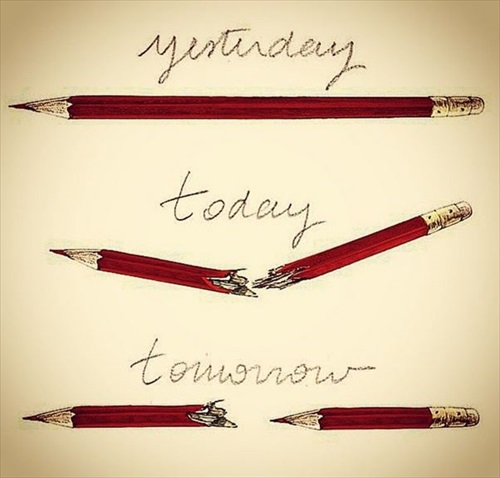
Guns cannot silence a pen. Never.
Sajid Hussain became the eyesore of Pakistani
deep state due to his pen. The sugar-coated narrative built by Pakistan Army about
fighting terror modules was deftly exposed by incisive writings of Sajid. And
that’s when they decided to silence Sajid Hussain.
Ironically, human rights champions all around the world will hardly discuss and berate Islamabad or Rawalpindi about this cold blooded murder. World’s mainstream media will write Sajid Hussain’s obituary as a news brief. Just one more addition to the 30,000 “missing” Baloch persons hardly makes any difference for the high and mighty. This has been a trend for the last several decades.
Not this time.
We will not let the world forget Sajid Hussain or his writings or the ideals that he stood for. Journalists and writers across the world will continue to write with renewed zeal about human rights violations and atrocities in Balochistan. Guns cannot silence a pen. Never.
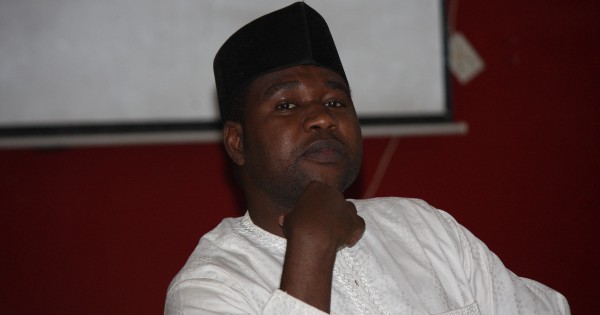
While the police authorities in Kano have confirmed that Nigerian Humanist Mubarak Bala is in their custody, they have not granted him access to a lawyer. He has been held incommunicado. The police arrested Mubarak in Kaduna three days ago following a complaint of insulting prophet Muhammad that some lawyers in Kano filed at the State Police Command.
Mubarak was detained in Kaduna for a night before being transferred to Kano two days ago. Since taken to Kano, the police authorities have not allowed him to see his lawyer. The police authorities have been blocking efforts to understand the details of the complaint. This is in breach of Mubarak’s human rights.
There are reports that Mubarak is being beaten and tortured while in detention. There are also concerns over the state of his health, especially with the outbreak of a strange disease and the coronavirus in Kano. In the last 48 hours, there has been no independent confirmation that Mubarak is alive and well, there is no confirmation that he is not being maltreated and that his rights are not being violated. Given the nature of the allegation, there are serious concerns over Mubarak’s health. According to family sources, Mubarak is hypertensive. Many people are worried that Mubarak could be killed while in detention given the several death threats that he has received.
Please kindly help draw the attention of the Nigerian authorities to the case of Mubarak. Ask the police authorities to grant Mubarak access to his lawyer today.
Urge the police to charge him in court formally or release him unconditionally.
Ramadan is a sacred month when Muslims across the world observe a month of fasting, an activity regarded as one of the five pillars of Islam. This year the month of Ramadan commenced on April 23 and will culminate on May 23. During this month, Muslims are decreed by Allah to emphasise on acts of “Deen” (religion) rather than worldly matters. Ramadan is not only about fasting, it is also about being humble, modest and above all, free of all animosities. It is about discipline, self control, self reflection and reformation, a time when the believer ponders over spirituality and piety and brings about a change in his own self for the better. Eid-ul-Fitr, a festival of joy, is a befitting celebration and thanksgiving that marks the end of the holy month of Ramadan.
It becomes very difficult to come to terms with the cult of violence and hatred that has, ever since advent of terrorism in Kashmir Valley, become a characteristic in the month of Ramadan. This year too, the terrorist cadre has remained active despite their drastically reduced numbers. Terror masters have increased efforts towards recruitment and are giving huge monetary incentives to the Kashmir youth to join the self destructive path of terrorism. It is so because infiltration of foreign mercenaries from Pakistan has been curtailed drastically by the vigilant Indian Army and, as such, internal recruitment is the only option left.
In the hinterland of Kashmir, terrorists, at the behest of their foreign masters, are hitting out during the holy period of Ramadan. The security forces are responding incisively. Relentless counter terrorist operations are being carried out in a professional manner. More than 30 terrorists have been killed in the month of April alone, of which, more than 15 have been eliminated in the last few days since the holy month has commenced. Through this year, terrorists have suffered a back-breaking loss of nearly 60 fatal casualties.
On April 22, a day before the holy period of Ramadan commenced, four terrorists were killed in Shopian. On April 23, a terrorist named Shakir Alie and affiliated to the Hizbul Mujahedeen was apprehended in Kulgam; three days later, on April 27, four terrorists were killed in Kulgam. On April 26, in two separate and successful operations security forces killed two terrorists in Pulwama and two in Anantnag. On April 29, three more terrorists were eliminated in a joint operation in Shopian, the operation went on for two days. Terrorists were of the view that they would get a free run during the holy period, bu the Indian security forces have put paid to such a thought process.
Despite being an Islamic state and despite being in a critical situation due to unfettered spread of the Coronavirus across the country, Pakistan has not stopped its consistent cease fire violation along the line of control during the month of Ramadan. It has, in fact, increased the pressure drastically. Border villagers of Nowshera, like Village Pukharni, where the Muslim community resides, have been observing the sacred month of Ramadan under shelling by Pakistan. A ground report prepared by a local newspaper Daily Excelsior says, “…one of the villagers Mohammad Altaf got injured due to bullet from Pakistan side, when he was sitting inside his house. Although he was treated but the bullet could not be taken out from his body.” Similarly, Pakistan has also been shelling in Bhawani, Shermakri areas. The same conditions prevail all along the LOC including the Kashmir sector.
There were two occasions when New Delhi took a decision to “suspend operations” during the holy month of Ramadan. The first initiative was taken by the Atal Bihari Vajpayee-led NDA government in 2000. It was termed as Non Initiation of Combat Operations (NICO). NICO was fuelled by an intense desire that Prime Minister Vajpayee nurtured to put an end to violence in Jammu and Kashmir. The noble policy failed to produce the desired results despite being in place for five long months.
As an end result the number of terrorists operating in the state increased drastically, resulting in intense counter-terrorist operations in 2001 and 2002 to neutralise the added numbers. Pakistan-based terrorist organisations like the Jaish-e-Mohammad got an opportunity to invigorate their cadre and this led to the attack on the Indian Parliament, which took the two countries to the brink of war.
The second such attempt was made by the NDA-led Union Government in 2018. A request for “ceasefire” was made by the then chief minister of the state and agreed to by the Union Government. The noble initiative hit a roadblock right from the word go. “Ceasefire is not an option. We deem it as sin to the sacrifices rendered in the freedom struggle. We are the heirs of martyrs and opting for such choice is treachery to their blood,” said Abdullah Ghazanwi, spokesperson of the terrorist organisation Lashkar-e-Taiba (LeT). Even as the ceasefire announcement was being made, terrorists opened fire on an Indian Army patrol in Shopian district of South Kashmir.
Not to be left behind, the Hurriyat leadership came up with its own brand of statements. Mirwaiz Umar Farooq said that a month of no action is nothing more than a “farce” while the chairman of the Jammu and Kashmir Liberation Front (JKLF), Yasin Malik, described the decision as a “Mazaak” (Joke).
The sad truth is that the people of Union Territory of Jammu & Kashmir and the security forces have to contend with an ignoble enemy who will not relent from his malicious objectives even on the most holy religious occasions. Hence, Ramadan and the fight against Coronavirus will perforce have to go hand in hand with the fight against Pakistan-sponsored terrorism and violence. The security forces, on their part, are very alert and vigilant to ward off terrorist attacks. It is for this reason that the terrorists are not getting the type of success that they are looking for despite making numerous attempts.
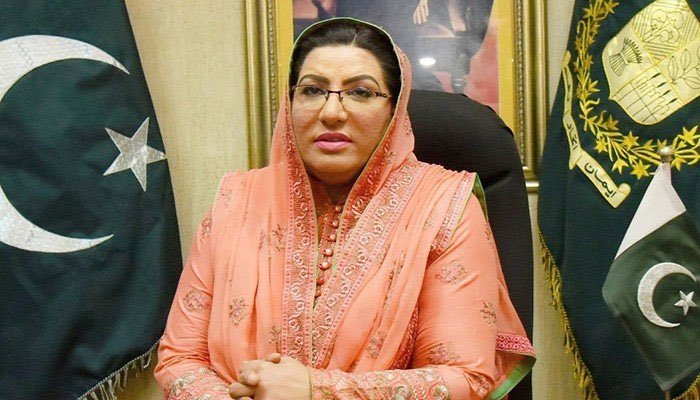
While the grim reaper’s ‘COVID-19 whetted’ scythe continues to relentlessly cut swathes through humans all over the world, some of those who were lucky enough to escape its wrath have instead, unfortunately fallen victim to what’s generally referred as “collateral damage.” Given US President Donald Trump’s mercurial disposition, his decision to jettison some important officials who were spearheading the war against COVID-19 comes as no surprise. But for a status quo-ist like Prime Minister Imran Khan to reshuffle his Ministry of Information and Broadcasting (MoIB) is not only a bolt from the blue but equally intriguing, because there appears to be much more to this move than what meets the eye!
The Federal Information Minister, Dr Firdous Ashiq Awan’s performance may have been lacklustre, but to put the blame for this on her leadership skills or competence would be incorrect. The fact of the matter is that by its domineering overreach, Inter Services Public Relations (ISPR), which is the media wing of Pakistan Army, has virtually rendered Pakistan’s Ministry of Information and Broadcasting defunct. Just one example is enough to prove this assertion. On any national decision, whether it be the declaration of war or commencement of a joint army-air force anti-terrorist operation, the prerogative to decide upon and announce the same is invariably that of the government. But this is not always so in Pakistan. Readers would recall that commencement of ‘Operation Zarb-e-Azb’ (which Pakistan Army terms as the biggest anti-terror operation in the world), was announced by ISPR and not the MoIB.
Since this operation became the cynosure of international focus, Rawalpindi realised its humongous faux pas and, on its directions, MoIB went into a frenzy to control the damage already done and it hurriedly issued the statement that “Assuring his fullest support, the Prime Minister said that entire nation is standing behind its armed forces in this war.” But rather than clear the air, both its text and timing of this statement clearly reflects subservience of the legislature to the army. Perhaps that’s why Rana Banerji, a reputed analyst and Distinguished Fellow at Institute of Peace and Conflict Studies, has so confidently opined that “Zarb-e-Azb’ was the Pakistan Army’s unilateral decision. The civilian government was left with no choice but to fall in line.”
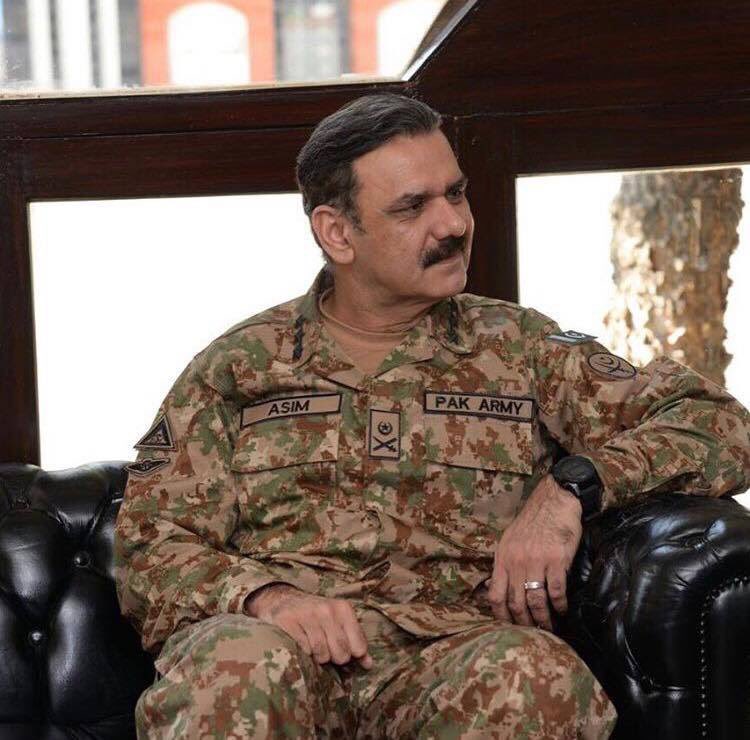
However, the contentious issue isn’t Dr Firdous Ashiq Awan’s removal or her replacement by Senator Shibli Faraz. It’s retired Lt Gen Asim Saleem Bajwa’s nomination as the Special Advisor to Prime Minister (SAPM) for Information and Broadcasting that’s raising eyebrows since its quite apparent that this decision has been influenced by considerations that transcend media related issues. Bajwa has been a former Director General (DG) of ISPR and his experience will certainly give MoIB a more nuanced approach that harmonizes perfectly with the anti-India focus of ISPR. There are no doubts that by talking more about Indo-Pak politics and internal affairs of India rather than matters military, the ISPR had starting to make a laughing stock of itself and that’s why Rawalpindi needs someone like former DG-ISPR Lt Gen Bajwa who can convert MoIB into an effective anti-India propaganda machine!
Pakistan Army’s Lt Gen Asim Saleem Bajwa has been nominated as the Special Advisor to Prime Minister (SAPM) Imran Khan.
Secondly, seeing the way Pakistan Army Chief Gen Qamar Javed Bajwa is repeatedly reminding the nation of how the army is rendering yeoman service in the COVID-19 pandemic and the ISPR’s overdrive on this issue indicates that the army chief isn’t quite happy with MoIB’s army-projection blitz. Perhaps that’s why he’s got his namesake to rejig this department and make it more attuned and dancing to the army’s tune. Lt Gen Asim Bajwa is certainly an excellent choice due to his proven track record of having extricated the Pakistan Army from several extremely embarrassing situations – the most impressive being the ISI-orchestrated abduction and killing of Syed Saleem Shahzad, an investigative journalist and reporter working for the Hong Kong-based Asia Times Online as well as Adnkronos International, an Italian news agency, in May 2011.
By the time Lt Gen Bajwa took over as DG-ISPR, a year since Shahzad’s abduction and murder had elapsed but the army and ISI were still facing the heat due to ISPR’s shoddy handling of this case. In the first place, ISPR failed to advise ISI against issuing any statement denying its role in the murder of Shahzad. Spy agencies generally don’t get directly involved in the business of issuing statements or rebuttals but in this case, the ISI made the colossal mistake of doing so, and rather than dispelling suspicions regarding its involvement, this denial only ended up raising more doubts about the ISI’s involvement.
Even the then US Chairman of the Joint Chiefs of Staff, Admiral Mike Mullen went on record to say that Shahzad’s murder “was sanctioned by the government (of Pakistan).” To add to Pakistan Army’s woes, just two and a half months before Lt Gen Bajwa became DG-ISPR, Paris-based Reporters sans Frontiers (RSF) or Reporters Without Borders, published a scathing report titled ‘Intelligence agency choking under heaps of blame in murder of journalist Saleem Shahzad’, indicting ISI and Pakistan Army. Lt Gen Bajwa deftly handled this crisis and soon Shahzad’s sensational abduction and murder that had enraged RSF, rights groups, civil society, media persons as well as the general public in Pakistan, became a mere input in Pakistan’s burgeoning list of media persons killed by “unknown persons,” and soon forgotten!
But this move has yet another spin-off. Besides commanding the Pakistan Army, Gen Bajwa is also a member of the newly formed National Development Council (NDC) headed by an obedient Prime Minister and so, he has a finger in every pie. But what he lacks is the charisma of his predecessor Gen Raheel Sharif and it’s no secret that it was Lt Gen Bajwa who as DG-ISPR had conceived and executed the unobtrusive but marvellous image projection plan that elevated army chief Gen Raheel Sharif to the status of a demigod. So, even as reorienting the MoIB’s focus on India bashing, in sync with the ISPR, will serve Rawalpindi’s interests of ensuring that there’s no meeting ground for Indo-Pak dialogue, the former DG-ISPR will also be able to use his new position to work towards giving his namesake army chief the image of the modern day Ataturk of Pakistan!
Tailpiece: Whether an army man breathing down the
neck of a Prime Minister on media matters will do Islamabad any good can’t be
said; but for Rawalpindi, it’s surely a ‘win-win’ situation!
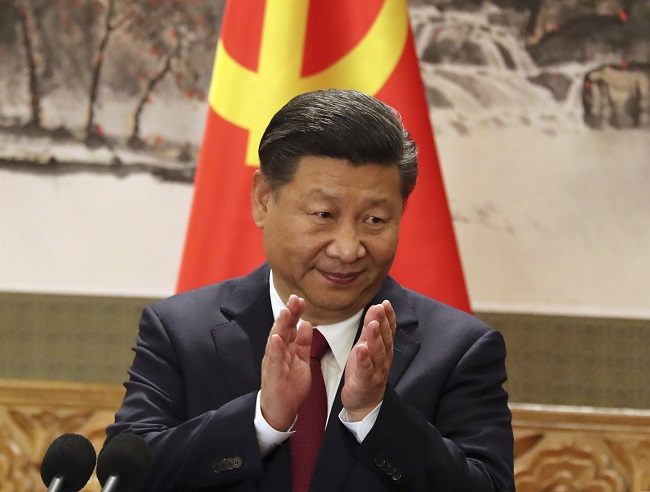
It’s not simply the terms of trade, rather the rise of China and the possibility of it overtaking US as the world’s greatest power that is at stake. At the beginning of the Trump administration, some commentators suggested that before he left office, China would overtake the US in terms of size of its economy.
Since then US’ growth has accelerated, thanks to Trump’s Keynesian-style government-backed tax cuts for business, while China’s growth has remained at a stable level — at more than double that of the US.
In his election campaign, US President Donald Trump had asserted fairer trade for the US. However, the push has him fighting with some of America’s oldest trading partners, China in the lead. With China, particularly, the US is embroiled in a tit-for-tat tariff battle on several fronts over the past few months. Mr Trump has imposed taxes on imports from China, Mexico, Canada and the EU, to encourage consumers to buy American products. All of these countries have retaliated. The world is keenly watching, albeit, with much concern, the ramifications of world’s two largest economies that are wrangling for global influence. China has accused the US of launching the “largest trade war in economic history.”
New import tax regime unfolded by the US will take effect from September 24, starting at 10% and increasing to 25% from the start of next year unless the two countries agree on a deal. The US president said if China retaliates then Washington would impose fresh tariffs on $267 billion worth of Chinese products. If Trump goes ahead with that
round of import taxes, it would mean virtually all of China’s exports to the US
would be subject to duties.
Mr Trump asserts that he wants to stop the “unfair transfers of American technology and intellectual property to China” and protect jobs.
The dispute dates back to January, with the US slapping controversial tariffs on imported washing machines and solar panels. Earlier the US had pulled out of the TPP (Trans-Pacific Partnership) to renegotiate the North American Free Trade Agreement (NAFTA).
The issue of imbalance in the US-China trade is an important phenomenon no doubt. For example, the International Monetary Fund (IMF) says an escalation of the tit-for-tat tariffs could take 0.5% off the global growth by 2020. This notwithstanding, the reverberations of a trade war are much louder in the strategic conundrum as a corollary to the rising crescendo of Chinese economic power with its political fallout on a global level.
The crux of US-China spat is the fiercely growing rivalry between the two for domineering influence in the world. While the US is determined to pursue its perception of economic multi-polarity and benign nationalism as the ingredients of a free and fair world society, China has been stoutly pushing the economic colonialism as the modern mantra for the unipolar power structure. The US considers it a direct challenge to its status as the most powerful country in the world.
Surprisingly, a reputed and much-respected organization called the World Health Organization (WHO), an affiliate of the United Nations, with very clean and appreciable antecedents has become a subject of controversy in the background of the COVID-19 pandemic.
Traditionally, the US has been premier donor to the UN and its various bodies and affiliates with the wide-ranging agenda of serving humanity. Even President Trump had a good word for the WHO. Late in February, when he was still minimizing the impact he anticipated from the Coronavirus on the United States, he had only glowing remarks to make about the World Health Organization’s role in checking the new global threat. On February 24, he tweeted, “The Coronavirus is very much under control in the USA. We are in contact with everyone and all relevant countries. CDC & World Health have been working hard and very smart. Stock Market starting to look very good to me!”
US President Donald Trump’s tweet on February 25, 2020
Suddenly, on April 14, Trump announced from the Rose Garden that he was suspending US funding for the WHO – about $450 million annually, which computes to over 20% of its annual budget. Justifying his decision, the President charged the organization with causing “so much death” by its “mistakes.” He asserted that WHO had failed to warn the world of the seriousness of the new Coronavirus early enough when it could have made a difference.
The President went a step further. He charged WHO with abetting China in a disinformation campaign about the origins of the Coronavirus. He accused China of a subsequent cover-up of the outbreak, an action he said had worsened the impact of the Coronavirus outside China.
Trump’s dismissive attitude towards the world body (UN) is noticeable in the withdrawal of the US from the membership of UN Human Rights Council charging it with a tendency of politicizing human rights issues in their totality. Many insiders in the UN think that by its frugal funding of various important organs of the UN, China has created a clout which she is exploiting for domination of the institutions. Two examples speak loudly. China put its foot down in rejecting the agenda item of G-20 video summit meeting recommending an inquiry into the rise of COVID-19 in Wuhan proposed for March 27. The second example is of China thrice using its veto power to stonewall the Security Council from designating Jaish-e Muhammad and its founder Maluana Masood Azhar as international terrorists.
By and large, UN member states do not consider President Trump’s orders of withholding its donations to WHO that it will prove a setback to the humanitarian work that WHO is doing in different parts of the world. Health experts close to WHO say its officials, including Director-General Tedros Adhanom Ghebreyesus, are frustrated that many of the organization’s 194 member states have paid little heed to the global emergency declaration it issued on January 30 and subsequent guidance for addressing the pandemic. Mr Trump accuses WHO of being slow to inform the world of the gathering threat, but in fact, Director-General Tedros has held nearly daily briefings on the health emergency since late January, often issuing guidance and stark warnings on the consequences of not taking swift mitigating actions.
However, others argue that the world had to pay heavily for China not disclosing the spread of pandemic for at least six weeks from the time it started in Wuhan and had already consumed thousands of lives. They cite the example of former WHO Director-General Gro Harlem Brundtland, also the former Prime Minister of Norway, who took quick and effective steps in 2002 and limited the reach of the SARS epidemic. Not bothered whether she had the authority or not of censuring member states of WHO, Madam Brundtland had handled China on the merits of the case then. Not following in the footsteps of his former Director-General, Mr Tedros had given rise to a wild rumour that WHO was oriented towards Chins in an extremely serious matter that involved the lives of millions of people.
As the controversy over the role of the WHO Director-General rages hot, China has announced a grant of $300 million to WHO to fill the gap caused by the US’ suspension of the grant. Does not that reinforce China’s credibility with the WHO member countries? Debating this issue, Stephen Morrison, Director of the Global Health Policy Center at the Center for Strategic and International Studies in Washington concludes, “Paradoxically it may be that the Chinese become a bigger player. As pandemic is entering a “new phase in which we’re going to see the higher impact in low-income countries … in Africa and Asia where WHO remains a central player, China coming to WHO’s financial rescue now could further muffle any criticism of China’s role in the pandemic.”
Finally, as the world is fighting the pandemic, last week China flexed its naval muscle in the Chinese and the South East Asian Sea and as part of its aggressive posture in the Indian Ocean attacked and sunk a Vietnamese ship accusing it of surveillance in the Chinese waters. India, Japan and the US have taken note of this threatening development.
*The situation escalated fast, the last escalation for Bala happenedin 2014 when he formally renounced Islam and became an ex-Muslim and an atheist. Dr. Leo Igwe has been working hard to providing reportage and acquire international support through the relevant networksin the international freethought community with many hearing the call and acting on it – kudos to all for the support for Bala. This is a legitimate, serious case and could end in death by (religious) law or murder by social reprisal for Bala.After reading the relevant legal and rights documents brought forward by S.S. Umar & Co., who made the formal complaint against Bala, internationally on rights, there is no or very little standing. Nationally, in terms of the Constitution of Nigeria, also, there appears little standing. I won’t go into the details. However, in Northern Nigeria dominated by Islamic jurisprudence privileges, Sharia courtsexist for the claims only the religious can make against the non-religious, i.e., claims of blasphemy. Many Nigerians on social media, appropriately, brought forward the comparison case of hundreds raped, thousands killed, and hundreds of thousands displaced – not to mention the financial costs to the Nigerian economy – because of Abubakar Shekau (Boko Haram leader) who claims the mantle of militant extremist Nigerian Islam (which seems to harm the image for ordinary Muslims far more than Bala), which makes the focus on this case of words online, especially in the midst of a pandemic while using public resources on it, all the more corrosive of the legitimacy of the claims against Bala.*
By Leo Igwe
Two days ago, the police arrested Mubarak Bala, President of the Humanist Association of Nigeria, in Kaduna. Detectives from the Kano State Police Command went to his residence, arrested and later detained him at Gbabasawa police station. According to local sources, the police were planning to transfer him to Kano where some lawyers had lodged a petition against him. They accused him of insulting the prophet Muhammad. The police should not take Mubarak to Kano due to the following reasons.
First of all, the police will be putting Mubarak’s life at risk if they do so. The police know this. And the concern has been registered with the Force headquarters in Abuja, the AIG at the zonal headquarters, and the commissioner of police in charge of the state command. Before his arrest, Mubarak received several death threats from Muslims in Kano who were angry with his posts and writings. They threatened to kill him if they could find him. According to Mubarak, one of those who made the threats was a police officer in Kano. So are the police taking him to Kano to be tried or to be killed?
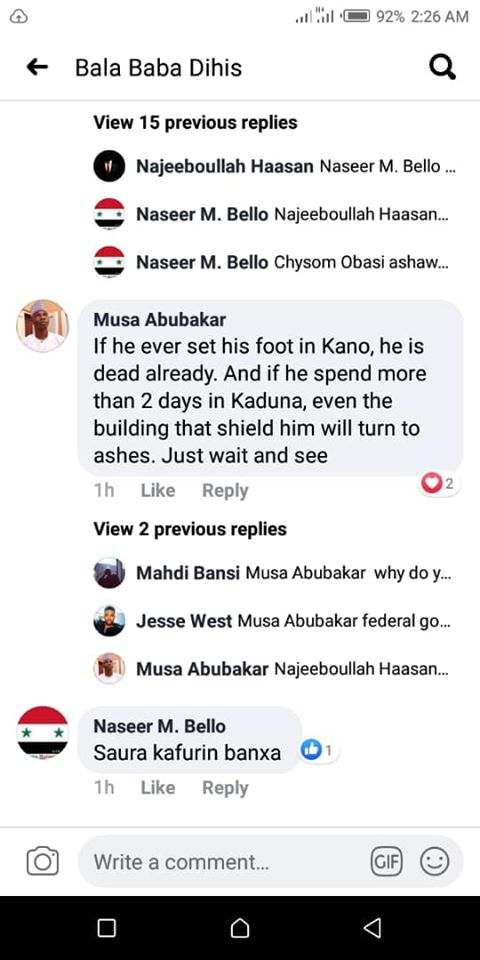
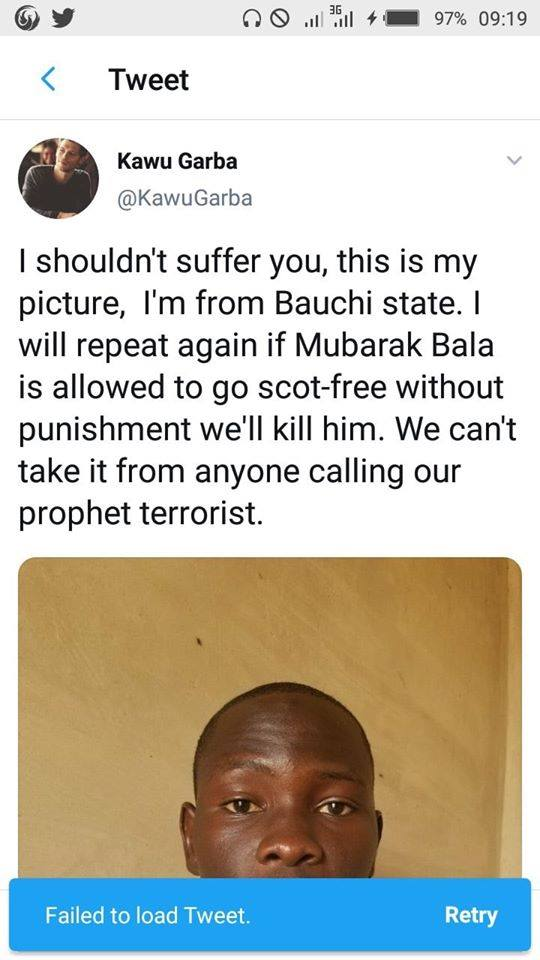
Mubarak informed me that a military officer had threatened to murder him some time ago. Following his arrest, there have been several threats from Muslims who plan to attack and kill Mubarak. These are not idle talks but unequivocal declarations of intent to shed the blood of this foremost humanist. So the threats should not be taken for granted or swept under the carpet. One of those who issued the threat on Facebook said that Mubarak would be killed if he set foot in Kano. That the police post in Kaduna where he was detained would be razed to the ground if they kept him there for more than two days. Another potential assassin, Kawu Garba stated that if Mubarak was acquitted, “We will kill him”. In the message, Garba went further to say: “Quote me.”
Now, these are not made up stories and hearsay but statements of intent by bloodthirsty individuals vying to eliminate Mubarak Bala. Mubarak informed me that these threats did not only emanate from jihadists in Kano but also from their allies in other parts of Northern Nigeria including Northern Nigerian Muslims living as far away as Saudi Arabia. They were not only male but also female.
Another reason is that Kano has a history of religious bloodletting, of ‘judicial’ and the extrajudicial killing of blasphemers. The Islamic mobs usually call the shots and determine the fate of those who are accused of blasphemy. Police investigation and prosecution of alleged blasphemers are a charade. They are usually a window dressing, conducted to placate the mob, not to uphold the rule of law and justice. There is nothing which shows that the case of Mubarak would be different. There is grave concern that Mubarak could be murdered while in police custody as Gideon Akaluka was in the 90s. Some think that while in detention, the jihadists would come in large numbers, overpower the police, burnt down the police station and kill Mubarak. The police should not pretend that they do not know that this is a likely possibility; that this has happened in the past and could happen to Mubarak.
Yet another serious concern is that if taken to Kano, Mubarak would be tried at the sharia court. Kano state has a very active sharia police. Meanwhile, efforts would be made to force him to return to Islam while in detention. Otherwise, he will be tried and if convicted of apostasy and blasphemy under the sharia penal code of Kano state, Mubarak will be sentenced to death. He would languish in jail until he is executed or returns to the Islamic faith.
Moving Mubarak to Kano is a risky and dangerous undertaking that could lead to his death. It is my submission that Mubarak Bala will not receive a fair hearing and investigation in Kano, that is if he lives to be investigated and tried.
Again, I want to draw the attention of the police that a thorough investigation could be carried out without taking Mubarak to Kano and endangering his life. Mubarak was born in Kano but does not live in Kano. He lives and works in Kaduna. Mubarak was accused of posting comments on Facebook that insulted Prophet Muhammad. Facebook is not domiciled in Kano. It is an online facility. So any crime supposedly committed on Facebook could be investigated from anywhere in the country.
In conclusion, the police should give priority to Mubarak’s safety and security; they should take the death threats seriously. The inspector general police should take urgent steps to move Mubarak’s case to a neutral place where an impartial investigation and a fair hearing would be conducted.
India’s top ayurvedic doctor, who once treated Apple big boss Steve Jobs, has sought the support of Prime Minister Narendra Modi to develop a wonder drug for Covid-19. In a letter dated April 19, 2020, to Modi, Balendu Prakash, an ayurvedic practitioner who lives in Dehradun, said he had actually developed the drug that could push immunity levels to great heights and protect people from the deadly Coronavirus.
Prakash, 61, said he was in a position to develop the wonder drug because of his vast experience in treating patients suffering from a host of deadly diseases like blood cancer, multiple sclerosis, chronic pancreatitis, nutritional anaemia and migraine.
“I seek your help, and I seek support from the Ayush Ministry to ensure this drug reaches every nook and corner of India, ” Prakash wrote in his letter, a copy of which is with this reporter.
It was not immediately known if the Prime Minister’ s Office (PMO) had responded to Prakash’ s request.
Dr Balendu Prakash, an ayurvedic practitioner (Vaidya), has written to PM Narendra Modi that he has developed an ayurvedic medicine that could push immunity levels to great heights and protect people from the deadly Coronavirus.
Prakash told this reporter that his wonder drug is a combination of a multiple of ayurvedic concoctions which include Lakshmi Vilas Ras, Mahadev Kahwa, Sanjeevani Siddh Yog Sangrah Booti, Sitopaladi Siddh Yog Sangrah Churna and Zandu Senxcure (the last name sounding more of an allopathic drug). “The government should help open clinics across India so that this drug can be made available to millions across India. These have all been clinically tested and I am confident of these drugs guaranteeing positive results,” said Prakash.
But there is a problem. Prakash says he would need a huge marketing initiative in delivering the drugs to millions across India by setting up special clinics, something which only the government can ensure. Secondly, there have been occasions when ayurvedic drugs have come under the government scanner for using prohibited materials.
Still, Prakash — considered the topmost ayurvedic doctor (read Vaidya) in India, is confident his drugs will do wonders to the millions. He said he even wrote to Rajesh Kotecha, secretary in the Ayush ministry, about his long clinical experiences in successfully treating Allergic, Viral and Infective Rhinitis by using what he claimed was his brand of rasaushadhis with certain dietary advice.
“A herbo-mineral formulation developed by me has established significant therapeutic effect in the treatment of Acute and Persistent Allergic Rhinitis in comparison to Levocetirizine (an allopathic drug). The product has also depicted anti-histamine and immuno-modulatory properties in in vitro studies. The product is commercially available in the market as Zandu Snez Cure. I strongly believe that rasaushadhis could be used in the COVID-19 affected population in the active or quarantine phase, ” he wrote in his letter.
Bharatiya Janata Party national spokesperson and Rajya Sabha MP Anil Baluni has thrown his weight behind Prakash, asking the BJP leadership in New Delhi to sympathetically look into the demands of the seasoned ayurvedic practitioner.
There has been increased global interest in traditional medicine across the world. In the West, there are renewed efforts to monitor and regulate traditional herbal medicine. Ayurveda, the traditional Indian medicine, remains the most ancient yet living traditions. Although India has been successful in promoting its therapies with more research and science-based approach, many — especially those belonging to the allopathic camp — say it still needs more extensive research. Increased side effects, lack of curative treatment for several chronic diseases, high cost of new drugs, microbial resistance and emerging, diseases are some reasons for renewed public interest in Ayurvedic alternative medicines.
Interestingly, the Goa government has started an integrated treatment for COVID-19 patients and those under quarantine by using both allopathy and ayurveda. Chief Minister Pramod Sawant said Goa was the first State to use allopathy and ayurveda in treatment of COVID-19 patients and to boost the immunity of those in quarantine. “This has been done in consultation with the team of doctors treating COVID-19 cases in Goa. In association with the AYUSH ministry, a mobile app for the purpose has also been launched, ” he said.
Sawant said he was confident Ayurvedic drugs will boost immunity. “The patients and those under quarantine will be given guidance on how to use ayurveda to boost their immunity,” he said.
Ever since Coronavirus has struck India, ayurvedic experts have been stressing on the need to explain ancient ayurvedic principles of cooking in a modern context so that the novel Coronavirus crisis is slightly easy to get by. “Recent findings indicate that Amyloid toxins are responsible for type-2 diabetes followed by heart problems, kidney problems, liver issues and Alzheimer’s. Ayurveda has described them as Ama 5000 years ago,” Dr Smita Naram, founder and CMD of Ayushakti, was quoted by a news portal.
“During this pandemic, building immunity is the key.” Dr Naram, who is known for her deep knowledge of ancient wisdom, said it is imperative for people to maintain a balance of doshas. The three doshas of Vatta, Pitta and Kapha must be balanced, she said.
On doshas and eating in accordance to it, Dr Smita Naram said, “Symptoms of high pitta are often headache, acid burning or skin issues, anger and sharp mind. To balance pitta, drink a warm herbal tea concoction with cumin, coriander and fennel powder (1 teaspoon each) and a tablespoon of ghee. Have this in the morning. Avoid sour, fermented and spicy food if you have high pitta.”
“Symptoms of excess vata include wavering mind, fear, depression, difficulty in sleeping, stiffness, pain and gas. Home remedy at night includes drinking a concoction in the night. It is made by adding one teaspoon of castor oil with warm water, ginger and coriander. Excess kapha symptoms are weight gain, slow decision making, rigid mind and frequently getting mucus in the respiratory system,” she told the portal.
“One must keep digestion and metabolism active. The symptoms of ama toxins in your body include white coating on the tongue, heavy stool stink in the toilet, weight gain, lethargy after food and a confused mind,” she said while explaining the principles of ayurveda.
Only the Ayush Ministry has the capacity and power to push a billion plus nation to consume ayurvedic drugs across.
The entire world is estimating a deep recession in 2020 due to COVID-19 pandemic. United Nations has projected that the global economy may shrink by up to 1% in 2020, a reversal from the previous forecast of 2.5% growth. It may contract even further if restrictions on the economic activities are extended without adequate fiscal responses. The COVID-19 pandemic is disrupting global supply chains and international trade. Millions of workers and professionals are facing the bleak prospect of losing their jobs. To avert a sharp economic downturn governments across the world are considering large stimulus packages. Some have even begun rolling out these stimulus packages.
The economic scenario is not much different in India due to the challenge posed by the pandemic. However, being a largely agricultural country does India has some advantages? Can the country fully leverage the potential of agriculture sector in reviving the economy? To understand how farming in India will help reboot the country’ economy, firstly we have to comprehend the agriculture sector’s contributions to the Indian economy.
Unlike western countries, around 60-70% of Indian population (directly or indirectly) depends on agriculture sector and currently it contributes to 16-17% of the GDP. India hosts nearly one fourth of the world’s farmers and possess 48% of world’s arable land. While the country has made significant strides in many off-farm sectors (service sector, industrial production etc.), agriculture continues to be the lifeline of the country, especially for the 64% Indians living in rural areas. Today, India is the world’s largest producer of milk, pulses; second largest producer of rice, wheat, fruits, vegetables and overall is the third largest producer of food grains. Agriculture also continues to remain the only sector that has a direct combined impact on poverty, rural livelihoods, health and nutrition.
The most fundamental step that needs to be done during this slowdown to leverage the potential of agriculture sector is to make the farming sector economically viable in the coming months. Some of the suggestive measures that could be implemented are given below.
Promoting group farming by forming Farmers Producers Organisations (FPOs)
The agriculture sector in India is hampered by high transaction costs and low access to credit and agricultural produce markets. One potential solution could be the formation of Farmers Producers Organisations (FPOs) and promoting group farming through them. There are several legal entities which aim to help farmers reap benefits of economies of scale via aggregation and FPOs are one such farmers’ aggregate. In the context of traders and middle men being the main source of price information and marketing, group farming and effective functioning of FPOs have a potential to give better collective bargaining power to farmers and thereby reduce the importance of middlemen traders in the value chain and improved price realisation by farmers through direct marketing of their produce. These farmers’ owned body can also channelise more institutional credit and government facilities for agricultural investment.
Develop trust building measures between farmers and financial institutions
Majority of small-holder farmers have a fear of taking loans from banks/financial institutions. The reason being, if they do not get good crop yields, they will not have the money to repay the loan. For poor farmers, land is their only asset and they are wary that they will have to mortgage or sell off their land to repay loans. A trust building measure needs to be taken by the bankers and officials from agriculture & extension departments. There is a need to come up with strategies to educate the marginal and smallholder farmers about the procedural aspects of loan repayment and the way forward for farmers if there is any loss of crops due to climate.
Recognising the role of women in farming and supporting them
Every year, a large number of male farmers leave agriculture for off-farm jobs; often leaving agriculture to women farmers who play an extremely important (yet mostly unrecognised) role in farming. Today, women are over 40% of the agricultural workforce in India. The increasing proportion of women farmers also means that agricultural yields and the overall agricultural output of India depends, to a large extent, on women’s participation. However, still their access over resources remains very low as compared to their male counterparts. Only less than 10% of India’s land is owned by women. According to some estimates, if women farmers are provided the same resources as their male counterparts, yields can be increased by as much as 30% per household and country can experience an increase of 2.5 to 4% in agricultural output. To achieve such outcomes, country needs to eliminate gender inequalities in agriculture. Ensuring the registration of all women farmers who do not own land in their name as cultivators in the land documents through systematic sensitisation of revenue department will be a step forward towards giving security for land use. Also, it will be a good idea to ensure that women farmers get subsidized bank credit by facilitating issuance of Kisan Credit Cards in their names.
Propagating the concept of Mahila Krishi Champion
Considering the role of women in agriculture, an attempt could be made to identify the progressive women farmers who contribute immensely and extraordinarily in the agriculture sector. Such women should be recognised and rewarded (reward could be in form of simple appreciation or incentives through cash or agricultural equipment etc.) to boost up their morale. These women may be termed as “Mahila Krishi Champion” and their stories can be projected and popularised as role models so that it can influence and motivate other female farmers too.
Promoting ICT-based farming
Information and Communication Technology (ICT)-based farming can support efforts to cope with an increasingly uncertain climate, including more frequent extreme weather events and more variable rainfall patterns, and the resulting effects on agriculture.
Contingent and regional crop planning
Climate variability in terms of the frequency and quantum of rainfall and temperature regimes varies across the country, as also within the same agro-ecological zone. Hence, having a contingent crop plan well in advance for the main cropping season helps prepare farmers for weather aberrations during the particular year. Also, ensuring regional crop planning and the agro-climatic zone model will make the agriculture profitable and sustainable.
Establishing weather stations
To better equip farmers to respond appropriately to climate variations and to minimise risks, having local automated weather stations at appropriate distances will help generate locale-specific crop-weather advisories.
Promoting indigenous crop varieties
Promotion and revival of indigenous crop varieties should be done to reverse the loss of agro-biodiversity caused due to market drivers. Indigenous crops are more resilient to climate variations and farmers have better knowledge of handling them. Communities need to be encouraged to preserve the heirloom varieties of seeds in seed banks, while rotating their stock each year to ensure that adaptability is retained.
In both farm and non-farm sectors there is a huge potential of upswing, increasing the ratio of farm to non-farm income to 70:30 by 2022-23 from the present 60:40. According to the agriculture census 2015-16, the real income of farmers doubled in almost 20 years from 1993-94 to 2015-16. In the given economic scenario also, only agriculture can reboot the economy, sustain millions of lives and at the same time reduce global warming.
We use cookies on our website to give you the most relevant experience by remembering your preferences and repeat visits. By clicking “Accept All”, you consent to the use of ALL the cookies. However, you may visit "Cookie Settings" to provide a controlled consent.
This website uses cookies to improve your experience while you navigate through the website. Out of these, the cookies that are categorized as necessary are stored on your browser as they are essential for the working of basic functionalities of the website. We also use third-party cookies that help us analyze and understand how you use this website. These cookies will be stored in your browser only with your consent. You also have the option to opt-out of these cookies. But opting out of some of these cookies may affect your browsing experience.
Functional cookies help to perform certain functionalities like sharing the content of the website on social media platforms, collect feedbacks, and other third-party features.
Performance cookies are used to understand and analyze the key performance indexes of the website which helps in delivering a better user experience for the visitors.
Analytical cookies are used to understand how visitors interact with the website. These cookies help provide information on metrics the number of visitors, bounce rate, traffic source, etc.
Advertisement cookies are used to provide visitors with relevant ads and marketing campaigns. These cookies track visitors across websites and collect information to provide customized ads.
Necessary cookies are absolutely essential for the website to function properly. These cookies ensure basic functionalities and security features of the website, anonymously.
Cookie
Duration
Description
cookielawinfo-checkbox-analytics
11 months
This cookie is set by GDPR Cookie Consent plugin. The cookie is used to store the user consent for the cookies in the category "Analytics".
cookielawinfo-checkbox-functional
11 months
The cookie is set by GDPR cookie consent to record the user consent for the cookies in the category "Functional".
cookielawinfo-checkbox-necessary
11 months
This cookie is set by GDPR Cookie Consent plugin. The cookies is used to store the user consent for the cookies in the category "Necessary".
cookielawinfo-checkbox-others
11 months
This cookie is set by GDPR Cookie Consent plugin. The cookie is used to store the user consent for the cookies in the category "Other.
cookielawinfo-checkbox-performance
11 months
This cookie is set by GDPR Cookie Consent plugin. The cookie is used to store the user consent for the cookies in the category "Performance".
viewed_cookie_policy
11 months
The cookie is set by the GDPR Cookie Consent plugin and is used to store whether or not user has consented to the use of cookies. It does not store any personal data.