Home Blog Page 409

Philosophical and Historical Foundations of American Secularism 4 – Anti-Catholic, Anti-Religion, and Non-Religion

0

Dr. Herb Silverman is the Founder of the Secular Coalition for America, the Founder of the Secular Humanists of the Lowcountry, and the Founder of the Atheist/Humanist Alliance student group at the College of Charleston. He authored Complex variables (1975), Candidate Without a Prayer: An Autobiography of a Jewish Atheist in the Bible Belt (2012) and An Atheist Stranger in a Strange Religious Land: Selected Writings from the Bible Belt (2017). He co-authored The Fundamentals of Extremism: The Christian Right in America (2003) with Kimberley Blaker and Edward S. Buckner, Complex Variables with Applications (2007) with Saminathan Ponnusamy, and Short Reflections on Secularism (2019).

Here we talk about the founders and beliefs.

Scott Douglas Jacobsen: As you noted the anti-Catholic nature of some of the framers of the American Constitution, you provided some insight into the ways in which the nature of the deism of the brightest American minds of the time represented something more akin to non-religion or a nearly modern notion of secularism in America with the base separation of church and state. 

My suspicion: if in an alternate universe in which Charles Darwin published On the Origin of Species (by Means of Natural Selection, or the Preservation of Favoured Races in the Struggle for Life) in the era of the framers of the American Constitution, then the established-as-deists would have identified and affirmed an atheist viewpoint of the world because biological, organic life must have seemed utterly incomprehensibly complicated and functional without the modern and fundamental theoretical basis for all life sciences. 

You and I live as modern secular and freethought people with due credit to the deists and pantheists of the previous generations. I decline any sentiment or argument as anti-Catholics or anti-religious-people – to individual religious believers, hierarchs, intellectuals, scientists, theologians, or similars, but affirm anti-Catholicism and anti-religion – to abuses of power, belief structures, beliefs, ideological stances, institutional orthodoxy, institutions, purported authority and inspiration of holy texts, supernatural and magic powers, and the like – and also affirm non-religion as in secularism within a more modern interpretation.  

When did anti-Catholicism and anti-religion wane amongst the framers or their descendants leading more into non-religion if there was any distinct set of moments or period in time? How were the seeds of modern atheist and non-religion movements set at the founding of America? How did the massive influx of religious immigrants change the landscape of America – its demographics? What amendments to the American Constitution have been important to the establishment equality of freethought and secular American citizens?

Dr. Herb Silverman: I agree with you that many eighteenth-century Deists might have been atheists had they been familiar with the work of Charles Darwin. However, Darwin’s theory of natural selection only explains that we have a variety of species, including human animals, because they adapted to their environment. Evolution says nothing about how life began. Many Deists would probably still have believed in a Creator who started the process, and then let nature take its course.

Later scientific discoveries would probably have turned these Deists into atheists. We now know that our universe did not begin with a Creator, but with a “Big Bang” approximately 13.8 billion years ago. We still don’t know how life began, although abiogenesis is a reasonable hypothesis. This is the natural process by which life has arisen from non-living matter, such as simple organic compounds. It’s interesting that Bible believers refuse to believe this hypothesis about life arising from non-life, though they believe that the first human was made from dirt and the second human from the rib of the first. Did God run out of dirt?

Since we don’t know for sure how life began, I understand why some people attribute life to a Creator. I can’t prove they are wrong, but I can prove that those who regard the Bible as a scientific book are wrong. I’m an atheist because I see no evidence for the existence of any gods, not because I can prove there are no gods.

You mention that you affirm non-religion. I do, too, but I would rather say that I affirm nontheism, meaning no gods. There are religions without gods or supernaturalism. As an atheist, some people assume I must be anti-religion. Not so. By one measure, I might be the most religious person in America. You see, I have not one, not two, but three different religions: I’m a member of the American Ethical Union, with Ethical Culture Societies; I’m a member of the Society for Humanistic Judaism, with atheist rabbis; and I’m a member of the Unitarian Universalist Humanists. All three religions are nontheistic and are active participants in the Secular Coalition for America.

When our nation was founded, not just anti-Catholicism flourished. There were 150 attacks against Baptists in Virginia between 1760 and 1778, many by leaders of local Anglican churches. In the seventeenth century, Massachusetts hanged people for being Quakers. The first “War on Christmas” was initiated by Puritans because the Bible did not sanction the holiday, and they believed Christmas was invented by Catholics and pagans, who engaged in too much merriment and drinking. The Puritans promoted Protestantism, the religion invented to protest Catholicism.

At America’s founding, 98 percent in the colonies were Protestant, but the divisions among Protestant sects and between Protestants and Catholics were intense. Some people were Protestant in name only, while others were fervent believers in their sect. Only 17 percent in 1776 attended church, so not many were passionate about their religion. Such indifference might indicate a large number of freethinkers in the colonies, including Deists and maybe even atheists.

Some of our framers, including James Madison, wanted the “no religious test” clause in the United States Constitution to apply to all states. That failed to pass. Initially, eleven of the thirteen states had religious tests, stipulating that only Christians, or in some cases only Protestants, could hold public office. A notable exception was Pennsylvania, founded by the Quaker William Penn. He decreed that Pennsylvania would be a “Holy Experiment” in toleration. All sects, including freethinkers, were welcome. Penn also founded Philadelphia, my birthplace, which is known as the city of brotherly love. Philadelphia is Greek for “brotherly love.” Philadelphia had the only Catholic church in the colonies that was protected by the authorities.

The influx of immigrants throughout its history has made America more religiously diverse. For that reason, there has always been an anti-immigrant constituency who feared the religion of the immigrants, and how that could change the values of the country. Initially the opposition was to Catholics, and today it is to Muslims. We have an opportunity now to show the world how people of different faiths and none can coexist and thrive. Founder James Madison argued that the best way to promote religion was to leave it alone. Previously, those who wanted to encourage religion had enlisted the government’s help. Without government support, America now has 360,000 houses of diverse worship.

Today Protestants, Catholics, and other Christians put aside some of their theological differences to work together on important political issues, and grab media attention. I disagreed with everything the Christian Coalition, founded in 1989 by Pat Robertson, stood for (preventing women from having access to reproductive health care, promoting that evolution is just a myth, contending that our country was founded as a Christian nation, opposing LGBT rights, demonizing atheists and secular humanists). Nevertheless, they helped change the culture, and made politicians take notice. The Secular Coalition for America is a counter to the Christian Coalition and its successors, and SCA member organizations are working together to keep the country secular, not theocratic.

The First Amendment to the U.S. Constitution guarantees freedom of religion, the right to practice any faith or none. Some people, including politicians, wrongly say that we have freedom OF religion, not freedom FROM religion. This is, of course, nonsense. You can’t have “of” without “from.” Giving people the right to believe also guarantees the right not to believe.

Finally, the 14th Amendment to the U.S. Constitution has been important to secular Americans. It says that constitutional rights guaranteed by the federal government must apply to all states, regardless of state laws. The amendment passed in 1868, after the Civil War, and granted citizenship and equal rights to slaves who had been emancipated. This amendment was also the basis of my winning court case when I learned that the South Carolina Constitution prohibited atheists from holding public office, a clear violation of the 14th Amendment because the U.S. Constitution prohibits religious tests for public office.

Jacobsen: Thank you for the opportunity and your time, Dr. Silverman.

Photo by LAUREN GRAY on Unsplash

Meghna Gulzar’s thriller Raazi shines at IIFA Awards 2019

The 20th edition of International Indian Film Academy Awards (IIFA) was a star-studded night at the SVP Stadium in Mumbai. Actors Radhika Apte and Ali Fazal hosted the night where Bollywood’s A-listers including Salman Khan, Deepika Padukone, Ranveer, Shahid Kapoor, Ayushmann Khurrana, Vicky Kaushal, Katrina Kaif and Alia made their way up the green carpet.

At IIFA 2019 Meghna Gulzar’s thriller Raazi, featuring Alia Bhatt and Vicky Kaushal, claimed Best Picture award at the 20th International Indian Film Academy (IIFA) Awards. Alia Bhatt also won ‘Best Actor Award (Female)’ for ‘Raazi’. Actor Ranveer Singh won ‘Best Actor (Male)’ for his outstanding performance in ‘Padmaavat’. ‘Best Supporting Actor (Female)’ went to Aditi Rao Hydari for ‘Padmaavat,’ while ‘Best Supporting Actor (Male)’ to Vicky Kaushal for ‘Sanju’. ‘Best Story’ award went to ‘AndhaDhun’ and ‘Best Director’ to Sriram Raghavan. Meanwhile, Best Playback Singer awards went to Arijit Singh for ‘Ae Watan’ & Harshdeep Kaur for ‘Dilbaro’ for ‘Raazi’. Overall, Raazi won four honours while Padmaavat and AndhaDhun won two.

The evening also saw the Outstanding Achievement in Cinema award being bestowed upon veteran actor Jagdeep. Director Ramesh Sippy and Ranveer presented him the honour.

The big show had some amazing performances by Neha Kakkar, Tulsi Kumar, Jassi Gill, Salim Sulaiman among others. The event also showcased the collection of ace designers Shantanu & Nikhil and Kunal Rawal.

Here is the full list of 2019’s IIFA Award winners:

Playback Singer (Male): Arijit Singh for Ae Watan (Raazi)

Playback Singer (Female): Harshdeep Kaur, Vibha Saraf for Dilbaro (Raazi)

Best Lyrics: Amitabh Bhattacharya for Dhadak (Dhadak)

Best Music Direction: Amaal Mallik, Guru Randhawa, Rochak Kohli, Saurabh-Vaibhav, Yo Yo Honey Singh, Zack Knight for Sonu Ke Titu Ki Sweety.

Best Performance in a Supporting Role (Male): Vicky Kaushal for Sanju

Best Performance in a Supporting Role (Female): Aditi Rao Hydari for Padmaavat

Best Debut- Male: Ishaan Khatter for Beyond the Clouds and Dhadak

Best Debut- Female: Sara Ali Khan for Kedarnath

Best Performance in a Leading Role (Male): Ranveer Singh for Padmaavat

Best Performance in a Leading Role (Female): Alia Bhatt for Raazi

Best Story: Sriram Raghavan and Pooja Ladha Surti for AndhaDhun

Best Direction: Sriram Raghavan for AndhaDhun

Best Picture: Raazi

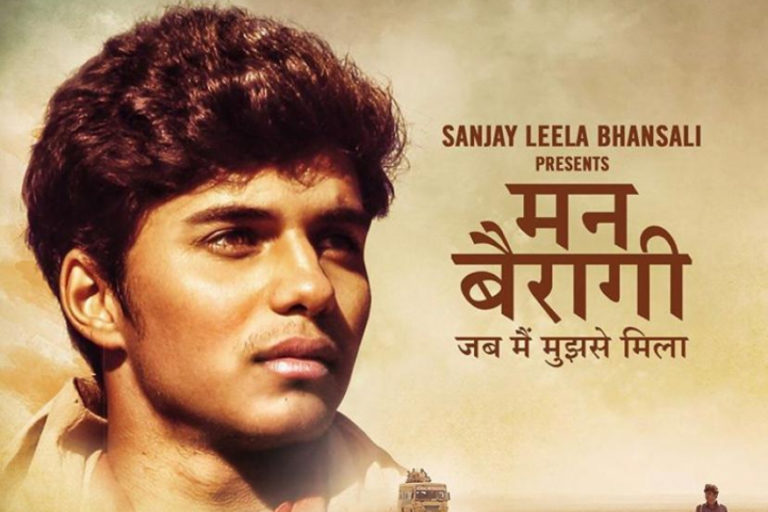
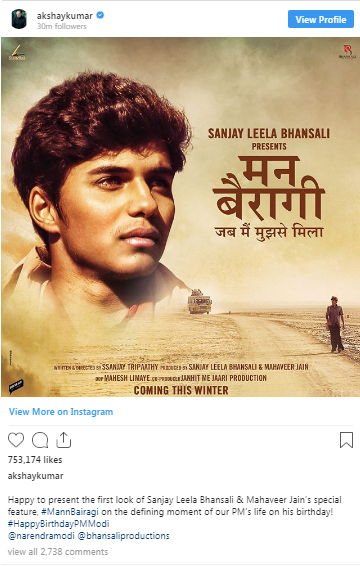
Akshya Kumar and Prabhas unveil first look of Mann Bairagi

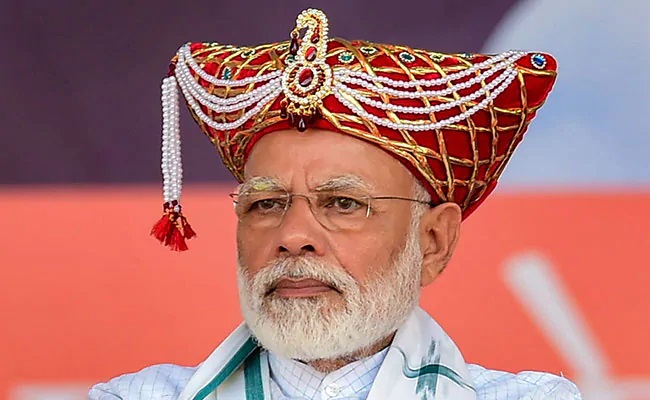
Prime Minister Narendra Modi, it seems, continues to be popular in Bollywood. After Omung Kumar’s PM Narendra Modi, starring Vivek Oberoi in the lead, another film of the Prime Minister is in the offing. Titled as Mann Bairagi, the film is co produced by Sanjay Leela Bhansali.

Based on Prime Minister Narendra Modi’s youth, the film will be an hour-long. Its first-look poster was unveiled by actors Prabhas and Akshay Kumar on the PM’s 69th birthday on September 17. It was shared by the actors on their twitter profile also.

The film is written and directed by Sanjay Tripaathy and co-produced by Mahaveer Jain and Sanjay Leela Bhansali. Talking about why the film caught his interest, Bhansali said, “The story was very well-researched, and the turning point of our PM’s life as a young man, really intrigued me. I felt that it’s an unheard story which needs to be told.”

Sanjay Tripaathy is confident that the film will strike a chord with the audience across generations. Talking about it he said, “For me, it’s a human interest story about the self-discovery of a person who went on to become such a strong leader of our country.” Co Producer of the film Mahaveer Jain is also confident about the film connecting with the youth. “Mann Bairagi brings out that defining moment in the journey of our PM which has not been in public knowledge so far. I am sure it will connect and inspire today’s youth deeply, and that’s what excited us to work on this film,” he said.

The poster says the film is “coming this winter”, indicating that the film might be released in December.

Slew of economic stimuli brings back the shine on Brand Modi

Barely few days ahead of Prime Minister Narendra Modi’s visit to the US and his meeting with American President Donald Trump, India’s finance minister Nirmala Sitharaman has brought good news for corporate India. She has doled out sops for companies and announced an array of economic stimulus aimed at accelerating economic growth. The recent announcements have brought back optimism in corporate boardrooms.

Insiders say that talks of economic slowdown in the country followed by reports of job losses and shrinking investments had started to erode the value and power of Brand Modi.

“He is back..Brand Modi is in news once again,” an analyst pointed out, requesting anonymity.

On Friday, the finance minister slashed corporate tax rate for domestic companies from 30% to 25.17% which includes all cess and surcharges. Among other things, domestic manufacturing companies that have been incorporated after October 1 can opt to pay income tax at 15%. Effectively, this will be 17.01% inclusive of surcharge and tax.

The new rates will be applicable from April 1.

The announcement of the new tax rates has provided a much-needed booster for economic growth, which slowed to a six-year low of 5% during the April to June quarter of the current financial year. More importantly, it has managed to spin positive sentiments — essential for investments, growth and more importantly jobs.

Today’s announcements will give PM Modi a huge opportunity once again to showcase India as an investment destination. High tax rates have been one of the major reasons for low investments. The late finance minister Arun Jaitley too had pointed out the need to lower tax rates for improving compliance, investments and expansion of tax base.  

With the lowering of corporate tax rate to 25.17%, India would be on par with several other Asian economies.

The moot point is: Why didn’t the government announce these measures earlier?

Well, the exchequer will take a hit of Rs 1.54 lakh crore annually due to these measures. The government, until now, had attached more importance to fiscal disciple and consolidation than other critical aspects and this has had a direct impact on economic growth and jobs. Despite the Rs 1.76 lakh crore that it has received from the Reserve Bank of India it will be difficult for the Modi government to adhere to the 3.3% fiscal deficit target this year with these announcements on the tax front.

The government must realise the over-arching importance of boosting the economy, crucial for generating jobs. No government can afford to let the economy be on a slowdown mode while keeping a tight watch on the fiscal path. The government, therefore, need not be over enthusiastic about maintaining fiscal deficit targets at this juncture when the economy does need a shot in the arm– even if it means stretching the target marginally for a year or two.

Kashmiris on the path to take control of their destiny

1

It’s a month and half since the decision to reorganise the state of Jammu and Kashmir into two Union Territories (UTs) was taken. The government has announced that these UTs will become effective on October 31, 2019 which is another one and a half month from now. We are therefore standing in the cusp of this monumental decision. Volumes have been written and spoken on the subject. In the public domain, there has been both approbation and criticism even as the tilt has remained towards the former. In international circles the reaction from Pakistan has been virulent, as was expected, but the country has failed to garner support from other nations except China, and that also to a limited extent.

Within the state, no upheaval has been witnessed in Jammu and Ladakh that roughly forms more than 80% of the geographical area and constitutes about 50% of the population. In the Kashmir region that constitutes about 16% of the territory and about half the population of the state, there is a perceived discontent even though there’s no violent spill-over, as some would have expected and even prayed for, has been witnessed.

Under prevailing circumstances a high degree of acceptance as also in consideration of the fact that the new dispensation is irreversible, the best option would be to look towards the future and see how it can be leveraged for the maximum benefit by the people of the state and the nation at large.

The first benefit is that the malevolent shadow of Pakistan which has been lingering over the state since partition of the sub-continent in 1947 is gone forever. New Delhi has exhibited extraordinary will and courage of conviction to break Pakistan’s bogey and also the ruckus at the international level that this country generates all the time. The people of Jammu and Kashmir can now make decisions in the manner that they deem fit. Pakistan, UN, Organisation of Islamic Conference, US, Saudi Arabia and others to whom their self professed leaders used to go running for help and assistance are not likely to interfere anymore.

With a view of seeing its bold decision hitting firm ground at the earliest, the government is seized with the challenge to provide peace, negate divisiveness and accelerate development within the state. The message to the people is “You root for peace and democracy; the nation will work with you towards employment, development and prosperity.” Such a message would hold great significance to all people in the current world where quality of life is rated above all else and Jammu and Kashmir should be no different.

The people need to strengthen roots of democracy in their state; they need to integrate with their nation and onwards with the world. They need to optimise the resources that their nation is providing for their uplift. This aid is not a favour; it is a necessity to facilitate them in getting over the troubled era of foreign sponsored terrorism; they do not need to show gratitude, they simply need to put it to good use.

The evolving situation has also opened for the people a window of opportunity to go for a leadership change. They can use it to shed the small coterie of self-centered leadership and so-called intelligentsia that has dominated them for decades, rather, since the country gained independence. While the politicians indulged only in self-serving politics that ensured control over the state and its people, the so-called intelligentsia that attempts to take ownership of this so called Kashmir cause had nothing more than a motivated agenda to work on. The divisive agendas based on anarchic contradictions are, by now, well known and need no elaboration. With this new dispensation coming in, the foundation for a more responsive and new set of leaders has been laid. Let the old remain, as democracy dictates, but let them also prove their worth and fight for space with the new.

The new leadership of Jammu and Kashmir should be such that shuns ideological contradictions that are the main cause behind the divisiveness and disruption which plagues the society. Politicians with contradicting views complicate matters. The leadership should instead remain focussed on the well being of the people while following the path of good sense and moderation.

Such a thought process has been well expressed by Lt. General (retired) PS Mehta who is also a son-of-the-soil from Kashmir. “I think the wisdom lies in facing the reality and seeing the present situation as the exit or escape route from the evils of Azaadi and indoctrination by Pakistan and Hurriyat, but with dignity and joining the mainstream socio-politics of the new UTs,” he has said, most aptly, in a comprehensive article.

Despite diverse geographical regions and demographics, Jammu and Kashmir has forever remained rooted in a spirit of brotherhood, mutual trust, democracy and the ability to understand each other’s point of view. It is to the credit of the people of the state, especially the Kashmiri population that they have kept their faith in democratic tenets even in the worst of times. They have, forever, maintained that their problems cannot be resolved by the gun. It is these qualities which will now help in building a new era that will see the people achieving their lost glory and once again getting to the forefront as a highly cultured and prosperous civilisation. Every citizen of the state has to make a contribution in order to maintain this momentum. It is time for the Kashmiri community to become a master of its own destiny. Give peace a chance and then see the results.

A public presentation by Armin Navabi: Humanist Association of Ottawa & Atheist Republic Ottawa Consulate

0

In today’s polarized climate of discourse in the public square, a consistent target of attack has emerged: enlightenment values of free speech, reason, scientific inquiry, and the separation of church and state. Government-backed suppression and execution of non-believers — particularly in Muslim-majority countries — is at the nexus of attention by human rights organizations around the world. Meanwhile, hardliners from both the regressive left and alt-right political extremes have pursued aggressive stances, advocating violence, bigotry and censorship. Beyond voicing outrage about this overall situation, what can be done?

Armin Navabi is author of Why There Is No God, a secular Muslim from Iran and the founder of Atheist Republic, the world’s largest atheist network — a non-profit organization with over 200 consulates worldwide. Atheist Republic is dedicated to offering a safe community for atheists around the world to share their ideas and meet like-minded individuals.

For event information:

https://www.eventbrite.com/e/enlightenment-under-attack-defending-secular-values-against-religious-and-political-extremism-tickets-69588746815

The Humanist Association of Ottawa and Atheist Republic Ottawa Consulate are organizing the talk at Sala San Marco, 215 Preston Street. Tickets are $10 for members and $15 for non-members on eventbrite.com, http://tiny.cc/navabi, or at the door.

Date And Time

Sun, September 22, 2019

2:00 PM – 4:00 PM EDT

Location

Sala San Marco Event & Conference Centre

215 Preston Street

Ottawa, ON K1R 7R1

Media Contact

Scott Jacobsen

Press Agent, Atheist Republic

Scott.D.Jacobsen@Gmail.Com

Robert Hamilton

robert.hamilton3@gmail.com

613-325-2400

No photo description available.

Rationalize taxes to boost tourism in India

Can you think of a country that is rich in natural beauty and history but has not been able to prioritise tourism? India is an example.

In 2018, just about 10 million foreign tourists arrived in India. In 2015, the number was 8 million. Compare this with other Asian giants. According to reports, China recorded 30.54 million foreign visitors in 2018

Thailand, a country which is about six times smaller than India, received over 38 million tourists. The industry accounted for about one fifth of the country’s GDP. Malaysia, despite registering a 3% drop in the number of inbound tourists, received about 26 million tourists in 2018.

These numbers speak volumes.

At a time when India is battling economic slowdown leading to job losses and shrinking investments, it needs to focus more on developing the tourism sector. This would mean intertwining the transport sector comprising roads, aviation, railways with hospitality – hotels and food and beverages.  

Prime Minister Narendra Modi, who celebrated his 69th birthday on Tuesday said that the 11 month old Statue of Unity in Gujarat has attracted an average of about 8,500 tourists per day.

However, this year has brought little cheer to the tourism industry. Political uncertainty has risen since the Pulwama attack in February, which killed over 40 Central Reserve Police Force personnel. Tension between India and Pakistan has been mounting since then. However, bilateral relations worsened after August 5, when India abrogated Article 370 and bifurcated Jammu and Kashmir into two union territories — Jammu and Kashmir with an assembly and Ladakh without one. Since August 5, the Kashmir Valley has been shut for visitors and blacking out of information by the government has further drawn widespread criticism from across the globe.

Not just that. One must also remember that the sudden demonetisation of high value currency notes in one stroke and the subsequent implementation of the Goods and Services Tax which left many confused in the initial phase have also had a role to play in dampening the sector. The GST rate applicable on luxury hotels with tariffs of over Rs 7,500 — categorised as “sin goods” is 28%.

These decisions, some of which have been sudden and implemented without any well thought out strategy, have only made things worse.

Countries such as Thailand, Malaysia and Sri Lanka have extremely competitive rates and India loses not only foreign tourists but even domestic tourists have preferred opting for international destinations because of their pricing.

Besides, a poll by global experts ranked India as one of the most dangerous countries for women. Reports suggested that crimes against women have significantly risen.

An industry insider, wishing anonymity said that such reports have dented the image of India. “Incredible India” – the campaign aimed at promoting tourism in India was launched in 2002. It has remained just a campaign.

According to India Brand Equity Foundation, the travel and tourism sector in India accounted for 8% of total employment in 2017, providing jobs to about 41.6 million people. This is one sector, which not only provides direct employment to people but has the potential to generate thousands of indirect jobs especially for those in the unorganised sector.

While the Narendra Modi government has underlined the need to boost this sector and worked towards easing issuance of visa, it has to do much more.

India and its policy makers must understand the real issues that plague the sector. The government has indeed reduced visa fees while facilitating e-visas but it needs to look beyond.

Safety for women across the country, stability and certainty in political moves besides improvement of tourism infrastructure will be critical. And it goes without saying that pricing is one area that needs immediate attention. After all, in today’s day and age, staying in a luxury hotel cannot be perceived as “sin”. Taxes have to be brought down.

Arizona and More Wedding Cake Challenges and Legalized Discrimination

0

E.J. Montini in the Arizona Republic reported on the Arizona Supreme Court move to attempt to use religion as a basis for “bigotry and discrimination.” Within the state Court of Appeals, the notion got rejected. However, the Supreme Court could turn either way at the time. Governor Doug Ducey stacked the Arizona Supreme Court with judges more in line with the individuals who prefer his ideology and temperament.

Jessica Boehm, from the Arizona Republic, stated that artists who make cakes do not have to make cakes for LGBTI+ couples because these could convey a message against the cake-makers’ deepest convictions, i.e., Christian beliefs stand against messages for equality in marriage of the LGBTI+ community.

Apparently, there was an ordinance for the city of Phoenix, Arizona, in which discrimination in the “providing [of] goods or services at places of public accommodation based on race, color, religion, sex, national origin, marital status, sexual orientation, gender identity or expression, or disability” is expressly illegal.

Brush & Nib in Phoenix designs custom wedding invitations. On the case, Montini provided a concise and astute observation, “It’s a shame this is even a issue. We can hold any beliefs we want. But discrimination is discrimination. “Heterosexuals only” is the same as ‘whites only.’ Every other argument is smoke and mirrors. The state’s highest court fell for the phony argument in a way that lower courts had not. Brush & Nib is like any other public accommodation. A gas station. A grocery store. A barber shop. A restaurant.”

If the denial of service to African-Americans on the basis of Christian beliefs with the same argument, based on the argument as to what message this will send to the public, and based on their deep religious convictions, we come to the, rather obvious, conclusion of the discrimination against the African-American population in wedding cake services. Similarly, one need merely apply the same argument form with different, LGBTI+, content to make the point more explicitly.

Montini concluded, “The owners and employees of such businesses are free to hold whatever beliefs they wish, and they are free to express them. Denying service is another thing, however. It’s a sad day when the state Supreme Court doesn’t recognize that. Because if it’s okay to discriminate against same-sex couples by claiming some devout religious beliefs then anyone can make similar claims to justify discriminating against … anyone.”

Photo by Diana Akhmetianova on Unsplash

Philosophical and Historical Foundations of American Secularism 3 – Idealism Above, Realism Below

1

Dr. Herb Silverman is the Founder of the Secular Coalition for America, the Founder of the Secular Humanists of the Lowcountry, and the Founder of the Atheist/Humanist Alliance student group at the College of Charleston. He authored Complex variables (1975), Candidate Without a Prayer: An Autobiography of a Jewish Atheist in the Bible Belt (2012) and An Atheist Stranger in a Strange Religious Land: Selected Writings from the Bible Belt (2017). He co-authored The Fundamentals of Extremism: The Christian Right in America (2003) with Kimberley Blaker and Edward S. Buckner, Complex Variables with Applications (2007) with Saminathan Ponnusamy, and Short Reflections on Secularism (2019).

Here we talk about the drafts of the American Constitution and personal beliefs behind it.

Scott Douglas Jacobsen: During the writing of the American Constitution in its first drafts, and after its completion after the Declaration of Independence, when considering the histories of the framers, what statements in these documents contradicted the personal beliefs or the individual biographies of the framers? 

Dr. Herb Silverman: The religious faith of our founders is irrelevant because they erected a wall of separation between religion and the government they created in our founding documents, the Declaration of Independence and the United States Constitution. However, since you ask, and since there is curiosity about the personal beliefs of our founders, here are some interesting tidbits.

Many of our founders were anti-Catholic. John Adams called Catholicism “nonsense, a delusion, and dangerous in society.” Thomas Jefferson called Catholicism “a retrograde step from lightness to darkness.” (I agree with these founders and would add, as Thomas Paine did, all the other religions.) John Jay, the first Chief Justice of the Supreme Court, drafted language for the New York Constitution proposing tolerance for everyone except Catholics who refuse to renounce papal authority. At the time of the American revolution only about 1.6 percent of the population in the colonies were Catholic. It wasn’t until the immigration waves of the nineteenth century that Catholics began arriving in America in large numbers. This led to the aptly named “Know Nothing” party, formally called the American Party, an anti-Catholic and anti-immigrant party formed in 1850. I was raised in Philadelphia, home of the 1844 “Bible riots” where both Catholics and Protestants were clubbed to death over which version of the Lord’s Prayer should be recited in public school. Protestants won the political battle, and Catholics responded by forming Catholic schools nationwide by 1860.

In a letter to John Adams in 1823, Thomas Jefferson said: “And the day will come when the mystical generation of Jesus, by the supreme being as his father in the womb of a virgin will be classed with the fable of the generation of Minerva in the brain of Jupiter.” He told his nephew in 1787 to “question with boldness even the existence of God.” Jefferson considered reason and science, not superstition and supernaturalism, to be his guides. He wrote his own version of the Christian Bible, leaving out miracle stories and including only what made sense to him. Jefferson referred to what remained as “Diamonds in a dunghill.”

Deism was a rational challenge to orthodox Christianity. Deists believed that the world was the work of a non-intervening Creator. Thomas Jefferson, Benjamin Franklin, and other founders expressed religious views that were strongly deistic. Many founders reflected Deist language in their writings. Thomas Paine, in The Age of Reason, argued that Deism should replace all revelation-based religion. Most of our Founding Fathers were religiously liberal for their time, and thought of the new country as an experiment in secular democracy. Producing a God-free Constitution showed their disdain for intermingling religion and government. George Washington refused to take communion (even though his wife did), reflecting his Deistic tendency to avoid supernatural ritual. He did make some religious gestures to conform to the religious expectations of the times, though he refused to have a priest or religious rituals at his deathbed.

Christian Deism stressed morality and rejected the orthodox Christian view of the divinity of Christ, often viewing him as a sublime, but entirely human, teacher of morality. Instead of accepting the entire Bible as divinely inspired, many believed that reason was the ultimate standard for determining which parts of the Bible were legitimate revelations from God. 

The Declaration of Independence was a call for rebellion against the British Crown. It does mention a higher power four times, as in Laws of Nature and of Nature’s God, Supreme Judge of the world, Creator, and divine Providence. In each case it is an appeal to human dignity. It emphasizes people having inalienable rights. No appeal is made in this document to a god that has authority of any kind. No powers are given to religion in the affairs of man. The founders never cited biblical principles during the Constitutional Convention and ratifications. Both the Declaration and the Constitution source the legitimacy of political rule exclusively in the consent of the governed. Benjamin Franklin, a co-author of the Declaration of Independence with Thomas Jefferson, decried Christian church services for promoting church memberships instead of “trying to make us good citizens.”

Benjamin Rush, a signer of the Declaration of Independence, believed that the Christian religion should be preferred to all others, and that every family in the United States should be furnished, at public expense, with a copy of the Bible. The founders rejected this idea. Orthodox Christians among the Founders include the Calvinistic Samuel Adams, John Jay (who served as president of the American Bible Society), Elias Boudinot (who wrote a book on the imminent second coming of Jesus), and Patrick Henry (who believed in Evangelical Christianity and distributed religious tracts while riding circuit as a lawyer).

As a member of the Constitutional Convention, George Mason strenuously opposed the compromise permitting the continuation of the slave trade. Although he was a Southerner, he called the slave trade disgraceful to mankind. “God” stayed out of the Constitution, but slavery remained in order to keep the Southern colonies as part of this new nation.

The forces opposed to adoption of the Constitution argued that the “no religious test clause” would lead to Catholics, Jews, Mahometans (Muslims), and pagans obtaining office. That is the point of including the clause.

The phrase a “hedge or wall of separation between the garden of the church and the wilderness of the world” was first used by Baptist theologian Roger Williams, founder of the colony of Rhode Island. It was later employed by Jefferson as a commentary on the First Amendment and its restriction on the legislative branch of the federal government. Thomas Jefferson refused to issue Proclamations of Thanksgiving sent to him by Congress during his presidency. After retiring from the presidency, James Madison argued for a stronger separation of church and state, opposing the very presidential issuing of religious proclamations he himself had done, and also opposing the appointment of chaplains to Congress. James Madison said, “Religion and government will both exist in greater purity the less they are mixed together.”

The absence of an establishment of religion did not necessarily imply that all men were free to hold office. Most colonies had a Test Act. Charles Carrol from Maryland, the only Catholic signer of the Declaration, guaranteed full rights to Protestants and Catholics, but not to Jews, Freethinkers, or Deists. He said, “When I signed the Declaration of Independence I had in mind not only our independence of England, but the tolerations of all sects professing the Christian religion, and communicating to them all equal rights.” Several states had these religious tests for a short time. In my state of South Carolina, Protestantism was recognized as the state-established religion. This stood in contrast to the Federal Constitution, which explicitly prohibits the employment of any religious test for federal office, and which, through the Fourteenth Amendment, later extended this prohibition to the States.

There were many attempts by state ratifying conventions to amend the Constitution and subvert the intent of the preamble by declaring that governmental power was derived from God or Jesus Christ, but the proposed religious amendments were defeated.

Though there was some debate about possibly including “God” in the congressional oath, the nation’s first lawmakers instead decided on strictly secular language. It was signed into law by George Washington on June 1, 1789, making it the first law passed by the new United States government.

Jacobsen: Thank you for the opportunity and your time, Dr. Silverman.

Photo by Aaron Burden on Unsplash

Indigo leaves behind check-in baggage of entire flight

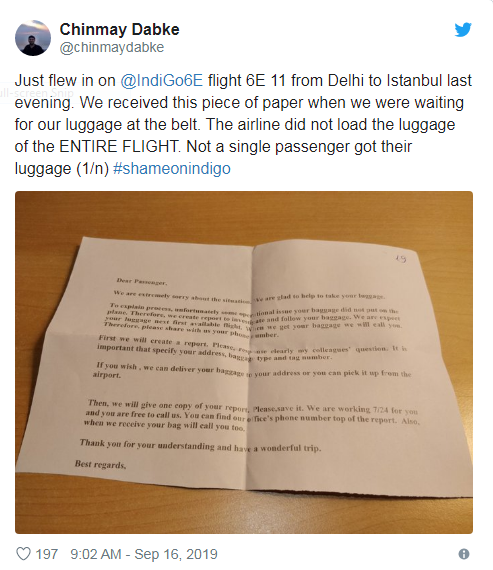
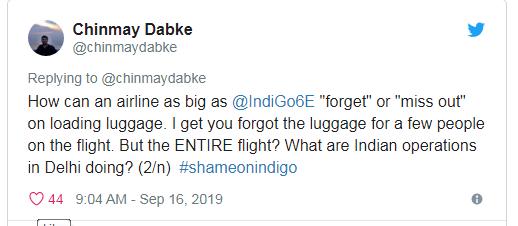
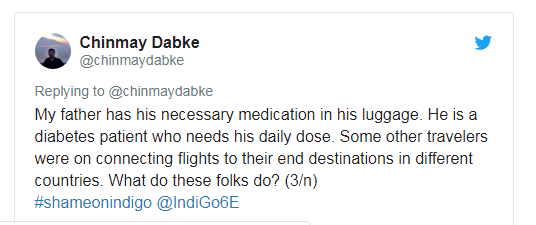
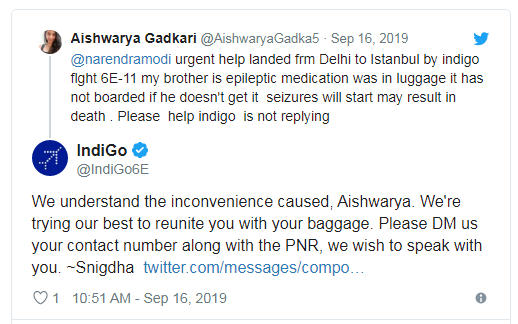
Several times in the past Indigo has attracted negative publicity and people’s ire due to unprofessional behavior of its ground staff and unwarranted delays in flight operations. Adding one more incident to that list, the airline has now set a new low in passenger services by leaving behind the luggage of an entire aircraft. Recently, IndiGo, which was flying the passengers to Istanbul, left behind the luggage of the entire aircraft back in Delhi. Twitterati attacked indigo mercilessly for this misadventure and the hashtag #ShameOnIndiGo was trending on Twitter.

Several Twitter users shared that they received a piece of paper when they were waiting for their luggage at the belt.

Twitter user Chinmay Dabke, who was on this Delhi-Istanbul flight, took to his account to share the details of the incident.

About the whole incident an IndiGo spokesperson said, “We upgraded our aircraft and adjusted the payload as long as the prevailing wind conditions remain. So, all the left behind baggage will be carried today. We regret the inconvenience caused to our passengers.”