Home Blog Page 411

New Delhi is determined to usher development in Jammu & Kashmir

1

“We as a nation, as a family, have taken a historic decision. A system due to which brothers and sisters of Jammu, Kashmir and Ladakh were deprived of many rights and which was a big obstacle to their development, that system has been done away with,” said Prime Minister Narendra Modi in his address to the Nation on August 8, 2019 post reorganisation of the state of Jammu and Kashmir into two Union Territories.

In saying so, the Prime Minister was referring to the deprivation as a result of certain anomalies that had come into existence due to the so-called “special status” given to the state by Article 370 and Article 35A, which now stands annulled. There were many socially relevant and development oriented legislations enacted by parliament and schemes initiated by the central government that were not applicable to Jammu and Kashmir due to the debilitating special status. Lack of audit scrutiny by the centre led to misuse of funds and corruption. The special status allowed a few families to dominate the political spectrum thus eroding evolution of democratic values in the state. There has been no major upheaval in the state post the decision of reorganisation. The change of status has, in fact, been welcomed by the people.

The question that arises here is: Will the NDA government under Prime Minister Narendra Modi be able to deliver on its promise of ushering democratic rights and development in the state as promised?

So far as the political aspects are concerned, New Delhi has promised early elections followed by a revision of the Union Territory status of Jammu and the Kashmir into a state. There exists no reason to doubt the will and determination of the government to stand by this promise. The timing will depend, to a great measure, on the manner in which political stability finds to roots in the region.

In areas of development the government has already taken many concrete steps to make good its promise. The Government of Jammu and Kashmir, under Governor’s rule, has been in a hyper-active mode to bring in projects and initiatives that will place the state at par with the rest of the country in the shortest period of time.

In an attempt to eradicate corruption, focus has been laid on ensuring empowerment at the grassroots. New Delhi has announced a grant of Rs. 366 crore to 4483 Panchayats for their development. Panchayats have been told to recruit 2000 accountants to maintain account books; the government has also decided to digitally connect 634 Panchayats, it is proposed to have two digital villages in each district and then spread the technology across the state. The government is conducting a mass reach to link all government schemes with Aadhaar and thus facilitate direct transfer of grants and subsidies. All these measures will go a long way in eradicating endemic corruption in the state.

The government has very rightly identified youth as the centre of gravity for ensuring progress and has proposed a special impetus for them. To ensure quality education at the school level, the process of making 43,000 teachers permanent under Sarva Shiksha Abhiyan has begun and honorarium of Anganwadi workers has been increased from Rs 3,600 to Rs 4,100. Also, 50,000 new jobs will be generated for the youth of J&K and focus will be on enhanced recruitment in central government jobs like paramilitary forces etc. Sports are an intrinsic part of child development; as such, a fund of Rs 250 crore has been set aside for building sports infrastructure; each Panchayat will soon have a playground. Juvenile Justice Board and Child Welfare Committee will be constituted in every district.

In the health sector, construction of AIIMS in Awantipora (Kashmir) and Vijaypur (Jammu) is underway. The number of MBBS seats has been increased from 400 to 900. A Cancer Institute is proposed to be built in Srinagar at a cost of Rs 120 crore. All grass roots Health Care Centres are being energised with manpower and equipment.

To give a perceptible boost to tourism, Phase 1 of Gulmarg Master Plan 2032 stands approved. Two wildlife sanctuaries are proposed at Tral and Kishanganga respectively. New tourist places are proposed to be developed in Leh and Kargil. Twelve new trekking routes across the region are being developed to promote eco-tourism.

Overall development is required to give a kick start economic activity in the state, in this regard effort is being made to maximise utility of the Rs 80,000-crore development package earlier announced for the state by Prime Minister Modi. Notably, implementation of this package remained slow and tardy under the PDP led state government.

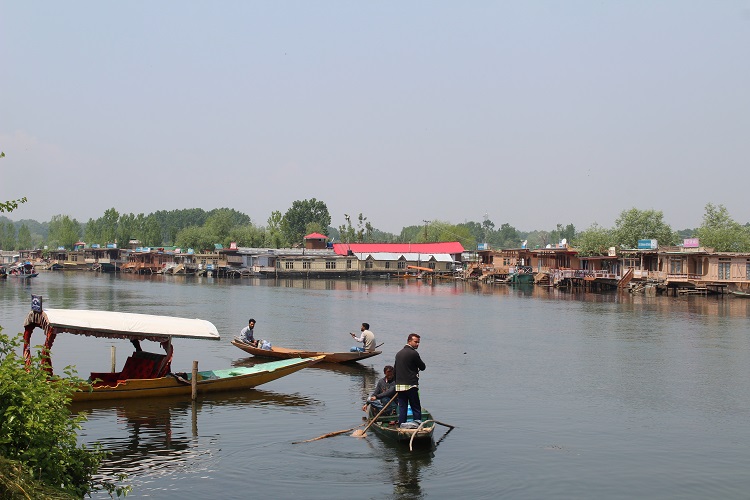
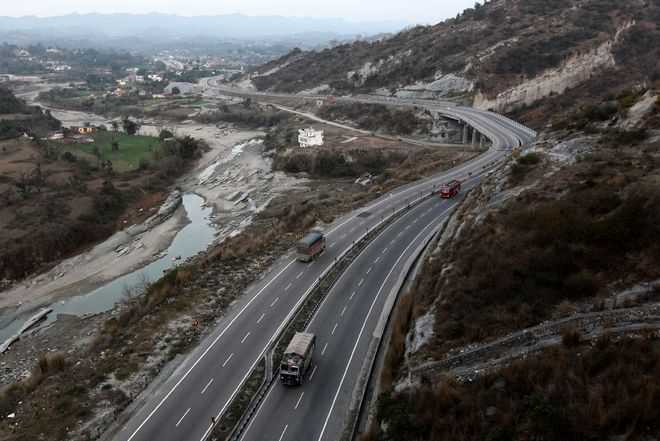
The first phase of Jammu Ring Road will be completed by December, 2019; groundwork to provide 24/7 drinking water through pipes to 15 lakh homes is underway; survey of the rail link between Baramula and Kupwara has been ordered; work is on to beautify the Dal Lake in Srinagar by 2024, Srinagar will have a state-of-the-art Metro Rail.

To meet urgent requirements of housing and infrastructure nearly 50,000 homes in satellite towns are proposed to be developed in Srinagar and Jammu under Pradhan Mantri Gram Sadak Yojana, 1632 kms of roads are to be built in the state; construction of Industrial Bio-Technology Parks is underway in Kathua (Jammu) and Handwara (Kashmir). Two IT Parks, set up across 5 lakh sq ft land will come up in Jammu and in Kashmir.

To enhance social security, 66 villages included in the list of Backward Areas to be given special incentive and 85,000 farmers have been registered under PM crop insurance scheme. 40,000 people are to be included in Old Age Pension, Widow Pension Schemes. Financial assistance will be provided to Rs 5.5 lakhs refugees living in the state.

Prime Minister Modi has a reputation of standing by his word. If he has promised development and political change then he will spare no effort to ensure the same. If people give active support, the benefits envisaged will take root faster, otherwise, it will take time. There should be no doubt that change for the better will take place for sure. It is important that the people correctly asses the emerging situation and do not fall prey to such inimical voices that do not want to see the region prospering.
Tapsee Pannu to appear as Amrita Pritam in next film

After a series of insignificant roles in her last few films, Taapsee Pannu is all set to play a powerful character in Anubhav Sinha’s next film. Tapsee, who recently announced about her new film with “Mulk” director Anubhav Sinha, has now shared more details about her character in the project. She will be seen playing the role of acclaimed novelist late Amrita Pritam in the film ‘Thappad’.

Taapsee on Tuesday took to Instagram and wrote: “‘When a man denies the power of women, he is denying his own subconscious’ — Amrita Pritam. Moving from one Amrita to the other… Main tenu pher milangi…in theatres from 6th of March 2020.”

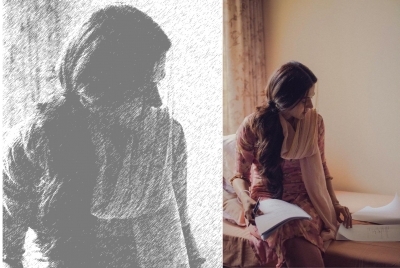
Along with the post, she uploaded an image in which she is seen reading a script donning a pink ethnic suit.

Pritam (1919-2005) was an acclaimed Punjabi poet-writer. She was born in Gujranwala (now in Pakistan) and is well-known for her poem “Ajj Aakhaan Waris Shah Nu” — a writing expressing the horrors and anguish of Partition. She is considered the first prominent female Punjabi poet, novelist, essayist and the leading 20th-century poet of the Punjabi language, who is equally loved on both sides of the India–Pakistan border.

Dharmendra Pradhan: Increasing energy consumption should be rooted in Energy Justice

Union Minister of Petroleum and Natural Gas & Steel Dharmendra Pradhan has said that the inevitable shift in global energy consumption to Asia is a reality. Addressing the opening session of the 8th Asian Ministerial Energy Roundtable in Abu Dhabi, he said that we now need to ensure that this change is rooted in Energy Justice, which was articulated by Prime Minister of India Narendra Modi as most important component of Energy Vision of India.

Pradhan said that the Emerging Asia will be driving the world economic growth in the coming 20 years. In the global context, developing economies will drive 80% of the incremental global growth, with India and China accounting for more than half of it.  He said “Energy access, higher standard of living and improved prosperity in developing countries will primarily drive the energy demand. It is important for the low income, low per capital energy consuming countries to have access to technology and capital when it comes to energy efficiency and clean technology. That will provide better energy security than short term interventions in fossil fuel supply and price.” He said that due to poor and imbalanced energy infrastructure, 400 million people in Asian region have no access to electricity, and rural residents have no access to clean electricity. Therefore, providing safe, stable, affordable and efficient energy has become an important task for governments of all countries.

Describing the Energy Vision of India, Pradhan said that it has been enunciated by Prime Minister Modi in 2016, and is based on four pillars i.e. energy access, energy efficiency, energy sustainability and energy security. “As part of our integrated approach towards energy planning during the last five years, India is placing enormous emphasis on energy access with energy justice as a key objective in itself,” he added. The Minister added that India has undertaken a number of path-breaking policies and initiatives during the last 5 years to realize energy justice for over 1.3 billion people in the country. 

Later, addressing the session on ‘Advancing Inclusive Access to Secure, Affordable, and Sustainable Energy Services’ in the event, Pradhan  said “In India, we have to improve availability of energy to over 1.3 billion people, whose per capita energy consumption is lower than the global average. Now, India is the third-largest energy consumer in the world, and its energy demand is growing faster than all major economies of the world. Our share of total global primary energy demand is set to double to 11% by 2040. We are preparing for such a growth path of energy demand in the country. This calls for making matching investments in the energy sector.”

Pradhan said “As part of our integrated approach towards energy planning, energy justice will be a key objective in itself. In this context, we are working towards the early realization of the UN Sustainable Development Goal (SDG) 7. A number of transformative policies and initiatives have been taken in India to realize the above objectives. We are significantly expanding our energy infrastructure – be it power generation, more renewables and gas-based infrastructure -pipelines, city gas network, LNG terminals. We launched a major campaign to improve access to clean cooking fuel under the Ujjwala Yojana scheme three years back, and Prime Minister Narendra Modi handed over the 80 millionth LPG connection couple of days back. A ‘Blue Flame Revolution’ is underway. LPG coverage has reached more than ninety percent from fifty-five percent five years ago. India attained universal electrification all villages. This year, India aims to achieve hundred per cent electrification of households, through SAUBHAGYA. Clean transportation is another area of high priority in India. We are jumping directly from BS-VI to BS-VI fuel by April 2020. India is moving towards a gas-based economy by increasing the share of gas from 6% to 15% in the energy mix by 2030. We have constructed over 16,000 km of gas pipeline and an additional 11,000 km is under construction. We have covered over four hundred districts and 70 percent of our population. There is already a cardinal shift to renewable energy sources. Our target is 175 GW by 2022, with solar target of 100 GW by 2022. We are promoting alternative fuels like ethanol and bio-diesel in a big way. A National Bio-Fuel Policy 2018 was unveiled, targeting 20% blending of ethanol in petrol and 5% blending of bio-diesel in diesel by 2030.” He informed the gathering that India joined the elite group of nations in August 2018 to operate a flight running on biofuel.

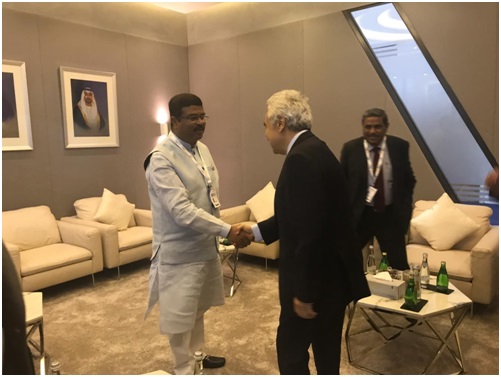
On the sidelines of the 8th Asian Ministerial Energy Roundtable in Abu Dhabi, Dharmendra Pradhan also held a series of bilateral discussions with leaders from other countries. He met his UAE counterpart Suhail Mohamed Faraj Al Mazrouei, Minister of Energy and Industry.

100 days of Modi govt 2.0: Kashmir cited as the biggest achievement

Prime Minister Narendra Modi has said that past hundred days of the BJP government have been days of development, trust and big changes in the country. He was speaking at a rally in Haryana. Modi said that in the past 100 days of the government at the Centre, the world and country had seen that India was now capable of “challenging any challenge”, be it decades old or of relating to the future.

“We know how to directly face challenges… Be it the issue of Jammu-Kashmir and Ladakh or impending water crises. The 130 crore people of the country have started finding new solutions to the problems… To fulfil the aspirations of the people of Jammu-Kashmir and Ladakh we all have started working with a fresh approach,” he said.

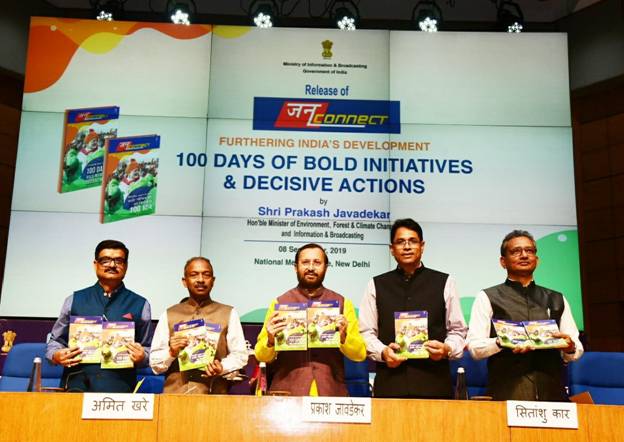
On the occasion of 100-days of Modi government, Union Minister Prakash Javadekar addressed a Press Conference on key decisions taken by the government in the first hundred days of its second term.

“Modi government 2.0 in its first 100 days has made historic and landmark decisions, with speed, be it Jammu and Kashmir or decisions regarding Unlawful Activity Prevention Act or reflections on status of economy. These could be done because the preparations for these decisions began before elections,” Javadekar said.

He added that the theme of the government, he said, is to empower the poor, farmers, labourers, Dalits and all those who did not get their share of development.

Union Minister Nitin Gadkari has said that the government under the leadership of Prime Minister Modi has been working in a decisive and transparent manner, with the vision of development and with the goal of making India a super-economy in the world. He said that the 100 days of the government has been just the beginning, and that many more decisive actions and bold initiatives are going to be made in the coming years. The Minister said this, while addressing a press conference on 100 days of the Government, in Mumbai today.

Javadekar also released a booklet ‘Jan Connect’ and inaugurated an Exhibition on ‘Furthering India’s Development – 100 days of Bold Initiatives & Decisive Actions’. The Booklet contains a compendium of key decisions of the government in hundred days.

Philosophical and Historical Foundations of American Secularism 1 – Knowing History and Making History

Dr. Herb Silverman is the Founder of the Secular Coalition for America, the Founder of the Secular Humanists of the Lowcountry, and the Founder of the Atheist/Humanist Alliance student group at the College of Charleston. He authored Complex variables (1975), Candidate Without a Prayer: An Autobiography of a Jewish Atheist in the Bible Belt (2012) and An Atheist Stranger in a Strange Religious Land: Selected Writings from the Bible Belt (2017). He co-authored The Fundamentals of Extremism: The Christian Right in America (2003) with Kimberley Blaker and Edward S. Buckner, Complex Variables with Applications (2007) with Saminathan Ponnusamy, and Short Reflections on Secularism (2019).

Here we talk about the beginnings of American secularism.

Scott Douglas Jacobsen: Herb, you made American history for the secular communities. This remains the fact of the matter. In the secular world, you exist as an icon and, in fact, a beloved one, as a mild-mannered liberal Jewish Yankee mathematician atheist who found his way, ironically, into the world of politics of Republican owned South Carolina. What is the feeling in the latter half of life in reflection of these facts, these achievements? When did American secularism start? What founding philosophy set this forth? Before America existed as a bounded geography, what Native American traditions seem to reflect secular ideals?

Dr. Herb Silverman: Thank you so much for your kind words. I don’t think of myself as an icon, just someone who stumbled into an unusual situation. When I learned in 1990 that our South Carolina Constitution prohibited atheists from holding public office, I spoke to a lawyer at the American Civil Liberties Union to see how this unconstitutional provision could be changed. He told me that an atheist would need to mount a legal challenge by running for governor, and he said that the very best candidate would be me. There was no competition, so after giving it some thought, I agreed to be the Candidate Without a Prayer. Finally, in 1997 the South Carolina Supreme Court ruled unanimously in my favour, nullifying the anti-atheist clause in the South Carolina Constitution.

All the credit for my Supreme Court victory belongs to my lawyers. I was just having fun giving talks and writing about my experiences. I also learned about and became engaged with the secular movement, leading me to help organize what became the Secular Coalition for America.

I’m optimistic about the future. The secular movement is growing, both formally through secular organizations and informally through “nones.” The “nones,” those who don’t subscribe to any faith, are the fastest growing “religion” in the United States, especially among young people. Some of the “nones” got fed up with their conservative religion that was anti-LGBTQ, anti-women’s rights, and anti-science, with little emphasis on loving their neighbour. Pedophilia has also discouraged people from maintaining their church affiliation.

On the other hand, religious fundamentalists continue to flourish during this period of increasing secularization. Influence of religion at the highest levels of government under Donald Trump has never been stronger. It is up to secularists working with all who favour separation of religion and government to counter the influence of religion in government.

Religious fundamentalists often claim that America is a Christian nation. It is, in the same way that America is predominantly a white nation. The majority of Americans are both white and Christian. However, we are not now, nor have we ever officially been, a white nation or a Christian nation. Those who believe America was once a Christian nation may be hearkening back to the first Europeans who settled here, before America became a nation.

Those Pilgrims and Puritans were religious dissenters from Europe who sought freedom of worship in America for their own religion, but most definitely not for other religions. They had no use for religious liberty. Most of the early colonies made blasphemy a crime, an offence that could be punishable by death. Those colonies were mostly theocracies, where people who believed in the “wrong” religion were excluded from government participation and persecuted. For example, the Puritans, who established the Massachusetts Bay colony in 1630, required all Massachusetts citizens to pay a tax to the Puritan Church. This church-state union led to the Salem witch trials of 1692, based on the biblical mandate: “Thou shalt not suffer a witch to live.”

In the American Revolution that started in 1776, political leaders began to construct a new federal government. The soon-to-be United States of America not only declared independence from England, but also declared something even more radical—that “Governments are instituted among men deriving their just powers from the consent of the governed.” Americans rejected kings crowned by bishops, who had been supposedly vested with a God-given authority to rule through “divine right.”

The framers of the U.S. Constitution wanted no part of the religious intolerance and bloodshed they saw in Europe. They wisely established the first government in history to separate religion and government. James Madison, affectionately known as the Father of our Constitution, said, “The purpose of separation of church and state is to keep forever from these shores the endless strife that has soaked the soil of Europe in blood for centuries.” Our founders understood the devastating nature of holy wars. They wisely established a secular nation whose authority rests with “We the People” (the first three words of the U.S. Constitution) and not with “Thou the Deity.”

Our founders were products of the Enlightenment. We can consider many of them freethinkers who felt that humans should not be governed by faith in the supernatural, but on reason and evidence from the natural world. Some were deists, believing in Nature’s God who set the laws of nature in motion and then retired as deity emeritus. Before Darwin and what we know of modern science, I, too, might have been a deist at that time.

The founders wrote the Constitution as a secular document, not because they were hostile to Christianity or religion but because they did not want the new federal government to have authority over religion or to meddle in it. Government must not favor one religion over another, or religion over non-religion. That’s why there are only two references to religion in the Constitution, and both are exclusionary. One is Article 6 of the U.S. Constitution: “No religious test shall ever be required as a qualification to any office or public trust under the United States.” The other is in the First Amendment to the Bill of Rights: “Congress shall make no law respecting an establishment of religion or prohibiting the free exercise thereof.” This guarantees American citizens freedom of conscience, the right to practice any religion or no religion.

No one’s religious liberty should feel threatened when the wall of separation between government and religion is kept strong and high. There is only one “religious liberty” Americans lack: The freedom to enlist the government to force others to acknowledge or support specific religious ideas. Unlike what many religious fundamentalists think, government neutrality is not government hostility toward religion. Our secular laws are based on the human principle of “justice for all,” and our civil government enforces those laws through a secular criminal justice system. 

Sinclair Lewis, the first American to win the Nobel Prize in literature, might have foreseen what could happen if the religious right were to triumph in America. In 1939, he made this chilling statement after spending six months observing Hitler’s rise in Germany: “When fascism comes to America, it will be wrapped in the American flag carrying a cross.” 

Beginning with Christopher Columbus, many Native Americans (then called savages) were enslaved and forced to convert to Christianity. They lost their land and were later forcibly put onto reservations, leaving the rich land they had lived on to Christian settlers ready to work for God and Country. The majority of Native American tribes, many of whom were agricultural, had no concept of dominion over the land.

Most Native American religions did not distinguish between the spiritual world and the natural world. Few Native American religions were considered absolutely unchangeable. Traditions varied from group to group, making their spirituality much less rigid than Christianity. What I like about Native American religions is that they don’t try to convert anyone. They accept that people have the religious freedom to believe and practice whatever they want. That’s also true of some religions today, but the most troublesome religious denominations are those that feel they deserve special rights and that they are obligated by God to convince everyone else of their one and only “truth.”

Jacobsen: Thank you for the opportunity and your time, Dr. Silverman.

Photo by Luke Stackpoole on Unsplash

Student films from 17 countries to be screened in Campus Film Festival in Delhi

With 41 student films from 17 countries participating in the 3rd edition of U-Special International Campus film festival, it’s going to be a visual treat for film lovers in Delhi. To be screened at multiple campuses in Delhi-NCR, the festival will also conduct masterclasses and workshops on filmmaking.

It is worth noting that U-Special International Campus film festival is India’s only global campus film festival, promoting student film.  The festival was launched in 2016 by Kirorimal College alumni and journalist Rao Narender Yadav, to provide a credible platform to student filmmakers from all across the globe. The 3rd annual edition of the festival will be organised from September 20th to November 8th, 2019 at several campuses across New Delhi. According to Rao, “This fest is a creative platform for the next generation of filmmakers to tell their stories, inspire hope and provoke change through filmmaking. Providing an exciting opportunity to various genres of young filmmakers this fest is poised to become the largest congregation of young minds in India.”

Prominent universities which will be having their films in the festival includes Rochester Institute of Technology, New York, Sri Aurobindo Centre of Arts & Communication, University of the West of England – UWE Bristol, National Institute of Design, Symbiosis Centre for Media & Communication (SCMC), Whistling Woods International, Kyoto University, Sussex County Technical School, Central Washington University, Scottsdale Community College, School of Art and Design Kassel, Curtin University, University of Portsmouth, Marmara University, DePaul – College of Computing and Digital Media, New York Film Academy, University of Gothenburg, Napier University, University of Music and Performing Arts, EICAR, The International Film and Television School of Paris, Beijing Film Academy, Istanbul Sehir University and Iranian Youth Cinema Society.

The festival organisers have recently appointed 30 Campus Ambassadors to make it a youth driven and owned film festival. For this, U-Special team has entered into a collaboration with Vivekananda Institute of Professional Studies (VIPS), which is affiliated to Guru Gobind Singh Indraprastha University.

Prime Minister Lauds the efforts of India’s Space Scientists

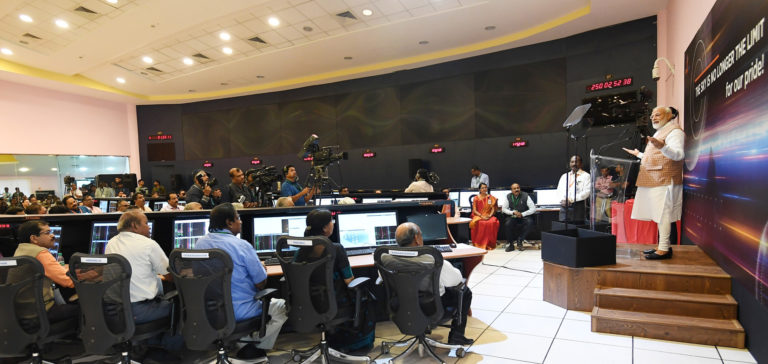
Even as the Chandrayan 2 Mission lost its communication with the Control Centre at the ISRO headquarters, Prime Minister Narendra Modi who was witnessing the descent of the Chandrayan 2 along with the ISRO Scientists at Bengaluru said “India is proud of our scientists! They’ve given their best and have always made India proud. These are moments to be courageous, and courageous we will be!”

In a personalized effort to boost the morale of the scientists, Prime Minister said “The country is with you, I am with you. The effort was worth it and so was the journey “

“You are those people who work for Mother India’s victory and struggle for it and have a grit and determination to make her proud. “

“I could feel and sense your despondency and emotions last night. I was amongst you when the communication from the Vehicle was lost. There are several unanswered questions but I am sure you would find the answers. I know there was hard work behind.”

“We might have faced a small setback in our journey but this would not let down our zeal and enthusiasm to achieve our goals”

Our resolve strengthens now.

“The whole nation was awake last night in solidarity with our scientist sisters and brothers. We came very close to the surface of the moon and that effort is highly laudable. “

“We are proud of our space programme and scientists, their hard work and determination has ensured a better life not only for our citizens but also other nations. It is their outcome of their innovative zeal that several people got better quality of life including better health care and education.”

“India knows that there would be many more proud moments to rejoice.”

“When it comes to space programme the best is yet to come.”

“There are new frontiers to discover and new places to go. We will rise to the occasion and scale newer heights of success. “

“To our scientists I want to say, India is with you. True to your nature, you ventured into a place where no one had never gone before.”

 “You have gone as close as you could. I can proudly say the effort was worth it and so was the journey

Our team worked hard and travelled far, and those teachings will always remain with us”

“The learning from today will get us a stronger and better tomorrow”

“I thank the families of our space scientists. Their silent but valuable support remains a major strength in our effort.”

“Sisters and brothers, resilience and tenacity are centre to India’s ethos. In our glorious history we may have faced moments that could have crushed us but we never gave up. This is the reason our civilization stands tall.”

In our glorious history we may have faced moments that could have crushed us but we never gave up. This is the reason our civilization stands tall.”

 “We have made historical achievements. I know that ISRO also does not failures to let it down”

“There will be a new dawn and a better tomorrow. Without worrying about results we go ahead and that is our history.”

I have confidence in you. Your dreams are higher than mine. And I am fully confident on your hopes.

I am meeting you to get inspiration from you. You are a sea of inspiration and a living evidence of inspiration

I congratulate you all and wish you all the best in your endeavours.

Negative reviews fail to dent Saaho’s box office collections; Crosses 370 Cr

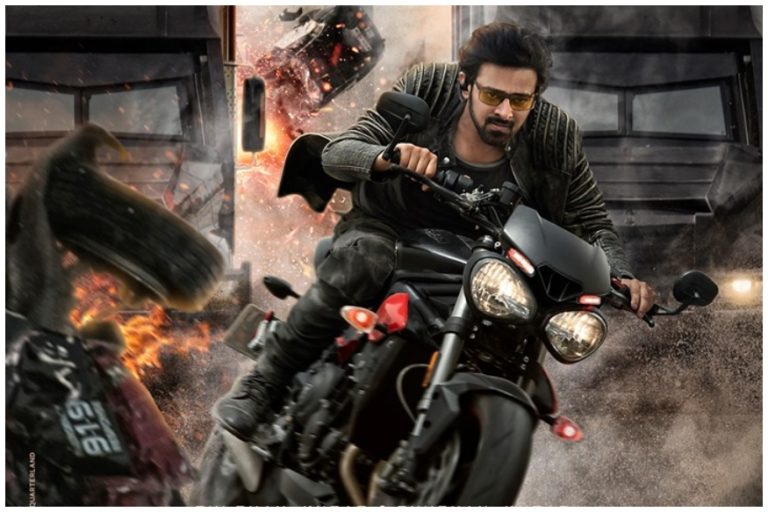
Despite widespread criticism, multilingual film Saaho continues to mint money at the box office. The film has currently crossed Rs. 350 crore worldwide. One of the major reasons for the film’s success is that is has been a trilingual release. It was shot simultaneously in Hindi, Tamil, and Telugu.

The Hindi version of Prabhas starrer has earned Rs 116.03 crore. Saaho makers UV Creations on Friday took to Twitter to share, “Setting Box Office on Fire #Saaho collects whopping 370 Cr+ gross & Counting in 7 days worldwide!” Taran Adarsh shared on Twitter, “#Saaho has an excellent Week 1… Is the fourth highest *Week 1* grosser of 2019… Fri 24.40 cr, Sat 25.20 cr, Sun 29.48 cr, Mon 14.20 cr, Tue 9.10 cr, Wed 6.90 cr, Thu 6.75 cr. Total: ₹ 116.03 cr Nett BOC. #India biz. #Hindi version.”

Prabhas and Shraddha Kapoor are riding the high tide with their first project together. Celebrating the achievement Prabhas took to Instagram to thank fans. In the post, he stated, “This film is what it is because of the sheer appreciation and incredible response you all have given. Lots of love to you all!”

Though Saaho is enjoying a good earning, the film’s story has been criticized by many for being dull and to be fuelled only by action sequences. Critics have pointed out weak story and a confusing screenplay, making it exhausting to watch the film.

Meanwhile, Director Sujeeth, in his Instagram post, asked the audience to give Saaho a second chance.

He wrote, “Made my first short film when I was 17 years old. No money, No team but had lot of support from Orkut and family. I edited, shot and directed 90% of my short films. I learned from my mistakes and criticism was always like extra boost for my journey. Travelled very long way and faced many hurdles but never gave up. TODAY MANY PEOPLE saw SAAHO – some expected more from it, but many loved it! Thanks to all for watching the movie 🙂 Please watch it again if you missed anything. I am sure you’ll enjoy even more. #Saaho.

Remove restrictions, but strengthen security in Kashmir

A month has gone by since the process of reorganisation of the state of Jammu and Kashmir was initiated in the Indian parliament and the legislation passed with a vast majority. Nothing has changed on ground since the decision is to be implemented on October 31, 2019. The matter, however, has elicited considerable reactions from various quarters at the local, national and international levels.

The prediction of widespread unrest in the state, especially in Kashmir Valley, has come to a naught. It seems that the people had anticipated that something of this sort would happen, revocation of Article 370 being an election promise of the ruling NDA dispensation. The people of Kashmir have a long term plan that revolves around getting financial and other benefits from the government instead of following the path of agitation. 

It is also quite obvious that the people are quite happy at the prospect of ridding themselves of the local leadership that is restricted to a few families of the Kashmir region. The space is now open for new leaders. They, however, will need to be honest, accountable and responsible if they wish to survive. The people are unlikely to repeat the mistakes of the past.  

New Delhi, on its part, is determined to weed out corruption from the state. The conduct of Panchayat and local bodies’ elections to ensure devolution of power at the grass roots and direct transfer of subsidies and aid to the beneficiaries are two major steps taken in this direction. Good governance will be the predominant buzz word in the “Naya (new) Jammu and Kashmir.”

At the national level, the decision created a frenzy, as was expected. Political parties, media houses, non-government organisations, intellectual circles fell over each other to get their voices heard. Quite clearly lots of “lobby fees” exchanged hands and, on this basis, positions and postures were adopted. The vituperative rhetoric against the move failed to break the resolve of the government, nor could it gain public support.

Now the inevitable “Kashmir fatigue” has set in. The so-called liberals have excused themselves from their pay masters with a “we tried our best” narrative. Political parties that depend on mindless opposition to survive are looking for other matters to hound the government with. For them, the “economic recession” narrative has come up as an apt alternative to keep their trade going and they have taken to it like fish takes to water. Kashmir stands relegated to the deep recesses of public memory.

The international community has, since long, decided to desist from wasting valuable diplomatic time and money on the flips flops that mark the Kashmir imbroglio. They were quick to term it as an “internal issue” and move on without getting engaged. Even US President Donald Trump has realised that he had created a problem for himself by offering to “mediate on the Kashmir issue” and has extricated himself from the mess.

The worst affected by the course of events is the political leadership of Pakistan. Prime Minister Imran Khan is in a very difficult situation indeed. He has built his political career on anti-India, pro-Kashmir rhetoric and now holds his position only on the goodwill of the Pak Army, which in turn, owes its survival to the “K” issue. Imran Khan needs to do something fast but is terribly devoid of options. He has received no assistance from the international community except some good words from China; he is not in a position to influence Prime Minister Narendra Modi to get some concessions; he cannot get into open conflict against India due to financial and military wherewithal constraints. In frustration, Imran Khan is making wild statements ranging from threat of nuclear war to downright knee-bent requests to start a dialogue process. It seems that Imran Khan will be the only casualty in the script being played out in Kashmir.

It is time for the government of India to pragmatically reassess the situation and carry out policy corrections in wake of the developing circumstances. Security should continue to remain centre stage in the evolving policy; local terrorism needs to be contained and eradicated in the shortest period of time. Pakistani attempts to increase the threshold of terrorism by infiltrating trained cadre and warlike stores, especially rifles and ammunition, has to be nipped in the bud. Effective counter-terrorism operations in the hinterland and counter-infiltration operations along the Line of Control, therefore, should be at the crux of the government’s policy.

Fortunately, the Indian Army is well poised and confident of playing out this role to the hilt. In a recent press conference, the General Officer Commanding at the Srinagar-based Chinar Corps said that two Pakistani nationals have been captured and many more killed while attempting infiltration. This has come as a morale booster and has sent a clear message to Pakistan that it will not succeed in its nefarious designs.

With a tight grip on the terrorist activities the centre can look at easing the restrictions soonest. It is appreciated that the government wishes to showcase this changeover as having been conducted without a single casualty, but, this requirement also needs to be balanced with the negative fallout of the discomfort being faced by the people. The opening up of movement and landline facility has greatly eased the situation; it has also indicated that a surging disruption and agitation is not likely. Under the circumstances, confinement and checks, especially curbs on communication can be done away with since they are causing avoidable friction and abrasiveness. It may be better to open up, allow the few disruptive incidents that are inevitable to take place and get it over with. The leadership that is known to create dissension can be kept under detention.

It is very clear that the changed status in Jammu and Kashmir is there to stay and the same has been accepted by the people. The next step should be to ensure that it accrues to the people the peace and prosperity that they crave for. Only then will it be accepted as a good and positive move.

India Pavilion at 44th Toronto International Film Festival 2019 Inaugurated

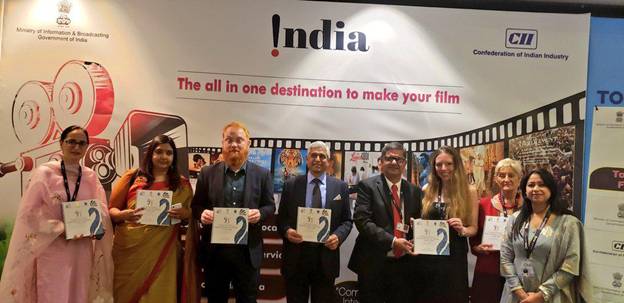
High Commissioner of India to Canada Vikas Swarup recently inaugurated the India Pavilion at the 44th Toronto International Film Festival (TIFF) 2019. The Inauguration of India Pavilion at TIFF 2019 will provide a platform to showcase Indian Cinema in the overseas market and facilitate new business opportunities.

The Ministry of Information & Broadcasting, Government of India, in collaboration with Confederation of Indian Industry (CII) is participating at the ‘Toronto International Film Festival’ from 5-15 September 2019 in Toronto, Canada. The Indian Delegation includes Chaitanya Prasad, Additional Director General, Directorate of Film Festivals and Dhanpreet Kaur, Deputy Secretary (Films), Ministry of Information & Broadcasting.

A key highlight of the inauguration related to the Golden Jubilee Edition of IFFI to be held in Goa later this year. IFFI 2019 poster and brochure were also released. Participants evinced keen interest regarding the various programming verticals, retrospectives, masterclasses, & in-conversation sessions in the Festival. A number of them expressed their keenness to come to Goa as Cine Appreciators & participants for the technical sessions to be held in IFFI.

Speaking on the occasion, Vikas Swarup said, “Indian movies have created new benchmark in film making globally. Every Film Festival today acknowledges the enormous potential of India’s soft Power. TIFF provides the ideal platform for the global outreach of the 50th International Film Festival of India (IFFI) 2019. Film-makers of the Global Film Fraternity have got an opportunity to understand the key elements of the Festival and the impact of the Indian Cinema on film making globally.”

Around 60 eminent personalities from the Film-making sector & Film Festivals, participated at the Inauguration Ceremony of the India Pavilion. Some of the eminent persons present included Geoff Macnaughton, Director of Industry, Toronto International Film Festival; Hannah Fisher, Senior International Program Consultant, Heartland Film Festival, Indianapolis, Indiana, USA; Roger Nair, CEO, Lionheart Production House;  Jana Wolff, Head – Marketing, European Film Market; Brittany Allan, Senior Coordinator – Industry, Toronto International Film Festival among others.

Discussions were held on a wide range of topics which included Participation in the Golden Jubilee edition of IFFI, 2019 including details regarding the nature of the programming during the Festival. A number of participants showed keen interest in understanding the policy framework on matters related to Co-production Agreements and Ease of Doing Business in the domain of Indian Media & Entertainment Industry. Stakeholders were also informed about the initiatives undertaken by the Government related to Single Window Clearance for filming in India.