Home Blog Page 380

It’s not CAA, pent-up anger on Kashmir and Ayodhya led to Delhi riots

The mayhem in Delhi streets has calmed down and the metropolis is limping back to normalcy. Amidst this eerie normalcy it’s time for some serious soul searching about the real reasons of communal riots in India’s capital. As videos, photographs and heart-wrenching stories continue to flash across the mainstream media and on various social media platforms the naïve Indians and blockbuster opinion makers from across the world are busy peddling the narrative that India is hell bent upon antagonizing the 25 crore (250 million) Muslims residing peacefully in the country. What was the need to introduce this contentious CAA (Citizenship Amendment Act-2019) that has triggered these communal riots, massive unrest and suspicion amongst this huge Muslim population of India, they ask.

Well, first things first. Nationwide protests followed by the Delhi riots after CAA was passed by the Indian Parliament on 11th December 2019 has nothing do with the CAA per se. Yes you read it right. These nationwide protests and, of course, the Delhi riots have nothing do with the new Citizenship Act. Protesters in the streets against CAA and those shouting their lungs out at public forums know it very well that the CAA has got nothing to do with Indian Muslims. It’s just a one-time provision that will directly affect religiously persecuted Hindus, Sikhs, Jains, Buddhists, Parsi and Christians who had escaped from Pakistan, Afghanistan and Bangladesh. The CAA grants Indian citizenship to around 15 lakh people who are already living in India. It does have a cut-off date of December 31, 2014.

All these film actors, comedians, 5-star journalists and shrewd politicians –the Lutyen’s coterie, know these facts quite well. It would be naïve to think that the likes of Mamata Banerjee, Ghulam Nabi Azad, Pinarayi Vijayan, Kanhaiya Kumar, Swara Bhaskar, Sharjeel Imam, Shehla Rashid, etc. etc. would not have read the finer provisions of CAA. And yet they went around the world spreading falsities that the Narendra Modi government is planning to put Muslims in detention centres and would strip them off their citizenship. Blatant lie. Yet this Lutyen’s coterie continues to shamelessly peddle this lie. The big question is why?

In fact, all this is a well-planned strategy. This rage is not about the CAA, rather it’s the pent-up anger about abolition of Art 370 in Kashmir and the Supreme Court’s unanimous judgement in favour of the Shri Ram Janmabhoomi Temple at Ayodhya. In order to understand the heartburn we need to step back and look at the turn of events over the last year.
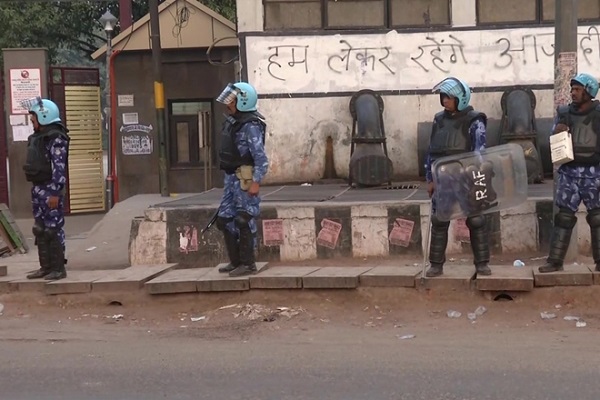
Secessionist “Azadi” slogans inscribed on the walls in riot affected areas of Delhi.
(Photo: PTI)

This Lutyen’s coterie has a penchant for fancy names such as “civil society members”, “liberals”, “seculars”, “free speech champions” etc. due to which they are darlings of international media and self-proclaimed custodians of Indian democracy and also the self-appointed spokesperson for Indians. However, despite their high decibel campaign to oust Narendra Modi during the 2019 General Elections he was voted back, this time with a larger majority. Modi getting back to the driving seat in New Delhi upset the plans of this conniving coterie who had been relegated to the sidelines during Modi’s first term. So dubious government funding for superfluous projects had stopped and illegal foreign grants put under scrutiny. They had hoped for the old order to come back if Modi was unseated. This did not happen and Narendra Modi took oath as India’s Prime Minister on May 30th 2019.  This was the first shock. With a massive mandate there was no chance to topple the government at New Delhi and so this coterie was left licking its wounds.

And to make matters worse, Modi 2.0 hit the ground running. The lighting struck on August 5th 2019. The contentious and controversial Art 370 & Art 35A were revoked, Jammu & Kashmir was bifurcated and downgraded into two separate union territories Jammu-Kashmir and Laddakh. This meant another stream of dubious funds dried up. Mind you this was August 2019, barely two months after Modi had returned at the hot seat in New Delhi. The gang got down to the drawing board to think of their future strategies. It was a question of survival for them. Falsities about Kashmir under lockdown and fake stories of human rights violations were doled out. But these conniving stratagems were exposed with equal zeal by the new age reporters, digital media organizations and social media warriors. The agenda of yesteryears did not work this time in Kashmir.

And then came November 9th 2019. Five-judge bench of the Supreme Court passed a unanimous judgement in favour of the Shri Ram Janmabhoomi Temple at Ayodhya. All the arguments put forward by the coterie’s “eminent historians” were summarily rejected. Historical arguments (read pulp-fiction) that had been used to build false narratives over last several decades in favour of the Babri Mosque were dismissed in toto. The Lutyen’s gang was exposed in full public view. It hurt them that it was archaeologist KK Muhammed (a Muslim) who gave clinching evidence in favour of Shri Ram Janmabhoomi Temple at Ayodhya. Hindu nationalists and Muslim rationalists were having a field day. They were thinking of building a new India where Muslims and Hindus could live in peace and harmony. KK Muhammed was seen as the new role model of Indian Muslims. The Muslim-as-a-victim narrative was fading away, or so it seemed.  
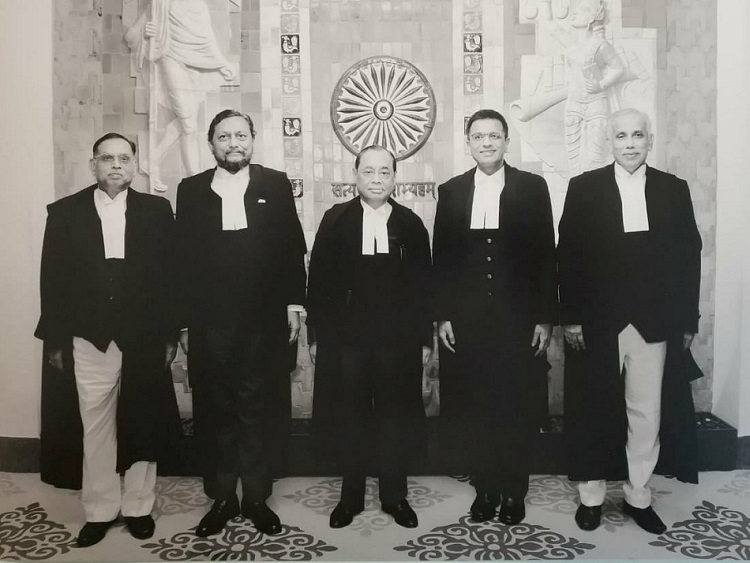
The five Supreme Court Judges who delivered the Unanimous Judgement on Ayodhya. Standing from Left to Right -- Justice Ashok Bhushan, Justice SA Bobde, Chief Justice of India Ranjan Gogoi, Justice DY Chandrachud and Justice S Abdul Nazeer.
The five Supreme Court Judges who delivered the Unanimous Judgement on Ayodhya. Standing from Left to Right — Justice Ashok Bhushan, Chief Justice of India (current) Justice SA Bobde, former Chief Justice of India Ranjan Gogoi, Justice DY Chandrachud and Justice S Abdul Nazeer.

How naïve are we? We just could not fathom the strike capabilities of this Lutyen’s coterie. After all they had to fight for their survival! It was in this backdrop that when the Narendra Modi government announced the Citizenship Amendment Bill (CAB), they sniffed an opportunity for themselves. The botched up NRC (National Register of Citizens) in Assam had already sowed seeds of mistrust in the minds of Muslims. Rumours had begun floating around in Muslim ghettoes across the country, and almost immediately this peep-hole was turned into a large window by the Lutyen’s brigade. They now began using this window to gleefully spread the vicious propaganda.

Even a cursory look at the statements emanating from a few 5-star journalists, film actors, comedians and, of course, the shrewd politicians will reveal that this malicious propaganda was started simultaneously by all and sundry in the coterie. Each one talked about how CAA has been brought in to strip the Muslims of their Indian citizenship rights that they will be asked to provide documents of their ancestors, failing which they would be “expelled” from India. Yes all of this is untrue and factually incorrect. But when did Lutyen’s coterie bother for facts?
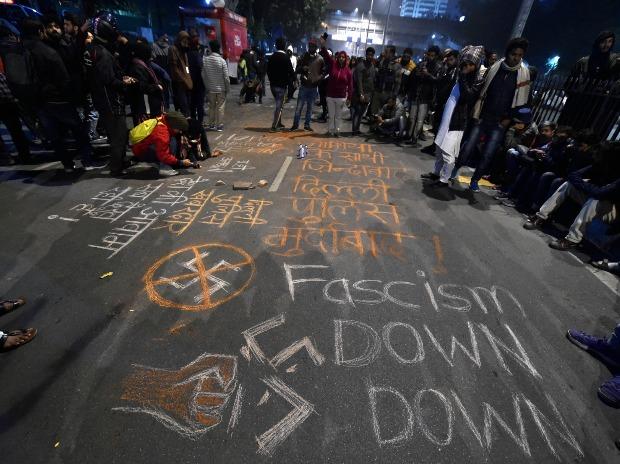
Graffiti against the Citizenship Amendment Act (CAA) on Delhi roads. (Photo: PTI)

As the Parliament passed the Citizenship Bill and it became an Act this hysteria of disinformation campaign reached a crescendo. Almost everybody questioned CAA and started talking of the CAA and NRC in the same breath. Rumours started flying thick and fast. With insecurity in the mind of a large section of Muslims strengthened, the fear psychosis was accentuated. Modi government was left grappling for answers, it was clearly on the back foot.

Dirty money running into hundreds of crore rupees was distributed to foster unrest on the CAA. Enforcement Directorate revealed that radical Islamic organisation Popular Front of India (PFI) received around Rs 120 crore that was used to fuel rumours and discontent. In a well thought out strategy Muslim women were brought to the forefront. Shaheen Bagh in East Delhi became the new flashpoint. All this while, ministers in the Modi government, politicians and foot soldiers from the ruling BJP were busy dispelling myths about CAA while the Lutyen’s coterie was busy fanning rumours about imaginary atrocities on Muslims. Slowly but steadily the coterie became successful in painting all previous decisions as discriminatory to Muslims, so by the dawn of New Year 2020 questions were being raised over revocation of Art 370 and fictitious stories about the Shri Ram Janmabhoomi Temple at Ayodhya started floating around.
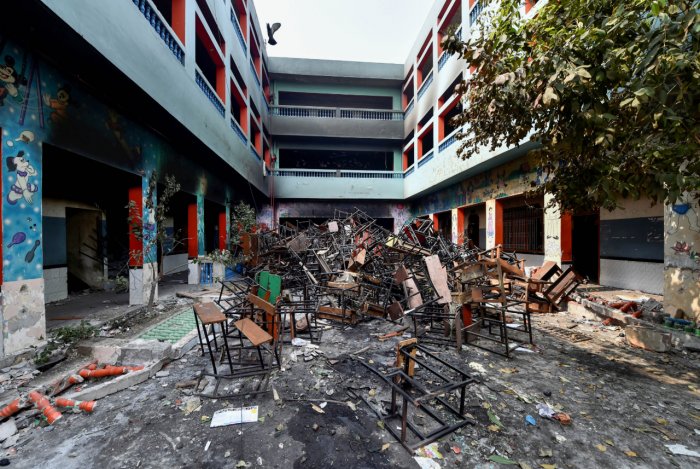
The 32-year old Arun Modern Senior Secondary School was burnt down by rioters in North East Delhi. (Photo: PTI)

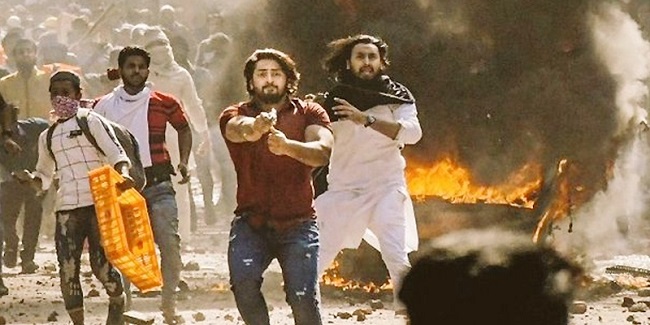
In this saga, the Modi government made a strategic mistake of thinking that this nationwide agitation was against some imaginary provisions of the CAA. The government thought that as people will get to know about the true picture about provisions in the CAA, these protests would die a natural death. This was their biggest mistake. It was due to this strategic mistake that protests in Shaheen Bagh was allowed to fester, which was ably used by vested international media groups to paint India as prejudiced against its vast Muslim population. The inaction at Shaheen Bagh also emboldened the radical Muslim groups and the Lutyen’s coterie who were waiting for an opportune time to strike back. Together they planned the Delhi pogrom to coincide with US President Donald Trump’s visit. The arms, ammunition and Molotov cocktails (petrol bombs) widely available with the rioters point to the fact that the widespread Delhi riots were not spontaneous rather they had been planned to the last minute.

Bottles of Molotov cocktail (petrol bombs) recovered from the terrace of AAP politician Tahir Hussain in North East Delhi. Tahir Hussain has been charged with the murder of Intelligence Bureau (IB) sleuth Ankit Sharma.

Postscript– Narendra Modi government has made tremendous gains in international diplomacy and on defence and security related matters, which no doubt is lot more than any previous governments. But Modi must realise that his government has no voice in the soft power centres such as the media, art, culture, academia, films and entertainment. Delhi riots are a proof that the Lutyen’s coterie is still a superpower in these realms. And soft power is as important as defence and security. Narendra Modi needs to address these soft power centres lest it becomes the Achilles’ heel for his government.

India must counter Pak’s gambit to neutralise FATF

It is business as usual so far as Pakistan and the Financial Action Task Force (FATF) are concerned. In the periodic ritual of reassessing Pakistan’s position the organisation has, once again, maintained the status quo of keeping the country on the “Grey List.” Pakistan, as usual, has taken some superficial actions to get its name struck from the Grey List.

In order to reduce pressure, Pakistan, a little before the plenary session was due, formulated a brazen plan of getting a lower court to convict the terrorist Hafiz Saeed for two terror crimes. The conviction also coincided with the visit of UN Secretary General, Antonio Guterres, to Pakistan. The sentence holds no consequence since it is liable for appeal in a higher court, but, is was enough for the friends of Pakistan in the FATF to bring down the pressure and see the country continuing in the Grey List for another six months. Blacklisting was deemed to be a more appropriate action by many members of the organisation.

Unwavering support by China is the predominant factor that comes to the aid of Pakistan in the FATF meetings. In the latest instance also the FATF Plenary held on February 19th and February 20th, was chaired by the Chinese President of the organisation Xiangmin Liu.

A big difference was that, this time round, the FATF was quite vocal in its censure of Pakistan. Its press release dated February 21st, expressed “concerns about Pakistan’s failure to complete its action plan in line with the agreed timelines and in light of the terrorist financing risks emanating from the jurisdiction.”

The dissatisfaction was followed by a warning to Pakistan to attend to the actionable items on the agenda and failing which stricter action would be considered in the next plenary to be held in June 2020.

Pakistan, however, is quite used to such threats that it has been facing since 2018, when it first came on the Grey List (as on earlier occasions too). It has taken an obdurate position of making only cosmetic efforts to reverse the situation. It probably does not look for the foreign investments that the FATF can stop since not much is coming or is expected to come, in any case. Its larger interest lies in staying out of the Black List which good friend China is in a position to ensure; hence, the very apparent ambivalence in its position.

As things stand now Pakistan is convinced that the FAFT pressure is because of the insistence of US President on the country taking affirmative action against terrorism. Instead of looking at the insistence with the degree of seriousness that it requires, Pakistan is depending upon heavy lobbying to turn the situation around to its favour. It has a strong belief that it will succeed considering that the current year will witness Presidential elections in the US and President Trump will need Pakistan’s support to deliver on Afghanistan.

In the meantime, Pakistan is managing to mull along despite a precarious financial position and restrictions on support due to FATF listing. The question is how?  Once again the biggest financial bailout is coming from China and the International Monetary Fund (IMF). In his article, “Pakistan: Terror and Impunity – Analysis,” the author, Ajit Kumar Singh, notes that IMF made a lot of noises about an Extended Fund Facility (EFF) for about US $6 billion being given to Pakistan “subject to the timely implementation of prior actions and confirmation of international partners’ financial commitments”. Among other commitments, Pakistan was expected to continue “anti-money laundering and combating the financing of terrorism efforts.” None of this has happened, Pakistan continues to remain on the FATF Grey List, and yet, on July 3rd 2019, the Executive Board of the IMF approved the EFF. Under such circumstances what reason has Pakistan got to dismantle its terror sponsoring infrastructure?

More than the Grey List, it is the blacklisting by the FATF that is a devastating nightmare for Pakistan. The country, however, is convinced that such a situation will not come by. It feels that it can leverage the political nature of the FATF to conduct horse trading that is excels in and stay afloat. After all, only three out of the 36 votes in the organisation can keep it out of the blacklist and such support is available in the form of China, Malaysia and Turkey. It is, therefore, looking only at getting itself removed from the Grey List with political lobbying and engineering of abstentions etc.

Many in the world feel that an upgrade of the country to the Black List would be justified. After all, if Iran can figure in the Black List then why not Pakistan with its unending resource of Islamic militants/terrorists and terrorist warlords like Hafiz Saeed, Maulana Azar Masood etc. It is apparent that Pakistan has its road map for neutralising the FATF threat chalked out, even as the world remains ambivalent to the threats posed.

India is directly affected by the terror activities that emanate from Pakistani soil and needs to move fast and strong if she wishes to expose the malevolent designs of Pakistan. The need of the hour is to strongly expose the direct involvement of the notorious Pakistani Inter-Services Intelligence (ISI) in all terrorist activities directed against India and in the support of militancy in Afghanistan. India also needs to emphasise its concerns regarding the fake Indian currency racket being run by Pakistan. The Pakistani proclivity to play the victim card needs to be exposed for its inherent duplicity.

Upon India now rests the mantle of generating a global consensus with regards to Pakistani involvement in proliferation of international terrorism. The recent very successful visit of US President Donald Trump to India, during which the need for the two countries to jointly fight terrorism has been emphasized should form the basis of renewed efforts by India to bring Pakistan to the dock not only in FATF but in other global forums as well.

Government of India announces Maiden Summit on Artificial Intelligence

The Government of India (GoI) has announced the mega event, RAISE 2020- ‘Responsible AI for Social Empowerment 2020,’ and will be held from April 11-12 in New Delhi. RAISE 2020 is India’s first Artificial Intelligence summit to be organized by the Government in partnership with Industry & Academia. The summit will be a global meeting of minds to exchange ideas and charter a course to use AI for social empowerment, inclusion and transformation in key areas like Healthcare, Agriculture, Education and Smart Mobility amongst other sectors. Prime Minister, Narendra Modi will inaugurate the summit.

Ahead of the summit, MeitY organized an Industry Consultation with industry representatives to bring in synergies within India’s Artificial Intelligence landscape. The consultation was chaired by Ajay Prakash Sawhney, Secretary, Ministry of Electronics and Information Technology (MeitY); Gopalakrishnan S., Additional Secretary, MeitY; Jyoti Arora, Additional Secretary & Financial Advisor, MeitY; Sanjay Goel, Joint Secretary, MeitY; Saurabh Gaur, Joint Secretary, MeitY and Abhishek Singh, President and CEO, National e-Governance Division (NeGD) from the Government. Apart from the Government, Industry associations including FICCI, CII, ASSOCHAM & NASSCOM and corporates namely Intel, AWS, KPMG, IBM, Oracle and AI startups amongst others participated in the consultation.

Speaking on the occasion, Ajay Prakash Sawhney, Secretary,Ministry of Electronics and Information Technology (MeitY), said,“We are extremely delighted to announce the first of its kind two-day summit- ‘Responsible AI for Social Empowerment 2020’. In our opinion, a data-rich environment like India has the potential to be the world’s leading AI laboratory which can eventually transform lives globally. AI technology is a powerful tool that can be used to create a positive impact in the Indian context, further becoming the AI destination for the world.”

Explaining in detail about the first of its kind event, Abhishek Singh, President and CEO, National e-Governance Division (NeGD), said, “The name ‘RAISE 2020’ came into being because we want to leverage responsible AI practices for enabling the masses. Through this summit we will outline India’s vision for utilizing the power of Artificial Intelligence to responsibly transform the social landscape for a better tomorrow. RAISE 2020 will facilitate an exchange of ideas to further create a mass awareness about the need to ethically develop and practice AI in the digital era.”

During session, the Government also launched the AI-Startup Challenge and the event website as a part of championing the AI movement in India.

RAISE 2020 is a first of its kind, global meeting of minds on Artificial Intelligence to drive India’s vision and roadmap for social empowerment, inclusion and transformation through responsible AI.  The event will start with a Startup Challenge – Pitchfest followed by the two-day summit, organized by Government of India along with Ministry of Electronics and Information Technology will witness robust participation from global industry leaders, key opinion makers, Government representatives and academia.

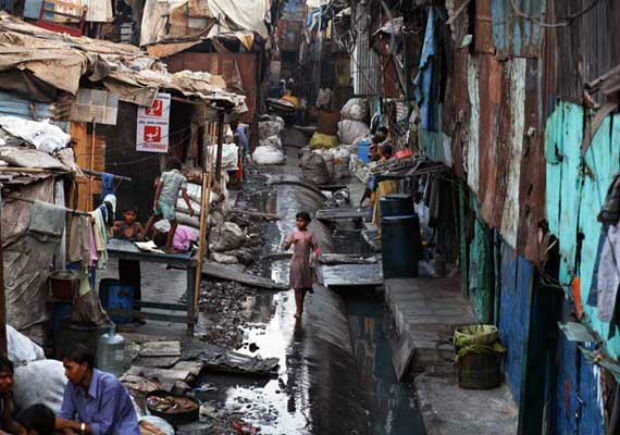
Making urban sanitation services inclusive and participatory

Government of India had launched Swachh Bharat Mission (SBM) – Urban on 2 October 2014 to accelerate the universal sanitation coverage in Indian cities. One of the objectives of the Mission was to ‘elimination of open defecation’. Under Swachh Bharat Mission (SBM) – Urban, toilet facilities have been created at a massive scale across the country. Till October, 2019, a total of 60,96,135 Individual Household Latrines (IHHLs) and 5,61,298 Community and Public Toilets (CTs/PTs) have been completed. In all over India, a total of 3,992 towns have been declared Open Defecation Free (ODF). In Rajasthan 90.10% (173) cities, in Uttar Pradesh 97.60% (650) cities and in Bihar 82.79% (101) cities have been declared as ODF.

The SBM-U also provided a significant impetus to collection, segregation, transportation and processing of Solid Waste Management (SWM). Since 2014, a total of 80,100 Municipal Wards (94.77% of all the Municipal Wards) have adopted 100% door to door collection solid waste. Of these, a total of 60,833 Municipal Wards now practice 100% segregation of solid waste. The Government of India has also introduced a Garbage Free City (GFC) star rating system to encourage the cities to strive for improving the SWM services.

Over the last six years, Indian cities with the support from the central and state governments on one hand and the community based organisations, civil society, academic and research institutions, media and other stakeholders on the other hand, have made significant improvement insanitation services including access to toilets, scientific treatment of solid and liquid waste management, and involving citizens in the operation chain of sanitation services. However, the biggest challenge here is the sustainability of the positive gains from this massive programme. The sustainability of the enhanced urban sanitation services will be contingent upon sustained citizen participation and behaviour changes along with enhanced capacities of ULBs and the city-level institutional ecosystem.

This sets thecontext for a National Conference on “Future of Urban Sanitation in India” that will be organized on Feb 27-28, 2020 in New Delhi by Participatory Research in Asia (PRIA), a global centre for participatory research and training. This consultation forum is an effort to identify solutions to the challenges of sustainable, inclusive and participatory management of urban sanitation services in the next decade.

According to Dr. Rajesh Tandon, Founder-President, Participatory Research in Asia (PRIA), “Indian policy-makers and development professionals have begun to recognise the growing opportunities from increasing urbanisation. However, it is only in the past six years that significant policy and programming push to urban development has begun to reach to small and medium towns of the country. Effective and accountable sanitation services, including access to and use of toilets, are critical for health of a city. Emerging lessons around inclusion and participation of all stake-holders for effective sanitation need to be shared so that new India can emerge in its many urban centres soon.”

Importantly, Society for Participatory Research in Asia (PRIA) has been implementing “Engaged Citizens Responsive City (ECRC)” project in Ajmer, Rajasthan; Jhansi, Uttar Pradesh; and Muzaffarpur, Bihar with the support from the European Union. The objective of the project is to enhance the participation of urban poor in planning, implementation and monitoring of urban sanitation services. Over the last four years, ECRC project has fostered numerous innovative practices to engage citizens with a particular focus on the urban poor in bottom-up participatory planning based on authentic data generated by the communities.

The National Conference will be inaugurated by Hardeep Singh Puri, Minister for State, Ministry of Housing and Urban Affairs (MoHUA), Government of India. A special objective of the National Conference is developing consensus on a framework, methodology, and mechanism for localising Sustainable Development Goals (SDGs) in Indian cities with a particular focus on SDG 11. It will also showcase scalable innovative solutions from across the country to address the challenges of inclusive urban sanitation services and creating a learning and knowledge platform by bringing together policy makers, researchers, experts, and practitioners on inclusive urban sanitation services.

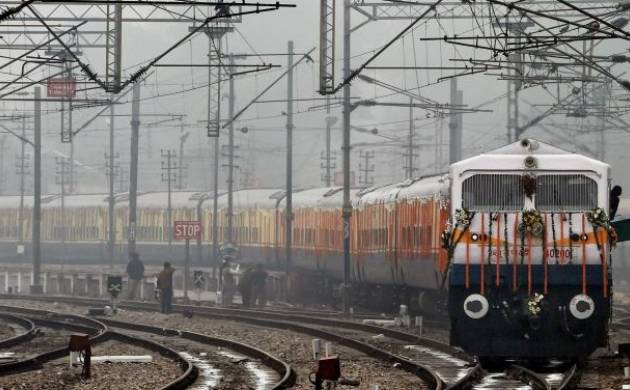
Best ever safety record of Indian Railways with no passenger deaths in last 11 months

Indian Railways has registered the best ever safety record in the current financial year 2019-20. In the year so far (from 01.04.2019 to 24.02.2020) there has been no fatality of any railway passenger in any consequential railway accident. The remarkable feat has been achieved for the first time in the year 2019-20 since introduction of Railway System in India 166 years ago in the year 1853. The zero passenger fatalities in the last 11 months is a result of continuous efforts by Indian Railways to improve safety performance in all respects. Safety being the topmost priority always, the measures undertaken for safety improvement include massive renewal of railway tracks, effective track maintenance, stringent monitoring of safety aspects, improved training of railway staff, improvements in signaling system, use of modern technology for safety works, switching over to modern and safer LHB coaches in phases from the conventional ICF coaches. Also total elimination of Unmanned Level Crossings Gates on broad gauge has resulted in elimination of accidents on this score thus giving huge impetus to safety of train operations.

All the above could become possible with inputs in the system in the form of Rashtriya Rail Sanraksha Kosh (RRSK) introduced in the year 2017-18 with a corpus of Rs1 lakh crore to be spent in next five years, having annual outlay of Rs 20,000 crore. With this fund, it has been possible to undertake very critical safety works of urgent nature and results are evident.

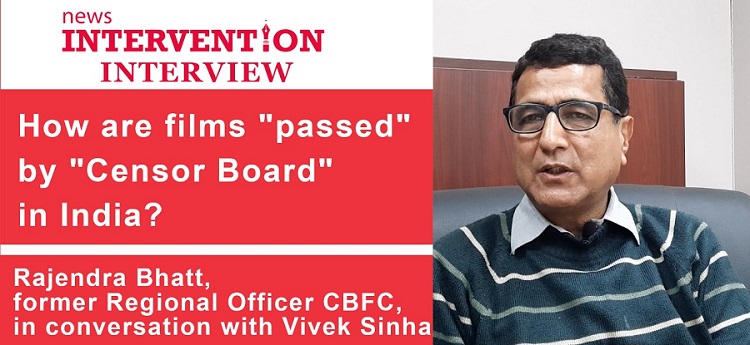
How are films “Passed” by the “Censor Board” in India?

0

We enjoy watching films and documentaries. And quite often we also hear controversies around the “Censor Board” that has been mandated with the task to certify films and documentaries. But do you know that “Censor Board” is a wrong terminology. The correct word is CBFC (Central Board of Film Certification) and its job is not to “censor” but to certify films. Surprised? Watch this conversation between Mr. Rajendra Bhatt, former Regional Officer CBFC and Vivek Sinha, Founder-Editor News Intervention where Mr Rajendra Bhatt explains several interesting facets about how films are cleared by the CBFC.

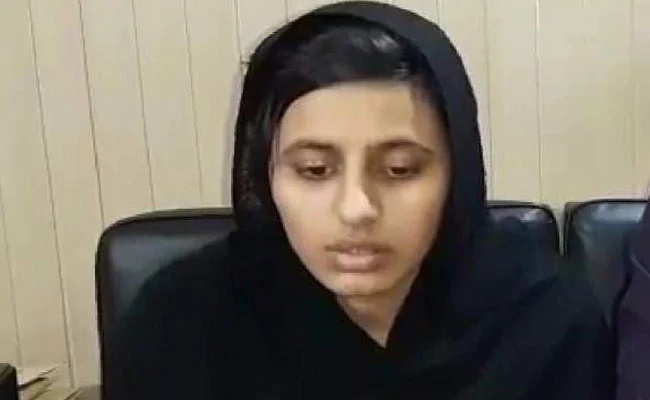
Pak refugees speak of inhumane persecution of minorities in Pakistan

Indian Parliament has enacted the Citizenship (Amendment) Act, 2019, (CAA), with the noble, justified and righteous intention of easing the process of grant of citizenship to the persecuted religious minorities of Pakistan, Afghanistan and Bangladesh.

The merits or otherwise of CAA, that are being deliberated across the nation, have led to many discussions and interactions with those who have fled Pakistan and are now living in India. These interactions have thrown light on the inhumane manner in which minority communities have been and continue to be treated in Pakistan.

In Pakistan, minorities live like slaves without any established rights or the liberty of free life and movement. Those few children to manage to get to school cannot say “Yes sir” to the roll call, instead have to respond by saying “Allah ho Akbar.” They do not have right to worship even privately in their homes. To cremate their dead with normal Hindu customs, they have to first take permission from the police and then find some place in a far flung jungle for the mortal remains to be consigned to flames. Quite often the cremation is done in one’s own house, even the bones are not allowed to be collected. They are not allowed to hold marriage celebrations in the open.

The young girls of these communities are forcibly converted to Islam and then married to Muslims. Police does not register complaints of the families when the process is being carried out. The girl is made to sign the conversion paper and married off. The conversion paper is then presented to the Court for acceptance which comes with great alacrity; then the case is closed. It is only recently that high profile cases like the abduction and marriage of the daughter of a Sikh religious teacher of Nankana Sahib got highlighted and skeletons started tumbling out of the closet.

The refugees of Pakistan term such conversions as a regular process that has been going on since Pakistan came into existence. It is one reason behind the population levels of minorities falling at such a devastating scale. Pakistan, at the time of partition had more than 14% minority Hindus, Sikhs, Christians, Buddhists, Jains and Parsis in Pakistan and now it is reduced to a paltry 1 %. Millions of people have simply disappeared in thin air.

The Sword of Blasphemy Law, one of the most brutal and discriminatory legislations in the modern world, is continuously hanging over the head of the minorities. On the face of it the law prohibits Blasphemy against any recognised religion and provides for punishment ranging from fine to death. In actuality, it is being used to suppress and brutalise the minorities in the country.  It is in absolute contravention to international norms on human rights, especially those related to the rights to freedom of religion and belief; freedom of expression; and equal protection by the law.

A good example of the diabolic nature of the law is the case of Asia Bibi which is now in the news. Asia Bibi is a Christian woman from Pakistan who got into a tiff with other ladies while harvesting their fields in 2009. She was accused of making some offensive comments against Prophet Muhammad (PBUH) for which she was arrested and sentenced to death. It was due to tremendous pressure from the Christian nations that she was allowed to leave the country and is presently settled in Canada. Others have not been as lucky with some having been stoned to death for Blasphemy in a barbaric medieval ritual. No record of such crimes is allowed to exist; it simply put under wraps. 

There are a large number of persecuted Hindu and Sikh families in Pakistan looking to leave the country but finding it difficult to do so due to enhanced restrictions that preclude any possibility of visiting India and staying back as was the norm earlier. Such families are now taking the Afghanistan and Nepal route to get to India which is both dangerous and expensive.

The harassment by Pakistan of those who have managed to come to India does not end with the deed done. Frequently, they have to visit Pakistan embassy to get their passports renewed where they meet with endless roadblocks and rampant corruption. Each renewal costs them more than Rs.10000/- which they can ill afford.

The refugees coming from Pakistan feel that only India can understand their problem and their plight. It is on this magnanimous country that they have pinned all hopes for their future. They are emphatic in their assertion that if Government of India does not take the lead to assist them then none other will. They are sending fervent appeals top the Government of India to apply the provision of CAA so that they can resume their shattered lives as proud Indians.

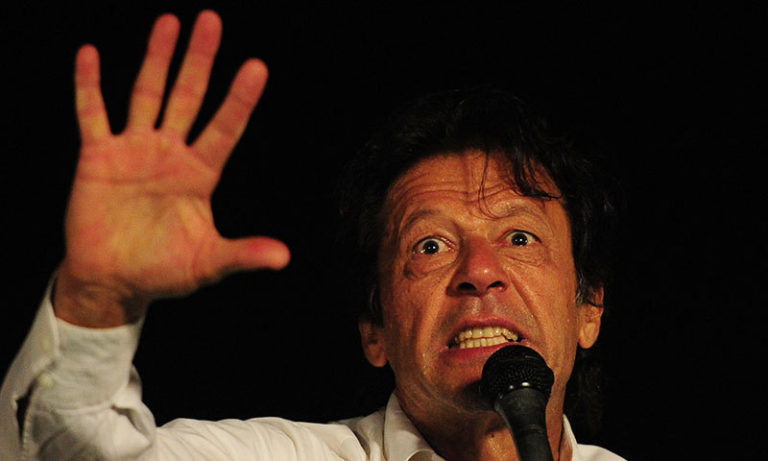
One can only look back with nostalgia at the promise made by Muhammad Ali Jinnah to the people of the country. “You are free; you are free to go to your temples, you are free to go to your mosques or to any other place of worship in this State of Pakistan. You may belong to any religion or caste or creed — that has nothing to do with the business of the State,” he said. Apparently, his successors have other ideas about what the nation will look like in the future. Prime Minister Imran Khan, particularly, has demonstrated that he will not hesitate from committing Blasphemy with this office and the minorities of his country to achieve his vision of a pure Islamic state.

The world needs to take cognizance of the genocide that is slowly taking place in Pakistan. The responsibility on India is all the more acute. While being concerned about all the groups that are suffering, special attention has to be given to the Hindu, Sikh and Christian communities.

Responsible Living Should be Everyone’s Karma

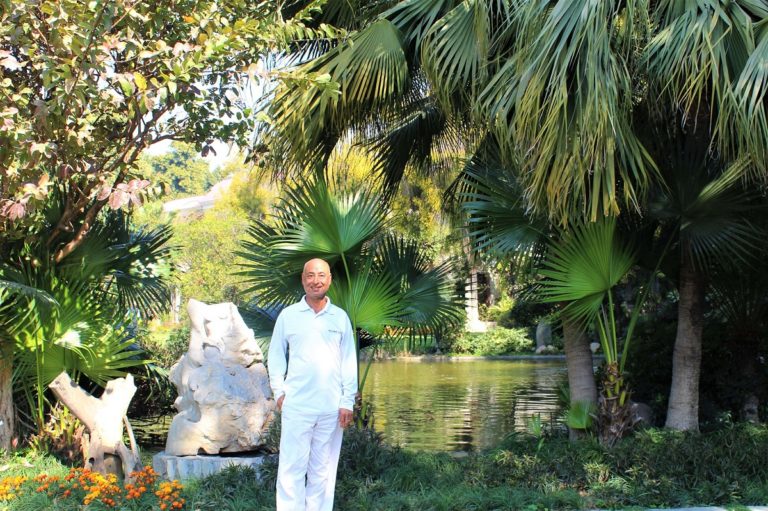
Sitting with a calm demeanour, amidst the rhythmic melody of chirping birds and steady burble of running water in his palatial home, Ashwani Khurana always gets excited when the issue of environment comes up for discussion. And, it’s quite natural. For someone who has planted more than 2.5 lakh trees in his lifetime, it’s the harmony of life with nature that accounts for all the happiness and excitement. But it is more than just a momentary exhilaration. This congruence with nature is something that has been nurtured and fostered by him over several decades and has gradually become his guiding philosophy of life in all its myriad spheres.

Khurana believes that planting trees has been his karma. His passion for planting trees began quite early in life. As a young man in early twenties, way back in 1980s, he had a life-changing experience of interacting with Nek Chand, the famous creator of Rock Garden in Chandigarh, which had a powerful influence on him. “It was an overwhelming experience and soon Nek Chand ji became my mentor and guide,” he shared ecstatically. In 1987, he took a vow to plant one lakh trees, which he eventually did during the next one decade and decided to commit his life to the harmony of humans and nature. “I lived by the self-guiding principle that greening, like charity, begins at home; but it shouldn’t end there. The easiest and yet most satisfying environmental initiative we all can take is planting more and more trees. Seeing trees grow has been immensely elating for me, as one would feel seeing their child grow. This bliss was inexplicable and I became an ardent nature lover,” he shared. The green natural surroundings of his home regularly host several resident and migratory birds. “We also get occasional visits by hornbills and partridges and it is said that if partridges visit any place it is the perfect ecosystem,” he chuckled.

His beautifully landscaped and eco-friendly home in Delhi’s Vasant Kunj has been a testing ground for several of his green experiments. Be it practising rain water harvesting, vermicomposting, organic agriculture, recycling of human and animal waste and much more, and the benefits are derived by the entire neighbourhood. “Earlier, a lot of people used to burn dry leaves, we asked them to send all the waste material to us. We have been organising ‘earth sense day’ in the neighbourhood collecting kitchen waste as well as e-waste from all the houses and re-using it. The e-waste is sent to an organisation for responsible disposable and recycling,” Khurana informed.  All the waste generated in kitchen and all other kind of animal and human waste is used to make organic manure in his farm, which has a cow shed, poultry, and vermicomposting units.   

Interestingly, Khurana, who was once known as the lottery king of India and was also the highest individual tax payer in 1989 in the whole country, feels his biggest asset has been the green oasis he has created in Delhi/NCR – Karma Lakelands, India’s greenest golf resort. Loving and caring the environment is a philosophy that he has nurtured and followed both in his personal and professional spheres and thus was born Karma Lakelands. “In 1989 land banking was done with deep passion to only grow lots and lots of trees and eventually it evolved as one of its kind eco-friendly luxury golf resort. What differentiates Karma Lakelands from others is its commitment towards eco-friendly practices,” he informed. From sewage treatment to plastic recycling, use of solar energy, bee keeping and organic farming, these have become the hallmark of responsible hospitality for him.

To promote sustainable living, rain water at Karma Lakelands is channelized and harvested for irrigation purposes. All kitchen-waste is sorted on site and recycled to feed farm animals or is used for making organic compost. All plastic-waste is sent for recycling. The compost that is used for soil enrichment, is a collection of leaves mixed with cow dung and sewage, as a result there are no flies or mosquitos. Karma Lakelands also has a dedicated Sewage Treatment Plant (STP) with a capacity to treat 500,000 liters of sewage daily. The sewage is piped from National Security Guards (NSG) campus next door and surrounding areas of the resort and the treated water which is also nutrient rich is used for irrigation and horticulture of the entire resort. “It’s not just our own waste, even waste generated by other nearby hotels and resorts is accepted by us and used for various purposes,” he informed.

And, what you get with these eco-initiatives is not just green surroundings but also fresh air, immense biodiversity and numerous varieties of birds dotting the landscape and skyline including sparrows, lapwing, pheasant, shikra, owl, pied wagtail, babbler, kingfisher, blue jay, lesser cormorant, mynah, green pigeon, koel, hoopoe and many more.

With a firm belief in the motto of responsible living for a sustainable future, Ashwani Khurana is creating a wonderful legacy, perhaps what Nek Chand did for Chandigarh, Khurana is on a mission to do the same for Delhi-NCR.

Farmer is the best teacher: Vice President M. Venkaiah Naidu

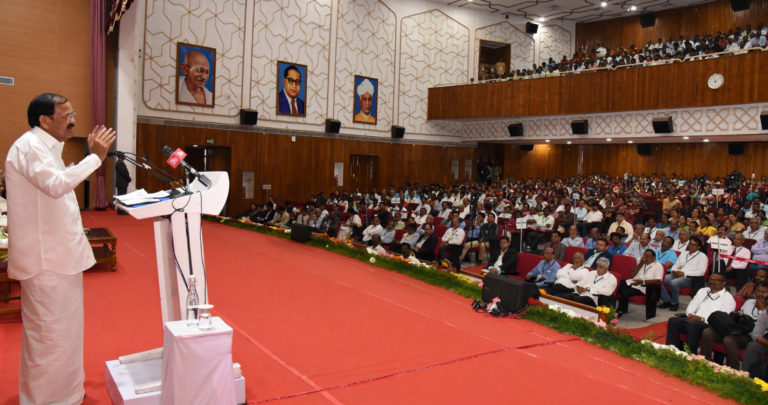
The Vice President of India M. Venkaiah Naidu called upon the scientist and researchers to come up with new innovations and ideas to find solutions to the challenges faced by the Indian farmers.

Inaugurating the 2nd Edition of Exhibition and Conference on Agri-technology & Innovation at Prof. Jayashankar Telangana State Agriculture University in Hyderabad today, the Vice President said that there has to be a meeting of minds between scientists, researchers, Krishi Vigyan Kendras and farmers, who are the main stakeholders, to adopt best practices and make agriculture remunerative.

Observing that a farmer is the best teacher on agriculture, Naidu said that miracles can be created if farmer’s knowledge relating to the field and the research of the scientist are brought together. He suggested to the students studying agriculture to spend half of their time in classrooms and the rest with farmers to gain first hand practical knowledge and acquaint themselves with the problems of the farmers.

The Vice President also called upon the agriculture universities to focus on developing new varieties including the pest resistant and climate smart variants, apart from enhancing the productivity levels. Calling for collective efforts to achieve self-sufficiency in food production, he said that a country like India should not depend on imported food security.

Stating that freebies and loan waivers were not the solution, Naidu said that they only provide temporary relief. What is needed are the long term and wholistic measures that make agriculture viable and profitable, he added.

Listing some of such long term measures, he suggested quality power supply, development of rural infrastructure including godowns, cold storage facilities, refrigerator vans apart from ensuring quality inputs and timely and adequate credit to the farmers.

Calling for the diversification of agriculture, the Vice President said that farmers should be encouraged to grow new crops in addition to traditional crops. He also stressed the need for taking up ancillary activities such as poultry, dairy, horticulture and aquaculture to supplement the farmer’s income.

The Vice President also emphasised the need for post harvest management and providing support to the farmers. He said e-NAM should be expanded to all regions in every state. Shri Naidu also highlighted the need for promoting food processing and value addition of agri products. He urged all entrepreneurs to evolve effective models in the food processing sector after consulting the scientific community, experts and farmers.

Indian delegation discusses strategic positioning of IFFI at Cannes Film Festival 2020

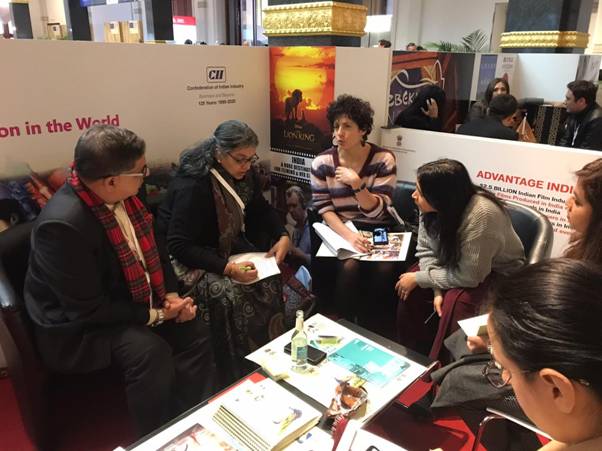
With the objective to positioning India much more strategically at Cannes this year, the Indian delegation at Berlin International Film Festival met Maud Amson, Head of Sales & Operations, Marche Du Film, Cannes Film Festival and Arnaud Menindes, Sales & Operations – Advertising at Marché du Film, Cannes Film Festival regarding Government of India’s participation at the Cannes Film Market 2020. Cannes expressed their collaboration and participation for the 51st edition of IFFI.

The delegation also met with Heads of renowned Film Festivals, Film Commissons, International Producers like Mariëlle Poupelin, Specialist International Business Development, Telefilm Canada; Enrico Vannucci, Deputy Executive Director, Eurimages; Kai Nordberg, Making Movies OY; Adriane Freitag, Executive Manager, Cinema do Brasil; Lefteris S. Eleftheroiu, Senior Officer, Head of Film Unit, Invest Cyprus, Katalin Vajda, Festival Manager, National Film Institute, Hungary, Luis Chaby Vaz, President of Board – ICA Instituto do Cinema e Do Audiovisual, Portugal and Sergio Scapegini, Italian Producer. Scapegini expressed that the Italy would actively consider participating and collaborating with India for the 51st edition of IFFI. He also underlined that the participation would pave-forward for more proactive ties between the two nations.

The Indian delegation, through these interactions, promoted the 51st edition of IFFI and ease of shooting films in India through Film Facilitation Office that facilitates Single Window Clearance for film-makers and provides a platform for ‘film tourism’ in India through the website www.ffo.gov.in. The delegation also explored opportunities regarding co-production with India and collaborations for films with international production houses.

Ministry of Information & Broadcating, in collaboration with Confederation of Indian Industry, is participating at the Berlin International Film Festival (Berlinale) 2020 in Germany.