
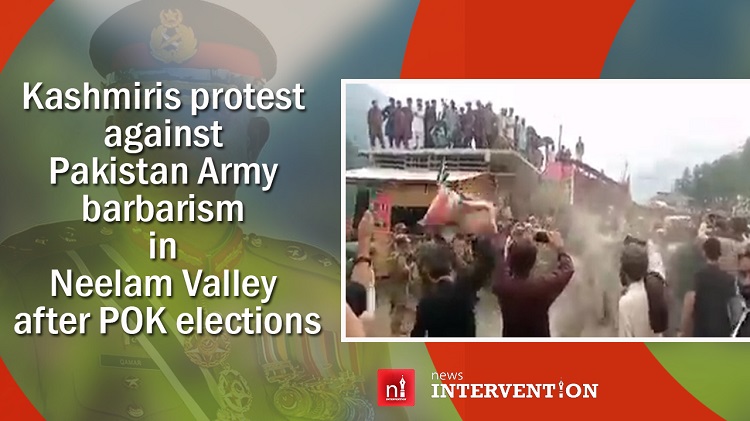
On July 26, Pakistan Army conducted sham elections in POK to “select” their candidates. Soon after voting closed the Pakistani Frontier Corps (FC) personnel forcibly took away local vehicles and misbehaved with the women. This was vehemently resisted by the Kashmiris. In response the Pakistan Frontier Corps personnel opened fire and killed one Kashmiri and injured thirteen others. After this the Kashmiris started raising slogans against Pakistan Army and soon massive protests erupted across Neelam Valley in Pakistan-occupied Kashmir (POK).
Watch News Intervention video report to understand the real picture inside Pakistan-occupied Kashmir (POK).
Kashmiris protest against Pakistan Army’s barbarism in Neelam Valley after POK elections
Pakistan has a direct hand in Afghanistan crisis and chaos
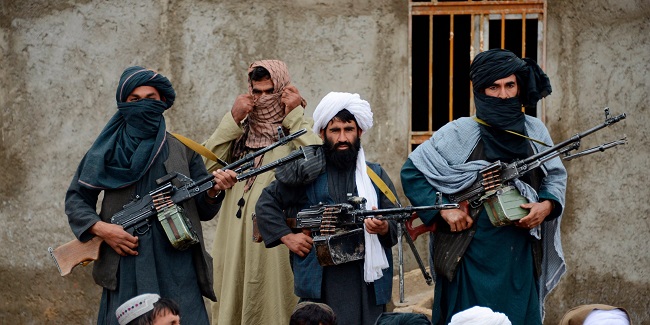
The irony of fate is that a country whose people have defended their freedom for centuries through sweat and blood has now become the battleground for the actors of the old “Great Game” directly or through proxies. Those who fought and drove away the intruders have now fallen apart like hungry wolves seeking one another’s blood. Some say that Afghanistan is the last theatre of several centuries’ old ideological war between the diehard Islamic orthodoxy and modernism.
Withdrawal of the US and NATO troops from Afghanistan, in no less ignominious a manner than the withdrawal of the Soviets in 1990, leaves behind a trail of uncertainties and also the looming threat of unimaginable catastrophe. The unsparing hand of history has exposed the immaturity and arrogance of both world powers in dealing with Afghanistan, the proverbial graveyard of the big powers.
The Soviets were aware of the intrepidity of Afghans in resisting southward push of Marxist ideology across the Oxus (Amu Darya) and beyond the Badakhshan Mountain. But unfortunately, intoxicated with the victory over Nazism, the Soviets did not show patience for formulating a workable option of pursuing their objective in the resolutely independent tribal state of Afghanistan. They had thought that the superficial groundwork done by a feigned leftist group would serve their purpose of reaching the warm waters of the Indian Ocean. History proved them wrong.
The policy of invoking Islamism, theoretically as well as militarily, for realizing political objective of forcing a disgraceful retreat on the Soviets in Afghan war was tantamount to playing with fire. American policy planners did not visualize the long-term consequences of arming the time-hardened Afghan fighters steeped in the conservatism of middle ages. It cost the US not only nearly five thousand precious lives of her soldiers fighting against the mujahedeen, the legions they had deeply patronized now become the auxiliary to Al-Qaeda and Taliban, but also several trillions of dollars to run the anti-Taliban war machine for two decades, and finally, take to their heels from Bagram air base at the dead of night leaving everything behind.
Thus, in a bid to show down the Soviets, the Americans added an unprecedented chapter of terror and bloodshed to the world history in the name of service to democracy, leaving the beleaguered and innocent people in vulnerable parts of the globe to be decimated and destroyed by a surge of Theo-fascism many times more devastating than communism.
The US has now dragged its feet from war-torn Afghanistan leaving the nationalist Afghans and pro-democracy forces in a quandary. Not only the people and the administrative machinery in Afghanistan are cast on the horns of dilemma, even the neighbouring states like India, Iran, Tajikistan, Uzbekistan and the Russian Federation are seriously watching the situation. The speed with which the Taliban are capturing strategic locations and border crossing points indicates that Kabul may capitulate sooner than later.
The Taliban claim they are in control of 85 per cent of Afghan territory. Many countries have already recalled the staff in their missions in Afghanistan. India has also withdrawn its diplomatic staff from Kabul. The national forces are fighting the Taliban bravely but we don’t think that retiring Americans have left behind for them any strong and decisive resistance mechanism to ensure that the government in Kabul does not collapse. The Afghans are left to fend for themselves.
It is obvious that President Ashraf Ghani will appeal friendly countries and also the countries wedded to democratic ideology to come to the help of the beleaguered Afghan nation. But no country seems ready to promise military support in given situation because the situation is too complicated and problematic. It has international ramifications.
The Taliban have issued warning that no country should take the risk of offering military support to the national government in Kabul and if any country makes a venture like that, it will have to face serious consequences.
On the eve of Tashkent conference the Afghan Vice President has accused Pakistan of threatening to fire missiles and destroy the Afghan fighter jets if the latter try to bombard Spin Boldak border crossing. President Ashraf Ghani has repeated the charge to which Imran Khan has said that these charges are baseless and regrettable.
Collapse of Kabul regime and return of Taliban to power will be a major setback to democracies in the Asian region. Although the Taliban have made it clear more than once that they do not carry their fight to countries outside Afghanistan, yet Taliban’s long association with Al-Qaeda and ISIS have the potential to change the ground situation irrespective of what the Afghan Taliban would say. There are undeniable proofs with the stakeholders that show Pakistan’s clandestine role in boosting the morale of the Afghan Taliban not only in theory but in practice as well. The evidence available is good enough to change to course of events and put Afghan crisis on a new trajectory.
BBC has been able to lay its hand on a secret report of NATO which has now been brought into the public domain. Coming at a sensitive time in Pakistan-NATO relations, the report notes that the Taliban in Afghanistan are being directly assisted by Pakistani security services. The leaked report, derived from thousands of interrogations, claims that the Taliban remain defiant and have wide support among the Afghan people. Indeed, it is painful reading for the international forces and the Afghan government.
A Pakistani foreign ministry spokesman called the accusations “ridiculous”. “We are committed to non-interference in Afghanistan and expect all other states to strictly adhere to this principle,” Abdul Basit told the BBC. He added, “A stable and peaceful Afghanistan is in our own interests. We cannot indulge in any activity which takes us away from achieving that objective.”
The report alleges that Pakistan knows the location of senior Taliban leaders. “We have long been concerned about ties between elements of the ISI (Pakistan’s intelligence service) and some extremist networks,” said US Pentagon spokesman Captain John Kirby, adding that the US Defence Department had not yet seen the report.
The BBC’s Quentin Somerville in Kabul says the report — on the state of the Taliban — fully exposes for the first time the relationship between the ISI and the Taliban. It is based on material from 27,000 interrogations with more than 4,000 captured Taliban, Al-Qaeda and other foreign fighters and civilians. Pakistan’s manipulation of the Taliban senior leadership continues unabatedly. It says that Pakistan is aware of the locations of senior Taliban leaders. “Senior Taliban representatives, such as Nasiruddin Haqqani, maintain residences in the immediate vicinity of ISI headquarters in Islamabad,” it said. It quotes a senior Al-Qaeda detainee as saying: “Pakistan knows everything. The Taliban are not Islam. The Taliban are Islamabad.”
BBC correspondent says the report seems to suggest that the Taliban feel trapped by ISI control and fear they will never escape its influence. However, it states: “As this document is derived directly from insurgents it should be considered informational and not necessarily analytical.”
Adm Mike Mullen, former chairman of the US Joint Chiefs of Staff, has explained Pakistan’s closeness to the Afghan Taliban by pointing to infiltration of its army by the religious right, but he also says it is part of a grand strategy to increase leverage in the region via “proxies”.
Despite NATO’s strategy to secure the country with Afghan forces, the secret document details widespread collaboration between the insurgents and Afghan police and military. Lt Col Jimmie Cummings, a spokesman for NATO’s International Security Assistance Force (ISAF) in Afghanistan, said the document was “a classified internal document that is not meant to be released to the public”.
The report also depicts the depth of continuing support among the Afghan population for the Taliban. It paints a picture of Al-Qaeda’s influence diminishing but the Taliban’s influence increasing. Gen. Jack Keane, former US Army vice chief of staff commented: “They (Pakistan) provide resources, sanctuary… and training”
In a devastating conclusion, the document says that in the last year there has been unprecedented interest, even from members of the Afghan government, in joining the Taliban cause. It adds: “Afghan civilians frequently prefer Taliban governance over the Afghan government, usually as a result of government corruption.” The report has evidence that the Taliban are purposely hastening NATO’s withdrawal by deliberately reducing their attacks in some areas and then initiating a comprehensive hearts-and-minds campaign.
It says that in areas where ISAF (International Security Assistance Force) has withdrawn, Taliban influence has increased, often with little or no resistance from government security forces. And in many cases, with the active help of the Afghan police and army.
The report says that surrender is far from their collective mind-set. “For the moment, they believe that continuing the fight and expanding Taliban governance are their only viable courses of action.”
According to the report, rifles, pistols and heavy weapons have been sold by Afghan security forces in bazaars in Pakistan.
The report adds that Taliban members “do not receive salaries or other financial incentives for their work”, but their operations are funded by the narcotics trade and they frequently take a cut from the trade. Their main revenue, though, is from donations, and they travel around the country from door to door making no secret of their affiliation, it says.
This then is the grim picture of Afghanistan and the role Pakistan is playing. The only change that is perceptible is that the Taliban chief has, in a recent statement, once again reiterated that he prefers a dialogue and an agreed solution of Afghan crisis. Ashraf Ghani government has deputed a team to Doha to engage the Taliban in bilateral talks. Several rounds of bilateral talks have been held but so far no concrete result has been achieved. A bilateral agreement between the two delegations is the right solution.
Kargil: Do not lament the death of a warrior in battlefield, they are honoured in Heaven
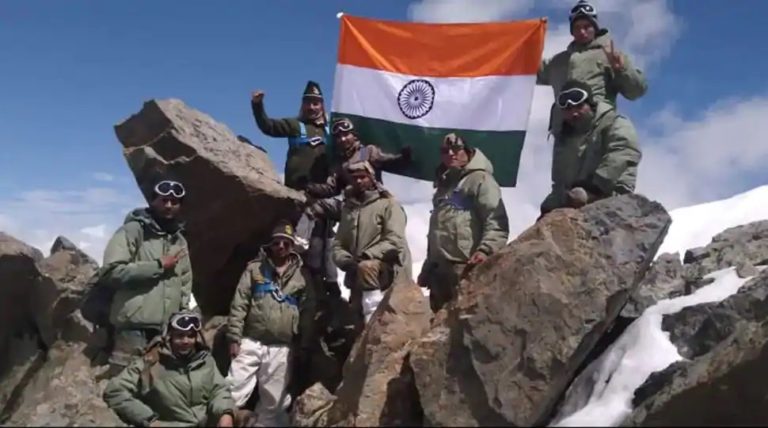
The fifth round of conflict between India and Pakistan was fought in the heights of Kargil. Code named Operation Vijay, it lasted for 83 days, starting from May 3, 1999 and ended on July 26, 1999. This short and intense war ended with a decisive victory for India. When a unilateral ceasefire was declared by the Indian Prime Minister Atal Bihari Vajpayee, there was actually no enemy left to fight against. Those who had intruded and occupied the heights were mostly killed while the remaining few set out on a difficult journey back home where they faced ignominy and humiliation. Prime Minister Vajpayee publicly admired the valour and determination of Indian Armed Forces and declared Operation Vijay a glorious victory as the Line of Control ( LOC) had been restored.
The story of Kargil is one of deceit and treachery by one person, General Pervez Musharraf, the then Chief of Pakistan Army. To satisfy his personal ego and ambition he launched Operation Koh Paima (as he named the Kargil intrusion) without the knowledge of the then Prime Minister of Pakistan, Nawaz Sharif. It was executed by a few sycophant Generals working under General Pervez Musharraf and were commanding the formations at Gilgit-Baltistan.
Operation Koh Paima was already underway when the Lahore declaration was being signed between the prime ministers of India and Pakistan as a consequence of the “Bus Diplomacy” initiated by PM Vajpayee on 21 February 1999.
Detection of the intrusions was done by a few shepherds and commanders on ground were informed about the presence of armed elements wearing Salwar-Kameez in the heights. The Pakistani plan was to pass off the intruders as Mujahedeen. By beginning May it was clear that the intruders were well equipped trained soldiers of the Pakistan Army of a Division minus strength who had occupied three pockets from Mushkoh and Dras to Yaldar. They were entrenched and had artillery support.
On achieving clarity, the Indian Army went in for the quick mobilisation and put in place two divisions for the attack to retrieve the positions. Thus started the Kargil War. There were initial setbacks when a patrol led by Captain Saurabh Kalia, 4 JAT, was taken prisoner of war on May 3, 1999 and later killed brutally.
The response of the Indian Army was ferocious. 8 SIKH recaptured Point 4256; Point 4440 and 16 Grenadiers captured Point 4480 by 16 May 1999. The government sanctioned the use of Indian Air Force on 26 May which launched Operation Safed Sagar with Mirage 2000 aircraft that ruled the skies with devastating effect. Five Regiments of 155mm Bofors guns reached the war zone and demolished enemy fortifications. Tololing and Point 4590 were captured on 13 June; Point 4760, Black Rock, 3 pimples were captured on 29 June. The battle for Tiger Hill was won after great effort and sacrifice.
Nawaz Sharif rushed to the USA to solicit assistance. The same day Muskoh and Dras area were recaptured and cleared. From 12 July to 18 July, withdrawal of Pakistan troops was permitted. Finally, Zulu Spur was taken on 24 July and sanctity of the LOC was restored. On 26 July 1999, Indian PM declared that Operation Vijay was over. The cost of victory was high, 22 officers, 21 JCOs and 452 brave soldiers of India made the supreme sacrifice. Pakistan lost almost 1200 soldiers.
While the complete saga of courage and devotion to duty cannot be recounted it is being exemplified here by taking note of a few such stories of valour.
Captain Vikram Batra, PVC (Posthumous)
Known as Sher Shah in the Kargil War, Captain Vikram Batra, was commissioned into 13 Jammu Kashmir Rifles on 6 December 1997. He therefore had less than two years service when he went into war. His Battalion was tasked to regain Point 5140, for which he volunteered and chose “Dil Maange More” as the success password which later became folklore. His team captured the heavily defended feature.
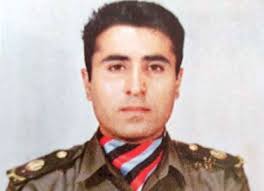
There was heavy fire coming from the neighbouring height Point 4875, the commanding officer Lt. Col. YK Joshi who is now a Lieutenant General and commanding the elite Northern Command appreciated the need for its immediate capture. He detailed another company for the attack but Captain Vikram Batra insisted on going in since he was already quite near to the objective. He convinced his commanding officer and went for the assault on Point 4875. He led the advance without care for his personal safety and was hit by a volley of Light Machine Gun fire. He crawled to the bunker profusely bleeding and lobbed a grenade thus silencing the enemy. The Indian Tricolour was soon placed on Point 4875 and sanctity of the LOC was restored in the Dras sector. Point 4875 has been renamed “Batra Top.” His farewell words to his commanding officer were, “either l will come back after hoisting the Tricolour, or will come back wrapped in it, but l will come back for sure”
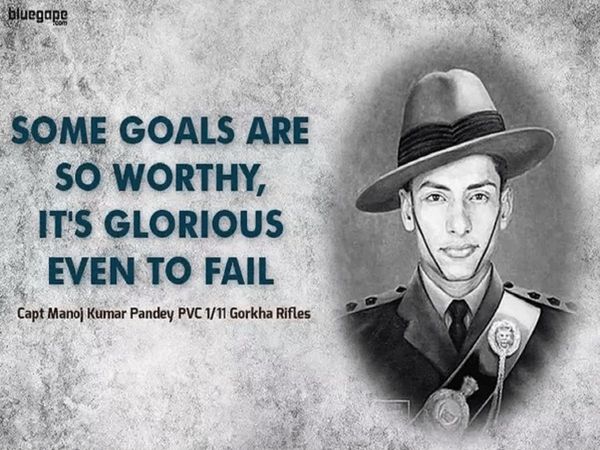
Captain Manoj Kumar Pandey, PVC (Posthumous)
Lieutenant Manoj Pandey was commissioned into 1/11 Gorkha Rifles in 1998. He went to war with less than one year of service. He was instrumental in dislodging a firmly entrenched enemy in the Kalubar Hill and Jabuar Top of the Yaldar Sector. Young Manoj led the assault personally under cover of darkness and got into hand to hand conflict with his Khukhri. The team cleared some parts but while heading for Jabuar Top it got day-lighted. Due to heavy fire he sustained multiple bullet injuries but continued firing and motivating his assaulting troops. Finally, Kalubar and Jabuar were captured even as Lieutenant Manoj Pandey died a hero. He was promoted as Captain and awarded the Param Vir Chakra.
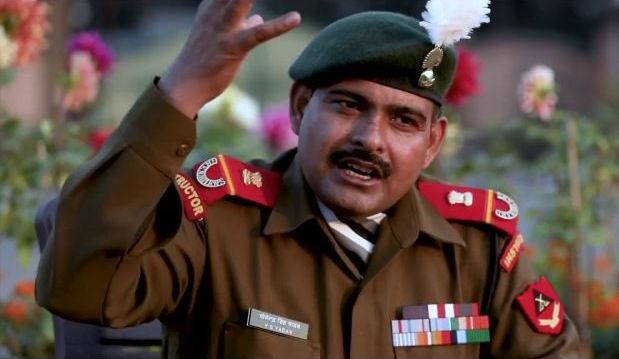
Lieutenant Yogender Singh Yadav, PVC
Grenadier YS Yadav moved with his unit 18 Grenadiers to Kargil Dras sector in early June 1999. The unit was tasked to capture Tololing Top on 10 June 1999. The height of the feature was 16,800 feet and it had near zero temp even in summer. The assault was launched on 12 June. Yogender Yadav was the leading scout of the commando platoon that took a rear cliff approach and climbed with the help of slithering ropes. Once upon the enemy, he lobbed a grenade from the rear and killed all in the bunker. While neutralising the second position he was hit by several bullets but he kept crawling forward. His platoon was reduced to half but he did not give up. Finally he killed four Pakistani soldiers with another grenade and the Tololing bastion came into Indian hands. This was the first Indian victory of the war. Grenadier Yogender Yadav was evacuated by Air to Army Hospital, Delhi almost dead, but he survived. He is presently serving in Indian Army in the rank of Honorary Lieutenant.
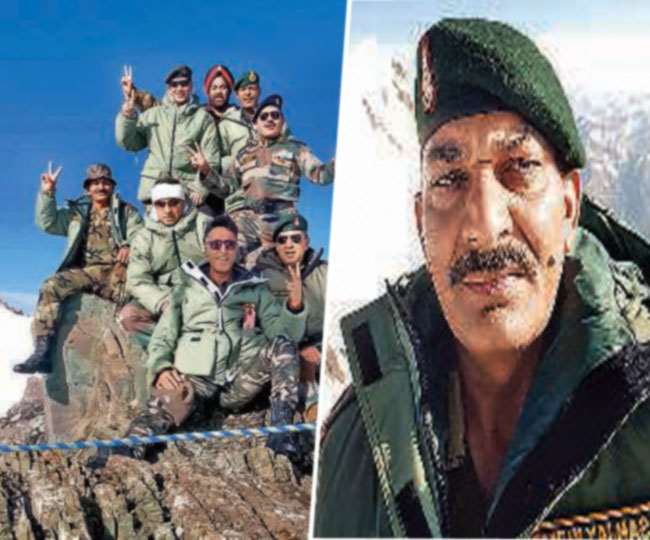
Rifleman Sanjay Kumar, PVC
Rifleman Sanjay Kumar, was enrolled into 13 Jammu Kashmir Rifles in 1996. The battalion under Lt. Colonel (now Lt. General) YK Joshi had moved to Muskoh sub sector in Dras. For the assault on Point 4875 (later Batra Top) Rifleman Sanjay Kumar along with his buddy were the leading scouts. The team came under heavy fire and Sanjay told his buddy to give covering fire while he charged at the post. He was hit on the shoulder and fell down but continued crawling forward and entered the enemy fortification where he killed the enemy in close combat.
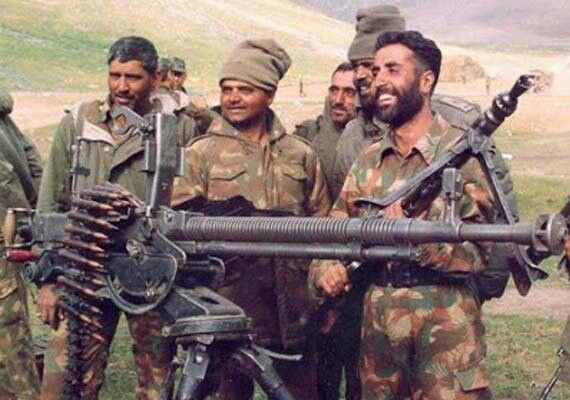
Despite bleeding profusely Rifleman Sanjay Kumar rushed to the next fortification which surprised the enemy who abandoned their position. Having finished his ammunition, he picked up an abandoned enemy machine gun and shot dead the fleeing soldiers. Thus Area Flat Top was captured and this helped in the capture of Point 4875.
There are so many soldiers who made supreme sacrifices or were severely wounded for the safety and integrity of the Nation. Ten infantry battalions were also awarded Battle Honour and the title of ‘Bravest of the Brave.’ We salute our War heroes, especially those who did not come back.
“Do not lament the death of a warrior in battlefield, they are honoured in Heaven.”
Kargil War 1999: Scenario then, and now
Kargil Vijay Divas celebrations have commenced across the country; these events are held by Indian Army and civilians across the country to commemorate the great Indian victory in the Kargil heights against Pakistani troops that coveted to seize the mountains duplicitously.
The Indian Army began operations on May 3, 1999 and in less than three months, removed the Pakistani troops from the positions that they had occupied. Final and comprehensive victory was declared on July 26, 1999. The enemy either lay dead or was compelled to retreat back.
This year, as one joins the celebration, thoughts go back to two soldiers, one from the Pakistan Army and the other from the Indian Army, who fought the war.
One of them now lies in a bed in foreign shores, wracked with disease, exiled from his own nation, cold, embittered and without friends. He is General Pervez Musharraf, the then Chief of Army Staff of Pakistan Army who ordered the intrusions in accordance with a plan that he had conceived while a Brigadier serving in the area.
The second, an Indian soldier then a Lieutenant Colonel who led his battalion to glory in the war is today an Army Commander of the same command under which he fought the war. He is Lt. General Yogesh Kumar Joshi, UYSM, AVSM, VrC, SM, ADC, who led his parent battalion, the 13 Jammu and Kashmir Rifles to a glorious victory in the Dras sector. His battalion among other feats captured Point 4875 which is now called Batra Top after Captain Vikram Batra, PVC, (Posthumous) who fell in battle and became a hero for all times to come; his war cry during the Kargil war ‘Yeh Dil Maange More’ caught the fancy of the nation and is a motivating slogan for the youth even today.
The 13 Jammu and Kashmir Rifles under Lt. General (then Lt. Colonel) YK Joshi was awarded more than twenty five gallantry medals during Kargil War including two Param Vir Chakras, eight Vir Chakras (including him) and fourteen Sena Medals apart from being conferred with the title of the ‘Bravest Of the Brave.’ The second PVC was awarded to Rifleman Sanjay Kumar.
This year, Lt. General YK Joshi, in a befitting tribute to his officer (Captain Vikram Batra) and to his Battalion flew over “Batra Top” in a Sukhoi-30 MK to commemorate their feats of bravery. The gesture was symptomatic of the enduring relation between a Commanding Officer and his command, his officers and his men who responded to his orders with such elan. It was also an apt recognition of the contribution of the Indian Air Force during the war.
General Musharraf caused so much bloodshed on both sides and sent his troops to certain death only to assuage his ego. He was egged on by his sycophantic juniors despite the plan being tactically unsound to the extent that the operation was kept a secret even from the political leadership of the country including the Prime minister, Nawaz Sharif. The chiefs of Pakistan Air Force and Navy and even the Inter Services Intelligence (ISI) had no knowledge of the operation.
With General Pervez Musharraf in evolving the plan code named Operation Koh Paima, was Lt General Aziz Khan, Chief of General Staff of the Pakistan Army and Second-in-Command to General Pervez Musharraf; Lt. General Mahmud Ahmed, General Officer Commanding of the Pakistan 10 Corps under which comes the Force Command Northern Area (FCNA) deployed in Pakistan occupied Gilgit-Baltistan and Major General Javed Hasan, General Officer Commanding of the FCNA. They are now referred to as the “Kargil Clique.” The worst aspect of their plan was that it did not cater for logistics or the safe withdrawal of the men sent in. It was based on a mindless misconception that the Indian Army would not respond. The soldiers sent in, all from the Northern Light Infantry (NLI) manned by troops from Gilgit-Baltistan were used as cannon fodder. This also indicates the very low regard that Pakistan Army had for the lives of the NLI troops.
General Musharraf saved his skin at that time by staging a coup and then remained a military dictator for almost a decade. Justice caught up with him in 2019 when a Pakistani court sentenced him to death in absentia. The disgrace of the failed Kargil operation has never left him.
The foregoing narration elucidates the victory of righteousness over deceit, of bravery over duplicity. Sadly, the duplicity has not waned. Pakistan continues with its witch-hunt against India. Under international pressure to build bridges with India for the sake of regional security in the wake of the US withdrawal from Afghanistan Prime Minister Imran Khan has evolved another duplicitous policy. He has agreed to a cease-fire on the LoC but in the matter of talks it has laid down a condition of reversal to the pre-August 2019 status of Jammu and Kashmir. He knows it well that the New Delhi will never agree to this demand. Pakistan has, therefore, kept open the option of increasing the threshold of violence in Kashmir when its assets created with the help of the resurgent Taliban are in place.
In Afghanistan, as the withdrawal continues, the Taliban, in complete disregard for the understanding that it has with the US, is busy taking over the areas being vacated. It is reported that its various factions have already taken control of more than 120 districts, thus expanding its influence from 73 to 195 districts.
As the process of engagement with all players in the Afghanistan imbroglio continues it would be quite realistic to expect a considerable security disruption in Kashmir in times to come. The terror activities in Kashmir may not end any time soon, in fact, a serious attempt towards escalation is on the cards.
The silver lining is that the security forces in Kashmir led by the Indian Army are ready for any challenge posed to them by the malicious foreign forces. Foreign terrorists attempting infiltration will not find things as easy as the earlier times.
While celebrating the courage and devotion of the Indian Army during the Kargil war, the government of India and each and every citizen of the country need to remain ever ready to counter whatever evil design Pakistan would put in place to harm the nation. Pakistan’s duplicity should neither be forgotten nor forgiven.
BLF refutes ‘news’ about Dr Allah Nazar’s death as Pak propaganda
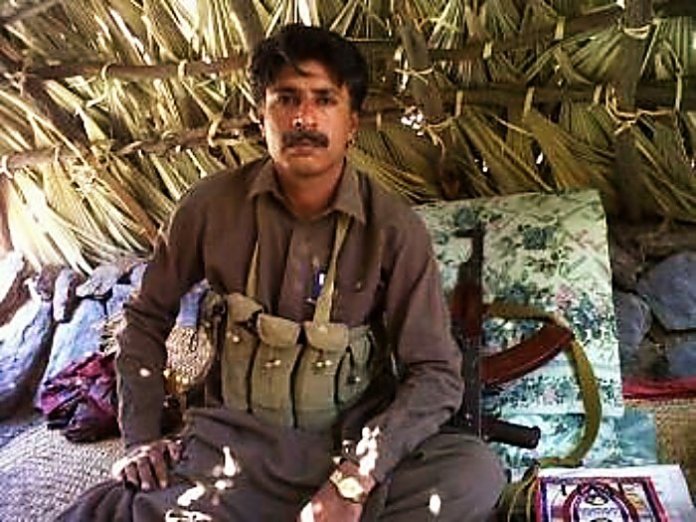
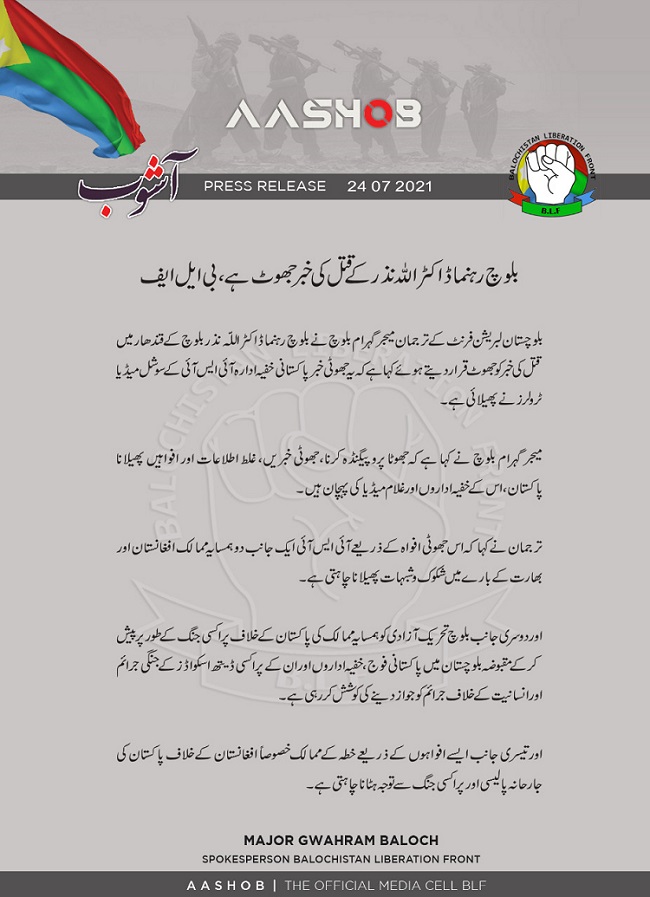
The fake news peddled by Pakistani security forces about the death of Balochistan’s tallest leader Dr Allah Nazar Baloch was refuted in strong words by the Balochistan Liberation Front (BLF) in a media statement released late on Saturday night.
Several Baloch media groups also confirmed that this “news” of the death of Baloch leader Dr. Allah Nazar Baloch in Kandahar, Afghanistan was absolutely baseless. “Our Baloch leader is alive and is leading the Baloch independence movement,” said a Baloch human rights activist in his tweet.
Balochistan Liberation Front (BLF) spokesman Major Gwahram Baloch termed the news of the assassination of Baloch leader Dr Allah Nazar Baloch in Kandahar as a lie and said that this false news was spread by the social media trolls of Pakistan’s ISI.
Baloch sources further confirmed that Dr. Allah Nazar Baloch is present and active in his homeland Balochistan along with thousands of sarmachaars (freedom fighters) who are struggling for the independence of Balochistan from Pakistan’s colonial occupation.
“…spreading false propaganda, spreading false news, misinformation and rumors are the hallmarks of Pakistan, its intelligence agencies and its subservient media. Through this false rumor, ISI wants to spread suspicions about two neighboring countries Afghanistan and India on the one hand and the Baloch independence movement on the other. They want to justify Pakistan Army’s proxy war,” said Major Gwahram Baloch, BLF spokesperson in his media statement. He further added that Pakistan is trying to justify the war crimes and crimes against humanity by their intelligence agencies and Death Squads backed by them.
The fake news about Dr Allah Nazar’s death is a propaganda launched by pliant media of Pakistan with a purpose to create an impression that the Baloch freedom struggle is dwindling. Islamabad’s campaign to spread malicious rumors is also aimed at diverting attention from its policy of continuing proxy war against Afghanistan and India. Even earlier such baseless news about the martyrdom of Dr. Allah Nazar Baloch was spread by Pakistan and its ally Sarfraz Bugti, which was later on proved as blatant lie. The purpose of spreading such fake news is only to dishearten Balochistan about its independence movement. However, with rapid democratization on news media and social media the Pakistani propaganda is exposed and truth is revealed.
“Pakistan Army’s morale is at an all time low and they have been suffering losses on all fronts. In order to lift the sagging morale they spread such canards to lift the morale of troops, which knows that Pakistan is gradually losing the war in occupied Balochistan (sic),” wrote a senior policeman from Karachi in his blogpost.
Pak Army in action to steal July 25 POK elections
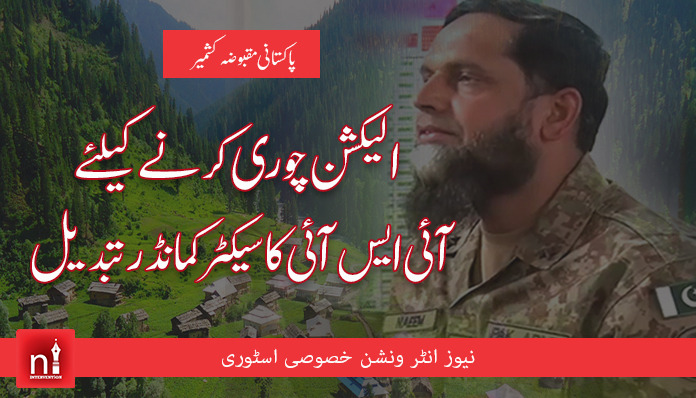
Abrupt Replacement of ISI Sector Commander in Gilgit-Baltistan & Kashmir
Elections will be held in Pakistan-occupied Kashmir (POK) on July 25, 2021. And like the earlier sham elections in POK, the Pakistan Army has made all arrangements to rig the voting process and install puppets as representative of Kashmiris through this electoral process.
The first step towards electoral theft in Pakistan-occupied Kashmir is the hurried transfer of Brigadier Naeem Malik, ISI’s Sector Commander for Gilgit-Baltistan and Kashmir. Rawalpindi has appointed Brigadier Nadeem as the new Sector Commander of Gilgit-Baltistan and Kashmir barely a few days before the actual voting in POK.
This sudden replacement of ISI’s Sector Commander for POK and Gilgit-Baltistan came to light when a local newspaper in Muzaffarabad published this news. The news daily explained that Pakistan Army announced this abrupt change of guard because it found Brig Nadeem to be more subservient to diktats from Rawalpindi. The very next day this local newspaper was shut down and editors and journalists started receiving death threats from ISI.
Rawalpindi sources said that Brig Naeem Malik was planting his own people in POK’s government set up and was giving PTI (Pakistan Tehreek-e-Insaf) tickets to several of his own candidates. General Qamar Javed Bajwa took stern action against Brig Naeem Malik and fired him for misusing powers.
Through the removal of Brig Naeem Malik as ISI’s Sector Commander in Gilgit-Baltistan and POK the Pakistan Army is trying to give an impression to the local Kashmiris and the international community that Rawalpindi is maintaining transparency in local elections and the electoral process in POK.
All of this is an eyewash, however.
It must be noted that Pakistan Army has full authority and control over the distribution of PTI election tickets. Even during the 2018 general elections in Pakistan all PTI tickets were distributed under the supervision of army in which Imran Khan had no involvement.
Brig Naeem Malik was removed only because he was working against the diktats of Pakistan Army generals and the ISI. Brig Naeem Malik had been tasked to distribute tickets of the ruling Pakistan Tehreek-e-Insaf PTI) and to ensure that PTI wins in POK elections. However, he overstepped his role and that angered Gen Bajwa.
Brig Naeem Malik provided constitutional space to Raja Farooq Haider, the puppet prime minister of Pakistan-occupied Kashmir (POK) and a PML-N (Pakistan Muslim League-Nawaz) politician. With Brig Naeem Mailk’s help Raja Farooq Haider was successful in bringing a constitutional amendment which curtailed the role of Pakistan in appointment of POK High Court judges. This was unacceptable to Rawalpindi as it went against its policy of keeping Kashmir under tight grip.
Brig Naeem Malik was given marching orders and replaced with compliant Brig Nadeem as the Sector Commander in Gilgit-Baltistan and Pakistan-occupied Kashmir.
Ali Amin Gandapur’s armed militia in POK
A local armed tribal militia led by Federal Minister for Kashmir Affairs Ali Amin Gandapur has also been formed under the supervision of Pakistan Army. The mandate of this tribal militia is to steal the elections in Pakistan-occupied Kashmir. Though local Kashmiris have rejected Ali Amin Gandapur in toto, he is still working through back channels to rig the July 25 elections.
Ali Amin Gandapur armed militia has been intimidating local Kashmiris to vote for candidates propped by Rawalpindi. This armed lashkar (militia) is working towards integrating Jammu and Kashmir into Pakistan by backing the candidates of their choice in the July 25 POK elections. However, the local Kashmiris have been resisting Pakistan Army’s dubious game of snatching away the people’s right to vote. Amin Gandapur was stopped and stones pelted on him and on his armed goons from the mountains by the local Kashmiris. In response, Federal Minister Amin Gandapur and his armed lashkar opened fire on Kashmiris.
After this firing incident the Kashmiris across Pakistan-occupied Jammu and Kashmir started protests against the armed forces. In Muzaffarabad and Poonch divisions, this tribal armed army of Amin Gandapur is facing stiff resistance.
Meanwhile, the puppet prime minister of Pakistan-occupied Kashmir (POK) announced a sit-in at Islamabad against this attack, while Barrister Sultan president of the Kashmir chapter of Pakistan Tehreek-e-Insaf (PTI) began debating the issue in his private meetings.
This protest drama by puppet politicians is a well thought over move to control the POK electoral process, deprive local Kashmiris of their voting rights and to hurt their self esteem.
POK’s puppet prime minister Raja Farooq Haider threatened in a press conference that if direct interference of Imran Khan and his ministers in Kashmir elections is not stopped, he will be forced to go to Islamabad. “Prime Minister Imran Khan and his cabinet colleagues are brazenly violating the constitution of Jammu and Kashmir. I want to put my case before the people of Pakistan,” Farooq Haider said during the press conference in Muzaffarabad.
Election Commission officials in Pakistan-occupied Kashmir banned Federal Minister for Kashmir Affairs Ali Amin Gandapur from attending rallies and giving speeches in Kashmir. Election Commission’s decision came in the backdrop of Gandapur’s firing on local Kashmiris, distribution of money in election meetings and use of abusive language in rallies.
In a letter to the chief secretary, the Election Commission said that Federal Minister for Kashmir Affairs Ali Amin Gandapur was constantly violating election laws in Kashmir. “He (Ali Amin Gandapur) is deliberately influencing the Kashmir elections in a negative way. As a result, he is immediately banned from participating in election campaigns and rallies in Pakistan-administered Kashmir,” said the POK Election Commission in its note to chief secretary.
The Election Commission further added that actions of Gandapur is creating law and order issues and there’s a constant fear about the loss of human lives in Kashmir.
Earlier an FIR was also lodged against Ali Amin Gandapur for violating the model code of conduct. During an election campaign in Kashmir a video of Gandapur had surfaced on social media where he was seen as openly distributing money among people and was asking them to vote for candidates backed by Rawalpindi.
Rawalpindi’s game to rig July 25 elections in POK
Pakistan Army conducts these sham elections in the areas of Kashmir illegally occupied by it, only to tighten its grip over the region. In the July 25 elections, a total of 22,37,058 Kashmiri voters are expected to cast their votes for 29 constituencies of the Pakistan-occupied Kashmir (POK), while 4,44,634 voters will cast their votes for the 12 constituencies of refugees. According to the model code of conduct issued for these elections, each candidate can spend up to Rs 2 million on elections and up to Rs 500,000 on personal expenses. All these directives remain merely on paper and the ruling PTI and Pakistan Army have been distributing huge cache of money in order to swing, rather rig, the electoral results in their favour.
The PML-N, PPP and PTI have fielded their candidates in these elections but the local Kashmiris have been saying that it’s certain that the ruling PTI (Pakistan Tehreek-e-Insaaf) will win, simply because it has the backing of Pakistan Army.
Public circles in POK is abuzz with talks that several local Kashmiri leaders of the PTI have been completely ignored in ticket distribution. Poonch’s Sardar Abdul Hameed Khan while talking to reporters said that persons who had been abusing Imran Khan and PTI for the last five years were given PTI tickets while those who had been working for the betterment of Kashmiris have been ignored. This clearly shows that none of the PTI leaders, including Prime Minister Imran Khan had any say in candidate selection from their party. Only the diktat from Pakistan Army decides the electoral candidates and also the election results.
The Pakistan Army has also helped register a political outfit “Tehreek-e-Jawanan Pakistan Jammu and Kashmir. This political party has been floated by Abdullah Gul, who is the son of former ISI chief Hamid Gul. Abdullah Gul is neck deep into islamic extremism, drugs and criminal activities. Abdullah Gul has been fielded as a candidate from LA-19 constituency. It is expected that Tehreek Jawanan will be “given” some seats in this sham July 25 POK elections and in return Abdullah Gul will help tighten Rawalpindi’s grip over POK.
Rules have been framed in the Election Commission under which only those parties which are in favour of POK’s accession to Pakistan accession can be registered and contest elections. All nationalist and liberal parties of POK have been prohibited from participating in the July 25 elections.
Leader of Jammu and Kashmir People’s National Party Habib-ur-Rehman said that they wanted to participate in the elections but Election Commission announced convoluted rules which debarred nationalist political parties. He strongly condemned the new laws.
Habib-ur-Rehman added that Pakistan was enacting certain laws on its occupied territory that ensured that liberals were not able to participate in elections. The Pakistani government wants to maintain its dominance under this double standard and continue to plunder Kashmir’s resources, said Rehman.
The July 25 elections in Pakistan-occupied Jammu Kashmir is merely an exercise to install new puppets in various government positions of occupied Jammu Kashmir. The selection of electoral candidates, conduct of elections and rigging of voting process is all being done to ensure that only those candidates who are subservient to the senior most coterie of Pakistan Army are elected, nay selected.
The local Kashmiris across Pakistan-occupied Jammu and Kashmir understand the sham of these elections and are angry at these sham electoral process. They are criticising Pakistan Army and its dirty deeds, but the Pakistani generals are least bothered about the opinion of Kashmiris.
Under the pretext of maintaining law and order in Kashmir, a total of about 43,500 personnel of the Pakistan Army, Police and Civil Armed Forces from other Pakistani provinces have been deployed for these elections.
Around 12,000 armed personnel from Punjab Police, 10,000 from Khyber Pakhtunkhwa, 1,000 from Islamabad Police, 400 from Frontier Constabulary and 3,000 Rangers have been deployed across Pakistan-occupied Jammu Kashmir to maintain law and order. Apart from this, these personnel will also get the support of over 7,000 soldiers of Pakistan Army, who have been deputed especially for July 25 elections.
It is certain that the Kashmiri’s right to vote in Pakistan-occupied Kashmir (POK) will be robbed in the July 25 elections, just as the generals robbed the Pakistani’s right to vote in 2018 general elections of Pakistan.
Critics of Pak Army are shot dead or end up in torture cells
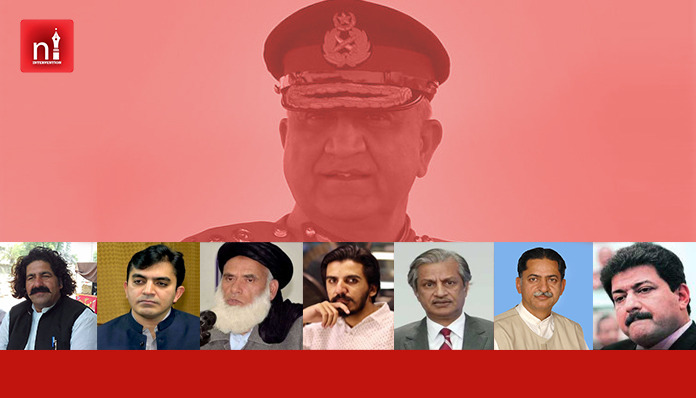
Freedom of speech and expression is the hallmark of a democratic state. Totalitarian regimes run by military dictators muzzle free speech, put curbs on criticism and eliminate dissenters or throw them away into torture cells. Ditto in Pakistan.
Pakistan Army that has been ruling Pakistan with an iron hand for the last seven decades ensures that no one ever dares to speak against them in the country. Islamabad as a seat of ‘democratically elected’ government is merely a smokescreen created by Rawalpindi. Real power rests with Pakistan Army that takes all important decisions for the country, from foreign policy to economic matters on behalf of the ‘selected’ government installed in Islamabad. And yet, despite this back seat driving, the GHQ Rawalpindi cannot tolerate questions or criticism about itself.
Journalists, political commentators, columnists, activists et al in Pakistan know quite well that raising questions, even in hushed tones, about the decisions of Rawalpindi would result in deadly attacks from the ISI-backed goons. Pakistani media, therefore, forbids any kind of critical views about the army and/or shuns anybody even remotely associated with outspoken critics.
No one is supposed to break this mafia-like code of omertà. The stakes are too high and Pakistan Army or the ISI never care about the stature or public standing about the critic and swiftly take action against him/her.
Murderous attempts on Journalists
Senior Pakistani journalist Hamid Mir has been facing attacks for the last several years only because he had been courageously questioning Rawalpindi’s actions. Attempts were made to assassinate Hamid Mir in 2014 at Karachi, when he raised the issue of Baloch “Missing Persons” in Pakistan’s mainstream media. Six bullets were fired on him, but he was lucky to survive this attack. Four bullets were surgically extracted, while two bullets are still embedded in Mir’s body.
A bomb was then planted under Hamid Mir’s car in Islamabad, which was defused before it could explode.
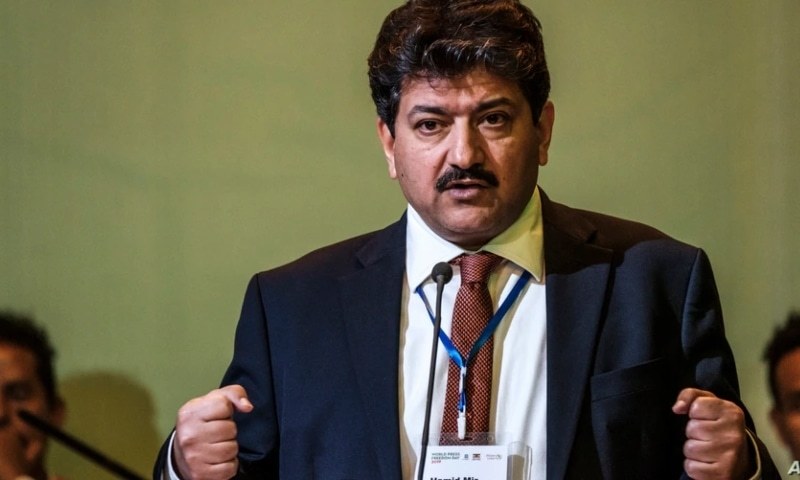
Days before these attacks Hamid Mir had written to his employer Jang Media group and officials in the Pakistan government that there was a threat to his life and his family. Mir had also said in his letter that if he was attacked then the responsibility would squarely lie with Lt. Gen. Zaheerul Islam, the then ISI chief.
Hamid Mir’s complaints had no effect on the plans of ISI or Pakistan Army. They had to teach a lesson to Mir who had ‘dared’ to go against Pakistani generals and so he was attacked.
Hamid Mir had courageously raised the issue of Baloch ‘Missing Persons’ in media and shown evidence of ISI and other intelligence agencies’ involvement in the enforced disappearances of innocent Baloch people.
Another senior Pakistani journalist Absar Alam was shot at in Islamabad and grievously injured. Absar Alam is not a rookie reporter, mind you, rather former chairman of Pakistan Electronic Media Regulatory Authority (PEMRA) and has an experience of about three decades in journalism. The only crime of Absar Alam was that he too dared to speak against the Pakistan Army.
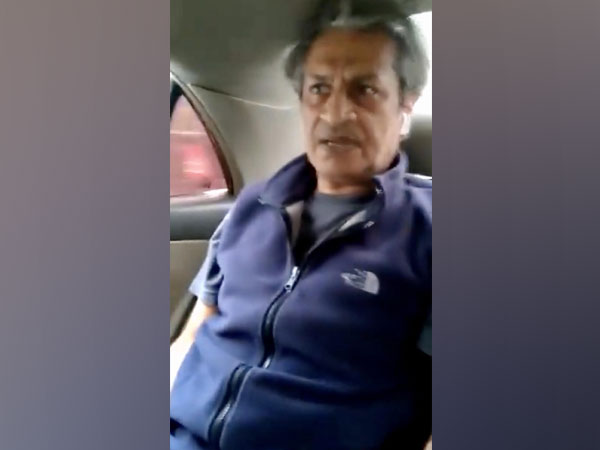
Another journalist who has been vocal against the atrocities committed by Pakistan Army and their loot is Asad Ali Toor. And he too was attacked by ISI-backed goons. Three armed men broke inside Toor’s house in Islamabad brazenly shouting “Long live Pakistan Army, long live ISI”. The attackers made no attempt to conceal their identity and ordered Asad Ali Toor to never criticize or question Pakistan Army in his video reports.
When Toor refused to accept their orders he was severely tortured. The attackers threatened him with painful death if he did not stop criticism of Pakistan Army’s actions.
Asad Ali is a journalist and vlogger (video blogger) who criticizes the wrong and undemocratic actions of the government and civil establishment, including the Pakistan Army, its officers and the political leadership.
Attack on Asad Ali Toor was widely criticized and Pakistanis erupted with anger on social media. Hamid Mir addressed a rally in support of Asad Ali Toor in Islamabad, where he warned the state agencies that no journalist in Pakistan should be subject to such violence. Mir said if this violence did not stop then journalists would expose what goes on inside the homes of Pakistani generals. Mir added that he would be forced to say why the wife of a Pakistani general shot at him.
A couple of days later Hamid Mir’s news show was dropped at Geo Television under pressure from Rawalpindi.
As per a Media Freedom Report released by Council of Pakistan Newspaper Editors (CPNE), at least ten journalists were murdered and several others attacked, kidnapped, tortured or arrested across Pakistan under fabricated charges in the year 2020.
Several social media reports and local language newspapers peg this figure a tad higher and say that more than forty Pakistani journalists, local politicians, social activists and social media activists have lost their lives while many others live in constant fear of retaliation. The names included in this exhaustive list are Ahmad Nawarani, Matiullah Jan, Asad Ali Toor, Absar Alam, Hamid Mir, Nadeem Malik, Zafar Naqvi and Rizwan Razi, among several others.
The situation is much worse in occupied Balochistan where forty four journalists who were reporting about the atrocities of Pakistan Army have been silently eliminated through targeted murders.
Backdoor legislations to muzzle criticism of Pakistan Army
The subtlety and shrewdness with which Pakistan Army imposes totalitarianism in Pakistan is often missed by the civilised world. Unlike other military dictators who impose their will blatantly, Pakistan Army camouflages it under different layers and gets a democratic sanction to its actions.
A couple of months ago the National Assembly Standing Committee on Interior passed a bill that allows two years imprisonment and/or fine upto five lakh rupees on anybody who questions Pakistan’s armed forces.
The introduction of this dubious bill, its terms and conditions and the pattern of voting, all bear the unmistakable stamp of Pakistan Army.
It all started with the introduction of a private member bill by the National Assembly member Amjad Ali Khan of the ruling political outfit Pakistan Tehreek-e-Insaf (PTI). This was named Criminal Law (Amendment) Bill that sought to amend the Pakistan Penal Code 1860 and the Code of Criminal Procedure 1898. It must be noted that Imran Khan, the current ‘selected’ Prime Minister of Pakistan is from the PTI.
Before the enactment of this bill the Section 500 of Pakistan Penal Code had provisions for defamation but did not explicitly mention the Pakistan’s armed forces. The text of Section 500 Pakistan Penal Code read: “Anyone who brings disgrace or disgrace to another can be sentenced to two years imprisonment or a fine or both.”
PTI member Amjad Ali Khan’s private bill sought to amend Section 500 by adding a sub-clause Section 500-A. The amended text read “punishment for intentional mockery of the Armed Forces etc”. The wording of this sub-clause was deliberately kept ambiguous to enable GHQ Rawalpindi to act on their whims.
Further, during meetings of Standing Committee on Interior the members of opposition parties Pakistan Muslim League-Nawaz (PML-N) and Pakistan People’s Party (PPP) opposed this draconian bill and also voted against it. Five votes were cast in its favour and five against this bill. However, the casting vote rested with Raja Khurram Nawaz, a representative of Pakistan Tehreek-e-Insaf (PTI) and the chairman of Standing Committee on Interior. And with Raja Khurram Nawaz’s casting vote this draconian bill was enacted as a law in Pakistan.
Under this new act Pakistan’s armed forces and their personnel can target any journalist, politician, author, social media activist, social worker etc. citing ridicule, insult and defamation of Pakistan Army. And all of this will be done according to a legislative law enacted by a democratically elected, nay selected, government in Islamabad.
Representatives of the PML-N and the Pakistan People’s Party (PPP) who opposed the bills said that freedom of expression would be further curtailed under the guise of this new law across Pakistan. Soon after the bill’s approval by standing committee, several people took to social media to express their concern over it.
Undeterred by social media outrage the Pakistan Army has already begun the misuse of this law.
Cases of treason have begun to be registered against journalists with lightening speed. For instance, the Punjab Police registered a case of incitement against Pakistan Army on Absar Alam, senior journalist and former chairman of the Pakistan Electronic Media Regulatory Authority (PEMRA). The police have also slapped a case of treason under Article 6 against him.
Similarly, a case has been registered against Bilal Farooqi, journalist and social media activist in Karachi for inciting revolt against Pakistan Army and spreading religious hatred.
Thereafter, the Rawalpindi Police registered a case against vlogger and journalist Asad Ali Toor for insulting, posting and commenting on Pakistani institutions, especially the army.
Criminal Law (Amendment) Act passed by the Pakistan’s civil administration under Imran Khan is, in reality, a deadly instrument in the hands of GHQ Rawalpindi through which they are now legally targeting journalists and activists across Pakistan.
Politicians and elected Parliamentarians on target
Pakistan Army’s obsession of curbing dissent is not limited to action against journalists and social media activists, rather any politician who refuses to sing the same tunes has to face the music from GHQ Rawalpindi.
Pakistan Muslim League-Nawaz (PML-N) National Assembly member Javed Latif has been punished for speaking out against the Pakistan Army. Latif had said that Maryam Nawaz, daughter of former Prime Minister Nawaz Sharif, lives under constant threat of being killed by the military establishment. After this statement Javed Latif was declared a traitor and was sent to jail.
Similarly, Mufti Kifayatullah, a senior leader of Jamiat Ulema-e-Islam, was criticized by the intelligence agencies for his utterances and kept in the torture cell for two months before being released. He was in jail for over five months.
Mufti Kifayatullah in an interview to a news channel in December 2019 had criticized the Pakistan Army and said that if theft has to be caught, then the generals of Pakistan Army must be caught. In this same interview, Kifayatullah had said that if government has courage, then former head of Pakistan Army’s public relations department (Inter-Services Public Relations) Lt. Gen Asim Saleem Bajwa must be arrested and his right hand be chopped off.
Mohsin Dawar and Ali Wazir, members of the Pashtun Tahafuz Movement (PTM) have also suffered severe retaliation for criticizing the Pakistan Army.
Ali Wazir’s torture by Pakistan Army
Ali Wazir represents Waziristan and Khyber Pakhtunkhwa. He is an elected representative in the National Assembly from Waziristan and a prominent Pashtun leader. Pakistan Army sees Ali Wazir as a major impediment in its strategy of breeding Taliban in Waziristan and other parts of Pashtunistan. Rawalpindi was desperately looking at an excuse to target Ali Wazir, and it found one at a public rally of Pashtuns.
Addressing a public rally, Pashtun leader Ali Wazir slammed the Pakistan Army’s use of force against unarmed people in Waziristan, burning of Pashtun houses, wanton killings and human rights violations across Pashtunistan.
Gen Qamar Javed Bajwa took Ali Wazir’s speech as a personal attack and thereafter named Ali Wazir in a fake land grabbing case and arrested him. Ali Wazir was also handcuffed and dragged on the roads in front of the Pashtuns, whom he represents in Pakistan’s parliament. All of this was done on the directions of Gen Bajwa to teach a lesson to the Pashtuns so that they refrain from speaking against the Pakistan Army.
Pakistani parliamentarians recently attended a secretive meet on national security at Parliament House Islamabad. This meeting of elected representatives of Pakistan was chaired by Gen Qamar Javed Bajwa and current ISI chief Lt Gen Faiz Hameed. During this meeting Shahid Abbas Khaqan, former prime minister, told Gen Bajwa that he was sad to see an elected parliamentarian, Ali Wazir, being handcuffed and paraded in front of the people he represents.
PPP chairman Bilawal Bhutto Zardari also pleaded with the army chief to release Ali Wazir. With folded hands Bilawal Bhutto requested Gen Bajwa that several people in Ali Wazir’s family have been killed and he is an elected parliamentarian who must be released.
But Gen Bajwa did not budge. On the contrary he shot back saying that if Ali Wazir apologizes then he can think about releasing him.
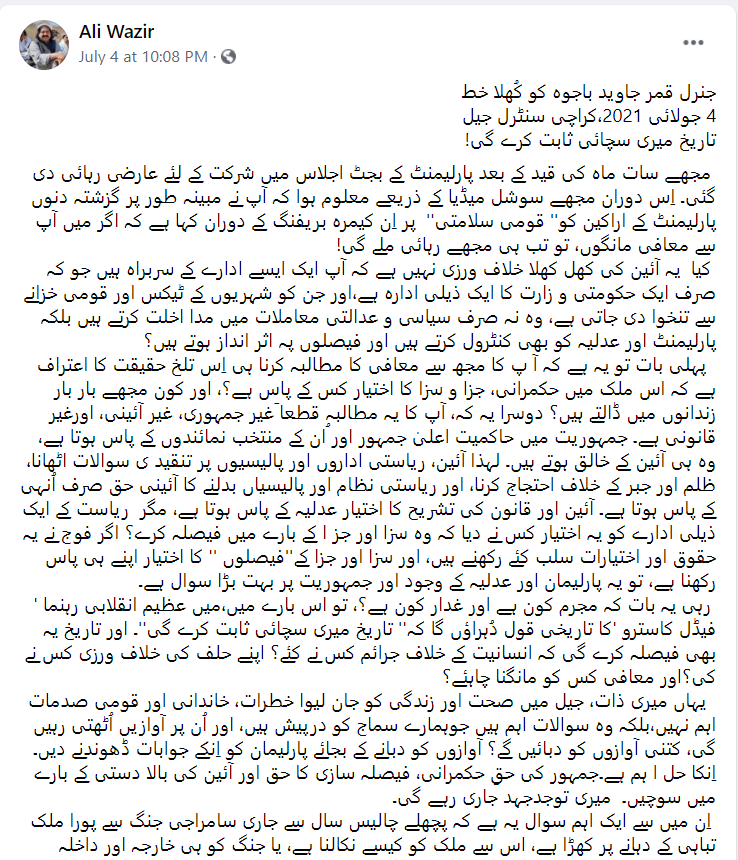
Upon hearing that Pakistan Army chief has demanded an apology, Ali Wazir wrote an open letter addressing General Qamar Javed Bajwa from jail in which refused to apologize and questioned Bajwa’s locus standi to demand apology from an elected representative.
“Isn’t it an open violation of the Constitution that you are the head of an institution that is just a sub-institution of government, and the government pays your salaries through national treasury after collecting citizens’ taxes. … They interfere in judicial matters but also control the parliament and the judiciary and the decisions are influenced… The first thing is that your demand of seeking apology from me… who has the power to rule, reward and punishment in this country?, And who put me in prison again and again? (sic)” questioned Pashtun leader Ali Wazir in his open letter to Gen Qamar Javed Bajwa.
Ali Wazir further stated in his open letter: “…your demand is absolutely undemocratic, unconstitutional and illegal. In a democracy, sovereignty is vested in its elected representatives. They are the creators of the constitution. Therefore, they have the constitutional right to raise critical questions about the constitution, state institutions and policies, to protest against oppression and repression, and to change the state system and policies…. Who is the culprit and who is the traitor? So in this regard, I will repeat the historical statement of the great revolutionary leader Fidel Castro that ‘history will prove my truth’. And history will also decide who committed crimes against humanity. Who violated his oath? And who should apologize? (sic),” asked Ali Wazir in his open letter.
If Pakistan is indeed a democratic state, then everyone should have the right to freedom of expression, but this is not at all the case. For the last seventy years, the Pakistan Army has been targeting journalists, politicians, government employees, bureaucracy, social activists, judiciary and lawyers in the name of national security and protection of Islam. A public perception has been created by Rawalpindi that every professional and all state institutions, except the Pakistan Army, are corrupt and it’s the military that’s the saviour of Pakistan and Islam.
However, gradually the stories about Pakistan Army’s systematic corruption, blackmail and two-timing have surfaced and thus common Pakistanis have understood the root cause of all rot within the country.
People have started questioning the generals about the source of their massive wealth. In its response the Pakistan Army has launched a full-scale crackdown on every critic who raises questions about rotting corruption in Rawalpindi.
Delimitation in Jammu & Kashmir is the right step
Security forces in Jammu & Kashmir led by the Indian Army have, on many occasions, created a conducive security environment in which the political process could be initiated. Sadly, many such opportunities have been lost out by previous governments at the centre; mostly due to lack of political resolve and disconnect with the people that led to failure of initiatives taken. The end result was frustration and a return of the threshold of violence.
In the last few years, security forces have launched sustained and relentless operations against terrorist forces while also capping the infiltration routes. Significant in this direction has been the success of Operation All-Out launched by the Indian Army. The end result has been a decline in violence to the extent that initiation of the political process once again became feasible.
The NDA government at the centre has put in tremendous effort to ensure that the window of stability now available is leveraged to bring about permanent peace and a strong democratic dispensation in the region.
The first step in this direction was taken on August 5, 2019 when the state was bifurcated into two Union Territories and the draconian Article 370 and Article 35A of the Constitution of India were abrogated by a constitutional process. Violence and rejection of the move was predicted by such inimical forces that have a vested interest in keeping the state subjugated. However, nothing of this sort happened; the state has accepted the new dispensation with relief since it has opened windows of lasting peace and prosperity.
On August 5, 2019 Home Minister Amit Shah had given an assurance that the Union Territory of Jammu and Kashmir will ultimately be given the status of a State with its own legislative institutions as available in the other states. This, he said, would be done by paving the way for elections post a process of delimitation for both parliamentary and state constituencies.
The Jammu & Kashmir Reorganisation Act, 2019, also added seven seats to the state Legislative Assembly in the Jammu region, thus, the number of seats in Jammu increased from 37 to 44 and the number of seats in Kashmir remained 46. This matter was left to be implemented by the Delimitation Commission. The move was necessitated to support people like the West Pakistan refugees and the Valmiki Samaj who had been leading a stateless existence for decades on end and who qualified as domiciles of the state under the Jammu & Kashmir Reorganisation Act, 2019. The delimitation would also facilitate reservation of seats for Scheduled Tribes where the Muslims Gujjars would emerge as the main beneficiaries.
The process of delimitation in the state is long overdue since the last such exercise was conducted under the President’s Rule in 1995. The next delimitation exercise was due in 2005, but in 2002, the Farooq Abdullah government chose to freeze delimitation until 2026 by amending the Jammu & Kashmir Representation of the People Act, 1957, and Section 47(3) of the Constitution of Jammu & Kashmir. This was done with a vested interest of keeping intact the dominance of Kashmir region over Jammu.
In 1995, J&K had only 12 districts, now there are 20; the number of Tehsils has gone up from 58 to 270. Constituency boundaries in as many as 12 districts are extended beyond the district’s limit. All such issues need to be resolved.
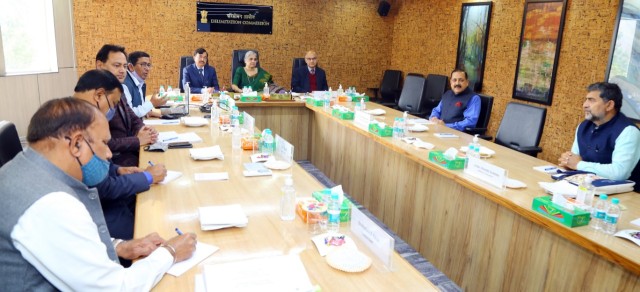
A Delimitation Commission has been constituted under the chairmanship of the former Supreme Court judge Ranjana Prakash Desai. It was given time till March 2021, to complete the process, now a one year extension has been given due to delay imposed by the COVID pandemics. The government has, thus, shown absolute seriousness in the process.
Delimitation was the main agenda in the meeting of J&K leaders held in New Delhi on 24 March 2021, under the chairmanship of Prime Minister Narendra Modi. The central government made it very clear that elections will be held only after the delimitation is done. Most parties have accepted this; the main exception being the Mehbooba Mufti-led People’s Democratic Party (PDP), which was on expected lines.
The Delimitation Commission panel recently (6 July onwards) visited J&K where it held talks with various stakeholders. All regional and national parties except PDP and the Awami National Conference formally presented their memorandums to the panel.
The Commission is determined to take into account all demands and recommendations and will also put up a final draft in the public domain for debate. It has, in the course of this visit, met 290 groups in Srinagar, Pahalgam, Kishtwar and Jammu to gather first-hand inputs.
Delimitation will be on the basis of the 2011 census as per Section 62 of J&K Reorganisation Act 2019 and the 24 seats reserved for Pakistan Occupied Kashmir (POK) will stay vacant. This decision overrules a demand by the BJP of de-freezing one third of the 24 seats reserved for POJK. This single decision points towards the apolitical posture of the panel.
The delimitation process in J&K is bound to be complex in nature; while population will form the main criteria, the geography, terrain and topography, population density, ethnic composition, etc., will also be considered. It is for this reason that such detailed meetings and briefings from deputy commissioners and other civil servants are being adopted by the commission.
It is universally accepted that delimitation of constituencies in J&K is very necessary. With the security situation well in control this is also the best time to go through the same to be followed by holding of timely elections. The security apparatus will assist the entire exercise as always and ensure that the people can vote without fear and intimidation when the time comes. The PDP and some other elements are trying to derail the process by saying that it is a pre-planned exercise. The commission, however, has proved by its actions present and proposed that it will go about doing its work in an honest and transparent manner after ensuring maximum participation of all communities and stakeholders. (
Northern Command: The people’s army in Jammu & Kashmir
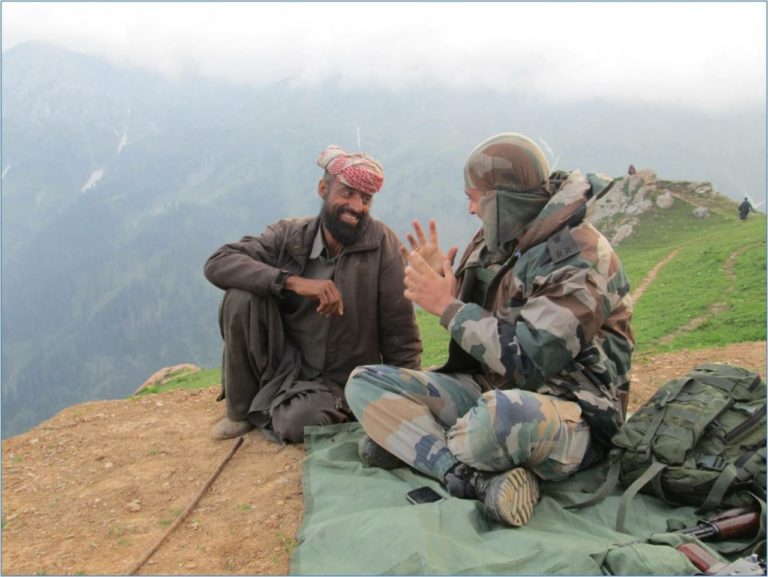
As the ceasefire holds along the Line of Control (LOC), the Northern Command of the Indian Army has initiated a number of welfare initiatives for the people of border areas, especially those living ahead of the Line of Control (LOC) fencing. Recently, a special training drive to prepare youth of the area for recruitment in the army has been launched by the Jammu-based White Knight Corps of the Northern Command.
This apart, a special drive for COVID vaccination has also been held for those living beyond the LOC fencing. Both initiatives have received tremendous response. As the ceasefire has come as a relief for the people, the Army is ensuring that no such incident takes place which would give to the other side a reason to break it, alongside, vigilance is being carried out through intensive patrolling.
The elite Northern Command is in the Golden Anniversary year of its dedicated service to the nation and the people of J&K. Raised on 17 June, 1972 it has completed 49 years of selfless service this year. The Command was raised by the legendary soldier Lt. Gen. P.S. Bhagat, VC, PVSM at a time when India had already faced four major wars. Initially the order of battle was of two corps and one Division; the Chinar Corps in Srinagar was responsible for Kashmir and Ladakh, the White Knight Corps in Jammu was responsible for the Jammu Theatre and the Dah Division was located at Palampur. Post the Kargil War, the Fire and Fury Corps was raised and located at Leh.
The theatre of operations of the command encompasses varied terrain from the glaciers of Siachen (the highest battlefield in the world) to the plains of Akhnoor. It comprises of thickly forested mountains, high altitude deserts, glaciers and hot plains. Several forward areas remain cut off for five to six months and have to be air-maintained.
It also has the unique distinction of guarding four different types of borders – the Line of Actual Control (LAC) and Actual Ground Position Line (AGPL) with China and the Line of Control (LOC) and International Border with Pakistan. Each one of these boundaries comes with a separate politico-military perspective which poses a very big challenge. It is not without reason that the command supports the logo “Always in Combat”.
In the 1980s, Pakistan built a notorious proxy war in Jammu and Kashmir by infiltrating terrorists in thousands through the porous LOC. The command was called upon to fight a debilitating internal security operation to quell foreign sponsored terrorism and insurgency. The enemy used all means, mostly foul, to gain ascendancy but the brave troops of the command succeeded in defeating his nefarious design. Today, the cult of terrorism lies destroyed.
Operation Meghdoot was launched on 13 April, 1984, to establish control over Indian territories in the icy heights of the Siachen glacier. In an unimaginable feat of grit and bravery the troops of Northern Command gained control over the dominating heights in a feat of valour that has no parallels in the annals of military history.
In June, 1999, Pakistan thrust a war upon India with its ignoble attempt to occupy the Kargil heights in Indian territories. The courage and commitment exhibited by the Indian soldiers in the short, swift and brutal war is now part of military folklore. The intruding Pakistani forces were completely decimated and the country faced international humiliation.
Alongside its achievements in operations, the Northern Command has earned for itself the reputation of being a “Peoples’ Army”. Having been compelled to fight an infiltrated enemy in its own territories, the Northern Command has followed a policy of zero tolerance for human rights violations by its own troops. Cases coming to light, however few and far between, are dealt with swiftly with exemplary punishment meted out to defaulters. Counter-terrorist operations in civilian areas are conducted with great care to ensure minimum collateral damage to civilian life and property, even at the cost of buying own casualties.
It is, however, in the domain of “Winning Hearts and Minds” (WHAM) that Northern Command has set a new benchmark. Decades of terrorism and turmoil has had a devastating effect on the psyche of the people of Jammu and Kashmir, especially so, in the Kashmir valley. The army has put in great effort to ameliorate the suffering of the people through welfare initiatives, in particular, Operation Sadbhavna. There are many areas like education, infrastructure development, medical aid, etc., where the army takes initiative to assist the people.
In times of calamity and natural disasters anywhere in J&K, the Northern Command has unilaterally undertaken relief and rehabilitation work at a massive scale, at times when it was itself grappling with the effects of the calamity.
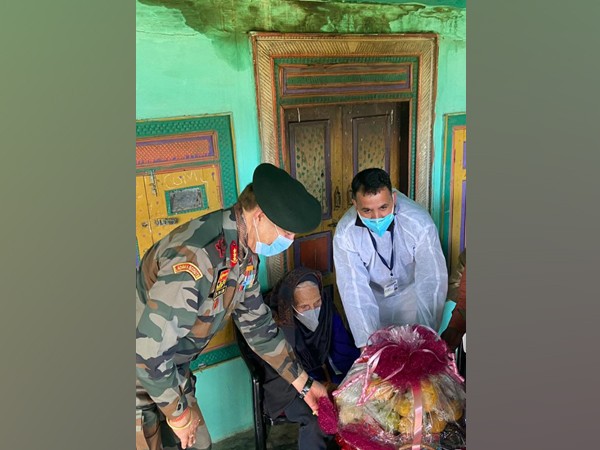
The Northern Command, under the leadership of the present GOC-in-C, Lieutenant General Yogesh Kumar Joshi, UYSM, AVSM, VrC, SM, ADC is striving to attain the next level of glory in its illustrious history. Since May 2020, the command has been the face of the mighty Indian Army. Under the strategic direction of Army Commander, Lt Gen Joshi, and other commanders it gained operational, psychological and moral ascendancy over the PLA and made it retract.
Lt. Gen Joshi is the only serving Army Commander who has been awarded the gallantry Vir Chakra and Sena Medal to his credit. He is also a known China expert, proficient with the Chinese language and capable of discerning the Chinese military thought process.
The locals share a deep bond of trust and faith with the soldiers of Northern Command which is living up to its slogan of “We Can, We Care”. “We Can” represents the might of the hard power, while “We Care” reflects its soft power and goodness of will. For the Northern Command, however, the time to sit back and enjoy the laurels of success has not arrived. The enemy is determined to continue with his nefarious designs at whatever cost, he is brutal and ruthless. There is no option but to stay constantly vigilant and ready for all contingencies. The entire nation stands firmly in support of the brave and noble soldiers of Northern Command with the firm belief that they will never let the enemy succeed.
Punjab govt turns a blind eye to attack on BJP leaders
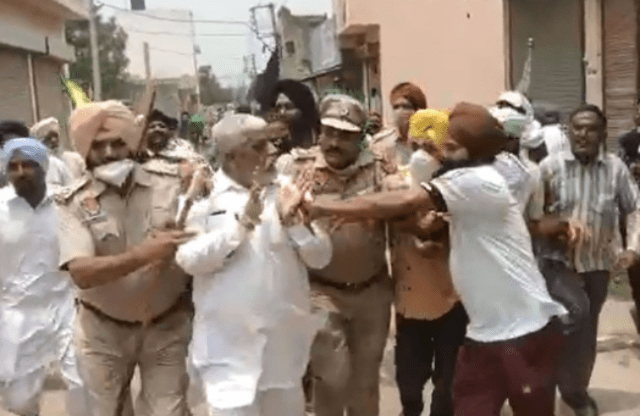
Yet another shameful incident of politically motivated mob violence in Punjab has come to light wherein senior leaders of the Bharatiya Janata Party (BJP), while holding an internal meeting of the party in Rajpura, Punjab were chased, roughed up and held hostage by an irate mob. The mob wished to be passed off as “agitating farmers” but it was quite obviously politically motivated and holding an agenda to suppress the BJP.
The mob comprised of more than 500 goons who were armed with weapons like swords and staffs; the presence of arms within the crowd cannot be ruled out.
The meeting was being chaired by BJP leader Bhupesh Aggarwal at the Bharat Vikas Parishad building near the new grain market in Rajpura. As the mob started increasing police, force intervened but not to the extent of dispersing the mob.
In what can be deemed to be a total failure of police authority, Bhupesh Aggarwal had been told earlier that he should finish the meeting in 30 minutes. That normal political activity anywhere within India would be thus curtailed by the very authorities that are responsible for maintaining law and order is appalling.
The police claim that it was on top of the situation but the reports and the videos coming from the site of the incident tell a very different story. They show half hearted attempts by the police to control the unruly crowd while the BJP leaders were being heckled and humiliated.
It is now well known that one Prem Singh Bhangu, who professes to be a farm leader, was at the helm of the attack. It will be interesting to know what action the police and administration take against the person and also if the farm agitation leadership will expel him for breaking the “peaceful agitation” code.
It is to the credit of the BJP leadership that it continued with its activities even as the threat from the mob continued. The BJP state General secretary Subash Sharma, most courageously, went to the site of the incident to address a press conference. The venue of his media interaction was also cordoned by the mob and he along with other leaders was held hostage for hours on end.
In a video released from the house where he along with other leaders was held hostage, Subhash Sharma said, “It’s like terrorism days in Punjab. Police are not acting against goons”. He did not mince any words in blaming the Congress for the lawlessness and politics of violence that were being played out.
The statement made by Subash Sharma was further reinforced by the BJP National General Secretary Tarun Chugh, who also slammed the Punjab government being led by Captain Amarinder Singh for allowing such elements a “free run” in the state. “These Goonda elements, in the name of farmers, have held the state to ransom and have plotted against the BJP”, he said.
Creditably, the High Court of Punjab assembled in the middle of the night and directed the Director General Police (DGP) of the state to ensure the safety of the BJP leadership. It has given time to the police till 2 PM on 12 July to submit a reply. The court has also served notice to the government to ensure the security of the political leaders.
The directions passed by the High Court are to the eternal shame of the state administration. It has been fairly and squarely ticked off for abdication of duty. Despite this shame and public revulsion at the state of affairs, Chief Minister Amarinder has issued no statement to condemn the attack nor has he given any assurance of a timely enquiry into the incident. This is a clear indication of the complicity of the Congress in what is going on; it gives credibility to the statements made by Subash Sharma and Tarun Chugh.
Such attacks have been going on ever since the Farmers agitation established camps on the borders of Delhi. The agitation leaders swear to the “peaceful nature” of the agitation. The central government is dealing with the agitation with utmost patience, there have been no incidents of the state apparatus attempting to pressurise the agitators. Sadly, what is happening in Punjab is quite contrary to the assertion of the agitation being peaceful. It is on the shoulder of the farm agitation that the horrifying attacks of BJP cadre are being carried out.
On 12 October, 2020, Punjab BJP President Ashwani Sharma was attacked by a violent mob in Hoshiarpur while he was travelling from Jalandhar to Pathankot. A little after that, the houses of many BJP leaders were surrounded by violent mobs and in one instance tons of garbage was thrown outside the house of a senior BJP functionary. The state government did not take any action against the assailants who gained the confidence to carry out more such attacks.
The practice continued till the shameful incident on 27 March 2021 when BJP MLA from Abohar, Arun Narang, was attacked by a mob of so-called farmers, actually political activists. His clothes were torn, black ink was thrown upon him and he was thrashed mercilessly. In this instance too, the police remained a mute spectator, refusing to take any action to control the crowd. “I have a hunch that the state government could be behind it. It needs a thorough investigation. I don’t trust Punjab police now”, said Narang in a forthright manner after the attack.
Then on 13 April 2021, a mob attacked the convoy of Shri Ram Gopal who is the State head of “Haryaval Punjab”, a social welfare organisation dedicated to promoting organic farming, sowing and growing useful trees and greenery, management of plastic waste and similar projects all over Punjab. He was targeted for being a member of the Rashtriya Swayamsevak Sangh (RSS).
The frequency of the attacks has been increasing over time. Two factors are attributed to this situation.
The first is that the BJP cadre is not reacting to the attacks in strength; this is a mature and noble policy that is greatly assisting in maintaining peace and harmony in the state despite grave and unjustified provocation. But it is also building the confidence of the opposition to continue with its nefarious activity.
The second and more important is the casualness and complicity of the administration, especially the state police which seems to be the direct consequence of the directions from the top. The success of each attack has emboldened the mob to become larger, more irate and aggressive.
It is very sad to note that some segments of the media are also glossing over the criticality of the situation. They have described the criminal attack at Rajpura as, “a group of farmers protesting against the Centre’s farm laws chasing away a local BJP leader”. A media report cannot get more callous than this. Others have covered the incident by use of the terminology of “reportedly and allegedly” when there is no doubt whatsoever about the incident having taken place. It is apparent that an attempt is being made to downplay such incidents with the intention of removing public perception from them and also ensuring that they can carry on in the future.
I am uploading a series of videos with appeal to Captain Amarinder Singh to put a check on what he termed as “Politics of Violence” in the state of Punjab.
It is sad to note that the CM has given no credence to the appeal and a series of attacks have taken place since then, the main being the one at Rajpura. It does give an impression that what is happening has his sanction.
In its aura of power, the ruling party in the state and its leader Captain Amarinder Singh are conveniently glossing over the fact that it is playing with fire. At stake is the social integration of Punjab that is so close to the heart of every Punjabi and the sanctity of the Constitution of India. This aspect has been very aptly expressed by Ashwani Sharma, President BJP, Punjab, “This is an attack on democracy, and not BJP. There is complete lawlessness in Punjab, as police have become mute spectators”, he has said.
It is the right of all citizens of India to follow their political affiliations freely and without fear/intimidation; any attempt to subdue the same goes against democratic tenets and the spirit of the Indian Constitution.
The parties that oppose the BJP should fight a political battle within acceptable democratic norms and defeat the party fairly and squarely in the ballot during elections, if they can. By resorting to such shameful and dishonourable tactics they are showing their own insecurity and lack of character.
What is happening in Punjab for the sake of political brinkmanship is absolutely reprehensible. It goes against the very tenets of the traditional brotherhood that Punjab has witnessed since centuries. It is a deep slur on the concept of “Punjabiat”.