Home Blog Page 396

Philosophical and Historical Foundations of American Secularism 12 – Lessons From an Elder: Coming Into One’s Own

0

Scott Douglas Jacobsen: You – and as a term of endearment and affection, for me, at least – exist as an elder within the freethought community, where you harbour a certain general affability, acquired wisdom, and perceptiveness on issues relevant to all ages of the freethought communities. 

You have a secure place in America freethinker history. What is lost with age? What is gained with age? How does this change over time develop an understanding more rich in practical wisdom and perceptiveness via the experience of the times of the founders of the United States and the leaders of the different social reform movements in American history? 

People in their time but not of it, in the sense of a widened vision of the possibilities of human relations. I intend this as a collective reflection on some of the writings in this series so far, in order to transition into other items of historical import to the philosophical and historical foundations of American secularism.

Dr. Herb Silverman: Thank you for saying I have a secure place in American freethinker history. If true, it would be because I did two things.

First, I ran for Governor of South Carolina in 1990 to challenge the state constitution prohibition against atheists holding public office. I didn’t become governor, of course, but in 1997 the South Carolina Supreme Court ruled unanimously in my favor, nullifying the anti-atheist clause in the South Carolina Constitution. Credit for my Supreme Court victory belongs to my ACLU lawyers. I was just having fun giving campaign talks and writing about my experiences.

Second, during my legal battle, I learned about and joined several national atheist and humanist organizations that all promoted causes I supported, like separation of religion and government and increasing visibility of and respect for freethinkers. However, each organization was doing its own thing without recognizing or cooperating with worthwhile efforts of like-minded groups. I thought that these diverse organizations would accomplish more by showing strength in numbers and working together on those issues to bring about cultural and political change. So in 2002, I helped form the Secular Coalition for America and became its founding president.

The Secular Coalition started with 4 and now has 19 national secular organizations as members, covering the full spectrum of our movement. It also represents hundreds of local secular communities. It was the first organization to hire a lobbyist to take our issues to Congress.

Working with allies in the faith community, the Secular Coalition combines the power of grassroots activism with professional lobbying to impact laws and policies governing separation of religion and government.

You asked what is gained by age. Being involved with secular organizations for close to 30 years has given me institutional memory. When I hear suggestions about something we might try, I can often point to having tried that before and the outcome.

You also asked what is lost with age. On this, I am an expert. I’m 77 years old and like to think I can do whatever I used to be able to do, but I have contrary physical and mental evidence. Aside from age, longevity in a leader can become problematic. “Founder’s syndrome” occurs when leaders view themselves as irreplaceable. I’ve seen many good leaders outstay their welcome. For an organization to flourish, a high priority for a leader should be to make him or herself replaceable. Atheists, above all, recognize that organizations have no “dear leaders” who communicate to us through a supernatural being. We pride ourselves on being independent, and we recognize the fallibility of all. Not to sound like a vampire, but new blood is good. 

I think I managed to avoid founder’s syndrome at the Secular Coalition for America. I sought and encouraged active participants and talented replacements. I’m now happily retired as SCA president, but was asked to continue to serve for a while on its Board of Directors.

Looking back at the history of the freethought movement, changes in communication have been mammoth. At the time of the founders and early social reform movements in the United States, social media consisted of books, pamphlets, and word-of-mouth. Today, people can instantly reach each other around the world through online communication. Word travels fast, but so does miscommunication, lately known as fake news (some of it intentional). Both atheists and religious fundamentalists are able to spread information as never before, but of course they differ on what they consider to be “fake news.”

Speaking of fake news, the influence of religion at the highest levels of government has never been stronger than under President Donald Trump. He has appointed more than 150 judges, most of whom seem hostile to the separation of religion and government. He has ordered every department in the executive branch to work on faith-based partnerships, signing an executive order creating the “White House Faith and Opportunity Initiative,” an office that undermines religious freedom by giving taxpayer money to religious groups and allowing them to discriminate, with little accountability and no transparency.

Not only are Trump’s cabinet members very religious, but they also seem to oppose the separation of religion and government. Ben Carson, the Secretary of Housing and Urban Development, referred to the separation of church and state as “crap” prompted by “political correctness.” Attorney General William Barr said, “The separation of church and state is for losers, liberals, and America-hating atheists.”

Christian Nationalists and evangelicals, with Trump’s blessing, have introduced legislation to teach the Bible in schools, display religious mottos in schools, discriminate in foster care and adoption, pass religious refusal in healthcare, and promote anti-science religious teachings. Whatever you think about Trump wanting to build a wall between Mexico and the United States, we must not let him tear down the wall between church and state.

Nonetheless, I’m cautiously optimistic about our future. It is up to secularists working with all who favor separation of religion and government to counter the influence of religion in government. The secular movement is growing, both formally through secular organizations and informally through “nones,” those who don’t subscribe to any faith. The “nones” are the fastest growing “religion” in the United States, especially among young people. Many “nones” broke from conservative religion because it is anti-LGBTQ, anti-women’s rights, and anti-science. Pedophilia has also discouraged people from maintaining their church affiliation. 

Based on surveys, the United States is becoming less religious every year. This is finally being reflected in politics. A Congressional Freethought Caucus, formed in 2018 with 4 members, promotes evidence-based public policy and is a forum for secular members of Congress. It now has 12 open members, with more likely to join. There has also been a 900% increase in the number of state legislators who identify with the atheist and humanist community (from 5 in 2016 to over 50 today).

And finally, thanks to the Secular Coalition of America and their Director of Governmental Affairs, Sarah Levin, the Democratic National Committee (DNC) this year embraced American nonbelievers for the first time, adopting a resolution that recognizes their contributions to society. At nearly one quarter of the total U.S. population, nonreligious Americans represent a sizeable voting bloc. This resolution marks the first time a major U.S. political party has specifically courted religiously unaffiliated people across the nation.

The resolution says that the DNC recognizes the value, ethical soundness, and importance of the religiously unaffiliated demographic, a group of Americans who contribute in innumerable ways to the arts, sciences, medicine, business, law, the military, their communities, the success of the Party and prosperity of the Nation; and that religiously unaffiliated Americans are a group that, as much as any other, advocates for rational public policy based on sound science and universal humanistic values and should be represented, included, and heard by the Party.

And looking to the future of freethought, I hope that one day every political party at every governmental level will adopt similar resolutions.

Jacobsen: Thank you for the opportunity and your time, Dr. Silverman.

Photo by Egor Vikhrev on Unsplash
Indian bookies ‘spot-fixing’ cricket matches across the globe

Tell us, who is this mysterious person from Punjab, now stationed in Chennai? Officials of the Anti-Corruption Unit (ACU) of the Board of Control for Cricket in India (BCCI) are asking people as they probe serious spot-fixing charges against a host of people successful in inducing cricketers to underperform and facilitating spot-fixing in a number of T20 cricket leagues in India and abroad.

The person, claim ACU officials, is stationed in Chennai, has a beachfront home, owns a few hotels, hobnobs with some of the topmost film stars of Bollywood and southern states, and had started his career with textiles. The person, who started taking interest in cricket around 2003-4, has expanded his reach and now has a solid grip on the Tamil Nadu Premier Cricket League and Karnataka Premier Cricket League and has done a number of fixings already. The ACU is investigating if he was the same person deported from the West Indies after it was revealed that an Indian was allegedly fixing matches with his Pakistani friend in the Caribbean Premier League (CPL). In CPL, the Indian bookie allegedly approached a Pakistani cricketer. Now, the CPL is largely owned by Indian stakeholders, with Shah Rukh Khan being the biggest, who owns the Trinbago Knight Riders. This year’s Caribbean Premier League was won by Barbados Tridents, who beat Guyana Amazon Warriors in the final.

What is both interesting and intriguing is that the particular team owner hails from South India and his exile was informed to the other owners of the franchise.

This Chennai-based person in question is rich, powerful.

“He works very closely with cricketers’ families, even relatives and takes care of them throughout the year. The players are ready to open up to him, spot-fix matches for him. He is very, very big,” a senior BCCI functionary told this reporter. The BCCI official said the matter is serious and has the BCCI, the world’s richest cricket board, tied up in knots. Officials of the board, which recently basked in the glory of hosting the first day and night test with the pink ball—en event which even turned Kolkata into a pink city—are justifiably worried because all fingers point toward three nations: India, Bangladesh and Pakistan where spot-fixing is rampant, so is betting.

Spot-fixing is gripping the world’s richest cricket board every now and then. Such is the crisis that organisers of the state T20 leagues have, claimed the BCCI official, openly started dealing with bookies and fixers. “Both the BCCI and ICC need to have an iron grip on the situation, else the subcontinent will be the game’s biggest hub for illegal cash,” said the official, speaking on condition that he should not be named.

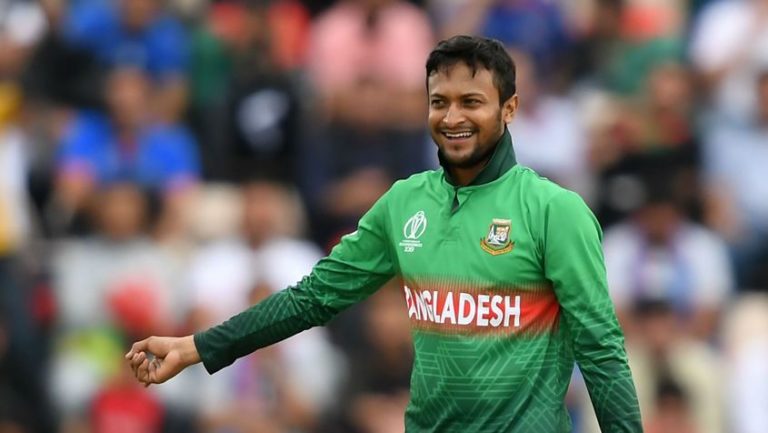
The Dubai-based ICC is justifiably worried that the majority of the bookies in cricket are emerging from India. Bangladesh’s top player Shakib Al Hasan got banned for two years last month after he was in touch with a seasoned Indian bookie, Deepak Aggarwal.

The star all-rounder, who is also the country’s Test and T20 skipper, could not make it to India for the recently concluded test series. His being involved in fixing has now compounded problems of the Bangladesh Cricket Board. The BCB is now taking stringent measures to protect the Bangladesh Premier League (now renamed Bangabandhu BPL) from India bookies. Shakib told the ICC that he had been receiving offers from Indian bookies, especially Aggarwal. The cricketer told the BCB that he did not report to the ICC’s ACU. What is interesting is that Aggarwal was arrested in Raigarh in 2017 along with two of his supporters and put behind bars. After getting out of jail, Aggarwal is back in business and was reportedly instrumental in the suicide of Indian cricketer Vijay Kumar, who left a note before committing suicide that he had borrowed Rs 500,000 from an Indian bookie and was unable to return the cash. The cricketer had also blamed Aggarwal of threatening him into placing bets.

ICC ACU chief Alex Marshall is on record saying Indian bookies were openly operating across the globe. “In most parts of the world it is mostly corrupt Indian bookies,” Marshall said. Corruption in cricket has dominated headlines ever since the much-publicised match-fixing saga hit Indian cricket in the early 2000s. The ICC fears that dubious operators were shaping new ways to stay in business and instead of only focusing on ODI, T20 and test matches, they are now shifting their attention on franchise-based leagues to mint cash. The extradition from London of a top Indian bookie, Sanjay Chawla, is awaited by Indian investigators.


Pakistani leg spinner Danish Kaneria had admitted to his role in spot-fixing in 2018.
Kaneria named a bookie of Indian origin, Anu Bhat, who had asked him to concede 12 runs in the first over of an English county game in 2009. (Photo: AP)

The involvement of Indian bookies is making the game’s controlling body sit up and take notice. For the record, the ICC is worried about the way Indian bookies are openly operating across cricket playing nations. Consider the case of Pakistan leg-spinner Danish Kaneria, who accepted charges of spot-fixing after years of denial, in 2018. Kaneria named a bookie of Indian origin, Anu Bhat, who had asked him to concede 12 runs in the first over of an English county game in 2009. The scandal led to the imprisonment of Kaneria’s former Essex teammate, Mervyn Westfield. And then, Bangladesh skipper Mohammad Ashraful—banned for eight years for his involvement in the Bangladesh Premier League spot fixing scandal—was lured into fixing by an Indian bookie. Worse, Dhaka Gladiators’ CEO Gaurav Rawat, an Indian living in Myanmar, also won a team in Sri Lanka Premier League, both marred by allegations of corruption.

The Indian angle in fixing in the world of cricket is becoming a matter of serious concern.

Already, Sanyam Gulati of Haryana is under arrest on charges of influencing KPL player Bhavesh Gulecha to spot-fix some of the matches in the 2019 Karnataka Premier League. Investigations are on even as Gulati has claimed he was functioning as an informer of the ACU of BCCI and that he paid Gulecha Rs 75,000 only to collect evidence for ACU. Gulati even named BCCI manager for anti-corruption Anshuman Upadhyay as his friend and said Upadhyay was kept in the loop about approaches to KPL players. Upadhyay has rubbished the claim, so have the cops in Chennai. It is more or less clear that Gulati worked with players participating in the Caribbean Premier League, Karnataka Premier League and Tamil Nadu Premier League and allegedly fixed a large number of matches. The modus operandi of the bookies has shocked the cops. Preliminary investigations have revealed that bookies were interacting with agents of the players, journalists who were being hired by news channels as guest commentators, cameramen of broadcasting channels, team owners and eventually, cricketers themselves. Look at the statement of the Bengaluru Crime Branch after Sanyam’s arrest: “International bookie Sanyam has been arrested. He is a resident of Haryana. He was absconding in the West Indies. An LoC (Look Out Circular) was issued. He is arrested in the case of match-fixing by (celebrity drummer) Bhavesh Bafna.”

The Bengaluru Police has formed a Special Investigation Team Central Crime Branch (CCB) to probe the scandal. Seven people have been arrested already. An LOC (Look Out Circular) has been issued against the Bellary Tuskers team owner Arvind Venkatesh Reddy in connection with the case, while Belagavi Panthers owner Asfak Ali Thara had been arrested earlier. Two cricket players, C.M. Gautam and Abrar Kazi were also recently arrested in connection with the scandal.

These are serious charges, especially in a nation where the game is almost a religion. For the records, the Tamil Nadu league is played at the iconic Chepauk Stadium and features top players like R. Ashwin, Vijay Shankar, Murali Vijay, Dinesh Karthik and Washington Sundar, among others. The league was inaugurated by former Indian skipper M.S. Dhoni. Star India is the official broadcasters of former international cricketers like Matthew Hayden, Brett Lee, Scott Styris, Michael Clark, and David Hussey as commentators.

“Bookies are making deals which are very, very scary. They are actually taking control of these leagues across states, across nations by corrupting franchisee owners and running teams in their way to make windfall gain in betting. This is serious and can compromise such leagues,” said the BCCI official.

The other disturbing factor emerging out of this fixing business involving Indian bookies is disputes over payments. Bookies from India are rarely keeping their commitment and often disappear for long after making windfall gains. “The issue came to light when some Bollywood stars made some discreet calls to check out about lost payments. Spot fixing and illegal betting are sucking many into a dead hole. This needs to be checked, and eventually stopped,” said the official.

BCCI’s ACU chief Ajit Singh, a former cop from Rajasthan, is on top of the crisis and is aware that players are being approached by the bookies. Singh told a newspaper that a detailed investigation is on. But those tracking such cases as outsiders feel that ICC does not have the clout or power to clean the game of such elements. Nor it has the financial prowess like the FIFA, which utilised the services of Scotland Yard to clean similar issues impacting global football.

“Internal investigations by ICC and BCCI will lead this nowhere,” said a former Indian cricket captain. He said BCCI should have taken a cue from the 2010 spot-fixing scandal in England involving four Pakistani players. It was the time when Scotland Yard probed the case and reached to some logical conclusions.

Till that happens with ICC and BCCI, spot-fixing will be tough to control and contain. The biggest problem is that there is no law in India against match or spot-fixing. This inability of the Board—claimed the former skipper—contributed to bookies convincing KPL, TNPL and other players that there was low-risk, easy money to be made.

Courtesy: Sunday Guardian

Imran-Bajwa power play and web of deceit will have serious consequences

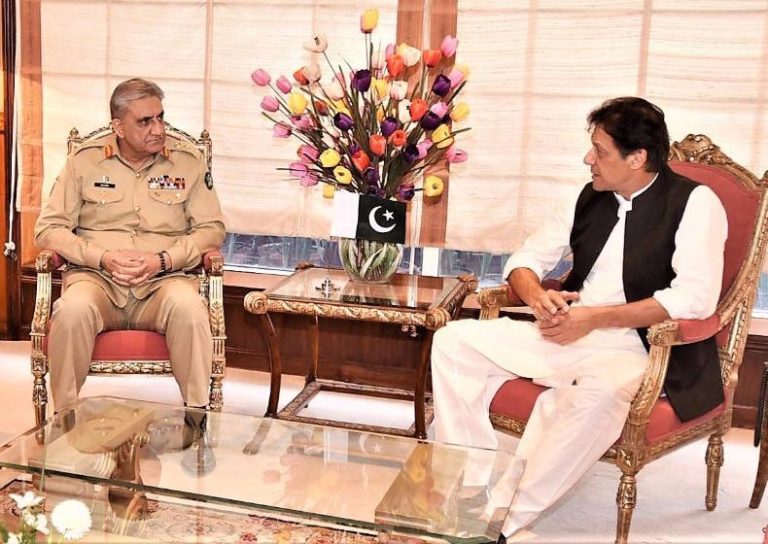
The perfidious power play in Pakistan has attained a notorious, dishonourable status. Gen. Qamar Javed Bajwa continues as Pakistan’s Army Chief while the Imran Khan government is left to grapple with the directions given by the Supreme Court of the country. This web of deceit smelled rotten right from the word go and has, not surprisingly, left the main protagonists (Imran Khan and Bajwa) with egg on their faces.

The basic fault line in the drama has been highlighted by Pakistan Supreme Court most lucidly. “If the [regional security] situation is so then the army as a whole body can deal with the situation, not the individual. If this criterion is allowed then every individual in the army can demand an extension on the same grounds,” said Asif Saeed Khan Khosa, Chief Justice of Pakistan, in what can be termed as the most telling indictment of the decision to extend the tenure of the Pakistan Army Chief.

A fair assessment would lead to a conclusion that, under Gen. Bajwa, the Pakistan Army has attained its weakest position ever, both professionally and as virtual rulers of the country.  It has completely lost the initiative in Kashmir from where it got its sustenance. It has antagonised its biggest ally, America, and as a result is suffering a crippling resource crunch with no aid or weapons coming in. It has also completely lost its hold in Afghanistan as a mediator and in relations with the Taliban. Bajwa has been unable to leverage on the good work done by the previous chiefs in containing internal militancy and, as a result, the internal security situation has deteriorated considerably.  

Bajwa has been openly accused by opposition politicians of electoral manipulation, meddling in politics, suspension of civil liberties and muzzling of the media to help Khan win elections last year. There is no reason to disbelieve these allegations. Imran Khan became prime minister with support of Gen. Bajwa and will remain so as long as the support remains. He, therefore, has mooted for the extension to save his own chair which is getting shaky. He knows that the best way to ensure continuity is to back a known horse; there is no knowing what a new Pak Army Chief would do. Under the circumstances, there are not many takers to the argument of “continuing tension with India over Kashmir” that Imran Khan is giving to justify the extension.

Further, there are many associated factors that also need to be considered, and the main is the fear that this word “Bajwa” strikes in the hearts of all Pakistanis. The Jurist Foundation had challenged the extension of Gen Bajwa and the petition had been filed by a person named Raiz Rahi. The petitioner developed cold feet almost immediately and sought to withdraw the application. The Chief Justice, however, rejected the withdrawal and took up the petition as a public interest litigation under Article 184. In a second equally bizarre episode, the law minister of the federal government, Farogh Naseem, resigned in order to represent Gen. Bajwa in the court. Hussain was terrified at the prospect of becoming a scapegoat in the entire fiasco and he genuflected in the most demeaning way, simply to save himself. These two instances indicate the reign of terror that at present has enveloped Pakistan under the watch of Gen. Bajwa and Imran Khan.

Interestingly, a section of Pakistan’s media is most courageously supporting the Supreme Court and more and more voices are being heard against the decision of the government. “This is without a doubt the most shambolic episode in the PTI government’s tenure so far,” says an editorial in Dawn, a leading English Daily of Pakistan. “Surely there are other officers more than capable of leading the army. General Bajwa’s next step will determine whether he is thinking of himself or his institution,” it adds.

So sure was Gen. Bajwa of his unassailable position that he had already brought about wide ranging changes in the military hierarchy to suit his extension. He has appointed Lieutenant General Sahir Shamshad Mirza, as his new Chief of General Staff (CGS). General Mirza will be the senior-most among those eligible to become Army Chief after General Bajwa retires in 2022. Getting him on to his side was very crucial indeed to offset Lieutenant General Sarfaraz Sattar, who was poised to take over as Chief and will now retire on being superseded. The Corps Commanders have also been shuffled. Obviously, Gen. Bajwa was afraid of an internal backlash from the Pak Army which has propelled him into making these changes. That some in the army are backing the action taken by the Supreme Court is not beyond the realm of reality.

The Supreme Court may have given Gen. Bajwa some respite but the matter is unlikely to end here. The court has announced the extension of six months on the basis of an assurance given by the government that it will, within this period, make the required amendments in Article 243 of the Constitution and specify the appointment, extension and tenure of the Army Chief. This is easier said than done. Even if the PTI (Pakistan Tehreek-e-Insaf) led government can muster the numbers to get the amendment through, the opposition will subject it to a loud and acrimonious debate. The end result will be Pakistan Army’s coming into public discussion for the first time, something that may strengthen democracy in the country but will damage the “holy cow” status of its establishment.

There remains no doubt that this self-serving move will dent the image of Pakistan Army and weaken it considerably. The hollowness of the incumbent government also stands exposed. And the situation can best be explained as a “lull before the storm.” The ultimate outcome is bound to leave Pakistan weakened and unstable. This opens the possibility of external aggression to offset internal issues, whereby, India will be adversely impacted. It is time to consolidate security in Kashmir and other parts of the country too.

Pakistan Army abducts four women in fresh crackdown in Balochistan

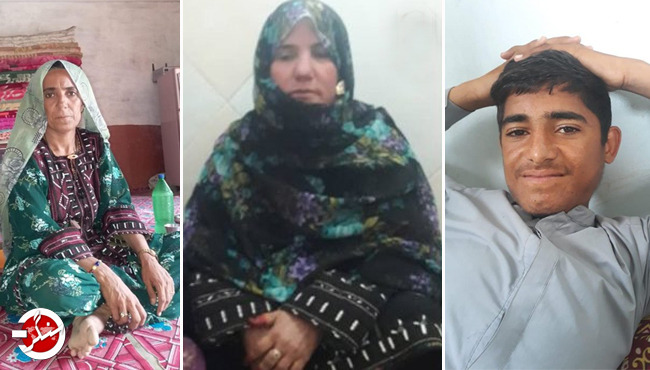
Pakistan Army has abducted four Baloch women and a boy, who is the son of one of these women during two separate illegal raids in the Awaran district of Balochistan. All women and the boy are now “missing”.

Local residents say that the Pakistan Army personnel attacked a house in Haroni Dunn area of ​​Awaran district on Friday night and arrested the women. They added that these “personnel from Pakistani Army have disappeared the women along with her son”.

These “abducted and disappeared” women have been identified as Bibi Sakina and Bibi Saeeda. Local residents explained that Sajid Baloch, who is the son of Bibi Sakina, was also forcibly abducted on November 25 by Pakistani security forces and has now been “disappeared” along with his mother and one another women.

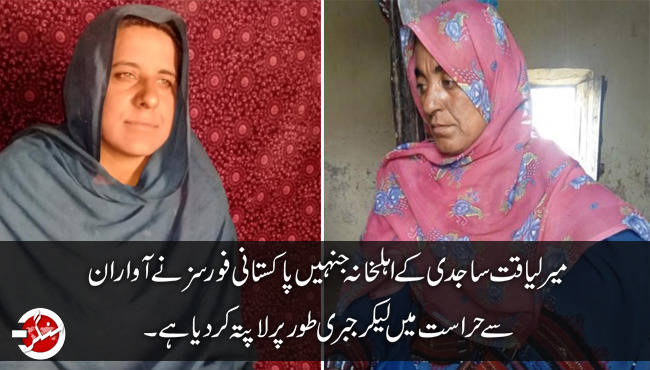
In a similar and related incidence, Pakistan armed forces attacked Mir Liaqat Sajdi’s house in the Peerandar Zeelag area of ​​Awaran district at midnight on Friday and took two women of his family into illegal custody. These two women have also now “disappeared” with no whereabouts of them available anywhere. The women are Bibi Nazal and Bibi Hameeda, sister of Mir Liaquat Sajidi.

Bibi Nazal and Bibi Hameeda who have been illegally abducted by Pakistan Army in Balochistan

Pakistan Army has been continuing these forced abductions, inhuman disappearances and several other atrocities across Balochistan for the last several decades. Armed forces of the Pakistan Army forcibly enter inside Balochistan homes, misbehave with women and abduct innocent people including women and children at their whim. It’s rather strange that mainstream Pakistani media never reports these crime and illegal abductions. International human rights organisations have also chosen to stay mum over gross human rights violations in Balochistan. Various local reports suggest that Pakistan Army is guilty of abducting and forcefully disappearing around 40,000 Baloch nationals.

Magic Bullet to Revive the Indian Economy

Earlier this week, India’s Finance Minister Nirmala Sitharaman painstakingly tried to convince the nation through her statement in the Parliament that the economy has slowed, and is not in recession. Coming directly from the government, it is indeed a matter of concern. There can be no magic to reverse the slowdown, yet that’s exactly what everyone is hoping for.

However, this magic is possible through one major correction which is long overdue, yet it’s the least talked about.

There is one big-ticket industry, which affects every family, both in the urban and rural areas: Housing, Construction and Real Estate. India’s real estate and construction is one such industry that creates demand for hundreds of other small and large industries. And these industries range from the heavy weights such as steel and cement to light industries such as electrical, fabric and furniture, among others. For comparison, what the automobile or car industry means to the American economy, is what construction, housing and real estate means to the Indian economy.

At present, India’s real estate is suffering not due to a lack in consumer demand, but primarily because of “very high prices,” which the masses cannot afford. Fortunately, policy correction (no, I am not advocating for any fresh fund allocation) can reverse this scenario and trigger a strongest recovery ever in the country, not merely for short-term, rather for a few decades. This is possible, as the entire country needs to be rebuilt, city-after-city (particularly the Tier-2 and Tier-3), village-by-village, both in the private and public spaces.

The three key questions which needs to be answered before this magic bullet can be fired for economic revival in India.

1) What is the right affordable price for a house?

2) How do we ensure that these affordable housing prices become viable for the industry as a whole?

3) How much GDP growth can be expected through this one move?

Well, answer to the first question is simple arithmetic, which one can compute on fingertips. For this we need to consider the prevailing monthly rents. A large majority of people who rent (or, may like to buy their own house if it’s affordable) pay ₹25,000/- to ₹50,000/- per month as rent for one to three bedroom dwelling in suburban metros and ₹10,000/- to ₹25,000/- in Tier-2 and Tier-3 cities. At an interest of around 9% per year, the value of these houses could vary from ₹35 lakh to ₹70 lakh in metros, and approximately ₹15 lakh to ₹30 lakh in Tier-2 and Tier-3 cities. One may put a premium of 20 to 25% for being the owner of a house and raise these prices a bit. But the big point is that affordable prices for a house are about half when compared to the current level of prevailing prices. Full demand (15-20 lakhs houses per year in urban areas alone) is worth about ₹10 lakh crore for houses alone. This lone example gives an idea of the magnitude of growth in real estate and housing sector.

The answer to second question about ways to reach affordable price levels, may appear to be a non-starter to many; but that is where the “true solution” to Indian economy lies. To appreciate this as a solution, one needs to pay attention as to how land and housing prices rose exorbitantly in the first place. If we go back to the year 2004, which is not too long ago, prices for 1-to-3 bedroom apartments were in the range of ₹10 lakh to ₹20 lakh in metropolitan cities, and ₹4 lakh to ₹8 lakh in Tier-2 and Tier-3 cities. How did these prices increase by 1000%, merely in a decade by 2014?

It can be said with conviction that speculative price increase of real estate between 2004 to 2014 was the greatest economic fraud, the nation has ever experienced. An astounding 100% increase every year! Incidentally, this is the same period, when banks disbursed huge corporate loans of over ₹15 lakh crore, much of which has eventually turned into NPAs (Non-Performing Assets). NPAs are termed as bad loans in common parlance or better called as ‘loan-defaults’. Much of this is commonly viewed today as telephone-banking frauds. Worst affected by these speculation are the youth who now face a situation where owning a house has become a distant dream. In fact, around 95% of the population is unable to afford a house today.

The big point is why did these phenomenal speculations did not raise an eyebrow. The reason is very simple. In real estate, even if one house sells at a hefty price in a colony, price of every other house in the area is considered to have been increased. Who dislikes, if told that price of their existing land or house has increased by 5-10 times in its value, provided they could sell it! People carrying notional value of the only house they own, in their mind, also forget that to acquire additional room for a growing family they would now need to pay ₹50 lakh instead of the earlier ₹5 lakh. Those who talk of shortage of supply being the reason for such price increase, need to note that not even 0.1% of existing stock of land and houses are really traded fresh.

In this context, following actions that are essentially policy decisions (not requiring financial outlays by the government) can trigger a fresh addition of more than 5% in India’s GDP, with almost immediate effect.

1) Government should make parts of government land in every city available at prices a little higher than 2004, for housing purpose. Remember, price depression of one house will bring down prices of every other house in the area. A quick, back-of-the-envelope estimate suggests that every 10% reduction in real estate price, can add more than 1% to the national GDP. Compared to the 10-folds price rise during 2004-14, the fall in current prices by half may not look so bad, after all. However, even after correction, real estate prices would be 5-times compared to the price of 2004. But people will accept this gladly.

2) Registration charges in real estate should be waived off for the next 2 to 3 years.

3) Income tax deductions for purchase of “first home”, should be allowed to the extent of 100% of payment.

The only people who would feel hurt to some extent are those who have purchased their first homes at the higher speculative price during the past decade. But even they would find it far easier to buy a bigger home, once affordable. Besides home owners, SMEs (small & medium enterprises) and budding entrepreneurs would benefit immensely. Reduced land and house costs will bring about overall cost reduction in prices of all kinds of daily-use commodities, ranging from vegetables, grains, etc. while adding huge employment at all levels, for unskilled to highly skilled.

Indian economy has slowed down due to the bursting of speculative bubbles, created during 2004-14 and not because of GST (Goods and Services Tax) or even demonetisation. It’s time, we correct this fraud, through simple policy interventions and put India on high road to prosperity for all.

Pak Army’s ISPR works tirelessly to conceal their military casualties

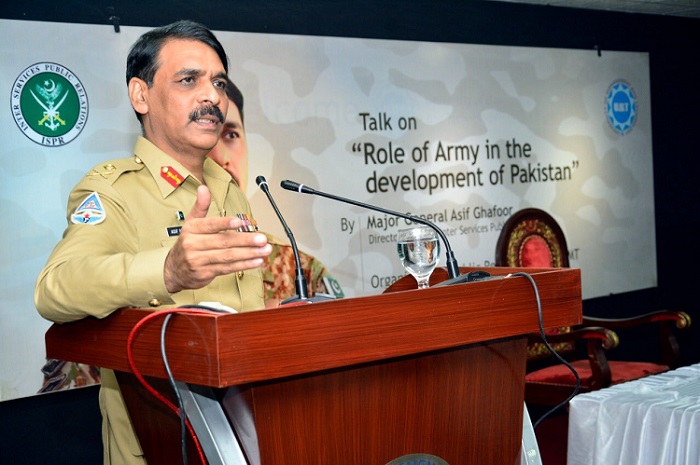
The good thing about Pakistan Army’s media wing Inter Services Public Relations (ISPR) is that it never disappoints those who are looking for a good laugh. Remember how after the post Balakot aerial combat, Director General (DG) ISPR Maj Gen Asif Ghafoor announced with great flourish that “our ground forces arrested two (Indian Air Force) pilots; one of them was injured and has been shifted to CMH (Combined Military Hospital) and, God-willing, he will be taken care of.” It seems that God answered Maj Gen Ghafoor’s prayer and had really “taken care” of the injured pilot, because by evening, this pilot simply vanished from the face of the earth without any trace and hasn’t been heard of ever since!

Then, on the same day, DGISPR went on to vehemently deny that Pakistan Air Force (PAF) had used US supplied F-16 fighter jets during its February 27 foray across the Line of Control (LoC). However, even when IAF displayed remnants of AIM-120 C-5 AMRAAM air-to-air missile that can only be fired from an F-16, DGISPR didn’t give up and continued to stand by his statement. But on April 1, he suddenly made a U-turn by saying “Even if F-16 have been used as at that point in time complete PAF was airborne including F-16s, the fact remains that Pakistan Air Force shot down two Indian jets in self-defence.” This admission once again revived the issue that a PAF F-16 being downed by IAF on February 27.

Surprisingly, just four days later, Foreign Policy, an American news publication carried an article quoting “two senior US defense officials with direct knowledge of the situation” as saying that US personnel had counted the F-16 of PAF after the February 27 aerial combat and found none ohttps://foreignpolicy.com/2019/04/04/did-india-shoot-down-a-pakistani-jet-u-s-count-says-no/f them missing. It went on to say that “The findings directly contradict the account of Indian Air Force officials, who said that Wing Commander Abhinandan Varthaman managed to shoot down a Pakistani F-16 before his own plane was downed by a Pakistani missile.” This report should have vindicated Maj Gen Ghafoor’s claim, but rather than settle the issue once for all, its contents and subsequent developments made his assertions appear all the more suspicious. 

For one, the article didn’t name the two officials, which is intriguing as the magazine said it was Pakistan that had invited the US to physically count its F-16 planes after the incident as part of an end-user agreement signed when the foreign military sale was finalised. Therefore, there was nothing secretive about US auditing the holding of F-16s of PAF that necessitated anonymity. Secondly, it’s quite unlikely that “two senior US defence officials” would indulge in speculation just to ratify DGISPR’s stance by saying “It is possible that in the heat of combat, Varthaman, flying a vintage MiG-21 Bison, got a lock on the Pakistani F-16, fired, and genuinely believed he scored a hit.”

However, the knockout blow came when Pentagon confirmed that it was “not aware” of US carrying out any such audit of F-16s!

But Maj Gen Ghafoor’s latest tweet claiming that the Indian Army had lost more than 60 soldiers along the LoC since February 27 suggests that ISPR hasn’t learnt anything despite its monumental failures of the past. But with India using its special forces, air force and long-range artillery to pulverise terrorist camps located inside Pakistan-occupied Kashmir (PoK), DGISPR has no other option but to exaggerate Indian Army casualty figures to such an extent that public opinion at home is diverted. The Indian Army, no doubt, has been suffering casualties due to ceasefire violations along the LoC, but unlike Pakistan Army which has a proven record of concealing its fatalities, the Indian Army doesn’t have any such perverted proclivity.

Remember how during the Kargil Aar in 1999, Pakistan Army refused to accept the dead bodies of its soldiers killed in combat? In fact, such has been Pakistan Army’s obsession with suppressing data on fatal battle casualties that in 2017, this issue was hotly debated in the Upper House of Pakistan Parliament and what transpired there was downright comical. During a discussion on the situation along the LoC, senators were shocked when the Minister of State for Power who was speaking on behalf of the Defence Minister only gave out the details of civilian casualties, clarifying that “Pakistan Army wants to withhold the information about the losses suffered by its troops due to security reasons.” This irked six-time Senator and Senate Chairman Raza Rabbani so much that he not only shot back saying “Nothing can be withheld from parliament” but even hit out at the Pakistan Army by saying “Declare us irresponsible people, then (it’ll be) fair enough.” 

Needless to say, Rabbani’s assertion on supremacy of the legislature fell on deaf years as the military stood by its illogical explanation that declaring details of fatal military casualties would compromise Pakistan Army’s security. Consequently, while Rawalpindi celebrated the deaths of Indian soldiers in artillery duels and skirmishes along the LoC, many of its own casualties were denied the respect that are due to martyrs simply because they went unreported. Data of Pakistan Army casualty figures collated by reputed military analysts who have been meticulously monitoring open sources of information reveals that the Pakistan Army has suffered inordinately high casualties after it escalated hostilities after the Balakot airstrike.

One such analysis lists out the names of more than 60 Pakistan Army soldiers along with the date and place where they were killed within just a matter of five weeks during July-August this year. The fact that this handle has been suspended by Twitter clearly indicates that this was done on the complaint of some entity that wasn’t very comfortable with such specific data and this in turn establishes beyond any doubt that the Pakistan Army does have plenty of skeletons in its cupboards when it comes to supressing data on its fatal casualties!

But ISPR would still like us to believe that while the Pakistan Army is bleeding Indian Army dry along the LoC, it itself remains unscathed despite Indian Army’s devasting retaliation and this in itself is a howler that’s beyond compare!   

Tailpiece: Napoleon may have been exaggerating when he said “God fights on the side with the best artillery” but the fact is that this adage is very apt for the LoC. It’s no secret that the guns and munition available to the Indian Army are far more superior in both quality and quantity than what the Pakistan Army has and it’s but natural that being badly outgunned, the Pakistan Army has always been at the receiving end when guns blaze along the LoC. That’s why, when Gen Pervez Musharraf declared a unilateral ceasefire along the LoC in 2003 even after having had to bite the dust in Kargil, it was not out of any goodwill or his quest for peace, but purely to reduce the humungous casualties that the Pakistan Army was suffering!

Lessons from Maharashtra’s new political landscape

0

Politics must change in the country before Indian entrepreneurs can prove their mettle. New way of politics, for new India is need of the hour.

Country is not the fiefdom of a handful of individuals or their families. Filling vacuum in political leadership is the primary need of the hour in India. Irrespective of which profession or work one is engaged in, doing one’s work with full honesty, is indeed a “Service to the Nation”.
In order to improve the political scenario in the country, it should be possible for any interested person who desires to enter public life through politics, to be able to seek lateral entry with ease into any party of his/her choice.

For this to happen, selection of candidates for any election by any party, should happen through involvement of local population too, rather be turned into an “internal issue” (read opaque decisions) of the political party. This way, politics will naturally improve through involvement of talented people, who choose to sacrifice private life, for greater public roles. And nation’s wealth grows for all, not looted by a select few.

Amongst the current lot, BJP is the most appropriate party, to take up this “pioneering initiative”, because “nationalism” is the very foundation of it’s ideology, not only of individuals or their families. I sincerely hope that BJP turns the tide of politics upside down: From “electoral machinations” to “rise of genuine leaders at all levels”.

America’s Terrorism Report Comes Down Heavily on Pakistan, Praises India

The United States of America (USA) released its annual “Country Reports on Terrorism” for the year 2018 on 22 November 2019. The report assesses all major nations of the world in terms of their fight against terrorism with special emphasis on compliance with international norms for countering terrorism. For each country there is an overview followed by listing of the number of terrorist incidents that have taken place, legislation, law enforcement and border security, countering the financing of terrorism, countering violent extremism and international and regional cooperation among others. The reports are not based as much on statics as on assessments.

In its foreword, the report identifies Iran as the “world’s worst state sponsor of terrorism.” Beyond this, one complete paragraph of the foreword is dedicated to Pakistan. The report openly admits that India continued to experience terrorist attacks from Pakistan-based organisations. “Pakistan-based Lashkar-e-Tayyiba – which was responsible for the 2008 Mumbai attacks – and Jaish-e-Mohammad (JeM) maintained the capability and intent to attack Indian and Afghan targets,” it says. It specifically mentions the terrorist attack on the Sunjwan Military Camp in the Indian state of Jammu and Kashmir in February, 2018. The foreword also indicts Pakistan for not doing enough to contain the Taliban and the Haqqani network that “Continued to launch lethal attacks throughout Afghanistan, including against the US military personnel.” With regard to the internal dimensions, the foreword indicts the inability of the state to contain the Tehrik-e-Taliban Pakistan (TTTP) that has continued to carry out attacks within Pakistan.

Main chapter of the report dedicated to Pakistan begins with a very serious indictment of Pakistan’s role in Afghanistan. It constitutes an elaboration of what is written in the foreword. “Although the Pakistani government voiced support for political reconciliation between the Afghan government and the Afghan Taliban, it did not restrict the Afghan Taliban and the Haqqani Network (HQN) from operating in Pakistan-based safe havens and threatening US and Afghan forces in Afghanistan,” the report states.

The report has further identified close relationships between the Pakistani state and terror groups in Pakistan that are aligned against India. “The government (of Pakistan) failed to significantly limit Lashkar e-Tayyiba (LeT) and Jaish-e-Mohammad (JeM) from raising money, recruiting, and training in Pakistan,  and allowed candidates overtly affiliated with LeT front organizations to contest the July general elections,” says the report.

The report further lists out the trouble that Pakistan has been facing because of the many terror groups active there and the sensitive internal security situation in provinces such as Balochistan and Sindh. “Terrorists used a range of tactics to attack individuals, schools, markets, government institutions, and places of worship, including IEDs, VBIEDs, suicide bombings, targeted assassinations, and rocket-propelled grenades,” it states.

The report quite openly blames the government of Pakistan for its inability to contain this proliferation of terror. The reason attributed is the “inconsistency” of the state apparatus (read Pakistan Army) to eliminate safe havens in the country, “Authorities did not take sufficient action to stop certain terrorist groups and individuals from openly operating in the country.” On the issue of terror financing also, the report comes down heavily on Pakistan, and in a rather blunt statement it says that Pakistan criminalises terrorist financing through the Anti-terrorism Act, but implementation remains uneven. The inability of the government of Pakistan to register and monitor all madrassas that are engaged in imparting fundamentalist Islamic education to children has also been mentioned in the report.

In the India segment the report identifies India as a victim of Pakistan-sponsored terrorism. “The parts of India most seriously impacted by terrorism in 2018 included the state of Jammu and Kashmir, the northeast Indian states, and parts of central India in which Maoist terrorists remain active,” it states. The report is very appreciative of the successful efforts put in by India to detect, disrupt, and degrade terrorist organizations’ operations within its border. “Indian leadership expressed resolve to prevent terrorist attacks domestically and to bring to justice the perpetrators of terrorism, in cooperation with the United States and other like-minded countries,” the report says.

Several initiatives taken by India and the US in counter-terrorism cooperation such as the Joint Working Group, 2+2 (top U.S. and Indian diplomatic & military officials), and the Ministerial Dialogue for increased information sharing, found special mention in this report.

Pakistan’s severe indictment in the “US Country Reports on Terrorism”, when seen along with their precarious position with the Financial Action Task Force (FATF), puts the country in a very precarious position. It is notable here that FATF, which is a global terror financing watchdog, has consistently put Pakistan in its grey list since the country failed to deliver on 22 out of 27 targets related to terror financing.

Pakistan is continuing with a blinkered approach, not realising that what it could get away with earlier, is now no longer feasible. Pakistan simply has to stop justifying its inimical interference in Kashmir by terming it as an internal problem of India. The world is no longer convinced by its line of thought. It also has to clean out the mess within its borders by coming down heavily on fundamentalist Islamic forces that are playing havoc in the country’s neighbourhood, especially in India and Afghanistan. It has also failed to meet global requirements on curbing terror funding. Finally, the country has to address the open revolts in its provinces such as Balochistan where untold atrocities are being perpetrated on innocent civilians by the government forces.

The “US Country Reports on Terrorism” leaves no doubt about the international appreciation for Indian efforts to fight the menace of terrorism and the concern that the international community feels with regards to the critical situation in Pakistan. Sadly, Pakistan is refusing to accept its own shortcomings and is hell bent upon putting the entire blame on India, which is totally unacceptable.

Media must learn how not to report during terror attacks

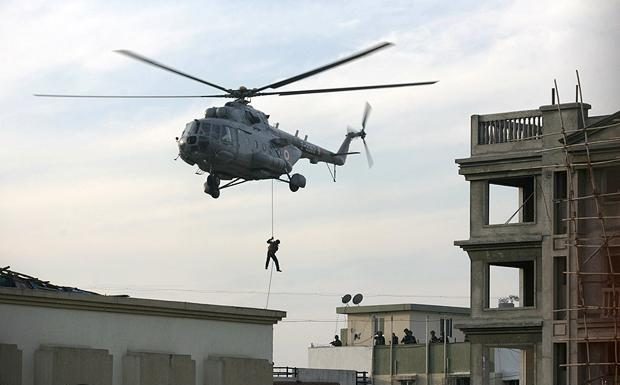
As India remembered the horrors of deadly terrorist attacks on November 26, 2008 that left more than 160 people dead and 300 injured, there is one area which, the country’s newsrooms, have conveniently chosen to ignore. Yes, the role of the media and the basic principles of reporting!

The terror attacks in Mumbai brought out a rather ugly side of the media.

It was officially documented that the terrorists could easily access television broadcasts and other news feeds, which helped them. Not just that, we also know that a few lives could have been saved if the media had exercised restrain in dissemination of information.  

The manner in which unfolding of 26/11 terror attacks and the response of our security forces was covered by media should be a lesson for all journalists to understand how not to report events during times of crises or emergency. While the media and public at large have the right to know in a democratic set up, it also comes with a great amount of responsibility, which we need to uphold.

Many of us know how the reportage of 26/11 made things extremely difficult for the National Security Guards (NSG) commandos.

In our journalism classes we were taught how to exercise restraint in reporting despite having critical pieces of information – if that helped in saving lives or maintaining peace. It seems somewhere down the line, the rule books have been re-written and these principles have been given a quiet burial by the media houses.

A few years after the unfortunate 26/11 Mumbai terror attacks, Bangladesh Prime Minister Sheikh Hasina slammed the media for its reportage in the middle of the terrorist attack at the Holey Artisan Bakery in Dhaka. In fact without mincing words she even said how the coverage helped the terrorists.

While providing 24×7 coverage on the Mumbai terror attacks, many of us in our urge to “break” news and increase our viewership, ignored the basic principles of journalism. Yes, challenges are rising for news organisations—whether print through their online presence or the television channels going in for 24×7 coverage. But equally important is to fiercely uphold the principles of journalism, especially when we seek full freedom.

Freedom of press is critical, especially at a time when we have been unanimous in raising the pitch for maintaining transparency in dissemination and sharing of information.

Bottom line —We, in the media industry, need to act responsibly too. Newsrooms must ensure that.

Inside Tihar, Inside Life, Inside Hell

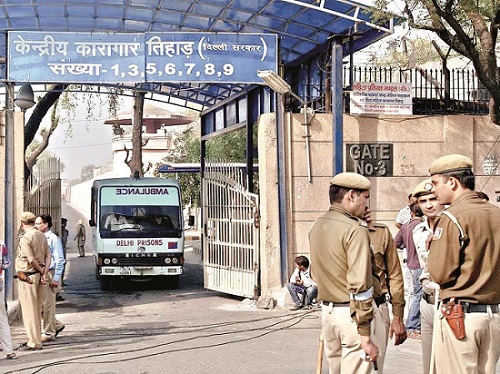
There are 17,000 inmates in Tihar Jail, many say its actual space is for just 6,000 inmates. I still haven’t figured out why it is called the Maximum Security Prison. I once covered the trial of alleged assassins of PM Indira Gandhi, Tihar Jail – South Asia’s largest prison – then looked like a correctional facility with barbed-wire fences, guard stations and cells scattered across 400 acres of land.

Tihar figured in the headlines every now and then, it still does. But  there was no classy documentation, no brilliant lines about life and death behind those huge, concrete walls. I had no idea whether the warden would share –like in the US — his handset number to every prisoner on release. I knew very little about Tihar.

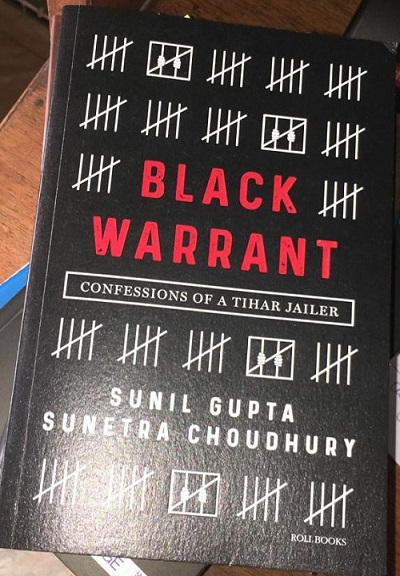
Roli Books latest, Black Warrant, offers a virtual walk the talk from inside Tihar, narrated by its former jailor Sunil Gupta and chronicled brilliantly by seasoned journalist Sunetra Choudhury, currently political editor of Hindustan Times newspaper. There is so much information that it becomes difficult to dissect it for an effective analysis. Black Warrant grows on you, its like travelling in a lift to the Eiffel Tower, the best view is reserved only when you reach the top. I found the best chapters towards the end: It had Manu Sharma, Subrata Roy and Jaswinder Singh Jassa, the King Cobra of Tihar. It was gripping.

Choudhury, who had an immaculate style when she anchored shows for NDTV, has managed to get almost anything and everything out of Gupta, and the two blended well to get both the news and the juice out of that prison. It’s not very easy because very few jailor open up as Gupta did, in one case he explains in detail about his dust up with Roy of the Sahara Group, considered among the top influencers in India. Gupta complained to Delhi CM Arvind Kejriwal who sought proof and – I have a feeling – the matter rested there without any more fireworks.

Gupta makes it clear that he wanted to push in a host of changes in Tihar and did not like the way some of the high profile prisoners like Charles Shobraj were throwing their weight around. And he knew he had to cut through many, many red tapes to achieve the near impossible. It’s clear from the book that Tihar blew hot, blew cold every now and then. It was not exactly a cold, harsh American prison, nor it was a Norwegian prison home that has the world’s best correctional systems in place. That Gupta liked prisoners who worked overtime to improve systems of Tihar is clear because he mentions how Manu Sharma, who killed Jessica Lall, worked overtime and helped Tihar earn some decent cash through new models of business. But hold it, Gupta also says he did not like the way Manu Sharma conducted himself inside the prison, often ordering food from expensive hotel outside Tihar and running a private durbar inside the prison.

Chowdhury and Gupta talk in detail about the Nirbhaya case and the way the accused were housed in Tihar, and the way they conducted themselves and the way they were treated by others, it was a fascinating read. So was the chapter on the assassins of Indira Gandhi. Black Warrant brilliantly chronicles life inside Tihar, tucked in a crowded West Delhi neighbourhood synonymous with huge crowds, backfiring trucks and belching lorries. The book also tells you moments of death when prisoners are taken to the gallows. Afzal Guru, a top political convict, sang a Bollywood song, assassins of Indira Gandhi shouted religious slogans, some just collapsed. Death is not just a five letter word, it means everything to those in the condemned cells. The condemned cells are a little far away from the ones which housed inmates convicted of lesser violent crimes. The condemned cells are eerily quiet — death is plastered all over the walls and there are no huge sounds of slamming metal doors or shouting inmates.

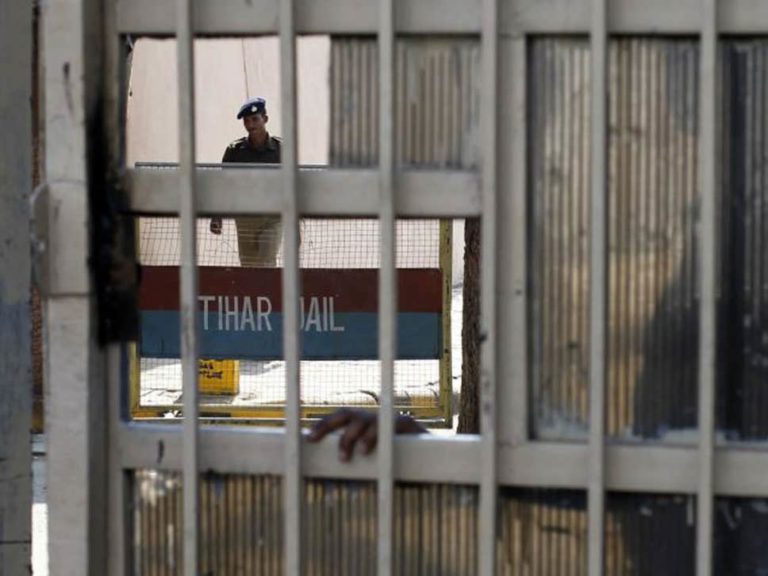
Tihar Jail, New Delhi

The book details the life and times of Shobraj, the notorious bikini killer now lodged in a prison in Kathmandu. And the incident leading to the rape and murder of Geeta and Sanjay Chopra by Billa and Ranga. The Chopra story had – for all practical purposes – dropped from my storyboard but Shobraj was a fascinating read. I tried tracking him a year or two ago in Nepal and even managed a brief conversation with him through a handset owned by his mother-in-law. I was amazed to hear that the serial killer – who once proudly claimed he could smuggle even an elephant in Nepal – was now a pale self of his flashy life. Even if he completes his sentence in Nepal, the Thai cops will be seeking his custody.

The book — actually — gets inside the minds of prisoners and explains how they miss the openness of light, the effect of fresh air coming through. The writers make a genuine effort to explain the strange, love-hate relationships between officers and inmates. Gupta worked hard in Tihar. For him it was not an ordinary job, he had to understand the life of the inmates within the walls, and what he could do to shape their lives once released. Choudhury, as a seasoned historian of crime and punishment inside Indian prisons, chronicled the events perfectly. The jugalbandi is a brilliant read, I would recommend it to be used as a standard tool in all journalism schools in India.