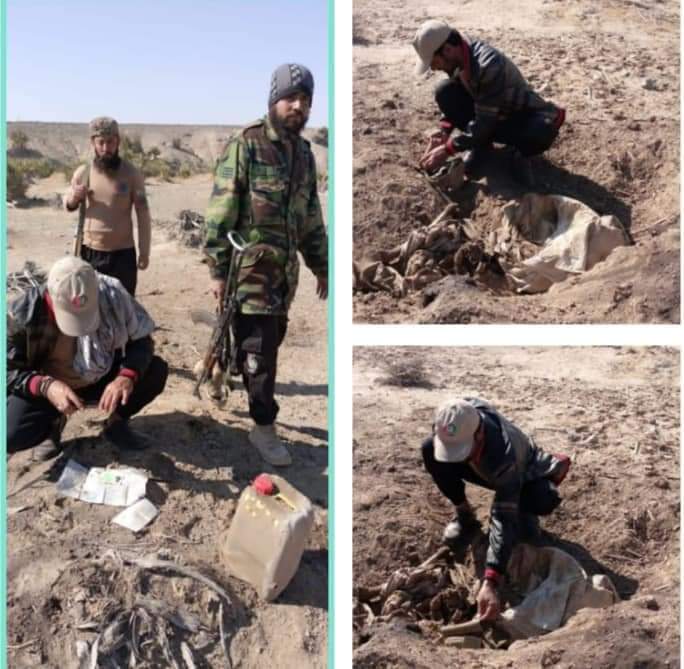
Dead body of a Baloch person killed and buried secretly by the Pakistani security forces was recovered Tuesday from Dalbandin in Pakistan-occupied Balochistan (POB). Locals in occupied Balochistan have identified the deceased as Allah Dad, son of Abdul Rehman, who was abducted by Pakistani forces four months ago.
Soon after receiving reports about the unidentified grave and the dead body the personnel of QRF (Quick Reaction Force) force rushed on the spot and took the body into custody. The body has completely decomposed, officials said.
The Voice for Baloch Missing Persons (VBMP) that has been protesting and demanding for the release of missing Baloch people said that thousands of Baloch people have been forcibly disappeared from Balochistan, and thousands of these missing persons are tortured to death under the custody of Pakistan Army and later their bodies are thrown away in remote areas.
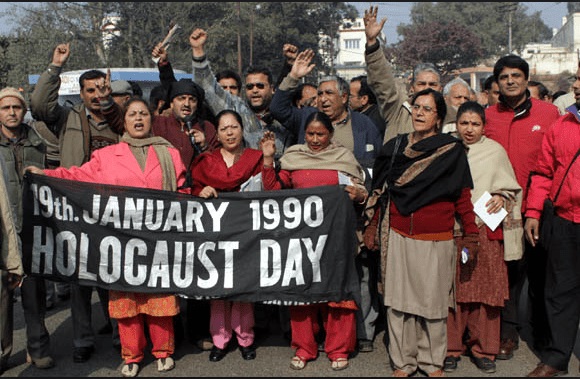
“Chapter I of this book (My Frozen Turbulence in Kashmir) deals with ten most critical days from January 19 to 28, 1990. It recalls the background of events and also describes the first of a series of stabs in my back,” writes Jagmohan, the then Governor of Jammu and Kashmir in the Preface to his above-named book. To the hundreds of thousands of Kashmiri Hindus (Pandits) 19 January, 1990 remains the day of their holocaust.
Why and in what sense were the ten days critical? What were the circumstances preceding and following the 19th of January and its unfolding aftermath? What and why were the series of stabs inflicted in the back of Governor Jagmohan and who played the et to Brutus part?
Much is written on the rise and quick spread of Islamic fundamentalism as also on the externally sponsored and abetted armed insurgency in Kashmir beginning 1989-90, which rages with unabated intensity even after a lapse of thirty-one years. This notwithstanding, what Governor Jagmohan saw, felt and understood about a situation of grave criticality which he was called upon to handle on January the 8, 1990, has been scantily focused. A sedition-like situation that had shaped in Kashmir on the eve of his second stint demands dispassionate and strictly objective analysis. Apart from exposing inexcusable flaws in the then government of India’s Kashmir policy, such a study will also lay bare the vested interests playing a dangerous role in the troubled situation.
Today, the 19 January 2021, the Hindus (Pandits) of Kashmir enter the thirty-second year of their holocaust. This day brings to their memory the horrible saga of their genocide, ethnic cleansing and finally their extirpation from their ten thousand year – old homeland of Kashmir by the Theo-fascists of the sub-continent.
What is more, no Union or State Government agency, no national or international human rights forum cared to raise the issue of the decimation and forced expulsion of a direly threatened people. Not even an inquiry has been ordered into the killing of nearly two thousand innocent members, men, women and children of the Pandit community and then the ethnic cleansing of their homeland. Contrarily, there has been no dearth of sadists rubbing salt onto the wounds of the oppressed community because it serves their interests.
Eschewing the
saga of their travail, here we would like to briefly unfold how the Kashmirian
polity, contrary to propagated stance, was bracing itself for the impending armed
sedition and ethnic cleansing of Kashmir through meticulous planning by
external conspirators in collaboration with local subversives.
In the light of some questions raised in the opening paragraph of this expose, we focus on some relevant excerpts from the authentic and valuable volume My Frozen Turbulence inKashmir authored by the then Governor, Jagmohan. We have chosen this particular work because an important adjunct of anti-Pandit and anti-India disinformation campaign vigorously carried forward by Kashmir separatists and valley leadership of all hues during the heyday of insurgency was that the Pandits had departed on the prompting of Governor Jagmohan. Such was the virulence of this canard that even the top Muslim leaders who once adorned the Sultanate of Kashmir, too, joined the vicious chorus of this allegation. Therefore it becomes very relevant to examine how the sedition was developing steadily months before 19 January and what was the actual plan for that day and thereafter.
Finding the situation extremely critical in Kashmir, Inder Kumar Gujral, the then foreign minister rang up Jagmohan in Delhi around the midnight of 17-18 January 1990 to immediately proceed to the residence of the then Home Minister Mufti Saeed for an emergency meeting. He was told to take over as Governor of J&K and handle the explosive situation. Jagmohan took the oath of office on Jan 18 at Jammu. NC and Congress both declined to attend the oath-taking function. Farooq, heading the Cong-NC coalition government, resigned on 18 January alleging that he had not been consulted about the selection of new Governor for J&K, reported the New York Times of 19 Jan. On 19th January Jagmohan boarded a BSF helicopter to arrive in Srinagar but owing to highly inclement weather the copter could not cross Banihal and had to return to Jammu.
In retrospect,
the morale of Kashmir insurrectionists was boosted by the kidnapping and then
murder of Ravindra Mhatre, the Indian diplomat in Birmingham on 3 March 1984 by
the activists of Kashmir Liberation Army, an adjunct of JKLF controlled by ISI
via Amanullah Khan. Six days later Maqbool Bhat, the founder of JKLF, convicted
in a murder case was executed in Tihar jail. A few days later three Central
ministers visited the President and complained that militants were dominating
the valley. Farooq Abdullah threatened that if Congress did not behave there
would be a blood bath.
During the
elections, if 1983, naked men, presumably from NC, were seen among the crowds
at Iqbal Park where Indira Gandhi addressed a public meeting. On January 15,
1984, four Congress party supporters were killed in police firing in Anantnag.
Bomb blasts with alarming frequency were reported from different parts of the
valley. Blasts occurred on Independence Day parade, in India Coffee House
Srinagar, in the house of Justice Dr Anand, Palladium Cinema, Kashmir
University Library and in the house of Sessions Judge Nilakanth Ganjoo. Earlier
in an international cricket match anti-India and Pro-Pak slogans were raised.
The national flag was disrespected. Strange slogans were raised in public
processions like Pakistan zindabad,
Khalistan zindabad, Noor-i-Chashm nor-i-Huq Zia ul Haq Zia ul Huq and Muslim
Sikh Bhai Bhai/ Hindu qaum Kahan se ai.
As Governor
Jagmohan moved to board a Srinagar bound BSF plane on January 20, a functionary
of the Information Ministry handed him a file to have a look at as it contained
important clippings from July 12, 1989, to date. During the flight, he looked
at the banner lines of some of the clippings reading: “Kashmir nearly lost
to the nation” (The Statesman Nov
6), “There seems to be a strange conspiracy of silence about the reign of
terror in the hapless valley of Kashmir” (The
Times of India (Nov 23). Other horrible events preceding 19 January were
the gunning down of Tikalal Taploo, BJP Vice President in Habba Kadal, Justice
Ganjoo the Sessions judge in Maharaj Bazar, P.N. Bhat, Advocate, poet and
historian in Anantnag, SHO Maisuma, and kidnapping of Rubiya Saeed, daughter of
Home Minister Mufti Saeed. This indicated the total collapse of administration.
(Some analysts raised doubts on the episode of Rubiya’s kidnapping and return
saying it was a stage managed show to seek release of several hardcore
militants from the prison through a deal)
Jagmohan writes:
“We inwardly recognized the infirmities of an immature democracy. We feared
that in a plebiscite, ignorance, parochialism, and communal prejudice would be
exploited. Yet we did nothing to eliminate these forces which fed this
ignorance, this parochialism and communal prejudice. On the other hand, the politics
of Kashmir was run in such a manner that these infirmities were multiplied. At
the oath-taking ceremony in Jammu the previous day, Lt. Gen. Gobinder Singh,
Northern Command chief had talked to Jagmohan in an aside saying the situation
in the valley was extremely serious. “Every time I spoke to the previous
authority (Farooq) I was assured things would be taken care of. Nothing
happened.”
Jagmohan
wondered why Farooq resigned at a crucial time. Unmistakably, Farooq knew that
under Jagmohan’s administration the insurrectionists and separatists would not
be able to get a quarter and his misdoings would be exposed.
The night of 19th January 1990
Let us see what the man at the helm of affairs has recorded about the most critical night viz. 19-20th January 1990, the holocaust night for the Kashmiri Pandits.
“In the day (19 Jan at Raj Bhavan, Jammu) I received frantic calls from Srinagar that large scale searches were made in Chota Bazar and Guru Bazar areas of Srinagar and 250 youth had been picked up. On contacting DGP Saxena, I was told me that three days earlier on 16 January, three CRP personnel were shot dead in Guru Bazar and the searches were ordered on the behest of Farooq Abdullah who had told the CRP to do whatever they liked but had privately instigated the people in those localities. On 19 Jan, Jagmohan contacted Peer Ghulam Hasan Shah DGP and offered him to be the Adviser which he accepted. But before morning he changed his mind and excused him telling Jagmohan that he feared a threat to his family members. This was the level of threat and insecurity created days ahead of Pandit exodus.
“The 19-20
January night was the strangest night I ever had. I had just been to bed when
two telephones rang simultaneously. Voices of alarm could be heard bewailing “Tonight
is our last night. By morning we all Kashmiri Pandits would be butchered. Our
womenfolk, our sisters, our mothers would be abducted and we men folk
slaughtered.” Some requested that I should hold on to the telephone to hear the
slogans and exhortations of Islamists emanating from loudspeakers fitted to
mosques.
How come a large
number of loudspeakers had been installed and the same calls made from them?
How was the technique of arousing mass frenzy acquired? Who had masterminded these
well-knit organizations? These questions haunted me. I contacted Srinagar
Divisional Commissioner Jalil Khan and DIG SS Ali advising them to take prompt
action and depute officers to trouble spots. I spoke to Allah Bux for I knew he
was the key man. I also got into touch with the army officers. In between,
calls from MHA Additional Secretary said, “Sir, we are getting frantic
calls from Hindus in Srinagar. Hell
seems to have broken loose. The Pandits are in utter pain. We cannot get any
officer on phone in Srinagar.”
This was the
depressing state of security particularly about a small defenceless religious
minority. The insensitivity of the Home Ministry — deliberate or inadvertent
—- was so deplorable that the ethnic revolt in Azerbaijan and Rumanian
Liberation struggle were being telecast as special programmes and huge crowds
of Srinagar youth were watching these in the cinema halls of the city. The
State administration at that time was not different from what it was on January
13, 1989, when on the occasion of Guru Gobind Singh’s birthday, 15 persons were
killed in a riot in Jammu within an hour at a short distance from the office of
Farooq Abdullah.
Jagmohan in Srinagar
On January 16,
Farooq arrived in Srinagar. In a meeting at the Police Headquarter, he said that
the National Front Government was taking serious note of non-action, and he was
under pressure to show positive results. Some officers said they were not
allowed to do certain things. Losing his temper, Farooq called local police as
thoroughly corrupt. “Do what you want to do?” he told them in an
angry mood. The police deployed CRP in
Chota Bazaar and Guru Bazaar area to conduct searches. I was not briefed on
searches. Dr Farooq had “instructed his secret men to incite reaction when
searches were made only to create hindrances in my way.”
On the night of
20-21 January” , records Jagmohan
“outside, the events moved with same feverish speed. The voices of horror,
fearful harangue and exhortations soaked in Islamic fundamentalist terminology
filled the air. Crowds were goaded to gather in mosques and people were
mobilized from rural areas to the city. No civil authority existed anywhere.
The passivity was unbelievable. The DG, later on, told me it took him more than
six hours to get the DIG out from his house for duty.”
The situation
was grim. Jagmohan summoned Adviser Ved Marwah and the Corps Commander of
Northern Command. The crucial meeting decided to act in minutes not hours.
Curfew hitherto existing nominally was firmly imposed in the city. Crowds had
gone berserk burning public property like SIDC office Narpora, Women’s Polytechnic
Saida Kadal, Mahjoor Bridge etc. The frenzied crowds had to be dispersed. The
firing took place at Hawal, Tulsi Bagh, and Gav Kadal. Lal Bazar, Safa Kadal
etc. all in the city of Srinagar. The story of the miraculous escape of one Ramesh
Marhatta — a hair-raising saga of the lone Pandit survivor from the captivity
of the terrorist— was published by the
Daily Excelsior of 8 December 2019. Militants and their supporters churned
stories of excesses by the forces. In public life, you have to choose the
lesser evil. The city was quiet by evening and arson stopped. The plan for 26th
was thwarted. Twelve lives were lost in the action.”
The plan for 26th January
A diabolic plan
of subversion had been worked out by the terrorist for 26th January
the Republic Day which fell on Friday. A million people would come together and
exhort through harangues delivered from loudspeakers fitted on mosques to
proceed to Idgah in small groups. Hordes of people would move from outlying
areas, villages and small towns by buses and private vehicles. Friday prayer (namaz) would be performed with all the
religious fervour. Slogans of independence would be raised; the terrorists
would shot fires in the air as a mark of celebrating the “dawn of independence.”
The national flag would be symbolically burnt and the flag of Islamic Republic
hoisted. Foreign correspondents and photographers would be there in any number to
report the event and do photographic coverage. The planners had calculated that
the government would allow free movement it is the Republic Day. They thought
that leaders and civil servants would be in Jammu taking salute of Republic
Day.
This was a
closely guarded secret. The only calculation not made was that Farooq
government was not there. It will be reminded that on August 14 in the previous
year viz. 1989, the then government had virtually permitted the terrorists to
take the salute in a parade at the Islamia College.
Jagmohan writes
that he was informed that Simranjeet Singh Mann, the Sikh leader, had arrived
in Srinagar and desired to meet with me. He met with me and talked in a rambling
manner. But he went on telling me that nothing should be done that would endanger
the lives of the masses. He kept his purpose of visiting Srinagar a closely
guarded secret.
The events that unfolded with time are bizarre but for want of space, we need these to be recounted at some other occasion.
Ahead of the Financial Action Task Force (FATF) meeting in February, the United States has re-designated Pakistani terrorist groups as Lashkar-i-Jhangvi (LJ) and Lashkar-e-Taiba (LeT) as foreign terrorist organisations.
The designation of the Pakistani terror groups as foreign terrorist organisations by Washington comes just weeks before the Financial Action Task Force’s meeting in February wherein the status of Islamabad in the grey list would be discussed.
“The Department of State has amended the terrorist designations of Lashkar- i- Jhangvi (LJ) and ISIL Sinai Peninsula (ISIL-SP) to include additional aliases. These aliases have been added to LJ and ISIL-SP’s designations as Foreign Terrorist Organizations (FTO) under Section 219 of the Immigration and Nationality Act and as Specially Designated Global Terrorists (SDGT),” the department of State said in a release.
“The State Department “has reviewed and maintained the FTO designations of LJ, ISIL-SP, Lashkar-e-Tayyiba, Jaysh Rijal al-Tariq al Naqshabandi, Jama’atu Ansarul Muslimina Fi Biladis-Sudan (Ansaru), al-Nusrah Front, Continuity Irish Republican Army and the National Liberation Army, pursuant to Section 219 of the Immigration and Nationality Act (INA),” it added.
FTO and SDGT designations seek to deny these terrorist organizations the resources to plan and carry out terrorist attacks. “Designations of terrorist individuals and groups expose and isolate them and deny them access to the US financial system. Designations can assist the law enforcement actions of other US agencies and governments,” the statement said further.
The re-designation is believed to be one of the final acts by outgoing US Secretary of State, Michael Pompeo.
As things stand, Pakistan is on the FATF’s grey list since June 2018.
The country is facing the difficult task of clearing its name from the FATF grey list. Islamabad is finding it difficult to shield terror perpetrators and implement the FATF action plan at the same time.
In a major setback, FATF’s Asia Pacific Group (APG) on Money Laundering kept the country on “Enhanced Follow-up List” for its slow progress on the technical recommendations of the FATF to fight terror financing, in October
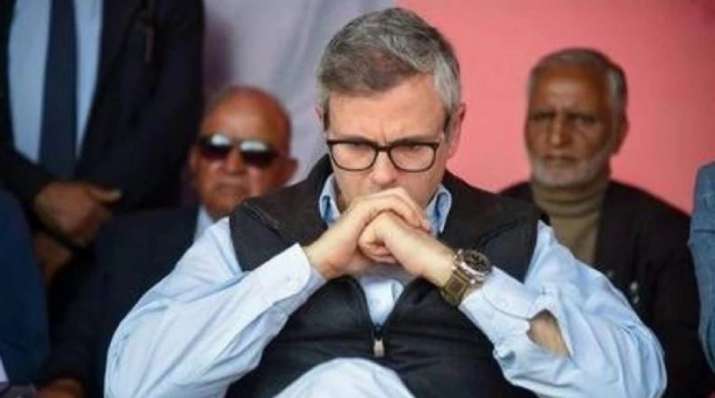
Kashmiri youth are puzzled to know that in his interview to Karan Thapar, Omar Abdullah has sounded pessimistic about his interest in politics. He has not given any cogent reason for the change of heart. Such depressing moods are the result of a combination of various factors, personal, circumstantial or professional. His abstention from politics will be a loss to the Kashmiri youth in the long run.
We should keep away from discussing Omar’s personal life. It is the circumstantial and political environment that seems to have triggered his despondency. Omar is young; he comes from a distinguished family entrenched in politics that forms an important chapter of the modern history of Kashmir. He has been groomed in local politics from his childhood under the supervision of his father and grandfather. The entire atmosphere in which he opened his eyes and grew to reach the adolescence was steeped in politics.
Omar may not have seen the tumultuous days of his grandfather’s struggle for replacing the autocratic dispensation in Kashmir by a popular government. But he has been a witness to the great turmoil in Kashmir caused by the externally sponsored and abetted armed insurgency in 1989-90 preceded by recurring incidents of planned or unplanned bombing or firing at odd places in Srinagar city or the towns. He was inducted into active politics of the state at a very young age and was catapulted into the seat of power without much experience for the crucial post of the chief minister. Observers think that his father was keen for the perpetuation of the dynastic rule. Farooq Abdullah neither observed the norms of a fresher going through the mill of party discipline and training, nor did he remember that his father’s long struggle was against the dynastic rule.
But why
single out Omar for the hateful dynastic rule. We have several states in which
progeny of erstwhile rulers still rule the roost and wield influence. Being the
scion of an outstanding dynasty is not as disgusting as being cast in an inward
looking and fixated mindset.
As party chief or as the chief minister, Omar had to be docile and submissive to his over-imposing and flamboyant father. The qualities of assertiveness, initiative and creativity, known as the hallmark of a successful leader, remained elusive for him. Farooq toed the line of the old guard in National Conference with which Omar was not compatible owing to the proverbial generation gap.
In the Gupkar
meet, one could find that Omar was more a sidelined odd man than a pro-active
member. His inner light is dimmer than what it was in the past. The explanation
is that when a youth leader who has all the pre-requisites at his bidding but
is unable to find space and freedom to translate his ideas, vision and
initiative into practice, his determination and urge slow down and pale into
insignificance.
The developments of August 5, 2019 has left its impact on him. Omar grew in an atmosphere of enormous public support to his grandfather’s house. The public support was misconstrued as the perennial source of power. The house began to believe in the permanence of power and influence forgetting that in democratic dispensation public opinion is not to be taken for granted.
His father had vowed that streams of blood would flow if Article 370 was removed. The NC in general and the Sheikh House in particular, believed that Article 370 was the eternal gift they had won for the Kashmiris. Contrary to all this tall talk he found that when Article 370 was torn to shreds not a dog barked in the valley. Farooq’s threats had vanished in thin air. Omar fathomed the shallowness of his party leader’s claptrap. He is justified in saying he is shocked by the aftermath of August 5 episode. It has come like a shock to many more especially those who used Article 370 as an instrument of blackmailing.
Omar has, perhaps for the first time, realized that power rests with the people. He had often argued that J&K had only “acceded” and not “integrated” into the Indian Union. Norms of democracy are not applied selectively. A federating unit economically and financially fully dependent on the federation has to understand that the line dividing accession from integration is no more existent as the unit moves ahead along the path to economic and social development. That is precisely what Nehru had meant by his famous comment on Article 370, viz., “ghiste ghiste ghis jaega”.
In hindsight, Omar must be ruminating over how National Conference failed to rise to the occasion in the face of externally sponsored armed insurgency. Perhaps he had no say in warning the NC cadres of the serious repercussions it’s hobnobbing with the jihadist-terrorists groups would bring in the trail. Not only that, Omar must be wondering how come his father wants to carry Kashmir into the lap of China as did the leaders of Pakistan did with Pakistan. The consequence is that thousands of Pakistani girls “married” to Chinese men have been taken to China where they finally landed in the brothels. Farooq is not to be blamed for the China daydream; his illustrious father, too, had fallen into the trance as on 31 March 1965, he had a long-secret meeting with the then Chinese premier Chow en Lai in Algiers.
Omar’s disillusionment is also caused by the incredible corruption that had seeped deep into the administrative cadres of the state and the collapse of moral force of the bureaucracy. The bureaucracy never obliged him, rather he obliged the bureaucracy by succumbing to the pressures they brought via his father and other bigwigs in the party.
Modi’s ascendency is a worry not only to Omar but to the entire Muslim leadership of the valley as well. It is because of the way the Islamic fundamentalists have projected him. The reasons are very simple. Modi understood the tricks of blackmail in which NC leaders are adept and he countered them. The earlier regime, viz., Congress gave the NC the requisite leeway to profile itself as the secularist symbol of Kashmir yet perpetrate rank communalism in practice. Manipulating elections, bureaucracy, administration, relations with the centre, insurgency, and ethnic cleansing of Kashmir, and above all, pursuing avenues of self-aggrandizement were the gifts to the people during latest phase of the NC regime. Omar could not move a single blade of grass without the permission of the High Command, viz., his father, uncle and close family elders reducing him to the status of a pawn on the NC’s chessboard of politics.
Omar has to reconcile with some fundamentals of statecraft if he intends to return to politics and do some lasting service to the people of Jammu & Kashmir. The foremost is that J&K is an integral part of the Union of India and it can survive only in that capacity and in no other form call it autonomy, greater autonomy, self rule etc. Kashmir is crucial not only to India’s foreign policy but more to her security parameters. As such Kashmir leadership has to reshape its relations and approach in a manner that it remains in the national mainstream. Secondly, the power rests in the hands of the people and democracy is the other name of the majoritarianism however obnoxious it may be. Lastly, Kashmir leadership has to realize that the days of blackmail are gone for all times as are the days of the dynastic rule. No people in this country deserve any special treatment because our economic development has to be universal and all-pervasive. All steps that lead to the integration of the State (at present UT) with the Indian Union have to be hailed and given due recognition.
If these realities are understood and recognized by Omar Abdullah, we can assure him that he will wriggle out of the dilemma and despondency. He will find new horizons of progress and happiness opening on him and his people in the State of Jammu and Kashmir.
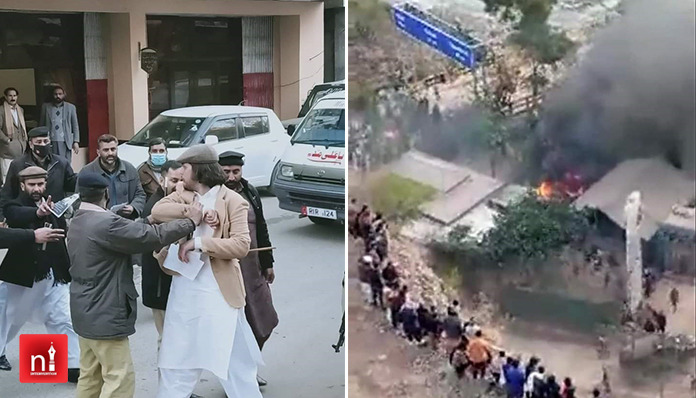
Massive protests erupted across Pakistan-occupied Kashmir (POK) on January 13 as protesters burnt police check posts and blocked bridges connecting POK with Pakistan. The immediate trigger for these impromptu protests was the huge price hike of food grains especially wheat flour that instigated an already restive Kashmir population that is now fed up with Pakistani misrule in POK.
Over the last one month, people of POK have been protesting for their legitimate demands, but the so-called government of “Azad Kashmir” run by Pakistan Army and its intelligence agency ISI continue to suppress these peaceful protests.
“On Wednesday Kashmiris came out in large numbers at Bagh, Rawalakot and other areas of Poonch division to protest against the steep rise in price of wheat flour, sugar and other commodities. People feel that this sudden price hike is tantamount to starving the people,” said Habib-ur-Rehman a local politician in POK.
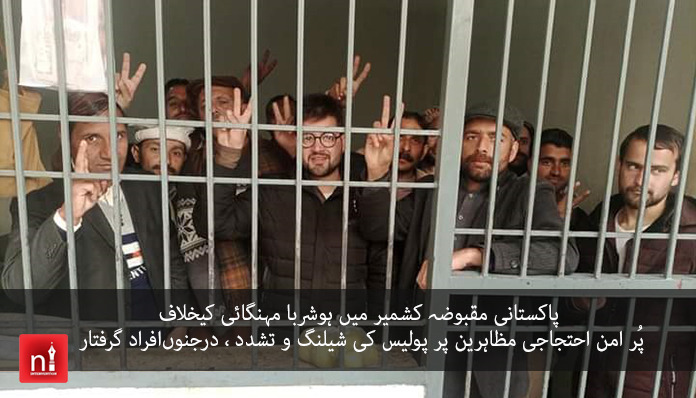
Local Kashmiris arrested by the police in Pakistan-occupied Kashmir (POK). (Photo: News Intervention)
Protests have been going on for the last one month under the banner of People’s Action Committee but this so-called government refused to reverse its decision to increase taxation on food items. A series of public awareness campaigns were launched and massive protests and rallies were supposed to be held on January 13, however, since the night of January 12 Pakistani forces began abducting and arresting Kashmiri activists and leaders.
Click on the link to watch our news video report
The Poonch Division, which is said to be the base of this ongoing revolution in POK has been locked by Pakistan Army and the police since morning of January 13 and Kashmiris were being arrested till the time of writing this news report.
Since January 13 morning there has been a complete strike in Rawalakot, Poonch as people reacted strongly after the police and intelligence personnel cracked down on the protesters. The protesters set a police check post on fire and chased away the police from Patan Bridge, which connects POK with Pakistani territory.
This wave of people’s revolution in POK has been seen after a long time. The Kashmiris in POK are very angry, people are chanting slogans against Pakistan that Kashmir is not part of Pakistan.
Sources within POK police said that people continue to block Patan Bridge in this biting cold where temperature is minus eight (-8 ) degrees Celsius. “The sit-in on the bridge is still on,” said a Kashmiri police constable.
Even the Dhandal Bridge and the Kuala Bridge, which also connect Pakistan with POK have been closed by the people in a sit-in and forces have been pushed towards Pakistan.
The Poonch Action Committee that is leading these protests said that the strike would continue indefinitely. Poonch Action Committee said that protests would continue till the time Pakistan issues a notification that their demands have been resolved.
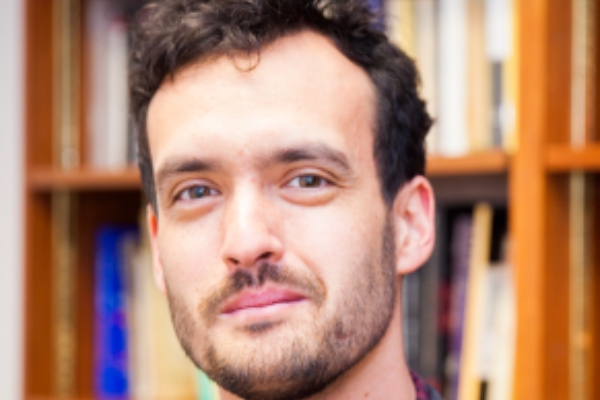
Dr. Alexander X. Douglas‘s biography states: “I am a lecturer in philosophy in the School of Philosophical, Anthropological, and Film Studies at the University of St. Andrews. I am a historian of philosophy, interested in the philosophy of the human sciences, particularly from the early modern period. I am interested in theories of human reasoning, desire, choice, and social interaction – particularly work that questions the foundations of formal theories in logic and economics from a humanistic perspective. I am particularly interested in the thought of Benedict de Spinoza, which continues to inspire alternatives to the dominant paradigm in economics and social science. My first book, Spinoza and Dutch Cartesianism, proposed a new interpretation of Spinoza, situating him in the context of debates within the Dutch Cartesian tradition, over the status of philosophy and its relation to theology. I am completing a book manuscript, which aims to introduce and develop Spinoza’s theory of beatitude. This is the culmination of Spinoza’s theory of desire, since it describes the condition of ultimate satisfaction. Although Spinoza saw the revelation of true beatitude as the ultimate goal towards which his philosophy reached, there are few interpretative works devoted primarily to this theme. Spinoza’s theory of beatitude is, in my view, the keystone that holds together diverse parts of his philosophy – his theory of desire and the emotions, his metaphysics of time, his theory of human sociability, and his philosophy of religion. These are often studied separately; my introduction to beatitude aims at helping readers understand Spinoza’s philosophy as a unified whole. I have also published a book examining the concept of debt from the perspective of language, history, and political economy. I’m interested in the philosophy of macroeconomics, which receives considerably less attention from philosophers than microeconomics. I am a member of the Centre for Ethics, Philosophy, and Public Affairs, the Executive Committee of the Aristotelian Society, the Management Committee of the British Society for the History of Philosophy, and a Research Scholar at the Global Institute for Sustainable Policy.”
In this series, we discuss the philosophy of economics. For this session, we come back after some time with session 11 on fundamental premises, utility-maximization automata, a choice, Dr. Carolina Christina Alves, human behaviour, a metaphysical theory of fundamentally “rational” human nature, normative stance or ethic reflective of ideology, political examples of Optimal Control Theory, profit-motive examples of Optimal Control Theory, understanding colonial narratives, and the pretense of “control.”
Scott Douglas
Jacobsen: When looking at some of the philosophical systems sitting behind
the economic theories, orthodox and heterodox, there’s, as you noted, a “very
big step from ‘can be represented as’ to ‘is in fact.’” This seems as if a
great point at which to begin to connect the philosophy of economics background
to the heterodox economics expertise of Dr. Carolina Alves/Dr. Carolina Cristina
Alves in “An Edge of Heterodox
Economics 1 – Everything has a History.” Her series will sprinkle into this one, as
yours will in hers.
With Dani Rodrik’s art/science or choosing models/building
models split, you had an interesting non-throwaway phrase, “…I really haven’t
seen the justification for taking that step, at least not in
most cases.” On the opposite of “not in most cases,” there exist some cases.
What are some of those cases? Those cases where the art of selection can be
justified based on the models built as “science” (quoting Rodrik).
Dr. Alexander Douglas: Well, for example, the mathematical solution
to noughts and crosses is quite simple, and adults play it reliably when
they’re told the rules of the game and instructed to try to win. So here you
have a mathematical model that reliably predicts and explains human action, in
a very limited domain. A key point here is how much control
needs to be exercised over the subjects for this explanation to work. The
subjects need to follow the rules carefully, and they’re guided on what to do
(try to win the game). Notice that they’re not setting their own agenda. Thus
the model is no good for predicting how adults will behave when playing with
young children whom they are trying to teach and encourage.
The economist and philosopher Don Ross has argued that the mathematical models used by economists should not be seen as explanations of human rationality. He thinks that human rationality is a crooked concept; there just isn’t one thing that it means to be rational independent of particular contexts and specific situations. Economic models are, rather, models that explain the workings of institutional mechanisms. The institutions make people behave in the algorithmic, maximizing way described by the models.
Ross is trying to defend economics, but he
makes a very revealing admission. Economics, according to him, describes how
people behave, not in general but within the institutions that make them behave
in those ways. So he’s admitting that the theory works because reality is
engineered to match it. Since this is something I’ve been arguing in the
previous interviews, as part of a critique, I was surprised to find it being
put forward as a defence of economics. Economics is often accused of being
ideology rather than science. Ross thinks he is countering that accusation, but
he seems to frame a new way of making it: if we build social institutions to
make us behave in certain ways, and economists describe those, then economists
are describing modes of control rather than patterns of behaviour. That sounds
a bit like the role of the practical theologian or liturgist with respect to
the church. It isn’t pure ideology, but it isn’t mere description either.
This also relates to questions about decolonization in economics. If we start thinking of economists as sociologists or anthropologists with a specialization in certain cultural institutions of eighteenth-century European origin, we should rethink the role they have with respect to global policy.
Jacobsen: With these “human actions, choices,
preferences,” and so on, ‘all having meanings.’ It raises some interesting
questions about meaning as only a property in minds in relation to the world,
not vice versa. If meaning arises in the context of any subject dealing with
objects in the universe, then subjectivity imbues meaning, which isn’t seen as
“relevant.” How do you build this aspect of subjective significance of things
into the models? Is it even reasonably feasible with any precision?
Douglas: Yes, I was trying to avoid the very difficult
question of what a meaning is. But the inference that meaning is irrelevant
because it’s purely subjective works only if we assume that subjective factors
aren’t themselves causes within the system. For example, whatever the shining
of the stars might mean to us, the nuclear reactions that cause them to shine
are one and the same. Here the meaning is irrelevant because it’s subjective.
But with human action meaning is (I believe)
among the causes. Let’s go back to the trading floor. When a trader buys some
stocks in some manufacturing firm, we could describe her action as “investing
in the production of peanut butter”. But this description gets the meaning
pretty wrong. The trader might not even know what the stocks she’s buying are
connected with, and she might be planning to sell them again in the next few
hours. If she were investing in the production of peanut butter, we shouldn’t
expect her to sell out very soon, but if she’s simply taking a temporary
position or in the middle of a short-selling gambit then our expectations
should be very different. Assigning a different meaning to one behaviour
classifies it as a different action, and the predictive consequences are
different.
Nor does it have to be the case that the meaning is represented by the actor for it to be causally relevant. Perhaps our
trader isn’t even thinking about what she’s doing. Maybe she’s an old hand who
has cultivated instincts and can run on autopilot most of the time. All the
same, the institution in which she cultivated those instincts imbued her
actions with the meanings. That’s why buying stocks on the trading floor is
very different from, e.g., investing in a friend’s start-up company, even
though, abstracting the actions away from their institutional context, they can
fall under a single description (investing).
So we need to understand the meanings of
actions, and there’s no science of this. We have to depend on our “commonsense”
understanding, infused as it is with our moral instincts and cultural biases.
We can’t depend on the scientific method to close these out, so the best we can
do is keep the conversation open to a diversity of perspectives.
Jacobsen: How do you separate the “explanatory
models” as “mathematical models” and the “descriptions under which the human
actions fall,” while using this clear distinction to link them? In short, how
can these subjective (and intersubjective) categories of meaning imbue the
mathematical models with more robustness of aim?
Douglas: I’m not sure a mathematical model on its own can represent human actions at all. Human actions aren’t paths through some state space in which each dimension maps some salient variable. I struggle to communicate this, but take a simple example. Suppose we reduce a person’s driving behaviour to two variables: l, which is the number of times turning left and r, which is the number of times turning right. We can model driving as an optimization problem: maintain equality between l and r, or minimize |l-r|. More left turns will trigger more right turns, and vice-versa. I expect that model probably gets the quantities right over the long term. But of course it completely misses the point of what a driver is doing. Somebody who had only that model wouldn’t even understand what the point of driving was.
And I don’t think that simply adding more variables would get you closer to understanding what the driver is doing. A mathematical model just outputs a vector of quantities. These could be left turns, right turns, speed, distance, position, etc. But turning left to avoid an accident isn’t the same as turning left to test the steering wheel, or to correct for a previous mistake, or to follow the road, or to switch to a different road… Can you add more coordinates to the vector to track these differences? Of course, just as you can add more coordinates to track the colour of the car, the population of Paris, the number of craters on the moon… Which of these are salient and should go in the model? Well to know this you need to already understand driving, at some hermeneutic, non-mathematical level. When we’re looking at behaviour whose meaning we don’t already understand then we don’t know how to build the right mathematical model for it. And so mathematical models can’t explain behaviour. They can only regiment and formalize the understanding we already have.
Returning to Ross’s point: why then can
algorithmic models, run on computer simulators, describe aggregate human
behaviour within certain institutions? I say, because the institutions are
themselves computers. At the limit you have a single piece of software
implemented on two machines. One is the electronic computer running the
economist’s model; the other is the computer running through the brains and
institutions of human beings. The computer works by disciplining electricity to
move in regular and predictable patterns through the circuits, rather than
flowing more wildly as it does outside the machine. The institution does the
same thing with human action; it regiments our thoughts to move in regular
patterns like the current through a circuit board. A computational model can
explain human action when human action is rendered computational. The mirroring
can look like magic, but the conjuring trick is to cover up the institutional
mechanism that makes it work.
Jacobsen: If the course of orthodox economic
theorizing directs the “the dehumanizing language to the false mass
psychology theory to ad hoc terminology to the complex mathematical
models to the implied metaphysical theory” may not be a choice, is
it, fundamentally, down to the consequences – economic cohort by economic
cohort – of specific ‘sets of techniques’ where the advances happen by “pushing
these techniques further”?
Douglas: Philosophers of science often talk about how
the institution of science works by filtering out our natural human biases,
blind-spots, etc. Scientific institutions pit humans into semi-competition
against one another so that various idiosyncrasies and epistemic vices carry a
cost and the elimination of less competitive theories drives convergence
towards the truth. This works when there is a truth to converge towards. But
with economics, I’ve suggested, reality is often engineered to match the
theories rather than vice-versa. Then the scientific institutions of
competition and filtration – peer-review for example – have a very different
result. They work to force convergence onto a general plan for society – e.g. a model for how to build institutions – rather than onto some
objective truth. I think the same is true of philosophy and other disciplines,
so I’m not singling out economics for attack here.
Jacobsen: Dr. Alves argues Lionel Robbin’sAn essay on the Nature and Significance of EconomicScience (1932) became the point at which economics began
formalization as a defined discipline, as old as some people’s grandparents.
Economics, Dr. Alves, quotes, becomes “the science which studies human
behaviour as a relationship between [given] ends and scarce means which have
alternative uses.” A “science,” so a natural philosophy, given our
conversations, this seems sincerely polyannaish, as per your example of the
healthcare catastrophe happening in the UK (and elsewhere) with COVID-19.
Now, Dr. Alves notes the use of this term widely in economic discourse. What seem
like the obvious consequences of asserting economics as a “science” on the
state of economics over time – one person’s definition widely used?
Douglas: Carolina points out how Robbins’ definition
works well with the ambition of Léon Walras to render economics as much like
the “hard sciences” as possible. Physics in Walras’s time benefited greatly
from models based on solving for equilibrium. You can use the same mathematics
to explain human behaviour, if you reduce it to a problem of allocating means
among ends. The solution to the model is a balance between competing demands,
just as a physical model is solved as a balance between competing forces.
Economists like Gary Becker made a big game of explaining unlikely behaviours
as allocation problems and then creating sophisticated mathematical models to
“solve” them.
Since Robbins there’s been a grand revolution
in economics through the development of game theory. Economists can now discuss
human institutions in a richer way, since they now model strategic interactions
among agents rather than the “games against nature” that are allocation
problems. But it seems no less fundamentalist to describe every human
interaction as a strategic game than to describe every human activity as an
allocation problem. So perhaps the modern-day version of that Robbins quotation
is what’s found at the start of Ken Binmore’s Game Theory: A Very Short Introduction: “a game is being played whenever human beings interact”.
I don’t think that either of these reductions – of human activities to allocation problems and human interactions to game theory – can be justified on sociological or anthropological grounds. That’s to say, I see no reason to believe that most human activities and interactions are, in their ultimate meaning, allocation problems and strategic games. Why, then, are they all modelled as such? Because modelling them like that allows for fancy mathematics to be invoked. By contrast, representing all human activities as sacrificial ceremonies, as some twentieth-century anthropologists did, doesn’t allow for mathematization.
So I stress, there’s nothing inherently scientific about mathematizing something. Let this interview be modelled as an ordered pair of numbers (7,9). Let it be modelled as a vector of integers x,y ∈ Z2. Let it be a pair of elements, x, y, of a ring, R, defined as a countable set of elements {a, b, c, …} and an operation, ⊕, forming an abelian group. Have I explained anything you didn’t know before? Of course not – I’ve just bamboozled you with a lot of symbols and terminology. Buyer beware, with this sort of “science”. And buyer beware with fancy models of meaningful human activities as allocation problems with budget lines and indifference curves and local maxima, or games with dominant strategies and information sets and Nash equilibria.
Jacobsen: What are the benefits of having a
career with the big journals using specific techniques? What are the benefits
of doing things one’s own way as an amateur blogger?
Douglas: Of the first: research funding, academic
positions, social status. Of the second… I’ll get back to you!
Modern economics or what we
call orthodox economics is about studying human interaction mainly through markets,
where markets are theorized as being about the interaction between demand and
supply, with equilibrium as a central concept and enduring reliance upon
methods of mathematical modelling. This approach went to become ‘the mainstream
economics,’ as it is the main and widely taught and researched approach.
Something “widely taught and researched” in
“orthodox economics” that “goes off in so many different directions,” which
produces “a pure tangle.” It sounds
hopeless. If it can’t tell us “much
about what we really want to know,” what do we really want to know if there you
“don’t see any scientific approach to answering these questions emerging”?
Douglas: Well I probably should avoid the word “we” in that way; philosophers are always going on about “our” intuitions, “our” questions, and so on, and it betrays a lot of groupthink and ignorance of human diversity. But what I want to know is which institutions society should retain, which it should reform, and which it should replace. Now that I’ve read the Ross book, I think I have a clearer sense of why economic theories form such a tangle. They don’t describe human behaviour in general; they describe it within different institutional contexts. In the recent past, economists got in the habit of modelling everything as an abstract market in the sense Carolina means there: a mathematical optimization problem. Now they look at specific institutions (though these too are formulated as solutions to optimization problems – namely “games”). Institutions overlap in confusing ways.
But I’ve said that to mathematically model an institution or activity, you need to already understand it. How do we understand our institutions? I don’t know, and I don’t know that we do a good job of it. I just don’t think that social science as we have it helps us to gain understanding rather than to formalize understanding we already have. But the same faculty that allows us to understand our institutions, insofar as we do, is what we must rely on to think about how we might redesign our institutions. The insight of a novelist or an essayist might be more valuable here than all the mathematics in the world. De Tocqueville didn’t need equilibrium solutions to gain his insights into the ancien régime, nor Madame de Staël to understand the Napoleonic system. Ross writes at one point that while informal insight might have worked for people like Emile Durkheim or Max Weber, they don’t yield great results in the hands of “mere mortals”. But are we in any danger of running out of “immortals”? In any case, if we restrict ourselves to only looking at the institutions that we’ve learned how to reduce to equations, aren’t we going to miss out most of human life?
Jacobsen: Insofar as algorithms “can be
represented by mathematical equations,” and if you “take the meaning out
of action and it becomes dead motion,” and if “meaning is
everything in human life,” is economics, as a self-proclaimed “science,” a
fruitless endeavour in generating theories or proper mappings of “meaning… in
human life”?
Douglas: That’s a good question, but I think the answer is no, because I don’t think that economists have really expelled meaning. They’ve just suppressed it. Since Milton Friedman’s essay on “the methodology of positive economics” in 1953, economists have philosophized as if all they’re trying to do (as “positive” economists) is track patterns so as to predict them. The realism of their assumptions is entirely irrelevant. In other words, they make it sound as if all they’re trying to do is find equations that output the data.
But their practice doesn’t match the theory. No economist explains stock prices by assuming that some omnipotent being determines their movements by tossing coins, though that would correctly “predict” the observed random-walk pattern. Nobody explains recessions as being caused by cosmic rays, though with the right assumptions in place one could easily generate the appropriate time-series data. If all economists were trying to do was predict data, why wouldn’t their theories consist of pure, uninterpreted equations? In purely mathematical terms, setting up a system of optimizing agents is a needless detour; you might as well just curve-fit a polynomial that directly outputs the data series you want.
The truth is that economists see the world
working a certain way, and their models reflect this. They model society as a
system of self-interested agents because, despite all their protestations,
they’re telling a story about human nature and human society. And in doing so,
they do ascribe meaning to actions and institutions: the meaning of the actions
is self-interest and the meaning of the institutions is strategic balance in a
power-struggle. Whatever economists might say, that will never just be a pure
fiction used to generate an empirically robust mathematical model; it will
always be a story economists tell us about ourselves, and we will always be
entitled to ask whether it’s the right story.
Jacobsen: What are some other ‘strong doses
of philosophical anthropology’?
Douglas: Since Ross’s book has been a theme for this interview, let me end with his idea about behavioural economics. This, he thinks, is a thoroughly misguided enterprise. It takes results of studying humans in experimental contexts, isolated from ordinary institutions, and tries to apply them to the behaviour of humans outside those isolated experimental contexts. For example, psychologists put people in a lab and find that they don’t “maximize” the way they’re supposed by economists to do. But, Ross argues, take them out of the lab and put them in a market setting – put them, say, on a trading desk or on the board of directors of a firm in which they’ve invested – and there’s no reason to expect that they’ll act the same way they did in the psychologist’s lab. Here the institutional setting primes and trains them to act as economic agents rather than subjects of a psychological experiment. “Maximisation”, in other words, is a social behaviour into which people are enculturated through capitalist institutions – a ritual they’re trained into.
Well, how is that for philosophical anthropology? Ross has probably been in some board meetings for American companies, so I’m sure he knows what he’s talking about. But this is in the background of economic theories that explain how we act as economic agents; “economic agents” means participants in the rituals and culture of certain familiar capitalist institutions. Western capitalist institutions, that is. Would Ross be as confident that economists’ models will hold up with respect to the behaviour of the directors of, say, an Indonesian state-run firm? I doubt that he should be. Ross advocates for the fusion of economics with sociology, but the examples of his chosen sociology come again from the study of familiar Western institutions, and are again heavily mathematized. Here the implicit philosophical anthropology is the assumption that human agency is, in general, amenable to mathematical treatment, and that behaviour within Western institutions reveals certain fundamental and universal principles.
Elon Musk becomes probably the richest man in the world. The world’s
technological giants flex their muscles in the arenas influential on social
discourse and political activism. More satellites than ever; more cell phones
than ever; more people to indulge the delights of science and technology than
ever.
Also, more to delude in astrological enquiries too. Apparently, the
ancient Babylonians had a 13th sign, eventually rejected. There were
numerous reports about the introduction of the 13th astrological
sign by NASA.
This is not true. Even on the larger point, astrology is not true, either,
and stands on a premise of base falsehoods. Astrology became astronomy. Now, we
should dispense with it, but haven’t done it. Nonetheless, some of the
interesting parts come in modern news and in ancient omissions.
On the former, there has been an ongoing hoax about NASA
supporting astrology, even adding the newest sign, Ophiuchus. This would be the
13th sign to the standard 12 seen to this day. Apparently, it has
been ongoing for about a decade, the hoax.
NASA has posted in its blog on dispensing with this hoax. However, it continues to make the internet cycle, nonetheless. NASA clarifies in not creating the 13th sign, let alone legitimating it. NASA doesn’t study, research, or promote astrology because it is a pseudoscience, not a science.
On the latter, Ophiuchus is the real 13th sign as one of
the 13 major constellations of the Zodiac within ancient Babylonian astrology.
However, Ophiuchus was rejected because the Babylonians sat on a 12-month
calendar.
Each of the signs, aside from Ophiuchus, was assigned a month. This
is the association between the number 12, the Babylonians, the 12 months of the
year, and 12 (not 13) signs of the Zodiac coming from the ancient Babylonians.
NASA has clarified on this point several times now. This is the danger of hoaxes, false information, misinformation, and pseudoscience in general. It deludes a wanting-to-believe set of the public. Those all-too-ready to imbibe nonsense grounded in a lack of sense about science or the world.
Western Zodiac is based on real constellations with shapes from
Greek mythology behind them. The association between these real constellations
and claims about temperament are base falsehoods.
NASA
explained as follows:
The constellations are different sizes and shapes, so the sun spends different lengths of time with each one. The line from Earth through the sun points to Virgo for 45 days, but it points to Scorpius for only 7 days. To make a tidy match with their 12-month calendar, the Babylonians ignored the fact that the sun actually moves through 13 constellations, not 12. Then they assigned each of those 12 constellations equal amounts of time.
The
Archdiocese of Vancouver made confirmations of 3 more Roman Catholic priests
are involved in the abuse settlements.
Those
priests who served in the Vancouver parishes are in the process of the settlements
related to sexual abuse. 13 more people
came forward to issue the reports on the Roman Catholic Church. In CBC’s The
Fifth Estate, the Catholic Archdiocese of Vancouver knew of 36 cases of
abuse.
All
36 abuse cases were under the jurisdiction of the clergy there. 26 out of the
36 involved children. At the time, the Catholic Archdiocese of Vancouver noted
nine clergymen had lawsuit settlements or criminal convictions, which went back
to the 1950s.
This
is in the backyard of British Columbia happening, at least, for half of a
century or more, probably. With an update to the report, Armand Frechette, John Edward Kilty, and Johannes
Holzapfel, were involved in settlements. Each served in parishes in Vancouver;
now, each is dead.
If this happens for
decades in Vancouver, and comes out more forcefully now, then this raises some
interesting questions about the national state of Roman Catholicism, not only
in British Columbia or per province or territory.
Because more cases
continue to flood forward of sexual abuse, as a core form of the abuse, and coming
out of the Roman Catholic Church as the identifiable organization in the
country. The allegations came from the 1940s and the 1960s, mainly, in the Catholic
Archdiocese of Vancouver cases.
The
report from the Archdiocese of Vancouver (2020) stated, “We understand that
some people think that we should speak less about this issue because it may
seem that it feeds into an ‘antifaith’ narrative… We believe that greater
transparency allows us to reach and care for more victims/survivors while
increasing vigilance and safe environments within our parishes.”
Since the 1920s,
there are ongoing cases. In August of 2020, one woman came out claiming assault
as a child at a Catholic elementary school in Vancouver. She claimed to be
suing the local archdiocese for “perpetuating and covering up decades of
alleged systemic abuse by priests, bishops and other members of its clergy.”
The class-action
lawsuit claimed the Archdiocese of Vancouver knew about the allegations of
abuse and engendered a culture of said misconduct while hiding complaints
against clergy – keeping them safe.
I went to war for the United States three times. I have always loved my country. I still do. It is the U.S. government that I despise, which has deliberately and decisively separated itself from the American people.
In his 1993 book, “The Wish for Kings,” Lewis Lapham described the U.S. government as an oligarchy: “…that 2% of the population who own the media and the banks, manage the government, operate the universities, print the money, write the laws and, every four years, hire a President.”
Is there any doubt that the oligarchy hired the enfeebled Joe Biden to run for President and carry out its wishes because Donald Trump would not?
That was the essence of the 2020 election and an explanation for the last four years of political turmoil in which the oligarchy illegitimately tried to remove Trump from the Presidency.
But it is now far worse than that.
In the past decades, the oligarchy was manipulating government simply to maximize its profits, as Lapham wrote: “The politicians dress up the deals in the language of law or policy, but they’re in the business of brokering the tax revenue, and what keeps them in office is not their talent for oratory but their skill at redistributing the national income in a way that rewards their clients, patrons, friends and campaign contributors.”
Today, in addition to maximizing profits, the oligarchy wants to control what you read, what you think and what you are permitted to express.
There is an unholy and dangerous alliance combining the media and Big Tech with the national security state, that is, the intelligence services, the military-industrial complex and law enforcement.
It is, quite literally, an effort to abrogate the First Amendment of the U.S. Constitution and eliminate free speech. The United States government has gone beyond authoritarianism towards the Chinese Communist Party model of state capitalism and totalitarianism.
And what better candidate to carry that model forward than Joe Biden, who is already compromised by his close connections with the Chinese government?
Make no mistake, Donald Trump won the 2020 Presidential election. It was stolen, not only from him, but, more importantly, it was stolen from the American people by the well-organized and well-financed application of massive electoral fraud.
A detailed description of the election fraud was publishedby Dr. Peter Navarro.
Most of what the media are reporting about the election and the events following it, such as the so-called “assault” on the Capitol building, are lies combined with Big Tech censorship and psychological operations conducted by those with connections to the national security state.
Media disinformation and Big Tech censorship are extensions of and an attempt to solidify the fraudulent 2020 election, which was not simply a contest between the Democrat and Republican ideologies, but a battle between the entrenched power of the bipartisan political establishment versus the freedom and well-being of the American people
Contrary to the claims of the discredited media, there was never a cult of personality.
Donald Trump was an instrument by which the American people might wrest control of their own government from the vicelike grip of the oligarchy.
The oligarchy hates, not just Trump, but hates and fears the American people, who represent an obstacle to the oligarchy’s use of government as a lever to obtain personal power and profit.
It is a fundamental principle of democracy that the efficiency and effectiveness of government are directly dependent upon the trustworthiness of government officials as representatives and executors of the views and desires of the people.
Americans now believe that we are not citizens of a republic, but subjects of a fraudulently-elected aristocracy, composed of a self-absorbed permanent political class, which serves the interests of international financiers at the expense of the American people.
Although we have elections in the United States, we no longer have representative government.
As an American patriot, it is painful for me to admit it because I have always considered the United States as history’s greatest democratic republic, but my country’s government is hopelessly corrupt.
The U.S. government must be stripped bare and rebuilt from the ground up according to the U.S. constitution as it was written, not how it has been interpreted by the self-centered incompetents, cowards, profiteers and deranged, but otherwise unemployable ideologues, all of whom currently populate the government’s executive, judicial and legislative branches.
Three years before the start of the American Civil War, Abraham Lincoln said a government cannot endure permanently half slave and half free — that a house divided against itself cannot stand.
Likewise, a government separated from the people cannot stand.
He may be inaugurated, but Joe Biden will never, under any circumstances, be considered a legitimate President.
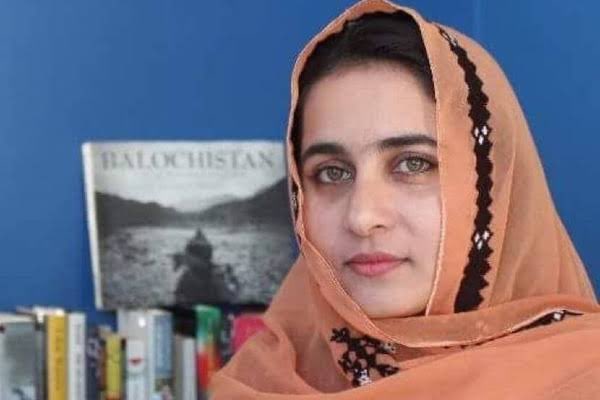
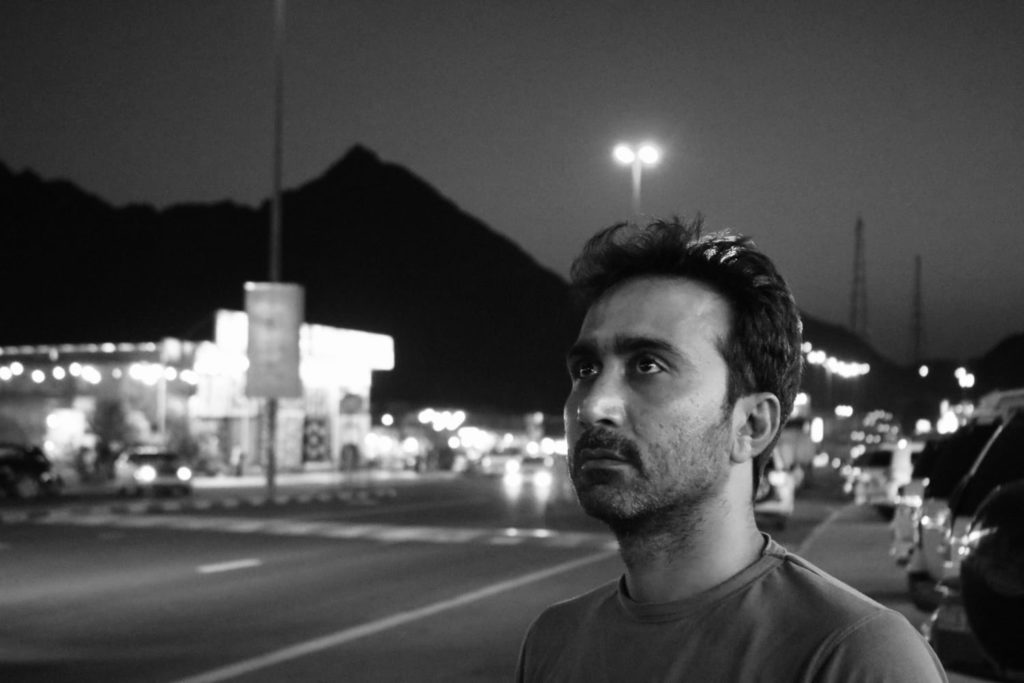
The atrocities and torture meted out to the people of Balochistan inside prison cells, or outside, have now reached new heights. The so-called state-puppets of Pakistan, whence failed to break Baloch nationalism among the Baloch people by forceful abductions or brainwashing the masses towards their baseless ideology, have now begun targeting leaders in exile. One after another news of two prominent Baloch leaders have surfaced as they became targets of ISI and Pakistan Intelligence. With the martyrdom of Sajid Hussain and Karima Baloch in two different countries the truth is now crystal clear. We now understand that no Baloch ideology is, or was ever, accepted by Pakistan.
The blood-fed war, which was so cold and bloody, includes the brutal assassination of every Baloch in any part of the world, and the Baloch now understand that the barbarity unleashed unto them is the handiwork of Pakistani regime.
Hence, in Balochistan anyone who partakes their roots or the originality of their mother tongue is immediately tortured and gets subjugated under Pakistani chains.
But the basic question is why in a political system Baloch are used as pawns to further one’s political ambitions and then discarded conveniently. In this system politicians like Maryam Nawaz dress in a Balochi attire, embraces the Baloch distressed sisters for the safe return of their missing brothers poses for the cameras and then that’s it. Baloch are welcomed when it suits certain agenda.
One cannot understand why whenever an attack occurs it’s the Baloch who are suspected? In Pakistani society, Baloch are marked as terrorists and most of its population barely recognizes Baloch as human beings. In these circumstances a Baloch who stands for his/her fundamental right of a free land is put forth as a terrorist. In 2007, when BBC interviewed Karima Baloch about liberation waves, she stated that the United Nations charter gives right to every nation to fight for its glory as a free state and that the Baloch freedom movement is entirely based on this tenet.
Under the Universal Declaration of Human Rights (UDHR), it is no crime for any nation to recognize and demand for a liberated state of their own and press for their right to be accepted.
On the other hand, ISI with no justification murders Baloch people. Lately, Sajid Hussain, a renowned Baloch writer and journalist, who in every possible way had drawn the issues of Balochistan through his writings in social media was first abducted, remained ‘missing’ for about two months and was found dead on April 30, 2020 at Uppsala in Sweden. Sajid Hussain had rightly highlighted in one of his articles that it is not the Baloch people who go ‘missing’ rather it’s Balochistan that is abducted and tortured. Balochistan is non-existent on Pakistan’s map.
Sajid Hussain, Chief Editor Balochistan Times was found dead at a river side in Uppsala, Sweden On April 30. He had been missing since March 2, from Uppsala.
Frankly, if one is to put forth just the recent facts deriving from fresh cases of the year, the reality becomes very vivid that the Pakistan government in reality is run by the Army and it fears the educational revolution among Baloch youth.
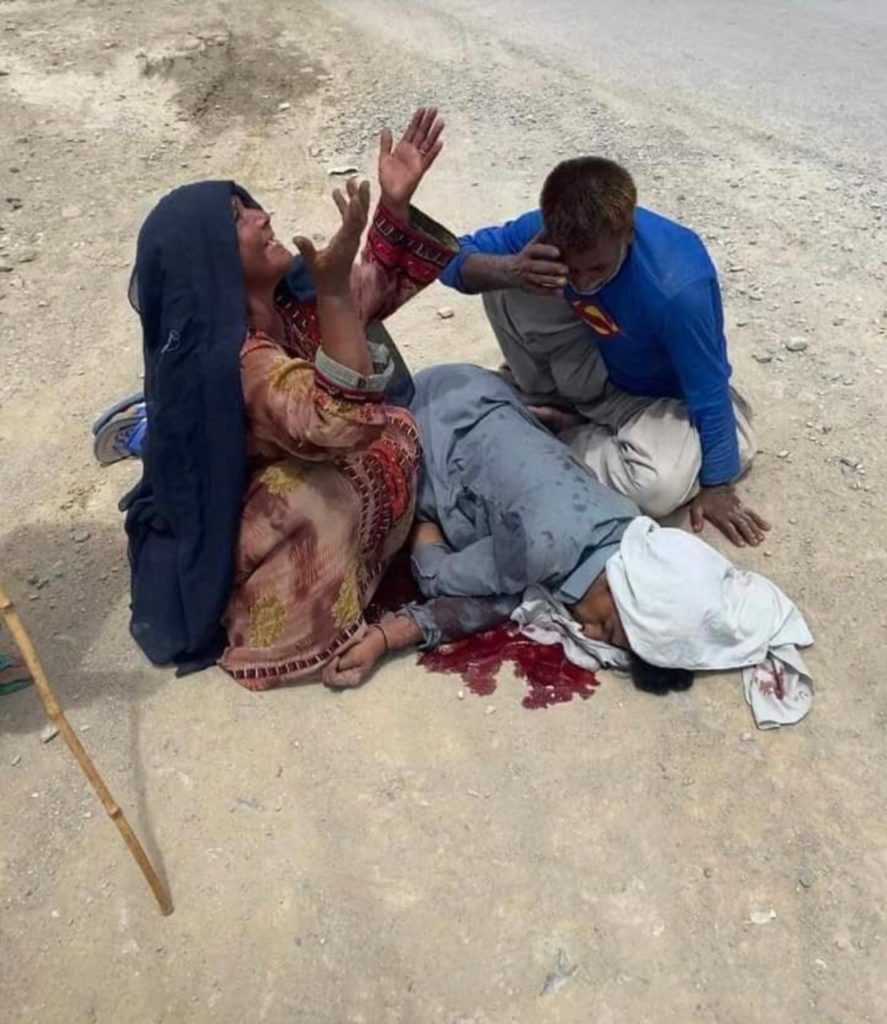
Mother and Father of Hayat Baloch crying over the body of their son. Hayat Baloch was murdered in cold blood by the Pakistani security forces in occupied Balochistan.
Earlier this year a Baloch youth was assassinated right in front of his parents. The cold blooded murder of Hayat Baloch marks two points. First, it points to the unbridled power of Frontier Corps who without any proof can murder a Baloch. Second, Hayat’s martyrdom has raised a lot of questions about Pakistani regime and anger continues to brew amongst Baloch youth. To quote Shaheed Ehsan Baloch, “the spark of terrorism, that Baloch is so famous for, is a direct and concrete lesson, injected inside, by the state of Pakistan. So yes, you keep on assassinating Karimas’ and Sajids’, and the more of what you label ‘terrorism’ shall spark out from the millions of Baloch Karimas’ and Sajids”.
We use cookies on our website to give you the most relevant experience by remembering your preferences and repeat visits. By clicking “Accept All”, you consent to the use of ALL the cookies. However, you may visit "Cookie Settings" to provide a controlled consent.
This website uses cookies to improve your experience while you navigate through the website. Out of these, the cookies that are categorized as necessary are stored on your browser as they are essential for the working of basic functionalities of the website. We also use third-party cookies that help us analyze and understand how you use this website. These cookies will be stored in your browser only with your consent. You also have the option to opt-out of these cookies. But opting out of some of these cookies may affect your browsing experience.
Functional cookies help to perform certain functionalities like sharing the content of the website on social media platforms, collect feedbacks, and other third-party features.
Performance cookies are used to understand and analyze the key performance indexes of the website which helps in delivering a better user experience for the visitors.
Analytical cookies are used to understand how visitors interact with the website. These cookies help provide information on metrics the number of visitors, bounce rate, traffic source, etc.
Advertisement cookies are used to provide visitors with relevant ads and marketing campaigns. These cookies track visitors across websites and collect information to provide customized ads.
Necessary cookies are absolutely essential for the website to function properly. These cookies ensure basic functionalities and security features of the website, anonymously.
Cookie
Duration
Description
cookielawinfo-checkbox-analytics
11 months
This cookie is set by GDPR Cookie Consent plugin. The cookie is used to store the user consent for the cookies in the category "Analytics".
cookielawinfo-checkbox-functional
11 months
The cookie is set by GDPR cookie consent to record the user consent for the cookies in the category "Functional".
cookielawinfo-checkbox-necessary
11 months
This cookie is set by GDPR Cookie Consent plugin. The cookies is used to store the user consent for the cookies in the category "Necessary".
cookielawinfo-checkbox-others
11 months
This cookie is set by GDPR Cookie Consent plugin. The cookie is used to store the user consent for the cookies in the category "Other.
cookielawinfo-checkbox-performance
11 months
This cookie is set by GDPR Cookie Consent plugin. The cookie is used to store the user consent for the cookies in the category "Performance".
viewed_cookie_policy
11 months
The cookie is set by the GDPR Cookie Consent plugin and is used to store whether or not user has consented to the use of cookies. It does not store any personal data.